If you’ve already read part 1 of this story on Facebook, go here for Part 2!
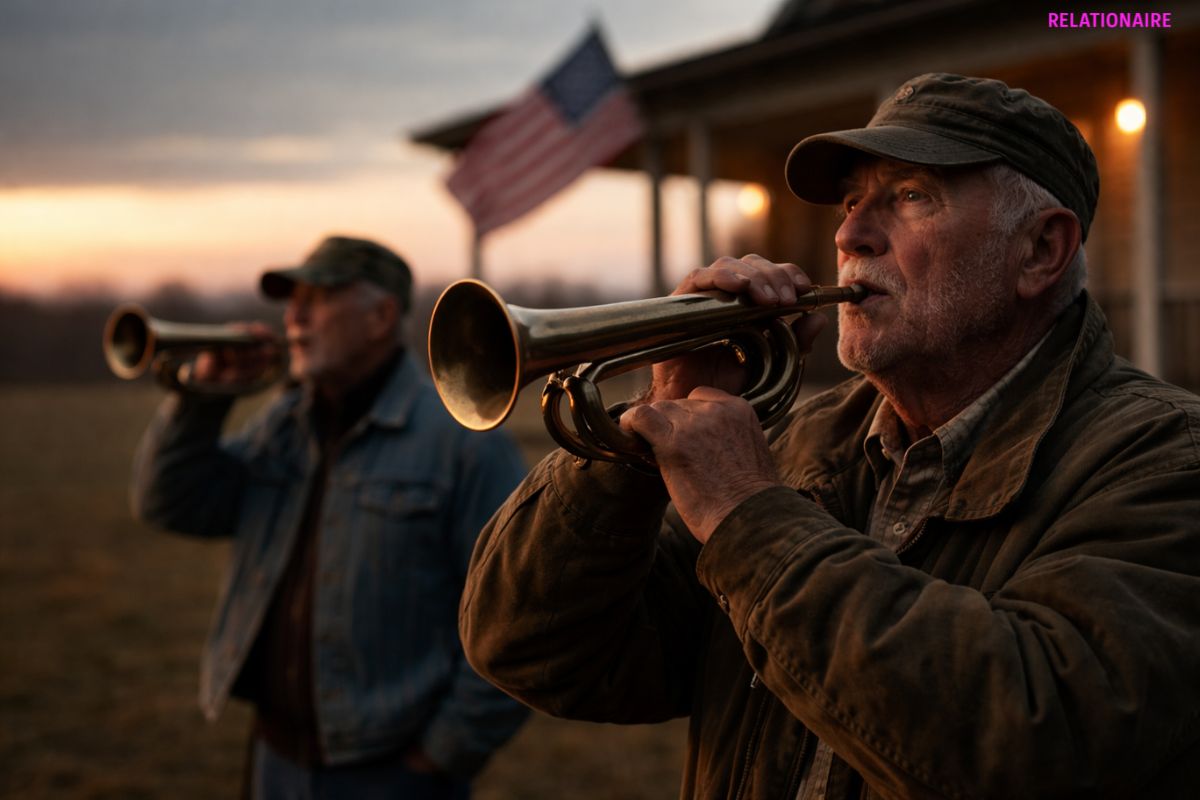
He Played Taps Alone Every Evening From His Back Porch, Until One Night a Second Bugle Answered From the Dark Field Behind His House
“Who’s out there?”
Walter Grady lowered the bugle from his lips and stood still in the cold evening air.
The last note of taps had barely faded over the dead grass behind his little house when the answer came again. Thin. Distant. Clear enough to raise the hair on his arms.
A bugle.
Not a recording.
Not some high school kid fooling around.
A real horn, played by somebody who knew what they were doing.
Walter took one step off the porch, boots settling into old wood that gave a tired creak. The screen door drifted shut behind him with a soft slap. His hand stayed wrapped around the worn brass bugle, thumb resting against a dent near the mouthpiece.
He listened.
Nothing now except a dog barking somewhere past the road, and the hiss of wind moving through dry weeds by the fence line.
Inside the house, the coffee on the warmer had gone bitter. The place still carried the smell of old canvas, floor polish, and worn leather from the footlocker by the wall. Everything in Walter’s life had a place. The folded flag in the shadow box. The framed photo on the mantel. The boots by the door, brushed though hardly worn outside church, the cemetery, and the porch at dusk.
Every evening at sunset, he stepped out and played.
Folks in town heard him.
Some bowed their heads.
Some rolled their eyes.
A few muttered that the old man liked attention.
Walter never answered any of them.
He just played.
Across the road, the football field sat empty under dim poles that had not yet flickered on. Beyond it stretched a low patch of winter grass and an old tree line black against the sky. That was where the sound had come from.
He lifted the bugle again, not to play, just to hold.
“Whoever you are,” he said, voice rough, “that ain’t something you joke about.”
No answer.
He stood there another minute, shoulders square in his faded jacket, then turned and went back inside.
The house was small enough that every sound had weight. The click of the door. The scrape of a chair leg. The rattle of the spoon in his coffee cup.
On the kitchen table sat a photograph facedown beside a pair of dog tags.
He had set them there an hour earlier and had not yet worked up the nerve to turn the picture over.
There were evenings when memory behaved itself.
There were evenings when it did not.
Tonight had been bad from the start.
He reached for the tags first.
The chain was cold in his palm. One tag was his. The other had belonged to Hank Mercer.
Walter closed his fist around both until the edges bit into his skin.
Forty-one years, and still there was one note in taps that caught him right behind the ribs. Not because he had forgotten how to play it. Because he remembered too well.
That final call.
That smoke.
That dirt in his teeth.
That moment when Hank, bleeding in the dark, had grabbed Walter’s sleeve and told him not to stop.
Play, Walt.
Just play.
Walter had played with shaking hands while medics yelled and rotors beat the air and the whole night smelled like mud, hot metal, and blood. He had played because Hank asked. He had played because there was nothing else left to do.
Hank died before dawn.
Walter never got over the fact that the last full piece of music his friend ever heard came through a mouthpiece Walter could barely hold steady.
He turned the photograph over.
Two young men in uniform sat on a jeep hood with paper cups of coffee, grinning like fools. Hank was broader through the shoulders, all easy confidence and bright eyes. Walter looked leaner, quieter, with the bugle across his lap.
On the back, in Hank’s handwriting, were the words: When we get home, you play and I’ll answer.
Walter stared so long the letters blurred.
He set the picture down carefully.
Then he heard tires on gravel.
He looked through the front window and saw a pickup pull in next door. Jim Rollins climbing out, carrying a grocery sack under one arm.
Jim was in his forties, worked over at the gas station on the county road, and had taken to checking on Walter without making a fuss about it. He’d show up with biscuits from the diner, furnace filters, or some excuse involving a socket wrench he didn’t really need.
A good man.
Too curious sometimes.
Walter opened the door before Jim could knock.
“You hear it?” Walter asked.
Jim frowned. “Hear what?”
“The bugle.”
Jim shifted the sack. “No, sir. I heard you playing a little while ago.”
“There was another one.”
Jim looked past him into the house, then back at Walter’s face. “From the school?”
Walter shook his head.
“Across the field.”
Jim didn’t laugh, but Walter saw the hesitation.
The kind people get when they start wondering whether an old man is lonely, confused, or worse.
Jim held out the bag. “Sarah at the diner sent over ham and beans. Said you forgot your leftovers at lunch.”
Walter didn’t move to take it.
“Walter,” Jim said more gently, “you okay?”
Walter straightened a little. “I know the difference between wind and brass.”
“I didn’t say you didn’t.”
“But you thought it.”
Jim exhaled through his nose. The cold put white into his breath. “I thought maybe somebody was messing around.”
“Nobody around here can play like that.”
Jim was quiet.
From inside the house, the old wall clock ticked.
A truck rolled past on the road without slowing.
Then, from somewhere out beyond the football field, a single note rose again.
Long.
Low.
True.
Jim’s head snapped toward the dark.
Walter didn’t say a word. He just watched the younger man’s face lose all its easy certainty.
“You heard that,” Walter said.
Jim swallowed. “Yeah.”
The note hung in the air and disappeared.
Now both of them stood frozen on the porch, listening hard enough to hear their own breathing.
The field looked empty. The bleachers, the goalpost, the strip of grass silvering under the first wash of moonlight—nothing moved.
Jim set the grocery sack down without meaning to. “You got a flashlight?”
Walter was already reaching behind the door.
Ten minutes later they crossed the road together, their beams cutting through cold air. Dry grass whispered at their boots. Somewhere nearby a screen door banged, and farther off someone laughed from a television set left too loud.
Town life kept moving.
Nobody knew two men were walking toward a sound that should not have been there.
At the fifty-yard line, Walter stopped.
The answer had come from farther out, past the fence, near the old practice field nobody used anymore.
Jim climbed through first, then held the wire up.
Walter ducked under, bugle tucked tight against his ribs.
Halfway across, his light caught something lying in the grass.
He bent, slow from the knees, and picked it up.
A mouthpiece.
Not new. Not polished. Army issue from years back, by the look and weight of it.
His hand trembled.
Jim shined the beam closer. “That yours?”
Walter stared at the metal in his palm.
On the rim, almost worn smooth, were two tiny initials scratched by hand.
H.M.
Walter’s throat worked, but no words came.
Wind moved across the empty field.
Then, somewhere in the darkness ahead of them, a man’s voice said quietly:
“You still miss that same note, don’t you, Walt?”
Walter went white.
Jim turned so fast his flashlight slipped and flashed wild over grass and fence and sky.
But Walter did not move.
Because he knew that voice.
And because Hank Mercer had been dead for forty-one years.
PART 2
Jim found his voice first.
“Who said that?”
The darkness gave nothing back.
Walter stood locked in place, Hank’s old mouthpiece cold in his hand, his own bugle hanging useless at his side. The night seemed to pull tight around them. Even the wind had gone still.
Then the voice came again, not loud, just close enough to make Walter’s chest hurt.
“You always rushed that note when you got nervous.”
Jim swung the flashlight hard toward the tree line.
“Show yourself!”
A figure stepped out from the dark edge of the practice field.
Not young.
Not straight-backed.
A man in a heavy coat and a knit cap, moving with a cane in one hand and a bugle in the other. His shoulders were narrow. His beard was white. He came forward slowly, into the weak wash of light, and stopped.
Walter stared like the ground had dropped out from under him.
The eyes were older.
The face was worn down and lined deep.
But the way the man held his head, the set of his jaw, the little scar by the brow—
Walter made a sound Jim would remember for the rest of his life. Not a word. Just a broken piece of breath.
“Hank,” he said at last.
Jim looked from one man to the other. “That’s not possible.”
The old man with the cane gave the faintest smile. It was tired, apologetic, and full of something close to shame.
“No,” he said. “It wasn’t supposed to be.”
Walter took one step forward and stopped again, as if getting too close might blow the whole thing apart.
“I buried you.”
Hank nodded once. “That’s what they told you.”
Walter’s face tightened. “I was there.”
“You were there when they loaded me. You weren’t there when they got me out.”
Jim said nothing now. He knew better.
Walter’s hands were shaking so badly the flashlight beam jittered over the grass.
“Why?” he asked.
One word.
No anger in it yet.
That made it worse.
Hank looked past him toward the porch across the road, where the flag moved in the dark. “Because I was alive, Walter. Barely. Wrong unit. Wrong paperwork. Wrong name on a body bag before sunrise.” He swallowed. “And by the time that mess got sorted out, I was somewhere else under another name being patched together.”
Walter’s eyes narrowed.
“That don’t answer the question.”
Hank took the blow because he deserved it.
“No,” he said. “It doesn’t.”
Jim stayed back while the two old soldiers faced each other in the field.
Hank lifted the bugle in his hand a little. It was not polished. It looked like it had traveled a long, hard road. “I came home years later. Not here. Not to town. I looked you up once from a distance and saw you had a family, a house, a life. I thought maybe my showing up would tear something open that had finally scarred over.”
Walter barked a laugh with no humor in it.
“Scarred over?”
Hank flinched.
Walter stepped closer.
“My wife stood beside me in a cemetery while they handed me a folded flag with your name tied to the whole thing. I told your mother what your last night was like because I was the one who lived. I listened to men at the VFW say you died brave, and I nodded like I had some right to speak for you. Every evening for forty-one years I played a call believing the dead could hear what the living couldn’t say.”
His voice cracked hard on the last word.
Jim looked away.
Hank’s mouth trembled. “I know.”
“You know?” Walter said. “You know?”
He lifted the mouthpiece with the initials scratched into it.
“I carried this all my life.”
Hank’s shoulders sagged. “I carried mine too. That’s how I found you. Heard about an old man in a base town who still played taps from his porch every dusk. I knew there couldn’t be two fools like that.”
Even then, even there, the line might have been a joke once.
It landed like grief.
Walter’s eyes shone, but he would not let tears fall. “Why tonight?”
Hank looked over at the football field. Empty stands. Silent goalposts.
“Doctor told me last month my lungs are about done. Said I shouldn’t be out in cold air, shouldn’t be blowing brass, shouldn’t be traveling at all.” He gave a weak shrug. “Sounded like orders. I never was good with those.”
Jim finally stepped in a little. “You’re telling me you stayed away four decades because you thought coming back would hurt him less?”
Hank turned toward him. “I’m telling you I woke up after hell with half my face bandaged, my hearing shot, and my best friend listed among the men told I was gone. Then I spent years learning how to stand, walk, breathe. Somewhere along the way shame dug in deep. Every year I waited made it harder.” He looked back at Walter. “After a while I did not know whether I was sparing you or sparing myself.”
That was the truth of it.
Ugly. Human. Too late.
Walter saw it and hated that he understood.
“You had no right,” he said.
“I know.”
“You let me grieve you.”
“I know.”
“You let your mother bury an empty box.”
At that, Hank’s face broke open. “No.”
Walter stopped.
Hank gripped the cane harder. “No. I came back in time for her. Quietly. She knew. Swore me to leave it be unless I could come clean all the way. She said you had already been handed your sorrow and she would not drag you through another war just to soothe mine.”
Walter stared.
That landed harder than everything else.
“Mae knew?” he whispered.
Hank nodded. “Till the day she died.”
Walter shut his eyes.
All those years. All those visits. All those casseroles after the funeral. Hank’s mother holding Walter’s hand too long on the porch and saying, You were a good friend to my boy.
She had known.
Jim made a small sound under his breath, the kind a man makes when the heart of a story turns and takes his balance with it.
Walter opened his eyes again, and when he did the anger in them had changed shape. It had not softened. But now there was room in it for something else. Something more dangerous.
Loss.
“You should have let me hate a dead man,” he said.
Hank looked at him with wet eyes. “I know.”
“But you came back old.”
Hank nodded once.
“And sick.”
Another nod.
“And with a bugle.”
A breath of a smile touched Hank’s face. “Only way I knew to knock.”
Walter looked at the horn in his old friend’s hand, then down at his own.
Two buglers.
Two old men in a field.
One life spent mourning.
One life spent hiding.
Across the road, a truck slowed, then kept going. Somebody in town had probably seen the flashlights and decided it was none of their business.
Public indifference. Private earthquake.
Jim bent and picked up the grocery sack he had forgotten near the fence. Ham and beans. Still warm.
Life refusing to stop for grief.
Walter straightened, wiped once at his mouth, and said, “Play it.”
Hank blinked. “What?”
“The answer. Play it.”
Hank lifted the bugle with a hand that shook almost as much as Walter’s. He set the mouthpiece to his lips.
The first note came ragged.
The second steadied.
By the third, Walter heard it—the old sound, buried under years but still there.
Hank lowered the horn, breathing hard.
Walter lifted his own.
For a moment Jim thought the old man would break right there in front of him.
Instead Walter played.
Taps drifted over the empty field, over the bleachers, over the houses with supper dishes still in the sink. The note that always caught in his throat came and nearly stopped him.
Hank raised his bugle and carried it for him.
Walter’s eyes closed.
Together they finished the call.
When the last note died, no one spoke.
Then Hank staggered.
Jim lunged forward, but Walter caught him first, one hand under the elbow, the other bracing his back.
Hank looked up at him, breath thin.
“I didn’t come for forgiveness,” he whispered.
Walter held on tighter than he meant to.
“Good,” he said.
And that was when everything changed.
PART 3
Hank was lighter than Walter expected.
That angered him too.
A man that solid had no business feeling this thin under the arm.
Jim helped get him across the field and into Walter’s kitchen, where the smell of coffee, old wood, and ham and beans seemed suddenly too ordinary for what had just walked through the door.
Hank stopped dead when he saw the footlocker, the shadow box, the framed photograph on the mantel.
“You kept all this.”
Walter gave him a hard look. “You think I wouldn’t?”
Jim pulled out a chair. “Sit before you fall.”
Hank lowered himself into it slow, cane leaning against the table. His eyes kept moving around the room, landing on the little things that proved the years had happened without him. Walter’s wife in a photo from long ago. A grandkid’s drawing taped to the icebox. Church bulletins stacked by the bread box.
There was history here.
Walter set the beans on the stove to warm and didn’t ask whether Hank was hungry.
He put a glass of water in front of him instead.
Hank drank like a man who had been traveling more than roads.
Jim stood by the counter, hands in his jacket pockets, wise enough to stay quiet.
At last Walter sat across from Hank and laid the dog tags on the table between them.
Metal clicked on wood.
“I want the truth,” Walter said.
Hank nodded.
So he told it.
Not like a speech.
Like a man unloading bricks one at a time.
He told Walter about the field hospital, the paperwork error, the transfer under heavy sedation. About months in military wards where they thought parts of him wouldn’t wake back up. About hearing loss, surgeries, and the kind of pain that makes a man smaller even when he survives it. He told him about the officer who advised silence until records got sorted, then about the bureaucratic snarl that turned weeks into months. After that came fear, then shame, then habit.
He told him about drifting west under contract work on bases where nobody asked many questions. About never marrying. About keeping to rented rooms and trailer lots. About taking out the bugle some evenings and failing to play the call clean because one note always broke him open.
Walter listened without interrupting.
Only once did he speak.
“When did you first know for certain I’d been told you died?”
Hank looked down at his hands. “When your mother’s Christmas card found me by mistake through an old forwarding file. She wrote she was proud of the man you’d become after carrying so much for others.”
Walter went still.
“My mother wrote you?”
“Not knowing who I was. She thought she was writing a veterans’ hospital chaplain that had helped me.” Hank swallowed. “That was the first time I understood what my silence had cost outside myself.”
Walter leaned back.
The kitchen clock ticked.
A car passed.
Somewhere on the back porch, the screen door gave a faint rattle in the wind.
Jim cleared his throat. “So what now?”
Nobody answered him right away.
Walter got up, went to the stove, and ladled beans into three bowls. He set one in front of Jim, one in front of Hank, one at his own place.
No ceremony.
No permission.
Just supper.
Hank stared down at the bowl like he didn’t know what to do with kindness. His hand trembled when he picked up the spoon.
That, more than anything, took the last hard edge off Jim. He sat and ate.
After a few bites, Walter spoke without looking up.
“You remember Rosie’s diner?”
Hank gave a soft laugh. “Coffee strong enough to strip paint.”
Walter nodded. “Still got coffee. Worse bacon now.”
Jim almost smiled.
Walter ate another spoonful, then set it down.
“Tomorrow morning,” he said, “we go there first.”
Hank looked up. “Walter—”
“Then we go to the cemetery.”
Silence.
Hank’s face lost color.
Walter met his eyes.
“You let me stand at your stone for forty-one years. You can stand there with me once.”
Hank’s mouth worked. He nodded.
“And after that,” Walter said, “we go to the VFW.”
Jim blinked. “You sure?”
Walter’s jaw tightened. “No. But we’re going.”
The next morning came hard and cold, with gray sky and breath hanging white in the air.
At the diner, the smell of coffee and bacon grease wrapped around them the moment they entered.
Conversations dipped.
Walter was known there.
So was the empty chair he usually took by the window.
Sarah behind the counter looked up with a smile ready, then froze when she saw the man beside him.
Hank had put on a clean coat, but there was no hiding the strain in his face or the cane in his hand.
Walter took his usual seat and pointed to the stool next to him.
“Sit.”
Hank did.
People stared.
Not because they knew.
Because they didn’t.
That was how dignity often looked from the outside—just two old men at a counter while the room made lazy guesses.
Sarah poured coffee. “Morning, Walter.”
Then, to Hank, cautious but polite, “You visiting family?”
Walter answered before Hank could.
“Yes,” he said. “He is.”
That was the first mercy.
At the cemetery, the grass was brittle with frost. Walter led the way to the stone.
HANK MERCER
BELOVED SON
LOYAL FRIEND
FOREVER REMEMBERED
Hank’s hand went to his mouth.
Walter stood beside him, not touching, not crowding him.
After a long time Hank bent with visible effort and laid his own bugle at the base of the stone.
“I’m sorry, Mama,” he whispered.
Then his knees gave.
Walter caught him before he hit the ground.
Hank held on to Walter’s sleeve the way he had all those years ago in the dark.
Only now there were no medics, no rotors, no gunfire.
Just cold morning air and two old men breathing through the truth.
Walter lowered him carefully onto the cemetery bench.
Then, with slow deliberate motion, he stepped back, raised his trembling hand to his forehead, and saluted the stone.
Not the lie.
Not the years stolen.
The mother who had carried silence.
The friendship that had lived crooked but not dead.
Hank began to cry without sound.
By the time they reached the VFW hall, word had already moved ahead of them.
Small towns are like that.
Men who had once slapped Walter on the shoulder and praised his faithfulness stood in uneasy clusters. Some looked suspicious. Some confused. Some ashamed for reasons they did not yet understand.
Walter walked Hank straight through the middle of them.
No speech.
No spectacle.
Just the quiet weight of two lives finally arriving in the same room.
Commander Mike Ellis stepped forward. “Walter… who is this?”
Walter looked around at the faces, then at Hank.
His voice, when it came, was not loud.
But every man in the hall heard it.
“This,” he said, “is Hank Mercer. He was my brother before blood ever got a vote.”
The room went still.
Mike stared, then looked closer, saw the scar, the eyes, the impossible truth settling into old flesh.
Hank stood with visible effort.
“I won’t ask any man here to excuse what I failed to do,” he said. “I came because this one deserved the truth while we were both still breathing.”
No one moved.
Then Jim, standing in the back, took off his cap.
One by one, the others did the same.
Not for perfection.
For service.
For sorrow.
For the cost of both.
Walter reached into his coat pocket and took out the mouthpiece with the scratched initials.
He placed it in Hank’s hand, then lifted his own bugle.
Hank looked at him through wet eyes.
Together, in that hall full of men who had learned too late not to judge a quiet burden from the outside, they played.
The notes were not flawless.
Neither were they.
But nobody there would ever forget the sound.
When it ended, Walter turned, put a hand on Hank’s shoulder, and held it there.
That was all.
No grand speech.
No parade.
Just one old soldier refusing to let the other stand alone anymore.
Some debts cannot be paid back clean.
Some love survives in silence until silence costs too much.
And sometimes the bravest thing a man can do is finally answer the call he should have answered years ago.
What hit you hardest in this story—the second bugle, the cemetery, or Walter calling Hank family after everything?