If you’ve already read part 1 of this story on Facebook, go here for Part 2!
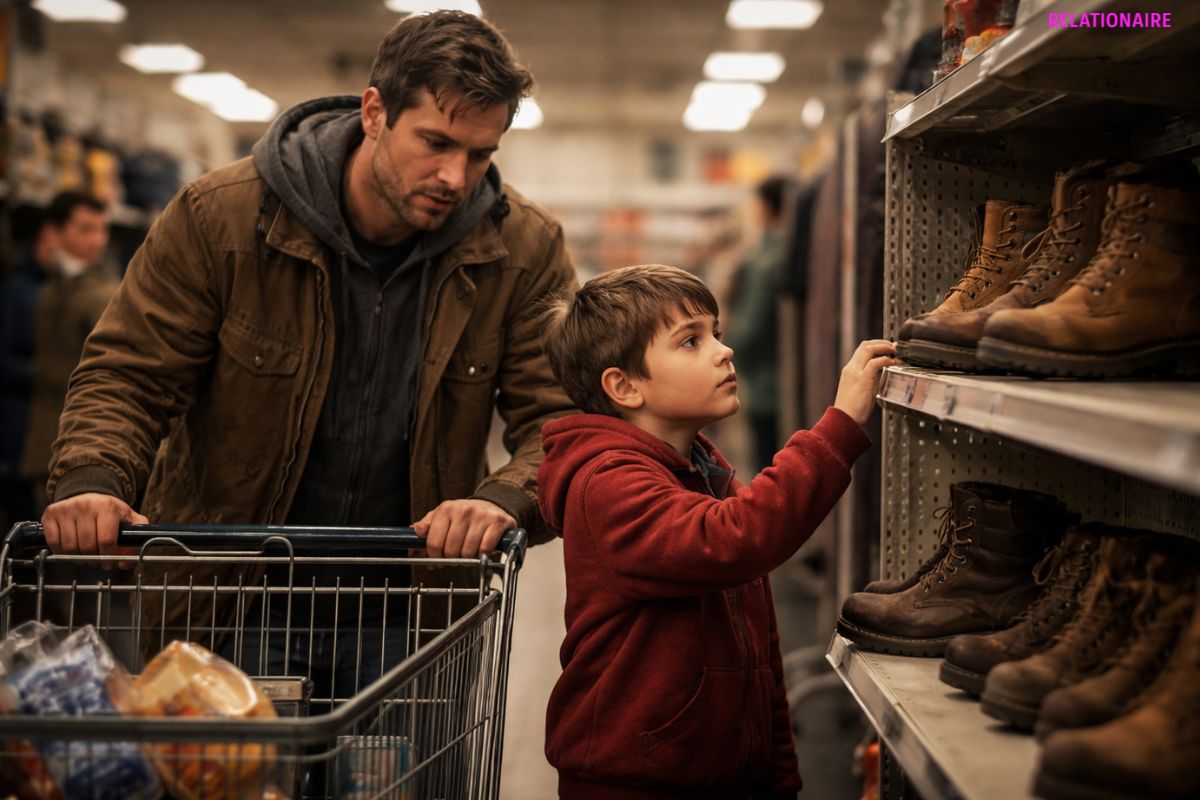
By the time they reached the boot aisle, the little boy was limping.
Not the dramatic kind children do when they want candy.
A real limp.
Small. Careful. Like every step had to be negotiated with the floor.
His name was Eli, and he couldn’t have been older than seven. He wore a thin red hoodie with a broken zipper and sneakers so worn at the toes that one sock peeked through when he walked.
His father saw it too.
You could tell by the way his jaw tightened every time Eli took another step.
“Come on, buddy,” the man said, trying for lightness and missing by a mile. “We’re just here for milk and cereal. That’s it.”
“But Dad.” Eli stopped in front of a row of sturdy brown boots with thick rubber soles and fuzzy lining. He reached out and pressed one mitten-less hand against the box like it was something alive. “These ones are warm.”
His father didn’t even look at the price tag at first. He looked at the boots the way people look at things they’ve already lost.
Then he looked.
And something in his face shut down.
“Not today.”
Eli swallowed. “But my feet get wet.”
A woman a few feet away glanced up from her cart. Then another. Then a third.
It was the kind of aisle where voices carried.
The father rubbed both hands over his face, rough and tired, like he hadn’t slept right in months.
“I said not today.”
He didn’t raise his voice. That somehow made it worse.
Eli stood very still, staring at the boots. “I can wear them for a long time,” he said quietly. “I’ll be careful with them.”
His father grabbed the cart handle harder. The cart held exactly four things: a gallon of store-brand milk, a box of generic corn flakes, a jar of peanut butter, and cough medicine.
No coat. No extras. No holiday junk. No room for anything that wasn’t necessary.
“Eli.”
The little boy flinched at the tone, though it wasn’t cruel. Just worn down to threads.
“I know,” Eli whispered. But he didn’t move.
A teenage cashier passing by slowed just enough to look. An older man in a hunting cap shook his head under his breath. A woman near the endcap pursed her lips the way strangers do when they’ve already decided what kind of parent they’re looking at.
Eli reached for one boot again.
His father caught his wrist, not hard, but too fast. Too sharp.
“Enough.”
The whole aisle went still.
Eli’s face went red first, then white. He pulled his hand back and tucked it under his arm. “Sorry.”
His father closed his eyes.
For one second, he looked like he might fall right there between the insulated socks and discounted gloves.
Then he cleared his throat, turned the cart around, and said, “We’re leaving.”
A woman near the shelves muttered, “Unbelievable.”
Another said, not quietly enough, “If you can’t take care of your kid, don’t drag him around a store to say no to everything.”
The father heard. Of course he heard.
His ears went red, but he kept pushing the cart.
Eli didn’t cry. That was the hardest part.
He just followed with that careful limp, blinking too much, trying to be brave in the way children are brave when they already know being easy is part of surviving.
That was when the stranger stepped into the aisle.
He was big enough that people moved without being asked. Broad shoulders. Dark wool coat. Scuffed work jeans. A face that looked carved out of old wood and weather. Late fifties maybe. Maybe older. Hard to tell with men who’ve spent their lives outdoors.
He had a pack of batteries in one hand and a gallon of windshield fluid in the other.
He didn’t look soft.
He looked like the kind of man people assumed wouldn’t notice much.
He watched the father push the cart past him. Watched the little boy hesitate one last time near the boots.
Then he set both items down on a shelf.
“Hey,” he said.
The father stiffened immediately.
“I’m not looking for trouble,” the stranger said.
His voice was low. Calm.
The father gave a short, humorless laugh. “That makes one of us.”
The stranger didn’t smile. He glanced down at Eli’s shoes, the split seam, the wet gray sock peeking through, then back at the boots.
“What size?”
The father’s expression changed from anger to embarrassment so fast it hurt to see.
“No.”
The stranger nodded once, like he’d expected that.
He crouched instead, so he was eye level with Eli.
Not too close. Not familiar. Just steady.
“What size, buddy?”
Eli looked at his father first.
His father’s throat moved. “You don’t have to do that.”
The stranger still didn’t look at him. “I know.”
That somehow made the whole aisle quieter.
Eli whispered the size.
The stranger reached for the box, checked the label, then took a second pair down too. “Try these.”
The father stepped forward. “I said no.”
The stranger rose to his full height, and for the first time looked directly at him.
Not challenging. Not pitying.
Just direct.
“Then call it a favor from one working man to another.”
“I can’t pay you back.”
“I didn’t ask you to.”
People were definitely watching now. Even the ones pretending not to.
The father’s face had gone pale with that particular kind of shame that comes from being seen at the exact moment you have nothing left to hide behind.
Eli sat down on the little bench at the end of the aisle and pulled one shoe off. His sock was damp through the heel. The stranger didn’t comment on it. Didn’t make it public. He just knelt, loosened the boot laces with thick careful fingers, and slid the first boot toward him.
“Try.”
Eli looked again at his father.
This time, after a long second, his father gave one tiny nod.
The boot fit.
So did the second one.
Eli stood up, and the difference was immediate. No wobble. No flinch. No careful testing of the floor. He took three steps, then four, and his whole face changed.
Children don’t know how to fake that kind of relief.
His mouth opened in a startled smile, like his body had stopped hurting before he’d had time to ask permission.
“These feel…” He looked down, almost confused. “These feel strong.”
The stranger’s eyes flickered once. Just once.
Then he took the box, tucked Eli’s old shoes inside, and walked to the register before the father could stop him.
The father followed halfway, then stopped.
Maybe because arguing would make it uglier.
Maybe because something in him had already broken.
By the time the stranger returned with the bag, the father couldn’t seem to meet his eyes.
“Thank you,” he said, but the words came out ragged and thin.
The stranger handed the bag to Eli instead.
“Keep the receipt,” he said to no one in particular.
It was an odd thing to say.
The father frowned. “What?”
But the man only picked up his batteries and windshield fluid again.
He gave Eli a small nod, then turned and walked away.
No speech. No smile for the audience. No waiting to be admired for doing the decent thing.
Just gone.
The father stood frozen for another moment, the plastic bag hanging from his hand, the little boy staring down at his new boots like they might disappear if he blinked too long.
Then he pushed the cart the rest of the way out.
The cold hit hard in the parking lot.
It was the kind of late-November wind that found every gap in your clothes and went straight to the bone.
Eli walked beside the cart, stepping harder now, testing the sound of the soles on the pavement.
Thunk. Thunk. Thunk.
“Dad?” he said softly. “Do you think Mommy would’ve liked these?”
His father stopped so suddenly the cart lurched sideways.
For one second, he didn’t breathe.
Then he gripped the handle, bent over, and made a sound so raw that a woman loading groceries into her trunk looked over in alarm.
Not crying, exactly.
Not at first.
More like a man getting hit somewhere no one could see.
Eli’s smile vanished. “Dad?”
The father pressed one hand to his mouth. In the other, crumpled tight against his palm, was the receipt the stranger had insisted they keep.
And when he opened his fist, Eli saw there was something folded inside it.
Not just paper.
A note.
The father stared at the handwriting on the outside, and all the color left his face.
Because across the fold, in block letters that shook just a little, were five words that made it clear the boots had never been just about winter.
For the son of Daniel Reed.
Part 2
For a moment, neither of them moved.
The parking lot kept going around them like nothing had happened.
Carts rattled.
Engines turned over.
Somewhere a teenager laughed too loudly near a pickup truck.
But Daniel Reed stood with one hand braced on the shopping cart, staring at the folded note like it had reached out and touched a bruise buried under his ribs.
“Dad?” Eli’s voice was small again. “What does it say?”
Daniel swallowed hard. His lips had gone bloodless.
He looked back toward the sliding doors as if he might still catch the stranger before he disappeared into the anonymous flow of people and fluorescent light. But there was no sign of him now.
Just reflections. Motion. A woman in a scarf, a man with paper towels, a teenager carrying soda.
Gone.
Daniel looked at the note again.
His fingers shook as he unfolded it.
Inside, there was one sentence in the same uneven block letters.
Your brother wore his boots proud too.
Daniel made that sound again.
This time it broke open into grief.
He turned away from the store and pressed the heel of his hand against his eyes, but it was useless. The tears came anyway, quick and helpless, like they’d been waiting right behind the bone for permission.
Eli stood beside him, confused and scared. “Dad, who wrote that?”
Daniel tried to answer. Failed. Tried again.
“I don’t know,” he said hoarsely. “I think… I think I do.”
He looked down at his son. At the new boots. At the little puff of white breath in the cold.
Then he crouched, right there in the parking lot between their dented sedan and a shopping cart corral, and pulled Eli close.
“You remember me telling you about your big brother, Ben?”
Eli nodded against his jacket. “The one who went to heaven.”
Daniel closed his eyes.
Ben had died at nine years old, six months earlier, in a hospital room with cartoon wallpaper someone had tried too hard to make cheerful. Leukemia, they’d said in careful voices, as if gentleness changed the fact of it. As if words could make a child dying sound less impossible.
Ben had loved work boots.
Not because he needed them. Because he thought they made him look like his dad.
Daniel had done construction all his life. Roofing in the summer, framing when the weather let him, drywall when it didn’t. Ben used to wait by the door just to help him untie his laces at night. He’d drag Daniel’s boots across the kitchen floor, set his own tiny feet inside them, and stomp around while his mother laughed.
“You walk just like Daddy,” she’d say.
After Ben got sick, the hospital socks replaced the boots. Then the slippers with rubber grips. Then months of blankets and tubes and Daniel learning the kind of fear that turns time cruel.
One day, during a bad week, Ben had asked for a pair of real boots again.
Not toy ones. Real ones.
“Because when I get strong,” he’d said, his voice papery from treatment, “I want to wear them home.”
Daniel had promised him he would.
But by the time Daniel finally had enough spare money to buy them, Ben was too weak to stand.
He still tried them on in the hospital bed, smiling at his own feet like they belonged to a boy going somewhere.
Ben died three days later.
Daniel had put the boots in the closet after that.
Mara—Daniel’s wife, Eli’s mother—couldn’t bear to look at them. Two months after the funeral, she got in her car to drive to the pharmacy and never made it home. Black ice. Guardrail. State trooper at the door before dawn.
After that, the house went quiet in a way Daniel did not know how to survive.
He went back to work too soon because rent didn’t stop for grief. Then work dried up. Then the truck transmission went. Then the heating bill doubled. Then the school called about Eli’s attendance because his cough kept getting worse and Daniel couldn’t always get him there.
Everything became about the next small emergency.
Food. Gas. Medicine. Rent. Stretch. Delay. Apologize. Endure.
And those boots in the closet stayed where they were.
Three nights ago, Eli had found them.
“Whose are these?” he’d asked, sitting on the floor with Ben’s boots in his lap.
Daniel had frozen in the doorway.
“They were your brother’s.”
Eli had looked at them for a long time. “They’re nice.”
Daniel had almost said, Don’t touch those.
Almost.
Instead he’d shut the closet and told Eli it was bedtime.
This morning, Eli had come out wearing his wet sneakers and said, “When snow comes, will my feet hurt like Ben’s did?”
Daniel had turned away so fast Eli probably thought he was angry.
At the store, when Eli begged for boots, Daniel hadn’t heard just need.
He’d heard memory.
Promise.
Failure.
He’d heard his dead son asking again for something simple, and his living one asking for it in the same thin winter light.
And he had not been able to bear it.
Eli pulled back enough to look at him now. “Did the man know Ben?”
Daniel wiped his face and stood slowly. “I think he might have.”
“How?”
Daniel looked again at the note, then at the receipt.
There was one more thing folded behind it: a second slip of paper, smaller, like it had been torn from a pocket notebook.
An address was written on it. Just an address. No name.
At the bottom: If you want to know.
Daniel stared at it.
He almost laughed from disbelief.
A woman walking past with two grocery bags gave him the kindest expression anyone had given him all day, then kept moving. No questions. No pity performed out loud. Just space.
Eli tugged his sleeve. “Dad?”
Daniel glanced at the time on the receipt. 4:12 p.m. The winter sky was already graying at the edges.
The address was on the far side of town, near the old mill road.
He should go home. He should start dinner. He should not drag his son into some stranger’s mystery in the cold after a day that had already cut too close.
But the note sat in his hand with the weight of something unfinished.
“Get in the car,” he said softly.
Eli blinked. “Are we going home?”
“Not yet.”
The sedan took three tries to start. The heater didn’t kick in until halfway down Main Street. Eli sat in the back touching the toes of his new boots together, then apart, then together again. Daniel kept glancing at him in the mirror, not trusting himself to look too long.
The address led them out past the feed store, past the boarded diner by the railroad tracks, past a line of bare trees bending in the wind.
Finally, they turned into a gravel drive beside a squat brick building with a faded sign:
REED FAMILY OUTREACH CENTER
Daniel stared.
The building used to be a union hall years ago. He remembered that. He’d been inside once for a contractor meeting back when work was steady and his knees didn’t ache in the mornings.
Now lights glowed in the front windows.
Cars lined the lot.
People moved inside carrying boxes.
Eli leaned forward between the seats. “What is it?”
Daniel didn’t answer at first.
Because through the glass front door, carrying a stack of winter coats over one arm, was the stranger from the store.
And beside him, smiling at a woman with a toddler on her hip, hung a framed photograph Daniel knew even from the parking lot.
Ben.
Eight years old in that picture, missing front tooth, grinning in a pair of oversized work boots.
Daniel’s breath caught so hard it hurt.
The stranger looked up.
Saw him.
And instead of surprise, the man’s face showed something closer to sorrow.
Like he had been expecting this part all along.
Then he set the coats down, came to the door, and opened it before Daniel could decide whether to leave.
“You came,” he said.
Daniel got out of the car on numb legs. “Who are you?”
The man’s eyes moved once to Eli’s boots, then back to Daniel’s face.
His answer landed like another blow.
“I’m the man who got your boy’s boots to Ben the first time.”
Part 3
For a second, Daniel thought he’d heard wrong.
The wind bit through his jacket. Gravel crunched under his boots. Somewhere inside the building, a child laughed.
But all Daniel could hear was that sentence.
“I’m the man who got your boy’s boots to Ben the first time.”
Daniel stared at him. “That’s not possible.”
The stranger stepped back from the doorway. “Come inside. It’s warm.”
Daniel almost said no.
Instead, maybe because Eli was shivering, maybe because the photograph of Ben inside had hollowed out every reason to run, he took his son’s hand and followed the man into the building.
Warm air hit them first. Then the smell of coffee and old radiator heat and donated laundry detergent.
The front room was full of folding tables covered with gloves, canned food, school supplies, children’s coats organized by size. A handwritten sign on the wall read:
TAKE WHAT YOU NEED. LEAVE WHAT YOU CAN.
Nothing fancy. Nothing polished.
Just practical mercy.
A few volunteers moved quietly in the background. Nobody crowded them. Nobody asked questions.
The stranger led Daniel and Eli into a smaller office off the main room. There was a metal desk, two mismatched chairs, a coffee maker that had probably been running all day, and that framed photograph of Ben on a bookshelf.
Up close, Daniel saw what he hadn’t from the parking lot.
The picture wasn’t random.
It was Ben in his hospital room.
Wearing the boots.
Daniel stopped dead.
“You were there,” he said.
The man nodded.
“My name’s Walter Hayes.”
The name pulled at something old and frayed in Daniel’s memory. Walter Hayes. The maintenance supervisor at County Memorial. Quiet guy. Heavyset. Always carrying tools. The kind of man families barely noticed until something broke and he fixed it before they could ask.
Daniel pressed a hand to his forehead. “You worked at the hospital.”
“For twenty-three years.”
Daniel looked again at the picture. “You took this?”
Walter nodded once. “Your wife asked me to.”
That landed even deeper.
Mara.
Daniel sat down without meaning to. The chair gave a little metal squeak under him.
Eli stayed close, standing by his father’s knee in the new boots.
Walter didn’t rush. He poured coffee into a paper cup for Daniel, hot chocolate from a packet for Eli, then sat across from them with his hands folded.
“When Ben was admitted,” Walter said, “I was the one who fixed the TV in your room the second week. Then the bed rail. Then the window latch. Little stuff. I saw a lot of families. Most never remembered my name, and that was fine. But I remembered yours.”
Daniel looked at the cup in his hand, not drinking.
Walter continued. “Your boy was always talking about boots. Real ones. Said he wanted to sound like his daddy walking down the hall.”
Daniel let out a broken breath.
“I heard him ask for them more than once,” Walter said. “I heard you say you were working on it.”
The shame came back, immediate and sharp. “I was.”
“I know you were.”
Daniel looked up at that.
Not pity. Not judgment. Just fact.
Walter glanced at Eli, then back. “One night I came by to fix the bathroom light. Mara was in the hall crying where Ben couldn’t see her. She told me the boots had to wait because the insurance mess had gotten worse and the pharmacy bill had come due.”
Daniel covered his mouth.
Walter went on quietly. “I had a grandson then. Same age as Ben. I kept thinking about that. A child wanting one ordinary thing that made him feel like himself. So I left during my break, drove to Dawson’s Work Supply, and bought the smallest pair they had.”
Daniel stared.
“You?” he whispered.
Walter nodded. “I gave them to the nurse on evening shift and told her to say they were from the hospital holiday fund. I figured if you knew it was me, you might refuse.”
Daniel blinked hard, trying to line this up against memory.
That night. The nurse smiling. Mara crying again, but softer. Ben laughing when he saw the box. Daniel had assumed some church group or hospital program had stepped in. He had been too overwhelmed, too grateful, too broken to ask questions.
“You should have said something.”
Walter looked almost embarrassed. “It wasn’t about me.”
Silence filled the office.
In the other room, someone opened a can of soup with a hand crank. A coat hanger scraped a rack.
Eli sipped his hot chocolate and listened with the solemn stillness children have when they know the adults are standing inside something important.
Daniel finally found his voice. “How did you know it was us today?”
Walter gave the smallest smile. “I didn’t. Not at first.” He nodded toward Eli’s boots. “Then I saw the way your boy looked at them. Same as Ben. And when I heard you say his name…” He paused. “I followed at a distance when you went outside. I know that may sound strange.”
Daniel shook his head. It didn’t. Not anymore.
Walter reached into a desk drawer and pulled out a worn manila envelope.
“Mara found out later it was me,” he said. “About a month before…” He let the sentence trail off with gentle respect. “She came here after one of our coat drives and brought this. Told me if I ever saw you again, I’d know when to give it back.”
Daniel went still.
Walter slid the envelope across the desk.
Daniel recognized his wife’s handwriting before he touched it.
He opened it with trembling fingers.
Inside was a photograph of Ben in the hospital boots, grinning so hard his eyes disappeared. Behind the photo was a folded letter.
Daniel unfolded it.
Mara’s voice rose off the page so clearly it made the room tilt.
Danny,
If you’re reading this, then life has probably done what life does and made a mess of all the things we thought we had time to fix. So I’m going to say this plain.
You were never failing him.
I know you felt that way. I saw it. Every time you counted cash in the chair by the hospital bed. Every time you thought he was asleep and apologized to him anyway. But Ben never measured you by what you could buy.
He measured you by whether you came back through the door.
And you always did.
Daniel’s vision blurred.
He kept reading.
If Eli ever asks for the boots, or anything that makes your heart panic because it belongs to grief, let him ask. Let him love what his brother loved. Don’t turn away because it hurts. Hurt isn’t the same thing as wrong.
And if a stranger ever helps you carry something you thought was yours alone, let them.
Love, Mara.
Daniel bowed over the letter.
Not dramatically. Not the way grief looks in movies.
Just one exhausted man folding around the sound of his dead wife being right.
Eli touched his arm. “Dad?”
Daniel pulled him close, pressing his face into the child’s hair.
“I’m sorry,” he whispered. “For today. For all of it. I’m so sorry.”
Eli wrapped both arms around his neck. “It’s okay.”
No, Daniel thought. It wasn’t okay.
But maybe it could still become something else.
Walter stood and went to the shelf. He took down the framed photograph of Ben and handed it to Daniel.
“Your wife asked me to keep it until the right time,” he said. “I think this is probably it.”
Daniel took the frame like it was made of breath.
“I can’t repay you,” he said again, because the truth had not changed just because it had deepened.
Walter’s mouth shifted, almost a smile. “Good. I’m too old to chase people down for money.”
A laugh broke loose from Daniel before he could stop it. Wet and jagged and real.
Walter nodded toward the other room. “But if you’re asking what to do with gratitude, we serve dinner here on Thursdays. Folks need rides sometimes. Shelves need stocking. Kids need winter boots sorted by size. You look like a man who knows how to work.”
Daniel looked through the office doorway at the tables, the food, the coats, the quiet movement of people helping without spectacle.
Not rescue.
Not charity done for show.
Just people carrying what they could for whoever came in bowed under too much.
Eli tugged on his sleeve. “Can we come back?”
Daniel looked at his son’s boots.
Strong, Eli had called them.
Strong.
Not because they were expensive. Not because they solved everything. But because someone had noticed pain and stepped toward it instead of away.
He looked at Walter. “Yeah,” he said, his voice rough. “I think we can.”
That Thursday, Daniel came back.
Then the Thursday after that.
He fixed a warped door in the pantry room. Replaced a leaking pipe under the sink. Sorted donated boots with Eli, who took the job very seriously and insisted every kid should get the warmest pair possible.
Weeks later, when the first real snow came, Eli stood by the front door in his coat and new gloves and stomped once in his boots just to hear the sound.
Thunk.
Thunk.
Daniel looked up from tying his scarf and felt the ache rise again, as it always would.
But this time it didn’t only hurt.
This time it carried Ben’s laugh in it. Mara’s steady voice. Walter’s quiet hands on a box of boots no one else knew mattered. The strange mercy of being seen on the worst day and not being left alone in it.
Eli grinned. “You coming, Dad?”
Daniel reached for his coat.
“Yeah, buddy,” he said.
And when he opened the door, the cold rushed in clean and sharp, and for the first time in a long time, it did not feel like something they had to survive by themselves.
Sometimes that is how life changes.
Not all at once.
Just when one person notices the weight another person is carrying and, without making a scene of it, reaches for one corner and helps lift.