The mothers at school left my seven-year-old’s birthday chairs empty because her father was gone—then the street began to shake, and a line of motorcycles rolled up to remind my daughter what family still looks like.
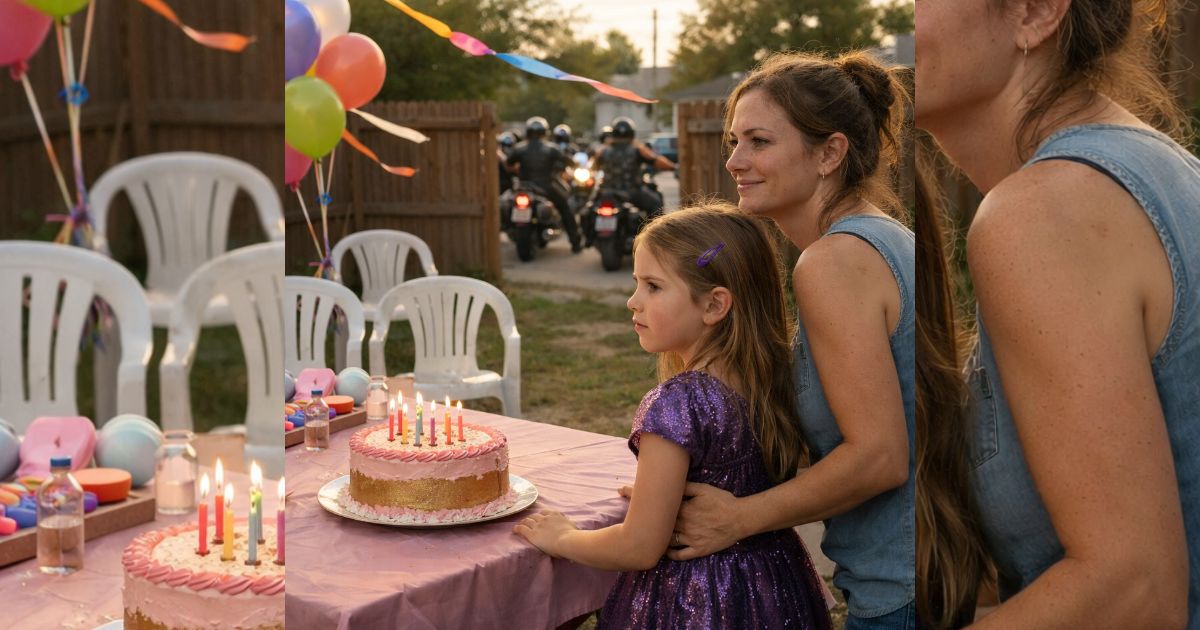
I was standing in the backyard with a pink-and-gold cake in both hands, trying to shield seven stubborn candles from the wind.
The table behind me looked like a picture from a party that had already happened.
Rainbow streamers.
Glitter balloons.
Paper plates with tiny stars around the edges.
Juice boxes in a tub of ice.
Little gift bags lined up like they were waiting for children who had simply run off for a minute and would come racing back any second.
But nobody was running through our gate.
Nobody was laughing.
Nobody was calling my daughter’s name.
My little girl, Maddie, sat alone at the end of the long folding table we’d borrowed from my neighbor the night before.
Her party crown had slipped to one side.
Her hands were folded in her lap.
She kept looking toward the side gate every few seconds, then back down at the table, then back at the gate again, as if hope was a muscle she refused to stop using.
I checked my phone for the fifth time in ten minutes.
Still nothing.
No texts saying they were around the corner.
No apologetic messages from parents who got delayed.
No sudden change of plans.
Just the same empty screen that had been mocking me all afternoon.
I forced my voice to stay light.
“They might still be on the way, baby.”
Maddie looked up at me and nodded so politely it almost hurt to see it.
“Okay, Mom.”
Then my phone buzzed.
I looked down too fast.
My heart actually jumped because for one foolish second, I thought maybe it was one of the moms finally saying they were coming.
It wasn’t.
It was a message from a parent whose daughter sat two rows over from Maddie in second grade.
We had stood next to each other at school pickup.
We had smiled at each other in the parking lot.
We had made the kind of soft, harmless conversation mothers make when they don’t know each other well enough for honesty but well enough for politeness.
The text said:
I think some people just didn’t know what to do with a birthday like this. A lot of parents felt it might be too sad for the kids.
I stared at it.
Read it once.
Read it again.
Then a second message came in before I could even breathe.
One of the moms said, “Who wants to celebrate a little girl whose daddy can’t be there?”
My fingers went cold.
For a moment I couldn’t hear the wind.
Couldn’t hear the country song playing softly from the speaker on the porch.
Couldn’t hear the plastic tablecloth snapping at the corners.
All I could hear was that sentence.
Not because it was loud.
Because it was so small.
So casual.
So easy for somebody to send with two thumbs and no idea what it would do on the other end.
I turned my head.
Maddie was still watching the gate.
Still hoping.
Still sitting up straight in the sparkly purple dress her grandma had mailed last Christmas because she said every little girl deserved one dress that made her feel like a celebration.
I swallowed hard and locked my phone.
I could not let that message touch her.
Not on her birthday.
Not after everything else.
So I picked up the cake tighter, walked toward the table, and made my face do what mothers make their faces do when their insides are falling apart.
Smile.
Just enough.
Not too wide.
Enough to say, We are still okay.
Enough to say, This day is still yours.
Enough to lie kindly.
“I think these candles are finally behaving,” I said.
Maddie gave me a tiny smile.
“Want me to help block the wind?”
Her voice was so careful.
Like she was trying to help me manage my own pretending.
I set the cake down in front of her.
She clapped once for herself.
Just one quiet little clap.
That nearly broke me right there.
I lit the candles anyway.
All seven.
They flickered hard in the breeze but stayed alive long enough for her to lean in.
I put a hand on her shoulder.
“Make a wish, sweetheart.”
She looked up at me first.
Not at the cake.
At me.
And in a voice barely above a whisper, she said, “It’s okay if they forgot. I still had fun helping you decorate.”
That was the moment I almost lost the fight to keep my face steady.
Because she was seven.
Seven-year-olds are supposed to be loud about their disappointment.
They’re supposed to pout and stomp and ask why.
They’re supposed to cry because the blue balloon popped or because the frosting flower landed on the wrong cupcake.
They are not supposed to sit there and comfort their mothers through a room full of empty chairs.
I brushed her hair back from her face.
“Make your wish, baby.”
She closed her eyes.
Her lashes trembled.
The candles leaned one way, then the other.
And right before she blew them out, we heard it.
A low sound at first.
Far off.
So far I thought maybe it was thunder rolling over the hills beyond town.
Then it came again.
Deeper this time.
Longer.
Not weather.
Engines.
More than one.
A lot more than one.
Maddie’s head snapped up.
Her chair scraped back.
Her eyes went huge.
She gripped the edge of the table, then looked toward the street with a look I couldn’t understand.
Not surprise exactly.
Recognition.
“Mom,” she breathed.
Then louder.
“Mom, that’s my letter.”
I blinked.
“What?”
“That’s Daddy’s friends.”
Before I could ask what she meant, the sound filled the whole front of the house.
Deep engines.
Heavy ones.
The kind that don’t just pass through a street but announce themselves to every porch and driveway along the way.
Maddie jumped to her feet so fast her chair tipped over behind her.
I reached out automatically.
She grabbed my hand.
We both stood there frozen as the first motorcycle turned onto our quiet little street and slowed in front of our house.
Then another one came behind it.
Then another.
Then another.
Chrome flashing in the late afternoon sun.
Leather vests.
Boots.
Helmets.
Large bikes rolling in one by one with the kind of control that made it clear this was no accident and no random pass-through.
This was a destination.
Our house.
Our yard.
Our little half-finished birthday party with the melting cupcakes and the sagging balloon arch.
I couldn’t speak.
I could only stare.
Maddie’s grip on my hand tightened until her fingers hurt.
More bikes lined the curb.
Then more behind them.
At least a dozen.
Maybe more.
Enough to make our sleepy street feel suddenly awake.
Curtains moved in neighboring windows.
A screen door somewhere down the block slapped shut.
Someone across the street stepped onto a lawn and just stood there.
The bikes slowed to a respectful stop.
Engines cut one by one.
And the silence afterward felt even bigger than the noise.
Maddie looked up at me with tears suddenly standing in her eyes.
Not sad tears.
The kind that arrive when hope turns out to be real and your body doesn’t know how else to handle it.
“I told you,” she whispered.
I didn’t know what I was looking at yet.
Not fully.
But I knew one thing.
My daughter had not given up.
Somehow, quietly, without telling me, she had reached past my grief and into a part of her father’s life I had left untouched for two years.
And whatever she had done had just come rumbling back to our front yard.
My name is Alyssa Carter.
If you asked me to describe the two years before that moment in a single word, I would say surviving.
Not healing.
Not rebuilding.
Not moving on.
Just surviving.
Showing up.
Getting my daughter to school.
Remembering field trip forms.
Making dinner when all I wanted was toast and silence.
Answering questions with a steady voice while the person who used to make half the noise in our house existed only in photographs, old voicemail clips, and the shape our grief took around his name.
Before life got small, it had been bigger.
Messier.
Louder.
Micah was like that.
He was one of those men who never walked into a room quietly even when he wasn’t trying to be noticed.
Not because he was arrogant.
Because he was alive in a very complete way.
He laughed with his whole chest.
Sang off-key while washing dishes.
Could not tell a short story to save his life.
He had grease under his fingernails half the time because he loved old engines, old tools, old things that still had some life left in them if somebody cared enough to restore them.
He had served in the Army when he was younger, then came home, married me, worked as a mechanic, and kept riding with a loose brotherhood of other veterans who had built their own kind of family after service.
They weren’t an outlaw gang.
They weren’t a movie stereotype.
They were welders and truck drivers and small business owners and warehouse managers and one middle-school history teacher with a beard down to his chest.
Men who met for weekend rides.
Men who showed up at each other’s hospital waiting rooms.
Men who remembered anniversaries and funerals and the names of each other’s children.
Men who had all seen enough of life to know loyalty was not a decorative thing.
Micah loved them.
And they loved him.
But once he was gone, they became part of the section of my life I could not look at directly.
People think grief is mostly crying.
It isn’t.
Crying is the part other people recognize.
Grief is paperwork.
It is forgetting to thaw the chicken because you spent twenty minutes holding one of his old T-shirts to your face in the laundry room.
It is hearing your child ask, “Would Dad like this movie?” and needing three full seconds before you can answer.
It is avoiding certain roads because they pass the diner where he used to stop for coffee on Saturday mornings.
It is opening the hall closet and finding his old jacket sleeve caught under the vacuum handle and then having to sit on the floor because your knees stop behaving.
Micah didn’t come home from an overseas support assignment.
The official call used soft words.
Unexpected.
Immediate.
Accident.
Review complete.
No pain.
No one ever tells you how insulting those words can sound when the person they’re describing is the one who used to lean against your kitchen counter eating cereal straight from the box at midnight.
There is no gentle way to receive a sentence that begins with We regret to inform you.
I got that call after dinner.
Maddie was five then.
She was in the bathroom brushing her teeth and singing nonsense to herself because at that age children still believe every tiled room is a concert hall.
I remember standing there with the phone against my ear and staring at the fridge where Micah had stuck one of Maddie’s crayon drawings with a magnet shaped like a peach.
A crooked stick-figure family.
A blue house.
A yellow sun.
And three people holding hands.
One of them taller than the others.
One of them colored with more care than the rest because even in a child’s drawing, she had known exactly who her daddy was.
The woman on the phone kept talking.
I don’t remember most of what she said.
What I remember is Maddie calling from the bathroom, “Mom, where’s my pink towel?”
Like the whole world had not just split open.
Like mothers still had to answer ordinary questions while the earth beneath them changed forever.
So I walked to the bathroom.
I handed her the towel.
And I learned, in that exact moment, what it means to keep standing for somebody else.
Maddie is seven now.
She is soft-spoken.
Thoughtful.
The kind of child who notices when the grocery cashier looks tired and whispers, “Maybe we should let the lady behind us go first because she only has two things.”
She has Micah’s eyes.
Micah’s curiosity.
Micah’s habit of trying to fix things that don’t belong to her.
Broken crayons in the classroom.
A loose porch light at my mother’s house.
A friendship problem between two girls at school she once tried to solve by making each of them a paper bracelet with the word KIND on it in marker.
For the first year after Micah died, I kept expecting her to ask about him less.
Children are supposed to adapt faster than adults, people said.
Children are resilient.
Children bounce back.
I came to hate those phrases.
Maddie did not “bounce back.”
She carried him forward.
That is different.
She kept one of his old photos in the front pocket of her backpack.
A small one from before I knew him, when he was younger and grinning into the camera with a helmet under one arm.
Every once in a while she would take it out and say, “He looks like he knows a secret.”
She still said goodnight to his picture.
Still asked what his favorite ice cream was.
Still wanted to hear the same stories.
The one about how he cried when she was born because she wrapped her entire hand around his thumb and he said that was it, his life had peaked.
The one about the time he tried to build her a dollhouse bookshelf and made one side too short because he was “measuring with confidence instead of accuracy.”
The one about how he used to lift her onto the gas tank of his parked bike in the garage and tell her she was his best copilot.
By the time her seventh birthday came around, the last two birthdays had been quiet.
Just us.
Cake at the kitchen table.
A movie.
A few gifts from my mom and sister sent through the mail.
No big parties.
No crowded living room.
No gaggle of children leaving frosting fingerprints on every flat surface in the house.
Part of that was money.
Part of it was my energy.
But the biggest part was fear.
I could handle my own sadness better than I could handle watching my daughter look for joy and not find enough of it.
This year, though, Maddie asked for a real party.
Not in an entitled voice.
Not in a demanding voice.
In that careful, hopeful way children use when they know the answer might be no but they want to believe love can still afford yes.
She asked while I was folding laundry.
“Can I have balloons this time?”
I looked up.
“Balloons?”
“And cupcakes.”
I smiled a little.
“Cupcakes I can do.”
She hesitated.
Then she said, “And a theme.”
I raised an eyebrow.
“A theme? Listen to you.”
She brightened.
“Rainbows and motorcycles.”
I laughed before I could help it.
“Rainbows and motorcycles?”
She nodded seriously.
“Because I like rainbows and Daddy liked motorcycles, and if it’s both, then it can be my birthday and him too.”
That sentence hit me so gently and so hard at the same time that I had to look back down at the towels for a second.
Then I said yes.
Of course I said yes.
What else could I say to a child who was trying to build a bridge between joy and grief with construction paper and glitter?
So we planned it.
We sat at the kitchen table with markers, stickers, and a pack of cardstock from the dollar store.
Maddie made invitations by hand because she said store-bought ones looked “too bossy.”
She wrote every name carefully.
Some letters huge.
Some tiny.
Some leaning off the lines.
She added stars.
She added hearts.
She added motorcycles that looked like friendly insects.
She handed invitations out at school.
She asked our neighbor Mr. Larkin if he would come for cake and he said he’d be honored.
She gave one to the little girl across the street, one to the sisters who rode her bus, and one to the boy in her class who once traded her his pudding cup because she forgot her lunch dessert.
For a week, she floated.
That is the only word for it.
She floated through the house talking about frosting colors and where the balloons should go and whether it was okay if some of the rainbow streamers touched the motorcycle paper centerpieces because “that would just mean they’re friends.”
I let her talk.
I let myself believe.
Or at least, I pretended to believe hard enough that maybe the pretending would become true.
I bought a cake from the little bakery near the post office because their buttercream tasted homemade and because Micah used to stop there on Saturdays to bring us cinnamon rolls.
I ordered pink and gold candles.
I bought inexpensive gift bags and filled them with stickers, bubbles, and little puzzle cubes.
I borrowed folding chairs.
I untangled a string of patio lights and draped them over the back fence even though the party was scheduled for afternoon, because part of me wanted the yard to look magical from every angle.
We spent the night before the party in the backyard together.
Maddie taped up her drawings.
Me and Dad on a motorcycle in the clouds.
Me and Dad on a motorcycle at the beach.
Me and Dad on a motorcycle to the moon.
She made all of them with crayons.
In every drawing Micah was smiling.
In every drawing I was either beside them or waving from the porch.
I noticed that and had to turn away for a second.
“Do you think a lot of people will come?” she asked me while we tied balloons to the fence.
I looked over the yard.
At the bright colors.
At the plates stacked neatly.
At the effort.
Then I looked at her.
“All the good ones,” I said.
I wish I could go back and take those words apart before they reached her.
Because technically they turned out to be true.
But not in the way I meant them.
The morning of the party, Maddie woke up before I did.
I found her in the kitchen already dressed, standing on a chair to peer into the fridge at the cake box like a person inspecting buried treasure.
Her hair was brushed.
Her socks matched.
She had put on the bracelet of plastic rainbow beads she’d made with her grandmother.
“Can I help carry stuff?” she asked.
“After breakfast.”
“I’m too excited for breakfast.”
“You are absolutely not too excited for breakfast.”
She laughed.
It was the kind of ordinary mother-daughter moment I didn’t realize I had been starving for.
We spent the morning setting everything out.
The tablecloth.
The napkins.
The speaker.
The cupcakes with swirls of pink, yellow, and blue frosting.
Around noon, I started checking the time too much.
By one, I was checking the street too much.
By one-fifteen, I was telling myself what every mother tells herself when other people are late.
Traffic.
Naps ran long.
A child spilled juice on their shirt.
Someone had to stop for a last-minute gift.
By one-thirty, Mr. Larkin from next door had shuffled over with a gift bag and a birthday card and stayed for twenty minutes before excusing himself because, as he gently put it, “I don’t want to crowd the children when they get here.”
That line sat in my chest like a stone after he left.
The children.
Plural.
Like he believed it.
Like I still wanted to believe it too.
Maddie did not ask questions at first.
She kept smoothing the front of her dress and making little adjustments to the favor bags.
Then she started looking at the gate every few minutes.
Then every minute.
Then constantly.
By two o’clock, the backyard looked like a stage waiting for actors who had missed their cue.
I played music.
I offered cupcakes early.
I suggested maybe we should open the present from Grandma first.
Maddie agreed to everything too quickly.
That was what made it unbearable.
Not tantrums.
Not tears.
Accommodation.
Children should not have to become gracious hostesses at their own empty birthday parties.
Around two-fifteen, I texted two of the mothers who had smiled warmly when their daughters accepted invitations at school.
Hey! Just checking in. Maddie keeps asking if friends are on the way. No pressure at all, just wanted to see if you were still coming 😊
I put a smiling face at the end because women are trained to soften pain until it becomes nearly unrecognizable.
One never responded.
The other sent the message that turned my hands cold.
Then the second one followed.
Who wants to celebrate a little girl whose daddy can’t be there?
I have replayed those words a hundred times since then and still cannot decide what hurts more.
The cruelty.
Or the laziness.
The fact that someone could reduce my child to the absence in her life instead of the person she was.
As if Maddie were not funny.
As if she were not kind.
As if she were not worth cake and balloons and one afternoon of showing up because grief made adulthood inconvenient.
After I hid the phone and lit the candles, after I watched her clap quietly for herself, after I heard the engines begin in the distance, I still did not understand what was happening.
Not until later.
Not until I remembered the envelope.
Because that afternoon, just a few minutes before the motorcycles rolled in, Maddie had reached beneath the party table and pulled out a folded white envelope.
I had almost forgotten that part in the shock of everything else, but it mattered.
It mattered more than any of us knew.
When the yard was still empty and I was trying to help her salvage some piece of joy, I knelt beside her chair and asked softly, “Do you want to cut the cake now, or wait a little longer?”
Instead of answering, she bent down, opened the little tote bag where we’d put extra napkins and plastic forks, and took out an envelope with creases all over it.
“I didn’t tell you because I wanted it to be a surprise,” she said.
I frowned.
“What is it?”
“I mailed something.”
“Mailed something?”
“A few weeks ago.”
She held the envelope out to me with both hands.
I turned it over.
On the front was an address written in shaky pencil.
On the back was our name and house number, written in her careful, oversized handwriting.
Inside was a folded sheet of notebook paper.
I opened it.
The paper had little smudges where she must have erased and tried again.
Some letters were backward.
Some words were spelled the way they sounded.
But I could read every line.
Hi, my name is Maddie.
I am turning seven.
My daddy was Micah Carter.
He liked motorcycles and pancakes and he sang loud in the kitchen.
He is in heaven now but I still love him every day.
I found a box with your name.
If you were his friend, I would love if you came to my birthday.
I think he would like that.
Love, Maddie.
I remember the exact sensation that moved through me when I read it.
Pride.
Shock.
Heartbreak.
A strange, aching admiration.
My daughter had gone into the one room of the house I avoided most, found one of Micah’s old boxes, seen a return address, and decided all on her own to send her heart out into the world.
Not because I told her to.
Not because anyone helped her craft the perfect sentiment.
Because she missed her father and thought maybe somebody else did too.
“You sent this?” I asked, my voice breaking on the last word.
She nodded.
“I found one of Daddy’s boxes in the garage. It had a letter from a man named Cal. I copied the address. I asked Mrs. Perez at school where the stamp goes.”
Mrs. Perez was the librarian.
Of course she had helped without knowing the full story.
I looked at my child like I was seeing a piece of her soul I had not fully understood until that moment.
“You mailed it all by yourself?”
“Mostly.”
She shrugged.
“I just thought if somebody loved him too, maybe they wouldn’t want him to be left out.”
That sentence settled over me so heavily I had to sit down.
Maybe they wouldn’t want him to be left out.
Not her.
Him.
Even at seven, she was not asking the world to pity her.
She was inviting the world to remember her father with her.
That is such a pure form of love that I still don’t know what to do with it.
I hugged her then.
Right there beside the table with the untouched juice boxes and the balloons drifting in the heat.
I held her and said, “Even if nobody comes, that was a very brave thing you did.”
She leaned against me.
Her voice was muffled against my shoulder.
“I just didn’t want Daddy to feel forgotten.”
I kissed the top of her head.
“He isn’t.”
But the truth was, in some ways, I had helped create exactly that feeling.
Not because I didn’t love Micah.
Because I loved him so much I had built a wall around everything that reminded me of the life we had before.
I hadn’t called his riding friends.
I hadn’t answered when a couple of them reached out after the funeral.
I hadn’t gone to the memorial ride they organized that first spring.
I hadn’t responded to sympathy cards that mentioned old stories or inside jokes or promises that they were there if we needed them.
At the time, I told myself I was protecting Maddie from confusion.
Protecting myself from reopening the wound.
Keeping things simple.
The truth was uglier and smaller.
I was afraid if I let too much of Micah back into the house, it would become undeniable that he wasn’t physically in it anymore.
So I made grief neat.
Private.
Controllable.
And in doing that, I may have accidentally left my daughter alone with a silence she had been trying to fill herself.
That night, after the motorcycles left and after I finally had a chance to breathe, I thought back to the moment she gave me that letter and realized it had changed everything long before the engines reached our curb.
But I’m getting ahead of myself.
Because before the party became what it became, there was a night in the garage.
A phone call.
A decision that cracked something open in me.
After the original party time had passed and after the motorcycles had not yet arrived, after I had tucked Maddie into bed that evening with frosting still at the corner of her mouth and disappointment tucked under every brave little answer she gave me, I sat alone in the living room with her letter in my hands.
The house had gone quiet in that tired, echoing way houses do after you’ve spent a whole day trying to make them sound joyful.
The balloons in the backyard had softened in the heat.
The leftover cake sat crooked in its box.
The speaker battery had died sometime after the third replay of Micah’s favorite old songs.
And there I was, at the edge of the couch, reading notebook paper written in a second grader’s hand as if it were scripture.
I could not stop thinking about the courage it had taken.
I could not stop thinking about the fact that while I had been shrinking our life down to what I could manage, Maddie had been reaching outward.
I stood up before I could talk myself out of it.
Walked through the kitchen.
Opened the door to the garage.
And switched on the bare overhead bulb.
Micah’s things were still there.
Not untouched, exactly.
But undisturbed in the way that says somebody cannot bear to dismantle a life but also cannot bear to interact with it.
His tool chest.
His old shop stool.
A pegboard with wrenches hanging in neat rows because he had this thing about tools having homes.
Plastic storage bins stacked against the far wall.
Three cardboard boxes labeled in his handwriting.
Garage.
Photos.
Ride stuff.
Seeing those words in his hand undid me more than I expected.
Micah’s handwriting had always looked cheerful.
Even labels.
Even grocery lists.
Like the letters themselves had somewhere good to be.
I set Maddie’s note on the workbench and opened the box marked Ride stuff.
Inside were folded bandanas, old event flyers, patched vests from charity rides, a bundle of photographs held together with a rubber band, and a small spiral notebook.
I picked the notebook up.
Inside were names.
Phone numbers.
Addresses.
Not organized in any modern way.
Just page after page of Micah’s writing.
Cal.
Drew.
Hank.
Luis.
Miller.
A few notes in the margins.
Good with welding.
Night shift.
Lives near Franklin now.
Ask about trailer hitch.
I laughed through tears at that because of course Micah would keep a contact list that read like both a social directory and a to-do list.
Tucked between two pages was an old envelope addressed to Micah from Calvin Boone.
Cal.
The name Maddie had written in her letter.
The return address matched the one on her envelope.
I remembered Cal dimly from the funeral.
Tall.
Broad-shouldered.
Quiet.
The kind of man whose stillness made other men lower their voices a little around him.
He had stood at the front with the others while they removed their helmets and held them against their chests.
I remembered him hugging Micah’s mother.
Not saying much.
Just standing there steady as a post while she cried into his shoulder.
I found his number in the notebook.
My heart started pounding immediately.
I stared at it a long time.
Then I sat down on Micah’s stool because my knees had turned weak.
There is a particular kind of fear that comes with reaching toward people who loved the same person you lost.
It is not only that they remind you of him.
It is that they hold versions of him you do not.
Stories you were not there for.
Pieces of his life that make him feel both closer and farther away.
Calling Cal felt like stepping into a room I had locked for my own survival.
But Maddie had already opened the door.
All I had to do was stop standing in it.
I took out my phone.
Typed in the number.
Deleted it.
Typed it again.
Stared at it.
Then pressed call before I could change my mind.
It rang once.
Twice.
Three times.
By the fourth, I was sure I would hang up.
Then a deep voice answered.
“This is Cal.”
I froze.
For a second I could not make sound happen.
Then I said, “Hi. My name is Alyssa. I’m Micah Carter’s wife.”
There was a silence on the other end.
Not empty.
Weighted.
Then he said more gently, “Alyssa.”
He remembered my name.
That alone nearly made me cry.
I swallowed.
“My daughter mailed you a letter,” I said. “Her name is Maddie. She turned seven today.”
“I know who she is,” he said.
Another pause.
Then, “I read that letter twice.”
I closed my eyes.
“You did?”
“Yes, ma’am.”
That “ma’am” was not formal in a stiff way.
It was Southern.
Respectful.
The kind of word some men use when they are trying to handle grief carefully.
“I didn’t know she’d written it,” I said. “I found out today. I just… I needed to say thank you for reading it. She misses him every day. She just wanted somebody else who knew him to remember him with her.”
I heard him exhale slowly.
Then he said something I will never forget.
“She’s got his heart.”
I started crying then.
Quietly at first.
The kind of crying where you are trying very hard not to make the other person feel responsible for your pain.
Cal did not rush me.
Did not fill the silence with soft platitudes.
He just waited.
Then he said, “We’ve been trying to figure out how to honor your space for a long time. Some of the guys wanted to stop by. Some wanted to call. But nobody wanted to make things harder on you or your little girl.”
I pressed the heel of my hand to my eyes.
“I know.”
“We figured if you needed us, you’d reach out.”
“She reached out,” I whispered.
“Yes, she did.”
Another pause.
Then his voice changed.
Not louder.
Just firmer.
“And because she did, we’re coming.”
I blinked.
“What?”
“We’re coming,” he repeated. “Not to overwhelm you. Not to make a scene you don’t want. But if that little girl asked whether somebody still remembers Micah, she ought to get her answer in person.”
I laughed and cried at the same time.
“Cal, you don’t have to do that.”
His answer came back almost offended.
“Yes, ma’am. We do.”
I covered my mouth.
On the workbench in front of me was Maddie’s letter.
On the pegboard behind it were Micah’s tools.
In my ear was one of the men from a part of my husband’s life I had been too scared to touch.
And suddenly grief did not feel like a sealed room anymore.
It felt like a door somebody was holding open from the other side.
“What do I tell her?” I asked.
Cal’s voice softened again.
“You tell her her daddy’s people still ride. You tell her we remember exactly who he was. And you tell her we’re proud she wrote that letter.”
After we hung up, I stayed in the garage a long time.
I held one of Micah’s old work gloves against my chest like it was something warm.
The leather still smelled faintly like him.
Oil.
Sun.
Soap.
The clean metal scent that clung to him after a long day in the shop.
I sat there crying, but it was the first time in a long time that my tears felt less like collapse and more like release.
The next morning, Maddie padded into the kitchen in her socks and asked if birthday rules meant she could have cake for breakfast.
I said yes before she finished the sentence.
She sat at the table eating frosting with a fork while I made coffee.
The envelope with her letter copy was still on the counter.
I looked at her small serious face.
At the way she always tilted her head when she was concentrating.
At the faint crease between her brows that reminded me so painfully of Micah when he was trying to fix something.
And I said, as casually as I could, “I made a phone call last night.”
Her fork stopped.
“To who?”
“To the man you wrote. Cal.”
Her whole face changed.
Not exploding.
Not screaming.
Just lighting from the inside out.
“Did he get it?”
“He did.”
She sat up straighter.
“What did he say?”
I came around the counter and sat beside her.
“He said he read it twice. He said you have your daddy’s heart.”
Her eyes went shiny right away.
Children do not always cry where adults expect them to.
Sometimes joy is what gets them there.
“Really?”
“Really.”
“And?”
I smiled.
“And he said he and some of your daddy’s friends are coming by.”
She blinked.
“Here?”
“Yes.”
“When?”
“Soon.”
That word “soon” took over our whole day.
Soon enough that she wanted to leave the decorations up.
Soon enough that she asked if she should change dresses.
Soon enough that she brushed her hair twice.
Soon enough that she carried two cupcakes to the porch and said one could be for Cal in case he liked vanilla better than chocolate.
The original party had been the day before, but our house still looked festive.
The streamers were a little twisted now.
A balloon had come loose and bumped lazily against the fence.
The cupcake icing had gone slightly soft.
But Maddie looked at it all like it had simply been paused.
Like maybe joy had not missed us after all.
It was late afternoon when the engines came.
The sun was low.
Not sunset yet, but close enough that everything had that golden edge to it.
Maddie sat on the front porch steps with her crown beside her and her elbows on her knees.
I was in the doorway behind her pretending to wipe down the porch rail because I was too nervous to sit still.
Then came the first rumble.
Deep.
Rolling.
Unmistakable.
She stood before I even fully recognized it.
And then the street began to fill.
That is the only way to describe it.
Not with chaos.
With presence.
Large motorcycles turned onto our block and moved slowly toward our house with the kind of care you use around a sleeping child or a gravesite.
No revving for show.
No reckless noise.
Just a long respectful line of men and women arriving with intention.
Our sleepy Tennessee street had probably never seen anything like it.
Cal was at the front.
I knew him the second he removed his helmet.
He was taller than I remembered, or maybe grief had made everyone from that old life look larger in memory.
Gray threaded through his beard now.
His face was weathered in the way men’s faces get when they spend years outside, working with their hands and letting the sun leave its record.
But his eyes were the same.
Quiet.
Steady.
Kind.
He parked, swung off the bike, and looked at me first, not because he was ignoring Maddie but because he was checking my face for permission.
I nodded.
He nodded back once.
Then he walked up our short path and crouched in front of my daughter.
“So you must be Maddie.”
She nodded, clutching the cupcake wrapper she’d been holding.
He smiled.
“Your daddy talked about you so much I feel like I already know you.”
Her mouth trembled.
“Really?”
“Really.”
Then he reached into his vest pocket and pulled out a small patch.
It was beautifully made.
Black background.
Gold thread.
A simple shield shape.
In the center, stitched neatly, were Micah’s initials.
Across the top in smaller letters were the words: Micah’s Legacy.
Cal held it out to her.
“We had this made after we got your letter,” he said. “Thought maybe the right person should have it.”
Maddie took it with both hands like it was breakable.
She looked down at it.
Then back up at him.
“You knew my dad?”
Cal’s face changed in a way I still remember.
Not sad exactly.
Tender.
“Sweetheart, we didn’t just know him. We loved him.”
Behind him, the others were getting off their bikes.
There were more than I expected.
Men I vaguely remembered from funeral photographs.
Women in denim jackets and boots.
One older man with a long white braid down his back.
A woman about my age carrying a bakery box.
A younger guy rolling out a cooler.
Someone else holding a gift bag with rainbow tissue paper sticking out the top.
No one rushed us.
No one stormed the yard.
They moved with a kind of practiced gentleness that told me these were people who knew how to enter grief without trampling it.
One of the women stepped up beside Cal and smiled at Maddie.
“I’m Jenna,” she said. “Your daddy once fixed my radiator in ninety-degree heat and refused to let me pay him, so I brought cookies in his honor.”
Another man, thick through the shoulders and wearing glasses that made him look more accountant than biker, lifted a stack of wrapped presents and said, “I’m Drew. Your dad beat me at cards three summers in a row and never let me forget it.”
Maddie looked from one face to another as if she had walked into a story her father forgot to finish for her and somebody had finally shown up with the missing pages.
Then one of the riders, a woman with silver hair under a bandana, came up carrying something that wriggled.
I blinked.
Maddie gasped.
It was a beagle puppy.
Tiny.
Round-eyed.
A red ribbon tied gently around his neck.
The woman crouched down and said, “Before anybody panics, Cal called your mama this morning and got permission.”
I laughed because yes, he had, in the middle of a hurried conversation while I was trying to sound calmer than I felt.
I had said yes before I could overthink it.
Maybe because Micah and Maddie had once spent three straight weeks campaigning for a dog before his deployment and I had kept saying, Let’s talk about it later.
Later never came.
Until then.
The woman placed the puppy gently in Maddie’s lap.
“This little fellow needed a home,” she said. “And your daddy once told us if he ever got his girl a dog, it’d be one with floppy ears.”
Maddie made a sound I had never heard from her before.
Not a scream.
Not a laugh.
A pure startled sound of joy.
The puppy immediately put one paw on her dress and licked her chin.
She wrapped both arms around him and looked at me with panic and happiness all mixed together.
“Mom?”
I nodded.
“He can stay.”
That was when the tears finally came for me.
Not during the empty chairs.
Not during the cruel texts.
Not even during the phone call with Cal.
Here.
On my front lawn.
Watching my daughter cradle a puppy while her father’s friends gathered around her like a wall that had decided to become a home.
One by one, they introduced themselves.
They did not offer her pity.
They offered stories.
Your dad taught me how to replace a belt on an old pickup.
Your dad could never remember where he set his sunglasses.
Your dad once drove two hours to help me when my truck died outside Murfreesboro.
Your dad cried at Christmas commercials and denied it every year.
Your dad loved peach pie more than any grown man should.
Your dad called you his best work.
Maddie listened to every single word.
Really listened.
As if she were collecting proof.
I realized then how hungry she had been for this.
Not only for company.
For witnesses.
For people who could tell her that her father had existed in dimensions beyond the photographs on our mantle.
That he had jokes.
Habits.
Friends.
A laugh people could still imitate.
A life that did not end just because his physical one had.
Someone set up a folding table near the porch and started unloading food.
Not a feast.
Just thoughtful things.
Cookies.
Cupcakes.
Sodas.
Juice boxes.
A tray of little sandwiches.
Enough to transform an abandoned party into a real one.
Someone else untangled one of the drooping streamers and retied it higher.
A woman named Paula fixed the balloon arch with the efficiency of somebody who had raised four kids and knew there was no problem tape and determination could not at least improve.
Cal stood back for a minute and looked around the yard.
Then he looked at me.
“You all right?”
I laughed through tears.
“No.”
He smiled a little.
“That means yes in days like this.”
“It means I don’t know what to do with this.”
“You don’t have to do anything with it,” he said. “Just let it happen.”
So I did.
I let it happen.
Maddie introduced the puppy to everyone as if she had been hosting backyard gatherings for leather-clad veterans her whole life.
She named him Buddy within fifteen minutes.
She held up the patch to show every person who came through the gate.
She asked Cal if she could touch his motorcycle.
He said yes, but only if he helped her.
He lifted her carefully onto the parked seat while three different people instinctively moved closer just in case she slipped.
She sat there with the sun on her face, her little crown back on her head, her hands resting on the handlebars like she had always belonged there.
I took a picture.
Then another.
Then too many to count.
At one point Cal asked if we still had the birthday cake from yesterday.
I laughed and said yes, though one corner had leaned a little in the fridge.
“Then bring it out,” he said.
I carried it to the yard.
Some of the candles were bent.
One had snapped in half.
Jenna took one look at them and said, “Give me ten seconds.”
Out of the bakery box she had brought, she produced fresh candles.
Gold.
All seven.
Because apparently somewhere between getting Maddie’s letter and coming to our house, these people had thought of details.
The kind of details that say: We were paying attention.
We set the cake on the table.
Everybody gathered around.
And when they sang, I had to bite the inside of my cheek to keep from folding in half.
Because it was not polished.
Not pretty.
Not coordinated.
It was deep voices and scratchy voices and a woman harmonizing by accident and one older rider coming in a beat late because he was laughing too hard.
It was grown men with weathered hands and sun-lined faces singing “Happy Birthday” with the sincerity of people who understood that a child’s heart was listening for more than melody.
Maddie looked around the circle of faces, then at me.
Just once.
That one glance said everything.
Mom, look.
Mom, they came.
Mom, I was right.
When the song ended, Cal lifted a soda can.
He did not make a grand speech.
Thank God he didn’t.
This kind of moment doesn’t survive performance.
He simply said, “To Micah. To his girl. And to family that still knows the way home.”
Everyone raised their cans.
“Family,” they answered.
And suddenly our yard was no longer the place where no one came.
It was the place where memory arrived on two wheels and refused to let a child feel invisible.
The evening stretched in the gentlest way.
No rush.
No awkwardness.
Just conversation and laughter and that strange sweetness that comes when sadness is still present but no longer in charge.
Maddie sat cross-legged on the grass opening gifts.
Books.
A little model motorcycle kit for kids.
A tiny denim jacket with a rainbow patch sewn onto the sleeve.
A set of colored pencils because, as one woman explained, “Your daddy drew terrible sketches on napkins and we heard you like art better than he did.”
Cal handed her a box last.
Inside was a small framed photograph.
Micah.
Cal.
Three other riders.
All younger.
All sunburned and smiling beside a row of bikes.
On the back, in Micah’s handwriting, were the words: Good roads, good people, good life.
Maddie traced the writing with one finger.
“That’s really his?”
“It is,” Cal said.
She held the frame to her chest.
“I’m putting this by my bed.”
The sky dimmed.
The patio lights I’d hung the night before finally earned their purpose.
They glowed softly over a yard now full of people, and for one moment I had the wild thought that maybe Micah would have loved this exact scene more than anything.
Not because it was sad.
Because it was real.
Not neat.
Not curated.
A little mismatched.
A little weathered.
Full of people carrying one another without making a show of it.
That was always his favorite kind of love.
Before they left, Cal walked over to me while Maddie was showing Buddy to the sisters from across the street, who had wandered over shyly once they saw the motorcycles.
He stood beside me, looking at the yard.
“She’s something,” he said.
“She is.”
“You did good, Alyssa.”
That caught me off guard.
I let out a breath that was almost a laugh.
“I don’t know about that.”
He looked at me.
“You kept her kind.”
I didn’t answer because I knew if I tried, I’d cry again.
He went on.
“Plenty of people get hurt and go hard in the wrong direction. Your girl didn’t. She missed her daddy, so she invited people to remember him. That says something about the home you’ve kept.”
I stared out at Maddie.
Buddy was chewing on the hem of her dress.
She was laughing with her whole body.
Head thrown back.
One hand on the puppy.
The other holding the patch.
For the first time in two years, she looked like a child whose joy was not apologizing for itself.
“Thank you,” I whispered.
Cal shook his head.
“No. Thank her.”
When the last of the motorcycles pulled away that night, the street fell quiet again.
But it was not the same quiet.
Before, quiet had felt like being left.
Now it felt like being held after a crowd had gone home.
Maddie sat on the kitchen floor in pajamas with Buddy asleep in her lap.
She still had frosting on one cheek.
Her hair was a mess.
Her crown was bent.
She looked up at me with that exhausted bright face children get after a truly happy day.
“That was the best birthday I ever had,” she said.
I set the dish towel down and crouched beside her.
“You made that happen.”
She shook her head.
“No. My letter did.”
I smiled.
“Your letter was you.”
She thought about that.
Then she pressed her cheek against Buddy’s back and said, “I think Daddy knew they would come.”
I kissed the top of her head.
“I think maybe he knew you’d ask.”
After she fell asleep, I sat at the kitchen table scrolling through the photos on my phone.
Maddie on the bike.
Maddie opening gifts.
Cal kneeling in front of her.
Buddy’s tongue halfway out of his mouth while she laughed into the camera.
One picture in particular stopped me.
Maddie standing in the street in front of the parked motorcycles, both arms around Buddy, smiling in a way that reached all the way into her eyes.
There was nothing staged about it.
Her crown was crooked.
One sock had slipped down.
The puppy looked confused.
The riders behind her were mid-conversation and not all facing the camera.
It was perfect.
I posted it.
No long explanation.
No polished caption.
Just: They came.
Within minutes the comments started.
Then the messages.
Then the shares.
People from town.
People from church.
Two cousins I hadn’t spoken to in months.
Mothers from the school.
Some wrote, I had no idea.
Some wrote, I’m sorry.
Some wrote the truth in the clumsy language people use when shame is trying to dress itself like honesty.
I didn’t know how to explain loss to my child.
I thought maybe it would be heavy.
I should have come.
One mother wrote, I saw the invitation on the counter and told myself we were busy, but really I was uncomfortable, and your little girl deserved better than my discomfort.
That one made me sit back.
Because it was the first apology that sounded like an actual understanding instead of an excuse.
I did not respond to everyone.
I couldn’t.
But I read all of them.
And as I did, I realized something that embarrassed me.
I had spent so much time assuming the whole town had chosen cruelty that I forgot how often people choose avoidance instead.
Avoidance is not kindness.
It still leaves damage.
But it is different.
And somehow that mattered to me.
Not enough to erase what happened.
But enough to make room for something other than bitterness.
The next Monday at school was stranger than I expected.
Maddie insisted on taking Buddy’s photo in her backpack next to Micah’s.
She wore the tiny denim jacket over her dress even though the weather was too warm for it.
When we walked her into the classroom, parents who usually offered quick nods suddenly looked directly at me.
A few smiled too brightly.
A few looked away too fast.
One mom touched my elbow and said, “I’m so sorry we missed it.”
I nodded.
“Thank you.”
That was all I had in me.
Then another mother, the one whose daughter had once traded Maddie a pudding cup, stepped closer and crouched beside Maddie.
“I heard you had a very special birthday,” she said.
Maddie nodded.
“My daddy’s friends came on motorcycles.”
The mother smiled.
“That sounds wonderful.”
Maddie looked at her for a moment, then said with total innocence, “Next time you can come too.”
The woman’s face crumpled in the smallest, saddest way.
Not because Maddie had been rude.
Because she hadn’t been.
She had given grace where adults usually wait to receive it.
“I’d like that,” the woman said softly.
After school pickup that afternoon, I was buckling Maddie into the backseat when I heard my name.
I turned.
It was the mother whose text had started with some people just didn’t know what to do.
She stood beside a silver SUV, clutching her purse strap with both hands.
She looked uncomfortable.
Good, I thought first.
Then immediately felt ashamed for thinking it.
“I owe you an apology,” she said.
I said nothing.
She kept going.
“My son asked me that morning why Maddie’s dad wasn’t coming, and I realized I didn’t know how to answer without making it sad, so I told myself we should probably sit this one out. Then later, when I saw that photo online…” She shook her head. “It hit me how selfish that was. I made your daughter’s loss about my comfort.”
I could have made her work harder.
Part of me wanted to.
Part of me wanted her to feel exactly how hard that day had been.
But Maddie was in the backseat humming to herself, and the thing about motherhood is that even your anger has to answer to what kind of world you are building in front of your child.
So I said, “It was hard on her.”
Her eyes filled.
“I know.”
“No,” I said more quietly. “You know now.”
She nodded.
“Yes.”
That was enough.
Not because it fixed anything.
Because it was true.
In the weeks that followed, Micah’s people kept showing up.
Not in a way that overwhelmed us.
In a way that settled into our life like they had found the correct door and simply meant to keep using it.
Cal came by on Tuesday evenings sometimes after work.
He’d sit on the porch with sweet tea while Maddie told him everything that had happened at school.
Who got moved for talking.
Who cried during reading time.
Who cheated during kickball but “not very professionally.”
He listened with the seriousness of a man being briefed before an important meeting.
Jenna brought over art supplies because she had seen how carefully Maddie handled her colored pencils.
Drew fixed the latch on our side gate.
Paula showed me how to train Buddy not to chew shoelaces by redirecting him to a rope toy every single time, no exceptions, even when you’re tired.
Another rider named Luis came by one Saturday with a child-sized helmet painted with a subtle rainbow stripe down the back.
Maddie wore it around the living room for three days.
I had not realized how empty the house had felt until it stopped feeling that way.
And empty is not the same thing as quiet.
Quiet can be peaceful.
Empty feels like something expected didn’t arrive.
For two years our home had functioned.
Now it began living again.
Not as it was before.
I want to be careful about that.
There is no replacing a husband.
No replacing a father.
These people did not erase the loss.
They widened the place around it.
That’s different.
That’s holy, in its own plainspoken way.
One afternoon about a month after the birthday, Maddie came home with a school assignment.
Family Heritage Week.
I nearly laughed at the timing because life really does enjoy a challenge.
She spread the paper across the kitchen table.
It said students should bring in a photo, object, or story that represented family.
“What are you going to take?” I asked.
She didn’t answer right away.
Instead, she went to the mantle and looked at the framed photo of Micah and the note she had written, which I had placed in a simple white frame beside it.
Then she looked at the patch.
Then at Buddy, who was snoring under the table.
Finally she said, “Can family be people who come back?”
I turned from the sink.
“Yes.”
She nodded slowly.
“Then I know.”
The next day she brought the patch.
And when I picked her up from school, she talked the whole ride home.
I stood up in front of the class and said my dad had good friends and they still know where I live.
Mrs. Perez cried a little but in a nice way.
Ben asked if motorcycles are loud on purpose.
I said only sometimes.
Then I said my dad is in heaven but his people are not, and everybody got very quiet.
I gripped the steering wheel tighter because there are moments when your child reveals a kind of wisdom so clean it almost frightens you.
“How did that feel?” I asked.
She looked out the window.
“Good. Because it sounded true.”
That fall, our lives developed new rhythms.
Cal became Uncle Cal because Maddie started calling him that and nobody corrected her.
Buddy grew long legs and ears too big for his head.
The biker friends organized a Sunday cookout at a local park and invited families.
I went, nervous at first, then less nervous when I saw picnic blankets, toddlers chasing bubbles, one rider’s wife cutting watermelon, and a cluster of older men arguing kindly over the proper way to smoke corn on the cob.
Micah would have loved it.
That thought still hurt.
But it no longer hurt alone.
At the cookout, a woman I didn’t know sat down beside me while Maddie ran after Buddy near the pavilion.
“I’m Beth,” she said. “My husband rode with Micah years ago.”
I smiled.
“Alyssa.”
She nodded toward Maddie.
“She’s got his energy around the eyes.”
I laughed softly.
“She’s got his stubbornness.”
Beth smiled.
“Good. That kind of stubbornness keeps people alive after loss.”
We talked for an hour.
Not about tragedy.
About practical things.
How children ask the same grief question five different ways over five different years because their understanding keeps changing.
How some days the missing is sharp and some days it’s background weather.
How widowhood in your thirties can make people either over-helpful or weirdly avoidant.
How casseroles are lovely the first week and useless by week three when what you actually need is someone to take your child to the park so you can sit in the shower without anyone needing juice.
I did not know how badly I needed that conversation until I had it.
Because grief can isolate you not only through sadness, but through the illusion that nobody else knows the language you’re speaking now.
Then someone sits down on a folding chair at a park and answers you fluently.
Around Thanksgiving, the school held a community gratitude night.
Normally I would have found a reason not to go.
Too crowded.
Too awkward.
Too much emotional labor in a room full of well-meaning people.
But Maddie had made a paper turkey with construction-paper feathers, and on each feather she had written something she was thankful for.
Mom.
Buddy.
Cupcakes.
Books.
Uncle Cal.
Daddy’s songs.
I could not stay home after reading that.
So we went.
The cafeteria smelled like coffee, cinnamon, and overworked slow cookers.
Children’s artwork covered the walls.
Parents stood in little circles balancing paper plates and conversation.
Maddie ran to show me her turkey hanging near the library display.
Then she tugged my sleeve.
“Mrs. Harper wants to talk to you.”
Mrs. Harper was the second-grade teacher.
Kind eyes.
Perpetually tired voice.
The sort of teacher who carried too many pencils in her cardigan pocket and knew which children needed gentleness before they asked for it.
She smiled when I walked over.
“I just wanted you to know Maddie has been a real gift in our classroom this year,” she said.
I blinked.
“Oh.”
“She notices people. That’s rare.”
I looked over at my daughter, who was kneeling beside another child showing him how to tape a paper feather back onto his project.
Mrs. Harper lowered her voice.
“After her birthday, some of the kids had questions. Simple ones. Honest ones. Maddie answered with more grace than most adults manage. She changed the room a little.”
I felt that in my chest.
“How?”
Mrs. Harper smiled.
“Children can smell discomfort on adults. After that week, a lot of them seemed less afraid to talk about missing people. We’ve had students share about a grandparent, a move, a family change. Maddie somehow gave them permission.”
I stood there with my paper cup of weak school coffee and thought, Again.
Again my child had done something I, with all my age and all my trying, had not known how to do.
She had made room.
Not with a speech.
Just by telling the truth plainly enough that other people could sit down near it.
December came with its own ache.
First holidays are hard.
Second holidays can be harder because everyone expects improvement.
By the second Christmas without Micah, the casseroles were long gone, the sympathy had thinned, and the world had mostly resumed normal speed.
But absence in December has a way of multiplying.
Every decoration seems to point at who used to hang it.
Every song feels like a memory ambush.
Every tradition asks, Who is missing from the picture?
I dreaded it.
Maddie sensed that.
She always sensed more than I said.
One night while we untangled lights from a storage bin, she held up one of Micah’s old metal ornaments—a little motorcycle he’d bought at a holiday market years ago—and said, “We don’t have to make Christmas quiet just because he’s not here.”
I sat back on my heels.
“Is that what I’ve been doing?”
She thought hard.
“A little.”
There are times when being loved by a child feels like standing in front of a mirror that tells the truth but still thinks you’re beautiful.
I took the ornament from her.
It was scratched.
One handlebar slightly bent.
Micah had insisted it was the first ornament we should hang every year because “everything else can follow the leader.”
So that year, for the first time since he died, I hung it first.
And when Cal and a few others stopped by two days before Christmas with a tin of homemade fudge and a giant dog toy shaped like a gingerbread man, the house did not feel invaded.
It felt aligned.
Like grief and joy had finally agreed to share a room.
By spring, Maddie’s birthday story had become something people in town referenced gently.
Not gossip.
More like folklore.
The motorcycles.
The little girl.
The letter.
The image of family arriving in a form nobody expected.
I worried sometimes that it would turn her into a symbol instead of a child.
But the people closest to her never did that.
To them she was still just Maddie.
A second grader who hated peas, loved drawing, and considered Buddy a full sibling.
One Saturday in March, Cal asked if we wanted to come by the shop where a few of the riders worked on bikes.
I hesitated.
Mostly because the garage had always been Micah territory in my mind and I still associated engine smell with ache.
Maddie, of course, answered for both of us.
“Yes.”
So we went.
The shop sat just outside town in a cinderblock building with a faded sign and three bay doors.
Inside it smelled like clean rags, metal, coffee, and machine oil.
The noise was steady but not harsh.
Tools clinking.
Music low on an old radio.
Someone laughing in the back.
Maddie looked around like she had stepped onto sacred ground.
“This smells like Dad,” she whispered.
I had to look away for a moment.
Cal heard her and simply said, “Yeah. It does.”
No one made a scene of her being there.
Nobody sentimentalized it.
They handed her a rag and showed her how to polish chrome in small circles.
Explained which tools were safe to touch and which weren’t.
Let her sit on a rolling stool and “inspect” a gas cap with serious importance.
At one point I found myself laughing at something Drew said about Micah once trying to fix a carburetor while eating a cinnamon roll at the same time.
I laughed out loud.
No caution.
No guilt.
Just reflex.
The sound shocked me.
I had not realized how long it had been since I’d laughed in a place that belonged to him.
Cal glanced at me but didn’t comment.
Bless him for that.
Some kindnesses are loud.
Some know when not to speak.
On the drive home, Maddie fell asleep in the backseat with grease on one cheek and a little wrench-shaped sticker on her jacket.
At a red light, I looked at her in the rearview mirror and felt something settle inside me.
Not closure.
I don’t believe in closure anymore.
I believe in continued life.
In rooms reopening.
In stories finishing differently than they begin.
A few weeks later, the mother whose cruel secondhand message had cut so deep approached me again.
This time at the farmer’s market downtown.
I was buying tomatoes.
Maddie was crouched nearby, trying to convince Buddy not to bark at a man playing fiddle tunes.
The woman came up slowly, holding a carton of strawberries.
Her face was tense in the way people look when they know they are walking toward a conversation they would rather deserve than endure.
“I’ve been wanting to say something else,” she began.
I looked at her.
She swallowed.
“The message that got sent to you—that line—I repeated it because another mom said it first. I’m ashamed I did that. I wanted to belong in the moment more than I wanted to be decent.”
That was brutally honest.
More honest than most apologies ever are.
I appreciated it against my will.
“She was seven,” I said.
The woman nodded, eyes wet.
“I know.”
“No,” I said again, because some truths need a second pass. “She was seven.”
She let that sit.
Then she said, “My daughter saw the photo of the motorcycles and asked me why grown-ups didn’t come when the little girl asked but came when the bikers did. I didn’t know how to answer her.”
I looked over at Maddie.
Buddy had now charmed the fiddler, who was playing while grinning down at him.
“Maybe tell her the truth,” I said. “Sometimes the people who look the roughest on the outside have practiced showing up the longest.”
The woman gave a shaky laugh.
“That sounds about right.”
We did not become friends after that.
Not every wound needs a friendship over it.
But something unclenched.
That was enough.
When summer came, Micah’s friends invited us to a charity ride they did every year for local families facing hard seasons.
Not money handed out in a flashy way.
Just meals delivered, home repairs, school supply drives, quiet support.
Seeing that changed something else in me too.
I had spent so long holding the image of them as Micah’s friends that I had forgotten to see them as full people in the present.
People with habits of service.
People who had already built communities around showing up long before they ever arrived for us.
Maddie rode in a support truck with Jenna for part of the route and returned flushed with importance because she had been allowed to hand out bottled water at one of the stops.
That evening, sitting on a blanket in the grass while people packed up folding chairs and coolers, she leaned against me and said, “Dad picked good people.”
I kissed her temple.
“He really did.”
Then she said something that stayed with me.
“Maybe people can leave love behind in other people.”
I looked at her.
“Yeah,” I said quietly. “I think that’s exactly what happens.”
By the time her eighth birthday began approaching, I noticed something I had not expected.
I was not afraid of planning it.
I was thoughtful.
Tender.
Still careful.
But not afraid.
Maddie decided she wanted a smaller party this time.
“Can it just be friends and family and maybe cookies shaped like dogs and motorcycles?”
“Absolutely.”
She grinned.
“And maybe no empty chairs because now we know better.”
That line made me laugh so suddenly I had to sit down.
Because yes.
We did know better.
Not only about who would show up.
About how to ask.
About how not to shrink our life down in advance just to protect ourselves from disappointment.
The year before, she had written one letter.
Now there was a whole circle around us.
Not a giant one.
Not a perfect one.
A real one.
People whose names my daughter knew.
People whose birthdays she remembered.
People who texted when Buddy ate something suspicious or when a school project required cardboard tubes I did not have.
We had not replaced what was lost.
We had built around it with truth.
That may be the most any of us can do.
A week before her eighth birthday, I found Maddie at the mantle staring at the framed letter again.
The paper had faded slightly where the sunlight caught it in the afternoons.
She read it sometimes even though she knew every word.
“You still like this one best?” I asked.
She nodded.
“Because this is when everything changed.”
I stood beside her.
“For me too.”
She leaned her shoulder into my side.
“Do you think if I hadn’t sent it, they still would have come back someday?”
I thought about that carefully before answering.
Maybe.
Probably.
Life has odd ways of circling toward what belongs to us.
But the truth mattered more than comfort.
“I think your letter helped everybody be brave faster,” I said.
She smiled.
“I like that.”
So do I.
Because courage is contagious.
That is what I learned from my daughter.
Not the kind that looks dramatic.
Not the kind that gives speeches.
The kind that writes a simple note in pencil and puts a stamp on hope.
The kind that keeps one extra cupcake aside for someone who hasn’t arrived yet.
The kind that does not let absence have the final word.
Some nights now, after Maddie is asleep and Buddy is sprawled at the foot of her bed, I stand in the hallway and look at the framed letter on the mantle through the dim light from the kitchen.
Beside it is Micah’s photo.
On the other side is the patch.
On the shelf below sits the small motorcycle ornament we now hang first every Christmas.
A stranger might look at that arrangement and see memorabilia.
I look at it and see a map.
A little girl’s handwriting.
A man’s memory.
A grief that refused to stay sealed.
A family that returned in parts and engines and stories and repair jobs and cupcakes and porch conversations.
There are still hard days.
I want that said plainly.
There are mornings when I miss Micah so badly it feels physical.
There are school events where I still look around for the height of him automatically.
There are forms that ask for father’s information and make my throat tighten.
There are songs I still skip.
There are milestones I still dread.
But the difference is this:
We are not carrying him alone anymore.
And Maddie does not sit at the edge of joy waiting to see whether anybody will come.
She knows now.
Love can come back through the side gate.
Through a phone call.
Through a framed photograph.
Through a man with a gray beard kneeling in a front yard to tell a child, “We loved your dad too.”
If you had told me two years ago that healing would begin not with therapy language or inspirational slogans or some perfect moment of peace, but with a second grader writing a crooked letter to an old address she found in a garage box, I’m not sure I would have believed you.
But that is exactly how it happened.
Not tidy.
Not grand.
Just honest enough to be answered.
And when I think back to that first terrible birthday afternoon—the empty chairs, the melting frosting, the messages on my phone that made adults look so small—I don’t stay there long.
Because that is not where the story lives anymore.
The story lives in what arrived after.
In the rumble down a quiet neighborhood street.
In the way Maddie’s eyes widened.
In the line of motorcycles stopping like an oath at our curb.
In the fact that my daughter, who had every reason to close up, chose instead to reach out.
She invited hope.
And hope, in our case, came wearing leather vests, carrying cupcakes, and knowing my husband’s laugh by heart.
That is the version I keep.
That is the one we live from now.
Thank you so much for reading this story!
I’d really love to hear your comments and thoughts about this story — your feedback is truly valuable and helps us a lot.
Please leave a comment and share this Facebook post to support the author. Every reaction and review makes a big difference!
This story is a work of fiction created for entertainment and inspirational purposes. While it may draw on real-world themes, all characters, names, and events are imagined. Any resemblance to actual people or situations is purely coincidenta