The Billionaire Reached for Cash After Three Black Teen Boys Saved Him in the Rain, but They Refused Every Dollar—and Days Later, a Quiet Street in a Small American Town Saw Something No One Expected
“Are you kidding me?”
Chris Mercer hit the steering wheel with the flat of his hand as the car dragged hard to the right.
The dashboard flashed a warning. The rim thudded against wet pavement. He fought the wheel, eased the black sedan onto the narrow shoulder, and sat there for one second with his jaw locked so tight it hurt.
He had forty-eight minutes to get downtown.
Forty-eight minutes to walk into a glass conference room and close the biggest deal of his year.
Forty-eight minutes to prove, once again, that the stories people told about him were true. That he was sharper than everybody else. Faster than everybody else. Harder than everybody else. The man who never slipped.
Then he opened the door, stepped into the rain, and realized he was standing on the side of a lonely county road in western Georgia with a ruined tire, a soaked suit, and no signal on his phone.
For a long second, he just stared.
He stared at the flat tire like it had personally betrayed him.
He stared at the useless bars on his phone. One second there. Gone the next. He raised the device, turned in a slow circle, and got nothing but cold rain in his face.
“Perfect,” he muttered.
Chris was fifty-two years old, worth more money than he had ever dreamed of at twenty-five, and standing there with the trunk open, he had to face a humiliating truth.
He did not know how to change a tire.
He knew how to buy companies.
He knew how to read a room, kill a negotiation with one sentence, and walk out of a board meeting with everybody agreeing to terms they swore they would never accept.
He knew how to hire people who knew how to do everything else.
But as he looked down at the jack, the spare, and the heavy wrench lying in the trunk, he felt a hot, private shame crawl up his neck.
Rain ran off his hairline and down the back of his collar.
Mud swallowed the polished edge of one expensive shoe.
He checked the time again and felt a sick twist in his gut.
The meeting today was supposed to be clean. Final. Controlled. A merger with a regional distribution group that would put his company in three more states by winter. Months of work. Endless calls. Late nights. Competing offers. Lawyers. Spreadsheets. Strategy.
And now he was stranded because of a blown tire on a road nobody seemed to use.
He crouched down, looked at the wheel, stood up again, then crouched once more, as if the answer might appear if he stared at it from the right angle.
It did not.
He could feel panic trying to move in under all that polished discipline.
Not loud panic.
The quiet kind. The kind that presses against your ribs and whispers that one delay becomes one bad impression, one bad impression becomes doubt, and doubt spreads fast in rooms full of rich men pretending not to be afraid.
Chris turned his face toward the road.
No houses in sight.
Just a stretch of wet blacktop, open fields, a few trees bent by the wind, and the gray sky pressing down like a lid.
Then he heard laughter.
He almost didn’t register it at first.
It sounded so out of place that he thought it had to be coming from his own memory. But then it came again, bouncing through the rain, light and easy.
He looked up.
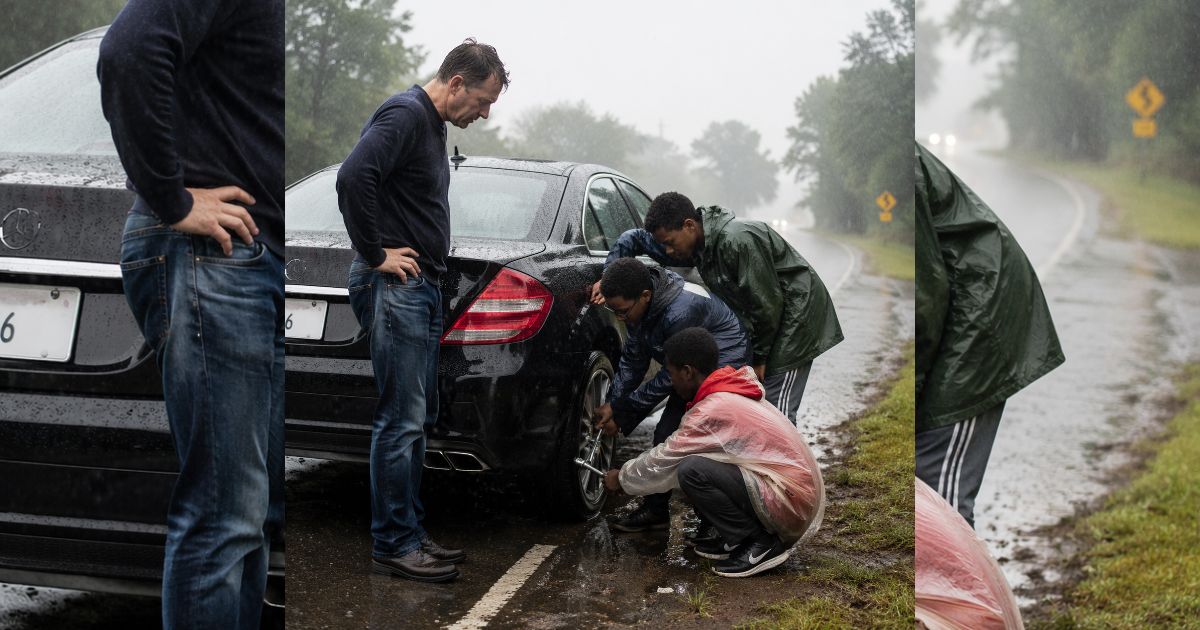
Three boys on bikes were riding toward him.
They came out of the misty edge of the road in mismatched rain jackets, their tires spraying water, their voices carrying over the storm. Black boys, all of them maybe fifteen or sixteen, skinny and quick, the kind of age where the body still had a little stretch in it and the face had not fully settled into adulthood yet.
The tallest one had broad shoulders, wire-frame glasses speckled with rain, and a blue jacket with one sleeve darker than the other like it had been patched. Another wore a red hoodie under a plastic poncho. The third had a green raincoat too short at the wrists and a grin that arrived before the rest of his face did.
They slowed when they saw the sedan.
The tall one lifted a hand.
“You need help, sir?”
Chris blinked.
It was not that he had never spoken to teenage boys before. He had. But in that moment, soaked, frustrated, and stranded, he found himself caught between pride and need. He almost said no out of reflex.
He almost said he had it handled.
He almost lied.
Instead, he looked at the flat and then back at them.
“I’ve got a blown tire,” he said. “And I’m running out of time.”
The boy in the blue jacket nodded once and leaned his bike against the ditch.
“We can fix that.”
Chris let out a short breath that almost turned into a laugh.
“I appreciate the confidence,” he said, “but this isn’t exactly a bicycle.”
The boy smiled. “A wheel’s a wheel.”
His friends hopped off their bikes too.
The one in the poncho stepped closer and peered at the trunk. “You got a spare?”
Chris pointed. “In there.”
The shortest boy gave a quick shrug. “Then we’re halfway done already.”
Chris looked at them carefully.
They were drenched.
Their jeans were dark with rain. Their sneakers were muddy. Their faces were young in a way that made him feel suddenly ancient, even though he took good care of himself and wore wealth like armor.
“You boys don’t have to stop for me,” he said.
The tall one gave him a look that was polite but direct.
“We already stopped.”
Then, before Chris could say another word, the boys moved as if they had done this together ten times before.
The tall one introduced himself as Isaiah and dropped to one knee by the flat.
The boy in the poncho, Malik, started pulling tools from the trunk without any hesitation. Not careless. Just comfortable.
The third boy, Jamal, braced a hand on the rear frame and leaned in close to check the placement of the jack.
Chris stood there in the rain, useless.
“Where’d you learn this?” he asked.
Isaiah didn’t look up. “My uncle runs a body shop outside town.”
Malik grinned. “And Jamal breaks stuff enough that we gotta learn how to fix it.”
“I do not break stuff,” Jamal said.
“You broke your cousin’s mower.”
“That was not fully my fault.”
Chris found himself staring at them.
Not because he distrusted them.
Because they were calm.
There he was, a man whose calendar was scheduled down to five-minute blocks, whose day could throw off entire teams if he arrived late, and he was the one unraveling. They were wet, young, and standing on a roadside in the rain, and somehow they seemed more grounded than he did.
Isaiah loosened the lug nuts with steady hands.
Malik handed him the wrench before he asked for it.
Jamal watched the car, keeping his shoulder ready, eyes sharp.
Their rhythm was effortless.
“What are your names again?” Chris asked.
“Isaiah.”
“Malik.”
“Jamal.”
Chris nodded. “I’m Chris.”
Malik looked up. “You from Atlanta?”
“Outside it.”
“That explains the shoes,” Jamal said.
Chris looked down at his mud-streaked leather loafers.
For the first time since the tire blew, he laughed.
A real laugh. Short, surprised, but real.
“Fair enough.”
The rain kept falling, but the moment had changed.
Something in him loosened.
Maybe because the boys treated him like a person first and whatever else he was second. Maybe because they weren’t nervous around him. Maybe because he had spent so many years in rooms where everybody measured everybody else that this roadside honesty felt almost shocking.
Isaiah lifted the damaged wheel away.
Malik rolled the spare over.
Jamal steadied the jack with both hands and looked at Chris.
“You got somewhere real important to be?”
Chris hesitated.
Normally he would have said yes with a certain kind of pride.
Today the word felt smaller.
“Yeah,” he said. “I do.”
Jamal nodded as if that made perfect sense. “Then good thing we came by.”
No edge in it.
No performance.
Just simple truth.
Ten minutes later, the spare was on.
Isaiah tightened the last lug nut and stood up slowly, stretching his back.
“All right,” he said. “You’re good.”
Chris stepped forward and crouched to look, though he had no idea what he was looking for. Everything seemed solid. Tight. Done.
“You boys did this in under twenty minutes.”
Malik wiped rain from his forehead. “Would’ve been faster if somebody here,” he said, cutting his eyes toward Jamal, “hadn’t dropped the wrench.”
“I dropped it once.”
“In the mud.”
“Still worked.”
Chris looked at the three of them standing there in the rain, and a strange feeling hit him in the chest.
It was not just relief.
It was embarrassment mixed with gratitude. Surprise mixed with something softer. A sense that he had just been handed help by people who owed him nothing and expected nothing.
That was rare in his world.
Rarer than honesty.
Rarer than loyalty.
He reached into his wallet and pulled out a stack of bills.
“Please,” he said. “Take this.”
Isaiah shook his head immediately.
Chris held the money out farther. “You saved me. I mean it.”
Malik stepped back.
“We’re good, sir.”
“It’s not charity,” Chris said quickly. “It’s a thank-you.”
Jamal smiled a little. “Still no.”
Chris stared at them.
“You boys just stood in the rain and fixed my car.”
Isaiah pushed his glasses up with one wet finger. “Yeah. Because you needed help.”
Chris looked from one face to the next.
He could not remember the last time somebody had done something valuable for him without checking what they might get out of it.
He held the money there another second.
Then slowly, almost awkwardly, he lowered his hand.
“At least let me know who to thank,” he said.
Isaiah pointed at himself, then his friends. “Isaiah, Malik, and Jamal. That should cover it.”
Chris gave a faint smile despite the lump building somewhere behind his ribs.
“Well,” he said, “thank you.”
Isaiah nodded toward the driver’s side door. “Drive safe, Mr. Chris.”
Then the three of them grabbed their bikes, pushed off, and rode away through the rain like the whole thing had been nothing more than a small stop in the middle of an ordinary day.
Chris stood by the car long after they disappeared.
The money was still in his hand.
He slid it back into his wallet, shut the trunk, and got behind the wheel, but his hands stayed on the steering wheel for a few extra seconds before he turned the key.
The clock on the dash kept moving.
The meeting still mattered.
He knew that.
But when he pulled back onto the road, the flat tire was no longer the thing occupying his mind.
It was three boys riding old bikes in the rain, laughing while they helped a stranger.
By the time Chris reached downtown Atlanta, the storm had thinned to a mist.
His assistant met him in the parking level with an umbrella and an anxious expression.
“You’re cutting it close.”
“I’m here,” Chris said.
She took one look at his damp sweater collar and muddy cuffs. “What happened?”
“Flat tire.”
She waited for more.
Chris usually gave more. Usually there was a brief command, a next step, a phone call to make, a name to remember, a problem to solve.
Instead he said, “It’s handled.”
Inside, the boardroom looked exactly the way it always did when money was about to change hands.
Cold water in glass pitchers.
Legal pads placed in neat angles.
Men and women in expensive jackets, careful expressions, polite voices.
Chris had built a life inside rooms like this. He understood their language better than some people understood their own families. He could read hesitation in the way someone capped a pen. Read weakness in what questions they did not ask.
And he performed.
He still knew how.
He stood at the end of the table. He spoke with clarity. He answered difficult questions in an even tone. He revised numbers on the fly. He anticipated objections before they were voiced.
The deal moved.
Heads nodded.
People relaxed.
Twice, someone complimented his timing. Once, someone said, “This is why Mercer always closes.”
But under the smooth surface of it all, something was off.
Not in the deal.
In him.
Every time the conversation slowed, his mind wandered back to the roadside.
To Isaiah’s calm.
To Malik’s grin.
To Jamal saying, Then good thing we came by.
The words stayed with him in a way numbers never did.
By late afternoon, the merger was done.
Signatures collected.
Hands shaken.
Smiles exchanged.
His team looked relieved. One of the investors even clapped him on the shoulder and said, “You must be feeling pretty good right now.”
Chris opened his mouth to give the answer he always gave.
Something about momentum. Something about vision.
Instead, he said, “I’m still thinking about something else.”
The man laughed lightly, assuming it was another deal.
It was not.
Back in his office, high above the city, Chris shut the door and stood by the window.
Below him, Atlanta spread out in wet glass and headlights.
He had started with nothing worth mentioning. A childhood in a rented duplex. A father who worked with his hands until his body wore down. A mother who stretched every dollar until it squealed. Chris had been the smart one, the restless one, the one people said was going somewhere.
He went.
College. Finance. Real estate. Logistics. Private equity. Growth. Expansion.
He learned fast that success came easier when you acted like you needed nobody.
He also learned that kindness, in his world, often arrived wrapped in invoice paper. Favor for favor. Access for access. Donation for naming rights. Generosity with a press release attached.
He had become good at that world.
Maybe too good.
He loosened his tie and sat down, but the chair did not give him the comfort it usually did.
He thought about the boys refusing the money.
Not dramatically.
Not with a lesson prepared.
Just no.
As if helping somebody was allowed to be the whole point.
His phone buzzed.
A message from his chief operating officer, Dana: Great work today. Media team wants approval on the announcement draft.
Another message from his younger sister, Elise, that he had missed earlier: Dad’s church is doing a repair drive this Saturday. They asked if you might send supplies. No pressure.
He stared at that one longer.
His father had been gone six years.
A good man, stubborn and proud, who had taught Chris one thing very clearly before life split them into different kinds of people.
If you have two hands, you use them. If you have more than enough, you share it. And if you help someone, don’t stand there waiting to be thanked like you’ve done them a favor bigger than their need.
Chris had loved his father.
He had also outgrown him, or at least that was what he told himself for years.
Now, looking out over the city with the deal signed and the adrenaline already fading, he felt something he did not enjoy feeling.
He felt ashamed of how far he had drifted from the man who raised him.
Not because he had money.
Because he had let money turn everything into a transaction.
He thought of the boys again.
Then he made a decision before he could overthink it.
He was going back.
The next morning, Chris left the city without a driver, without an assistant, and without telling anybody on his team where he was going.
He wore jeans, boots, and a dark pullover.
Nothing expensive-looking enough to make a point.
The road seemed different in daylight.
The fields were greener than he had noticed in the storm. The town he passed into was smaller than he expected, with a feed store, a barber shop, a diner, a church with white siding, and a row of homes that looked worn but cared for.
He drove slowly.
Part of him felt foolish.
What exactly was he doing? Looking for three boys in a small town because they had fixed a tire? That sounded thin when he put it into words.
But the feeling that brought him here did not feel thin.
It felt important.
He found them outside a diner called Hattie’s.
Their bikes were leaned against the brick wall. They were sharing fries from a red plastic basket, arguing about something with the complete seriousness only teenage boys can bring to nonsense.
Malik saw him first.
“Well, look who figured out where the county line is.”
Isaiah turned and smiled in quiet recognition. Jamal straightened in his seat.
“Car still holding up?” Jamal asked.
“So far,” Chris said.
He stood there for a second, suddenly aware that he had no polished script for this.
Isaiah saved him.
“You want to sit?”
Chris nodded.
He sat on the bench beside them, awkward at first, aware of how old he felt and how different his life was from theirs, yet also aware that none of them seemed impressed by any of that.
“I came to thank you properly,” he said.
Malik popped a fry into his mouth. “We heard you yesterday.”
“No,” Chris said. “I don’t think you did.”
That made them quiet.
He looked down the street before speaking again.
“I’ve spent most of my life around people who never do anything without a reason that benefits them. Yesterday you boys stopped, got soaked, fixed my car, and refused money like it was the easiest thing in the world. I’m still thinking about it.”
Jamal looked almost embarrassed.
“It was just a tire.”
Chris shook his head. “No. It wasn’t.”
Isaiah studied him.
There was a steadiness in the boy’s face Chris respected immediately. He had the look of somebody used to being older than his years.
“What are you asking?” Isaiah said.
Chris appreciated that.
Not what are you offering.
What are you asking.
It was the right question.
“I want to do something useful,” Chris said. “Not for show. Not to make myself feel good for five minutes. Something that matters to you.”
Malik leaned back. “Like what?”
“That depends on what’s needed.”
The boys exchanged glances.
Jamal shrugged. “We don’t need anything.”
Chris believed him.
That was the problem.
The people least likely to ask were often the ones carrying more than they should.
Isaiah took a sip of his soda, thinking.
Then he said, “There is something the town needs.”
Chris waited.
“It’s the youth center over on Walker Street,” Isaiah said. “After school place. Basketball, tutoring, summer meals, all that. Roof leaks. Air barely works. Half the computers don’t boot up. Ms. Karen keeps trying to hold it together, but it’s rough.”
Malik nodded. “That place matters.”
Jamal added, “A lot of kids go there till their people get off work.”
Chris looked at them.
“And that’s what you want me to help?”
All three boys nodded.
Not one of them mentioned themselves.
Not new bikes.
Not cash.
Not clothes.
A building for other kids.
Chris looked away for a second because the force of that hit him harder than he expected.
“You had a chance to ask for anything,” he said quietly.
Malik smiled. “Yeah. We did.”
Chris exhaled through his nose and gave a small, helpless laugh.
“Okay,” he said. “Then let’s start there.”
Walker Street Youth Center sat behind a chain-link fence with peeling paint on the sign and a basketball hoop bent slightly to the left.
The building had once been cheerful.
Chris could tell that much.
The bones of it were hopeful. Big windows. Wide rooms. A small play area in back. A kitchen that probably served more meals than anyone ever counted. But time and money had been unkind. Roof patches layered on roof patches. Steps worn down. A door that stuck in the frame. Gutters hanging like loose thoughts.
Inside, the director looked like she had slept three hours and spent all of them worrying.
Karen Holloway was in her early forties, with tired eyes, quick hands, and the kind of smile people use when they have had to be strong too long.
When the boys walked in with Chris behind them, she looked up from a stack of paperwork and immediately straightened.
“Boys, if this is about the copier again, I told you I am not arguing with that machine today.”
Then she saw Chris.
Her whole expression changed into careful professionalism.
“Can I help you?”
Chris introduced himself.
Not his full title. Not the company. Just his name.
Karen glanced from him to the boys and back again, already suspicious in the way people become when too many promises have passed through their lives without staying.
Isaiah spared her the guessing.
“He’s the guy from the road,” he said. “We helped him yesterday.”
Karen looked at the boys for another beat, then back at Chris.
“And now?”
Chris answered plainly.
“And now I’d like to help this place, if you’ll let me.”
Karen did not melt.
She did not gasp.
She did not clap a hand over her mouth.
She folded her arms.
“In what way?”
Chris almost respected her more for that than he would have respected gratitude.
“In whatever way actually helps,” he said. “Repairs. Equipment. Maybe more, depending on what’s needed.”
Karen’s face stayed guarded.
“I’ve had men in polished shoes walk in here before,” she said. “Most of them liked the idea of helping more than the work of it.”
The room went still.
Malik looked from her to Chris, as if waiting to see who would flinch first.
Chris did not.
“What happened with them?” he asked.
Karen let out one dry breath and glanced at the paperwork on her desk.
“One promised a donation if we renamed the center after his wife.”
She pointed to a corner where buckets sat under a water stain.
“One promised to ‘look into grants’ and disappeared.”
She touched a stack of forms with the back of her hand.
“One brought a camera crew, handed out school supplies for ten minutes, and left before the kids even got back from the gym.”
Chris listened without interrupting.
When she finished, he nodded slowly.
“That would make me suspicious too.”
Karen held his gaze.
“So why are you here?”
Because three boys in the rain embarrassed me with their decency.
Because I signed a deal yesterday worth more than this whole block and felt less satisfaction than I did hearing one of them say, We already stopped.
Because somewhere along the way I forgot what helping someone was supposed to feel like.
He could have said all of that.
Instead, he said, “Because they asked for this instead of themselves. That told me enough.”
Karen’s expression shifted, only slightly.
Chris stepped closer to the desk.
“I’m not asking for a plaque. I’m not asking for a public event. I’m not asking you to put my name on anything. I just want an honest list of what this place needs and what it would take to do it right.”
Karen looked at him for a long moment.
Then she looked at the boys.
Jamal gave her a small nod.
Isaiah said, “He’s serious.”
Malik added, “And if he acts weird, we’ll tell you.”
Karen laughed despite herself.
It changed the room.
Not completely.
But enough.
“All right,” she said. “You want the truth? The truth is we need more than a patch job.”
“Good,” Chris said. “I’m not interested in a patch job.”
The next hour was not glamorous.
Chris walked the building with Karen while the boys followed close behind.
She showed him the roof line where water pushed in during hard rain.
She showed him two classrooms where the ceiling tiles had swollen and bowed.
She showed him the old computer room with six machines, only three of which worked reliably.
The kitchen refrigerator hummed like it was breathing through its nose. The back fence leaned. The bathroom sinks drained slowly. The play area had cracked rubber surfacing and one slide too hot in summer because the shade canopy tore two years ago and was never replaced.
Chris took notes.
Actual notes.
By hand.
Karen noticed.
“You doing this yourself?”
“Yes.”
“Why?”
“Because if I hand it off too fast, somebody else turns it into a project. I’m trying to keep it human for at least one full day.”
That made her look at him differently.
By the time they finished the tour, Chris had a legal pad full of practical problems and a chest full of something he had not felt in a very long time.
Direction.
Not the kind that grows companies.
The kind that settles a person.
Before he left, he asked Karen one more question.
“What’s the biggest thing standing in the way besides money?”
Karen didn’t answer right away.
Then she said, “People get tired of being disappointed.”
Those words followed him all the way back to Atlanta.
By Monday morning, Chris’s office was buzzing again.
Announcements about the merger. Scheduling calls. Two interviews his communications team wanted him to do. A lunch with lenders. Internal projections. Expansion planning.
Dana walked into his office with three folders, one coffee, and the expression of someone already solving five problems at once.
“You disappeared Saturday.”
“I took a drive.”
“You never ‘take a drive.’”
Chris set down the pen he had been using to sketch out repair estimates on a yellow pad.
“Dana.”
She stopped.
They had worked together twelve years. She knew his moods better than most of his family did.
“What is it?” she asked.
Chris slid the pad across his desk.
She scanned the page.
Roof replacement.
HVAC repair.
Computers.
Playground surface.
Kitchen equipment.
After-school staffing reserve.
Transportation fund.
Dana looked up slowly.
“This isn’t business.”
“No.”
She leaned back in the chair. “Then what is it?”
Chris told her.
Not every emotion.
Not every private thought.
But enough.
The flat tire.
The boys.
The refusal of money.
The youth center.
Karen’s suspicion.
Her line about people getting tired of disappointment.
Dana listened without speaking.
When he finished, she tapped the legal pad once.
“And what do you want to do?”
“All of it.”
She raised an eyebrow.
“All of it?”
“Yes.”
“Quietly?”
He met her gaze. “Quietly.”
Dana sat back farther and crossed one leg.
“For the record, I like this version of you more than the one who was ready to spend four million dollars on a lobby waterfall in 2018.”
Chris winced. “That was not my finest hour.”
“It really wasn’t.”
They both smiled.
Then Dana went practical.
“If you do this personally, it stays clean. If you run it through the company, the board will want structure, and structure will bring branding, press, and half a dozen people trying to measure social return.”
“I know.”
“So fund it yourself.”
“That’s the plan.”
Dana nodded once. “Then do it properly.”
Chris exhaled.
That was one problem handled.
The other came two hours later.
His media director had somehow caught wind that Chris was involved in a “community revitalization effort” and entered the office with visible excitement.
“This could be excellent timing,” she said. “Post-merger, a human-interest angle would play beautifully.”
“No.”
She blinked. “We could keep it tasteful.”
“No.”
“A small local rollout, maybe. Nothing too polished.”
“No.”
She tried again, gentle now.
“Chris, public goodwill matters.”
He turned in his chair and looked at her.
“So does not turning people’s need into content.”
That ended the conversation.
Not neatly.
But completely.
Over the next week, Chris made calls he would once have made for entirely different reasons.
Roofing crews.
Electricians.
A playground company.
A local contractor recommended by Karen’s church and trusted by three different families in town.
He avoided anybody who sounded too smooth.
He avoided bargains that came with strings.
He did not want cheap. He wanted durable.
He drove back to town twice that week to meet vendors in person because Karen had made one thing clear: if adults were going to make decisions around the youth center, the community deserved to see them with their own eyes.
That was fair.
He met Isaiah’s mother on his second visit.
Her name was Rochelle.
She worked long shifts at a nursing home, wore her hair tied back, and had the watchful look of a woman who had learned to read people quickly because life did not give her room for mistakes.
She thanked Chris for helping.
Then she said, very calmly, “My son told me you’re a rich man from the city. I hope what he also told me is true, and that you’re not the kind who comes through here trying to feel important.”
Chris respected her immediately.
He answered the only way that seemed worth anything.
“I hope so too.”
That made her smile just a little.
Malik lived with his grandmother, Miss Bernice, in a yellow house with two metal chairs on the porch and potted plants lined up like company.
Miss Bernice invited Chris in, gave him sweet tea, and watched him over the rim of her glasses as if evaluating a used appliance.
“You planning to stay useful,” she asked, “or just be impressive for a month?”
Chris set his glass down carefully.
“Stay useful, I hope.”
She nodded.
“Good. Impressive doesn’t keep roofs from leaking.”
Jamal’s father, Curtis, worked nights loading trucks and spoke less than everyone else.
But when Chris mentioned the center, Curtis said, “That place kept my boy somewhere safe after school when I couldn’t be home yet. If you help that building, you help more than walls.”
That line went into Chris’s notebook too.
He wrote down more during those weeks than he had in years.
Not business notes.
Human notes.
What people said when they weren’t trying to win.
What mattered to them.
What made them cautious.
What made them soften.
By the end of the second week, plans were in motion.
The roof was first.
Karen insisted on that.
“We can’t dream big under a ceiling that still drips,” she said.
Then HVAC. Then electrical work. Then paint, flooring, computers, kitchen upgrades, and the play area out back. Chris added a small transportation fund after learning some kids missed programs simply because nobody could get them there consistently.
When Karen found that line item in the budget sheet, she stared at it.
“You thought of that?”
“One of the tutors mentioned attendance drops on Fridays.”
Karen looked up. “Most donors don’t listen that closely.”
Chris almost told her he was trying to learn how.
Instead he said, “Maybe they should.”
Word spread fast in the town.
Small towns worked that way.
By the time the first crews arrived, people already knew the basics.
Some believed it.
Some did not.
A few expected a catch.
A couple of older men at the diner told anybody who would listen that nothing in this world came free and the city man would want his name plastered on the building by Christmas.
Chris heard about that through Jamal, who reported gossip with enormous satisfaction.
“You know Mr. Dorsey said you’re probably gonna put a giant golden statue of yourself by the front door.”
Chris deadpanned, “I was thinking fountain, actually.”
Malik nearly choked laughing.
The boys became part of the work almost immediately.
Not in dangerous ways.
Chris was careful about that.
But they were there every day after school, carrying lighter supplies, cleaning up, helping Karen organize classrooms, asking workers questions, learning names, sweeping floors, and acting like unofficial assistant foremen by the end of week one.
Isaiah kept lists.
Malik kept spirits up.
Jamal found problems nobody else noticed, including a loose gate hinge and three boxes of old books stored under a leak.
Watching them, Chris understood something that had never been obvious to him from conference tables and quarterly reports.
People took better care of what they had been invited to build.
One afternoon, while a roofing crew pounded overhead and Karen sorted donated books in the corner, Chris stood in the old computer room with Dana on speakerphone.
“You’re smiling,” she said.
“How do you know that?”
“You sound less expensive.”
He laughed.
“Everything’s moving.”
“Good.”
Then her tone shifted.
“There is one thing.”
Chris leaned against the window frame.
“What?”
“The board heard you’re funding something personally.”
He closed his eyes for a second. “Of course they did.”
“One of the members thinks it might be ‘strategically underleveraged.’”
Chris stared at the ceiling.
“That sounds like him.”
“He suggested looping the company in for visibility.”
“No.”
“I told him you’d say that.”
“Thank you.”
Dana paused. Then, more softly, she said, “They aren’t used to seeing you care about something this way.”
Chris looked through the window at the boys in the back lot, measuring spaces for new benches like it was the most important task in the world.
“I’m not used to it either,” he said.
She let that sit between them.
Then she asked, “You okay?”
It was a simple question. One people in his orbit rarely asked without agenda.
Chris answered honestly.
“I think I’m getting there.”
The renovation took eight weeks.
Not because he rushed it carelessly.
Because he paid for enough good people to do it right the first time.
But the real change started before the building was done.
Parents began stopping by again, not just to pick up forms but to ask when programs would restart.
Former volunteers returned.
A retired schoolteacher offered to run reading hours twice a week once the rooms reopened.
A mechanic from two streets over said he could teach a basic bike repair class if the center wanted one.
Miss Bernice organized a lunch rotation for work crews on Saturdays and treated every contractor like a nephew who needed better posture.
Rochelle convinced two nurses she knew to help with health information nights for parents.
Curtis showed up one evening with folding tables in the back of his truck and simply said, “Had these in storage.”
The town was not passive anymore.
It was waking up.
And Chris, who had spent years believing leadership meant standing at the top of things, found himself learning the power of stepping back just enough for other people to step forward.
There was one difficult day.
He should have expected it.
Success always invited interpretation.
A local reporter caught wind of the renovation and called Karen asking for a feature on “the billionaire benefactor transforming a forgotten town.”
Karen handed the phone to Chris without a word.
He listened to the pitch.
He heard phrases like remarkable generosity, inspiring narrative, redemption angle.
Then he said, “The story isn’t me.”
The reporter pressed.
Chris stayed firm.
“If you want to cover the reopening when the center is ready, cover the center. Cover the families. Cover the kids. Cover the director who kept this place alive when nobody was looking. But don’t build a fairy tale around me.”
The reporter sounded disappointed.
Chris did not care.
Later that day, Karen found him in the hallway checking measurements on new shelving.
“That was the right answer,” she said.
Chris shrugged. “It was the true one.”
Karen watched him for a second.
“You know,” she said, “I didn’t trust you at all.”
“I know.”
“I trust you now.”
Those five words landed harder than some awards he had won.
On a bright Saturday in early fall, the last trucks pulled away.
The new roof sat clean and solid under a wide blue sky.
The walls had been painted in warm colors. The classrooms looked alive again. The computer room held twelve updated machines. The kitchen gleamed. The back lot had a new shade structure, safe surfacing, fresh benches, and a garden bed one of the volunteers had insisted on planting with the younger kids.
The old sign had been repaired and repainted.
Not renamed.
Just restored.
Walker Street Youth Center.
That was enough.
Karen wanted a reopening celebration.
Chris tried to decline any attention.
Karen overruled him.
“This town needs to celebrate good things when they happen,” she said. “That includes the people who helped make them happen. Sit down somewhere humble and survive it.”
He did.
Families came early.
Kids came earlier.
Music played from a portable speaker near the front steps. There were crockpots, sheet cakes, folding chairs, paper plates, and enough laughter to fill the whole block.
Chris stood off to the side for most of it, coffee in hand, trying not to look like a man uncomfortable with being appreciated.
The boys found him anyway.
Malik had somehow acquired a volunteer badge and was wearing it like a medal.
Jamal pulled him toward the back lot before he could protest.
“You haven’t seen the benches.”
“I paid for the benches.”
“Yeah, but now they got people on them. That’s different.”
He was right.
It was different.
Mothers sat talking while younger children chased each other past the play area.
Older boys tested the new basketballs in the gym.
A little girl with two puffs in her hair sat in the computer lab moving a mouse with deep concentration while a volunteer showed her how to open a drawing program.
Karen stood at the front, wiping her eyes every third minute and pretending she was not.
Isaiah walked beside Chris more quietly than the others.
“You did all this,” he said.
Chris looked around.
“No,” he said. “I helped. That’s different too.”
Isaiah seemed to think about that.
Then he nodded.
The official remarks were short because Karen knew people had not come to hear speeches.
Still, she said what needed saying.
She thanked the work crews.
She thanked volunteers.
She thanked families who had not given up on the center even when it looked like giving up might be easier.
Then, against Chris’s wishes but with the full support of half the town, she asked him to say a few words.
He stood on the steps with a paper cup in one hand and no prepared speech.
That had once terrified him.
Now it felt clean.
He looked at the crowd.
At the parents.
At the kids.
At the workers he had hired and the neighbors who had shown up anyway.
At the three boys in the front row with expressions halfway between pride and amusement.
Then he spoke.
“A few weeks ago,” he said, “I was stuck on the side of the road with a flat tire and a very bad attitude.”
The crowd laughed.
“Three young men from this town stopped to help me. They did not know me. They did not care what I had or where I was headed. They saw someone in need and they stopped.”
He looked at the boys.
“I tried to pay them. They refused.”
A murmur moved through the crowd, though many already knew that part.
Chris swallowed once.
“I’ve spent a lot of years in places where everything has a price. Everything gets measured. Traded. Negotiated. But those boys reminded me that not everything worth receiving can be bought.”
The crowd grew quieter.
“When I asked what they wanted in return, they didn’t ask for anything for themselves. They asked for this place.”
He turned and gestured toward the building.
“So if you thank anybody today, thank the people who were already living the kind of life that makes a thing like this possible. Thank the ones who kept showing up. Thank the ones who didn’t stop believing this center mattered, even when the paint peeled and the roof leaked and money got tight.”
He paused.
Then he said the truest sentence he had spoken in public in years.
“They fixed my tire, yes. But they also fixed something in me I didn’t realize had gone flat.”
For one second, the crowd was silent.
Then people laughed softly, clapped, wiped eyes, nodded, and the sound rose up warm and full.
Chris stepped back before emotion could catch him off guard in front of all those people.
Karen hugged him anyway.
He stiffened for half a second, then let himself return it.
Late in the afternoon, once the food was mostly gone and the kids had moved from running wild to dragging with happy exhaustion, Chris slipped away to the side of the building for some quiet.
He found Karen there first.
She handed him a fresh cup of coffee without asking.
“You survived.”
“Barely.”
She smiled.
“You know what the best part is?”
“What?”
She pointed through the window into the tutoring room.
“It’s not finished.”
Chris looked at her.
“The repairs are finished,” she said. “The place is just starting.”
He followed her gaze.
A volunteer was helping two boys with homework at one table. A grandmother sat reading to a little girl in the corner. Someone was stacking art supplies on shelves.
Life had already moved in.
Not ceremony.
Life.
Chris nodded slowly.
“I think that’s my favorite part too.”
After a moment, Karen said, “Can I ask you something personal?”
“You can ask.”
“Were you lonely before all this?”
Chris looked down into his coffee.
The answer came without effort.
“Yes.”
Karen did not react with pity.
Just understanding.
“I thought so,” she said.
He gave a short breath that almost counted as a laugh.
“Was it obvious?”
“Only to somebody who sees tired adults for a living.”
He nodded.
“That sounds right.”
Karen leaned against the wall beside him.
“Then I’m glad you got a flat tire.”
Chris smiled into the coffee.
“So am I.”
As the evening cooled, families began heading home.
Chairs got folded.
Leftovers got packed into foil pans.
Children who had sworn they were not tired suddenly could not keep their eyes open.
The sky turned soft over the neighborhood.
Chris was near his car when the boys caught up to him.
Isaiah came first, hands in his pockets.
Malik carried two wrapped containers of food someone had forced on him.
Jamal held a basketball under one arm like he might sleep with it.
They stood in front of Chris for a second, and none of them seemed quite sure how to begin.
Finally, Jamal said, “You really did it.”
Chris looked back at the building.
“We really did it.”
Malik shifted the containers to one hand. “You know, Ms. Bernice says now you can’t disappear. She says if you show up for one fish fry, you’re family-adjacent.”
Chris laughed. “That sounds legally binding.”
“It probably is.”
Isaiah stepped forward then.
His voice was quieter than the others’.
“My mom said to tell you something.”
“What’s that?”
“She said some people spend a lot of money trying to matter. But what people remember is who showed up.”
Chris felt that line settle deep.
“Your mom is smart.”
“She says that too.”
They all smiled.
Then Jamal, never built for long sentimental pauses, bounced the ball once and said, “So when are you coming back? We’re starting a bike repair class next month and you still don’t know how to change a tire.”
Chris stared at him.
Then he laughed so hard he had to bend a little.
“That bad?”
“That bad,” Malik confirmed.
Chris opened his car door, then stopped.
He turned back to them.
“Next month,” he said. “And before then, if the center needs something, you call Karen. Karen calls me.”
Isaiah nodded.
“Deal.”
Chris hesitated.
Then he added, “Actually, one more thing.”
The boys waited.
“I set up a separate fund for the center,” he said. “Not huge. Enough to help with programs, transport, and emergencies for a while. Karen has full control over it. No headlines. No speeches. Just there when needed.”
Malik’s eyebrows went up.
Jamal whistled softly.
Isaiah just looked at Chris with that same steady expression he had worn in the rain.
“Why didn’t you say that before?”
Chris thought about it.
Because the old version of me liked to announce generosity like a product launch.
Because I am still learning not to center myself in other people’s relief.
Because some good things grow better when they’re not performed.
He answered simply.
“Because I wanted today to be about this place being open, not me doing one more thing.”
Isaiah nodded once.
“Yeah,” he said. “That makes sense.”
They stood there in the fading light, four people from very different lives tied together by one broken tire and what came after it.
Then Jamal lifted the basketball toward Chris.
“You wanna take one shot before you go?”
Chris looked at the ball, then at the hoop in the back lot.
“If I miss, are you all going to remember it forever?”
Malik answered immediately. “Absolutely.”
Chris took the ball anyway.
They walked to the court together.
A few people still lingered nearby, talking and laughing, but nobody crowded him. Nobody turned it into a moment bigger than it needed to be.
He stood at the free-throw line, bounced the ball once, and took the shot.
It hit the backboard, kissed the rim, and dropped through.
The boys exploded like he had just won a championship.
Chris lifted both hands in mock triumph.
“I’m retiring undefeated.”
“You took one shot,” Jamal said.
“That’s all legends need.”
When he finally got into the car, he did not rush to start it.
He sat there with the window cracked, listening to the last sounds of the evening.
A child laughing.
A folding chair scraping pavement.
Someone calling for leftovers.
The bounce of a basketball.
For years, Chris had ended his nights with screens glowing in dark rooms, numbers moving, deals forming, a constant feeling that the next thing mattered more than the present one.
This felt different.
Not bigger.
Better.
The road back to Atlanta was quiet.
No storm this time.
No panic.
Just open highway and a kind of peace he had once thought belonged only to people who had asked less from life than he had.
He knew better now.
Peace was not what came after winning enough.
It was what came when you stopped treating every human moment like a ladder.
At a red light outside the city, his phone buzzed on the console.
A text from Dana.
How’d the reopening go?
Chris looked through the windshield at the glow of downtown in the distance.
Then he typed back.
Best thing I’ve done in years.
Three dots appeared almost instantly.
Told you I liked this version of you better.
Chris smiled and set the phone down.
When he reached home, the house was as polished and quiet as ever. Clean counters. Perfect lighting. Art on the walls chosen because it looked valuable and restrained. For the first time, it felt too quiet.
Not empty exactly.
Just unfinished.
He set his keys down, loosened his shoulders, and walked to the kitchen.
On the counter, he found the containers Malik had shoved into his hands before he left.
One held catfish.
The other peach cobbler.
A folded napkin was tucked under the lid with a note in big crooked handwriting.
For the city man.
Learn tires next.
— M, J, and I
Chris stared at the note for a long time.
Then he laughed softly and sat down at the kitchen table instead of eating over the sink like he usually did when he got home late.
He took one bite of cobbler.
Then another.
Outside, the city moved on without him for one ordinary evening, and for once he did not mind.
A month later, he kept his promise and came back for the bike repair class.
Then he came back again for the winter coat drive.
Then in spring for the garden boxes behind the center.
He never became the hero of the town, and that suited him fine.
He became something quieter.
Reliable.
Karen called when a freezer died unexpectedly.
Dana handled the wiring of funds without turning it into theater.
Isaiah started mentoring younger boys in the bike workshop.
Malik ran the center’s social board and somehow made every flyer look like an event.
Jamal taught Chris how to check tire pressure properly and enjoyed his own expertise far too much.
Chris did not mind that either.
Because every time he drove down Walker Street and saw lights on inside that building, he felt the same truth settle into place.
The thing that changed his life had not been a billion-dollar deal.
It had not been applause in a boardroom, or a headline, or another elegant signature drying on expensive paper.
It had been a bad day, a ruined tire, three boys in the rain, and a kindness so pure it left no room for ego.
Sometimes that is how grace arrives.
Not with thunder.
With laughter.
Not asking what you can afford.
Only whether you are finally ready to receive what cannot be bought.
Thank you so much for reading this story!
I’d really love to hear your comments and thoughts about this story — your feedback is truly valuable and helps us a lot.
Please leave a comment and share this Facebook post to support the author. Every reaction and review makes a big difference!
This story is a work of fiction created for entertainment and inspirational purposes. While it may draw on real-world themes, all characters, names, and events are imagined. Any resemblance to actual people or situations is purely coincidenta