If you’ve already read part 1 of this story on Facebook, go here for Part 2!
The first time Lena’s shoe split open at school, she kept her foot tucked under her chair and smiled like nothing was wrong.
By lunch, the sole was hanging loose at the toe, flapping every time she walked.
A girl at the next table looked down and said, not even quietly, “Did your shoe just open its mouth?”
Three other girls laughed.
Lena laughed too, because sometimes that felt better than letting your face tell the truth.
But when she got home, she kicked both shoes so hard at the apartment door that one hit the wall and left a gray mark above the baseboard.
Her father was at the stove, stirring canned soup with the tired slowness he seemed to carry everywhere these days. He turned when he heard the sound.
“What happened?”
Lena pointed at the shoe on the floor.
“What do you think happened?”
He looked at it, then at her. “Lena—”
“No, seriously. What do you think happened?” Her throat already felt hot. “They fell apart. Again.”
He set the spoon down carefully. “We just bought those.”
“Exactly.”
The kitchen smelled like soup and laundry detergent from the coin-op machines downstairs. There was a stack of unopened mail on the counter, a school calendar held to the fridge with a faded magnet from a beach town they hadn’t visited since her mother was alive.
Lena was thirteen, old enough to notice things she wished she didn’t.
The empty spot in the medicine organizer on the counter.
The way her father cut coupons at night with his reading glasses slipping down his nose.
The way he always said, “We’re fine,” in the same voice people used when they weren’t.
She hated that voice.
At school, girls noticed brands. They noticed laces and labels and whose jeans had the right stitching on the pockets. Lena told herself she didn’t care, except she did. She cared every time she changed for gym and tried to hide her shoes behind her backpack. She cared every time she saw the clean white sneakers on other girls’ feet, bright and untouched, like their lives had room for things lasting longer than six weeks.
Her father rubbed a hand over his jaw. He had started doing that after her mother died, like he was always trying to wake himself up inside his own face.
“I’ll get you another pair this weekend.”
Lena stared at him.
“That’s your answer?”
“It’s the answer I have right now.”
She laughed once, sharp and ugly. “Of course it is.”
He went quiet. That was another thing she hated. His silence. It made her feel mean even when she was the one hurting.
He picked up the broken shoe and turned it over in his hands, examining the worn sole like he could reverse time by looking hard enough.
“I know it’s frustrating.”
“No, you don’t.”
His eyes lifted.
That should have been enough. But once Lena started, she couldn’t stop.
“You don’t know what it’s like to walk into school and know people are looking at you. You don’t know what it’s like when every other girl has normal things and you always have the cheapest version of everything.”
“Lena.”
“And I’m tired of pretending it’s okay.”
The apartment went still.
Outside, someone’s car alarm chirped. Upstairs, a toddler ran across the floor in quick little thuds. The soup on the stove started to bubble.
Her father turned the burner down.
When he faced her again, he looked older than he had that morning. Not angry. Just worn out in a way that made her feel like she was pushing on a bruise she couldn’t see.
“I’m doing the best I can.”
The sentence landed between them with a dull, heavy sound.
She hated that sentence too.
Kids with enough money never had to hear their parents say that.
“Well, your best isn’t working.”
His face changed then.
Not much. Just enough.
A tiny flinch. A tightening around the eyes. A man hit somewhere deeper than pride.
For one second, Lena almost took it back.
Then she thought about the girls laughing in the cafeteria, about the rip at the front of her shoe, about pretending not to care until it felt like your whole body ached from holding in the humiliation.
So she grabbed her backpack and headed for her room.
“Dinner in ten,” he said behind her.
“I’m not hungry.”
“You need to eat.”
She turned in the hallway. “Maybe if we bought food and shoes that lasted more than a week, I’d feel like this was a real house and not some place where everything’s always about what we can’t have.”
The words came out harder than she meant.
His hand dropped to the edge of the counter.
For a moment he didn’t say anything at all.
Then, very quietly, he said, “Don’t say that about this house.”
Lena stood there breathing fast.
It was a small apartment. One bedroom for him, one for her. Paint peeling near the windows. Heater that clicked all winter like it was thinking. Shoes always lined up by the door because her mother used to say a home felt calmer when the entrance was neat.
Her mother had been gone almost three years, and her father still lined the shoes up every night.
Even the broken ones.
Especially the broken ones.
Lena looked away first.
That night she heard him moving around long after the apartment went dark.
Cabinets opening.
The front door.
Then the soft, familiar scrape of shoes being straightened by the mat.
The next morning, there was a new pair waiting by the door.
Cheap black canvas shoes.
Not the ones she wanted. Not even close.
She stared at them while her father buttoned his work shirt with tired fingers. He drove a delivery truck for a restaurant supply company and left before sunrise most days. His thermos sat on the counter. His lunch was packed in an old insulated bag with a broken zipper.
“I can’t wear those,” she said.
He glanced at the shoes. “They’ll get you through a while.”
“A while.” She gave a short laugh. “That’s always the goal, right? Just survive a while.”
“Lena.”
“No. I’m serious.” She looked at him, and all the resentment she had been swallowing for months came up at once. “Do you even see me?”
The question hit harder than she expected.
He froze with one sleeve half-rolled.
Something moved across his face, there and gone.
Then he said, “Every day.”
But he didn’t say it like a defense. He said it like a fact that hurt.
She should have heard that.
Instead, she grabbed the shoes, shoved them into her backpack, and left in her socks, carrying yesterday’s broken pair until she reached the stairwell and had to put them back on.
At school, she kept her head down.
By the time she got home, shame had turned into anger again.
Her father wasn’t there yet. His workdays had been running later. More deliveries, less help, more excuses from a company that always wanted one more hour from him.
Lena went into his room looking for the spare phone charger he sometimes borrowed.
She didn’t usually go in there. It still felt too much like the part of the apartment adults kept to themselves, full of folded work shirts, old receipts, and the quiet loneliness he never showed in the kitchen.
The room smelled faintly of laundry soap and his aftershave.
She checked the nightstand.
Then the top drawer of the dresser.
Then the closet shelf.
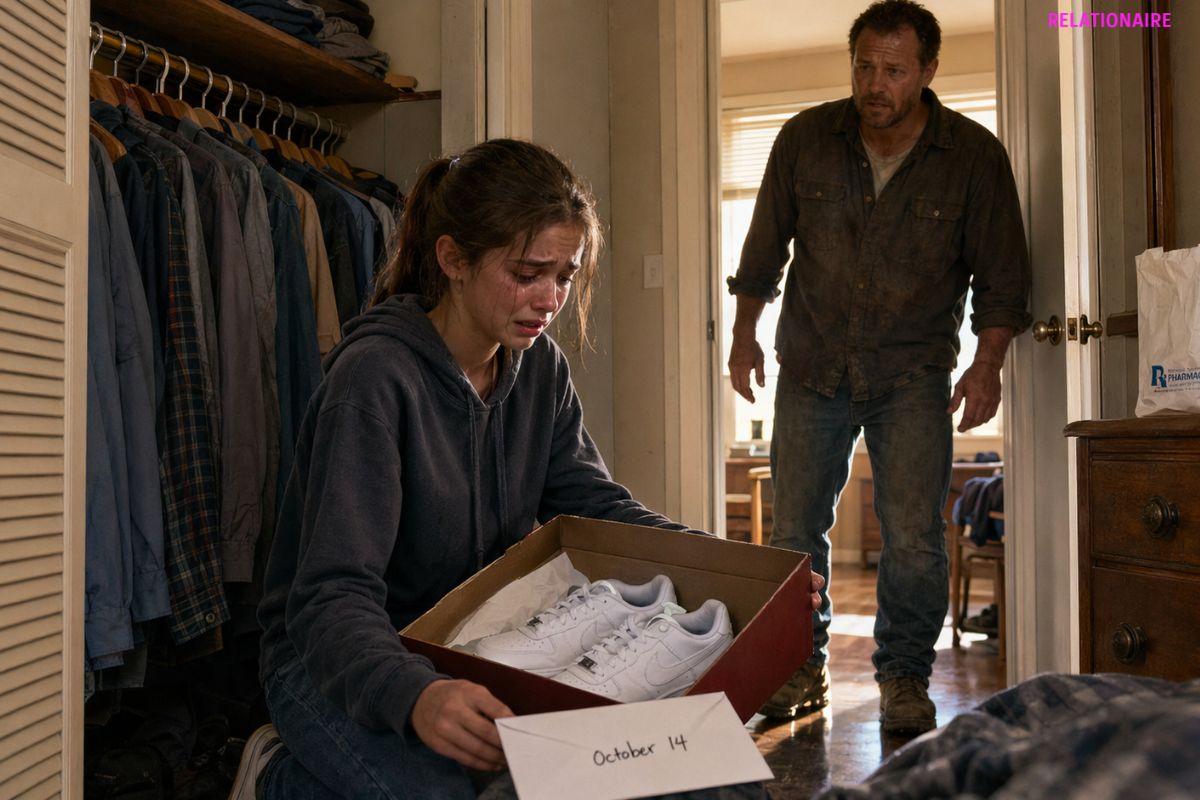
That was when she saw the shoebox tucked behind a stack of blankets.
A white box with gold lettering.
Not discount-store shoes. Not clearance-rack shoes.
The kind of shoes girls at school wore with confidence. The kind Lena had paused in front of at the mall and pretended not to stare at.
Her hands went cold.
She pulled the box down slowly and opened the lid.
Inside was a pair of cream-colored sneakers with soft leather sides and clean stitching, still wrapped in tissue paper.
Her size.
Under the box was an envelope.
Plain. Sealed. Her father’s handwriting on the front.
Not her name.
Just a date.
October 14.
Her mother’s birthday.
Lena stared at it, confused, then heard the front door unlock.
Her father stepped into the apartment, saw the box in her hands from the hallway—
and went completely still.
Part 2
For a second, nobody moved.
Lena stood in his bedroom doorway holding the shoebox against her stomach like she had stolen something sacred. Her father was still near the front door, one hand on the knob, his shoulders hunched from a long day, work shirt damp at the collar.
His eyes went first to the shoes.
Then to the envelope.
Then to Lena.
“What is this?” she asked.
Her voice came out smaller than she wanted.
He closed the door behind him quietly. Too quietly. The apartment felt full of sounds that had stopped—no running water, no television from a neighbor, no spoon against a pot. Just the hum of the refrigerator and the pounding in Lena’s ears.
“You shouldn’t have been in my room,” he said.
It wasn’t harsh. That somehow made it worse.
She looked down at the shoes again. “These are my size.”
He didn’t answer.
The heat rose into her face. “You told me we couldn’t afford decent shoes.”
His jaw tightened.
“Lena.”
“No.” Her fingers curled around the edge of the box. “You kept buying me those cheap ones and acting like that was all there was, and these were here the whole time?”
He took a breath like he was bracing himself against something.
“They were for next month.”
She stared at him.
“Next month?”
He looked at the envelope, then away. “I was waiting.”
“For what?”
He crossed the room and sat on the edge of the bed, like his legs had suddenly become too tired to hold him. Up close, she could see how pale he looked. There were darker shadows under his eyes than usual, a faint tremor in his right hand as he rested it on his knee.
“For your mother’s birthday,” he said.
Lena blinked.
He nodded once toward the envelope.
“She used to save for one good pair every year. Not five cheap ones. One good pair.” His voice had gone low, flat in the way people talk when they’re holding onto too much. “She said every girl deserved one thing that made her feel proud when she walked into a room.”
Lena remembered that.
Not clearly. More like a warm shape in memory. Her mother kneeling on the floor tying laces. Smiling up at her. Saying, Stand straight, baby. Good shoes change how a girl feels about herself.
Lena’s throat tightened.
“I thought…” He stopped and rubbed at his forehead. “I thought I could do it the way she used to. Save little by little. Surprise you on her birthday. Make it feel like she still kept her promises somehow.”
Lena looked down at the box in her arms.
All at once, the shoes didn’t look shiny anymore.
They looked heavy.
“Then why did you keep buying the other ones?”
“Because your feet kept growing.”
The words were plain, almost helpless.
He gave a tired laugh that wasn’t really a laugh at all. “I kept thinking I was close. Then school started, and the electric bill came in high, and the truck needed work, and…” He shook his head. “Those cheap pairs were what I could do in the meantime.”
Something inside Lena shifted painfully.
She thought of every time she had rolled her eyes, every time she had thrown the box aside, every time she had said You don’t get it.
He had gotten it so much that he had been trying to build a surprise out of money they didn’t have.
Her eyes fell to the envelope again.
“What’s in that?”
He was quiet for a beat. “A note.”
“To me?”
He nodded.
“From you?”
“From both of us,” he said, and now his voice finally cracked. “At least that was the plan.”
The room blurred a little.
Lena sat down on the carpet because suddenly standing felt like too much. The shoebox rested in her lap, tissue paper whispering under her fingers.
She thought of her mother’s birthday coming every year like a day the apartment tried not to touch too hard. No cake. No music. Just a little extra quiet and her father washing dishes slower than usual.
“I didn’t know,” she said.
“I know.”
That should have made her feel better.
It didn’t.
Because knowing he knew only made her feel younger and crueler at the same time.
He leaned forward, elbows on his knees. “You had every right to be upset.”
“No, I—”
“You did.” He looked at her. “School can be hard in ways adults forget. Being singled out for things you can’t control—it stays with you.”
Lena stared at him. She had wanted him to say that for months.
Now she almost couldn’t bear hearing it.
“Then why didn’t you just tell me?”
He smiled, but it was tired and sad. “Because I wanted one thing to feel like a gift instead of another explanation.”
A silence settled between them.
Not the angry kind from the night before.
A different kind. The kind that happens when the truth enters the room and everyone has to make space for it.
Lena’s gaze drifted to his nightstand.
There, half-hidden behind a water glass, was an orange prescription bottle.
She frowned. Then she noticed another one in the top drawer she had left open. Empty.
Then a folded pharmacy receipt tucked beneath a stack of socks.
She reached for it before she thought better of it.
“Lena,” he said softly.
Too late.
The paper shook in her fingers.
It wasn’t long. Just a printed receipt, the kind that looked meaningless unless you knew what you were looking at.
Medication not picked up.
Refill returned to stock.
Another date.
Then another.
She looked up slowly. “Dad.”
He said nothing.
The room seemed to tilt.
“You didn’t refill these?”
“It’s fine.”
“That’s not what I asked.”
He looked away, which was answer enough.
Lena remembered the last few months in a rush of details she had ignored because children are experts at trusting the adults they need to stay standing.
The nights he rubbed his chest and called it heartburn.
The way he sat down halfway up the apartment stairs once and said he was only catching his breath.
The headaches.
The long pauses before he got out of bed.
Her mouth went dry.
“You skipped your medicine?”
He exhaled slowly, as if he had lost the strength to hide it anymore. “Sometimes.”
“For the shoes?”
“For everything,” he said.
The words weren’t defensive. They were tired. Bone tired.
“For rent. For groceries. For the gas bill. For those cheap shoes you hated. For the class trip money you thought I forgot until I handed it to you the morning it was due. For life, Lena.”
He rubbed his hand over his face.
“And yes,” he added, quieter, “for these too.”
Lena felt something inside her crack open.
All this time, she had been counting what she didn’t have.
Not once had she counted what he had been giving up.
Tears stung her eyes, hot and immediate.
“Why would you do that?”
He looked at her like the question didn’t even make sense.
“Because you’re my daughter.”
That was it.
No speech. No noble tone. No dramatic pause.
Just the truth.
Because you’re my daughter.
Lena started crying then, not neatly, not quietly. The kind that hurt your chest and made you ashamed of every sharp word you ever thought was justified.
“I said awful things to you.”
He shook his head.
“I meant them.”
“I know.”
“I told you this wasn’t a real house.”
His eyes closed for a moment.
When he opened them, they were wet too.
“It still hurt,” he said.
That honesty undid her more than anything.
She set the shoebox aside and crawled the two feet to him like she was six again, like grief and pride and thirteen-year-old anger had all burned off in one terrible minute.
He put his arms around her immediately.
That was the part that broke her most.
Not hesitation. Not punishment.
Immediate.
As if her apology had already been accepted before she even formed it.
She pressed her face into his work shirt and smelled sweat, detergent, outside air, and something faintly medicinal. She could feel how tired he was in the way he held her—not weak, but stretched thin.
“I’m sorry,” she said into his chest. “I’m so sorry.”
His hand moved over her hair slowly.
“I know, baby.”
They sat like that a long time.
When Lena finally pulled back, her father wiped under his eyes and gave her a look that tried to be steady.
“Open the envelope.”
She stared at him.
He nodded once.
With shaking fingers, she reached for it, slid one thumb under the flap, and pulled out the folded paper inside.
There were two lines in her mother’s handwriting at the top.
Lena knew it before she even understood how.
The loops. The slant. The way the y dropped low.
The air left her lungs.
She looked up at her father, stunned.
He swallowed hard.
“I found it in her recipe box last winter,” he said. “And there’s something else you need to know.”
Part 3
Lena stared at the note until the letters doubled.
Her mother’s handwriting.
Real.
Not copied. Not imagined. Not remembered wrong from old birthday cards and grocery lists taped to the fridge.
At the top of the page, in blue ink fading softly at the edges, were the words:
For Lena, when she gets old enough to think I don’t understand her.
Lena let out a broken sound that was half sob, half laugh.
Her father looked down at his hands.
“I found it by accident,” he said. “In that old recipe box with the index cards and the church potluck cookies she never let me make.” His mouth twitched weakly. “It was folded between the banana bread and the lasagna.”
Lena pressed the paper flat in her lap.
Below the first line, her mother had written:
If you’re reading this, I’m guessing you’re mad about something. Maybe your clothes. Maybe your shoes. Maybe the whole world. That’s allowed. Growing up can feel meaner than adults admit.
Tears slipped down Lena’s face and landed on the page.
Her father continued, voice rough. “I was going to give it to you on her birthday with the shoes. I thought maybe…” He stopped. “I thought maybe it would feel like she was still reaching for you.”
Lena kept reading.
You should know something right now: if I ever couldn’t give you everything you wanted, it would never be because you weren’t worth it. It would be because life sometimes asks parents to do impossible math.
Lena covered her mouth.
Impossible math.
That was exactly what their life had felt like for years. Rent or groceries. Gas or field trip. Medicine or shoes.
Her father sat beside her in silence, letting her have the note.
But listen to me, baby. Wanting things doesn’t make you spoiled. Being embarrassed doesn’t make you shallow. It just means you’re a person in the world, trying to belong.
Lena thought of the cafeteria. The laugh. The flapping sole. All the shame she had felt for caring at all.
And all at once, she understood something else.
Her father had never laughed at her for caring.
He had only looked wounded when she mistook his limits for indifference.
The next line was shakier, as if her mother had paused before writing it.
Your father will love you in ways that don’t always look pretty from the outside. He worries with his whole body. He will seem quiet when he is scared. He will act practical when his heart is breaking. Please don’t mistake that for not seeing you. Nobody will ever see you more.
Lena folded in on herself.
Because that was the sentence she had thrown at him that morning.
Do you even see me?
She could barely breathe through the force of it now.
Her father rose and went to the kitchen without a word. She heard the tap run. A cabinet open. Two glasses set down.
He came back with water and put one beside her, then sat again.
“I wanted to wait,” he said. “I wanted the day to be right.”
Lena wiped her face. “There wasn’t going to be a right day, was there?”
He gave a tired smile. “Maybe not.”
She looked at the prescription bottles on his nightstand.
“Tomorrow,” she said, her voice still uneven, “we’re getting your medicine.”
He started to protest.
She shook her head. “No.”
Something in him softened.
“You’re thirteen.”
“I know.” She swallowed. “But I’m old enough to know expensive shoes aren’t worth you getting sick.”
He looked at her then, really looked at her, and for the first time that night she saw a little relief under the exhaustion. Not because she had forgiven him. Because she had finally understood the shape of the house they were living inside.
Not lack of love.
Lack of room.
“That money’s already spent,” he said gently, nodding at the shoes.
“Then we return them.”
He blinked.
Lena put a hand on the box. The shoes she had wanted for months sat between them, perfect and untouched. Yesterday she would have put them on immediately. Yesterday they had felt like proof of something she deserved.
Now they felt like proof of something he had nearly taken from himself to give her.
“I don’t want them like this,” she said.
His brow tightened. “Lena, you don’t have to prove anything.”
“I’m not.” She took a breath. “I’m choosing.”
He sat very still.
Then he nodded once, slowly, like the decision hurt and healed him at the same time.
The next morning, they called in late—him to work, her to school.
The woman at the pharmacy knew her father by name and didn’t hide the concern in her face when she saw how long it had been.
Lena stood beside him while he picked up the refills.
No speeches.
No dramatic scene.
Just a paper bag across a counter, and the smallest easing in her chest when she saw him tuck it into his jacket pocket.
After that, they took the shoes back to the store.
Lena thought she might cry when the cashier lifted the lid and checked the unworn soles. Not because she was losing them. Because she understood what they had cost before they ever touched her feet.
The refund wasn’t enough to fix everything.
That was another thing she was old enough to understand now.
There was no magical turnaround waiting on the other side of one emotional night. Their apartment was still small. The bills were still stacked. Her father still drove the same truck, still came home tired, still lined their shoes up by the door every evening.
But something had changed.
Not outside them.
Inside.
That weekend, Lena cleaned out the hall closet without being asked. She found loose change in coat pockets, matched old socks, threw away takeout menus, and taped one of her mother’s faded recipes to the fridge where both of them could see it.
Her father noticed.
He didn’t say much. He just touched the corner of the paper as he passed, like it was fragile.
At school on Monday, Lena wore the black canvas shoes.
They were still cheap.
They still pinched a little at the heel.
But when one of the girls from lunch looked down and smirked, Lena felt the old shame rise—and then stop halfway.
Because now the shoes weren’t just shoes.
They were a measure she finally understood.
Not of what her father failed to give.
Of what he had been willing to go without.
That afternoon, when she got home, she found him asleep on the couch with the TV on low and a blanket twisted at his feet. The medicine bottle sat on the table beside him, opened and used.
That sight alone nearly undid her.
She stood there a second just watching him breathe.
The lines at the corners of his eyes.
The work-rough hands resting open on his chest.
The way sleep made him look less like a father who always knew what to do and more like a man who was trying, every single day, not to drop what mattered most.
She went to the door and straightened the shoes on the mat.
His work boots.
Her canvas sneakers.
The old broken pair she still hadn’t thrown out.
Then she noticed something tucked behind the lamp on the entry table.
Another envelope.
This one with her name on it.
Her heart jumped.
She opened it carefully.
Inside was the rest of her mother’s note. Maybe he had separated the pages, or maybe the second half had slipped loose and he found it later. At the bottom, in the same blue ink, her mother had written:
One day you will learn that love in a family is often easiest to miss when you are standing right in the middle of it. It won’t always arrive looking beautiful. Sometimes it will look like tired eyes, repeated sacrifices, worn-out shoes by the door. Look closely anyway.
Lena read that line three times.
Then she sat on the floor beside the couch and leaned her head against her father’s arm until he stirred.
He woke slowly, blinking down at her.
“You okay?”
She nodded.
He brushed her hair back from her forehead the way he used to when fever kept her up at night.
“What is it?”
Lena held up the note, then folded it and tucked it against her chest.
“Nothing,” she said softly. “I just wanted to sit here.”
He looked at her a long moment, like he knew it wasn’t nothing at all.
Then he shifted his arm so she could lean closer.
Outside, someone shouted in the parking lot. A car door slammed. Upstairs, water ran through old pipes. The apartment was still the same apartment—small, worn, imperfect.
But it was a real house.
Not because they had enough.
Because love had stayed.
And sometimes that was the only thing holding the walls up.
Maybe that is what children spend years learning, and parents spend years proving without words: that the deepest love in a family does not always arrive as ease or elegance. Sometimes it arrives looking tired, late, and quietly incomplete but if you look closely, it is still there, standing by the door, waiting to be understood.