If you’ve already read part 1 of this story on Facebook, go here for Part 2!
Every Friday, six-year-old Noah stood at the far end of the school parking lot like he was waiting for someone who never came.
Rain or shine.
Cold wind or burning sun.
Even when his grandmother, Ruth, leaned on the horn of her old blue sedan and called, “Noah, get in the car.”
He would not move.
He would just stand beside the yellow curb, his backpack hanging off one shoulder, his little hand pressed against the strap like it was the only thing keeping him still.
At first, Ruth thought it was a phase.
Children had strange little habits. They got attached to cracks in sidewalks and favorite rocks and the same cup every morning. Noah had always been quiet, always more watchful than other kids. Since his mother started driving the city bus route full-time, he had become even quieter.
But by the fourth Friday, Ruth’s patience was gone.
“Noah James,” she called through the open window, “I am not sitting in this line forever.”
The pickup lane crawled around them.
Mothers waved from minivans. Fathers leaned out of trucks. Children climbed into back seats holding lunch boxes, art projects, and wrinkled spelling tests.
Noah stayed where he was.
At the far edge of the parking lot, where the school fence met the main road.
Ruth could feel people looking.
That was the part that bothered her more than she wanted to admit.
She had raised three children. She had worked nights at a grocery store and still made pancakes on Saturday mornings. She had gone to school plays after ten-hour shifts. She knew stubbornness when she saw it.
And this, she told herself, was stubbornness.
Attention-seeking.
Maybe even punishment.
Because his mother could not pick him up anymore.
Because his grandmother’s car smelled faintly of peppermint gum and old church bulletins instead of his mother’s coconut hand lotion.
Because Friday used to mean his mother would be waiting at the curb with a tired smile, calling, “There’s my boy.”
Now Friday meant Ruth.
And apparently, Ruth was not enough.
She parked crookedly in an empty space and got out.
The air was damp. A gray sky hung low over the school, and tiny drops of rain dotted the windshield.
“Noah,” she said, walking toward him. “Enough.”
He looked at her, then quickly back at the road.
Not angry.
Not defiant.
Worried.
That somehow made Ruth more irritated.
“What are you looking for?”
“Nothing,” he whispered.
“Then come on.”
“One minute.”
“You said that last week.”
He swallowed. “Please, Grandma.”
Ruth crossed her arms. “Your mother asked me to pick you up. That means when I say it’s time to go, we go.”
His face changed at the word mother.
Just slightly.
Like someone had touched a bruise.
Ruth saw it and softened for half a second, but only half.
She was tired too.
Tired of being the spare adult. Tired of watching her daughter, Elena, run herself into the ground. Tired of seeing bills on Elena’s kitchen counter facedown like shame. Tired of stepping in and still somehow being treated like the enemy by a child with untied shoes.
“Noah,” she said more gently, “your mom is working. She can’t be here.”
“I know.”
“Then why are we doing this every Friday?”
He didn’t answer.
A gust of wind pushed rain under the awning. Noah tucked his chin into his jacket.
His jacket was too thin for the weather. Ruth had told Elena twice that he needed a heavier one. Elena had said, “I know, Mama,” in that flat voice she used when she knew something but had no room left to fix it.
Ruth looked down at Noah’s sneakers. The white rubber toes were scuffed gray. One lace had a knot in it.
“Come here,” Ruth said, bending. “Let me tie that before you trip.”
He stepped back.
It was small.
Barely anything.
But it hurt.
Ruth straightened.
“Fine,” she said. “Stand here and freeze, then.”
The words came out sharper than she meant them to.
Noah’s eyes filled, but he did not cry.
That was another thing Ruth had noticed lately. He had stopped crying in front of people.
A six-year-old boy should not know how to hold tears like groceries that might spill.
The school doors opened again, and his teacher, Ms. Bell, came out with a clipboard tucked under her arm.
“Everything okay?” she asked, smiling carefully.
Ruth forced her own smile.
“He just likes making pickup interesting.”
Ms. Bell looked at Noah.
Noah looked at the road.
The teacher’s smile faded a little.
“He does this every Friday,” Ruth said, needing someone else to agree that this was ridiculous.
Ms. Bell nodded slowly. “I’ve noticed.”
“Well, if he’s waiting for his mother, he needs to understand she’s working. Life doesn’t stop because we want it to.”
Ms. Bell’s eyes moved to Noah again.
This time, Noah’s hand tightened around his backpack strap so hard his knuckles went pale.
Ruth saw the teacher notice.
She saw something pass over Ms. Bell’s face.
Not judgment.
Concern.
And for the first time, Ruth felt a thin thread of unease.
“What?” Ruth asked.
Ms. Bell shook her head softly. “Nothing.”
But it was not nothing.
Teachers had a way of knowing things before families did. They saw children at lunch tables, on playground benches, in the quiet seconds after everyone else ran ahead.
Ruth looked back at Noah.
He was standing on his toes now, trying to see past a line of cars pulling away from the curb.
“Noah,” Ruth said, quieter. “Who are you waiting for?”
His lips parted.
Then closed.
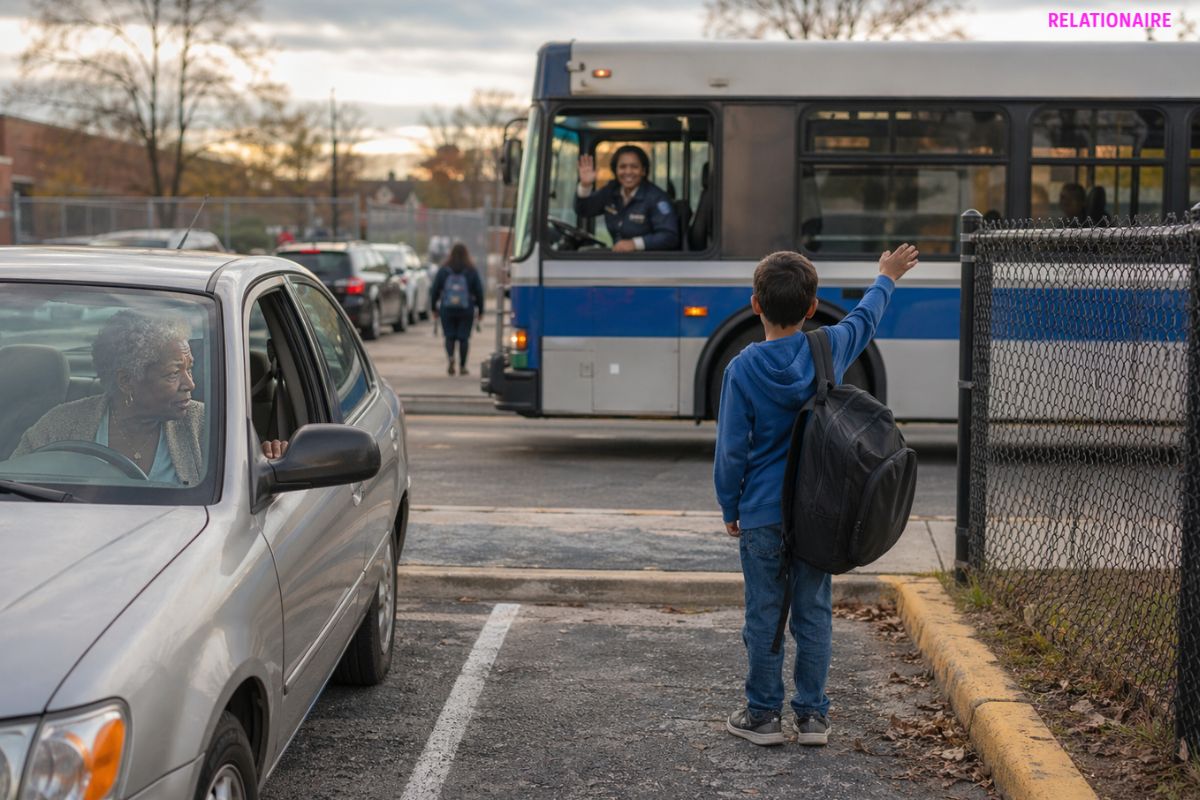
A city bus appeared at the traffic light.
Blue and white. Route 14.
It slowed as it reached the corner by the school.
Noah’s whole body changed.
He lifted his hand.
Not a big wave.
A small one.
The kind children give when they are not sure they are allowed to hope too much.
Ruth followed his gaze.
The bus rolled forward, rain streaking the windows. Faces blurred behind the glass. A woman in a dark driver’s jacket sat behind the wheel, one hand steady on the turn, the other lifting just slightly from the steering wheel.
Just enough to wave back.
Ruth’s breath stopped.
Because she knew that hand.
She knew the silver ring on it.
She knew the way those tired shoulders bent forward like they had been carrying more than a bus full of strangers.
“Elena?” Ruth whispered.
Noah smiled then.
For one second, he was not the difficult child at pickup.
He was a little boy being seen by his mother.
The bus kept moving.
Noah’s hand stayed raised until it disappeared down the road.
Ruth stood frozen in the rain.
Ms. Bell said nothing.
Noah wiped his sleeve under his nose and finally turned toward the car.
“I’m ready now,” he said.
Ruth could barely speak.
All those Fridays.
All that waiting.
All the times she had thought he was trying to make her feel unwanted.
She looked at the road where the bus had vanished, then back at her grandson.
“Noah,” she said, her voice unsteady, “how long has your mother been doing that?”
He looked down at his shoes.
Then he said the line that made Ruth’s heart fold in half.
“Since she promised she’d never miss pickup.”
PART 2
Ruth did not drive home right away.
She sat behind the wheel with both hands resting in her lap while Noah buckled himself into the back seat.
The rain made little tapping sounds on the roof.
Noah looked out the window in the direction the bus had gone.
He was smiling to himself.
Not a happy smile exactly.
A safe one.
That hurt Ruth worse.
“Does she pass here every Friday?” Ruth asked.
Noah nodded.
“What time?”
“Three twenty-one.”
Ruth looked at the dashboard clock.
3:23.
He knew the exact minute.
Of course he did.
Children remembered the times adults almost made it. They built their little hearts around them.
Ruth swallowed. “Why didn’t you tell me?”
Noah shrugged. “Mom said not to make Grandma worry.”
That sounded like Elena.
Always carrying a full basket and then apologizing if anyone noticed it was heavy.
Ruth backed out of the parking space slowly.
The car was quiet all the way to Elena’s apartment, except for the heater blowing warm air against the windshield.
Noah held a crumpled drawing in his lap.
Ruth noticed it when they stopped at a red light.
It was done in blue crayon. A city bus. A tiny boy beside a yellow curb. A woman with long dark hair in the front window.
Under it, in crooked letters, he had written:
FRIDAY MOMMY
Ruth stared at it too long.
The car behind her honked.
She drove.
Elena’s apartment was on the second floor of a brick building where the hallway always smelled like laundry detergent and someone’s dinner. Ruth used her spare key because Elena would not be home until after seven.
The apartment was clean in the way exhausted people kept homes clean.
Not decorated.
Managed.
Dishes drying in the rack. A folded blanket on the couch. Noah’s school papers stacked under a magnet shaped like a strawberry. A pair of Elena’s work shoes by the door, the soles worn thin on one side.
Noah dropped his backpack by the table and went to wash his hands.
Ruth stood in the kitchen and looked around as if she had never been there before.
She had been so busy worrying about the unpaid bills and the too-small jacket and the half-empty fridge shelf that she had missed the love hiding in plain sight.
On the counter sat a lunch bag.
Inside were two crackers, an apple with one bite taken out of it, and a folded napkin.
Ruth opened the napkin.
A note was written in Elena’s hurried handwriting.
I saw you yesterday when you waved with both hands. Best part of my day. Love, Mom.
Ruth pressed the napkin flat with trembling fingers.
Noah came back into the kitchen.
He saw the note in her hand and froze.
“Grandma?”
Ruth turned. “She writes you notes?”
He nodded carefully. “Sometimes. When she has paper.”
“How many?”
He hesitated.
Then he went to his bedroom.
Ruth followed.
His room was small. A twin bed against the wall. A plastic dinosaur on the windowsill. A stack of picture books from the library.
Noah knelt beside his bed and pulled out a shoebox.
It was an old shoe box Ruth recognized.
Elena’s work shoes had come in it.
Noah lifted the lid.
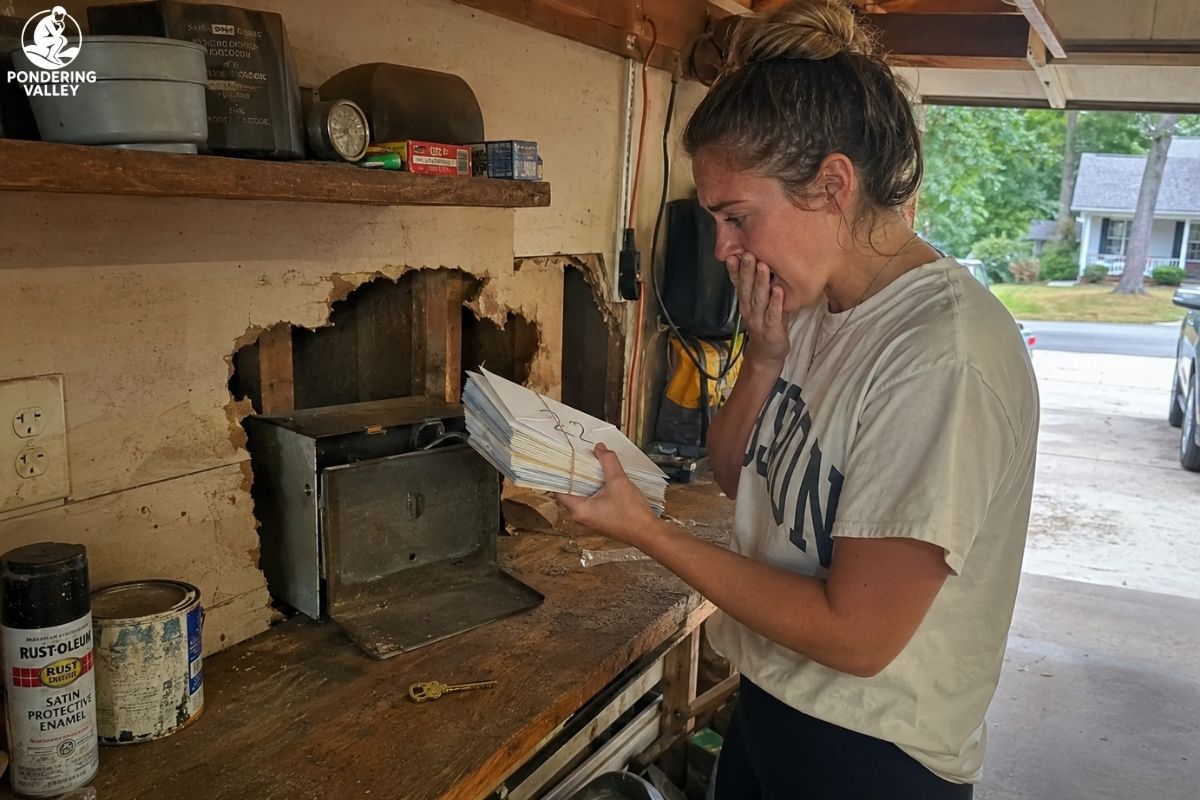
Inside were napkins, bus transfers, sticky notes, grocery receipts, and tiny scraps of paper. Some had hearts drawn on them. Some had only a few words.
I love your brave face.
I packed the orange one because you said it tastes like sunshine.
I’m sorry I missed bedtime. I kissed your forehead when I got home.
Friday wave soon.
Ruth sat on the edge of the bed.
She did not ask permission.
Her knees simply gave out.
Noah touched the edge of the box like it was treasure.
“She says these are proof,” he said.
“Proof of what?”
“That she didn’t forget me.”
Ruth covered her mouth.
The shame came so quickly it made her dizzy.
She had watched her daughter become thinner, quieter, harder to reach. She had judged her in little private ways.
Why didn’t Elena ask for help sooner?
Why take so many shifts?
Why promise a child things she could not do?
Why let him stand in the rain?
But now Ruth saw the answer.
Because Elena was trying to give Noah something she could not afford to lose.
Trust.
Even if all she could give was a wave through a bus window.
That night, Ruth stayed until Elena came home.
Noah had fallen asleep on the couch with his cheek pressed to the blanket. Ruth had carried him to bed, tucked him in, and stood there longer than necessary, looking at his small hand curled around one of the notes.
At 7:42, Elena came through the door.
Her hair was pulled back badly, loose pieces stuck to her face. Her uniform jacket was damp at the shoulders. She carried a plastic grocery bag with milk, bread, and a small pack of chicken marked with a discount sticker.
She stopped when she saw Ruth at the kitchen table.
“Mama?” she said. “Is everything okay?”
Ruth had planned to be gentle.
She had planned to say she understood now.
But mothers and daughters had old wounds, and sometimes love came out wearing armor.
“Why didn’t you tell me?” Ruth asked.
Elena set the bag down slowly. “Tell you what?”
“That you’ve been driving past the school every Friday.”
Elena closed her eyes.
For a second, she looked like a child caught doing something wrong.
Ruth hated that.
“I saw him wave at you.”
Elena gripped the back of a chair.
“He wasn’t supposed to make you wait long.”
“He stands there in the cold, Elena.”
“I know.”
“In the rain.”
“I know.”
“You made him think that was pickup?”
Elena’s face tightened. “No. I made him know I was trying.”
Ruth stood. “You should have told me.”
“So you could tell me it wasn’t enough?”
The apartment went silent.
The words landed hard because they were not unfair.
Ruth looked away first.
Elena rubbed both hands over her face.
“I didn’t mean that.”
“Yes, you did,” Ruth said quietly.
Elena’s shoulders dropped.
Then, for the first time in months, she stopped pretending she was fine.
“I can’t be at the curb anymore,” she said. “My shift changed after the routes got cut. If I say no, they give the hours to someone else. If I lose the hours, we lose the apartment.”
Ruth said nothing.
Elena kept going, voice cracking but controlled.
“Noah cried the first Friday you picked him up. Not because of you. Because he thought I forgot. He kept saying, ‘You promised.’”
She pressed her knuckles to her mouth.
“I was two blocks away at a red light in a bus full of people, and I could see the school sign. I couldn’t stop. I couldn’t leave the route. I couldn’t get out. So I called the dispatcher and begged him to let me stay on Route 14 on Fridays.”
Ruth’s eyes burned.
“He said it would cost me my lunch break.”
Elena gave a small, humorless laugh.
“So I said yes.”
Ruth looked at the lunch bag on the counter.
Two crackers.
An apple with one bite gone.
Elena saw her looking.
“Mama, don’t.”
But Ruth had already understood.
Every Friday, her daughter gave up her break so the bus would pass the school at the exact minute her son needed to be seen.
Not hugged.
Not picked up.
Just seen.
“Elena,” Ruth whispered.
Elena shook her head. “He doesn’t need to know all that. He’s six.”
“He already knows more than you think.”
Elena’s face changed.
“What do you mean?”
Ruth walked to the bedroom and returned with the shoebox.
Elena stared at it.
Her lips parted.
Noah stood in the hallway behind her, barefoot, holding his blanket.
No one had heard him wake up.
His eyes were fixed on his mother.
“What don’t I need to know?” he asked.
Elena turned slowly.
Ruth set the shoebox on the table.
And for once, no one in that little kitchen knew how to protect anyone from the truth.
PART 3
Elena knelt so fast one knee hit the kitchen floor.
Noah stood in the hallway, small and pale in his dinosaur pajamas, clutching his blanket under his chin.
“Baby,” Elena said softly, “you should be sleeping.”
“What don’t I need to know?”
His voice was not angry.
That made it worse.
It was careful.
Like he was afraid the answer might break something.
Elena looked at Ruth, then back at him.
For years, Ruth had believed mothers should hide the worst of life from children. Keep bills turned facedown. Smile over empty cupboards. Say “everything’s fine” until the room believed it.
But looking at Noah, she wondered if children were hurt more by the silence.
Maybe they filled it with their own little fears.
Maybe they thought they were the reason everyone was tired.
Elena held out her arms.
Noah walked into them.
She wrapped herself around him right there on the kitchen floor, one hand cupping the back of his head.
“I didn’t want you to worry,” she said.
“I already worry.”
Elena closed her eyes.
Ruth turned toward the sink, pretending to rinse a cup that was already clean.
Noah pulled back just enough to see his mother’s face.
“Do you not eat lunch because of me?”
Elena’s face crumpled.
Only for a second.
Then she tried to fix it, the way parents do when they forget children have already seen the crack.
“No, sweetheart.”
Noah looked at the lunch bag.
Elena followed his eyes.
The lie died there.
She took a breath.
“Sometimes I eat later,” she said.
“That’s not lunch.”
A tiny smile tugged at Elena’s mouth through tears. “No. I guess it isn’t.”
Noah looked down at his blanket.
“I thought if I didn’t wave, you’d think I didn’t need you.”
Elena made a sound Ruth had never heard from her daughter before.
Not a sob.
Not quite.
More like pain finally finding a door.
“Oh, Noah.”
“I need you,” he said.
“I know.”
“I need Grandma too.”
Ruth stopped rinsing the cup.
Noah turned his head toward her.
“I just wait because Mom comes by.”
Ruth dried her hands slowly.
Her throat felt thick.
“I know now,” she said.
“I wasn’t being bad.”
“No,” Ruth whispered. “You weren’t.”
She crossed the kitchen and crouched beside them.
Her knees protested, but she ignored them.
“I thought you were mad at me,” she said. “I thought you didn’t want to come with me.”
Noah shook his head. “You drive slower than Mom.”
Despite everything, Elena laughed.
Ruth laughed too, wiping under one eye.
The sound was small, but it changed the room.
Elena pulled them both in.
For a moment, three generations sat on the kitchen floor under the buzzing light, surrounded by discount groceries, school papers, damp shoes, and all the things love had been trying to do without enough money or time.
The next Friday, Ruth arrived at school ten minutes early.
She brought a heavier jacket for Noah. Navy blue, with a zipper that stuck a little at the top. She had found it on sale and sewn his name inside with thread from her old sewing tin.
When the bell rang, Noah came out with his class.
He saw Ruth and smiled.
Not politely.
Really.
She helped him into the jacket, then walked with him toward the far end of the parking lot.
He looked up at her. “We can wait?”
“We can wait.”
The sky was clear that day, washed pale after rain. Children called to each other across the lot. A crossing guard lifted one hand to stop traffic.
Ruth stood beside Noah at the yellow curb.
For the first time, she saw what he saw.
Not a delay.
Not defiance.
A window of love moving through the city on a schedule.
At 3:21, Route 14 turned the corner.
Noah stood taller.
Ruth raised her hand too.
The bus slowed just enough.
Behind the glass, Elena saw them.
Her mouth opened in surprise.
Then she smiled so hard Ruth had to look away.
Noah waved with both hands.
Ruth waved with one.
Elena lifted her fingers from the steering wheel for one brief second.
Three waves.
One family.
Separated by glass, traffic, work, worry, and everything life had placed between them.
Still connected.
The bus moved on.
Noah watched until it disappeared, then slipped his hand into Ruth’s.
“I’m ready now,” he said.
This time, Ruth did not hurry him.
That evening, she showed up at Elena’s apartment with two grocery bags and no speech.
Elena opened the door and frowned. “Mama, I told you I don’t need—”
“I know what you told me.”
“Mama.”
Ruth walked past her and put the bags on the counter.
Chicken. Rice. Apples. Peanut butter. Bread. A thermos for Elena’s lunch. A small pack of chocolate pudding cups because Noah loved them and Ruth had decided childhood should still have pudding sometimes.
Elena stared at the bags.
Her pride rose first. Ruth could see it.
Then exhaustion.
Then something softer.
“I can pay you back,” Elena said.
“No.”
“I don’t want to owe you.”
Ruth turned to her daughter.
“You don’t owe me for being your mother.”
Elena looked down.
Ruth stepped closer.
“And I’m sorry.”
Elena’s eyes lifted.
Ruth had said sorry before in her life, but usually with explanations attached.
This time, she gave none.
“I saw you struggling,” Ruth said. “And I thought help meant telling you what you should have done. I should have stood closer. I should have listened sooner.”
Elena’s face tightened.
“Mama, I didn’t make it easy.”
“No,” Ruth said gently. “But you shouldn’t have had to earn help by falling apart.”
Elena covered her mouth.
Noah came from his bedroom holding the shoebox.
He set it on the table.
“I made a new one,” he said.
Inside was a fresh folded paper.
Elena opened it.
It was a drawing of a bus, a grandmother’s blue car, and a little boy between them.
Above the bus window, he had drawn his mother.
Above the car window, he had drawn Ruth.
Underneath, in big crooked letters, he had written:
BOTH PICKUPS
Elena pressed the paper to her chest.
Ruth sat down before she started crying again.
Over the next months, Friday became their ritual.
Ruth brought a thermos of soup for Elena and handed it to her at the bus depot after her shift. Noah kept waving at 3:21. Sometimes Ms. Bell waved too from the school steps.
On cold days, Ruth wrapped Noah’s scarf twice around his neck.
On rainy days, they stood under one umbrella, his little shoulder pressed against her coat.
On days Elena looked especially tired behind the glass, Ruth would send a message after.
We saw you. He smiled all the way home. Eat your soup.
Elena always replied when she could.
Best part of my day.
Spring came slowly.
The trees near the school grew new leaves. The parking lot smelled like wet pavement and warm grass. Noah’s navy jacket became too warm, so Ruth carried it instead, folded over one arm like something precious.
Then one Friday, the bus did not come at 3:21.
Noah stood at the curb.
Ruth checked her phone.
Nothing.
At 3:24, Noah’s hand found hers.
At 3:26, his chin began to tremble.
Ruth crouched. “She’ll come if she can.”
“What if she forgot?”
Ruth put both hands on his shoulders.
“Noah, listen to me. Your mother has never forgotten you. Not once. Sometimes the bus is late. Sometimes grown-up things get in the way. But forgetting is not what this is.”
He stared at her, breathing hard.
Ruth realized she was saying it to both of them.
To the little boy.
To the daughter she had misread.
To the mother she had been years ago, trying to survive and still make love visible.
At 3:29, Route 14 appeared around the corner.
Noah gasped.
The bus pulled to the light.
Elena leaned toward the window and held up a piece of paper.
The words were big enough to read from the curb.
I’M HERE.
Noah laughed out loud.
Not a small laugh.
A child’s laugh.
Full and bright and free.
Ruth felt it move through her like forgiveness.
Elena waved.
Noah waved.
Ruth waved.
And when the bus pulled away, Noah did not look broken by the leaving.
He looked held by the coming.
That was the thing Ruth learned in that parking lot.
Children do not always need perfect parents at the curb.
Sometimes they need a tired mother behind glass, fighting the clock just to be seen.
Sometimes they need a grandmother willing to stop judging and stand beside them in the rain.
Sometimes love is not a grand rescue.
Sometimes it is a bus passing at 3:21.
A hand lifted through a window.
A little boy waiting because he knows someone is trying.
And a family finally understanding that showing up does not always look the way we expected.
Sometimes it looks smaller.
Quieter.
Harder.
But when it is love, children know.
They always know.