If you’ve already read part 1 of this story on Facebook, go here for Part 2!
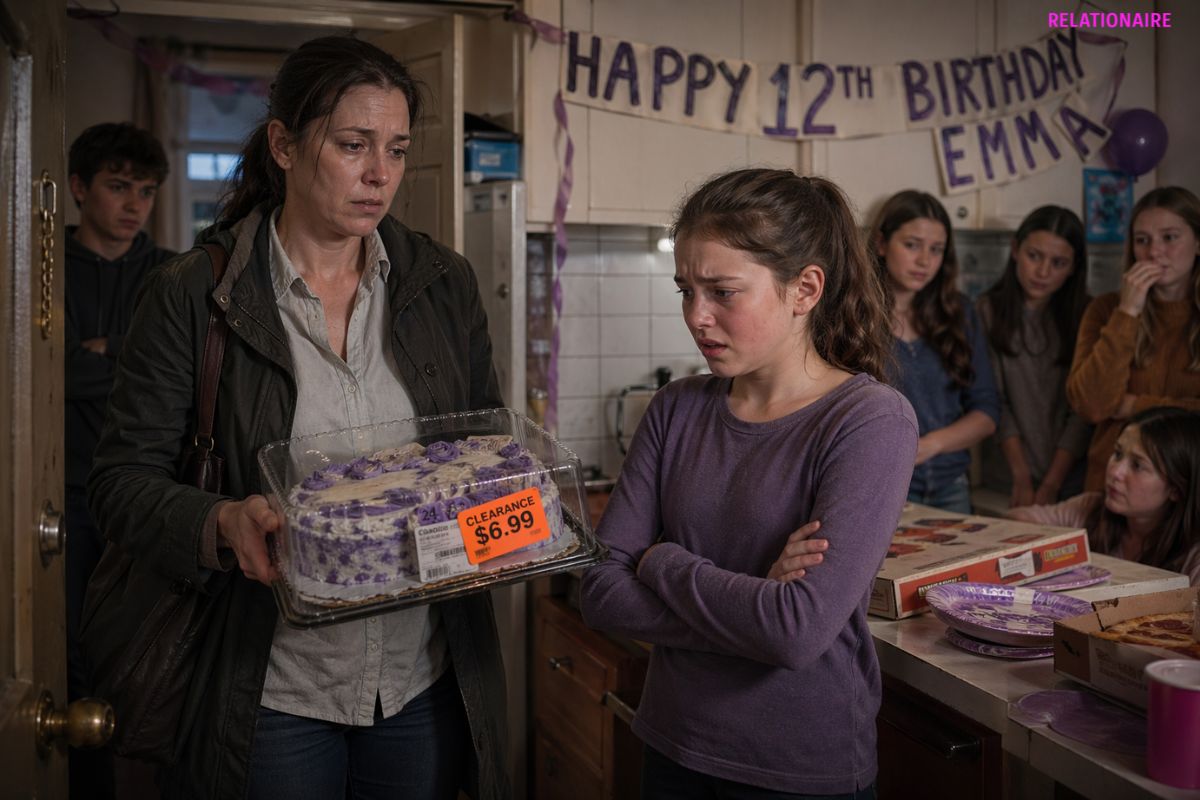
The first thing Emma saw was the sticker.
Not the frosting.
Not the pink plastic flowers sliding down one side.
Not even the way the cake leaned in the box like it had given up before the party started.
She saw the bright orange sticker in the corner.
CLEARANCE — $6.99
And for one awful second, with six girls from school standing in her mother’s kitchen, Emma wished her mom had not come home at all.
“Surprise,” her mother said softly.
She was standing in the doorway with her purse slipping off one shoulder, her hair pulled back too tight, her work shirt wrinkled under her coat. One hand held the bakery box. The other held a pack of birthday candles from the dollar store.
Emma’s friends turned around.
Madison, who had the perfect bedroom and the perfect birthday sleepovers and a mother who knew how to order balloon arches, looked at the cake first.
Then at Emma.
Then at the sticker.
Nobody laughed.
That almost made it worse.
Emma felt her cheeks burn so hot she thought everyone could see it. She had talked about this birthday for weeks. Not a huge party. Not anything crazy. Just pizza, music, and the custom cake she had shown her mom three times on her phone.
White icing.
Gold stars.
A little blue butterfly in the corner.
Her name written in pretty letters.
Her mother had nodded every time.
“I’ll figure it out,” she’d said.
But here she was, standing in the doorway at 5:37 p.m., thirty-seven minutes late, holding a lopsided clearance cake with purple roses and someone else’s name scraped off badly enough that Emma could still see the ghost of the letters underneath.
Maybe it had said Happy Birthday Linda.
Maybe it had said Congratulations.
It didn’t matter.
It wasn’t hers.
“Mom,” Emma whispered, but it came out sharp.
Her mother’s smile flickered.
“I know it’s not exactly—”
“You said you ordered it.”
The kitchen got quiet.
The pizza boxes sat open on the counter. Paper plates with gold rims from the party pack were stacked beside the sink. A banner her brother had taped crookedly above the cabinets said HAPPY 12TH BIRTHDAY EMMA, but the Y had already fallen halfway down.
Emma’s older brother, Caleb, stood near the fridge with a two-liter bottle in his hand. He was sixteen, tall and quiet, with the kind of face that always looked like he knew something but was too tired to say it.
“Em,” he said under his breath.
She ignored him.
Her mother set the cake gently on the table, as if it were something fragile instead of something embarrassing.
“They didn’t have the one I wanted,” Mom said.
That was what she always said.
They didn’t have it.
The store was out.
The car needed gas.
The check hadn’t cleared yet.
Next time.
Always next time.
Emma stared at the sticker.
“Couldn’t you have taken that off?”
Her mother looked down.
For the first time, she seemed to notice it.
“Oh,” she said quietly.
Just one word.
She reached for the sticker with her thumb, but it tore halfway and left a sticky orange strip on the plastic window.
Madison pressed her lips together.
Ava looked at her shoes.
Sophie whispered, “It’s fine,” but in a voice that meant it wasn’t.
Emma wanted the floor to open.
She wanted to grab the cake and throw it away.
She wanted her mother to understand that middle school was a place where tiny things became huge, where a clearance sticker could follow you until Monday, where girls remembered what your mother couldn’t afford and smiled about it in the lunch line.
Instead, her mother just stood there with that tired look.
The one Emma hated most.
Not angry.
Not sorry enough.
Just tired.
“Let’s light the candles,” Mom said.
Emma let out a small laugh, but it didn’t sound like a laugh.
“You’re serious?”
Her mother’s face changed then. Not a lot. Just enough.
“Emma.”
That was the warning voice.
The mother voice.
The voice that said: don’t do this in front of people.
But Emma was already doing it. She could feel herself doing it and couldn’t stop.
“You didn’t even care,” she said.
Her mother went still.
Caleb’s eyes snapped to her.
“Emma,” he said again, harder this time.
But she kept going, because her chest hurt and her face was hot and Madison was standing right there watching her entire life look cheap.
“You knew this mattered to me,” Emma said. “You knew. And you still brought that.”
Nobody moved.
The refrigerator hummed.
A candle rolled off the table and hit the floor.
Her mother looked down at the cake box. At the torn sticker. At the purple flowers sliding into the frosting.
Then she looked at Emma.
“I’m sorry,” she said.
That should have made Emma feel better.
It didn’t.
It made her angrier.
Because sorry did not fix the cake. Sorry did not erase the sticker. Sorry did not make her mom show up on time, with the right thing, like other mothers did.
Emma folded her arms.
“I don’t want it.”
Her mother blinked.
“What?”
“I said I don’t want it.”
“Em, it’s still cake,” Caleb said quietly.
“I don’t care.”
Her mother swallowed. Her fingers tightened around the little pack of candles until the cardboard bent.
For a second, Emma thought she might cry.
Instead, Mom nodded once.
“Okay,” she said.
She picked up the cake.
That was somehow worse.
“Where are you going?” Caleb asked.
“To put it away.”
Her voice was calm, but her hands were shaking.
She carried the cake to the fridge and made room beside a carton of eggs and a jar of pickles. Emma watched her shove aside a plastic container of leftover rice and slide the box in carefully, like even now she didn’t want to ruin it.
Then Mom turned back to the girls and smiled.
It was a terrible smile.
“Pizza first, then,” she said.
No one cheered.
The rest of the party moved like a song playing too slow.
They ate pizza. They opened gifts. Madison gave Emma a lip gloss set. Ava gave her a bracelet with a tiny silver moon. Sophie made her a handmade card with stickers on the front.
Emma smiled at all the right times.
Her mother stayed in the kitchen most of the evening, cleaning things that were not dirty.
When the girls played music in the living room, Mom wiped the counter.
When they took photos near the crooked banner, Mom stood back.
When Caleb carried in the old speaker from his room and made a big show of taking requests, Mom laughed once, very softly, from the sink.
Emma pretended not to hear it.
At 8:15, Madison’s mom came first.
She wore perfume and a cream-colored coat and said, “Cute party,” in a voice that made Emma want to disappear all over again.
By 8:40, the apartment was quiet.
Ava’s glittery gift bag sat folded on the chair. Empty paper cups lined the counter. The banner had finally fallen on one side and hung over the stove like it was tired too.
Emma went to her room without saying goodnight.
She changed into pajamas and sat on the edge of her bed, pulling the bracelet from Ava around her wrist again and again.
She told herself she had been right.
A mother should remember.
A mother should try.
A mother should not make her daughter feel poor in front of everyone.
But a few minutes later, she heard something through the wall.
Not crying.
Worse.
The sound of her mother trying not to cry.
Emma held her breath.
The apartment was small. Sounds traveled. The click of the bathroom door. The faucet running. Her mother blowing her nose once, quickly.
Then silence.
Emma stared at her closed bedroom door.
She almost got up.
Almost.
Then Caleb knocked once and opened it before she answered.
He stood there with his hoodie on and his jaw tight.
“What?” Emma said, wiping at her eyes even though she wasn’t crying.
Caleb stepped in and closed the door behind him.
For a moment, he didn’t say anything.
Then he reached into the pocket of his hoodie and pulled out a folded hospital visitor sticker.
It was crumpled and stuck to itself at the edges.
Emma frowned.
“What is that?”
Caleb looked at her like he had been deciding all night whether to tell her.
Then he said the sentence that made her stomach drop.
“Mom wasn’t late because of the cake, Em.”
PART 2
Emma stared at the hospital sticker in Caleb’s hand.
The room suddenly felt too small.
“What do you mean?” she asked.
Caleb rubbed the back of his neck. He looked older in that moment. Not sixteen. Not her annoying brother who stole fries off her plate and called her dramatic.
Older.
Tired in the same way Mom was tired.
“She was with Grandpa,” he said.
Emma’s fingers stopped moving on the bracelet.
Grandpa.
Their mother’s father.
The man who kept butterscotch candies in his glove compartment and called Emma “kiddo” even though she told him she was almost a teenager now. The man who had missed Thanksgiving because of “a cold” and Christmas because he “didn’t want to spread anything.”
Mom always said it lightly.
Grandpa’s resting.
Grandpa had an appointment.
Grandpa’s just moving slower these days.
Emma had believed her because believing was easier than asking.
“What happened?” Emma whispered.
Caleb sat on the edge of her desk chair. It squeaked under him.
“He got dizzy at the pharmacy. Fell against one of the shelves. The pharmacist called Mom.”
Emma’s throat tightened.
“Is he okay?”
“He’s home now.”
“That’s not what I asked.”
Caleb looked at the floor.
“He scared her.”
Those three words did something to Emma.
They made her remember the way Mom’s hand had shaken around the candle package. The way her smile had looked like tape barely holding something together.
“She left work early,” Caleb said. “Picked him up from the ER. Waited with him for tests. Then took him home, made sure he ate, picked up his medicine, and still tried to get here before your friends did.”
Emma looked toward her bedroom door.
The apartment was quiet now except for water running in the kitchen sink.
“She could’ve told me,” Emma said, but her voice had gone weak.
Caleb gave her a look.
“Would you have wanted that during your party?”
Emma did not answer.
Because she knew.
She would have hated that too.
She would have hated her party becoming about Grandpa. She would have hated everyone asking questions. She would have hated feeling scared in front of Madison, who already had enough ways to make Emma feel small without knowing the family’s private fears.
“She didn’t want you worrying,” Caleb said.
Emma swallowed.
“She said the bakery didn’t have the cake.”
“Yeah.”
“So she lied.”
“She protected your birthday.”
“That was protecting it?”
Caleb’s face tightened.
“She had twenty-two dollars left after Grandpa’s medicine.”
Emma looked at him.
The words landed slowly.
Twenty-two dollars.
The pizza had cost more than that.
The paper plates. The balloons. The soda.
The candles.
“How do you know?” she asked.
“I was there when she counted it in the car.”
Emma’s chest hurt.
A picture came to her without permission.
Mom in the driver’s seat, purse open on her lap, counting bills with tired fingers. Caleb beside her, pretending not to look. The dashboard clock glowing. The grocery store bakery closing soon. Her mother choosing between what her daughter wanted and what she could still give.
“She went to the first bakery,” Caleb said. “The custom cake was there.”
Emma felt a strange ringing in her ears.
“What?”
“It was ready.”
“No.”
“She saw it.”
Emma shook her head, as if shaking could change the shape of the evening.
“It wasn’t there. She said—”
“I know what she said.” Caleb’s voice cracked. “It was there, Em.”
The bracelet slid from Emma’s fingers onto the blanket.
Caleb leaned forward, elbows on his knees.
“It was forty-eight dollars.”
Emma stared at him.
Forty-eight dollars for white icing and gold stars and a blue butterfly.
Forty-eight dollars for the cake she had wanted so badly she had shown Mom the screenshot three times.
Forty-eight dollars might as well have been a thousand.
“She stood there looking at it,” Caleb said. “The lady behind the counter asked if she wanted to take it. Mom just kept staring at your name.”
Emma pressed her palms into her knees.
“What did she do?”
“She asked if they could hold it until tomorrow.”
“They wouldn’t?”
“They said they couldn’t because it had to be paid for.”
Emma closed her eyes.
She saw Mom standing under bright bakery lights, still wearing the hospital visitor sticker on her coat, her phone buzzing with messages from Emma asking where she was.
Mom where are you?
Everyone’s here.
Did you get the cake?
“She walked around the store for ten minutes,” Caleb said. “Like maybe money would appear somewhere.”
Emma’s eyes burned.
“She called Aunt Denise. No answer. Checked her banking app. Declined something. I don’t know what. Then she saw that clearance cake.”
The lopsided one.
The purple one.
The one with someone else’s name badly scraped away.
The one Emma had looked at like proof her mother did not care.
“She picked it up,” Caleb said. “Put it back. Picked it up again. She stood there so long I thought she was going to leave without anything.”
Emma’s voice was barely there.
“Why didn’t you tell me?”
Caleb looked up.
“Because she told me not to.”
That sounded exactly like Mom.
Carry it alone.
Smile anyway.
Don’t make the kids feel the weight.
“She said, ‘Your sister’s twelve. Let her be twelve tonight.’”
Emma covered her face.
The sentence broke something open.
All evening she had wanted to be older. Cool enough. Polished enough. The kind of girl who had the right cake and the right photos and no orange clearance sticker in the corner.
But her mother had been trying to give her something else.
Not a perfect birthday.
A protected one.
Even badly.
Even with frosting sliding down the side.
Caleb stood.
“I’m not saying you can’t be disappointed,” he said. “I get it. It was embarrassing.”
Emma looked up at him.
His eyes were red now too.
“But you said she didn’t care.”
The words sat between them.
Emma remembered Mom’s face when she said it.
Not angry.
Not defensive.
Wounded.
Quietly wounded.
Like those four words had reached a place her mother had no strength left to guard.
“What do I do?” Emma whispered.
Caleb opened the door.
“Start by not making her cry in the bathroom on your birthday.”
It was harsh.
But he did not say it cruelly.
He left her sitting there with the hospital sticker on her desk and the bracelet in her lap.
For a long time, Emma did not move.
Then she got up.
The hallway felt different now. The whole apartment did.
The same narrow walls. The same carpet with the worn patch near the bathroom. The same kitchen light flickering faintly above the table.
But now everything looked like evidence.
The pizza boxes stacked neatly, because Mom hated wasting food.
The dollar store candles sitting unopened near the sink.
Her mother’s purse on the chair, still open, with a pharmacy receipt sticking out.
Emma stepped closer.
She knew she shouldn’t look.
But she did.
The receipt was folded, the print already fading.
Blood pressure medication.
Antibiotics.
A discount applied.
Balance paid in cash.
Under it, tucked into the side pocket of the purse, was the bakery receipt for the custom cake.
Not paid.
Just an order slip.
Emma pulled it out with trembling fingers.
There it was.
Emma — 12th birthday
White icing.
Gold stars.
Blue butterfly.
Pickup time: 4:30 p.m.
Her mother had ordered it.
She had remembered.
Emma felt a sob rise in her chest, but she pressed her lips together.
From the living room came a soft noise.
Her mother was on the couch, still in her work pants, asleep sitting up. Her head had tipped against the cushion. One hand rested open on her lap. The other still held a dish towel.
She looked so small.
Not like a mother who ruined things.
Like a person who had been holding up too much with both hands and still tried to carry a cake across town.
Emma stood there for a long time.
Then she walked to the fridge.
The clearance cake sat on the middle shelf.
The sticker was still half-torn.
The purple roses had slumped more.
Emma took it out carefully and set it on the kitchen table.
She found a butter knife in the drawer.
Slowly, gently, she scraped away the orange sticker residue from the box.
It would not all come off.
Some things didn’t.
Then she opened the lid.
The frosting smelled like sugar and cold air.
Emma looked at the blank spot where someone else’s name had been scraped away.
She found the little tube of icing leftover from decorating cookies at Christmas. It was almost empty and a little hard near the tip.
She squeezed carefully.
The letters came out shaky.
Mom
Then she stopped.
That wasn’t right.
She wiped it away with a napkin and tried again.
This time she wrote:
We saved you a piece.
She put one candle in the center.
Not twelve.
One.
Because one apology was all she had the courage for.
Then Emma went to the living room and stood beside the couch.
“Mom?” she whispered.
Her mother startled awake.
For one second, she looked scared.
Then she saw Emma.
“Baby?” she said, voice rough with sleep. “Are you okay?”
Emma tried to speak.
Nothing came out.
Her mother sat up, instantly alert, already reaching for her.
“What happened?”
Emma looked back toward the kitchen.
Then at her mother’s tired face.
“I saw the receipt,” she whispered.
Her mother’s hand froze in the air.
And for the first time all night, she had no smile ready.
PART 3
Her mother closed her eyes.
Just for a second.
But Emma saw it.
That small surrender.
Like the last thread holding the night together had finally snapped.
“You weren’t supposed to see that,” Mom said.
Emma stood barefoot on the carpet, arms wrapped around herself.
“I know.”
Her mother rubbed her face with both hands. The dish towel slid from her lap to the floor.
“I didn’t want you to know,” she said.
“About Grandpa?”
“About any of it.”
Emma’s throat hurt.
Mom leaned forward, elbows on her knees, looking not at Emma but at the coffee table where someone had left a party napkin with frosting on the corner.
“I wanted you to have one day where you didn’t have to think about bills or hospitals or how tired I am,” she said. “One day where you got to be the girl with the cake she wanted.”
Emma’s eyes filled.
“But I wasn’t.”
Mom looked up.
“No,” she whispered. “And I’m sorry.”
It was the same apology from the kitchen.
But now Emma could hear what was underneath it.
Not excuse.
Not dismissal.
Grief.
“I ordered it two weeks ago,” Mom said. “I put five dollars down because that’s all they required. I thought I’d have enough by today.”
She gave a small, embarrassed laugh without any joy in it.
“I kept moving things around. Gas can wait. Phone bill can wait. Groceries can stretch. I thought I had it handled.”
Emma wiped her cheek.
“You always say that.”
Mom looked at her.
“What?”
“You always say you have it handled.”
Her mother’s face softened.
For a moment, she didn’t answer.
Then she patted the cushion beside her.
Emma hesitated, then sat.
Not close enough at first.
Then closer.
Mom looked down at her hands. They were rough near the knuckles from work, with a tiny cut on one finger.
“When your dad left,” she said carefully, “I promised myself you and Caleb wouldn’t feel like your whole life had changed.”
Emma went still.
They didn’t talk about Dad much.
Not because he was forbidden.
Because there wasn’t much to say that didn’t hurt.
He called on holidays. Sometimes. Sent money when he could. Sometimes. Started over in another state with another life that had space for weekend promises but not school conferences or broken refrigerators.
“I couldn’t stop the divorce from changing things,” Mom said. “But I thought maybe if I worked enough, smiled enough, stretched enough, you wouldn’t feel the missing parts so much.”
Emma looked toward the kitchen.
The cake waited under the flickering light.
“You think we don’t notice?” she asked.
Mom’s eyes glistened.
“I hoped you didn’t.”
Emma almost laughed, but it came out like a sob.
“We notice everything.”
Her mother turned toward her.
Emma pulled her knees up onto the couch.
“I notice when you say you’re not hungry but you make Caleb and me plates. I notice when you don’t buy shampoo for yourself but get me the kind I like. I notice when you sit in the car before coming inside.”
Mom’s mouth trembled.
“I thought I was hiding that.”
“You’re not very good at hiding,” Emma whispered.
Mom let out one shaky breath.
Then another.
“I didn’t want you to feel like a burden.”
The word hit Emma hard.
Because that was the secret ache she had never named.
Every time Mom counted coupons at the kitchen table.
Every time Caleb needed shoes and said his old ones were fine.
Every time Emma wanted something simple and watched Mom’s smile pause before she said, “We’ll see.”
A burden.
That was what Emma had feared she was.
“I don’t want a cake if it makes you cry in the bathroom,” Emma said.
Her mother broke then.
Not loudly.
Just one hand over her mouth, shoulders bending forward, tears slipping through fingers she had used all night to clean and carry and pretend.
Emma moved without thinking.
She wrapped her arms around her mother’s waist and held on.
For a second, Mom stayed stiff, like she didn’t know how to be comforted by the child she was supposed to comfort.
Then she folded around Emma.
“I’m so sorry,” Mom whispered into her hair.
Emma shook her head.
“I’m sorry too.”
They stayed like that until Caleb appeared in the hallway.
He looked at them, then at the kitchen.
“Is this a private crying thing or a family crying thing?”
Emma laughed through tears.
Mom did too.
It was small, but it changed the room.
Caleb walked over and sat on the other side of Mom, bumping her shoulder with his.
“She knows,” he said.
Mom gave him a tired look.
“You told her?”
“She needed to know.”
“I told you not to.”
“I know.”
Mom sighed, but there was no anger in it.
Just exhaustion. And love. And maybe a little relief.
Emma wiped her face with her sleeve.
“Grandpa’s okay?”
Mom nodded slowly.
“For tonight. He needs more tests. But he’s home. He asked about you.”
“He did?”
“He wanted to know if the cake had the butterfly.”
Emma’s face crumpled.
Mom reached for her hand.
“I told him yes.”
Emma looked at her mother.
Mom gave a helpless little shrug.
“I couldn’t tell him I left it there.”
Caleb stood.
“Okay. Enough couch sadness. We still have cake.”
Emma’s stomach twisted.
“You don’t have to eat it,” Mom said quickly.
But Emma stood too.
“I want to.”
In the kitchen, the cake looked even worse than before.
The purple roses had collapsed into soft, sugary puddles. The scraped spot was messy. Emma’s shaky icing words leaned to one side.
We saved you a piece.
Mom saw it and covered her mouth.
“Oh, Emma.”
“I tried to fix it,” Emma said.
“You did.”
“It still looks bad.”
Mom laughed quietly.
“It looks perfect.”
Caleb found three forks because nobody wanted to wash plates. Emma put the single candle back in the center and lit it.
The flame wobbled.
The three of them stood around the clearance cake in their tiny kitchen, under the half-fallen birthday banner, with crumbs on the counter and unpaid bills in a purse and a hospital sticker still on Emma’s desk.
It was not the birthday photo Emma had wanted.
No gold stars.
No blue butterfly.
No perfect letters.
But when Mom slipped one arm around Emma’s shoulders and Caleb leaned into both of them like he was too cool to admit he needed the hug too, Emma wished someone could take a picture.
Not for Madison.
Not for school.
For later.
For the days she might forget.
“Make a wish,” Mom said.
Emma looked at the candle.
At her brother.
At her mother.
Then she closed her eyes.
She wished Grandpa would be okay.
She wished Mom would stop carrying everything alone.
She wished she could take back the words from the kitchen.
Then she blew out the candle.
They ate the cake straight from the box.
It was too sweet.
A little dry at the edges.
The frosting stained Caleb’s tongue purple, and he stuck it out until Emma laughed for real. Mom took the smallest piece, so Emma cut a bigger one and put it on her napkin without asking.
Mom looked at it.
Then at Emma.
And this time, she didn’t argue.
The next afternoon, they drove to Grandpa’s apartment with the last piece of cake in a plastic container.
Grandpa sat in his recliner wearing pajama pants and a cardigan, looking thinner than Emma remembered but smiling the second he saw her.
“There’s my birthday girl,” he said.
Emma walked straight to him and hugged him carefully.
He smelled like peppermint and medicine and the old aftershave he wore to church.
“I saved you cake,” she whispered.
He patted her back.
“Best kind.”
Mom stood by the door with her arms folded, watching them.
For once, she didn’t look like she was rushing to the next problem.
Grandpa opened the container and squinted at the frosting.
“Purple,” he said. “Fancy.”
Emma laughed.
“It was on clearance.”
The room went quiet for half a beat.
Then Mom looked down.
Emma crossed the room and took her hand.
“But she still brought it,” Emma said.
Mom squeezed her fingers.
Grandpa nodded slowly, like he understood more than cake.
“That’s the part people miss,” he said. “They see what someone couldn’t give. Not what they carried to give anything at all.”
Emma never forgot that.
Years later, she would remember plenty of birthdays.
Some nicer.
Some with better cakes.
Some with photos where everyone smiled at the right time.
But the one that stayed was the lopsided cake from the clearance rack.
The torn sticker.
The single candle.
Her mother’s tired hand in hers.
Because sometimes love does not arrive looking the way you hoped.
Sometimes it comes late.
Wrinkled.
Embarrassed.
Holding the best it could afford.
And if you are lucky, one day you learn to see the gift before all you notice is the sticker.