If you’ve already read part 1 of this story on Facebook, go here for Part 2!
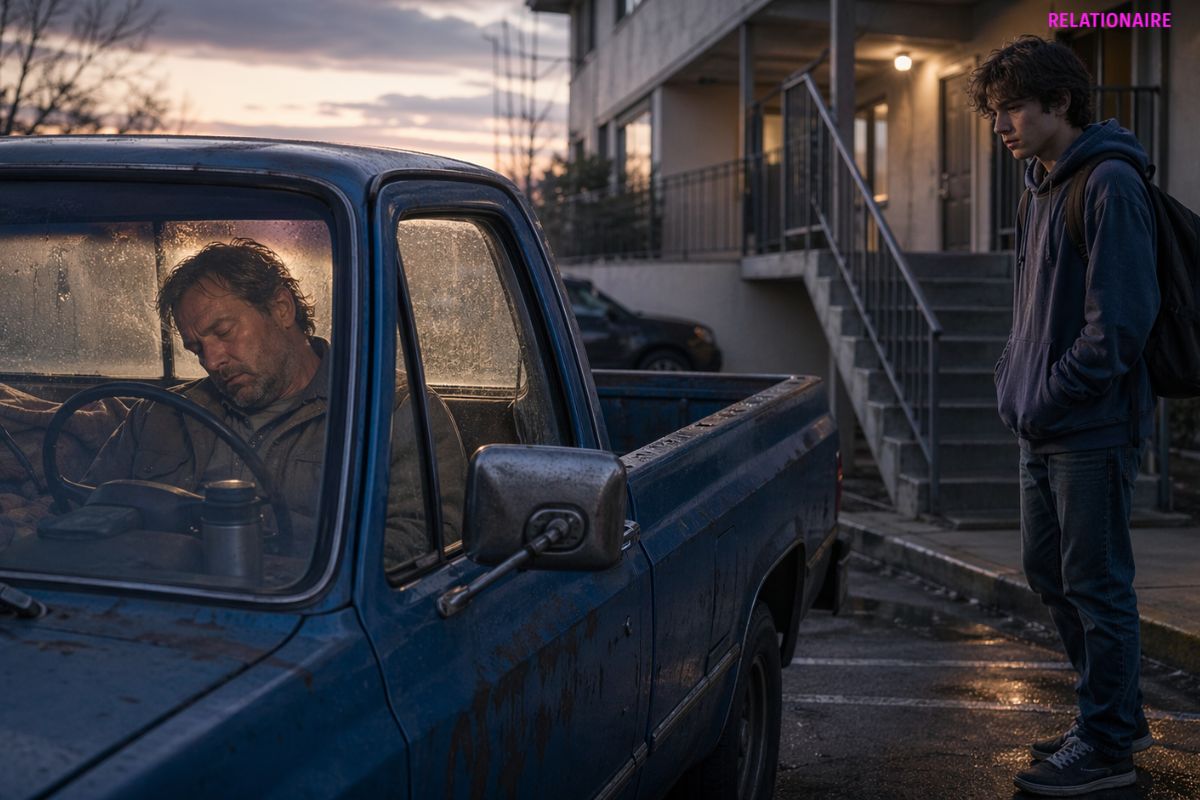
The first time Caleb told someone his dad had left, his father was sitting thirty feet away in an old blue pickup, asleep with his mouth open and one hand still wrapped around a paper coffee cup.
Caleb saw him through the glass doors of the apartment lobby.
So did Jaden from biology.
And because fourteen-year-old boys are cruelest when they are scared of being embarrassed, Caleb looked away and said, “Yeah. He doesn’t live with us anymore.”
Jaden glanced toward the truck.
“Seriously?”
Caleb tightened the strap on his backpack. “Yeah.”
His father’s name was Mark, but everyone in Building C knew him as the man in the pickup.
The truck had a dented front bumper, one missing hubcap, and a towel folded behind the driver’s seat like a pillow. Every morning before school, it was parked under the dying maple tree by the curb. Sometimes the engine was running. Sometimes it wasn’t. Sometimes Caleb came down and found his dad’s forehead resting against the steering wheel.
That was the part Caleb hated most.
Not the divorce.
Not the apartment with thin walls.
Not the fact that his mother had moved three hours away after the custody hearing and only called when she remembered it was Sunday.
It was walking outside in front of other kids and seeing his father looking like a man who had been forgotten somewhere.
“Get in,” Mark would say, blinking hard, voice rough from sleep.
Caleb would climb into the passenger seat without looking at him.
There was always something in the truck that made him angry.
A gas station breakfast wrapper.
A grocery receipt tucked near the gearshift.
A folded blanket.
An extra work shirt hanging from the back window.
A smell of old coffee and cold air and the cheap cinnamon gum his father chewed when he was trying not to fall asleep.
“You eat?” Mark asked one morning.
Caleb stared out the window. “I’m not hungry.”
Mark reached behind the seat and pulled out a brown paper bag anyway.
“Peanut butter. Apple. One of those granola bars you like.”
“I said I’m not hungry.”
Mark set the bag carefully on Caleb’s lap.
“You don’t have to eat it now.”
Caleb wanted to throw it back at him. Not because of the sandwich. Because of the bag. Because his father had written CALEB on it in block letters, like he was still in kindergarten.
At the red light, Caleb shoved the bag into his backpack.
“Can you stop parking right in front of the building?” he muttered.
Mark looked over. “What?”
“Nothing.”
“No, say it.”
Caleb’s face burned. “People see you.”
Mark’s fingers tightened on the steering wheel.
The light turned green, but he didn’t move until the car behind them honked.
“People see me driving my son to school,” Mark said.
“That’s not what they see.”
The truck went quiet except for the rattle in the heater.
Mark pulled into the school drop-off line behind a row of clean SUVs and minivans with school magnets on the back windows. Mothers leaned over seats to kiss cheeks. Fathers handed out water bottles. Kids laughed, slammed doors, ran toward friends.
Caleb waited until they were still half a block from the entrance.
“Let me out here.”
“It’s raining.”
“It’s not raining that hard.”
Mark didn’t argue. He eased the truck to the curb.
Caleb got out, then leaned back in only because his backpack strap had caught on the door handle.
Mark held up the lunch bag.
“You forgot this.”
Caleb saw two girls from his English class walking past.
He took the bag fast and stuffed it under his jacket.
“Thanks,” he said, but not warmly.
Mark heard it.
Caleb saw that he heard it.
For one second, his father looked older than he had the day before.
Then he nodded. “Have a good day, bud.”
Caleb hated when he called him that in public.
By lunchtime, the story had already changed.
Jaden told someone Caleb’s dad was living in his truck.
Someone else said his dad got kicked out.
Someone else said he was probably drinking.
Caleb heard the whispers before last period.
By the time he reached the hallway, he had decided what was easier.
“My dad left,” he told Mia Turner at his locker, because Mia had kind eyes and an even kinder silence.
She frowned. “I’m sorry.”
Caleb shrugged like it was nothing. “It’s better that way.”
He did not tell her his father still made his lunch.
He did not tell her his father waited every afternoon under the same maple tree, no matter how tired he looked.
He did not tell her that sometimes, when Caleb came out late from practice, his father was asleep so deeply Caleb had to knock on the window to wake him.
That Friday, Caleb had a parent-teacher conference.
He hadn’t told his father.
He told himself it was because Mark would be too tired.
But really, it was because the last thing Caleb wanted was his dad walking into school in the same wrinkled jacket he slept in.
At 4:15, Caleb sat outside the conference room while Mrs. Alvarez, his history teacher, spoke with other parents. Caleb had failed two assignments and snapped at a substitute. Nothing dramatic. Just enough to make adults use quiet voices.
He watched parents walk in one by one.
A mother in scrubs.
A grandfather with a cane.
A father still wearing a hardware store vest.
At 4:28, Mark turned the corner.
Caleb’s stomach dropped.
His father was wearing jeans, work boots, and a navy jacket with SECURITY printed in faded white letters over the chest.
His hair was wet like he had tried to wash up in a sink. There was a red crease on his cheek from sleeping against something hard.
“What are you doing here?” Caleb whispered.
Mark looked confused. “Your teacher emailed me.”
“You didn’t have to come.”
“I’m your father.”
Caleb stood up fast. “You can’t just show up like this.”
Mark looked down at his jacket, then back at Caleb.
“Like what?”
Caleb’s voice cracked, which made him angrier.
“Like this. Like you slept in your truck again. Like everyone doesn’t already know.”
Mrs. Alvarez opened the conference room door.
“Mr. Reyes?”
Mark turned toward her, polite even when his face had gone pale.
“Yes, ma’am.”
Caleb stepped closer to him, whispering through his teeth.
“People think you’re homeless.”
Mark blinked.
Something moved across his face.
Not anger.
Not shame, exactly.
Pain that tried to stay quiet.
Mrs. Alvarez pretended not to hear. “You can both come in.”
But Caleb couldn’t stop now.
All the whispers, all the stares, all the mornings of seeing his father curled in the truck like a stranger finally came out at once.
“Why don’t you just go home?” Caleb said.
The hallway went still.
Mark stared at him.
Then his father said one sentence so softly Caleb almost didn’t catch it.
“I would, son. But I gave you the only home I had left.”
Caleb froze.
Mrs. Alvarez’s hand tightened on the doorframe.
Mark reached into the pocket of his security jacket and pulled out a folded white envelope with Caleb’s name written across the front.
His hand shook as he held it out.
“Your mom asked me to give this to you when you were ready,” he said. “I guess maybe that’s today.”
Caleb stared at the envelope.
He didn’t take it.
Not yet.
PART 2
Caleb did not remember reaching for the envelope.
He only remembered how thin it felt in his hand.
Like there couldn’t possibly be enough paper inside to explain everything that had just fallen apart in him.
Mrs. Alvarez quietly closed the conference room door, leaving father and son alone in the hallway with the buzzing lights and the distant sound of a basketball bouncing in the gym.
Mark rubbed one hand over his face.
“I shouldn’t have said it like that,” he murmured.
Caleb looked at the envelope. “What does that mean?”
“Caleb—”
“What does it mean you gave me the only home you had left?”
Mark looked toward the trophy case like the answer might be sitting behind the glass.
Then he nodded once, not to Caleb, but to himself.
“The house payment got behind after the divorce.”
Caleb’s throat tightened.
“You said we moved because the apartment was closer to school.”
“It is closer to school.”
“That’s not what I asked.”
Mark breathed in slowly.
“We lost the house.”
Those four words didn’t sound loud.
They sounded like a chair being dragged across an empty room.
Caleb thought of his old bedroom. The glow-in-the-dark stars still stuck crooked above his bed. The scratch on the kitchen doorway where his mother measured his height every birthday. The backyard fence his father fixed three summers in a row because Caleb kept kicking soccer balls into it.
Lost.
Like a wallet.
Like keys.
Like something careless.
“But you said—”
“I know what I said.”
“You lied.”
“I tried to give you a softer version of the truth.”
Caleb laughed once, bitter and scared. “That’s still lying.”
Mark looked at him then.
“You’re right.”
That made Caleb feel worse.
He wanted his father to fight back. He wanted him to say something unfair so Caleb could stay angry.
Instead, Mark just stood there in his wrinkled jacket, looking like a man who had run out of places to hide.
Caleb unfolded the envelope.
Inside was a short letter from his mother.
Her handwriting was the same as the birthday cards she mailed late. Loopy, pretty, a little careless.
Caleb,
I know your dad probably told you the move was temporary. It wasn’t. He fought hard to keep the house, but there was too much debt after the legal bills and missed work. I couldn’t help the way I should have. I’m sorry.
He refused to let you change schools. He said you had already lost enough.
He gave me the car and kept the truck. He took the apartment near your school because he wanted you to have something familiar.
Please don’t blame him for the parts that were mine too.
Mom
Caleb read it twice.
Then a third time.
The words blurred at the edges.
“He refused to let you change schools.”
He looked up.
Mark’s eyes were red, but his voice stayed calm.
“You liked your teachers. Your friends were here. Basketball was here. I thought… I thought one thing should stay where it was.”
Caleb swallowed hard.
“And the truck?”
Mark looked down.
“The apartment costs more than I expected. After the warehouse cut hours, I needed another job.”
“The security job.”
Mark nodded.
“Night shift at the medical building off Westfield. Ten at night to six in the morning.”
Caleb’s mouth went dry.
Every morning.
The truck.
The coffee.
The towel behind the seat.
“Then you come get me?”
“I clock out at six. Your school starts at seven-thirty.”
“So you sleep in the parking lot?”
“Sometimes outside the apartment. Sometimes near school.”
Caleb shook his head slowly.
“Why?”
Mark gave a tired half-smile that didn’t reach his eyes.
“Because if I went upstairs, I might sleep through the alarm.”
The answer landed harder than Caleb expected.
Not because it was dramatic.
Because it was small.
Because it was exactly something his father would do.
Choose the uncomfortable thing because it was safer for Caleb.
The hallway felt too bright.
“Why didn’t you tell me?”
Mark leaned back against the wall.
“I didn’t want you going to school with my worries in your backpack.”
Caleb thought of the brown paper lunch bag.
CALEB written in block letters.
He thought of all the times he had shoved it away like it embarrassed him.
“You let everyone think…” Caleb stopped.
Mark looked at him quietly.
“Think what?”
Caleb couldn’t say pathetic.
He couldn’t say homeless.
He couldn’t say the words he had let other people use because he was too ashamed to correct them.
Mark seemed to understand anyway.
“I’ve had worse things said about me.”
“But I said them.”
His father didn’t answer.
That was worse than if he had yelled.
Mrs. Alvarez eventually opened the door again, her expression gentle.
“We can reschedule,” she said.
Mark straightened immediately. “No. We’re here.”
Caleb wanted to disappear.
They sat at a small round table while Mrs. Alvarez talked about missing assignments, attitude, a quiz Caleb had left half-blank though she knew he understood the material.
“Caleb is bright,” she said carefully. “But something is weighing on him.”
Mark looked at Caleb.
For the first time in months, Caleb did not look away fast enough.
His father’s eyes weren’t hard.
They were tired.
And afraid.
After the meeting, they walked to the truck in silence.
Rain had started again. Thin and cold.
The pickup sat under a streetlight, windshield dotted with water, blanket visible behind the seat.
Caleb stopped before getting in.
“I told people you left.”
Mark’s hand paused on the door handle.
Caleb stared at his shoes.
“I said you didn’t live with us anymore.”
The rain tapped on the hood.
Mark didn’t speak for a long time.
Then he said, “Did that make it easier?”
Caleb expected anger.
He almost wanted it.
Instead, his father’s question was quiet.
Honest.
Caleb’s face twisted. “No.”
Mark nodded.
“I figured.”
That was when Caleb noticed the passenger seat.
There was a stack of papers sitting there, held together by a binder clip.
Bills.
A rent notice.
A work schedule.
And on top, a school flyer for the winter concert, folded in half.
Caleb’s name was circled in pen.
He had thrown that flyer away three days ago.
“You found that?”
“In the trash,” Mark said.
“You went through my trash?”
“I was looking for the electric bill.”
Caleb looked at the flyer.
“You work that night.”
“I switched shifts.”
Caleb stared at him.
The winter concert wasn’t even important. He only had two lines in the chorus. He had told himself his father wouldn’t come, then decided he didn’t care.
But Mark had circled his name.
Not the concert.
Not the date.
His name.
Caleb climbed into the truck and shut the door.
The air inside smelled like damp fabric and coffee.
Mark started the engine, then rested both hands on the wheel without pulling away.
“I’m sorry you were embarrassed,” he said.
Caleb turned toward him sharply.
“That’s what you’re sorry for?”
Mark looked confused.
Caleb’s voice broke. “You’re sleeping in a truck so I can go to the same school, and you’re sorry I was embarrassed?”
His father’s jaw moved like he was holding back words.
Then he said, “I’m sorry you had to see me struggle.”
That undid something in Caleb.
Not all the way.
Just enough for tears to come before he could stop them.
He looked out the window fast, wiping his face with his sleeve.
Mark didn’t reach for him.
He just sat there, giving him the mercy of not being watched.
At the apartment, Caleb went upstairs ahead of him.
He opened the fridge.
Milk. Eggs. Half a jar of pickles. A container of spaghetti.
On the top shelf was one lunch bag for tomorrow.
His name was already written on it.
Caleb touched the letters with one finger.
Then he heard his father’s keys at the door.
For a second, Caleb almost picked up the bag and apologized.
But fourteen is an age where love gets stuck behind pride.
So instead, he walked to his room and closed the door.
That night, he lay awake listening.
At 9:18, the shower turned on.
At 9:37, the microwave beeped once.
At 9:52, keys jingled.
At 9:55, the front door opened.
Caleb sat up.
Through the thin wall, he heard his father pause in the hallway.
Then came the soft sound of something being placed on the kitchen table.
The door closed.
Caleb waited until the truck engine started outside.
Then he walked into the kitchen.
Under the yellow light, beside the lunch bag, was the white envelope from his mother.
And beneath it, a second folded note.
This one was from his father.
Caleb picked it up with both hands.
PART 3
His father’s note was written on the back of an old work schedule.
Caleb,
I know today was hard. You deserved the truth sooner.
I didn’t tell you because I thought silence was protection. Maybe it was just fear.
I need you to know something. None of this is your fault. Not the house. Not the divorce. Not the money. Not me being tired.
You are not a burden.
You are the reason I keep going.
Dad
Caleb stood in the kitchen with bare feet on cold tile and read the last two lines until they stopped looking like sentences and started feeling like hands on his shoulders.
You are not a burden.
You are the reason I keep going.
Outside, his father’s truck idled below the apartment window.
Caleb went to the window and pulled the curtain aside.
Mark was still parked under the maple tree, headlights on, face lit by the dashboard. He was rubbing his eyes with the heel of his hand.
For months, Caleb had seen that same scene and felt shame.
Now he saw something else.
A man trying not to fall asleep.
A father trying not to fail.
Caleb put on shoes without socks, grabbed his hoodie, and ran downstairs.
The cold hit him hard when he opened the lobby door.
Mark looked up as Caleb crossed the wet sidewalk.
He rolled down the window.
“Everything okay?”
Caleb held out the note.
“You wrote this?”
Mark’s face softened with worry. “Yeah.”
Caleb’s mouth opened, but nothing came out.
All the words were too big or too late.
So he said the only one that fit.
“Dad.”
Mark turned off the engine.
Caleb stood beside the truck, rain misting his hair, the note shaking in his hand.
“I thought you were choosing the truck over us,” Caleb whispered.
Mark’s eyes closed for a second.
“No, bud.”
Caleb hated that the nickname made him cry now.
Mark opened the door and stepped out.
“I was choosing mornings,” he said. “I didn’t want you waking up alone. I didn’t want you catching buses in the dark. I didn’t want you thinking one more person had disappeared.”
Caleb pressed the note against his chest.
“I told them you left.”
“I know.”
“You don’t even sound mad.”
Mark looked toward the apartment windows, then back at his son.
“I was mad for a minute,” he admitted. “Then I remembered what it felt like to be fourteen and scared people could see too much.”
That was the kind of forgiveness Caleb did not know what to do with.
It didn’t erase what he had done.
It made him want to be better.
He stepped forward and wrapped his arms around his father.
For one second, Mark froze.
Then his arms came around Caleb so tightly Caleb could feel the tiredness in him.
Not weakness.
Tiredness.
There was a difference.
The next morning, Caleb woke before his alarm.
His father’s lunch bag sat on the counter like always, but this time Caleb took a marker from the junk drawer and wrote something underneath his name.
CALEB
AND DAD
Then he made another sandwich.
It was ugly. Too much peanut butter on one side, jelly leaking through the bread. He wrapped it in foil and put it in a second paper bag.
He wrote MARK on it.
Then he crossed it out and wrote DAD.
When Mark came in at 6:12, moving quietly so he wouldn’t wake him, Caleb was sitting at the kitchen table.
Mark stopped in the doorway.
“What are you doing up?”
“Waiting.”
“For what?”
Caleb slid the second lunch bag across the table.
Mark stared at it.
His face changed in that quiet way adults’ faces change when they are trying very hard not to fall apart in front of their children.
“You made me lunch?”
“It’s not good.”
Mark picked it up carefully. “I doubt that.”
“It’s probably terrible.”
“I’ve eaten vending machine tuna at three in the morning. I’ll survive.”
Caleb almost smiled.
Then he said, “I want to ride with you early.”
Mark shook his head. “You need sleep.”
“So do you.”
The words sat between them.
Mark looked down at the lunch bag again.
That morning, they sat together in the truck outside the apartment while the sky turned from black to gray.
Caleb brought a blanket from the couch.
Not the old towel behind the seat.
A real blanket.
He spread half over his father’s lap and kept half over his own.
Mark leaned back for twenty minutes while Caleb watched the streetlights blink off one by one.
No speeches.
No big music.
Just a boy sitting guard while his father slept.
At school, Jaden saw the truck and smirked.
“Your dad back from leaving?”
Caleb felt the old heat rise in his face.
But this time, shame did not get the first word.
“My dad works nights,” Caleb said. “Then he drives me to school.”
Jaden shrugged, uncomfortable now. “Oh.”
“And he didn’t leave.”
Caleb opened his backpack and pulled out the lunch bag with both names on it.
“He stayed.”
That was all he said.
Rumors don’t die in one day.
Neither does pride.
Caleb still got embarrassed sometimes. Mark still got too tired. Bills still came. The apartment walls stayed thin. His mother still called some Sundays and not others.
Nothing magically fixed itself.
But something changed.
Caleb stopped letting his father walk through the hard parts alone.
He started doing dishes without being asked. He set alarms on his own phone for Mark’s shifts. He learned which gas station had the cheapest coffee. On Fridays, when Mark came home with gray shadows under his eyes, Caleb left a blanket folded on the couch.
At the winter concert, Caleb stood on the risers under bright cafeteria lights and searched the crowd.
For one terrible second, he didn’t see him.
Then he did.
Back row.
Navy security jacket.
Wet hair.
Hands folded around a paper coffee cup.
Mark looked exhausted.
He also looked proud enough to break.
When Caleb’s two lines came, his voice shook.
Not because he was nervous.
Because his father was there.
Afterward, in the parking lot, Caleb handed him a folded program.
Mark looked at the front and laughed softly.
“You circled your own name?”
Caleb shook his head.
“Open it.”
Inside, Caleb had written in blue pen:
Dad,
You didn’t miss it.
You didn’t leave.
I know now.
Mark read it once.
Then again.
Then he folded it the way people fold things they plan to keep.
Years later, Caleb would forget most of that winter.
He would forget the exact assignments he missed and the names of the kids who whispered.
He would forget the rent notices, the cheap coffee, the cold mornings.
But he would never forget the sight of his father asleep in that truck.
Not as something shameful.
As proof.
Proof that love doesn’t always look like a warm house and a perfect dinner and a parent who knows the right thing to say.
Sometimes love looks like a man in a dented pickup, sleeping twenty minutes at a time, just so his son never has to wonder who will be waiting in the morning.