The Whole Town Feared The Biker At Her Door, But The Newborn In His Arms Made One Lonely Widow Break Every Rule She Had Left
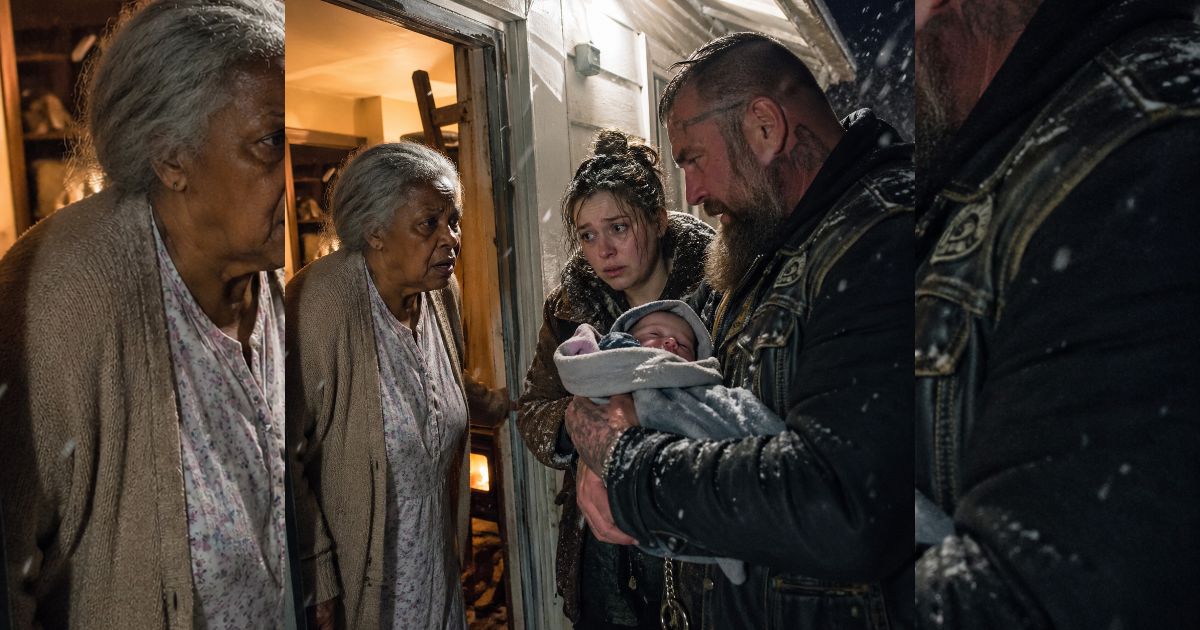
“Please, ma’am,” the big man said through the storm, holding the baby against his chest like she was made of glass. “She’s getting colder. We just need a warm room.”
Martha Bell’s hand froze on the deadbolt.
On the other side of her front door stood the kind of man people warned old women about.
Broad shoulders.
Wet beard.
Leather vest.
Heavy boots planted in the snow.
A patch across his chest she couldn’t read through the ice on the glass.
Behind him stood a young woman shivering so hard her teeth clicked together. Her thin coat was soaked through. Her face was pale, scared, and worn out in a way no young mother’s face should ever be.
Then Martha heard the baby.
Not a loud cry.
Not the strong, angry cry of a healthy child.
A weak little sound.
A tired sound.
The kind that slipped under a person’s ribs and found every old grief still hiding there.
Martha was seventy-three years old.
She lived alone at the end of Maple Ridge Road, in a small white house with a sagging porch and a woodstove that worked harder than anything else in the place.
Her husband, Samuel, had been gone seven winters.
Her son, Marcus, still lived across town, but somehow farther away than any stranger on the highway.
And the only grandchild Martha had ever held had lived three days.
Three days.
Long enough for her to learn the weight of him.
Long enough for her to kiss the soft place above his eyebrow.
Long enough for her to knit yellow booties he never grew into.
That weak cry came again.
Martha unlocked the door.
The wind shoved snow into her hallway.
The man leaned forward, not stepping in until she moved aside.
“Get in here,” Martha said, her voice sharp with the old schoolteacher command she thought she had lost. “All of you. Right now.”
The young woman made a small sound like a prayer breaking in half.
“Thank you,” she whispered. “Thank you.”
The man ducked through the doorway, turning his body sideways so the baby stayed shielded from the wind. Snow clung to his beard and lashes. His hands were huge, but they trembled as he unwrapped the blanket.
“I’m Jack Morrison,” he said. “This is my wife, Anna. Our little girl is Lily.”
Martha reached for the baby before anyone asked.
Anna hesitated for one second, then placed the child in Martha’s arms with a trust so desperate it nearly broke Martha’s heart.
Lily was tiny.
Too tiny, Martha thought.
Her cheeks were cold.
Her little fists were tucked tight under her chin.
Martha pressed the baby against her chest and turned toward the stove.
“Oh, sweet girl,” she whispered, rocking without thinking. “You’re safe now. You hear me? You’re safe now.”
Jack stood by the door as if he still wasn’t sure he was allowed to breathe in her house.
Anna moved closer to the stove, holding her hands out to the heat. Her lips had lost their color. Her wet hair stuck to her cheeks.
“We knocked on four houses,” she said. “One man looked at Jack’s vest and shut the curtain. Another yelled through the door that he wasn’t getting involved.”
Jack lowered his eyes.
“Can’t blame folks for being careful,” he said quietly.
Martha looked him over.
There were tattoos on his hands.
A scar by his jaw.
A leather vest with a stitched name: Iron Shepherds.
He looked like a man built out of road dust and hard weather.
But his eyes never left his daughter.
Not for a second.
That was what Martha saw.
Not the vest.
Not the boots.
Not the patch.
The way he watched that baby like the whole world might fall apart if he blinked.
“You can blame them a little,” Martha said.
Jack looked up.
Martha adjusted Lily against her shoulder. “No child should be left out in a storm because grown folks are scared of a jacket.”
Anna’s eyes filled.
Martha didn’t ask more questions.
She heated water.
She found the small can of formula she kept in the pantry for mothers from church who sometimes stopped by. She warmed a bottle, tested it on her wrist, and tucked it into Lily’s mouth with hands that remembered everything.
The baby drank slowly at first.
Then with hunger.
Anna covered her mouth and turned away.
Jack sat down hard in the kitchen chair like his legs had finally given up.
The blizzard slapped the windows. The lights were out all over town, but Martha’s stove kept the kitchen alive with an orange glow.
For the first time in years, her house sounded full.
A baby swallowing.
A young mother crying softly.
A tired man breathing through his fear.
The kettle rattling on the stove.
Martha held Lily and felt something inside her chest shift, like a locked door opening just an inch.
“She’s six weeks old,” Anna said. “We were driving home from Jack’s sister’s place when the storm turned. The road closed behind us. The truck slid near the old bridge. We walked the last stretch because we saw porch lights down here.”
Martha glanced at Jack.
“You walked with a six-week-old baby in this?”
Jack swallowed.
“We didn’t have a choice.”
Martha wanted to scold him.
She wanted to tell him that babies and winter roads did not mix.
But then she saw his hands again.
Red.
Cold.
Careful.
He had been using his own body as a wall between the storm and his child.
Sometimes love looked foolish from the outside.
Sometimes it looked like a bad decision.
Sometimes it was just a father doing the only thing left.
Anna accepted the mug of tea Martha handed her.
“People see him and decide the whole story,” Anna said. “They don’t see him getting up at five to work at the repair shop. They don’t see him singing to Lily because she sleeps better when his voice is low. They don’t see him fixing neighbors’ cars for half price when he knows they’re struggling.”
Jack gave her a look.
“Anna.”
“What?” she said, wiping her eyes. “It’s true.”
Martha smiled faintly.
“My Samuel used to say the loudest people in town usually know the least.”
Jack looked toward the mantel.
Samuel’s photograph sat there in its plain wooden frame. He had one arm around Martha on their wedding day, both of them young and proud, standing in front of a church that had long since become a parking lot.
Beside the photo sat the little cedar box Samuel had carved with his own hands.
Inside were the yellow booties.
Martha had not opened that box in months.
But tonight, with Lily’s warm little body resting against her, she felt those booties as if they were in her hand.
“I had a grandson once,” Martha said before she meant to.
The room went quiet.
Anna looked up.
Jack did not move.
“Marcus’s boy,” Martha continued. “He was born too early. We had him three days. That was all.”
Her voice stayed steady because old women learn how to speak around pain.
But her eyes burned.
“I held him every minute they let me. Sang to him. Told him about the peach tree out back. Told him about his granddaddy. Then the fever came, and the doctors did what they could, and the good Lord took him home before I knew how to let go.”
Anna’s face crumpled.
“I’m so sorry.”
Martha looked down at Lily.
The baby’s eyes were half closed now. Her little mouth still worked at the bottle. One fist opened, then closed against Martha’s sweater.
“I couldn’t keep my grandson warm long enough,” Martha whispered. “But I can keep this baby warm tonight.”
Jack bowed his head.
The fire crackled.
The storm howled like it wanted in.
But the house held.
Martha made them take off their wet outer clothes and hang them by the stove. She found Samuel’s old sweatshirt for Jack and a thick robe for Anna. She laid towels on the floor and gave them dry socks from the basket by the back door.
Jack tried to refuse.
Martha pointed at him.
“Do not start arguing with me in my own kitchen.”
Anna gave a tired laugh.
It was small, but real.
By midnight, Lily slept in a laundry basket lined with clean blankets, pulled close to the stove but not too close. Anna slept on the couch, one hand hanging down toward the basket as if she needed to feel her baby near.
Jack stayed awake in the rocking chair.
Martha saw him every time she stirred.
His eyes opened.
He checked the baby.
He checked Anna.
Then he checked the door.
At dawn, the storm had spent itself.
The whole town lay under snow so deep it softened every hard edge. Trees bent under ice. Cars looked like white lumps. The road was quiet except for the distant scrape of a county plow.
Martha fried eggs and warmed biscuits from yesterday.
Jack ate like a man who had forgotten food existed.
Anna fed Lily and cried again, though this time she smiled while doing it.
“We can call my brother once the signal clears,” Jack said. “He’ll bring a truck.”
Martha packed biscuits in a paper bag.
“You take these.”
“Mrs. Bell, you’ve already done too much.”
“Martha,” she corrected.
Jack nodded.
“Martha.”
He stood on her porch a little later, holding Lily in her bundle while Anna stepped carefully through the snow.
At the bottom of the steps, Jack turned back.
His leather vest was dry now.
The patch showed clearly in the pale morning light.
Iron Shepherds.
Martha could see why people judged it.
The stitched wolf head looked fierce. The lettering was bold. The vest carried miles and mud and a few rough stories.
But when Jack came back up the steps, his voice was gentle.
“Most of this town shut their doors,” he said. “You opened yours.”
Martha shrugged like it was nothing.
It had not been nothing.
They both knew that.
Jack held out his hand, then seemed to remember Lily was in his arms.
So Martha took his wrist instead.
His skin was rough and warm now.
“I won’t forget this,” he said. “None of us will.”
Anna slipped something from her pocket.
A braided bracelet.
Blue, yellow, and white.
“I made this before Lily was born,” she said. “It was supposed to hang on her crib. But I want you to have it.”
Martha opened her mouth to protest.
Anna shook her head.
“Please.”
Martha held out her wrist.
Anna tied it there with fingers still red from the cold.
Lily made a soft sleeping sound between them.
Martha watched them leave.
A pickup came eventually, crawling slow over the icy road. Jack’s brother helped them in. Anna turned in the seat and lifted Lily’s tiny hand like a wave.
Martha stood in her doorway until the truck disappeared beyond the snowbanks.
Then she went inside.
The kitchen felt too quiet.
The laundry basket was empty.
The blanket inside still held the shape of a baby.
Martha sat down by the stove and pressed the bracelet to her lips.
For seven years, she had believed her house was only a place where things ended.
That morning, it felt like something had begun.
One week later, the sound came rolling down Maple Ridge Road.
Low.
Steady.
Like thunder moving over the frozen ground.
Martha was at the sink washing a cup when she heard it.
At first, she thought another storm was coming.
Then she looked through the window and saw motorcycles.
Not one.
Not two.
A whole line of them.
They came slowly, respectfully, tires crunching over packed snow. No wild speeding. No showing off. Just a careful procession of riders in dark jackets and winter gloves, their headlights glowing in the cold gray morning.
Martha’s heart jumped.
Across the street, curtains moved.
Mrs. Adler next door cracked her blinds.
Mr. Pruitt stepped out onto his porch with his bathrobe pulled tight, his mouth hanging open.
The motorcycles stopped in front of Martha’s house.
Engines cut off one by one.
The silence after them felt enormous.
Jack climbed off the first bike.
This time, he wore a clean flannel shirt under his vest. His beard was trimmed. His eyes were bright with something nervous.
Anna stepped out of a pickup behind the riders, carrying Lily in a pink blanket.
The baby looked rosy and round-cheeked, nothing like the cold little bundle Martha had held that night.
Martha opened the door before Jack reached the porch.
“Well,” she said, trying to sound stern though her lips were shaking. “You brought half the county with you.”
Jack smiled.
“Only the polite half.”
Anna laughed.
Martha covered her mouth, but the laugh got out anyway.
Jack turned serious.
“Martha, we came to thank you properly.”
“You already thanked me.”
“No,” he said. “We said thank you. That isn’t the same.”
Behind him, riders began unloading things.
Toolboxes.
Lumber.
Paint.
Weather stripping.
A box from the bakery two towns over.
A man with silver hair and a gentle face carried a new storm door like it weighed nothing.
Martha gripped the doorframe.
“What is all this?”
Jack looked back at the group.
“This is what we do.”
Anna stepped beside him with Lily.
“The Iron Shepherds aren’t what people think,” she said. “Some of them ride because the road gives them peace. Some ride because they lost people and found family here. Most of them work regular jobs. Mechanics, electricians, carpenters, nurses, teachers, delivery drivers. They look rough, but they show up.”
Jack reached into his pocket and pulled out a white envelope.
Martha took one step back.
“Oh no.”
“Martha.”
“No.”
“You haven’t even seen what it is.”
“I know what envelopes mean when people stand like that.”
Jack’s mouth twitched.
Anna’s eyes softened.
“It’s not payment,” Anna said. “Please don’t think that.”
Jack held it out anyway.
Martha took it only because refusing would have made a scene in front of the whole street.
Inside was cash.
Not a fortune, but more than Martha kept in her checking account most months.
There was also a folded note.
The handwriting was different in every line, like several people had signed it.
For the woman who opened her door when others closed theirs.
For Lily.
For warmth.
For grace.
Martha’s eyes blurred.
“I can’t take this,” she whispered.
Jack’s face changed.
Not hurt.
Not offended.
Just patient.
“You can do whatever you want with it,” he said. “Keep it. Give it away. Buy firewood. Fix that porch step that almost took me down just now.”
One of the riders coughed behind him.
“He’s not wrong,” the silver-haired man said. “That step has a personal grudge.”
Martha gave him a look.
He smiled and removed his cap.
“Name’s Ray, ma’am.”
“Martha.”
“Yes, ma’am, Martha.”
She wanted to say no again.
Then Lily made a happy squeal from Anna’s arms.
That sound went through Martha like sunlight through thin curtains.
She reached for the baby.
Anna handed her over without hesitation.
Lily curled against Martha’s chest as if she remembered.
Martha closed her eyes.
The old ache rose up, but it was different now.
Not gone.
Never gone.
But warmed.
Softened at the edges.
Behind her, the riders waited.
Big men.
Tough-looking women.
Leather, denim, boots, gloves.
Every one of them quiet as church.
Martha looked at the money.
Then at the peeling paint by her porch.
Then toward town, where people who had shut doors were now peeking through windows.
“All right,” she said. “But nobody touches my kitchen curtains. I like them ugly.”
Ray nodded solemnly.
“We respect ugly curtains.”
That was when Martha cried.
Not the silent kind.
Not the polite kind.
The kind that shook her shoulders.
Jack stepped forward, then stopped, unsure.
Martha waved one hand at him while holding Lily with the other.
“I’m fine,” she said, though she clearly was not.
Anna wrapped her arms around Martha from the side.
Jack put one careful hand on Martha’s shoulder.
And right there on the porch, with the whole neighborhood watching from behind blinds, Martha Bell stood surrounded by strangers who had somehow become less strange than her own blood.
For three days, the Iron Shepherds worked on her house.
They fixed the loose porch railing.
Replaced the storm door.
Sealed the windows.
Repaired the back steps.
Stacked firewood.
Cleaned the gutters.
Changed the cracked light fixture in the hallway.
Ray fixed the cabinet hinge that had been hanging crooked since Samuel’s last year.
A woman named Denise, who drove a blue motorcycle and had laugh lines deep as riverbeds, painted Martha’s porch rail a soft cream color.
Another rider, a quiet man called Tuck, repaired the old rocking chair without being asked.
Martha cooked for them.
Big pots of soup.
Cornbread.
Pancakes one morning because Ray mentioned he had not had homemade pancakes since his mother passed.
The riders ate at folding tables in the yard, stamping snow from their boots, laughing low, always cleaning up after themselves.
By the second day, neighbors began pretending to have reasons to walk by.
By the third day, Mrs. Adler crossed the street with a pan of sweet rolls and a guilty face.
“I didn’t know,” she said to Martha on the porch.
Martha looked at her.
“Didn’t know what?”
Mrs. Adler’s cheeks flushed.
“That they were… decent.”
Martha glanced at Jack, who was kneeling by the steps with a drill, holding screws between his lips.
“Most folks are decent if you don’t make them prove it in a blizzard.”
Mrs. Adler had no answer for that.
The story spread, of course.
Small towns do not let kindness stay private any more than they let scandal sleep.
By the following Sunday, people at church knew about the baby, the storm, the bikers, and Martha’s fixed porch.
Some told it warmly.
Some told it with raised eyebrows.
Some said Martha was brave.
Some said she was foolish.
Some said old women got lonely and made poor choices.
Martha heard all of it.
She kept her chin high.
But across town, the gossip reached Marcus Bell in a different shape.
Not as kindness.
Not as community.
As money.
Tiffany was the one who brought it home.
Marcus sat at their little kitchen table, sorting mail into piles he did not want to face. Late notices. Medical bills. A final reminder from the storage place. His lunchbox sat unopened beside him.
He was forty-six, but stress had pulled his face older. His work boots were still dusty from the warehouse. His shoulders sagged under the weight of a life that had not turned out the way he once promised his mother it would.
Tiffany leaned against the counter, scrolling on her phone.
“Well,” she said, “your mother has quite the social circle now.”
Marcus did not look up.
“What?”
“Motorcycle people,” she said. “A whole bunch of them. Fixed her house. Gave her money, too, according to Mrs. Adler’s niece.”
Marcus lifted his head.
Tiffany smiled without warmth.
“Must be nice.”
Marcus went still.
“My mother doesn’t need money from strangers.”
“Apparently she takes it just fine.”
He pushed the mail aside.
“What are you saying?”
“I’m saying maybe she has more tucked away than she lets on. Your dad’s house. Your dad’s things. That land. That old cedar box she guards like it’s treasure.” Tiffany’s voice sharpened. “And you’re sitting here worrying about bills while she plays grandmother to a biker’s baby.”
Marcus stood.
“Don’t talk about my mother like that.”
Tiffany blinked, then softened her voice in the way she did when she wanted to move him without seeming to push.
“I’m talking about fairness, Marcus. You’re her son. Not them. You should know what’s going on with the house before strangers start circling.”
The word strangers did its work.
Marcus looked away.
He had not been a good son.
He knew that.
He called when he needed something.
He visited less than he should.
He got tense in that house because every corner reminded him of being a boy who had disappointed a good man.
Samuel Bell had been patient.
Too patient, Marcus thought sometimes.
The kind of father who could make silence feel like a mirror.
When Samuel died, Marcus had promised himself he would step up.
Then bills came.
Then shifts changed.
Then grief turned into pride.
Then pride became distance.
Now strangers were fixing his mother’s porch while he sat there with past-due envelopes under his hand.
Tiffany watched the shame move across his face and mistook it for agreement.
“You need to talk to her,” she said. “Tonight.”
Marcus shook his head.
“Not tonight.”
“Then when? After she signs the house over to some club?”
“She wouldn’t do that.”
“You sure?”
That question stayed with him.
By evening, it had grown teeth.
Marcus drove to Maple Ridge Road after work. Tiffany insisted on coming. He told himself it was only a conversation.
No yelling.
No accusations.
Just a conversation.
But when he pulled up and saw the new storm door, the fixed railing, the clean porch light glowing warm over the steps, something bitter rose in him.
A stranger had done what he should have done.
That shame came out looking like anger.
Martha opened the door before he knocked twice.
“Marcus?”
Her face changed in that quick way mothers cannot hide.
Hope first.
Then caution.
Then love trying to stand between them.
“Can we come in?” he asked.
“Of course.”
Tiffany brushed past with a tight smile.
“House looks different.”
Martha closed the door slowly.
“It needed repairs.”
Marcus looked around the living room.
The same worn couch.
The same braided rug.
The same mantel with Samuel’s photograph.
But now the window did not rattle. The room held heat better. The old rocking chair sat mended by the stove.
And on the side table was a framed photo of Martha holding Lily while Jack and Anna stood behind her.
Marcus stared at it.
Tiffany saw it too.
“Well, that’s cozy,” she said.
Martha’s eyes narrowed slightly.
“They’re good people.”
“They’re not family,” Tiffany said.
The room went quiet.
Marcus should have stopped it there.
He knew it.
He felt the moment open like a crack in ice.
But he was tired.
He was embarrassed.
He was afraid his mother had found people who showed up better than he did.
So he said the worst thing in a small voice.
“Maybe that’s the point.”
Martha looked at him as if he had set something fragile down too hard.
“What does that mean?”
Marcus rubbed his forehead.
“I don’t know what’s going on here, Mama. People are talking. They’re saying these riders gave you money. They’re saying they’re around all the time.”
“And?”
“And I’m your son.”
“I know who you are.”
“Do you?” His voice rose before he could stop it. “Because from where I’m standing, it looks like you found a new one.”
Martha took that in.
Her hand went to the braided bracelet on her wrist.
Tiffany folded her arms.
“No one is saying you can’t have friends,” she said. “But Marcus has a right to know what’s happening with this house. With your accounts. With everything Samuel left.”
Martha’s face changed at Samuel’s name.
“Your father left this house to me.”
“For now,” Tiffany said.
Martha turned to her.
“For as long as I breathe.”
Tiffany’s cheeks flushed.
Marcus looked at the floor.
“Mama, we’re struggling.”
“I know.”
“No, you don’t know. You don’t ask.”
“I ask, Marcus. You don’t answer unless you need cash.”
The words landed clean.
Not cruel.
True.
That made them worse.
Marcus’s jaw tightened.
“I came here to talk.”
“Then talk to me like I’m your mother,” Martha said. “Not like I’m a bank with a porch.”
Tiffany let out a small laugh.
Martha looked at her.
“And you,” Martha said gently, “do not get to stand in my living room and measure my life like furniture.”
Tiffany’s face hardened.
“I’m trying to protect my husband.”
“From what?”
“From being cut out.”
Martha’s voice dropped.
“Cut out of what? My grief? My grocery money? My old roof? The chair your father died in?”
Marcus flinched.
Martha saw it.
Her voice softened.
“Baby, if you needed me, you could have come to me.”
“I did come.”
“You came angry.”
He had no answer.
Tiffany walked to the mantel and picked up the framed wedding photo of Martha and Samuel.
“This is what she does,” Tiffany said, looking at Marcus. “She makes everything sacred so nobody can question her.”
Martha stepped forward.
“Put that down.”
Tiffany did, but carelessly.
The frame tipped and slid against the mantel. It did not fall, but the sound made Martha gasp.
Marcus reached out without thinking and steadied it.
For one second, his hand rested over his father’s face in the photo.
He saw Samuel’s smile.
He saw Martha in white, young and bright-eyed.
He saw himself at ten years old, standing outside that same church, holding a bag of rice and laughing because Samuel had winked at him during the vows renewal.
The memory hit him so hard he almost sat down.
Tiffany did not notice.
“We should see the papers,” she said. “The deed. The insurance records. Whatever these people had you sign.”
Martha stared.
“Had me sign?”
Marcus looked up.
“Mama, did you sign anything?”
“No.”
“Nothing?”
“Nothing but a thank-you card to a baby.”
Tiffany’s lips thinned.
“Then prove it.”
Martha looked at her son.
Not Tiffany.
Marcus.
The boy she had fed.
The boy she had held through storms.
The man standing in her living room asking her to prove she had not been tricked by people who had treated her with more care than he had.
She turned and walked to the cedar box by Samuel’s picture.
Marcus stiffened.
“Mama—”
She opened it.
Inside were not stacks of money.
Not jewelry.
Not secret papers.
Just yellow baby booties.
A hospital bracelet.
A tiny cap.
A folded photograph of Marcus holding his newborn son, face wet with tears and wonder.
Martha lifted the booties.
“This is what I keep in here,” she said.
Marcus looked like the floor had moved under him.
Tiffany said nothing.
Martha held up the photograph.
“And this.”
Marcus stared at the younger version of himself.
He remembered the weight of that baby.
His son.
Three days.
He remembered Martha sitting beside the hospital bed, humming under her breath while everyone else forgot how to speak.
He remembered Samuel standing in the hallway, one hand on the wall, trying to be strong enough for all of them.
He remembered leaving the hospital empty-handed and deciding, somewhere in the dark part of his mind, never to need anybody that much again.
“Mama,” he whispered.
Martha put the photo back.
“I kept a little of the money they gave me for repairs. The rest went to a children’s home outside town. They needed heat. Babies needed formula. Kids needed winter coats.”
Tiffany’s head snapped up.
“You gave it away?”
Martha closed the cedar box.
“Yes.”
Marcus let out a breath.
Tiffany looked at him, furious.
“Do you hear that? She gave away money while we’re drowning.”
Martha turned.
“You are not drowning because I helped children stay warm.”
Tiffany opened her mouth.
Marcus finally found his voice.
“Stop.”
Tiffany stared at him.
“What?”
“I said stop.”
The word was not loud.
But it was firm.
Tiffany looked shocked, then wounded.
“Marcus, I’m trying to—”
“I know what you’re trying to do.”
Martha stood very still.
Marcus rubbed his hands over his face.
“I came here angry because I was ashamed,” he said. “I saw that porch fixed and I hated that it wasn’t me who fixed it.”
Martha’s eyes filled.
Marcus looked at her.
“I hated that those people showed up.”
“They showed up because you didn’t,” Tiffany said.
Marcus turned to her.
“And maybe I needed to hear that. But not like this.”
The room held its breath.
Martha reached toward him, then stopped.
She had learned not to grab for what might pull away.
Marcus saw the movement.
His face crumpled for one second before he rebuilt it.
“I need air,” he said.
He left the house.
Tiffany followed after a sharp silence, heels clicking on the porch boards Denise had just painted.
Martha stood alone in the living room.
The cedar box was closed.
The wedding photo still stood on the mantel.
Nothing had broken.
But something had cracked anyway.
She lowered herself into the rocking chair and looked at Samuel’s picture.
“I don’t know how to reach him,” she whispered.
The stove answered with a soft pop.
The next morning, Martha did what she had promised herself she would do.
She went to the children’s home.
The place sat on the edge of the next town, in a plain brick building with a playground fence and a faded mural of bluebirds on one wall.
It was not an orphanage like in old books.
It was a home for children who needed temporary care, steady meals, warm beds, and adults who did not quit when life got complicated.
Martha had called ahead.
The director, Carol Henderson, met her in the lobby with tired eyes and a smile that looked practiced but kind.
“You must be Martha Bell.”
“And you must be the woman who needs a heating system more than she needs polite conversation.”
Carol laughed.
“I like you already.”
Martha brought two large shopping bags and one envelope.
Inside the bags were blankets, children’s books, socks, baby formula, and simple toys she had chosen carefully at the discount store.
Inside the envelope was most of the money the riders had given her.
Carol opened it and went quiet.
“Martha.”
“Don’t make a fuss.”
“This is more than a fuss.”
“Then make a small fuss.”
Carol pressed the envelope to her chest.
“Our heat has gone out twice this month,” she said. “We’ve been moving the little ones into the center room at night. This will help us repair the old system before the next freeze.”
A little boy with missing front teeth peeked around the hallway.
“Are you Grandma Martha?”
Martha blinked.
Carol smiled.
“Word travels here too.”
The boy stepped out.
He was about seven, with a cowlick and serious eyes.
“I’m Eli,” he said.
“Well, Eli,” Martha said, “I brought books.”
“About trucks?”
“One about trucks. One about a frog. And one about a dog who thinks he runs a bakery.”
Eli considered this.
“I’ll take the dog.”
By noon, Martha was sitting on a worn rug with four children around her, reading in her slow, warm voice while snow tapped softly against the windows.
For the first time in a long time, she did not feel like a house waiting for footsteps that never came.
She felt useful.
That afternoon, when Jack stopped by to check the porch light, he found her smiling to herself while stirring soup.
“You look suspiciously happy,” he said.
“I read a book about a bossy bakery dog to four children and a stuffed rabbit.”
“Sounds like a tough crowd.”
“The rabbit judged me.”
Jack grinned, then grew softer.
“Martha, Anna wanted me to ask if you’re all right. After yesterday.”
Martha’s spoon slowed.
“Marcus came by.”
“I know.”
She looked at him.
“Mrs. Adler may have mentioned raised voices.”
“Mrs. Adler needs a hobby.”
“She has one,” Jack said. “Windows.”
Martha gave a tired laugh.
Then she sighed.
“He thinks I replaced him.”
Jack leaned against the counter.
“Did you?”
“No.”
“But he wasn’t wrong to feel the empty space.”
Martha looked at him sharply.
Jack lifted both hands.
“I’m not defending how he came at you. I’m saying sometimes people see someone else standing where they should have stood, and it burns.”
Martha looked back at the soup.
“You sound like you know.”
“I do.”
He said it simply.
Martha waited.
Jack looked toward the window.
“My mother died when I was nineteen. I spent years angry at anyone who was kind to my dad after that. Like they were trying to take her chair at the table. Took me a long time to understand love doesn’t work like chairs. Someone can sit with you without stealing a seat.”
Martha absorbed that.
Then she whispered, “He used to be sweet.”
Jack nodded.
“Most angry men were sweet boys first.”
Martha’s eyes filled.
Before she could answer, the front door opened without a knock.
Marcus stepped in.
Alone.
Jack straightened.
Marcus froze when he saw him.
The air tightened.
Martha wiped her hands.
“Marcus.”
He looked rough.
Not unsafe.
Not wild.
Just tired down to the bone.
His coat was buttoned wrong. His eyes were red-rimmed like he had not slept.
“I didn’t know he was here,” Marcus said.
Jack’s voice stayed calm.
“I was fixing the porch light.”
Marcus looked at the light, then at the floor.
“Of course you were.”
Martha took a breath.
“Would you like soup?”
“No.”
A pause.
“Yes.”
She set a bowl on the table.
Marcus sat, but he did not eat.
He looked at Jack.
“Can I talk to my mother?”
Jack nodded.
“I’ll be outside.”
Martha touched his arm lightly as he passed.
Thank you, the touch said.
Jack stepped onto the porch and closed the door behind him.
Marcus stared at the soup.
“Mama, I’m sorry.”
Martha sat across from him.
She did not rush to forgive.
That was new for her.
All Marcus’s life, she had tried to smooth the road before he cut his feet. Maybe that had not helped either of them.
“What are you sorry for?” she asked.
He looked up.
The question seemed to surprise him.
“For coming here like that. For letting Tiffany talk to you that way. For thinking…” He swallowed. “For thinking the worst of you.”
Martha nodded slowly.
“That is a start.”
His face fell a little.
He had expected her to open her arms.
She wanted to.
Lord, she wanted to.
But love without truth had worn them both thin.
Marcus pushed the bowl away.
“I went home and looked through Dad’s old toolbox,” he said.
Martha blinked.
“What?”
“The one in my garage. The blue one. I took it after he died.”
“I wondered where that went.”
He winced.
“I found an envelope taped under the tray.”
Martha went still.
Marcus reached into his coat and pulled out a folded paper.
His hands shook.
“It was from Dad.”
Martha did not touch it yet.
Marcus unfolded it carefully.
“He wrote it to me.”
Martha’s throat tightened.
Samuel had always written letters when spoken words felt too heavy.
Marcus read, voice rough.
“Son, if you’re finding this, it means I’m gone and you’re still carrying more pride than peace. Your mama will never stop loving you, but don’t mistake her love for something you can lean on without giving weight back. A house is wood. Family is what you do inside it. If you want what I left behind, start by caring for the woman I loved.”
Marcus stopped.
His mouth trembled.
Martha covered her lips.
Samuel.
Even gone, he had found the tender place and pressed.
Marcus set the letter on the table.
“I don’t know how to be what he wanted.”
Martha’s tears slipped free.
“Neither do I, baby. Not every day.”
He looked at her then.
Really looked.
Not at the house.
Not at what she had.
At her hands.
Her tired face.
The bracelet on her wrist.
The soup she had made before knowing he would come.
“I got mad at those riders,” he said. “Because they made it obvious.”
“What?”
“That I had left you alone.”
Martha looked down.
“You did.”
He nodded.
No defense.
No excuse.
“I did.”
The words sat between them.
Painful.
Clean.
Martha reached for the letter.
Samuel’s handwriting blurred under her tears.
“Your father loved you so much,” she said.
“I know.”
“No,” she whispered. “I don’t think you do.”
Marcus covered his face with one hand.
Martha let him sit like that.
Outside, Jack’s boots creaked on the porch as he moved the ladder.
Inside, mother and son sat with soup going cold and a dead man’s words breathing between them.
After a while, Marcus said, “Tiffany wants me to push you about the house.”
Martha closed her eyes.
“I figured.”
“I told her I won’t.”
Martha opened them.
Marcus looked ashamed.
“But I need to be honest. We’re in trouble. Not because of you. Because of choices. Bills. Pride. Me not asking for help until I’m angry.”
Martha nodded.
“I can help you make phone calls. I can sit with you while you sort papers. I can make supper. I can be your mother.” Her voice steadied. “But I will not hand you money while you speak to me like I owe you my bones.”
Marcus flinched, then nodded.
“That’s fair.”
“It should have been fair years ago.”
“I know.”
He finally picked up the spoon.
His first bite made him close his eyes.
“Still tastes like home,” he whispered.
Martha almost broke then.
Almost.
But she held herself together long enough to say, “Home has rules now.”
Marcus looked up.
“No coming here to accuse me. No letting Tiffany disrespect me. No talk of my house like I’m already gone. And if you want to be part of this family again, you show up when nothing is broken too.”
He absorbed each word.
Then nodded.
“Yes, ma’am.”
For the first time in years, he sounded like her boy.
Not healed.
Not fixed.
But reachable.
The door opened a crack.
Jack stuck his head in.
“Porch light works.”
Marcus stood.
The two men looked at each other.
There were a hundred things Marcus could have said.
Jealous things.
Proud things.
Instead, he cleared his throat.
“Thanks for fixing what I didn’t.”
Jack studied him.
Then nodded once.
“You can fix the next thing.”
Marcus looked surprised.
Jack stepped in, wiping snow from his boots.
“Back fence is leaning. Martha said it’s been bothering her.”
Martha raised an eyebrow.
“I said no such thing.”
Jack looked at her.
“It bothers me on your behalf.”
Despite herself, Martha laughed.
Marcus did too.
Small.
Rusty.
But real.
That Saturday, Marcus came back.
Alone.
He brought work gloves and a toolbox.
Martha watched from the kitchen window as he and Jack worked on the back fence in the cold morning sun.
They did not become friends that day.
That would be too easy.
They measured boards.
Held posts.
Argued mildly about screws.
Ray showed up halfway through with coffee and unnecessary opinions.
Marcus did not smile much, but he stayed.
At noon, Martha brought sandwiches outside.
Jack took his with a grin.
Ray took two.
Marcus took one and said, “Thank you, Mama.”
Not “thanks.”
Not a mumble.
Thank you, Mama.
Martha carried those words around all day like a warm stone in her pocket.
Tiffany did not come.
For two weeks, Marcus visited every Saturday.
Sometimes he worked.
Sometimes he sorted old boxes with Martha.
Once, he sat at the kitchen table with his bills while Martha folded laundry beside him, neither of them saying much.
That quiet felt awkward at first.
Then it felt almost normal.
He and Tiffany were still strained. Martha knew better than to ask too many questions. But Marcus had begun saying “I” instead of “we” when talking about choices, and Martha noticed.
One evening, Anna came by with Lily.
The baby was bigger now, round and curious, reaching for everything she should not touch.
Marcus happened to be there, fixing a drawer track.
He froze when Anna walked in.
So did Anna.
Martha looked between them.
“Anna, this is my son, Marcus. Marcus, this is Anna. And this little sunshine is Lily.”
Anna smiled gently.
“It’s good to meet you.”
Marcus wiped his hands on a rag.
“You too.”
Lily stared at him with serious baby judgment.
Marcus stared back.
“She always look at people like that?” he asked.
Anna laughed.
“Only when she’s deciding if they’re worth her time.”
Martha lifted Lily from Anna’s arms.
“She decided I was worth it.”
Marcus’s face softened as he watched his mother with the baby.
Not jealous this time.
Sad, maybe.
And glad.
Both could live in the same room.
Lily reached for the screwdriver in Marcus’s hand.
He quickly moved it away and held out the rag instead.
She took it proudly.
“Smart,” Anna said.
Marcus shrugged.
“I remember babies grabbing everything.”
The room went quiet for half a breath.
Martha knew which baby he meant.
So did Marcus.
He did not run from the memory this time.
He looked at Lily, then at his mother.
“She would have been a good grandma,” he said softly.
Martha’s eyes filled.
Anna touched Lily’s back.
“She is a good grandma.”
Marcus looked down.
Martha pressed a kiss to Lily’s hair.
That winter loosened slowly.
Snow melted from the gutters.
The road turned muddy.
The porch rail held steady.
Martha’s house became a strange little gathering place at the edge of town.
Jack and Anna still came by, often with Lily.
Ray came whenever something needed fixing or whenever he needed Martha’s biscuits, which he claimed was a medical necessity, though Martha told him not to invent doctor talk in her kitchen.
Denise brought yarn one afternoon and sat with Martha for three hours, teaching her a new stitch while Lily slept in a playpen near the stove.
Marcus came when he could.
Not perfectly.
Not every time he said he would.
But more.
And when he missed a Saturday, he called.
That mattered.
Tiffany stayed away for nearly a month.
Then one rainy afternoon, she came alone.
Martha found her on the porch, soaked at the shoulders, face stiff with pride.
“I’m not here to fight,” Tiffany said before Martha could speak.
Martha opened the door wider.
“Then come in out of the rain.”
Tiffany stepped inside.
She looked different without Marcus beside her.
Less sharp around the edges.
More tired.
Martha put on tea.
For a few minutes, neither of them spoke.
Tiffany stared at the braided bracelet on Martha’s wrist.
“I was wrong,” she said finally.
Martha did not soften her face too quickly.
“About what?”
Tiffany swallowed.
“About the money. The house. Those people. You.”
Martha poured tea.
Tiffany’s hands closed around the mug.
“My parents fought about money until there was nothing left to fight over,” she said. “When I see things slipping, I grab. That doesn’t make it right. But it’s the truth.”
Martha sat across from her.
“Truth is a better place to start than blame.”
Tiffany nodded.
“I made Marcus worse.”
“He chose his words.”
“I know. But I pushed.”
Martha studied her.
Tiffany looked near tears, but she held them back with stubborn force.
“I don’t know how to be part of a family that doesn’t keep score,” she said.
Martha’s voice softened.
“Most of us are still learning.”
Tiffany let out a shaky breath.
“I’m sorry I touched the picture.”
Martha’s eyes flicked to the mantel.
Samuel smiled from the frame.
“You scared me more than you damaged anything.”
“I know.”
“No,” Martha said. “I mean you scared me because I saw how easy it was for you to treat memory like clutter.”
Tiffany’s eyes lowered.
“My family threw everything away when people died. Said keeping things made you weak.”
Martha leaned back.
“Keeping things can make you stuck. Throwing everything away can make you empty. There’s a middle, if you’re brave enough to stand there.”
Tiffany gave a short, wet laugh.
“You always talk like that?”
“Like what?”
“Like a church sign that got tired of being polite.”
Martha blinked.
Then laughed so hard Tiffany laughed too.
It did not fix everything.
Tea never does.
But when Tiffany left, she hugged Martha awkwardly at the door.
Martha let her.
The hug was stiff.
Unpracticed.
But it was something.
By early spring, the children’s home heating system had been repaired.
Carol called Martha the day the new parts were installed.
“I wish you could see them,” Carol said. “The little ones are walking around in socks instead of coats.”
Martha closed her eyes.
“Good.”
“There’s something else,” Carol said. “The children made cards for the motorcycle group. And for you.”
Martha smiled.
“Oh, they did?”
“Yes. One of them drew you as a superhero.”
Martha laughed.
“What was my power?”
“Soup, apparently.”
“That child understands me.”
Carol’s voice warmed.
“We’re having a small open house Saturday. Nothing fancy. Just cocoa, cookies, and a thank-you wall. Would you come?”
Martha said yes.
Then she called Jack.
By Saturday morning, the Iron Shepherds rode in again.
This time, not to Martha’s house first.
To the children’s home.
They came slowly, respectfully, parking across the lot so the engines would not scare the little ones.
The children pressed their faces to the windows.
Eli, the boy with the missing teeth, ran outside with Carol close behind.
“Grandma Martha!”
Martha stepped out of Jack’s pickup and opened her arms.
Eli ran straight into them.
Jack stood beside the truck, suddenly quiet.
Anna held Lily on her hip.
Ray took off his cap.
Denise wiped under one eye and pretended it was the wind.
The children had taped drawings to a wall inside.
Motorcycles with giant hearts.
A baby wrapped in blankets.
A little white house with smoke coming from the chimney.
Martha with a cape and a soup pot.
Jack stared at that one for a long time.
Eli tugged his sleeve.
“Are you the biker baby dad?”
Jack crouched to his level.
“I guess I am.”
Eli studied his beard.
“You look scary, but Grandma Martha says scary-looking people can be soft.”
Jack’s face cracked into a grin.
“Grandma Martha knows too much.”
Eli nodded seriously.
“She does.”
The room filled with cocoa steam and cookie crumbs.
Riders sat in tiny chairs.
Children asked questions about engines, helmets, patches, and whether motorcycles could ride on the moon.
Ray said not yet, but he was open to the challenge.
Anna let a little girl touch Lily’s sock.
Martha watched it all from near the window.
For years, she had thought grief was a room that got smaller over time.
But that day, she realized grief could become a doorway.
Not because the loss was good.
Never that.
But because love, when not buried, had a way of making more room.
Marcus arrived late.
Martha saw him in the doorway, uncertain.
Tiffany stood behind him holding a tray of cookies from the grocery store bakery.
Not homemade.
Not perfect.
But brought.
Martha waved them in.
Marcus looked at the room.
At Jack kneeling beside Eli.
At riders reading picture books.
At his mother laughing with a child in each arm.
Then he walked to her.
“Didn’t know if it was okay to come.”
Martha touched his cheek.
“You came. That makes it okay.”
Tiffany held up the cookies.
“They’re from the store.”
Ray appeared beside her.
“Store cookies have saved many lives.”
Tiffany smiled despite herself.
Martha watched Marcus move slowly through the room.
He stopped at the thank-you wall.
His eyes found the drawing of the white house.
Under it, in crooked child letters, Eli had written:
The warm house.
Marcus stared at those words.
Then he looked back at Martha.
Something passed between them.
An apology.
A promise.
Not spoken yet, maybe.
But alive.
A month later, on a clear Sunday afternoon, Jack and Anna brought Lily to Martha’s house after church.
The baby had started making sounds that almost became words. She crawled fast now, determined and fearless, with a laugh that made everyone in the room turn toward her.
Martha had made chicken and dumplings.
Marcus brought green beans.
Tiffany brought paper plates and then apologized because Martha had real plates, and Martha told her paper plates were a gift to tired women everywhere.
Ray came with a pie.
Denise came with flowers.
Somehow the little kitchen held them all.
After supper, Jack stayed behind while the others carried dishes to the sink.
Martha sat in the rocking chair with Lily in her lap. The baby slapped both hands on Martha’s knees and babbled with deep seriousness.
Jack stood near the stove, turning his cap in his hands.
Martha noticed.
“What’s on your mind?”
He looked embarrassed.
“Something I’ve been wanting to ask.”
Anna, at the sink, turned around with a soft smile like she already knew.
Marcus leaned against the counter, listening.
Jack cleared his throat.
“That night in the storm, you opened your door when you had every reason to be afraid. You didn’t know us. You didn’t owe us anything.”
Martha rubbed Lily’s back.
“You had a baby.”
“I know. But still.”
His voice thickened.
“I can’t be Marcus. I would never try to take his place.”
Marcus looked down, then back up.
Jack continued.
“But my mother is gone. Has been for years. And when I sit in this kitchen, I feel something I haven’t felt in a long time.”
Martha’s eyes filled before he finished.
Jack swallowed.
“If it’s all right with you, I’d like to call you Mom.”
The room went still.
Even Lily seemed to pause.
Martha stood carefully, lifting Lily to Anna.
Then she walked to Jack.
He looked huge in her small kitchen.
A man who had scared half the town just by standing on a porch.
But in that moment, he looked like a boy asking for a place at the table.
Martha put both hands on his face.
“You can call me Mom,” she whispered.
Jack closed his eyes.
She pulled him down into a hug.
He held her gently at first, then tighter when she patted his back.
Marcus watched them.
There was a pinch in his chest.
But not the same as before.
This time, he saw it clearly.
Jack was not taking his mother.
He was reminding the world she was worth coming home to.
When Jack stepped back, Marcus came forward.
He looked at Martha.
Then at Jack.
“I’m still learning how to be her son,” Marcus said.
Jack nodded.
“I’m still learning how to be one too.”
Martha let out a laugh through tears.
“Then both of you can start by taking out the trash.”
Everyone laughed.
And they did.
Both of them.
Side by side.
That night, after the house emptied, Martha sat alone by the stove.
Not lonely.
Alone.
There was a difference now.
The dishes were drying by the sink. The porch light glowed steady. The repaired chair no longer creaked under her. The baby’s blanket lay folded on the couch.
On her lap was the old photograph of Marcus holding his newborn son.
She touched it gently.
“I’m still here,” she whispered, not sure whether she was speaking to the baby, Samuel, Marcus, or herself.
A soft knock came at the door.
Martha looked up.
Marcus stepped in.
“I forgot my gloves,” he said.
They were on the table.
He picked them up but did not leave.
Martha waited.
He walked over and sat in the chair across from her.
For a while, they listened to the fire.
Then Marcus said, “I miss him.”
Martha’s hand tightened around the photograph.
“Your daddy?”
Marcus shook his head.
“My boy.”
Martha closed her eyes.
There it was.
The grief they had both stepped around for years like a hole in the floor.
“I do too,” she said.
Marcus leaned forward, elbows on knees.
“I didn’t know how to talk about him. Every time I looked at you, I saw that you remembered everything. And I couldn’t stand it.”
“I thought you forgot,” Martha whispered.
His face twisted.
“I never forgot. I just buried it so deep I started burying everything else with it.”
Martha reached for him.
This time, he did not pull away.
He slid from the chair to his knees in front of her like he had as a boy when the world was too big.
She held his head against her lap.
He cried quietly.
No drama.
No big speech.
Just years of unsaid sorrow finally finding air.
Martha bent over him, one hand on his back, the other holding the photograph.
“My son,” she whispered. “My sweet, stubborn son.”
“I’m sorry, Mama.”
“I know.”
“I’ll do better.”
“Start tomorrow.”
He gave a wet laugh.
She smiled through tears.
“Tonight, just breathe.”
Outside, a motorcycle passed somewhere far down the road.
Low thunder.
Softened by distance.
Marcus lifted his head.
Martha looked toward the window.
“That used to scare people around here,” he said.
“Still might.”
“Does it scare you?”
Martha smiled.
“No. Sounds like somebody keeping a promise.”
Spring came fully after that.
The peach tree in Martha’s backyard bloomed for the first time in years. Maybe it had bloomed before and she had not noticed. Grief can blind a person to whole seasons.
But that year, she noticed.
Pink-white blossoms opened against the blue sky.
Lily sat on a quilt under the tree, chewing on a soft toy while Anna took pictures.
Jack helped Marcus build a small bench beneath the branches.
Ray supervised badly.
Denise planted marigolds by the porch.
Tiffany brought lemonade and only complained once about bugs, which Martha considered great progress.
Neighbors stopped whispering as much.
Some even waved when the Iron Shepherds rode by.
Mrs. Adler began bringing extra rolls without apologizing first.
Mr. Pruitt asked Ray to look at his mower, then spent the next week telling everyone motorcycle folks knew more about engines than half the shops in town.
The town did not transform overnight.
Towns rarely do.
Some people held on to their judgments because old fear can feel safer than new understanding.
But others changed.
One door opened.
Then another.
Then another.
And all of it began because one night, an old woman heard a weak baby cry and decided fear would not be the loudest thing in her house.
On Lily’s first birthday, Martha’s little yard filled with people.
Not too many.
Just enough.
A folding table held cupcakes with uneven frosting. Balloons bobbed from the porch rail. Someone had hung a paper banner that said HAPPY BIRTHDAY, LILY in bright crooked letters.
Carol came from the children’s home with Eli and two other kids.
Eli gave Lily a stuffed dog and told her very seriously not to let grown-ups wash it too much because “dogs need character.”
Lily clapped without understanding a word.
Jack stood beside Martha while Anna helped Lily poke one finger into her cupcake.
“She wouldn’t be here without you,” Jack said quietly.
Martha shook her head.
“Don’t put that all on me.”
“I’m putting the truth where it belongs.”
She looked at Lily.
The baby had frosting on her nose.
Marcus stood nearby, laughing at something Ray had said.
Tiffany was talking with Denise by the flowers, her arms no longer crossed like a shield.
For one bright second, Martha saw all of it at once.
The repaired porch.
The riders in the yard.
Her son smiling.
The baby alive and warm.
The children chasing bubbles near the peach tree.
The open door.
The stove waiting inside.
Samuel’s photograph on the mantel.
The yellow booties in the cedar box.
Loss had not disappeared.
It never would.
But it was no longer the only story in the house.
Martha touched the bracelet on her wrist.
Anna saw.
“You still wear it.”
“Every day.”
“I made it with the colors I wanted for Lily’s nursery,” Anna said. “Blue for calm. Yellow for joy. White for a clean start.”
Martha smiled.
“Then you chose well.”
A little later, Jack tapped a spoon gently against a glass.
Everyone quieted.
He looked embarrassed by the attention, which made Ray grin.
Jack ignored him.
“I’m not much for speeches,” he said.
Ray coughed.
“False.”
Jack pointed at him.
“Don’t start.”
Laughter moved through the yard.
Jack looked at Martha.
“A year ago, my wife and I were scared out of our minds on a road we shouldn’t have been on in weather nobody should have been out in. We knocked on doors. People saw my vest and decided they knew me.”
His voice caught.
“Then Martha Bell opened her door.”
Martha looked down.
Jack continued.
“She didn’t ask what club I rode with. She didn’t ask what people would think. She heard my daughter cry, and she made room by the fire.”
The yard went still.
Marcus watched his mother.
Jack lifted his glass.
“To Martha. Who reminded us that kindness is not soft. It is brave.”
Ray raised his cup.
“To Mom Martha.”
Denise lifted hers.
“To the warm house.”
Eli shouted, “To soup power!”
That broke everyone.
Martha laughed until she cried.
Then Marcus stepped forward.
He had not planned to speak.
She could tell.
His face had that open, terrified look of a man walking without a map.
“I want to say something too,” he said.
The yard quieted again.
Marcus looked at the people gathered there, then at Martha.
“For a long time, I thought being family meant having a claim. A claim to a house. A claim to forgiveness. A claim to being first in line just because of blood.”
He swallowed.
“I was wrong.”
Tiffany’s eyes lowered.
Marcus continued.
“Family is showing up. It’s fixing what you can. It’s telling the truth before anger tells it for you. It’s not making your mother beg you to care.”
Martha pressed a hand to her mouth.
Marcus looked at Jack.
“I was jealous of you.”
Jack nodded once.
“I know.”
“I’m not proud of it.”
“I know that too.”
Marcus turned back to Martha.
“But I’m grateful now. Because when I wasn’t standing where I should have been, you were.”
Jack’s eyes shone.
Marcus lifted his cup.
“To the people who show up. And to the mothers who keep the door open longer than we deserve.”
Martha could not stay seated.
She crossed the yard and wrapped her arms around her son.
Marcus held her tight.
Not like a man embarrassed by love.
Like a boy who had finally come home.
Around them, nobody clapped at first.
It was too tender for that.
Then Lily squealed and slapped frosting on her high chair tray.
Everyone laughed.
And just like that, the moment became life again.
Messy.
Sweet.
Loud.
Warm.
That evening, after the last guest left and the last paper plate was thrown away, Martha stood on the porch with Marcus and Jack.
The sun was low.
The motorcycles were lined along the road, shining softly in the golden light.
Lily slept against Anna’s shoulder in the yard.
Tiffany gathered the leftover cupcakes.
Ray tried to leave with half a pie and got caught by Denise.
Martha breathed in the smell of cut grass, sugar, and cooling engines.
Marcus leaned on the porch rail he had helped repair.
“Looks good,” he said.
“It does.”
“I should’ve fixed it years ago.”
Martha looked at him.
“You fixed it now.”
He nodded.
Jack stood on her other side.
For a while, none of them spoke.
Then Martha said, “You know what Samuel would say if he saw all these motorcycles in his yard?”
Marcus smiled.
“He’d say they better not leak oil on his grass.”
Jack laughed.
Martha grinned.
“Then he’d feed every one of you.”
Marcus’s smile softened.
“Yeah. He would.”
The first stars came out.
One by one.
Small lights in a darkening sky.
Martha thought about that freezing night.
How close she had come to leaving the door locked.
How fear had stood beside her like a second person, whispering all the reasons not to open up.
And how one weak cry had been stronger than fear.
She had thought she was saving a baby.
But maybe Lily had saved something too.
A house.
A mother.
A son.
A town’s narrow heart.
Martha stepped inside later and left the door open behind her while Marcus carried in chairs and Jack banked the stove for the night.
The fire caught quickly.
A steady orange glow filled the room.
On the mantel, Samuel’s photograph watched over all of it.
The cedar box sat beside him.
The bracelet circled Martha’s wrist.
The baby’s laughter still seemed to hang in the corners.
Outside, the last motorcycle started.
Then another.
Then another.
The low sound rolled down Maple Ridge Road, past the houses that had once shut their doors, past the windows where people now watched with different eyes.
Martha stood in the doorway until the final taillight disappeared.
Marcus came up beside her.
“You cold?”
She smiled.
“No.”
He put an arm around her shoulders anyway.
Jack, about to leave, paused at the bottom of the steps.
“Night, Mom.”
Martha’s eyes warmed.
“Night, son.”
Marcus did not flinch at the word.
He only squeezed her shoulder and called after Jack, “Ride safe.”
Jack lifted a hand.
The road carried him away.
Martha closed the door gently.
Not because she was shutting anyone out.
Only because everyone she loved knew they could knock.
And as long as there was fire in that stove, soup in that pot, and breath in her body, the warm house at the end of Maple Ridge Road would never again be just a place where grief lived.
It would be a place where strangers became family.
Where sons could come home slowly.
Where babies were kept warm.
Where a woman everyone thought was alone became the heart of a whole road.
And where one open door proved that kindness, once given, can ride farther than fear ever will.
Thank you so much for reading this story!
I’d really love to hear your comments and thoughts about this story — your feedback is truly valuable and helps us a lot.
Please leave a comment and share this Facebook post to support the author. Every reaction and review makes a big difference!
This story is a work of fiction created for entertainment and inspirational purposes. While it may draw on real-world themes, all characters, names, and events are imagined. Any resemblance to actual people or situations is purely coincidenta