If you’ve already read part 1 of this story on Facebook, go here for Part 2!
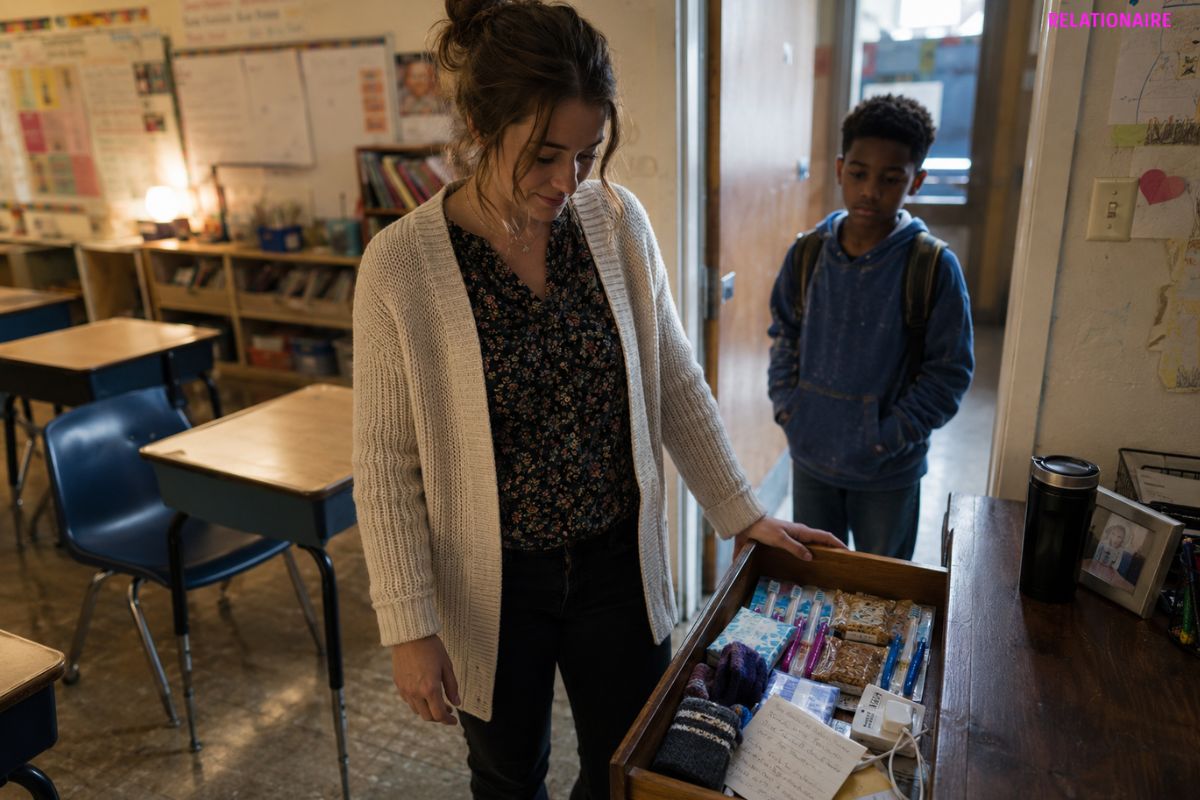
The first thing Miss Clara found in the old teacher’s desk was a toothbrush.
Not one.
Seven.
Still sealed in plastic, tucked beside dry erase markers, a stack of hall passes, and a half-empty roll of peppermint candies.
She stood there alone in Room 214, one hand on the drawer handle, listening to the building settle after the final bell. Somewhere down the hall, a custodian pushed a mop bucket over the scuffed tile. The wheels squeaked once, then faded.
Room 214 still smelled like someone else.
Lemon hand sanitizer.
Old books.
Expo markers.
And the faint cinnamon scent of the retired teacher’s coffee, even though Mrs. Evelyn Hart had been gone for three weeks.
Gone suddenly, too.
That was what everyone kept whispering.
“Unexpected retirement,” the principal said.
“Health reasons,” the secretary said.
“Burnout,” one fifth-grade teacher said in the staff lounge, lowering her voice like it was contagious.
Clara was twenty-eight, newly hired, and trying very hard not to look overwhelmed.
She had inherited Mrs. Hart’s classroom in October, after the school year had already grown its own heartbeat. The students knew the routines. The laminated name tags were curling at the corners. The anchor charts were written in Mrs. Hart’s careful blue handwriting.
Read with your finger.
Kindness before cleverness.
Everybody gets to start over.
Clara had spent the week trying to make the room feel like hers without erasing the woman everyone still loved.
But the desk had stayed untouched.
Until Friday.
Until the principal poked her head in and said, gently, “You’ll need the storage space eventually.”
So Clara opened the drawer.
And found toothbrushes.
Then granola bars.
Mittens with the tags still on.
Two phone chargers wrapped with rubber bands.
A packet of bus passes.
A small sewing kit.
Bandages.
Hair ties.
Travel-size deodorant.
Tissues.
A zippered pouch full of quarters.
And folded notes.
So many folded notes.
Clara pulled one out and opened it.
Malik — size 3 shoes. Says he “likes old ones better.” Check soles.
She frowned.
Another note.
Jenna — hates strawberry. Pretends she isn’t hungry if embarrassed. Offer plain crackers first.
Another.
Eli — bus pass only on Wednesdays. Don’t ask in front of others.
Clara set the notes down slowly.
The drawer suddenly felt less like storage and more like something private.
Something she should not be touching.
For a moment, she felt a little embarrassed for Mrs. Hart. Not in a cruel way. More like she had accidentally opened a purse and found receipts, medicine, secrets.
The old teacher everyone adored had filled her desk with children’s emergencies.
But there were too many.
Too organized.
Too specific.
Clara pushed the drawer halfway shut.
Then she heard a small voice behind her.
“You’re not supposed to throw that away.”
She turned.
A boy stood in the doorway with one backpack strap hanging from his elbow. Marcus Reyes. Fourth row, second seat. Always late from lunch. Always sharpening pencils he never used. Always smiling too quickly when adults asked if he was okay.
“I’m not throwing anything away,” Clara said.
Marcus looked at the open drawer.
His eyes went straight to the granola bars.
Then away.
“I forgot my math folder,” he said.
Clara nodded. “Go ahead.”
He crossed the room, moving carefully between desks. His backpack zipper was broken, and one side gaped open like it was tired of holding things in.
At his desk, he found the folder under a wrinkled spelling test.
Clara pretended not to watch.
But she saw his eyes return to the drawer.
To the bars.
To the bus passes.
To the mittens.
When he turned to leave, she picked up one granola bar and held it out.
“Marcus,” she said softly. “Do you want—”
“No.”
The word came too fast.
His face changed. Not angry. Worse.
Ashamed.
“I’m good,” he said. “My mom buys snacks.”
“I wasn’t saying she didn’t.”
“She does.”
“I know.”
“You don’t.”
The hallway seemed to go quiet around them.
Clara lowered the bar.
Marcus tightened his grip on the folder until the paper bent.
“She gave them to us,” he said.
“Mrs. Hart?”
He swallowed.
“Not like charity.”
Clara waited.
Marcus looked at the desk again, and his voice dropped.
“She said a classroom needs supplies.”
Then he left before Clara could answer.
That night, she stayed later than she meant to.
The school emptied in layers. First the buses. Then the after-school kids. Then the coaches. Then the office lights clicked off one by one until Room 214 was an island of yellow light.
Clara sat at Mrs. Hart’s desk and read the notes.
Each one was written on scraps.
Sticky notes.
Index cards.
The back of copier paper.
A torn piece of a field trip form.
Some were simple.
Ana — keep extra hair ties. Gets teased after gym.
Sam — charger. Dad sleeps days, phone must stay on.
Nina — cries when coat is wet. Put near heater quietly.
Others made Clara’s throat tighten.
Lucas — toothbrush. Sleeps at aunt’s some nights. Never mention.
Maddie — left mitten only. Keeps losing same hand because she holds brother’s hand.
Henry — lunch balance. Do not let him hear total.
At the very back of the drawer, under a stack of old attendance sheets, Clara found a small blue notebook.
The cover was soft from use.
No title.
Just a sticker of a gold star that had faded at the edges.
She should have stopped.
She knew that.
But the notebook felt less like curiosity now and more like a door someone had left open on purpose.
Clara opened it.
The first page had a list of names from years past. Some crossed out. Some circled. Some marked with dates.
Not grades.
Not test scores.
Needs.
Coat.
Glasses.
Quiet lunch.
Call Grandma, not Mom.
Let him draw first.
Ask about sister.
Never send note home on Fridays.
Clara turned another page.
And another.
Then she stopped at one name.
Her own stomach dropped before she understood why.
Marcus Reyes.
Under his name, Mrs. Hart had written only three lines.
Backpack breaking.
Keeps refusing food.
Ask about the little girl.
Clara stared at the last sentence.
The little girl?
Marcus had never mentioned a sister. There was no little girl on his emergency contact form. No sibling listed in the office system.
Just one mother.
One address.
One phone number that often went straight to voicemail.
The classroom door creaked.
Clara looked up.
Marcus stood there again, breathing hard like he had run back.
This time, he wasn’t holding his math folder.
He was holding a small pink shoe.
A child’s shoe.
Scuffed at the toe.
Too tiny for any student in Room 214.
His eyes were wet, but his voice was sharp with panic.
“Did Mrs. Hart tell you where she put the other one?”
PART 2
Clara did not move at first.
The little pink shoe sat in Marcus’s hand like evidence.
It had a glitter heart on the side, half peeled off. The Velcro strap was gray with playground dirt. A name was written inside in faded marker.
LILY.
Marcus held it out, but not to give it to her.
To make her understand.
“I need the other one,” he said. “She can’t go tomorrow with just this.”
“Who is Lily?” Clara asked.
His face closed.
“No one.”
“Marcus.”
“No one from school.”
That was when Clara understood the strange way he had said it.
Not from school.
Not on a form.
Not someone the system knew how to care about.
She sat down slowly so she would not tower over him.
“Is Lily your sister?”
He looked toward the hallway.
The school after hours had its own kind of silence. Vending machine hum. Pipes knocking. A door closing far away.
“My cousin,” he said finally. “But she calls my mom Mama sometimes.”
Clara kept her voice gentle. “How old is she?”
“Three.”
“And Mrs. Hart knew her?”
Marcus nodded once.
Not proudly.
Not easily.
Like every answer cost him.
“My mom cleans rooms at the hotel. Nights mostly. My aunt was supposed to watch Lily, but sometimes she doesn’t come. So Mrs. Hart let us wait here after school till my mom got off the bus.”
Clara felt the sentence land piece by piece.
Wait here.
After school.
A retired teacher’s room becoming a shelter in plain sight.
“Here?” Clara asked.
“In the reading corner.” Marcus pointed to the rug under the window. The one with faded planets and a basket of picture books. “Lily liked the dragon book. Mrs. Hart said dragons can guard little girls.”
Clara looked at the rug.
She had seen it all week.
Just a rug.
Just books.
Just another cheerful corner in another classroom.
Now it looked different.
Like a place that had held fear quietly.
Marcus rubbed the shoe with his thumb.
“She kept extra stuff because Lily forgets things. And because my mom tries, but…” He stopped. “She tries.”
“I believe you.”
He looked at her then, really looked, as if deciding whether adults meant the words they said.
“People don’t,” he whispered.
The sentence was so small Clara almost missed it.
People don’t.
She thought of the teachers in the lounge. The sighs over late pickups. The jokes about families who never checked folders. The office secretary saying Marcus’s mother “never answers,” like silence was always carelessness and not exhaustion with a cracked phone and two buses home.
Clara felt heat rise in her face.
She had thought things too.
Not out loud.
But thought them.
Marcus is distracted.
Marcus is dramatic.
Marcus needs structure.
She had written “missing homework” in red pen on his planner twice that week.
A planner he probably carried home to a room where a three-year-old needed shoes.
“Let’s look,” Clara said.
They opened the drawers together.
This time, Clara did not feel like she was invading Mrs. Hart’s privacy.
She felt like she was walking into her work.
They found mittens.
A charger.
Two juice boxes.
A plastic bag labeled emergency clothes — Lily.
Inside were leggings, socks, a small sweater, and the other pink shoe.
Marcus grabbed it and pressed both shoes to his chest.
His shoulders dropped.
Not relief exactly.
More like someone had taken a backpack full of bricks off him for five seconds.
“Thank you,” he said.
Clara nodded. “Does Lily need them tomorrow?”
He looked down. “Social worker’s coming.”
The words chilled the room.
“My mom says the apartment has to look right. Lily needs shoes that match. She needs to look…” He searched for the word, then gave up. “Fine.”
“Is your mom home now?”
“She’s sleeping before work.”
“Are you walking home alone?”
“I do it all the time.”
“How far?”
He did not answer.
That was answer enough.
Clara almost reached for her phone, then stopped. She remembered Marcus flinching at help in front of the drawer. She remembered Mrs. Hart’s note.
Do not ask in front of others.
Not charity.
Supplies.
So she said, “I’m leaving now. I can walk out with you.”
He shook his head.
“I don’t need—”
“I know. I just don’t like walking to the parking lot alone when it’s dark.”
He knew what she was doing.
She knew he knew.
Still, he let her walk beside him.
Outside, the evening air smelled like wet leaves and bus exhaust. The last football practice was ending behind the gym. A coach shouted, “Bring it in,” and whistles echoed across the lot.
Marcus tucked the shoes into his broken backpack.
At the edge of the sidewalk, a little girl waited behind the chain-link fence near the daycare gate.
She wore one purple sock and one bare foot.
Her hair was in two uneven puffs.
When she saw Marcus, she ran.
“Mar-Mar!”
He bent down before she reached him and put one finger to his lips.
“Shh. You said you’d wait by the fence.”
“I did wait.”
“You crossed the line.”
“I didn’t cross the big line.”
Clara watched Marcus kneel and help her with the shoes. He did it with the tired patience of someone who had been old for a long time.
Lily looked up at Clara.
“Are you the new Miss Heart?”
The words broke something quiet in the air.
Marcus froze.
Clara swallowed. “I’m Miss Clara.”
“Miss Heart gave me crackers.”
“Mrs. Hart,” Marcus corrected softly.
Lily nodded like that was what she had said.
Then she dug in her sweater pocket and pulled out a folded yellow paper.
“She said give this to the new one.”
Marcus snatched it gently. “You were supposed to give that before.”
“I forgot.”
He stared at the paper like it might burn him.
Clara held out her hand.
Marcus hesitated, then gave it to her.
The handwriting was Mrs. Hart’s.
For whoever opens the drawer.
Clara could barely breathe as she unfolded it.
The note was short.
If you found this, then I didn’t get to explain.
I’m sorry.
Some children will not ask for help because they have already learned help can cost them something.
Do not make them pay twice.
There was more on the back.
A list.
Not supplies.
Names.
Adults.
A church pantry contact.
A laundromat owner who let families wash coats.
A dentist who took children without insurance forms first.
A bus driver named Mr. Al who “notices without reporting unless there is danger.”
A counselor at the community center.
And at the bottom, one line underlined twice.
Marcus is not the problem. He is the alarm.
Clara read it three times.
Marcus watched her face.
“She wasn’t supposed to leave,” he said.
His voice cracked on leave.
“She said she’d come back after tests. She said she just had appointments.”
Clara looked at him, confused.
“Appointments?”
Marcus nodded.
“At the hospital.”
The whole story shifted again.
Not retirement.
Not burnout.
Not simply gone.
Clara folded the letter carefully.
The next morning, before the first bell, she walked into the front office and asked the secretary for Mrs. Hart’s forwarding address.
The secretary’s smile faded.
“Oh, honey,” she said.
Clara’s hand tightened around the note.
“What?”
The secretary looked toward the principal’s door, then back at Clara.
“You don’t know?”
PART 3
Mrs. Hart was not retired in the way people said retired.
She was home on hospice.
That was the word the principal used when Clara asked again in his office, standing by the filing cabinet with Mrs. Hart’s note pressed in her hand.
Hospice.
It made the fluorescent lights feel too bright.
“She asked us not to tell the students,” Principal Mendez said quietly. “She didn’t want them scared. She said enough of them already carry adult worries.”
Clara sat down.
For a moment, she heard only the muffled sounds of school beginning outside the door.
Sneakers squeaking.
Lockers slamming.
Someone laughing too loudly near the office fish tank.
Life continuing, rude and ordinary.
“Why didn’t anyone tell me?” Clara asked.
“We were trying to respect her privacy.”
The answer was reasonable.
It also felt useless.
Because Clara had been standing inside Mrs. Hart’s life all week without knowing it.
Using her stapler.
Erasing her board.
Reading her charts.
Opening her drawer.
And now there was no chance to ask her how to carry all of it.
That afternoon, Clara did the only thing she could think to do.
She made a list.
Not a grand one.
A classroom list.
Granola bars.
Plain crackers.
Toothbrushes.
Mittens.
Hair ties.
Bus passes.
Small socks.
Deodorant.
Notebook.
She did not write children’s names where anyone could see.
She did not make announcements.
She did not turn kindness into a bulletin board.
On Monday, she placed a basket by the sink and labeled it:
Classroom supplies. Take what you need.
No explanations.
No speeches.
No pity.
The first day, no one touched it.
The second day, a granola bar disappeared.
The third day, two hair ties.
By Friday, someone had taken a toothbrush.
Clara did not look around to see who.
That was the point.
Then she started learning the other things.
Jenna never ate strawberry because strawberry yogurt was what the shelter served every morning for three months.
Sam needed his phone charged because his father had seizures, and the neighbor had Clara’s room number on a sticky note.
Ana did not forget her gym clothes. Her washing machine at home had been broken since September.
Henry’s grandmother sent envelopes of coins to cover lunch debt, always with a note that said Sorry so small Clara almost missed it.
None of these children were stories to be solved.
They were children trying to survive a school day without being exposed.
Mrs. Hart had understood that.
Clara was learning.
Slowly.
Imperfectly.
Some days she still got tired. Some days she still corrected too sharply. Some days she sat in her car after school with her forehead against the steering wheel, wondering how one person was supposed to teach fractions, answer parent emails, document behavior, prepare test review packets, and still notice the child whose sleeve smelled like mildew.
Then she would remember the drawer.
Not as a burden.
As a promise.
Two weeks later, Marcus came in early.
He stood beside her desk while the morning announcements crackled overhead.
“Lily said your crackers are too dry,” he said.
Clara looked up from attendance.
“She did?”
“She says Miss Heart had the square ones.”
“Mrs. Hart,” Clara corrected gently.
He gave a small smile. “Yeah.”
It was the first real smile she had seen from him.
She opened the drawer, pulled out a fresh pack of square crackers, and slid it across the desk.
Marcus stared at the drawer.
“You kept it?”
“I added to it.”
He touched the edge of the desk with two fingers, like it was something holy and ordinary at the same time.
“My mom got day shifts,” he said. “Just two. But still.”
“That’s good.”
“She cried when the social worker left.”
“Was it okay?”
He nodded. “The apartment looked good. Lily had both shoes.”
Clara breathed out.
Marcus turned to go, then stopped.
“Can we write to her?”
The question was quiet.
Clara knew who he meant.
So on Friday, Room 214 wrote letters.
Not get-well cards with balloons.
Real letters.
Messy, folded, misspelled, honest.
Dear Mrs. Hart, I still read with my finger.
Dear Mrs. Hart, I got 8 out of 10 on spelling.
Dear Mrs. Hart, Lily says dragons are still guarding her.
Clara wrote one too.
She sat at the desk after everyone left, the winter light turning the windows silver.
Dear Mrs. Hart,
I opened your drawer.
I thought I had inherited supplies.
Then I thought I had inherited secrets.
Now I know I inherited a way of seeing.
I don’t know if I can do it as well as you did.
But I am trying.
She sealed the envelope before the tears could spot the page.
Mrs. Hart died on a Thursday morning in November.
The principal told the staff before school. Quietly. Gently.
Clara stood in the staff lounge holding a paper cup of coffee she did not want. Around her, teachers cried without making much sound. The secretary pressed a tissue under her glasses. The custodian took off his cap and stared at the floor.
When Clara returned to Room 214, the children knew something was wrong.
Children always know.
She did not lie to them.
She did not give them details too heavy to hold.
She told them Mrs. Hart had been very sick, and that she had died, and that it was okay to feel sad, confused, angry, or quiet.
Marcus did not cry.
He got up, walked to the reading corner, and picked up the dragon book.
Then he sat on the rug and held it open on his knees.
One by one, the others joined him.
No one asked to start math.
So Clara did not start math.
She sat in the chair beside them and read the dragon book out loud.
Her voice shook on the first page.
Then steadied.
At the end, Marcus raised his hand, even though they were on the rug.
“Can we keep the drawer?” he asked.
Clara looked at the desk.
At the ordinary wood.
At the drawer that had held hunger, cold hands, loose teeth, wet coats, dead phone batteries, family secrets, and love disguised as organization.
“Yes,” she said. “We can keep the drawer.”
By December, the whole school knew about it.
Not the names.
Never the names.
Just the idea.
A drawer in every classroom.
A shelf in the nurse’s office.
A basket in the cafeteria with crackers no child had to explain.
The bus driver kept extra gloves.
The secretary kept blank birthday cards for children whose parents forgot or couldn’t manage.
The custodian fixed broken backpack zippers with pliers from his cart.
No assembly.
No banner.
No picture for the district newsletter.
Just adults noticing.
Just adults refusing to let children be embarrassed by need.
On the last day before winter break, Clara found something in her drawer.
A folded note.
No name.
Blue crayon.
Thank you for not asking loud.
Clara sat down hard in Mrs. Hart’s old chair.
For a long time, she just held the note.
Outside, the hallway filled with the wild joy of children leaving for break. Coats dragged. Papers spilled. Someone shouted about cupcakes. A glue stick cap rolled under the door.
Life, again, continuing.
Messy and loud and full of needs no test could measure.
Clara opened the drawer and placed the note inside.
Not because it belonged to her.
Because it belonged to the work.
Years later, people would ask when she really became a teacher.
She would not say graduation day.
She would not say her first contract.
She would think of a pink shoe, a boy trying not to need anything, and a drawer full of small mercies left by a woman who understood that children do not always raise their hands when they are hurting.
Sometimes they come to school with broken zippers.
Sometimes they refuse the granola bar.
Sometimes they ask for the other shoe.
And sometimes the lesson that saves them is not written on the board.
It is hidden in a drawer, waiting for someone kind enough to open it.