If you’ve already read part 1 of this story on Facebook, go here for Part 2!
PART 1
The nurse who scared my son was the only person in that hospital who knew he was pretending to be brave.
I did not know that at first.
At first, I thought she was exactly what everyone whispered she was.
Cold.
That was the word I heard three times before noon.
“She’s good,” one mother said quietly in the pediatric surgery waiting area, pulling a blanket tighter around her little girl. “But she’s cold.”
Another father muttered it near the coffee machine after she walked past without looking up.
Even the young nurse at the desk softened her voice when she said, “That’s Maren. She’s… very focused.”
Focused was a polite word.
Maren Walsh was tall and thin, with gray-blue eyes that looked like they had not rested in years. Her brown hair was always pulled into the same tight knot. Her shoes squeaked down the hallway with the same steady rhythm, like she had trained herself not to hurry, not to panic, not to feel.
She did not bend down and talk in a bright voice to the children.
She did not say, “You’re so brave.”
She did not laugh when parents made nervous jokes.
She checked bracelets. Checked charts. Checked medication bands. Asked direct questions. Gave short answers.
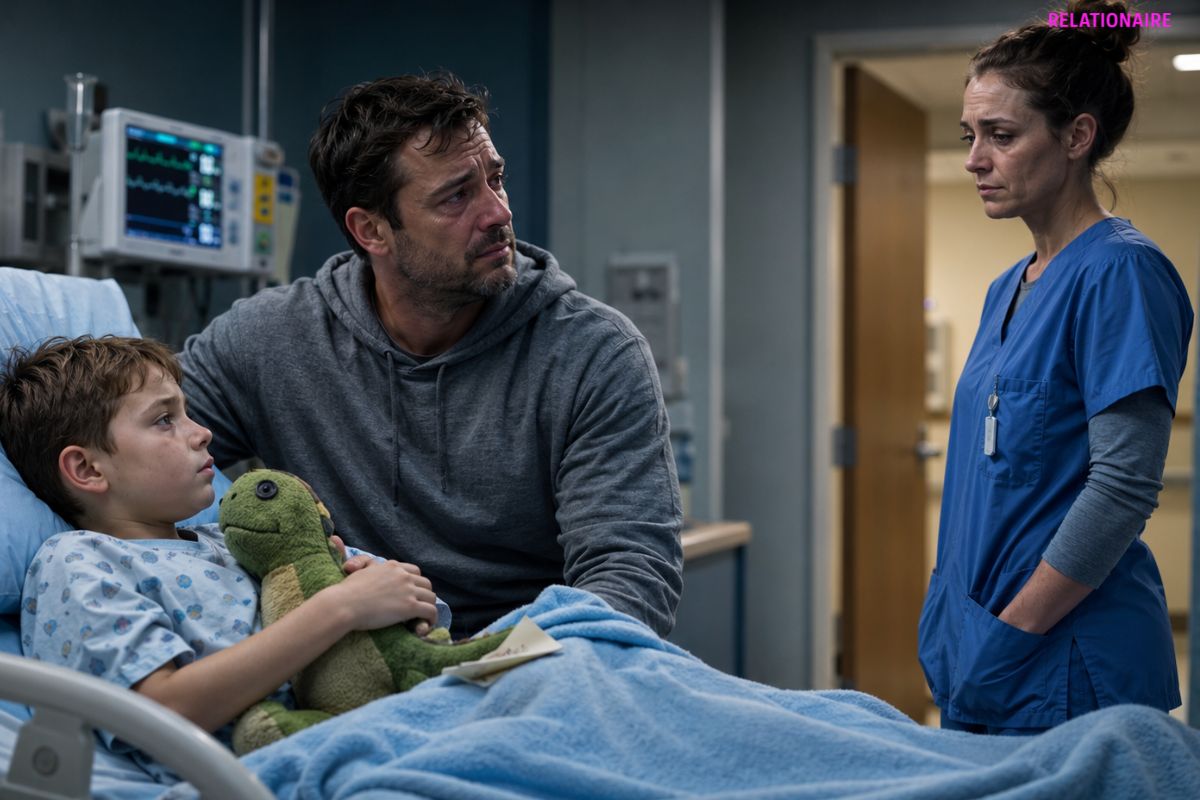
And when my eight-year-old son, Eli, tried to hand her his stuffed dinosaur, she only looked at it for half a second and said, “Keep it with you until they say otherwise.”
No smile.
No warm voice.
Nothing.
Eli pulled the dinosaur back to his chest and looked at me.
I hated her right then.
Maybe that sounds unfair.
But when you are a widowed father standing in a hospital room with your only child in a gown too big for his body, unfairness comes easily.
Eli had been complaining about stomach pain for weeks. Doctors had used calm voices and careful phrases. Nothing dramatic. Nothing anyone wanted to frighten him with. The surgery was supposed to be routine. Necessary, but routine.
Still, when you have already watched one hospital bed take away your wife, the word “routine” does not comfort you as much as people think it should.
It just sounds like something adults say before the world changes.
Eli sat on the bed swinging his small feet, his dinosaur tucked under one arm. He had named it Captain Pickle when he was four. One of its button eyes had been sewn back on twice by his mother.
Before she got sick.
Before our house became too quiet.
Before Eli started sleeping with my old sweatshirt because it still smelled, somehow, like the laundry soap she used.
That morning, he was trying hard not to cry.
I could see it in the way his mouth kept twisting.
I could see it in the way he kept asking the same questions.
“Will I wake up fast?”
“Yes.”
“Will Dad be there?”
“As soon as they let me.”
“Will Captain Pickle wait for me?”
“Right by your pillow.”
Then Maren came in.
She washed her hands, checked his bracelet, confirmed his name and date of birth, then glanced at the dinosaur again.
“Is that staying with him?” I asked.
“If it’s cleared by the team,” she said.
“That’s not really an answer.”
Her eyes moved to mine.
“It’s the answer I can give right now.”
Eli looked between us.
I should have let it go.
I know that now.
But grief makes a man sensitive to every unkind tone. It makes him hear threat where there is only procedure. It makes him want the world to be gentle because home has already been cruel.
“He’s scared,” I said.
“I know,” Maren replied.
But she said it so flatly that it made me angrier.
“Then maybe act like it.”
The room went still.
Eli froze.
Maren looked at me for one second too long. Not angry. Not embarrassed.
Just still.
Then she turned back to my son.
“Eli,” she said, “when the anesthesiologist comes, they’ll explain the mask. You may feel sleepy fast. Your dad will wait close by. You don’t need to answer every adult if you feel tired. You can squeeze the blanket instead.”
Eli swallowed.
“Will it hurt?”
“Not the sleeping part.”
I waited for her to add something soft.
Something comforting.
She did not.
She adjusted the blanket over his knees and said, “Don’t waste your energy pretending you’re not scared.”
Eli’s face changed.
His eyes filled.
I stepped forward.
“What did you just say to him?”
Maren did not look at me.
She looked only at Eli.
“Being scared is not the same as being weak,” she said. “You can be scared and still do hard things.”
Then she left the room.
Eli turned his face into Captain Pickle and started crying.
Not loud.
Not dramatic.
Just the small, broken kind of crying that children do when they have been holding too much in their little bodies.
And I saw red.
“She had no right,” I said to the nurse at the desk five minutes later.
The young nurse looked uncomfortable.
“I’m sorry. What happened?”
“She frightened him. He was holding it together until she came in with that stone face and told him not to pretend.”
The young nurse opened her mouth, then closed it.
That made me angrier.
“I want her kept away from my son.”
A man in blue scrubs behind the desk glanced up.
The young nurse nodded carefully. “I’ll let the charge nurse know.”
“Good.”
I went back to Eli’s room, trying to slow my breathing before he saw me.
He had stopped crying by then.
He was sitting up again, red-eyed, Captain Pickle tucked under his chin.
“Dad?”
“Yeah, buddy?”
“I think Nurse Maren is sad.”
That stopped me.
“What?”
“She didn’t say it,” he whispered. “But her eyes look like the hallway at night.”
I almost laughed, because it sounded like something his mother would have said.
Instead, I sat beside him and kissed his hair.
“You don’t have to worry about grown-ups today.”
He nodded.
But he kept looking at the door.
The surgery team came not long after. Everything moved faster than I wanted. Papers. Questions. A pen shaking in my hand. Eli’s small fingers gripping mine. Someone saying we could walk with him until the doors.
Maren did not come back.
I was glad.
At least, I thought I was.
When they wheeled Eli away, he tried to smile at me.
I tried to smile back.
Then the doors closed, and I stood there like a man who had just handed his whole life to strangers.
I spent the next hour in the waiting area holding a paper cup of coffee I never drank. Parents came and went. A toddler cried over a missing sock. A grandmother prayed into folded hands. A wall clock moved slowly enough to feel cruel.
Finally, the surgeon came out and told me the words every parent waits to hear.
“He did well.”
My knees almost gave out.
Eli was sleepy when they let me see him. Pale, but safe. Breathing softly. Captain Pickle was tucked beside his shoulder.
I sat next to him and cried with my hand over my mouth so I would not wake him.
That was when I noticed the blanket.
It was not the thin hospital blanket from earlier.
It was softer. Blue. Fleece. The kind they kept for children who were cold after surgery.
I pulled it gently higher over Eli’s chest.
Something slipped from the fold near his dinosaur.
A small piece of paper.
Folded once.
Then again.
My first thought was that it was a medication label or some instruction sheet.
But when I picked it up, I saw my son’s name written on the outside.
ELI.
In careful handwriting.
I looked toward the door.
No one was there.
My fingers tightened around the note.
And underneath Eli’s name, in smaller letters, someone had written:
For his dad, but only after he wakes up.
PART 2
I did not open the note right away.
That surprises people when I tell them.
They think curiosity would win.
But fear won first.
There are some pieces of paper a parent learns to distrust. Lab reports. discharge summaries. forms with too many blank lines. Notes handed over by people with careful faces.
So I sat there holding that folded note while Eli slept, listening to the soft beep of the monitor and the wheels of carts passing in the hallway.
His eyelashes rested on his cheeks.
Captain Pickle lay under one hand.
His mother used to say Eli looked younger when he slept. Like all his little defenses fell away and you could see the baby he had been.
I rubbed my thumb over the folded paper.
For his dad, but only after he wakes up.
It bothered me.
It felt private. Intentional.
And it had to be from Maren.
I knew that before I opened it.
There was something about the handwriting. Neat. Controlled. No wasted motion.
I put the note in my pocket.
Not because I wanted to respect the instruction.
Because I did not want to be wrong yet.
When Eli woke, his first word was not “Dad.”
It was “Pickle.”
I placed the dinosaur in his arms.
He squeezed it weakly.
Then his eyes found mine.
“Did I do it?”
I leaned down and pressed my forehead to his.
“You did it.”
His smile was tiny, but real.
A nurse came in to check on him. Not Maren. A different one, warm-faced and quick to praise him.
“You were such a champ.”
Eli nodded, but his eyes moved to the door.
“Where’s Nurse Maren?”
The warm-faced nurse paused.
“She’s on the floor.”
“Can she come?”
I felt something twist in my chest.
“Eli,” I said gently, “you don’t need to see her.”
His brow creased.
“But I want to say thank you.”
I stared at him.
“For what?”
He looked down at the blanket, then at Captain Pickle.
“She told them he could come.”
I thought I had misheard him.
“What?”
“She told the sleep doctor Captain Pickle was clean because she put him in a bag thing. She said he was my brave buddy.”
His voice was scratchy. Soft.
“She also told me Mommy’s sweatshirt could stay under my pillow if I didn’t show the doctors too much.”
My hand went still.
His mother’s sweatshirt.
I had folded a piece of it into his hospital bag that morning. Not the whole sweatshirt, just the cuff. Eli kept it when he was scared. It was worn soft from his fingers.
I had forgotten it in the side pocket.
I had not told anyone.
“How did she know about that?” I asked.
Eli blinked slowly.
“She saw me touch my pocket.”
That was all he said.
She saw me touch my pocket.
Noticed.
Understood.
Protected.
The note in my pocket suddenly felt heavier.
When the nurse left, I asked Eli if I could open it.
He nodded, already drifting.
I unfolded it carefully.
There were only seven lines.
Mr. Carter,
Eli hides fear by asking practical questions.
He touches his right pocket when he needs his mother.
His dinosaur helps him answer when he is overwhelmed.
Please do not make him be brave too loudly.
Quiet works better for him.
He asked if fathers get scared too.
I told him yes, but some fathers stay anyway.
—M. Walsh
I read it once.
Then again.
By the third time, the words had blurred.
Please do not make him be brave too loudly.
That sentence found something in me I did not know was still bleeding.
Since my wife, Anna, died, I had praised Eli for being strong every time he did not cry.
When he put away her shoes.
When he walked past her empty chair.
When he started second grade with his hair combed wrong because I still could not do the part the way she did.
“You’re so brave, buddy.”
I had said it because I thought it helped.
Maybe sometimes it did.
But maybe sometimes I had asked too much from a child who was only trying not to scare me.
I folded the note and held it in my lap.
For a while, I could not move.
Later that afternoon, when Eli was sleeping again, I went looking for Maren.
I found the young nurse from the desk near the supply room.
“Is Nurse Walsh here?”
Her expression changed just enough to make me ashamed.
“She’s charting.”
“I need to speak to her.”
“If this is about earlier—”
“It’s not a complaint.”
She studied me, then pointed down the hall.
“Room twelve is empty. She’s in there.”
I found Maren standing beside a bed with no patient in it, entering notes into a computer. The room smelled faintly of disinfectant and apple juice. A child’s drawing had been taped to the wall by someone and forgotten there.
She did not turn around when I stepped in.
“I know you asked that I not be assigned to your son,” she said.
Her voice was quiet.
“I did.”
“I respected that.”
“I know.”
She clicked something on the screen.
“I came to say I was wrong.”
Her fingers stopped.
I had imagined this moment with anger still in it. Or embarrassment. Maybe some stiff apology exchanged between adults who both wanted to escape.
But standing there with her back to me, I suddenly saw how tired she was.
Not rude tired.
Not impatient tired.
The kind of tired that lives behind the bones.
“You helped him,” I said. “In ways I didn’t see.”
She turned then.
Her face did not soften.
But her eyes did.
“Eli helped himself.”
“No. You noticed him.”
She looked down at the keyboard.
“I notice all of them.”
There was no pride in it.
Only fact.
“I read the note.”
Her shoulders tightened.
“I asked you to wait until he woke.”
“I did.”
She nodded once.
A silence opened between us.
Then I said the wrong thing again.
“I thought you didn’t care.”
I expected her to defend herself.
She did not.
She only looked past me toward the hallway, where a child laughed once and then coughed.
“Caring is not always useful if the child needs calm,” she said.
“That sounds like something people say when they don’t want to feel.”
Her eyes came back to mine.
This time, there was something in them that made me wish I had kept quiet.
“Feeling has never been my problem, Mr. Carter.”
The room changed.
Not loudly.
Just enough.
She reached for a stack of folded blankets on the chair and moved one onto the bed that did not need it.
Her hands were careful.
Too careful.
“I’m sorry,” I said.
She shook her head.
“You were afraid.”
“That doesn’t excuse it.”
“No,” she said. “But it explains more than people admit.”
I took the note from my pocket.
“Why did you write this?”
For a moment, she did not answer.
Then she looked at the old drawing on the wall. It was a rocket ship in blue crayon, crooked and bright.
“Because he reminds me of someone.”
“Who?”
Her lips pressed together.
Outside the room, an overhead announcement called for a doctor to the east wing. A cart rattled by. Somewhere nearby, a child asked for water.
Maren folded the blanket edge with her thumb.
“My son,” she said.
I felt the air leave my chest.
I had not known she had a child.
No one had said that.
No one whispering in the waiting room had mentioned a son.
She kept her eyes on the blanket.
“He used to ask practical questions too,” she said. “When he was scared. How long? How many needles? Where will you stand? Could his bear come? Would the lights stay on?”
I did not speak.
“He had the same way of trying to protect his father.”
The words landed softly, but they landed hard.
“Is he…?”
She turned toward me.
And for the first time since I had met her, her face changed.
Not into tears.
Not into drama.
Into something far more difficult.
A person holding a door shut from the inside.
Then she said, “There is something in your son’s blanket you haven’t found yet.”
My hand went cold.
“What do you mean?”
Maren looked toward Eli’s room.
“I put it there because he asked me to. But I think he meant it for you.”
PART 3
I walked back to Eli’s room slower than I had ever walked anywhere.
Maren did not follow me.
Maybe she knew it was not her moment to enter.
Maybe she knew fathers sometimes need to fall apart where their children cannot see.
Eli was awake when I came in, half sitting up, cheeks pinker now, watching cartoons with the sound low. Captain Pickle was tucked under one arm. The blue blanket covered his legs.
He smiled when he saw me.
“Hi, Dad.”
“Hi, buddy.”
My voice sounded strange.
I sat beside him and tried to look normal.
That is one of the quiet jobs of parenthood. You can have your heart breaking open, and still you ask if they want water.
“Do you want a sip?”
He nodded.
I held the paper cup to his mouth.
His hand trembled a little, but he drank.
Then I looked at the blanket.
“Eli,” I said carefully, “did you put something in here?”
His eyes widened.
Not with fear.
With the shy embarrassment of a child caught doing something tender.
“Nurse Maren helped,” he whispered.
I lifted the blanket gently.
At first, I saw nothing.
Then Captain Pickle shifted, and something small slipped from under his belly.
It was a sticker.
One of those hospital stickers they give children after blood pressure checks. A yellow star with a smiling face.
But on the back, in pencil, Eli had written crooked words.
For Dad when he gets scared.
I turned it over and over in my hand.
A sticker.
A child’s sticker.
The kind most people throw away before leaving the hospital.
My son had saved it for me.
“I asked her if dads get stickers,” Eli said.
I could not speak.
“She said not usually. Then she said sometimes dads need one more than kids.”
I put my hand over my eyes.
Eli’s small fingers touched my wrist.
“Dad?”
“I’m okay.”
“You’re doing the fake okay.”
It was such an Anna thing to say that I laughed and cried at the same time.
Eli looked relieved.
“I told Nurse Maren you do that.”
“You did?”
He nodded.
“I told her when Mommy died, everybody said I was brave, but you were sad in the laundry room. And I didn’t know if I should hug you because you said you were okay.”
The room blurred.
All those nights I had thought I was protecting him.
All those times I cried into towels with the dryer running so he would not hear.
He had heard anyway.
Children always hear the things we try to hide quietly.
“I’m sorry,” I whispered.
Eli frowned.
“For what?”
“For making you think you had to be brave for me.”
He looked down at Captain Pickle and rubbed the worn spot behind its sewn eye.
“I like being brave sometimes.”
“I know.”
“But not all the time.”
I took his hand.
“No. Not all the time.”
Later, Maren came to check his vitals.
She knocked first.
A small thing.
But it felt like respect.
Eli brightened when she entered.
“I gave him the sticker.”
Maren looked at me, then at the yellow star in my palm.
“I see that.”
“I told him dads can be scared.”
“That was true.”
Eli nodded seriously.
“And he cried a little.”
Maren wrote something on her chart.
“That can be true too.”
I expected embarrassment to rise in me.
It did not.
For once, I did not feel weak in front of my son.
I only felt seen.
When Maren finished, Eli said, “Did your kid have a bear?”
The question froze the room.
I started to stop him.
“Maren—”
But she lifted one hand slightly.
“It’s okay.”
She sat on the edge of the chair, not the bed. Still careful. Still contained.
“He had a rabbit,” she said.
Eli’s eyes grew soft.
“What was its name?”
“Toast.”
Eli smiled. “That’s a good name.”
“It was a very good rabbit.”
“Did he have surgery too?”
Maren looked at the monitor for a moment.
“Yes.”
“Was he scared?”
“Yes.”
“What did you say?”
Her throat moved.
“I told him the same thing I told you.”
“That scared doesn’t mean weak?”
She nodded.
Eli thought about this.
“Did he wake up?”
The question was so innocent that it hurt more than any cruel thing could have.
Maren’s face went still.
I leaned forward, ready to protect her from the answer.
But she spoke before I could.
“No, sweetheart,” she said softly. “He didn’t.”
Eli’s hand tightened around Captain Pickle.
“I’m sorry.”
“Thank you.”
“Is that why your eyes look like the hallway at night?”
Maren blinked.
For the first time, her mouth trembled.
Just once.
Then she smiled.
It was small.
Barely there.
But it changed her whole face.
“A little,” she said.
Eli lifted Captain Pickle toward her.
“You can hold him if you want.”
Maren did not move.
Then, slowly, she reached out and placed one hand over the dinosaur’s soft green back.
Not taking it.
Just touching it.
Like it was something holy.
I never forgot that.
I never forgot the way my son, still pale and tired in a hospital bed, offered comfort to the woman I had accused of having none.
We stayed two more days.
During that time, I learned things I had missed because I had been too busy judging.
Maren knew which children hated grape medicine and which ones needed their blankets warmed first. She knew which parents wanted details and which ones needed chairs brought closer without being asked. She kept extra crackers in the break room because siblings got hungry and nobody remembered them. She wrote down the names of stuffed animals so they would not be called “it.”
She still did not smile much.
She still did not make small talk.
But she was everywhere.
Quietly.
Precisely.
Holding pieces of families together without making them notice her hands.
On the morning Eli was discharged, he insisted on walking to the nurses’ station himself. Slowly, with one hand in mine and Captain Pickle under his arm.
Maren was there, reviewing a chart.
Eli held out a folded piece of paper.
“I made this for Toast.”
Maren took it.
It was a drawing of Captain Pickle and a rabbit with long ears sitting under a yellow star.
Above them, Eli had written:
Brave buddies can be scared.
Maren stared at it for a long time.
The nurses’ station grew quiet.
Then she folded the drawing carefully and slipped it into the pocket over her heart.
“Thank you, Eli.”
“You can keep it in your locker.”
“I will.”
He nodded, satisfied.
Then he looked up at me.
“Dad, say sorry better.”
Every nurse within earshot suddenly found something else to look at.
I deserved that.
I turned to Maren.
“I’m sorry,” I said. “Not just for complaining. For deciding who you were before I understood what you were carrying.”
She held my gaze.
Then she nodded.
Not dramatic forgiveness.
Not a speech.
Just a nod.
Sometimes that is all grace looks like.
Before we left, she handed me a small envelope.
“Open it at home,” she said.
Inside was the first note she had written about Eli, the one I had already read until the folds grew soft.
And beneath it, a second note.
Mr. Carter,
You are not failing him when he sees you cry.
You are teaching him that love does not disappear just because someone is gone.
Let him comfort you sometimes.
Children do not break from being trusted with tenderness.
They break from believing they must carry it alone.
—M. Walsh
I kept that note in my wallet for years.
Not because it fixed grief.
Nothing fixes grief like that.
But it changed the shape of our home.
After that, Eli and I stopped calling tears “bad days.” We called them missing days. We kept Anna’s sweatshirt in a drawer we could open without whispering. We gave Captain Pickle a place at the dinner table on hard anniversaries. Sometimes I cried in front of my son, and sometimes he leaned against me without saying anything.
Years later, when Eli was taller than me, we brought flowers to the pediatric floor on the anniversary of his surgery.
Maren still worked there.
Older. Same tight knot. Same steady shoes.
But in her locker, taped inside the door where almost no one could see it, was a child’s drawing of a dinosaur and a rabbit under one yellow star.
People still said she was cold sometimes.
I never corrected them with a lecture.
I just thought of a blue blanket.
A folded note.
A sticker saved for a scared father.
And a nurse who had learned to keep her grief quiet so frightened children could borrow her calm.
Some people love loudly enough for the whole room to notice.
And some love so quietly that you only understand it later, when you find what they left folded inside the blanket.