If you’ve already read part 1 of this story on Facebook, go here for Part 2!
PART 1
The first time Margaret found the photos standing straight again, she thought she was losing her mind.
Her husband’s bedside table had become a tiny museum of the life he could not wake up to.
Three framed photos.
One of their wedding day, where Henry’s hair was still black and his grin looked almost too big for his face.
One of their two sons standing barefoot in the backyard, holding up fish they had barely caught.
And one of their granddaughter Lily, missing her front teeth, holding a crayon drawing that said, Wake up, Grandpa.
Every morning, Margaret placed them carefully beside Henry’s bed in Room 412.
Every afternoon, one of them would be tilted.
Sometimes the wedding photo leaned against the water pitcher.
Sometimes Lily’s picture had slipped flat on its face.
Sometimes the frame with their boys slid so close to the edge that Margaret’s stomach dropped when she walked in.
And every evening, when she returned from the cafeteria with bad coffee and a dry sandwich she never finished, the photos were perfect again.
Not just picked up.
Perfect.
Wedding photo in the middle.
Boys on the left.
Lily on the right.
All three angled toward Henry’s face, like they were sitting with him.
“Must be one of the nurses,” Margaret whispered the first few times.
The nurses were kind enough. Busy, but kind.
They checked monitors, changed bags, adjusted pillows, softened their voices when they spoke to her. They said things like, “Stroke recovery can be unpredictable,” and “We look for small signs,” and “Talk to him. Hearing can be a comfort.”
So Margaret talked.
At first, she talked all day.
She told Henry the weather.
She told him Lily had lost another tooth.
She told him the neighbors had finally trimmed that terrible hedge he always complained about.
She told him their youngest son, David, had flown in from Ohio and cried in the parking garage where nobody could see.
She told him she was angry.
Then sorry.
Then scared.
Then quiet.
By the second week, Margaret had started speaking less.
There were only so many things a woman could say to a man who had not opened his eyes.
Only so many ways to say, “I’m here.”
Only so many mornings she could button the same blue cardigan, drive the same road, pass the same gift shop full of balloons that said Get Well Soon, and sit in the same vinyl chair while the man who used to whistle through his teeth lay still beneath a thin hospital blanket.
Henry had always been the loud one.
He sang in grocery aisles.
He talked to dogs through fences.
He called strangers “friend” and meant it.
Now the room hummed louder than he did.
On the fifteenth day, Margaret walked in and found Lily’s photo polished so clean she could see the window reflected in the glass.
She stared at it.
A small thing.
A ridiculous thing, maybe.
But her throat tightened.
Because that morning, she had been too tired to clean anything.
She had noticed the fingerprint on Lily’s frame and thought, I’ll wipe it later.
Later had become the word she used for everything.
Later I’ll eat.
Later I’ll sleep.
Later I’ll cry.
Later I’ll imagine what happens if Henry never comes home.
A nurse came in to check Henry’s IV.
Margaret stood quickly.
“Excuse me,” she said. “Do you know who keeps fixing the photos?”
The nurse glanced at the bedside table. “Fixing them?”
“They fall sometimes. Or slip. But someone keeps arranging them.”
The nurse smiled gently. “That’s sweet. Maybe Anna on day shift?”
“Could you ask her?”
“I can.”
But Anna only shook her head when Margaret asked.
“No, honey,” she said, tucking the blanket under Henry’s shoulder. “I wish I could take credit.”
Another nurse guessed it might be the volunteer who delivered newspapers.
The volunteer said no.
A young doctor said perhaps housekeeping moved them while cleaning.
Margaret nodded, though the idea made her uneasy.
Not because it was wrong for housekeeping to touch them.
Because whoever it was had touched them with care.
And somehow, not knowing who made the kindness feel heavier.
On day eighteen, Margaret arrived earlier than usual.
The hallway outside Room 412 was pale with morning. A food cart rattled somewhere near the elevators. Someone laughed softly at the nurses’ station, then stopped when a call light chimed.
Margaret paused outside Henry’s door.
Inside, she heard a woman’s voice.
Not a nurse’s voice.
Not rushed.
Not clinical.
Low and soft, like someone speaking beside a sleeping child.
“You’ve got a beautiful family, Mr. Henry,” the woman said. “Your granddaughter drew you sunshine again. That’s good. A man needs sunshine.”
Margaret froze.
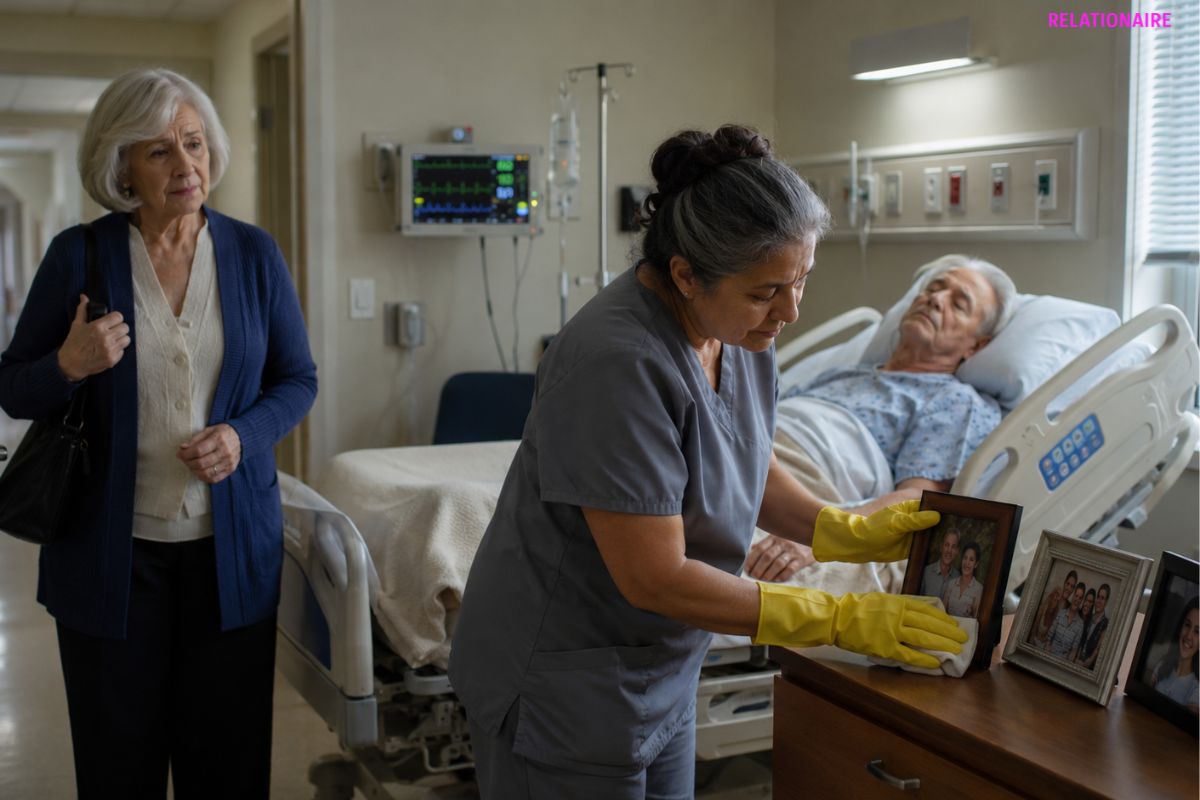
Through the half-open door, she saw a cleaner standing beside Henry’s bed.
The woman was small, maybe in her late fifties, with silver threaded through dark hair pulled into a bun. She wore gray housekeeping scrubs, yellow gloves, and soft black shoes that made almost no sound.
A cleaning cart sat near the wall.
The woman held Lily’s photo in one hand and a cloth in the other.
She wiped the frame slowly.
Not like she was doing a task.
Like she was holding something fragile.
Then she set it down at the perfect angle, facing Henry.
“You keep looking at them,” the cleaner whispered. “Even with your eyes closed. They’re still here.”
Margaret stepped into the room.
“What are you doing?”
The cleaner startled so hard the cloth dropped from her hand.
Her face changed instantly. The softness disappeared. She lowered her eyes.
“I’m sorry,” she said quickly. “I was only cleaning.”
Margaret looked at Henry.
Then at the photos.
Then at the woman’s gloved hands.
“You’ve been touching our pictures?”
The cleaner swallowed.
“Yes, ma’am. Just to dust them.”
“You’ve been talking to my husband?”
The woman’s eyes flickered toward Henry, then back to the floor.
“I didn’t mean any disrespect.”
Margaret felt something hot rise in her chest.
It wasn’t anger exactly.
It was fear.
It was exhaustion.
It was the unbearable feeling of a stranger doing something intimate in the place where Margaret already felt helpless.
“You don’t know him,” Margaret said.
The cleaner nodded once, small and wounded.
“No, ma’am.”
“Then why would you talk to him like that?”
The room seemed to shrink around them.
The monitor kept its quiet rhythm.
The cleaner picked up the fallen cloth and folded it in her hand.
For a moment, Margaret thought the woman would apologize again and leave.
Instead, the cleaner looked at Henry’s still face with such tenderness that Margaret forgot to breathe.
Then she said, barely above a whisper,
“Because once, no one talked to my husband at all.”
Margaret stared at her.
The cleaner reached slowly into the pocket of her gray scrub top.
Her fingers trembled as she pulled out a small, worn photograph with bent corners.
And just before Margaret could see the face in it, the cleaner turned it over in her palm.
PART 2
The cleaner held the old photograph like it could still break.
Margaret said nothing.
She had come prepared to defend Henry.
His room.
His dignity.
Their life together.
But the woman standing beside the bed did not look like someone who had stolen a private moment.
She looked like someone who had carried one for years.
“My name is Rosa,” the cleaner said quietly. “Rosa Alvarez.”
Margaret’s hand tightened around the strap of her purse.
“I didn’t ask.”
“I know.”
Rosa nodded once, accepting the sharpness without flinching.
That made Margaret feel worse.
Rosa looked down at the photograph again. Her thumb moved over the back of it, over a crease worn white from years of touching.
“My husband’s name was Mateo,” she said. “He was a bus mechanic. Big hands. Always smelled like soap and motor oil. He could fix anything except the kitchen drawer that stuck.”
Margaret did not want to listen.
That was the truth.
She did not want another sad story in a room already crowded with fear.
She did not want to know that the woman who wiped spills and emptied trash had a grief with a name.
Because knowing would make it harder to stay angry.
Rosa turned the photograph around.
It showed a younger woman and a man standing in front of a yellow house. The woman was laughing. The man wore a short-sleeved shirt and had one arm around her shoulders.
The picture was faded, but the happiness in it had survived.
“He had an accident,” Rosa said. “Not here. Another hospital. Long time ago.”
Margaret’s face softened before she could stop it.
“He was unconscious?”
“For six weeks.”
The number landed between them.
Six weeks.
Margaret had been counting days like coins in an empty pocket. Eighteen days had felt impossible.
Six weeks felt like another country.
“I sat beside him every day,” Rosa said. “Same chair. Same coffee. Same sweater because hospitals are always too cold.”
Margaret glanced down at her own blue cardigan.
Rosa noticed, but she did not smile.
“At first, people came,” she continued. “His brothers. Friends from work. Neighbors. They brought food. They said prayers. They told stories.”
Her voice thinned.
“Then life kept moving for them. It has to. I understood. But after a while, it was mostly me. Nurses came in and out. Doctors talked over him. People changed sheets, checked machines, wrote numbers.”
She looked at Henry.
“But almost nobody talked to Mateo.”
Margaret sat slowly in the chair beside the bed.
The chair sighed under her.
Rosa stayed standing, as if she did not feel she had permission to take up space.
“I was afraid,” Rosa said. “Afraid he was trapped somewhere quiet. Afraid he thought I had left. Afraid the room felt empty when I went downstairs to eat.”
Margaret looked at the three photos on the table.
Wedding.
Boys.
Lily.
All facing Henry.
“I started bringing pictures,” Rosa said. “Our wedding. Our daughter’s school photo. His old dog, Chico. I put them where he would see them if he opened his eyes.”
She laughed once, but there was no joy in it.
“The first week, they kept falling. Someone would move them to clean. Or turn them away. One day I came back and found all of them stacked flat on the windowsill.”
Margaret felt a small pinch behind her ribs.
Rosa’s fingers closed around the old photograph.
“I know they didn’t mean harm. They were busy. Everyone was busy. But I remember standing there, looking at those pictures facedown, and feeling like he had been forgotten in his own room.”
The words entered Margaret quietly.
Not with drama.
With recognition.
Rosa looked at her then.
“So I promised myself, if I ever saw another family doing what I did—bringing photos, bringing little pieces of home—I would keep them standing.”
Margaret’s eyes filled, but she blinked hard.
“Why didn’t you just tell me?”
“I didn’t want to bother you.”
“You were talking to my husband.”
“Yes.”
“Every day?”
Rosa hesitated.
“Only when I clean this room.”
“What do you say?”
Rosa looked embarrassed now.
“Small things.”
“What things?”
Rosa glanced at Henry again.
“I tell him his wife came early. I tell him she fixes his blanket even when it’s already fixed. I tell him his granddaughter has good handwriting. I tell him the boys look like they used to cause trouble.”
A sound came out of Margaret that was almost a laugh and almost a sob.
“They did.”
Rosa’s mouth lifted gently.
“I thought so.”
The room settled into a silence that was not empty.
Margaret looked at Henry’s face. His gray hair had been combed back that morning. She had done it herself with a little plastic comb from the admission bag. He hated having his hair flat, but it was the best she could do.
“I thought you were crossing a line,” Margaret said.
“I understand.”
“I thought you were pretending to know him.”
“No, ma’am.”
Margaret looked down at her hands. The skin around her wedding ring was loose now. She twisted the ring without meaning to.
“I think I was angry because you were doing something I stopped being able to do.”
Rosa’s eyes softened.
Margaret hated how quickly tears came.
“I used to talk all day,” she said. “Now I sit here and listen to the machines. I look at him and I don’t know where to put all the things I’m afraid of.”
Rosa did not rush to comfort her.
That was her kindness.
She let Margaret speak without trying to tidy the pain.
“I’m scared he’ll wake up different,” Margaret whispered. “And I’m scared he won’t wake up at all. And sometimes, God forgive me, I’m scared he can hear me being scared.”
Rosa pulled off her yellow gloves carefully, finger by finger.
Then she stepped closer, but not too close.
“My Mateo woke up,” she said.
Margaret looked up fast.
Rosa’s expression changed.
“He woke up, but not the way we imagined. He couldn’t speak at first. Couldn’t move one side. He had to learn how to swallow, how to hold a spoon, how to write his name. We were grateful. We were exhausted. Sometimes both in the same minute.”
Margaret nodded, tears sliding now.
“How long did he live after?”
Rosa looked at the photograph.
“Eleven years.”
Margaret covered her mouth.
“Eleven years,” Rosa repeated. “Not easy years. Not storybook years. But real years. Our daughter got married. He met both grandsons. He learned to say my name again.”
Her voice broke on that last part, just slightly.
Margaret heard it.
“When he finally passed,” Rosa said, “it was quiet. At home. His photos were still on the dresser.”
A tear dropped onto the back of Rosa’s hand.
She wiped it quickly, almost ashamed.
“I’m sorry,” Margaret whispered.
Rosa shook her head.
“No. I’m sorry I frightened you.”
Margaret looked at the old photograph again.
“Do you carry that with you every day?”
Rosa smiled sadly.
“In this pocket. Always.”
Henry’s monitor continued its patient rhythm.
Outside the room, wheels squeaked. A nurse called for warm blankets. Somewhere nearby, a child complained about grape gelatin.
Life kept moving.
Inside Room 412, two women stood on either side of a quiet man, both knowing what it meant to love someone who could not answer.
Then Henry’s hand moved.
Not much.
Not enough to be certain.
But enough that Margaret stopped breathing.
His fingers twitched against the sheet.
Rosa saw it too.
Margaret leaned forward.
“Henry?”
The fingers moved again.
This time, they curled weakly toward the bedside table.
Toward the photos.
Margaret grabbed his hand, trembling so hard she could barely hold on.
“Henry, I’m here. I’m right here.”
Rosa stepped back toward the door.
“I’ll get the nurse.”
But before she left, Henry’s eyes fluttered.
Once.
Twice.
Margaret sobbed his name.
His eyelids opened just a sliver.
His gaze did not find Margaret first.
It drifted, unfocused, toward the bedside table.
Toward the three straightened frames.
And when his eyes stopped on Lily’s drawing, one tear slid slowly from the corner of his eye.
PART 3
For a long moment, nobody in Room 412 moved.
Not Margaret.
Not Rosa.
Not even the air.
Henry’s eyes were barely open, cloudy and tired, but they were open.
Margaret bent over him, both hands wrapped around his.
“Henry,” she cried softly. “It’s me. It’s Maggie.”
His lips moved.
No sound came out.
A nurse rushed in, then another. Questions filled the room, gentle but urgent.
“Mr. Whitaker, can you hear me?”
“Henry, squeeze my hand.”
“Can you follow my finger?”
Margaret backed away only when they asked her to. Even then, she kept one hand on his blanket, as if a corner of fabric could keep him from slipping away again.
Rosa stood near the door, half-hidden behind her cleaning cart.
She did not come closer.
She did not claim the moment.
She simply watched Henry’s eyes move from face to face, then back to the pictures.
The wedding photo.
The boys.
Lily’s drawing.
His fingers trembled again.
Margaret saw.
“He wants the picture,” she said.
The nurse looked at the table. “Which one?”
Margaret knew without asking.
She picked up Lily’s frame and held it where Henry could see.
His eyes fixed on the crooked crayon sun.
His mouth moved again.
This time there was a sound.
Small.
Rough.
Almost nothing.
“Sun.”
Margaret broke.
She lowered her forehead to his hand and cried in a way she had not let herself cry in eighteen days.
The nurses smiled through their professional calm. One of them wiped her own cheek quickly and pretended she hadn’t.
Rosa turned away.
Margaret saw her.
Even through tears, she saw the cleaner’s shoulders shake once.
Just once.
Then Rosa pushed her cart quietly into the hall.
In the hours that followed, everything changed and nothing changed.
Henry was awake, but fragile.
He slept more than he spoke.
His words came slowly, as if each one had to climb a hill.
The doctors were careful. Hopeful, but careful.
“There will be evaluations,” they said.
“Therapy.”
“Good signs.”
“Long road.”
Margaret did not care about long roads anymore.
She had walked one already.
That evening, when the room finally emptied, she found Rosa in the hallway outside the supply closet, folding fresh trash liners with red-rimmed eyes.
“Rosa.”
The cleaner turned quickly.
“Yes, ma’am?”
Margaret hated the “ma’am” now. It sounded like a wall.
“Please don’t call me that.”
Rosa looked unsure.
“Margaret, then.”
Margaret nodded.
For a second, neither woman spoke.
Then Margaret held out Lily’s framed drawing.
Rosa’s face tightened. “Did something happen to it?”
“No.”
Margaret’s voice trembled.
“I wanted you to clean it.”
Rosa stared at her.
Margaret gave a small, tearful laugh.
“I know that sounds silly.”
“No,” Rosa said softly. “It doesn’t.”
Rosa took the frame with both hands.
She wiped it gently with the corner of a clean cloth.
Not because it was dirty.
Because some rituals are not about dirt.
When she handed it back, Margaret did not take it right away.
“He saw it because of you,” Margaret said.
Rosa shook her head. “He saw it because he loves you.”
“He saw it because you kept it standing.”
The words settled between them.
Rosa looked down.
“I only did a small thing.”
Margaret’s voice became firm.
“No. You did the thing I was too tired to notice mattered.”
Rosa pressed her lips together.
Margaret stepped closer.
“Will you come say hello to him?”
Panic crossed Rosa’s face.
“Oh, I shouldn’t. He needs rest. Family should—”
“You are part of why this room still felt like family.”
Rosa looked as if she had been handed something too heavy.
Then slowly, she followed Margaret back into Room 412.
Henry was awake.
His eyes shifted toward the door.
Margaret sat beside him and touched his arm.
“Henry, this is Rosa.”
Rosa stood near the foot of the bed, hands folded, suddenly shy.
“She’s the one who kept the photos straight.”
Henry blinked.
Margaret leaned close. “The pictures, sweetheart. Every day.”
Henry’s gaze moved to Rosa.
His mouth worked.
Rosa stepped closer, her eyes full.
“Hello, Mr. Henry,” she whispered. “You gave us a scare.”
For a moment, it seemed he might not answer.
Then his fingers lifted from the sheet.
Not far.
Just enough.
Rosa looked at Margaret, uncertain.
Margaret nodded.
Rosa reached out and took his hand carefully, as if touching a sleeping bird.
Henry’s thumb moved against her fingers.
His lips shaped a word.
“Thank.”
It came out broken.
It came out barely there.
But it was enough.
Rosa covered her mouth with her free hand.
Margaret looked away to give her privacy, though they were all standing in the same light.
After that, Rosa became part of their days in the quietest way.
She still emptied trash.
Still wiped counters.
Still mopped carefully around wires and chair legs.
But now Margaret saved a few minutes for her.
Some mornings, they talked about Mateo.
Some afternoons, Rosa brought Henry a paper cup of water and said, “Your granddaughter’s sun is still shining.”
Henry always looked toward the frame when she said it.
Little by little, he began to return.
Not all at once.
Not like the movies.
He returned in pieces.
A squeeze.
A nod.
A crooked smile when Margaret complained about hospital coffee.
The first time he whispered “Maggie,” Margaret had to sit down because her knees forgot how to hold her.
The first time Lily visited after he woke, she stood in the doorway clutching a new drawing.
She was brave until Henry lifted two fingers at her.
Then she ran to the bed crying.
“I made you another sun,” she said.
Henry looked at it.
Then at Margaret.
Then at Rosa, who was pretending to wipe the windowsill.
“Two,” he whispered.
Lily frowned. “Two what?”
Henry’s mouth curled faintly.
“Suns.”
Rosa laughed then.
A soft laugh.
A sound with years inside it.
Three weeks later, Henry was moved to rehab.
The morning he left Room 412, Margaret packed the photos into a tote bag with his slippers, discharge papers, and the blue cardigan she had practically lived in.
Before the transport team came, she found Rosa by the elevators.
“I have something for you,” Margaret said.
Rosa looked startled. “For me?”
Margaret handed her a small envelope.
Inside was a copy of Lily’s drawing.
The yellow sun.
The wobbly letters.
Wake up, Grandpa.
Only Lily had added something new at the bottom in purple crayon.
Thank you, Miss Rosa.
Rosa stared at it for a long time.
Her lips pressed together.
Margaret touched her arm.
“I asked Lily what she wanted to say to you. That was all her.”
Rosa held the paper to her chest.
“I’ll put it in my locker,” she whispered.
“With Mateo?”
Rosa’s eyes lifted.
Margaret smiled gently.
“With Mateo.”
When Henry’s wheelchair rolled past, Rosa stepped forward.
He looked smaller in the chair, thinner, still wrapped in the tiredness of survival.
But he was awake.
He was there.
Margaret placed the tote bag on his lap, and one corner of Lily’s framed drawing peeked out from the top.
Rosa bent slightly.
“Take care, Mr. Henry.”
Henry looked at her.
His hand moved slowly to the tote bag.
He touched the frame, then pointed weakly at Rosa.
Margaret leaned down to hear him.
His voice was rough, but clear enough.
“Keep… standing.”
Rosa’s face crumpled.
Margaret cried too.
Even the young transporter looked down at his shoes.
Rosa nodded.
“I will,” she said. “I promise.”
Months later, Margaret would still think about Room 412.
Not because of the machines.
Not because of the fear.
Not even because Henry opened his eyes there.
She would remember the small table beside the bed.
Three photos facing a man who could not answer.
A cleaner with yellow gloves and an old picture in her pocket.
And the quiet truth that love is not always loud enough to be noticed.
Sometimes it is a frame turned gently toward the light.
Sometimes it is a stranger speaking softly when the family has run out of words.
Sometimes the person holding everything together is the one no one thought to thank.