
If you’ve already read part 1 of this story on Facebook, go here for Part 2!
PART 1
The first time Mara heard the cleaner humming beside her husband’s hospital bed, she wanted to ask the woman to stop.
Not because the song was loud.
Because it was his.
It floated softly through Room 418, barely louder than the squeak of rubber soles and the whisper of a mop across tile.
You are my sunshine, my only sunshine…
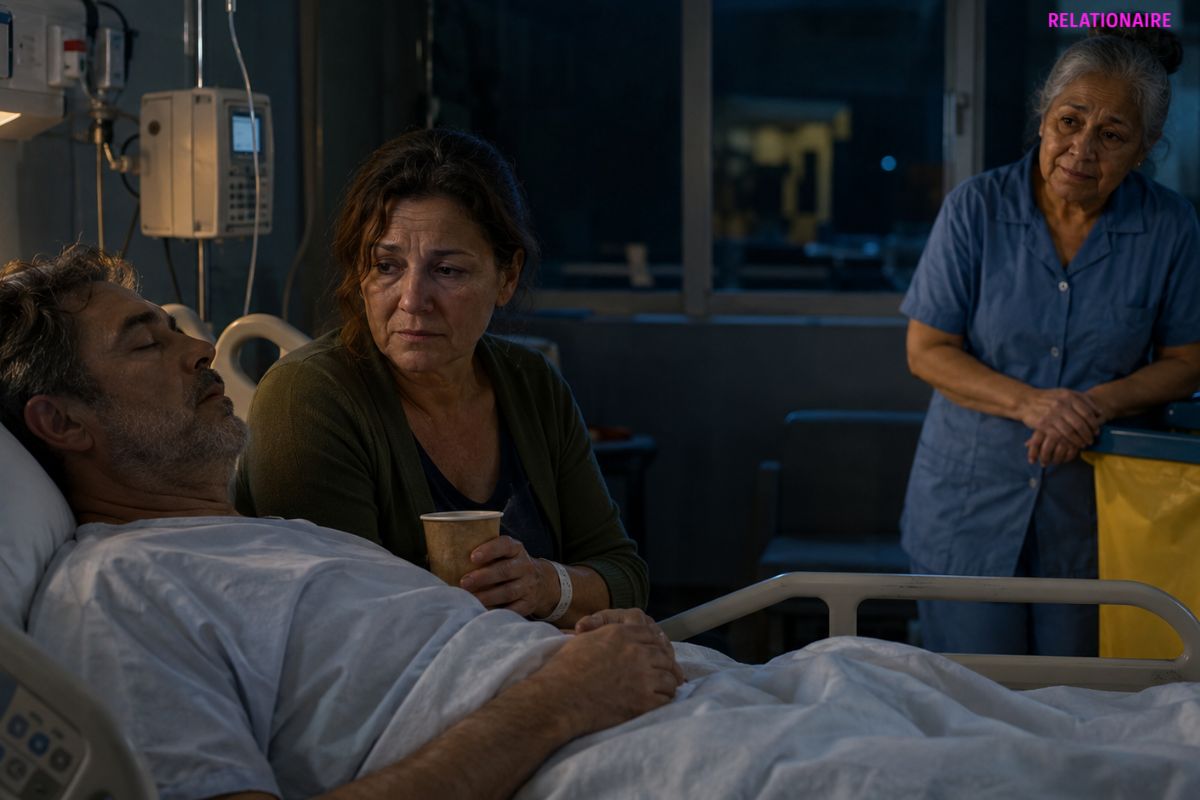
Mara’s fingers tightened around the paper cup of water she had not touched in three hours.
Her husband, Eli, lay still beneath a thin white blanket, his face turned toward the window like he was listening to rain that wasn’t there. Tubes ran quietly beside him. Machines blinked in their patient rhythm. A folded visitor badge hung from Mara’s sweater, its corner curled from being held too many times.
The cleaner moved carefully around the room.
She was small and plain-looking, maybe in her late fifties, with gray threaded through a tight bun and a blue hospital uniform faded at the knees. Her name tag said Ruth.
She didn’t look at Mara much. She wiped the tray table, changed the trash liner, straightened the chair near the wall. Ordinary things. Invisible things.
But she kept humming.
Mara closed her eyes.
That song had belonged to Saturday mornings.
It had belonged to Eli standing on the front porch in an old sweatshirt, one foot on the ladder, one hand gripping the porch light while Mara stood below pretending not to worry.
“Don’t fall,” she would say.
And he would grin down at her, a screwdriver between his teeth, humming that same tune like he had all the time in the world.
When the light finally worked, he always sang one line out loud just to make her laugh.
You’ll never know, dear, how much I love you…
Then he’d tap the bulb and say, “See? Even the porch knows who it’s coming home to.”
Mara had not laughed in four days.
Four days since Eli collapsed in the driveway while carrying groceries.
Four days since she followed an ambulance through traffic with her hands shaking on the steering wheel.
Four days since doctors spoke in careful voices and nurses touched her shoulder too gently.
Now this stranger was humming their song while wiping fingerprints off the bed rail.
Mara opened her eyes.
“Could you please not do that?”
Ruth stopped moving.
The mop handle rested against her shoulder. Her eyes lifted, calm and tired.
“I’m sorry?”
“The humming,” Mara said, sharper than she meant to. “Could you not?”
Ruth’s face changed only a little. Not hurt exactly. More like she had been corrected before and had learned where to put the sting.
“Yes, ma’am,” she said.
The room went quiet except for the machines.
Too quiet.
Mara looked down at Eli’s hand, limp on the blanket. His wedding ring was loose now. She had been turning it with her thumb all morning, afraid it might slip off, afraid everything might.
Ruth finished cleaning without another sound.
Before leaving, she paused near the foot of the bed and looked at Eli. Not long. Not in a way Mara could accuse her of anything. But long enough that Mara noticed.
Then Ruth stepped out, pushing her cart down the hall.
Mara watched her go with a strange irritation sitting in her chest.
It wasn’t fair, she knew that.
The woman was only doing her job.
But grief makes small things feel personal. A song. A glance. A stranger’s soft voice in a room where you are trying not to fall apart.
That afternoon, Mara’s sister called.
“Did he wake up?”
“No.”
“Did the doctor say anything new?”
“No.”
“Did you eat?”
Mara looked at the untouched cafeteria sandwich on the windowsill. “A little.”
Her sister was quiet.
“Mara.”
“I’m fine.”
“You’re not.”
Mara rubbed her forehead. “A cleaner came in humming Eli’s song.”
“His song?”
“The porch light one.”
“Oh.”
That was all her sister said. Because she knew.
Everyone who loved Eli knew that song somehow. He hummed while fixing sinks, while stirring soup, while folding towels badly. He sang it when their daughter had fevers as a baby. He sang it into Mara’s hair the night they found out they couldn’t have another child.
It was silly.
It was old.
It was theirs.
Later that evening, Ruth returned.
Mara was half-asleep in the chair, Eli’s hand still in hers, when the soft wheel of the cleaning cart stopped outside the door.
Ruth stepped in carrying fresh towels.
This time she did not hum.
She moved silently, almost too silently, like she was trying not to exist.
Mara felt guilt touch her, then pushed it away.
“Night shift?” Mara asked, because the quiet had become uncomfortable.
Ruth nodded. “Most nights.”
“That must be hard.”
“It’s work.”
Mara expected her to leave it there.
But Ruth glanced toward Eli and said, “Some rooms are harder than others.”
Mara stiffened.
“Why?”
Ruth folded a towel and placed it on the cabinet. “People waiting. People hoping. Hard to clean around that without feeling like you’re stepping on something sacred.”
The words were simple.
Too simple.
Mara looked at her for the first time.
Ruth’s hands were thin, with swollen knuckles. One trembled slightly as she smoothed the towel’s edge.
Mara noticed the tremor. Ruth noticed Mara noticing and tucked that hand against her side.
Neither of them said anything.
The next day was worse.
Eli did not wake.
The doctor said words like “watch,” “response,” and “time.” Nurses adjusted monitors. A chaplain left a small card on the table. Mara placed it under the paper cup because she could not bear to look at it.
By evening, exhaustion had made everything blurry.
Mara stepped into the hallway to breathe.
That was when she heard it again.
The same song.
Not from Eli’s room.
From two doors down.
Ruth was inside another patient’s room, mopping slowly near the bed of an old man who kept pulling at his blanket. His daughter stood beside him, crying into her sleeve.
Ruth hummed low.
The old man’s hands stopped moving.
His eyes fluttered.
His daughter looked up, startled by the sudden calm.
Mara stood frozen in the hallway.
Ruth kept humming, soft as a hand on a shoulder.
You make me happy when skies are gray…
Mara felt heat rise into her face.
She had thought the song was too familiar.
Too careless.
Maybe even rude.
But now, watching Ruth hum to a frightened old man like she had done it a hundred times before, Mara realized the song had not belonged only to her.
Or maybe it had belonged to anyone who needed to be held together for one more minute.
Ruth came out of the room and saw Mara standing there.
For a second, neither woman moved.
Mara swallowed. “Why that song?”
Ruth gripped the handle of her cart.
Her trembling hand was worse tonight.
She looked down the hallway, then back at Mara.
“My son used to sing it,” she said quietly.
Mara’s breath caught.
Ruth reached into the pocket of her blue uniform and pulled out something small, folded, and worn soft from years of being touched.
A piece of paper.
She held it in both hands.
“This is why I remember every line,” Ruth said.
And before Mara could ask another question, Ruth unfolded it.
PART 2
The paper in Ruth’s hands had been folded so many times the creases looked permanent.
Mara should have looked away.
It felt private.
But Ruth held it between them like an offering, and Mara could not move.
Inside was a child’s drawing.
The colors had faded, but Mara could still make out a yellow sun in one corner, a stick-figure woman with a blue dress, and a boy beside her holding what looked like a mop twice his size.
Across the top, written in uneven letters, were the words:
Mommy cleans the scary rooms. Mommy sings the sun song.
Mara covered her mouth.
Ruth’s eyes stayed on the paper.
“He was seven when he drew this,” she said. “He thought every room in the hospital was scary. He hated the smell of disinfectant. Hated the beeping. Hated the white sheets.”
Mara did not ask what happened.
Some questions are too heavy to place in someone else’s hands.
Ruth folded the drawing carefully along the old lines.
“He used to get anxious at night,” she said. “Couldn’t sleep unless someone hummed. My mother sang that song to me. I sang it to him. Then, after he was gone, I couldn’t stand silence.”
The hallway seemed to shrink around them.
A nurse passed with a clipboard. A visitor slept curled into a chair by the window. Somewhere nearby, a vending machine dropped a bag of chips with a dull thud.
Life kept going in hospitals.
Even when someone’s world had stopped.
Ruth slid the drawing back into her pocket.
“At first, I only hummed because my hands shook too much if I didn’t,” she said. “Then I noticed patients calmed down. Families too, sometimes. So I kept doing it.”
Mara’s throat tightened.
“I’m sorry,” she said.
Ruth shook her head gently. “You didn’t know.”
“I snapped at you.”
“You were protecting something.”
Mara looked toward Eli’s room.
Protecting something.
Yes.
But maybe she had been protecting the wrong thing.
The song had felt like a locked drawer in her heart. Ruth had opened it without asking. Mara had not stopped to wonder if Ruth carried a drawer of her own.
That night, Mara did not sleep.
She sat beside Eli and told him about Ruth.
“You’d like her,” she whispered. “She’s quiet. But not empty quiet. The kind that’s been through things.”
Eli did not answer.
His chest rose and fell beneath the blanket.
Mara touched his ring.
“I was rude,” she said. “You would’ve made that face.”
She tried to make the face herself. Eli’s patient, disappointed, loving face. The one he used when she honked at slow drivers or threw away takeout containers he wanted to reuse.
It almost made her smile.
Almost.
Around midnight, the hallway settled into its strange overnight softness.
Lights dimmed. Voices lowered. Wheels still rolled, but slower. The whole hospital seemed to breathe through its mouth.
Ruth came by with clean pillowcases stacked on her cart.
She did not enter at first.
She stood at the doorway and knocked lightly, although the door was open.
Mara looked up. “You can come in.”
Ruth stepped inside.
For a minute, she worked in silence.
Mara watched her hands. The tremor came and went. It was worse when the room was very quiet.
“You can hum,” Mara said.
Ruth looked at her.
“I mean it.”
Ruth’s face softened. “Only if it helps.”
Mara glanced at Eli. “I don’t know what helps anymore.”
Ruth nodded like she understood that sentence too well.
Then she began.
Softly.
Not performance. Not comfort wrapped in a bow. Just a worn, familiar melody drifting through a tired room.
Mara looked at Eli’s face.
Nothing changed.
No miracle. No fluttering eyelids. No sudden squeeze of the hand.
Just Eli breathing.
Just Ruth humming.
Just Mara sitting there with her heart cracked open a little wider than before.
But after a while, Mara realized her own shoulders had dropped.
She had been holding herself tight for four days. Tight enough to ache. Tight enough to forget she had a body.
Ruth wiped the counter and hummed.
Mara cried quietly.
No big sobs. No collapse. Just tears slipping down her face because someone had made the room gentle without asking for credit.
When Ruth noticed, she pulled a paper towel from the dispenser and laid it beside Mara’s elbow without saying anything.
That kindness undid her more than a speech would have.
The next morning, Mara’s daughter, Sophie, arrived from college.
She came rushing in with a backpack over one shoulder and her hair still damp from a rushed shower. At twenty-one, she had Eli’s eyes and Mara’s habit of pretending she was calmer than she was.
“Mom.”
Mara stood, and Sophie fell into her arms.
For a long moment, they held each other beside Eli’s bed.
Then Sophie turned to her father.
“Hi, Dad,” she whispered, trying too hard to sound cheerful. “I’m here. You’re not allowed to be dramatic without me.”
Mara pressed her fingers to her mouth.
Sophie pulled a chair close and sat down. She took Eli’s other hand.
Hours passed.
A nurse came. Then a doctor. Then another nurse with kind eyes and cold hands. Nothing changed.
By afternoon, Sophie noticed Ruth’s drawing taped gently inside the cleaning cart’s upper shelf.
“Is that hers?” Sophie whispered after Ruth left the room.
Mara nodded.
Then she told her daughter the story.
Sophie listened without interrupting.
When Mara finished, Sophie looked toward the hallway.
“Dad used to sing that song to me when I was scared,” she said.
“I know.”
“No,” Sophie said. “I mean in the hospital too. When I broke my arm. Remember? I was eight. I was screaming before the X-ray, and he sang it until I stopped.”
Mara remembered.
Of course she remembered.
Eli had sat on a plastic chair with Sophie in his lap, singing badly while the technician adjusted the machine. He had acted silly so their daughter would not be afraid.
That was Eli.
Making fear smaller.
Making hard things less lonely.
That evening, Sophie went to get coffee from the cafeteria. Mara stayed behind, reading discharge information she knew they were not ready for, just to give her hands something to do.
Ruth appeared at the doorway.
“Can I ask you something?” Mara said.
Ruth nodded.
“When you hum… do you ever feel like it hurts too much?”
Ruth looked at Eli.
“Yes.”
“Then why keep doing it?”
Ruth’s answer came slowly.
“Because some pain turns bitter if you keep it only for yourself.”
Mara felt those words settle somewhere deep.
Ruth reached for the trash can near the wall, tied the liner, and replaced it with a fresh one.
Then she said, almost to herself, “My boy used to say the next line wrong.”
Mara looked up.
“What do you mean?”
Ruth smiled faintly.
“Instead of ‘please don’t take my sunshine away,’ he’d sing, ‘please don’t tuck my sunshine away.’ Like sunshine needed a blanket.”
Mara laughed before she could stop herself.
It came out broken and wet.
Ruth laughed too, just once.
For the first time in days, Room 418 felt almost human.
Then Eli’s fingers moved.
Mara froze.
At first, she thought she had imagined it.
But then Sophie’s coffee cup dropped in the doorway, spilling brown across the tile.
“Mom,” Sophie whispered.
Mara leaned over Eli.
“Eli?”
His eyelids fluttered.
Ruth stepped back so quickly her shoulder bumped the wall.
Mara took Eli’s hand in both of hers. “Eli, honey, can you hear me?”
His lips parted.
No sound came at first.
The nurse call button was suddenly in Sophie’s hand. She pressed it again and again.
Mara bent closer.
Eli’s mouth trembled.
Then, barely louder than breath, he whispered one line.
Not Mara’s name.
Not Sophie’s.
The next line of the song.
PART 3
“You’ll never know, dear…”
Eli’s voice was thin as thread.
But it was his.
Mara made a sound she did not recognize, half laugh, half sob, and pressed his hand to her cheek.
Sophie burst into tears.
The nurse rushed in, then another. Calm voices filled the room. Questions came gently.
“Eli, can you hear me?”
“Can you squeeze my hand?”
“Do you know where you are?”
Eli’s eyes opened just enough to find Mara.
He looked confused. Exhausted. Far away.
But there.
Still there.
Mara kept saying his name like it was a prayer she had been saving in her mouth.
“Eli. Eli. I’m here. Sophie’s here.”
Sophie leaned over the bed. “Hi, Dad.”
His eyes shifted toward her.
A tiny crease formed between his brows, like he was trying to understand why everyone was crying.
Then his lips moved again.
“Porch light,” he whispered.
Mara laughed through tears. “Yes. The porch light. You ridiculous man.”
The nurses smiled, but kept working.
In the movement and relief, Mara turned toward the corner of the room.
Ruth was gone.
Her cart was gone too.
Only a damp shine on the tile showed where she had been standing.
Mara looked toward the hallway, expecting to see the blue uniform, the gray bun, the small woman who had carried a song into the room and then disappeared before anyone could place gratitude in her hands.
But the hallway was busy now.
Nurses. A doctor. Sophie crying into her sleeve. Monitors beeping in a new rhythm that sounded, somehow, less lonely.
By evening, Eli was still weak, still confused in patches, still being watched carefully.
But he had spoken.
He had come back enough to make Mara believe the room had a door again.
When the doctor left, Sophie sat in the chair with both hands wrapped around a paper cup.
“I want to thank her,” she said.
“Me too,” Mara replied.
They asked the nurse.
“Ruth?” the nurse said, checking a chart. “She left early tonight.”
“Is she okay?”
The nurse hesitated.
“She does that sometimes after hard rooms.”
Hard rooms.
Mara looked at Eli, asleep again but different now. Not unreachable. Not lost behind glass.
“She shouldn’t have left without knowing,” Sophie said.
Mara nodded.
But part of her understood.
Some people spend their lives stepping into pain quietly. They learn how to enter without disturbing anything. They also learn how to leave before the spotlight finds them.
The next afternoon, Eli stayed awake for almost twelve minutes.
He did not remember everything. He remembered the driveway in pieces. A white ceiling. Mara’s hand. A song somewhere in the dark.
“It was like…” He paused, searching for words. “Like I was under water. I couldn’t get to you. But I heard humming.”
Mara’s eyes filled.
“Sophie?”
Sophie shook her head. “Not me.”
Mara touched his arm. “A cleaner. Her name is Ruth.”
Eli blinked slowly.
“She sings better than me,” he whispered.
Mara laughed. “Everyone sings better than you.”
His faint smile changed the room.
Later that day, Mara found Ruth in the basement hallway near the service elevators.
She was restocking supplies from a metal shelf, placing paper towels and soap refills on her cart. Down there, the hospital sounded different. Less like healing. More like machinery. Pipes hummed overhead. The fluorescent lights flickered at the edges.
Ruth looked surprised to see her.
“Mrs. Vance.”
“Mara,” she said.
Ruth tucked a roll of trash bags onto the lower shelf. “How is your husband?”
“He woke up.”
Ruth went very still.
Mara watched the news reach her.
Not loudly.
Not dramatically.
Just through the softening of her mouth, the release of her shoulders, the hand that rose briefly to her chest.
“He did?”
Mara nodded. “The first thing he said was the next line.”
Ruth looked away.
For a second, Mara thought she might cry. But Ruth only pressed her lips together and turned back to the shelf.
“That’s good,” she said.
“That’s more than good.”
Ruth picked up a bottle of cleaner. “I’m glad.”
Mara stepped closer.
“You left before we could thank you.”
Ruth gave a small shrug. “Doctors and nurses did the important work.”
“Yes,” Mara said. “They did.”
Ruth nodded as if that settled it.
Mara did not let it.
“But you did something too.”
Ruth’s eyes lifted.
“You made that room less frightening,” Mara said. “For him. For me. For my daughter. You gave us something familiar when everything felt strange.”
Ruth looked down at her hands.
They were shaking.
Mara reached into her purse and pulled out a folded piece of paper.
“I brought you something.”
Ruth did not take it right away.
“What is it?”
“A drawing.”
Mara smiled through the ache in her chest. “Sophie made it this morning. She said she isn’t seven anymore, so no judging the art.”
Ruth’s fingers trembled as she unfolded it.
On the paper was Room 418.
A hospital bed. A woman beside it. A man with his eyes open. And near the door, a small figure in blue pushing a cleaning cart.
Above them, Sophie had drawn a yellow sun.
Underneath, she had written:
Thank you for not letting the scary room stay scary.
Ruth stared at it for a long time.
Then she sat down on an overturned supply crate as if her knees had forgotten how to hold her.
Mara sat beside her.
Neither woman spoke.
Sometimes the deepest thanks does not need many words. Sometimes it just needs to be placed gently into the hands of someone who has been invisible for too long.
Finally, Ruth wiped one cheek with the heel of her hand.
“My son would’ve liked this,” she whispered.
“I think he would’ve liked knowing what you do with his song.”
Ruth folded the drawing carefully, the same way she folded the old one.
But she did not put it in the same pocket.
She placed it in the pocket over her heart.
When Eli was moved out of the hospital a week later, he was still weak and slow, but he insisted on walking three careful steps past the doorway with a nurse on one side and Mara on the other.
Ruth stood near the wall with her cart, trying to stay out of the way.
Eli stopped.
He looked at her.
“You Ruth?”
She nodded.
His voice was rough, but steady enough.
“I hear you kept my wife company.”
Ruth smiled shyly. “She kept me company too.”
Eli glanced at Mara, then back at Ruth.
Then, in the middle of the hospital hallway, with nurses passing and phones ringing and a lunch tray rattling somewhere nearby, he sang the line he always sang after fixing the porch light.
“You’ll never know, dear, how much I love you…”
His voice cracked on the last word.
Mara covered her mouth.
Sophie cried immediately.
Ruth stood very still.
Then she hummed the next line with him.
Softly.
Not as a performance.
As a promise.
People looked over. A nurse smiled. Someone near the desk wiped their eyes and pretended not to.
When the song ended, Ruth reached for her cart.
Eli held out his hand.
She hesitated, then took it.
“Thank you,” he said.
Ruth nodded once.
This time, she let herself hear it.
Months later, when Eli fixed the porch light again, Mara stood below him with one hand on the ladder.
“Don’t fall,” she said.
He looked down, thinner now, slower, but smiling.
“I have excellent supervision.”
The light flickered on.
Warm gold spilled across the porch.
From inside the house, Sophie began humming.
Mara joined her.
Then Eli.
For a moment, the old song belonged to all of them.
To a man who came back.
To a woman who waited.
To a cleaner who knew that even the smallest tenderness can find someone in the dark.
And sometimes, the people who seem to be only passing through our hardest rooms are the ones quietly helping us survive them.