If you’ve already read part 1 of this story on Facebook, go here for Part 2!
PART 1
The drawing should have gone into the trash.
That was what happened to things left in hospital sheets.
Hair ties. Visitor stickers. Half-used tissues. Old receipts. Prayer cards softened by someone’s hand.
But the little crayon picture stopped Luis Mendoza cold in the middle of the laundry room at 5:43 in the morning.
It came sliding out of a fitted sheet from the pediatric floor, folded twice, warm from the dryer, with one corner curled like it had been held too tightly.
A smiling nurse stood in the middle of the page.
At least, Luis thought it was a nurse.
She had yellow hair scribbled in wild loops, blue shoes, and a red heart drawn on her chest where a badge should have been. Beside her stood a small boy in a green bed, smiling so big his crayon mouth touched both sides of his face.
Above them, in crooked letters, someone had written:
NURSE ANGEL.
Luis stared at it longer than he should have.
Around him, the machines thumped and spun. Steam made the air heavy. A cart squeaked past with another mountain of sheets waiting to be sorted.
He knew the rule.
Check pockets. Remove objects. Toss anything soiled, torn, or unidentified.
But his fingers would not let go of the paper.
So he did something he had not done in eighteen years of working hospital laundry.
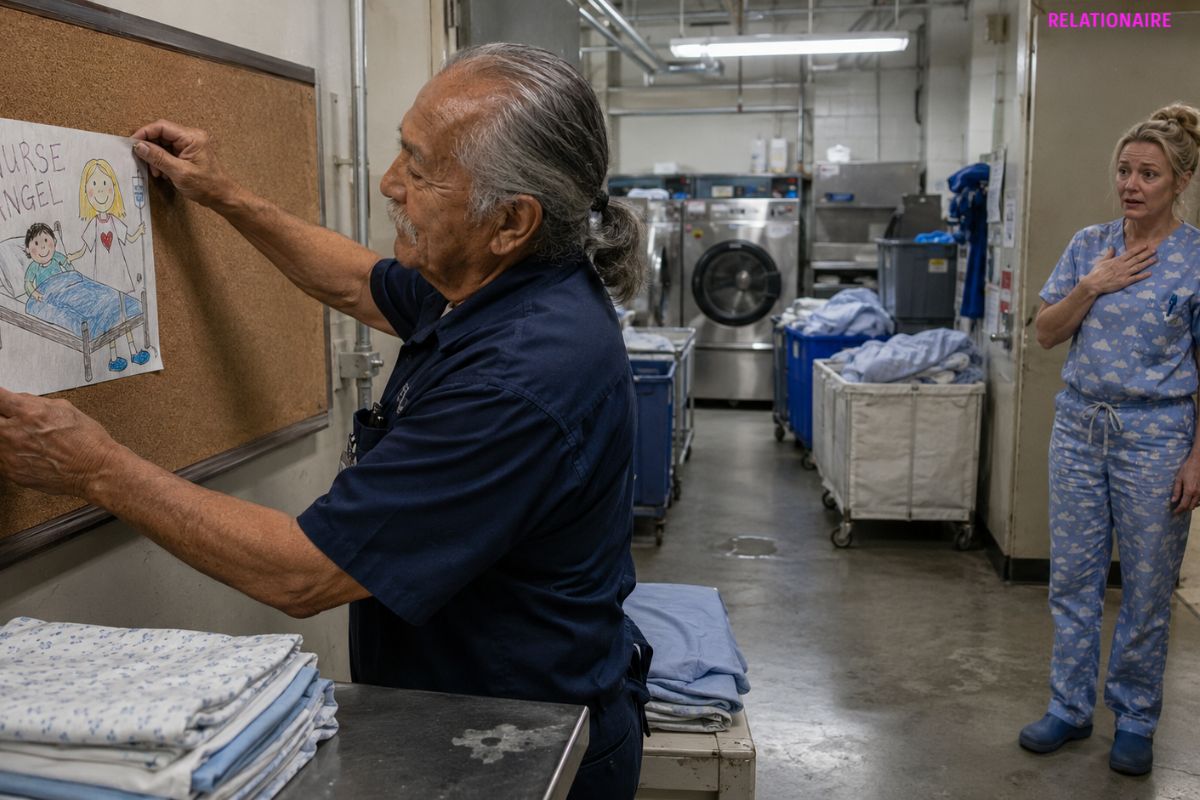
He smoothed the drawing carefully against the metal table.
Then he pinned it to the corkboard beside his station.
Right above the schedule.
Right beside a faded photo of his late wife, Rosa, holding a baby with round cheeks and serious eyes.
By 6:15, everyone had noticed.
“Luis,” Marcy from linen delivery said, slowing her cart. “You running an art gallery now?”
Luis only smiled.
“It was in the sheets,” he said.
“Then it belongs in the trash.”
“Maybe,” he said.
But he left it there.
The hospital laundry room was underground, one floor below where families cried in waiting rooms and doctors moved quickly with coffee they never finished.
Most people upstairs never thought about the laundry.
Clean sheets simply appeared.
Warm blankets arrived folded.
Gowns came back smelling like soap instead of fear.
Nobody saw Luis arrive before sunrise, tying his gray hair at the back of his neck, slipping on gloves, sorting what other people were too tired or too broken to notice.
He had seen the evidence of hard nights.
A child’s sock wrapped inside a pillowcase.
A mother’s bracelet tangled in a blanket.
A discharge packet left behind by someone who had waited too long to go home.
He did not know the names. He did not ask.
He just returned what he could.
And threw away what he couldn’t.
But not the drawing.
At 8:40, a nurse burst through the double doors carrying two bags of linens against her hip.
She moved like someone already late for three different things.
Her blonde hair was twisted into a messy knot. Her scrub top had a cartoon cloud pattern, faded from too many washes. There was a coffee stain on her sleeve and a pen tucked behind her ear.
Luis recognized her.
Everyone did.
Nurse Clara Bennett from pediatrics.
She was one of those nurses who seemed to live in motion. Fast steps. Fast charting. Fast smile for a child. Fast apology to a parent. Fast swallow of cold coffee before another call light pulled her away.
She dumped the bags into the marked bin and pressed her hand to her lower back.
Then her eyes landed on the corkboard.
She laughed.
Not a cruel laugh.
Just tired.
Surprised.
A little sharp around the edges.
“Luis,” she said, pointing at the drawing. “Please tell me you didn’t save that.”
He turned from the folding table.
“It was nice.”
“It’s crayon on scrap paper.”
“Still nice.”
Clara stepped closer. Her badge swung against her chest. Her face softened for half a second, then she shook her head like she did not have room for soft things.
“You’re too sentimental,” she said. “If we kept every paper kids left behind, this whole hospital would be wallpaper.”
Luis looked at the drawing again.
The little nurse with the red heart.
The small boy smiling from the bed.
“Maybe that would not be so bad,” he said.
Clara smiled, but it did not reach her eyes.
“Trust me,” she said. “Some things are easier not to keep.”
Then the pager on her waistband chirped.
The smile disappeared.
She grabbed an empty laundry bag, turned, and pushed back through the doors.
Luis watched her go.
He did not know why her words sat heavy in him.
Some things are easier not to keep.
That was true.
He had tried it.
After Rosa died, he packed her sweaters in two garbage bags and left them by the door for three days. He told himself grief was clutter. He told himself a small apartment had no room for ghosts.
On the fourth day, he opened one bag and pressed his face into the blue cardigan she used to wear on Sundays.
He kept it.
Some things were not easier to throw away.
Some things were the only proof that love had passed through the room.
All morning, people came and went.
A resident asked for extra towels.
An aide came looking for a missing stuffed bear.
Housekeeping needed clean mattress pads.
No one stopped for long.
Except Luis.
Every time he walked past the corkboard, his eyes found the drawing.
NURSE ANGEL.
At lunch, he ate a banana and two crackers by the folding table. He opened his old flip phone and looked at the same photo he looked at almost every day.
His grandson, Mateo, seven years old now, grinning with two missing front teeth.
Luis had not seen him in person for almost six years.
Not because of a fight with the child.
Never because of the child.
It was his daughter, Elena, who had disappeared.
One winter night, she had called him crying from somewhere loud.
“Papá, I messed everything up,” she said.
Luis had been washing dishes.
He still remembered the dish in his hand. A white bowl with a blue rim.
“What happened?”
“I can’t explain now.”
“Where are you?”
“I need you not to ask me that.”
His heart had changed shape in his chest.
Behind her voice, he heard a child coughing.
Mateo.
His Mateo.
“Elena, bring him here.”
“I can’t.”
“You can.”
“No, Papá. You don’t understand. I’m trying to keep him safe.”
The line went quiet.
Then she said something he had carried for years.
“If anyone asks, you haven’t heard from us.”
That was the last night Luis heard his daughter’s voice for eleven months.
When she came back, she was thinner. Quieter. Ashamed in a way he did not know how to reach.
She told him only pieces.
A bad relationship.
A rushed move.
A hospital visit under a name that was not theirs.
Kind people who helped without asking too much.
A nurse who sat with Mateo when Elena could not stop shaking.
Luis had asked which hospital.
Elena shook her head.
“Please, Papá. Let that year stay buried.”
So he did.
Because parents sometimes love their children by asking questions.
And sometimes they love them by not asking one more.
At 2:10 that afternoon, Clara came back.
This time she was not rushing.
She held a sealed plastic bag in her hand. Inside was a tiny blue sweater with a dinosaur stitched on the front.
“Lost item,” she said. “Found in 318.”
Luis took the bag.
“I will log it.”
Clara glanced at the corkboard again.
The drawing was still there.
She folded her arms.
“You really kept it.”
“Yes.”
“Why?”
Luis shrugged.
“Someone made it for someone they loved.”
Clara’s face changed.
Only a little.
A flicker.
Then she looked closer.
For the first time, really looked.
Her eyes moved over the yellow hair, the blue shoes, the red heart on the nurse’s chest.
Then she leaned in.
Her voice dropped.
“Where did you get this?”
Luis glanced at the sorting bin.
“Sheets from pediatrics.”
“No.” Clara swallowed. “I mean, when?”
“This morning.”
She reached toward the paper, then stopped before touching it.
All the color had gone from her face.
Luis felt something inside him tighten.
“Do you know it?” he asked.
Clara did not answer.
She stared at the bottom corner of the drawing, where Luis had not noticed a small green mark folded under the paper.
He lifted the corner carefully.
There was a name written there in tiny, uneven crayon letters.
Not Mateo.
Not any name Luis knew.
Clara covered her mouth with one hand.
Then she said, so softly he almost missed it:
“Oh my God. I know this child.”
Luis looked from her face to the drawing.
And for the first time that day, he felt afraid of what he had saved.
PART 2
Luis did not move.
The laundry room seemed louder suddenly.
Machines knocked and hummed. A dryer door slammed somewhere behind him. Someone laughed in the hall beyond the double doors.
But Clara was silent.
Her hand stayed over her mouth.
Luis looked again at the small name in green crayon.
Milo.
“Milo?” he asked.
Clara nodded, but her eyes stayed on the paper.
“That’s what he called himself.”
Luis felt a strange coldness pass through him.
Children used the wrong names all the time. Nicknames. Stuffed animal names. Names from cartoons. Names they wished were theirs.
Still, something about Clara’s voice made him careful.
“You remember him?”
She gave a small laugh, but it broke before it became sound.
“I remember all the ones who needed me to.”
Then she caught herself.
She stepped back, straightened her badge, and became a nurse again.
Busy face. Professional hands. Emotion folded away.
“It was years ago,” she said. “I shouldn’t have said anything.”
Luis looked at the drawing.
The nurse with yellow hair.
The blue shoes.
Clara wore blue shoes.
Old ones. Soft at the sides. The kind bought by someone who stood twelve hours and called it normal.
“You said you know this child,” Luis said.
“I said I knew a child like this.”
“No,” Luis said gently. “You said this child.”
Clara’s eyes lifted to his.
For a moment, neither of them looked away.
Then her pager chirped.
She flinched like it hurt.
“I have to go.”
“Clara.”
She stopped with her hand on the door.
Luis did not know what he wanted to ask. Not yet.
But the paper on the corkboard had begun to feel less like a lost drawing and more like a door.
“Was he sick?”
Clara closed her eyes.
“No,” she said. “Not exactly.”
Then she left.
That answer followed Luis home.
Not exactly.
His apartment smelled faintly of beans and laundry soap. A fan clicked in the corner. The evening news played too softly for him to understand.
On the kitchen table sat a stack of envelopes he had not opened.
A bill.
A grocery flyer.
And one small card with his daughter’s handwriting.
Elena had started sending cards two years earlier.
Never many words.
Never enough.
Mateo likes soccer now.
Mateo lost another tooth.
Mateo asks if you still have the red truck.
Luis kept every card in a cookie tin under the sink.
He did not push.
He was afraid pushing would make her disappear again.
That night, he opened the tin.
Inside were school pictures, birthday cards, one paper wristband from a community fair, and a small crayon drawing Mateo had made when he was four.
Luis had saved that too.
A stick man with gray hair.
Big ears.
A square body.
Above it, in crooked letters:
ABUELO.
Luis placed it beside the hospital drawing.
The hands were different now, of course. Children changed quickly. Crayon pressure changed. Letters changed.
But something in the smiling mouth.
Something in the way the sun was drawn in the corner with too many rays.
Luis sat down slowly.
No.
It was impossible.
There were thousands of children in that hospital.
Thousands of drawings.
Thousands of smiling nurses.
He told himself that.
Then he picked up his phone.
His daughter answered on the fourth ring.
“Papá?”
Her voice still made him sit up straighter.
“Elena,” he said. “Did Mateo ever call himself Milo?”
There was silence.
Long enough for the refrigerator to click on.
Long enough for Luis to hear his own breathing.
“Why are you asking me that?”
His hand tightened around the phone.
“At work today, I found a drawing.”
“What drawing?”
“A child drew a nurse. It says Nurse Angel.”
Elena made a small sound.
Not a word.
Not a cry.
Something from years ago catching in her throat.
“Elena.”
“Send me a picture.”
He did.
For almost a minute, nothing happened.
Then his phone rang again.
This time, Elena was crying.
Softly.
Like she had one hand over her mouth, the way Clara had.
“Papá,” she whispered. “Where did you find that?”
“At the hospital. In the laundry.”
“No,” she said. “No, that can’t be.”
“Is it Mateo’s?”
She did not answer.
That was answer enough.
Luis pressed his fingers against his eyes.
The drawing blurred on the table.
For six years, he had lived three bus stops away from the place where his grandson had once been carried through the doors under a false name.
For six years, he had washed sheets from the floor where someone had sat beside Mateo.
For six years, the person Elena called “the nurse who saved us” may have passed Luis in the hall without either of them knowing.
“What happened that night?” Luis asked.
Elena cried harder.
“I was ashamed.”
“I know.”
“No, Papá. You don’t. I had no money. No insurance card with the right address. No safe place to go. He had a fever and I was so scared, but I was more scared someone would ask questions I couldn’t answer.”
Luis closed his eyes.
He saw her at nineteen, braiding her hair in the bathroom mirror. He saw her at twenty-two, holding Mateo like he was the only good thing left in the world.
“I gave them a different last name,” Elena said. “I told Mateo we were playing a quiet game. That if anyone asked, his name was Milo.”
Luis’s heart ached.
“And the nurse?”
Elena took a shaky breath.
“She knew.”
Luis opened his eyes.
“She knew?”
“Maybe not the details. But she knew I was hiding from something. She didn’t push. She just sat beside me in that little room with the dinosaur stickers on the wall and said, ‘You don’t have to tell me everything for me to help you tonight.’”
Luis looked at the drawing again.
The red heart on the nurse’s chest.
“I never forgot that,” Elena whispered. “I was so tired, Papá. I thought one wrong answer would take Mateo away from me. She brought him apple juice. She found clean clothes from donations. She called a social worker who knew how to help without making me feel like a criminal.”
Luis could not speak.
“And when I said I had nowhere safe to sleep, she gave me a number. A shelter that didn’t list the address publicly. I stayed there three months.”
“Elena…”
“That nurse didn’t just help Mateo. She helped me become his mother again.”
Luis bowed his head.
The kitchen light hummed above him.
For years, he had imagined the unknown nurse as someone older. Softer. Maybe someone with gray hair and gentle hands.
Not Clara, who came into the laundry room at full speed.
Clara, who laughed at sentiment.
Clara, who said some things were easier not to keep.
“Do you remember her name?” he asked.
Elena sniffed.
“No. I only remember her shoes. Blue. Mateo called her Nurse Angel because she had little clouds on her shirt.”
Luis let out a breath.
The phone felt heavy in his hand.
At work the next morning, he arrived early.
The drawing was still pinned to the corkboard.
But someone had moved it.
Only slightly.
Luis noticed because the pin was now in the other corner.
Below it sat a folded sticky note.
His name was written across the front.
Luis.
He looked around the laundry room.
No one else had arrived.
He unfolded the note.
The handwriting was small and rushed.
Please don’t ask me about this in front of anyone. I remember him. I remember his mother. I also remember the promise I made her.
Luis stared at the words.
Then he read the last line.
And I need to know if they’re okay.
The double doors opened behind him.
Clara stood there in her cloud-patterned scrubs, one hand gripping the strap of a linen bag, her eyes already wet.
This time, she was not rushing anywhere.
PART 3
Clara looked smaller without her speed.
That was the first thing Luis noticed.
When she was moving, she seemed impossible to catch. A blur of scrubs and responsibility. A woman made of footsteps, coffee, and other people’s emergencies.
Standing still in the laundry room doorway, she looked like someone who had been carrying a full glass of water for years and was afraid one breath might spill it.
Luis held up the note.
“They’re okay,” he said.
Clara pressed her lips together.
Then she nodded once, quickly, like she did not trust herself with more.
“His name is Mateo,” Luis said.
Clara’s face changed at the sound of it.
Not surprise.
Recognition.
Relief.
A kind of pain.
“Mateo,” she repeated.
The name seemed to settle into the room.
Luis pointed to the folding table.
“Sit.”
She laughed weakly.
“I don’t think anyone has ever told me to sit in this hospital.”
“Then it is overdue.”
For the first time since he had known her, Clara obeyed.
She sat on the edge of the metal stool while Luis poured coffee from his thermos into a paper cup.
“It is not fresh,” he warned.
“I’m a nurse,” she said. “Fresh coffee would scare me.”
He smiled.
Then silence returned.
Not awkward.
Necessary.
Clara wrapped both hands around the cup.
“I wondered about them,” she said. “For years.”
Luis leaned against the table.
“Elena thought of you too.”
Clara looked down.
“She was so young.”
“She was scared.”
“She had reason to be.”
Luis waited.
Clara took a small sip of coffee and closed her eyes.
“I don’t know what she told you.”
“Enough.”
“I couldn’t put much in the chart,” Clara said. “Not the parts that mattered. There are rules. There are always rules. But sometimes a person is standing in front of you and you know the rule will not be the thing that saves them.”
Luis listened.
He knew rules.
He knew how many pounds a laundry cart could hold. Which bags required double gloves. Which lost items had to be logged, labeled, sealed, and locked.
He also knew the things rules could not measure.
The way a mother gripped a child’s sweater.
The way grief left a room quiet after everyone had gone.
The way a piece of crayon paper could hold six years of someone’s life.
“She kept apologizing,” Clara said. “Your daughter. Over and over. For not having the right card. For giving the wrong name. For crying. For needing help. She apologized every time she breathed.”
Luis swallowed.
“That sounds like Elena.”
“Mateo was trying to make her laugh. He kept saying he was brave because superheroes don’t cry. But when she stepped into the hall to speak with the social worker, he started crying into his blanket.”
Clara’s eyes filled.
“He asked if his mom was in trouble.”
Luis looked away.
There were some pictures the heart made without permission.
A little boy under a hospital blanket.
A mother in the hallway holding herself together with both arms.
A nurse choosing softness when the world had already been hard enough.
“What did you tell him?” Luis asked.
Clara wiped her cheek quickly with the back of her hand.
“I told him his mother was doing the bravest thing I knew.”
“What was that?”
“Asking for help.”
Luis closed his eyes.
For years, he had been angry that Elena had not come to him first.
He had never said it aloud. Not fully. But it lived inside him.
A quiet hurt.
A father’s useless question.
Why not me?
Now, hearing Clara speak, he understood something that hurt in a different way.
Sometimes shame locked the door before love could reach it.
Sometimes a stranger got there first.
Not because family failed.
Because pain moved faster.
“She drew that for you?” Luis asked.
Clara shook her head.
“He did. Mateo. Right before discharge. He said if angels worked in hospitals, they probably got tired feet.”
Luis laughed once, but it came out broken.
Clara smiled through tears.
“I told him I was not an angel. Just a nurse.”
“What did he say?”
“He said, ‘That’s what an angel would say.’”
Luis pressed his palm over his mouth.
The laundry room blurred.
Clara looked at the drawing on the corkboard.
“I kept it for a while,” she whispered. “Not this one. Another one he made on the back of a menu. But after my son died, I threw away almost everything.”
Luis looked at her.
She did not flinch from the words, but her hands tightened around the cup.
“He was five,” she said. “Different hospital. Different life. Before I came here. After that, I thought keeping things made grief louder. So I stopped. Cards. Photos on the fridge. Drawings from patients. I told myself I was being practical.”
Luis thought of Rosa’s blue cardigan.
The garbage bags by the door.
The fourth day.
“Some things are not easier to throw away,” he said.
Clara looked at him.
Then she nodded.
“No,” she said. “They’re not.”
Later that week, Elena came to the hospital.
She almost turned around twice before reaching the laundry room.
Luis saw it in the security camera monitor near the loading hallway. His daughter standing by the elevator, smoothing her hair, holding a boy’s hand.
Mateo was taller than Luis expected.
Children had a cruel way of growing during absence.
He wore a red hoodie and carried a soccer ball tucked under one arm. His two front teeth had grown back. His eyes were still serious.
When he saw Luis, he froze.
Then Elena whispered something.
Mateo walked forward.
“Abuelo?”
Luis bent down, though his knees protested.
“Yes, mijo.”
The boy hugged him carefully at first.
Then tightly.
Luis closed his eyes and held him like every missing year was folded between them.
Elena stood behind him crying silently.
“I’m sorry,” she said.
Luis shook his head.
Not because there was nothing to forgive.
Because the laundry room was not big enough for all the years they had lost, and he did not want to waste one more second stacking blame on top of them.
“You came,” he said.
She nodded.
“I came.”
Clara arrived a few minutes later.
She stopped when she saw Elena.
For a long moment, neither woman moved.
Then Elena stepped forward.
“You probably don’t remember me,” she said.
Clara laughed softly, already crying.
“I remember you apologizing for things that weren’t your fault.”
Elena covered her face.
That was all it took.
Clara crossed the room and hugged her.
Not like a nurse hugging a former patient’s mother.
Like one tired human being finally setting down a weight beside another.
Mateo looked at the corkboard.
His head tilted.
“Is that mine?”
Luis smiled.
“We think so.”
Mateo stepped closer, studying the drawing.
He frowned.
“My handwriting was terrible.”
Everyone laughed.
A small laugh.
A kind one.
The kind that does not erase pain, but makes room around it.
Clara touched the corner of the paper.
“You called me Nurse Angel.”
Mateo looked embarrassed.
“I was little.”
“You were right,” Elena said.
Clara shook her head.
“No. I was just there.”
Luis looked around the laundry room.
At the carts of sheets.
At the bins.
At the corkboard with Rosa’s photo, Mateo’s drawing, and now something else too: a fresh picture Mateo had drawn that morning in the cafeteria.
This one showed four people.
A gray-haired man.
A woman with dark hair.
A boy in a red hoodie.
And a nurse in blue shoes.
Above them, in neater letters, he had written:
PEOPLE WHO HELPED US.
Luis pinned it carefully beside the old one.
No one laughed this time.
Not Marcy.
Not the aide waiting for towels.
Not Clara.
For once, the laundry room felt less like the place where the hospital sent what needed washing.
It felt like the place where something forgotten had been returned clean.
Years do not always come back to us.
Neither do chances.
But sometimes, in the middle of an ordinary workday, between a pile of sheets and a humming dryer, life hands us one small thing someone else would have thrown away.
And if we are wise, we pin it where our hearts can see it.