
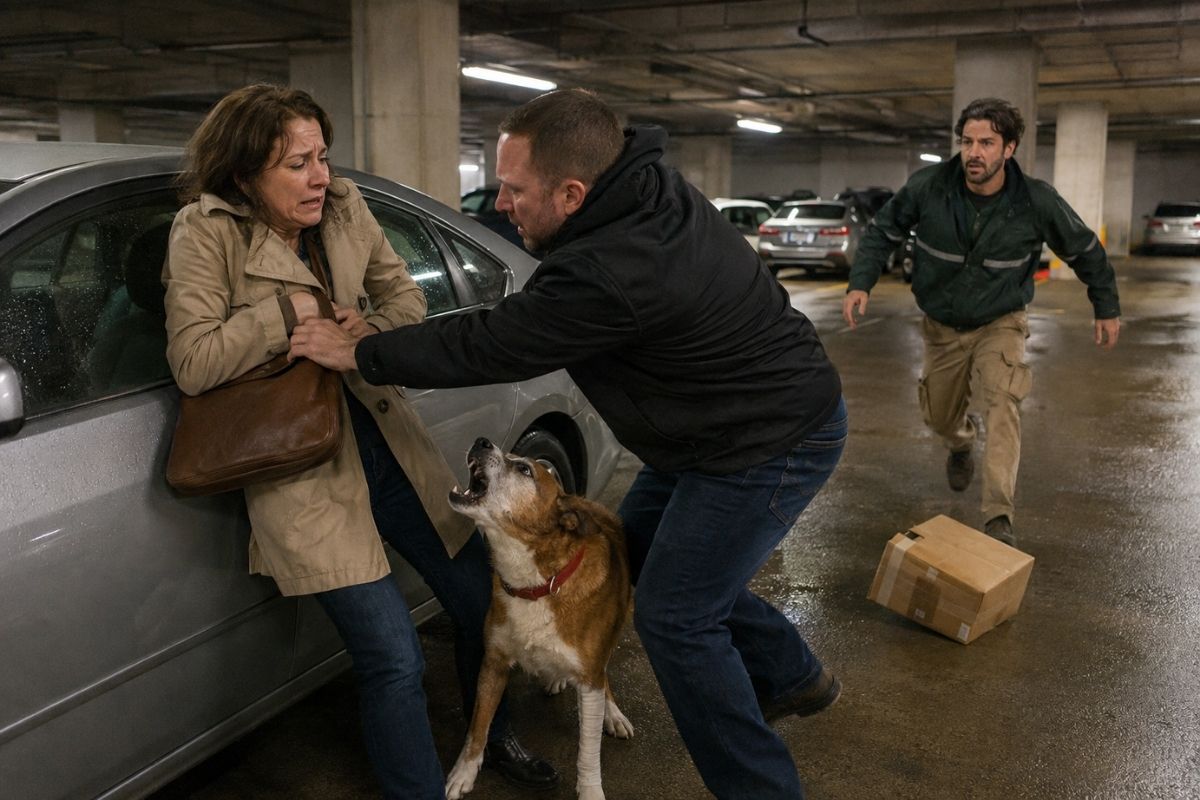
“Give me the bag.”
Claire Bennett stopped so abruptly that Roscoe bumped against her knee.
The underground garage beneath North Ridge Medical Center hummed with fluorescent lights and distant ventilation fans. Rainwater had followed cars down the ramp, leaving the concrete floor slick in places.
The man in front of her had stepped out from behind a support pillar.
Mid-thirties, maybe. Shaved head. Black jacket. Tired eyes.
He didn’t look drunk.
That somehow made Claire more afraid.
“I said give me the bag.”
His eyes dropped to the brown leather purse hanging from Claire’s shoulder.
Roscoe moved forward.
The old dog was eleven now, brown and white around most of his body and increasingly gray around the muzzle. A white bandage wrapped his front left leg from the paw upward.
The veterinarian upstairs had told Claire ten minutes earlier that the torn ligament was healing.
“Easy,” Claire whispered.
Roscoe ignored her.
A low growl rose from his chest.
The stranger glanced at him.
“Keep the dog back.”
“He’s injured.”
“I don’t care.”
Claire tightened her grip on the purse.
She didn’t care about her wallet.
She didn’t care about the twenty-seven dollars inside it.
She didn’t even care about the credit cards.
But inside that purse was the last box of things she had taken from her father’s house that afternoon.
A photograph.
A sealed envelope.
And Walter Bennett’s battered red notebook.
Her father had been dead for three weeks.
Claire still had not decided whether she missed him more than she was angry with him.
“Take the wallet,” she said. “I’ll give you the wallet.”
“The whole bag.”
“No.”
The man’s jaw tightened.
“Lady, don’t make this harder.”
Roscoe barked once.
The man stepped forward.
Claire backed into the side of a silver sedan.
The purse strap pulled tight across her shoulder.
Then the man grabbed it.
Claire held on.
For two ridiculous seconds, neither of them moved.
Then he shoved her.
Her shoulder struck the car door.
Roscoe erupted in barking.
The man jerked his leg toward the dog.
“Get that thing away from me!”
“Leave him alone!”
Claire barely heard the slap of running boots behind them.
The stranger turned.
A cardboard package hit the floor twenty feet away.
A delivery driver was charging toward them.
“Hey!”
The man holding Claire’s purse swung first.
The delivery driver ducked.
His shoulder caught the attacker in the middle, driving both men against the silver sedan.
The car alarm began screaming.
Claire stumbled sideways and pulled Roscoe with her.
The fight was nothing like the clean, choreographed scenes she had seen on television.
It was awkward.
Fast.
Ugly.
The delivery driver took an elbow to the shoulder and crashed against a concrete pillar hard enough to make Claire flinch.
The attacker grabbed a loose metal parking barrier pole lying near the wall.
Roscoe barked again.
The attacker glanced toward him.
That half-second was enough.
The delivery driver caught the man’s arm, twisted the pole away, let it clatter across the floor, then turned his momentum and pushed him forward across the hood of the sedan.
The attacker grunted.
The delivery driver pinned one wrist against the car.
His free fist rose.
Claire saw the anger in his face.
Then something changed.
He stared at the man beneath him.
Not like a stranger.
Like someone he knew.
His fist remained in the air for one long second.
Then he lowered it.
“Enough.”
Police sirens sounded faintly somewhere outside the garage.
The delivery driver released him.
Claire expected him to step back and keep watching the attacker.
Instead, he turned his back completely.
He walked straight to Roscoe.
“You okay, buddy?”
The dog stopped barking.
The man knelt carefully beside him.
He had short black hair, light stubble, and the dark green jacket of a regional courier service. His breathing was hard from the fight.
He gently touched the edge of Roscoe’s bandage.
Claire stared at him.
“You just turned your back on that man.”
“He’s done.”
“How do you know?”
“I know.”
Roscoe sniffed his hand.
Then, to Claire’s surprise, the dog leaned slightly toward him.
Claire swallowed.
“Why did you do that?”
The man looked up.
“Do what?”
“Run toward us.”
He glanced at Roscoe.
“Someone stopped for me once.”
Before Claire could ask what that meant, two security officers and then police entered the garage.
Everything after that became questions.
Names.
Statements.
A paramedic insisting on checking Claire’s shoulder.
Another officer examining the delivery driver.
The attacker gave his name as Derek Cole.
Claire barely registered it.
She was sitting on the edge of a concrete divider with Roscoe pressed against her legs when the delivery driver came over holding several things he had gathered from the garage floor.
Her wallet.
Her phone.
A photograph.
And the red notebook.
“Think these are yours.”
“Thank you.”
He handed her the photograph first.
It showed Walter Bennett standing in front of an old city bus nearly twenty-five years earlier.
Walter was younger in the picture, though still unmistakably Walter: thick forearms, serious eyebrows, an expression suggesting that smiling for photographs was an inefficient use of time.
The delivery driver glanced at the picture.
Then at the notebook.
He opened it just enough to check the name inside.
His face changed.
Claire saw it immediately.
“What?”
He didn’t answer.
His thumb remained pressed against the inside cover.
“Is something wrong?”
He looked at her.
“Walter Bennett?”
Claire stood.
“Yes.”
The noise of the garage seemed to pull away from her.
“He was your father?”
Claire narrowed her eyes.
“Yes.”
The delivery driver stared at the notebook again.
“What is it?”
He closed it.
For several seconds, he said nothing.
Then he handed it back.
“Your father did something for me a long time ago.”
Claire felt an unexpected flare of irritation.
Of course he had.
Her father had done something for everyone.
“What?”
The driver shook his head.
“Not here.”
“Why not?”
A police officer called him from several yards away.
The man glanced toward him.
Then back at Claire.
“My name’s Marcus. Marcus Reed.”
Claire waited.
He seemed to want to say more.
Instead, he gave a small nod toward Roscoe.
“Take care of him.”
Then he walked away.
Claire watched him go.
Roscoe sat beside her.
In her hand, Walter’s red notebook suddenly felt heavier than it had ten minutes earlier.
Claire did not open the notebook that night.
She put it on her kitchen table.
Then she moved it to the counter.
Then back to the table.
By ten-thirty, it had traveled through three rooms without being opened once.
Roscoe lay on his bed near the refrigerator, his bandaged leg stretched in front of him.
Claire’s nineteen-year-old son, Evan, came home shortly after eleven from his evening shift at a hardware store.
He dropped his keys into the ceramic bowl by the door.
“You okay?”
“I’m fine.”
“Mom.”
“I said I’m fine.”
Evan looked at the bruise beginning to form near her shoulder.
His face tightened.
“They said the guy got arrested?”
“Yes.”
“And the delivery driver?”
“Marcus.”
“Yeah. Him.”
“He’s fine.”
“You called him?”
“No.”
Evan looked at her.
“So you know he’s fine because…”
“I don’t know.”
He leaned against the counter.
At nineteen, Evan had inherited his grandfather’s height and Claire’s tendency to ask a second question before the first one had been answered.
“Grandpa’s notebook?”
Claire followed his gaze.
“Yes.”
“You finally found it.”
“I wasn’t looking for it.”
“That’s not what you said last week.”
Claire rubbed her forehead.
Walter had kept the notebook on a shelf beside his old garage manuals.
After his death, Claire had discovered it while sorting through boxes in his basement.
She had brought it home because she suspected it contained information about the missing money.
Three thousand dollars, approximately.
Not a fortune.
But Walter had lived on a modest pension and Social Security.
And during the last year of his life, when medical bills began appearing, Claire had learned he had withdrawn money repeatedly.
Two hundred.
Four hundred.
Eight hundred.
Sometimes more.
He would not tell her why.
The final argument happened in his kitchen.
Walter was sitting at the table in his flannel shirt, thinner than Claire wanted to admit.
She had placed three bank statements in front of him.
“Dad, this is almost three thousand dollars.”
“I know arithmetic.”
“Then explain it.”
“No.”
“Why?”
“Because it’s mine.”
“You can barely cover everything now.”
“I’m covering it.”
“Because I’m covering half of it.”
Walter looked up.
That had been the wrong thing for Claire to say.
She knew it immediately.
His mouth flattened.
“I didn’t ask you to.”
“No. You never ask.”
He folded the bank statement once.
Then again.
Claire had spent months driving him to appointments, organizing his medications, cleaning his house, calling insurance companies, paying several bills without telling him.
And still strangers kept calling.
People from his old bus route.
People from the garage.
People asking if Walter could look at a car, recommend somebody for work, lend a truck, make a phone call.
“You’re seventy-two,” she had said. “You don’t have to rescue everybody.”
Walter stared at the folded statement.
“Didn’t say I did.”
“Then stop acting like you do.”
Silence.
“Claire.”
“No. I mean it. You spent your whole life showing up for people who disappeared the second you needed something.”
Walter’s eyes lifted.
“That’s not true.”
“Isn’t it?”
“No.”
“Then where are they?”
That had hurt him.
Claire saw it.
And instead of stopping, she kept going.
She had been tired.
Frightened.
Angry at his illness.
Angry at his stubbornness.
Angry because her mother was already gone and she could see another loss approaching.
“Maybe your strangers can take care of you, then.”
Walter had looked at her for a long time.
Then he said quietly:
“You don’t know who those strangers are.”
They spoke again after that.
Of course they did.
About groceries.
Appointments.
Roscoe.
Evan.
The ordinary scaffolding families build around what they cannot say.
But they never returned to the argument.
Walter died eighteen days later.
Now Claire stared at the red notebook on the kitchen table.
Evan pulled out a chair.
“You going to open it?”
“I have before.”
“No. I mean really open it.”
Claire looked at him.
“What does that mean?”
“You always flip through it like you’re checking a receipt.”
“How do you know?”
“Because Grandpa did the same thing when he didn’t want to admit something mattered.”
Claire almost laughed.
Almost.
Instead she sat down.
The notebook was small enough to fit in one hand.
The cover had once been bright red but was worn pale at the corners. Grease darkened the edge of several pages.
Claire opened it.
The first pages contained names.
Some she knew.
Most she didn’t.
Terry — alternator.
Malik — Route 8.
Devon — interview Tuesday.
J. Parker — $60. Do not give cash again.
Nate — baby due June.
Luis — passed GED.
Kenny — radiator. Paid 20.
Then, several pages later:
Marcus.
Claire stopped.
Evan leaned forward.
“That him?”
“I think so.”
Under the name were dates spanning more than a decade.
M.R. — bike.
M.R. — school called again.
Marcus — $46.
Marcus — garage key.
Marcus — paid back.
Marcus — first apartment.
Then nothing for years.
Claire turned the page.
Another name appeared.
Derek.
Then again.
And again.
Derek — interview Sam.
Derek — car.
Derek — missed again.
Derek — Ray.
Derek — not cash.
Claire’s stomach tightened.
She reached for her phone.
The police had given her a case-information sheet.
The attacker’s name was printed near the top.
Derek Cole.
Evan read it over her shoulder.
“No way.”
Claire stared at the notebook.
“Marcus knew him.”
“What?”
“In the garage.”
“How do you know?”
She remembered the fight.
Marcus’s raised fist.
The pause.
The way he had looked at Derek.
Not like a stranger.
“I think he knew him.”
Marcus Reed arrived at Claire’s house the next afternoon carrying a paper grocery bag.
She had called the courier company that morning and left a message.
At three-twenty, he called back.
At four-fifteen, he stood on her porch.
Roscoe barked from inside.
Marcus held up the bag.
“Peace offering.”
“For what?”
“Your dog.”
Claire opened the door.
Inside the bag were two soft dog treats and a rubber chew toy.
“You almost got your head knocked into a pillar yesterday and you brought my dog something?”
Marcus shrugged.
“Dogs don’t complicate things as much as people.”
“Roscoe absolutely complicates things.”
“Then I misjudged him.”
Roscoe limped forward.
Marcus crouched.
The dog sniffed him and accepted the treat.
Claire watched.
“Did you know Derek?”
Marcus did not look surprised.
He remained crouched beside Roscoe.
“Yes.”
“From my father?”
“Yes.”
“How?”
Marcus stood.
“That’s complicated.”
“So was yesterday.”
He nodded.
“Fair.”
Claire led him to the kitchen.
The red notebook was on the table.
Marcus stopped when he saw it.
Claire noticed a small brass key hanging from his key ring.
Old.
Scratched.
Not the kind that belonged to a modern car or apartment.
“What’s that?”
Marcus looked down.
For the first time since entering the house, he seemed uncertain.
“Nothing.”
“My father’s garage key?”
Marcus’s fingers closed around it.
Claire stared.
“You still have it?”
“He gave it to me.”
“When?”
“Twenty years ago.”
“He sold that house twelve years ago.”
“I know.”
“Then why keep it?”
Marcus pulled out a chair.
“Because it stopped being a key a long time ago.”
Claire sat opposite him.
Marcus ran his thumb along one edge of the brass.
“When I was thirteen, my grandmother cleaned offices downtown at night. My mom had been gone about a year by then.”
“Gone?”
Marcus’s eyes stayed on the key.
“She left.”
Claire did not ask where.
The way he said it suggested that whatever answer existed was beside the point.
“I took the Route 8 bus home from school,” Marcus continued. “Your father drove it three days a week. I started staying on after my stop.”
“Why?”
“Because Grandma didn’t get home until after seven. Winter was cold. Apartment hallway was colder.”
“You didn’t have a key?”
“I did.”
“Then why not go inside?”
Marcus smiled without humor.
“Because thirteen-year-old boys make strange decisions when they don’t want people knowing they’re alone.”
Claire thought of Walter.
She could picture him behind the wheel.
Quietly noticing.
Not asking.
“He let you stay?”
“Not officially.”
Marcus looked up.
“He’d finish the route, park somewhere, do paperwork for twenty minutes. Sometimes thirty. Never said why. Never asked why I stayed.”
“That sounds like him.”
“One day he caught me trying to fix a bike outside the apartment building.”
“Were you fixing it?”
“I was making it worse.”
Claire smiled despite herself.
Marcus did too.
“Your dad looked at my wrench and said, ‘You planning to repair the bike or punish it?’”
Claire laughed.
The sound startled her.
Marcus continued.
“He took me to his garage. Showed me how to fix the chain. Then brakes. Then a lawn mower. Then cars.”
He tapped the key.
“Saturday mornings.”
Claire looked at the notebook.
“You were one of them.”
“One of what?”
“The boys.”
Marcus frowned.
“What boys?”
Claire gestured toward the book.
“All these names.”
Marcus opened it.
His expression changed as he scanned the pages.
“He never showed you?”
“No.”
Marcus slowly shook his head.
“There were always kids around the garage. Not all the same time. Some stayed months. Some one afternoon.”
Claire thought of countless Saturdays when Walter had been unavailable.
Her irritation returned.
“So he was running some unofficial youth program and never bothered mentioning it to his own daughter?”
Marcus glanced up.
“No.”
“What do you mean, no?”
“He wasn’t running anything.”
“Then what was it?”
Marcus thought.
“A garage where Walter happened to be. Sometimes that was enough.”
Claire crossed her arms.
“You make him sound like a saint.”
Marcus shut the notebook.
“He wasn’t.”
The answer came quickly enough to surprise her.
“He could be judgmental. He hated excuses. He never apologized properly. If he thought he was right, he’d wait you out until you got tired.”
Claire looked away.
“That part sounds familiar.”
“And he didn’t forgive everything.”
Marcus paused.
“I stole from him.”
Claire looked back.
“What?”
“Forty-six dollars.”
She remembered the notebook.
Marcus — $46.
“I was fifteen. Took it from a coffee can in the garage.”
“Why?”
Marcus smiled faintly.
“Does it matter?”
“Yes.”
“It mattered to me then. I wanted shoes.”
Claire stared at him.
“That’s it?”
“That’s it.”
“What did Dad do?”
“Made me repay it.”
“You had forty-six dollars?”
“No.”
“He made you work?”
“Eight Saturdays.”
Claire almost protested that eight Saturdays was excessive.
Then she saw Marcus’s expression.
“What?”
“He paid me for the work.”
Claire frowned.
Marcus nodded.
“Then made me hand the money back.”
“That is the most Walter Bennett thing I’ve ever heard.”
Marcus laughed.
“Yeah.”
“What happened after?”
“I disappeared.”
“For how long?”
“Three weeks.”
“Because you were embarrassed?”
“Because I was angry.”
Marcus looked at the key again.
“When I came back, I expected the garage to be locked.”
“It wasn’t?”
“No.”
He held up the brass key.
“Your dad gave it back.”
“What did he say?”
Marcus’s voice softened.
“Being trusted twice matters more than being trusted once.”
Claire sat very still.
Her father had never said that to her.
Not in those words.
Marcus placed the key on the table.
“That’s why I kept it.”
Claire stared at it.
“So yesterday…”
“I recognized Derek.”
“You knew the man attacking me.”
“Not right away.”
“When?”
“When he grabbed the pole.”
“How could you recognize somebody after twenty years?”
“Some people change more than others.”
Claire’s voice hardened.
“And you didn’t think that was worth mentioning?”
“To the police? I did.”
“To me.”
“I didn’t know what to tell you.”
“How about the truth?”
Marcus’s jaw tightened.
Claire saw something defensive rise in him.
“He wasn’t always that man.”
“He was yesterday.”
“I know.”
“He shoved me.”
“I know.”
“He threatened my dog.”
“I know.”
“Then don’t make excuses for him.”
“I’m not.”
Claire stood.
Marcus stayed seated.
Finally he said:
“Understanding somebody isn’t the same thing as letting them hurt you.”
The words stopped her.
Marcus looked toward the notebook.
“Your dad taught me that too.”
Derek Cole had first come to Walter’s garage at fourteen.
Marcus remembered him as thin, sharp-faced, and constantly talking.
Derek could identify engines from sound.
He could take apart a carburetor faster than boys three years older.
He could also lie without blinking.
“He’d tell Walter anything,” Marcus said.
They were still in Claire’s kitchen.
The light outside had turned orange.
“Why?”
“To get what he wanted. Money. Rides. Another chance.”
“And Dad kept helping?”
“For a while.”
Marcus flipped through the notebook until he found Derek’s name.
“This interview? Sam Ortega.”
“Who’s that?”
“Owns Ortega Auto over on the west side.”
“Dad knew him?”
“Everybody with grease under their fingernails knew Walter.”
Claire rolled her eyes.
Marcus smiled.
“Derek got hired there at nineteen. Lasted four months.”
“Why’d he lose the job?”
“Missed shifts.”
“Then?”
“Walter got him another one.”
“How long?”
“Maybe six months.”
“And the car?”
“Old Buick. Barely ran. Walter helped rebuild it.”
Claire pointed at the notebook.
“It says ‘sold.’”
“He sold it two weeks later.”
“For money?”
“Yes.”
“What did Dad say?”
Marcus became quiet.
“He said, ‘Helping you doesn’t mean pretending your choices don’t matter.’”
“And Derek?”
“He left.”
“For twenty years?”
“Off and on.”
Claire turned several pages.
There were more recent entries.
Derek — Ray.
Derek — rent.
Derek — called again.
“How recent is this?”
Marcus leaned closer.
“Eight months.”
Claire felt a chill.
“Dad was talking to him this year.”
“Looks like it.”
“Why?”
“I don’t know.”
“Wouldn’t you?”
Marcus looked at her.
“No.”
“Why not?”
He hesitated.
“I hadn’t spoken to Walter in almost four years.”
That surprised Claire more than anything else he had said.
“You kept carrying his key but didn’t speak to him?”
Marcus looked embarrassed.
“We had an argument.”
“About what?”
“An award.”
Claire blinked.
“What?”
“There’s a nonprofit called Second Mile Trades. I volunteered there for a while. Somebody found out how many young guys Walter helped over the years.”
Claire already knew what came next.
“He refused.”
“Wouldn’t even come to the dinner.”
“That sounds right.”
“I told him he was proud.”
Claire stared.
“You called my father proud for refusing an award?”
“I said he was so committed to not needing anybody that he’d turned humility into another kind of pride.”
Claire almost smiled.
“That also sounds right.”
“He didn’t.”
“What did he say?”
Marcus looked down.
“He said kindness wasn’t supposed to become somebody’s résumé.”
Claire could hear Walter saying it.
She could see his eyebrows rising.
Marcus continued.
“I told him maybe letting people thank you was something you did for them, not yourself.”
“And?”
“He told me to quit giving speeches in his garage.”
Claire laughed once.
“What did you do?”
“Left.”
“For four years?”
“Not exactly.”
Marcus rubbed his jaw.
“I called a few times. He called me twice. Christmas cards. That kind of thing.”
“But you never fixed it.”
“No.”
Claire looked toward the living room.
Roscoe was asleep.
“So both of us had final conversations with him we wish had gone differently.”
Marcus didn’t answer.
He didn’t need to.
Claire opened the envelope that night.
She sat alone at the kitchen table after Evan went to bed.
The seal tore unevenly.
Inside were three things.
A cashier’s receipt for $2,840.
A handwritten address.
And a folded note.
Claire recognized Walter’s handwriting immediately.
His letters had become shakier during the final months.
Claire —
Please don’t decide what this means until you know the whole thing.
Dad
That was all.
Claire read it three times.
Then she laughed bitterly.
“Of course.”
Roscoe lifted his head from the floor.
“Even dead, he’s making me do homework.”
The dog sighed and lowered his chin again.
Claire placed the receipt beside the notebook.
$2,840.
The missing money.
Except the receipt showed that the money had been converted into a cashier’s check.
It had not been deposited.
It had not been cashed.
And the check itself was nowhere in the envelope.
The address belonged to an apartment complex on the west side.
The next morning, Claire drove there.
She sat in her car for ten minutes before going inside.
The leasing office was small and smelled like burned coffee.
A woman named Trina looked up from a computer.
Claire showed her the address.
“I’m trying to understand something my father was arranging before he died.”
Trina’s expression changed when Claire said Walter’s name.
“You’re Walter Bennett’s daughter?”
Claire felt that old irritation immediately.
Another stranger.
“You knew him.”
“A little.”
“Of course.”
Trina blinked.
Claire closed her eyes.
“I’m sorry. That wasn’t fair.”
“It’s okay.”
“No, it isn’t.”
Claire placed the receipt on the desk.
“Do you know what this was for?”
Trina looked at it.
Then at Claire.
“I can’t give you private tenant information.”
“I understand.”
“But I can tell you what involved your father.”
Claire waited.
“Mr. Bennett came here about eight months ago with Derek Cole.”
Claire felt her stomach tighten.
“Derek lived here?”
“His brother does.”
“Raymond.”
Trina nodded.
“Ray uses a wheelchair.”
Claire looked at the handwritten address.
“Derek was caring for him?”
“When he could.”
Trina’s voice was careful.
“Ray’s a good tenant. Derek was staying there temporarily after losing work. There was overdue rent. Mr. Bennett asked if he could help pay it directly.”
“He was going to pay $2,840?”
“Part of it.”
Claire stared.
“He didn’t want Derek touching the money?”
Trina gave a faint smile.
“He was very clear about that.”
That sounded like Walter.
“What happened?”
“The payment never came.”
Claire looked at the receipt again.
“Why?”
“I don’t know. Mr. Bennett called once and said he’d been ill.”
Claire sat back.
“So Derek never received it.”
“Not through us.”
The certainty Claire had carried for weeks shifted.
She had accused Walter of giving away money he could not afford.
But Walter had not actually completed the payment.
The missing check might still exist somewhere.
More importantly, Derek had apparently believed help was coming.
Then Walter disappeared.
Claire looked toward the leasing office window.
Outside, an older man maneuvered carefully up the accessible ramp.
“Can I speak to Raymond?”
Trina hesitated.
“I can tell him you’re here.”
Ten minutes later, Raymond Cole rolled into the office.
He was forty-one.
Thin.
Dark-haired.
He looked enough like Derek that Claire immediately knew.
When she introduced herself, Raymond’s face fell.
“I heard about the garage.”
Claire did not respond.
“My brother had no right.”
“No.”
“He told me.”
“From jail?”
Raymond nodded.
Claire looked at his hands resting on the wheels of his chair.
“Did he know who I was?”
“No.”
“You’re sure?”
“Yes.”
“Did he know my father had died?”
Raymond’s mouth tightened.
“Not until after.”
Claire sat.
“Why was Walter helping you?”
Raymond smiled faintly.
“He wasn’t helping me.”
“What do you mean?”
“He was making Derek help me.”
Claire waited.
“Derek lost his warehouse job because he kept missing shifts.”
“To care for you.”
“Sometimes.”
Raymond looked down.
“Sometimes because he’s Derek.”
The honesty caught Claire off guard.
“He’d take me to appointments. Then miss the next day because he got into some argument. He’d fix my chair brakes, then disappear for two days.”
“So Walter was helping him.”
“He was trying.”
Raymond looked at her.
“Your dad told Derek he’d cover enough rent to keep me here while Derek worked temp shifts. But only if Derek showed up for the work.”
“And did he?”
“For six weeks.”
“What happened?”
“Walter stopped answering.”
Claire looked away.
“He got sick.”
“We didn’t know.”
“Derek thought he changed his mind?”
Raymond nodded.
“That’s what he always thinks.”
“What?”
“That people eventually see what he sees in himself.”
Claire looked back at him.
“What does he see?”
Raymond’s expression held no self-pity.
“Someone people get tired of.”
Claire called Marcus from the parking lot.
“I need you to take me somewhere.”
“To where?”
“Ortega Auto.”
There was a pause.
“You talked to Ray.”
“Yes.”
Another pause.
“What did you learn?”
“That I don’t know my father nearly as well as I thought.”
Marcus was quiet.
Then:
“Join the club.”
Sam Ortega was fifty-eight, broad-shouldered, mustached, and wiping his hands on a blue shop towel when Claire entered the garage.
Three mechanics worked behind him.
The shop was fictional only in the legal sense; emotionally, it looked exactly like the garages Claire had known her entire childhood.
Oil smell.
Radio playing softly.
Coffee nobody admitted had been sitting too long.
Sam looked at Marcus first.
Then Claire.
“Walter’s daughter.”
Claire almost laughed.
“Does everybody know who I am?”
“Walter talked about you.”
That stopped her.
“What did he say?”
Sam shrugged.
“That you were stubborn.”
Marcus coughed.
Claire looked at him.
“Do not.”
Sam smiled.
“He was proud of you.”
“That isn’t what I asked.”
“Usually isn’t.”
Claire studied him.
“Did my father bring Derek here?”
“Yes.”
“Marcus?”
“Yes.”
“Other boys?”
“A lot.”
“Did he ever guarantee loans for them?”
Sam’s eyebrows rose.
“No.”
“Sign for cars?”
“No.”
“Give you money to employ them?”
“No.”
Claire felt strangely relieved.
“What did he do?”
“Annoyed me.”
Marcus laughed.
Sam pointed at him.
“Especially about this one.”
“What?”
“He’d show up and say, ‘You need somebody Saturday.’”
“I’d say no.”
“He’d say, ‘You sure?’”
“I’d say yes.”
“He’d say, ‘You got a broom?’”
Claire smiled.
“That was his strategy?”
“Persistence.”
“Manipulation,” Marcus said.
Sam shrugged.
“Worked.”
Claire looked around the shop.
“Derek worked here?”
“Four months.”
“Why’d you fire him?”
“Because he stopped showing up.”
“Was he good?”
Sam looked offended by the simplicity of the question.
“He was excellent.”
That surprised Claire.
“At what?”
“Engines. Could hear things other people needed machines to diagnose.”
“What happened?”
“Life.”
Marcus shook his head.
“Choices.”
Sam looked at him.
“Both can be true.”
Marcus’s jaw tightened.
Claire noticed.
Sam continued.
“Derek’s father was in and out. Mother moved away when he was sixteen. Ray got hurt later. Derek started carrying everybody and resenting everybody at the same time.”
“That doesn’t excuse what he did to Claire,” Marcus said.
“I didn’t say it did.”
Marcus looked away.
Claire saw something familiar in his anger.
Walter’s voice came back to her.
You don’t know who those strangers are.
Maybe Marcus didn’t either.
Not fully.
Marlene Hayes lived in a small ranch house twenty minutes outside Columbus.
She was sixty-seven and had retired from an adult-education program after thirty-four years as a school secretary.
Claire found her name twice in Walter’s notebook.
Marlene — forms.
Marlene — Devon GED.
When Claire called, Marlene invited her over immediately.
She served coffee in mismatched mugs and placed a plate of store-bought cookies between them.
“Your father never filled out paperwork correctly.”
“That sounds right.”
“He’d bring somebody in, stand beside my desk, and say, ‘He needs to finish school.’”
“And you’d enroll them?”
“If they wanted to.”
“Did Dad pressure them?”
“Walter pressured everybody.”
Claire smiled.
Marlene stirred her coffee.
“But he didn’t do things for people they could do themselves.”
Claire looked up.
“What do you mean?”
“He’d drive them to the office. Then sit in the waiting room.”
“He wouldn’t fill out forms?”
“No.”
“Why?”
“He said, ‘If I fill it out, whose life is it?’”
Claire stared at her mug.
“He never told me any of this.”
Marlene studied her.
“Maybe he assumed you knew.”
“I didn’t.”
“Walter assumed a lot of things.”
There it was again.
Not saint.
Not hero.
A difficult man who happened to do good things.
Somehow that made Claire miss him more.
Marlene stood.
“I have something.”
She disappeared into a back room and returned with an old photograph.
Five teenagers stood outside an adult-education building.
Walter was at one end.
Marcus was there.
So was Derek.
Claire took the photo.
Derek looked about seventeen.
He was grinning.
Marcus stood beside him, pretending not to smile.
Walter looked annoyed by the entire concept of photography.
On the back, someone had written:
All five registered.
Walter refused picture. We took it anyway.
Claire turned it over again.
For the first time, Derek stopped being the man in the garage.
He became a boy.
Not innocent.
Not redeemed.
Just unfinished.
Evan found the box two days later.
“Mom.”
Claire was sorting through Walter’s remaining papers in the basement.
“What?”
“You need to see this.”
He carried a shoebox down the stairs.
Inside were drawings.
Dozens.
Claire recognized the first immediately.
A crooked blue house.
A stick figure beside a giant yellow sun.
Her handwriting was printed across the bottom.
FOR DAD.
She had been six.
Beneath it were school papers.
Birthday cards.
A folded note from when she was fourteen.
DAD I HATE YOU FOR NOT LETTING ME GO TO KELLY’S.
Claire laughed.
Evan held up another drawing.
“This one’s mine.”
It showed Walter and Evan fishing.
Evan had been eight.
“You gave him that?”
“I guess.”
“He kept everything.”
Evan sat on the basement floor.
“I thought Grandpa threw stuff away.”
“He threw everything away.”
“Apparently not this.”
Claire reached deeper.
There were photographs from her divorce.
Not formal pictures.
Ordinary ones.
Claire and Evan eating takeout on Walter’s porch.
Claire asleep on the couch.
Evan riding a bike in the driveway.
On the back of one photograph Walter had written:
First week home.
Another:
She went back to work today.
Claire’s throat tightened.
Evan looked at her.
“You okay?”
She nodded.
He didn’t believe her.
Neither did she.
At the bottom of the box lay a note in Walter’s handwriting.
Call Loretta Reed — birthday next month.
Claire froze.
“Marcus’s grandmother.”
Loretta Reed was seventy-eight and still lived in the same apartment neighborhood where Marcus had grown up.
She answered the door wearing slippers and a purple cardigan.
“You’re Claire.”
Claire smiled.
“Apparently everybody knows me.”
Loretta laughed.
“Walter complained about you constantly.”
Claire laughed too.
“That sounds more believable.”
They sat in a small living room filled with family photographs.
Marcus appeared in many of them.
Thirteen.
Sixteen.
Graduation.
Wedding.
Holding a baby niece.
“You raised him.”
Loretta nodded.
“His mother wasn’t able to.”
“Marcus told me.”
“He told you the nice version.”
Claire did not ask.
Loretta folded her hands.
“What are you looking for?”
“My father.”
Loretta’s eyes softened.
Claire continued.
“I thought I knew him.”
“You did.”
“Then why does everything I learn feel new?”
“Because knowing somebody and knowing everything about them are different things.”
Claire showed her the notebook.
Loretta smiled.
“He kept that ugly thing forever.”
“You saw it?”
“Many times.”
Claire hesitated.
“Did Dad ever talk to you about me?”
Loretta looked almost surprised.
“All the time.”
Claire’s face tightened.
“What did he say?”
Loretta leaned back.
“When Marcus was fifteen, Walter came here one night and said he had to stop.”
“Stop what?”
“Marcus.”
Claire stared.
“Why?”
“He said you were going through your divorce.”
Claire said nothing.
“He said your husband had moved out. You had Evan. You were trying to work. Walter thought he was spending too much time on people who weren’t family.”
Claire looked down.
“He said that?”
“Almost those exact words.”
“What did you tell him?”
Loretta smiled faintly.
“I told him he was being foolish.”
Claire laughed.
“What else?”
“I said, ‘You don’t have to choose which person deserves you.’”
Claire felt something inside her shift.
Loretta continued.
“He started rearranging everything.”
“What do you mean?”
“He’d pick Marcus up earlier. Go to your house afterward. Sometimes bring Evan to the garage.”
Claire remembered.
Evan as a toddler sitting in an old booster seat near Walter’s workbench.
She had thought Walter was babysitting reluctantly.
“He never told me.”
“He probably thought showing up was telling you.”
Claire closed her eyes.
“That was his problem.”
“Yes.”
Loretta nodded.
“Walter could rebuild a transmission but couldn’t explain a feeling if you handed him instructions.”
Claire laughed through the pressure in her throat.
Loretta reached across the table.
“Don’t make him better than he was just because he’s gone.”
Claire looked up.
“He hurt people.”
“Yes.”
“He disappointed you.”
“Yes.”
“He loved you.”
Claire looked down.
“I know.”
Loretta squeezed her hand once.
“No. I think you’re learning it.”
Marcus went to see Derek the following week.
He told himself he was doing it for Raymond.
That was partly true.
Derek sat across from him in a small visitation room wearing county-issued clothing.
He looked older than thirty-five.
Not because of his face.
Because of the way he sat.
Like somebody waiting to lose an argument he had already lost.
Marcus stared at him.
“You remember me.”
Derek almost smiled.
“Took you long enough.”
“You attacked Walter’s daughter.”
“I didn’t know.”
“I know.”
Derek looked away.
“How is she?”
“Why?”
“So I can ask.”
“She’s fine.”
“And the dog?”
Marcus studied him.
“Fine.”
Derek nodded.
Silence.
“You knew Walter died?”
“After.”
“You thought he abandoned you.”
Derek laughed bitterly.
“Wouldn’t have been the first.”
Marcus felt anger rise.
“You had chances.”
“I know.”
“You had Sam.”
“I know.”
“You had Walter.”
“I know.”
“You had more than most people.”
Derek looked at him.
“Did I?”
Marcus’s mouth tightened.
Derek leaned forward slightly.
“You had your grandma.”
“Don’t.”
“You had Walter every week.”
“So did you.”
“No.”
Marcus stared.
Derek continued.
“I had Walter when I behaved.”
“That’s not true.”
“It felt true.”
“You sold the car he helped you fix.”
“I know.”
“You lied about rent money.”
“I know.”
“You disappeared.”
“I know.”
Marcus leaned back.
“Then what exactly are we arguing about?”
Derek looked toward the wall.
“Nothing.”
For several seconds neither man spoke.
Then Derek said:
“Ray fall behind?”
“Claire’s handling something.”
Derek’s face sharpened.
“No.”
“What?”
“Don’t let her.”
“Why?”
“Because of me.”
“It’s not for you.”
“It’ll feel like it.”
Marcus looked at him.
Derek rubbed his hands together.
“I didn’t know who she was.”
“I believe you.”
“I wasn’t looking for her.”
“I know.”
“I just…”
He stopped.
Marcus waited.
Derek’s jaw tightened.
“I was tired.”
“That isn’t enough.”
“I know.”
“I don’t mean for me. It isn’t enough for what you did.”
“I know.”
Derek looked at him then.
For the first time, Marcus saw the teenager from the photograph.
Not because Derek looked young.
Because he looked cornered by himself.
Marcus left without offering forgiveness.
Outside, he sat in his truck for almost fifteen minutes.
For years, he had told himself a simple story.
Walter helped both of them.
Marcus changed.
Derek didn’t.
Therefore Marcus had been stronger.
Better.
More grateful.
But Marcus had Loretta.
When he stole forty-six dollars, he still had somewhere to sleep.
When he disappeared from Walter’s garage, Loretta kept looking for him.
When he failed a class, a community-college instructor helped him find another path.
Derek had made bad choices.
Real ones.
Serious ones.
But Marcus could no longer pretend they had stood at the same starting line.
Claire found her own name near the back of Walter’s notebook.
She almost missed it.
The pages had shifted from mechanical notes and names to shorter entries.
Claire — moved home.
Claire — work Monday.
Claire — faucet.
Claire — Evan graduation.
Claire turned the page.
More.
Claire — Mom anniversary.
Claire — finally slept.
Claire — new job.
Claire — would not take money.
Claire stared.
Her father had been recording her too.
Not as a debt.
Not as a problem.
As progress.
She turned another page.
Marcus — stopped needing me. Best possible outcome.
Claire covered her mouth.
Below it:
Derek — still angry. Still lying sometimes. Still shows up for Ray. Don’t confuse failure with finished.
Claire sat back.
The final page contained only three entries.
Ray — chair ramp.
Derek — rent if work holds.
Claire.
She stared at her own name.
Below it, Walter had written:
She thinks I gave everybody else the best of me.
Claire’s vision blurred.
She wiped her eyes with the heel of her hand and kept reading.
I don’t know how to tell her she was the reason I believed people could start again.
Claire stopped.
The room became very quiet.
Her father had written another line beneath it.
After her mother and I nearly broke everything years ago, Claire was the one who told me people can change only if they stop pretending they didn’t cause the hurt.
She was sixteen.
Never forgot it.
Claire leaned back.
She remembered the argument.
Not with her father.
With both parents.
Walter had been working six days a week then.
Her mother had threatened to leave.
Claire had stood in the kitchen at sixteen years old and shouted at him.
“You keep saying you’re doing this for us, but we don’t get you.”
Walter had changed after that.
Not completely.
He still worked too much.
Still struggled to talk.
Still fixed things instead of discussing them.
But he began coming home for dinner.
Took Sunday mornings off.
Showed up to Claire’s school events.
Years later, he began bringing boys into the garage.
Claire had always assumed that was just who Walter was.
Now she saw the line connecting it.
Her father had not invented his belief in second chances for strangers.
He had learned it inside his own family.
From failure.
From embarrassment.
From being told he was hurting people he loved.
And from being allowed to try again.
Claire closed the notebook.
She cried then.
Not loudly.
No collapse.
No dramatic grief.
She simply sat at the kitchen table with her hand resting on the faded red cover while her coffee went cold beside her.
The cashier’s check was found two days later.
Evan discovered it inside a repair manual Walter had used to flatten receipts.
The amount was exactly $2,840.
Claire drove to Raymond’s apartment.
She brought Marcus with her.
Raymond opened the door.
Derek was still in custody.
The apartment was clean but cramped.
A narrow ramp had been added near the kitchen threshold.
Claire placed the check on the table.
Raymond looked at it.
“No.”
“It’s not Derek’s.”
“I know.”
“It was Dad’s intention.”
Raymond shook his head.
“You don’t owe us anything.”
“I know.”
Marcus watched Claire.
He had argued with her in the car.
Not because he wanted the money.
Because he feared what the gesture might mean.
“You don’t have to finish every thing Walter started,” he had said.
Claire had stared through the windshield.
“No.”
“Then why this?”
“Because I know what it was for now.”
“Derek attacked you.”
“I know.”
“He made choices.”
“I know.”
Marcus’s frustration had risen.
“Then why does it feel like everybody is trying to turn what he did into something understandable?”
Claire had looked at him.
“Because understandable doesn’t mean acceptable.”
Marcus said nothing.
Claire continued.
“Dad didn’t believe consequences and kindness were opposites.”
Now, inside Raymond’s apartment, she slid the check forward.
“This goes directly toward your housing and accessibility costs. Not to Derek.”
Raymond looked at her.
“You sure?”
“No.”
That made him smile.
Claire continued.
“But I’m doing it.”
Raymond touched the edge of the check.
“Why?”
Claire looked at the red notebook in her purse.
“Because I spent too many years deciding what my father meant before I knew the whole thing.”
Derek accepted a plea arrangement months later.
There was no courtroom speech.
No public redemption.
No applause.
He accepted responsibility for the attempted robbery and assault and entered a structured reentry and work program after serving the required sentence.
Claire did not attend every proceeding.
She attended one.
Derek saw her in the hallway afterward.
For several seconds, they stood ten feet apart.
He looked as if he might approach.
Claire hoped he wouldn’t.
He didn’t.
He only nodded once.
Claire nodded back.
That was enough.
For then.
Roscoe recovered slowly.
His limp never disappeared completely.
The veterinarian said age had as much to do with that as the injury.
Evan began spending Saturdays at Ortega Auto.
At first, Claire thought he simply wanted something to do.
Then she learned Marcus was teaching him basic repairs.
“How much are you paying him?” Claire asked.
Evan looked offended.
“Nothing.”
“Then why is he doing it?”
“Because I’m terrible.”
Marcus shouted from across the garage.
“He is.”
Evan laughed.
Claire watched her son holding a wrench incorrectly.
Marcus corrected his grip.
For a second, she saw Walter.
Not literally.
Marcus was younger.
Different.
More patient in some ways.
Less in others.
But the posture was familiar.
One person standing beside another without doing the work for them.
Claire finally understood why that mattered.
Marcus visited Walter’s grave in October.
He did not tell Claire he was going.
She happened to be there.
When he saw her car, he almost left.
Claire noticed.
“You can stay.”
Marcus stood several feet from the headstone.
Leaves moved across the grass.
For a while, neither spoke.
Then Claire walked toward a nearby bench.
“I’ll give you a minute.”
Marcus nodded.
She sat far enough away not to hear everything.
But she heard parts.
“You were right about the award.”
Pause.
“I was right too.”
Another pause.
“You could’ve called.”
Marcus laughed quietly.
“So could I.”
Claire looked down at her hands.
Marcus stayed there a long time.
When he finally returned, his eyes were red but dry.
Claire held something out.
The brass garage key.
Marcus stopped.
“No.”
“Yes.”
“That’s mine.”
“Technically, it was Dad’s.”
“He gave it to me.”
“I know.”
“Then why are you giving it to me again?”
Claire closed his fingers around it.
“It was never really a key to the garage, was it?”
Marcus looked at her.
Then down at his hand.
“No.”
“Then keep it.”
The unused service bay behind Ortega Auto had been full of broken shelves, old tires, and a refrigerator nobody would admit owning.
Sam offered it in November.
“One condition.”
Claire looked around.
“What?”
“You clean it.”
Marcus laughed.
It took six Saturdays.
Evan brought friends.
Marlene brought folding chairs.
Loretta arrived with sandwiches and criticized everybody’s sweeping technique.
Raymond helped design a better ramp.
Several men from Walter’s notebook appeared after Claire began making calls.
Luis, who had passed his GED twenty-two years earlier.
Devon, now a city maintenance supervisor.
Malik, who owned a small landscaping company.
None called Walter a saint.
One remembered being thrown out of the garage for lying.
Another said Walter once refused to lend him money and instead made him apply for a job.
Another said Walter had forgotten his birthday three years in a row.
Claire loved hearing those stories.
They gave her father back his rough edges.
The shop bay opened in January.
They did not name it after Walter.
Marcus suggested they should.
Claire shook her head.
“He’d haunt us.”
Sam agreed.
Instead, Evan made a wooden sign.
Two words.
SECOND CHANCE.
They hung it above the workbench.
No speeches.
No ribbon cutting.
By noon, three teenagers were changing oil under supervision.
A twenty-seven-year-old man was learning how to replace brake pads.
An older woman from the neighborhood brought cookies.
Claire stood beside Marcus.
“You think Dad would approve?”
“No.”
Claire smiled.
“He’d say the sign is crooked.”
“It is crooked.”
“Don’t tell Evan.”
“I already did.”
Claire laughed.
Then she looked toward the doorway.
Derek wasn’t there.
She had told herself she did not expect him.
Still, she noticed.
The first envelope arrived three weeks later.
Claire found it on the workbench.
Her name was written on the front.
Inside was forty dollars.
No return address.
A folded note.
First payment.
Don’t tell me it doesn’t matter.
Claire sat down.
Marcus read it over her shoulder.
He went still.
“What?”
Marcus took the note.
“That’s what Walter said to me.”
“When?”
“When I complained about repaying the forty-six dollars.”
Claire looked at the money.
“Do you know where Derek is?”
“Work program. Staying with Ray part-time.”
“Did you tell him to repay this?”
“No.”
“Did anyone?”
“Not that I know.”
Claire folded the forty dollars carefully.
Another envelope arrived a month later.
Twenty-five dollars.
Then fifty.
Then thirty.
No apology.
No dramatic explanation.
Just payments.
Claire kept each note in the red notebook.
Spring arrived.
Roscoe’s bandage had been gone for months.
He still favored the leg after long walks.
On a cool Saturday morning, Claire pulled into Ortega Auto before seven.
The mentoring bay did not open until eight.
She expected to be alone.
Then she saw somebody crouched beside the building.
Derek.
Claire stopped.
He was beside a teenage boy holding a bicycle upside down.
The chain hung loose.
Derek had grease on his hands.
The boy looked frustrated.
“I can’t do it.”
“You can.”
“I already tried.”
“Then try again.”
“It keeps slipping.”
Derek exhaled sharply.
For one second, Claire saw irritation cross his face.
The old impatience.
The part of him that had not magically vanished.
He almost reached for the wrench.
Then he stopped.
He pulled his hand back.
“Okay.”
The boy looked at him.
Derek pointed.
“You had it almost right.”
“No, I didn’t.”
“You did.”
The boy frowned.
Derek handed the wrench back.
“Try it twice.”
Claire froze.
Walter used to say that.
Not exactly those words every time.
But close enough.
Derek looked up and saw her.
The boy did not.
Claire and Derek stared at each other.
He stood.
“I can leave.”
Claire looked at the bicycle.
“Why are you here?”
“Sam said they needed help Saturdays.”
“Did Marcus know?”
“No.”
“Why not?”
Derek wiped his hands on a rag.
“Because I didn’t want him deciding whether I was ready.”
Claire almost smiled.
“That sounds like something Dad would say.”
Derek looked away.
“I’m not trying to be him.”
“I know.”
“I’m not trying to make what happened okay.”
“I know.”
“I still think about the garage.”
Claire’s body tightened slightly.
Derek noticed.
“I’m sorry.”
It was the first time he had said it directly.
Claire did not tell him she forgave him.
She wasn’t sure she did.
Instead she said:
“You scared me.”
Derek nodded.
“I know.”
“You scared my son when he found out.”
He nodded again.
“You scared Roscoe.”
Derek looked toward her car.
“Dog still hate me?”
“He hates vacuum cleaners and squirrels. You’re somewhere below those.”
Derek almost laughed.
Claire didn’t.
Then, after a second, she did.
Barely.
Derek looked toward the teenage boy.
“I should go.”
Claire considered him.
Then shook her head.
“No.”
He looked back.
“The bike’s still broken.”
Derek stared at her.
Claire nodded toward the boy.
“Finish what you started.”
By summer, the Saturday bay had become routine.
Not famous.
Not large.
Not particularly organized.
Walter would have approved of that part.
Some young people came twice and never returned.
Some stayed.
One boy stole a tool.
Marcus wanted him banned.
Derek argued he should be allowed back after repaying it.
Marcus stared at him.
Derek stared back.
Claire watched both men realize the irony at exactly the same moment.
The boy came back.
He repaid the tool.
Marcus gave him the cabinet key again.
Nobody commented on it.
They didn’t need to.
Nearly a year after the attack, Claire returned to North Ridge Medical Center for Roscoe’s follow-up appointment.
Marcus came with her.
Not because she needed protection.
Because his delivery route ended nearby and he had promised Roscoe a cheeseburger afterward.
“You know he’s a dog,” Claire said.
Marcus looked offended.
“He’s a client.”
Roscoe limped happily between them.
They entered the underground garage.
Claire was talking about Evan’s plans for community college when Roscoe stopped.
So did she.
They were near the silver sedan row.
Near the concrete pillar.
The exact place.
Roscoe stared ahead.
Claire felt the memory return physically before she understood it.
The purse strap.
The shove.
The car alarm.
Marcus running toward them.
She looked beside her.
Marcus had stopped too.
He said nothing.
Roscoe took one step.
Then another.
Claire breathed.
The garage looked ordinary.
Cars.
Concrete.
Fluorescent lights.
Nothing dramatic.
That was almost the strangest part.
The place where her life had changed looked like somewhere people forgot where they parked.
Roscoe moved forward.
Claire noticed Marcus’s keys hanging from his belt loop.
The old brass key was there.
Walter’s key.
She thought about the phrase her father had repeated for years.
Somebody has to stop.
Claire had always thought it meant Walter believed he had to rescue people.
Fix them.
Carry them.
Spend himself on them.
She had resented him for it.
Now she understood the sentence differently.
Walter had never fixed Marcus.
Marcus had done that work himself.
Walter had not fixed Derek.
Derek was still doing the work.
Walter had not even fixed his own family.
He had failed Claire in ways love did not erase.
Claire had failed him too.
But somewhere along the way, one person had stopped walking past another person long enough for something to become possible.
Not guaranteed.
Possible.
Marcus looked at her.
“You okay?”
Claire nodded.
“Yes.”
Roscoe began walking again.
They followed.
Halfway toward the garage exit, Roscoe suddenly stopped once more.
Claire smiled.
“What now?”
The dog turned around.
Behind them, an elderly man was moving slowly through the garage carrying two grocery bags and looking uncertainly at the numbered signs above the parking rows.
Roscoe waited.
The man noticed them.
“Sorry,” he said. “Do you know where Row C is?”
Marcus pointed.
“Other side of that elevator.”
The man nodded.
“Thank you.”
Roscoe watched until he began walking again.
Claire felt her hand tighten around the strap of her purse.
Inside was Walter’s red notebook.
She still carried it sometimes.
Not because she needed answers anymore.
Because some questions were worth remembering.
Marcus scratched Roscoe behind the ears.
“Come on, buddy.”
Roscoe looked toward Claire.
Claire looked at the elderly man disappearing around the corner.
Then at the old brass key beside Marcus’s hand.
For once, she did not hurry.
And when Roscoe stopped to wait for the person behind him, Claire didn’t pull him forward.
Thank you so much for reading this story!
I’d really love to hear your comments and thoughts about this story — your feedback is truly valuable and helps us a lot.
Please leave a comment and share this Facebook post to support the author. Every reaction and review makes a big difference!
This story is a work of fiction created for entertainment and inspirational purposes. While it may draw on real-world themes, all characters, names, and events are imagined. Any resemblance to actual people or situations is purely coincidental.