If you’ve already read part 1 of this story on Facebook, go here for Part 2!
By the second time the vending machine ate his money, Caleb was shaking hard enough to rattle the plastic front.
Not from rage, exactly.
From two nights of no sleep. From coffee gone sour in his empty stomach. From the smell of bleach and hand sanitizer and burnt hospital coffee. From the sound of monitors down the hall, all those machines keeping rhythm with people’s worst days.
And from the fact that his six-year-old daughter had finally whispered, an hour ago, “Daddy, I think I could eat a cracker.”
Just a cracker.
After two days of fever, vomiting, tests, more waiting, more blood draws, more doctors saying words that felt too big and too calm, Emma had asked for one small thing.
And Caleb couldn’t even get that.
He jabbed the keypad again.
B4.
The machine buzzed, lit up, and did nothing.
One packet of peanut butter crackers tilted forward like it might fall, then sat there crooked and stubborn, hanging halfway over the metal coil.
Caleb stared at it.
“Come on,” he whispered.
He hit the glass with the heel of his hand.
Not hard.
Just enough to say please in the only language left in his body.
Nothing.
He shoved another dollar into the slot. The bill went in, disappeared, and the screen blinked back to SELECT ITEM as if it had never seen him before.
A woman walking past with a hospital bracelet and an overnight bag looked away fast.
Two teenage boys in visitor stickers slowed down, then kept moving.
At the far end of the hallway, a security guard lifted his head from the desk.
Caleb knew what he looked like.
Thirty-two, but older this week. Hoodie wrinkled at the shoulders. Jeans stained with coffee from yesterday. Beard grown in uneven and dark. Eyes red. Hands restless. Jaw locked too tight. The kind of man people watched before he had even done anything.
The kind of man he used to judge too, if he was honest.
He pressed both palms against the vending machine and bowed his head to the cool glass.
On the other side of the machine, those stupid crackers waited inches away, bright orange packaging glowing under fluorescent lights like a joke.
His phone buzzed.
He snatched it up so fast he nearly dropped it.
Not a doctor.
Not news.
A text from his sister.
Any update?
Caleb stared at the screen, then shoved the phone back in his pocket. He couldn’t answer one more person with still waiting. He couldn’t type they found something on the scan but they’re not sure yet. He couldn’t say Emma smiled for me this morning and then cried because her hair hurt because children should never have sentences like that in their lives.
Behind him, a chair scraped.
Security was standing now.
Caleb inhaled hard through his nose. Counted to three. Failed at four.
He slapped the side of the machine.
This time the sound cracked down the hallway.
“Sir.”
Caleb turned.
The guard was walking toward him, not fast, not slow, in that careful way people approached stray dogs and crying men.
“Sir, I’m going to need you to step back from the machine.”
Caleb laughed once, sharp and ugly. “It took my money.”
“I understand.”
“No, you don’t.”
The words came out louder than he meant them to.
Heads turned at the nurses’ station.
Shame burned straight up his neck.
He lowered his voice, but it came out rough. “My little girl finally asked for food. I’ve got ten dollars left in my wallet, and this thing just ate half of it.”
The guard glanced at the machine, then back at Caleb’s face. His expression softened for half a second, but training beat sympathy. “I need you to calm down.”
Caleb almost said something he would regret.
Something about how calm was a luxury for people whose kids weren’t upstairs with IV tape on their hands.
Something about how he hadn’t been calm since the doctor used the phrase abnormal bloodwork.
Instead, he swallowed it.
His throat hurt.
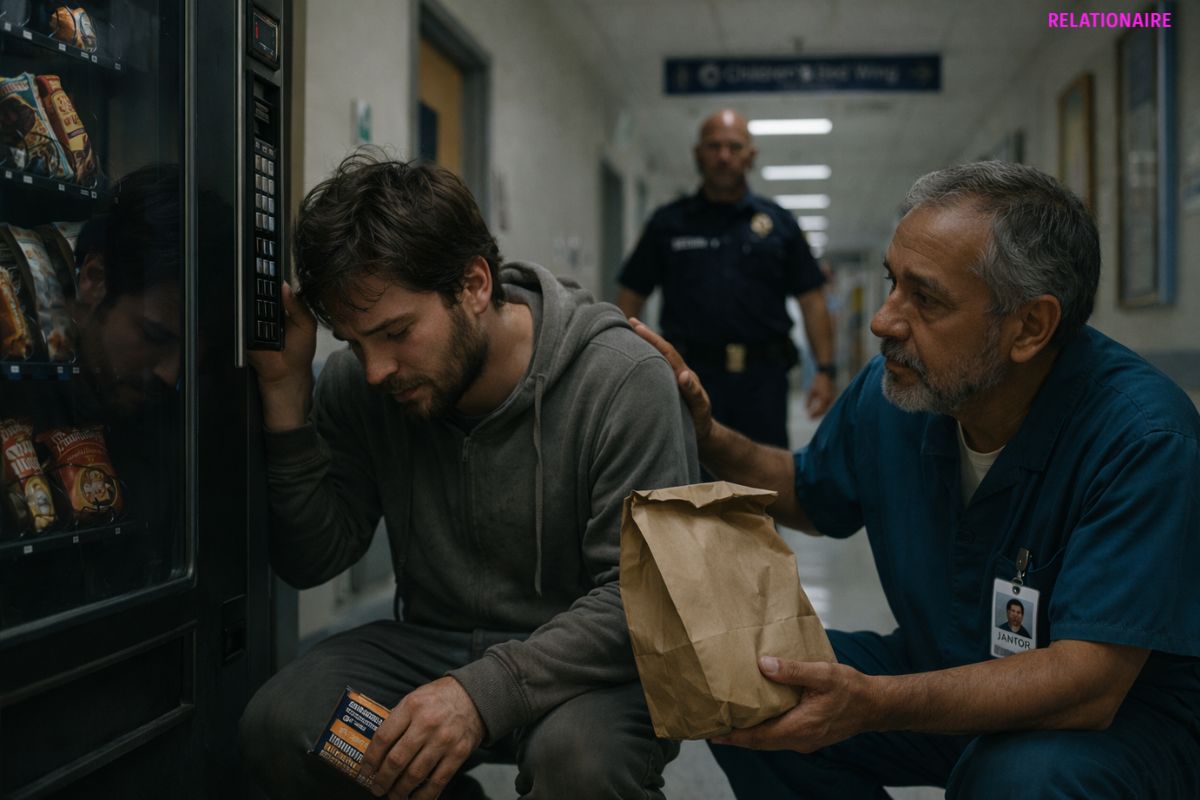
A cart squeaked somewhere behind him. Slow, uneven wheels. The soft swish of a mop handle bumping linoleum.
Neither Caleb nor the guard turned at first.
Then a voice came from the side.
“Machine on this floor’s been mean since Christmas.”
It was an older man in dark green janitor scrubs, hands broad and dry-looking, pushing a yellow cleaning cart with a black trash bag tied at the side. He had silver at his temples, deep lines around his mouth, and the kind of tired posture that came from years of lifting things nobody noticed until they were gone.
On his cart sat a roll of paper towels, spray bottles, and a plain brown lunch sack folded shut at the top.
The guard paused. “We’ve got it handled, Mr. Navarro.”
The janitor nodded once. “Looks like you do.”
But he didn’t move on.
He looked at Caleb instead, not at his fists, not at his beard, not at the anger hanging off him like steam.
At his face.
At whatever was there besides anger.
“Your kid ask for something specific?” he asked.
Caleb blinked. “Crackers.”
“Saltines?”
“Peanut butter if I can get them.” He hated how desperate he sounded. “Anything plain. She just— she said crackers.”
The janitor set the mop aside, reached into the pocket of his scrub top, and pulled out a ring of keys thick enough to anchor a boat.
The security guard sighed. “Mr. Navarro—”
“It’s fine.”
With calm, practiced hands, the janitor unlocked the front panel of the vending machine.
Caleb stared. “You can do that?”
“Only because this one likes embarrassing people.” The man crouched, reached in, and pulled free the hanging crackers. Then he checked the tray below, fished out two crumpled bills and three coins, and held them out.
“These yours?”
Caleb looked at the money in the janitor’s palm and nearly cried right there in the hallway.
He took it too quickly. “Yeah. Yes. Thank you.”
The janitor straightened, then opened the brown lunch sack on his cart. Inside were two packs of saltines, a small applesauce cup, a plastic spoon, and a juice box.
He held it out like it was nothing.
“Take this too.”
Caleb frowned. “No, I can pay for it.”
“Wasn’t selling it.”
“I can still—”
“Take it,” the janitor said, gentle but firm. “Before that guard decides I’m running an illegal grocery store out of Environmental Services.”
To Caleb’s surprise, the security guard smiled a little.
Caleb gave a broken laugh and took the bag.
It was heavier than it looked.
“You keep food on your cart?” he asked.
The janitor shrugged. “Sometimes people need a bridge between bad news and cafeteria hours.”
The sentence landed somewhere deep.
Caleb looked down into the bag again. Saltines. Applesauce. Juice box. Cheap, ordinary things.
Not ordinary here.
Here, they were relief.
“Thank you,” he said again, quieter this time.
The janitor nodded toward the row of chairs by the window. “Sit a minute before you go back in there.”
“I should take this to my daughter.”
“You should. But you look like you might fall down on the way.”
Caleb almost said he was fine.
Then he sat.
The security guard returned to his desk.
The janitor parked the cart beside the wall and lowered himself into the chair next to Caleb with a slow exhale, like his knees had opinions about it.
For a moment neither of them spoke.
Downstairs, an elevator dinged.
Overhead, the fluorescent lights hummed.
Caleb held the little lunch sack in both hands like it might disappear.
“My daughter’s name is Emma,” he said finally, not sure why.
The janitor nodded. “Pretty name.”
“She’s six.”
Another nod.
“She hasn’t kept food down since Thursday.”
The janitor stared straight ahead. “That’s a hard age to be sick. Old enough to understand fear. Too young to carry it.”
Caleb turned and looked at him.
Most people in hospitals said the same things. She’s strong. Kids are resilient. You hang in there now.
This man said it like he had learned it the expensive way.
Caleb swallowed. “Are you always posted by broken vending machines, or did I just get lucky?”
A small smile tugged one side of the janitor’s mouth.
“My route ends here on purpose.”
Caleb frowned. “On purpose?”
The man looked down at his hands. Big hands. Chapped knuckles. A pale scar across one wrist.
Then he reached into the chest pocket of his scrub shirt and pulled out a folded note so worn the edges had turned soft.
Not a work paper.
Not a receipt.
A child’s note, written in purple marker on lined paper.
He held it for a second, staring at it, then looked at Caleb.
“The food’s not really why I stop here,” he said.
Caleb felt something in the air change.
The hallway seemed to go quieter around them.
The janitor rubbed his thumb over the folded paper and said, very softly:
“My daughter died on this floor twelve years ago. And the last thing she asked me for was crackers.”
Caleb stopped breathing.
The lunch sack slipped in his hands.
And before he could say a word, the janitor unfolded the note and turned it toward him.
PART 2
The note was written in thick purple marker, the letters big and uneven the way children write when they are still learning how much space words take up.
Some of the strokes had bled through the paper. The fold lines were worn nearly white.
It said:
Daddy
for families who forgot to eat
leave them snacks
love, Sofie
There was a crooked heart under her name.
Caleb looked at it, then at the man beside him, then back at the note.
His chest tightened so hard it hurt.
The janitor folded it carefully, almost reverently, and slid it back into his pocket.
For a second Caleb didn’t trust himself to speak.
Finally he asked, “She wrote that?”
The man nodded.
“Here?”
“Room 614.” He glanced down the hall, though the room was nowhere in sight. “Different wallpaper then. Same bad coffee.”
Caleb let out a shaky breath he hadn’t realized he was holding.
He had seen grief in hospitals all around him for two days now. In faces. In silence. In half-finished cups of coffee and people sleeping bent over in waiting room chairs. But this was different.
This wasn’t raw.
It was lived-in.
Worn smooth and still sharp in places.
“How old was she?” Caleb asked.
“Seven.”
Emma was six.
That single year between them suddenly felt very small.
The janitor looked at Caleb’s face and seemed to understand immediately why he had gone quiet.
“She liked saltines better than the peanut butter kind,” he said. “Said peanut butter made your mouth lonely.”
Despite himself, Caleb laughed once through his nose.
Then his eyes stung.
The janitor gave him a minute.
“My name’s Luis,” he said after a while.
“Caleb.”
“I know.”
Caleb looked up.
Luis nodded toward his visitor badge. “You’ve been wearing it upside down all night.”
Caleb glanced down and saw that he was right.
That somehow made him feel more exposed, not less. Like this man had been seeing him before today. Seeing him the way some people saw water stains spreading on the ceiling—quiet signs that something was wrong.
“You do this for a lot of people?” Caleb asked.
Luis rested his forearms on his knees. “Some weeks more than others.”
“Out of your own money?”
Luis shrugged one shoulder.
“That’s a yes.”
“My wife used to get mad when I bought too much in bulk,” he said. “Now she just leaves coupons on the kitchen counter.”
Caleb smiled faintly. Then it faded.
“I thought you were just being nice.”
Luis turned to him. “I was.”
“No, I mean…” Caleb looked at the lunch sack. “I thought it was just because I looked wrecked.”
Luis didn’t rescue him from the awkwardness.
“You did look wrecked,” he said. “Security was about two minutes from making your day worse. But that’s not why I stopped.”
Caleb waited.
Luis’s gaze drifted to the humming vending machine.
“The night Sofie asked for crackers,” he said, “I’d been in her room almost thirty hours. My brother kept telling me to go downstairs, take a walk, get coffee, something. I told him I wasn’t leaving. Then around midnight she woke up and whispered she was hungry.”
He paused.
“I had never been so glad to hear a child ask for food.”
Caleb’s fingers tightened around the bag.
Luis continued in the same steady voice, the kind that made every word hit harder.
“The cafeteria was closed. Nurse offered graham crackers, but Sofie wanted saltines. Said they were the hospital kind and that made them magic.” His mouth twitched. “Kids like making bad things into games.”
Caleb nodded without meaning to.
“I came to this same machine,” Luis said. “It took my money. Ate another bill. I hit it. I cussed at it. I probably looked worse than you.”
“What happened?”
Luis’s eyes stayed on the floor. “No one helped.”
The words were simple. They landed like a weight.
“People walked around me. One woman gave me a dirty look. Security told me if I kicked the machine again I’d be escorted out. I remember thinking how strange it was that the worst thing in my life was happening upstairs, and down here I still had to prove I was not a threat.”
Caleb shut his eyes for one second.
Because yes.
That was exactly it.
Luis went on.
“Finally a nurse from pediatrics came off shift, dug crackers out of her tote bag, and handed them to me in the hallway. Didn’t even let me thank her properly. Just said, ‘Go. She’s waiting.’”
He rubbed the scar on his wrist absentmindedly.
“When I got back to the room, Sofie had drifted off again. She woke long enough to eat two crackers. Two.” He held up his fingers. “Then she asked me if other kids ever got hungry here at night.”
Caleb could already feel where the story was going, and somehow that made it worse.
“I told her yes,” he said quietly.
Luis nodded.
“She asked what happened if their grown-ups didn’t have money or were too tired to go looking. I told her someone would help.”
He smiled then, but it was the saddest kind. Not broken. Remembering.
“She looked at me like she knew I was making that up.”
Caleb let out a breath that shook.
“The next afternoon, she asked for paper. Drew hearts all over it. Told me to write what she said, because my handwriting looked more serious.” He patted the note in his pocket. “That was the note.”
“And she…” Caleb couldn’t finish.
Luis finished it for him, with the gentleness of someone who had answered this question before.
“She died three days later.”
The elevator dinged again.
Somewhere farther down the hall, a baby cried.
Caleb looked at the lunch sack in his lap until the hospital blurred.
He had been holding himself together with irritation, logistics, caffeine, numbers, doctor names, scan times, parking validations. Small hard things he could grip.
But this pierced straight through all of it.
“I’m sorry,” he said, and hated how useless those words sounded.
Luis nodded anyway. “Me too.”
Caleb wiped at his face with the heel of his palm. “So you started leaving food.”
“At first just on this floor.” Luis leaned back in his chair. “Then NICU waiting room. Oncology family lounge. ER if I had extra. I don’t make enough for heroics. I do enough for crackers, applesauce, sometimes juice.”
Caleb thought of the careful way the bag had been packed.
Not random.
Chosen.
Things a sick child could maybe keep down. Things exhausted parents might hand over in relief.
“How many families?” Caleb asked.
Luis gave a little huff. “Not counting?”
“You don’t count?”
“Would’ve made it feel like math.”
They sat in silence again.
Then Caleb’s phone vibrated.
This time it was the doctor.
His stomach dropped so suddenly he thought he might be sick.
He answered on the first ring. “Hello?”
“Mr. Mercer, this is Dr. Levin. Are you with Emma right now?”
“No, I’m in the hallway. I’m coming back. Is she okay?”
There was the briefest pause.
“She’s stable. I’d like to speak with you in her room. We have the preliminary results.”
Caleb stood so fast the lunch sack nearly fell.
“Okay. I’m coming now.”
He hung up and stared at the dark screen.
Preliminary results.
In hospitals, that phrase could mean anything and nothing. It could mean answers. It could mean new fear with better vocabulary.
Luis stood too.
“Go on,” he said.
Caleb nodded, but his legs wouldn’t move.
He looked at Luis. Really looked at him.
The scrub top with a bleach mark near the hem. The cart with the squeaky wheel. The face everybody probably forgot five minutes after he left the room. This man had built a private ministry out of snack food and memory and never said a word about it unless someone happened to fall apart in front of the right vending machine.
Caleb swallowed hard. “Why this floor? Still?”
Luis’s eyes moved down the corridor.
“Because some nights,” he said, “I think I hear my daughter in the hallway.”
Caleb’s throat tightened.
Luis gave a small shake of his head, embarrassed by his own honesty. “Not like that. I’m not saying ghosts. Just…” He searched for the words. “Some griefs leave an echo. And sometimes when a father’s trying not to break a machine with his bare hands, I know exactly what that echo sounds like.”
Caleb laughed through tears.
Then he did something he hadn’t done in two days.
He stepped forward and hugged a stranger.
Luis froze for half a second, then patted his back once, twice.
“Take the juice out first,” he muttered. “You’ll crush it.”
Caleb pulled back with a wet laugh and fumbled the juice box out of the sack.
He was halfway down the hall before he turned around.
Luis was already pushing his cart again, heading toward the elevators, toward whatever room needed mopping, emptying, wiping down, making bearable.
Just an ordinary man in green scrubs.
Just a janitor.
Except now Caleb knew that wasn’t small at all.
He hurried back to Emma’s room with the crackers and the applesauce and the note burning in his mind.
When he stepped inside, Emma was awake against her pillows, eyes too big in her pale face.
Beside her bed stood Dr. Levin with a chart in one hand.
And in the other, a single folded page.
“Mr. Mercer,” the doctor said softly. “Before we talk about the test results… there’s something your daughter asked me to give you when you came back.”
Caleb stared at the paper.
Emma looked at him with a strange, fragile seriousness no child should ever wear.
And then she said, “Daddy, I wrote it while you were gone.”
PART 3
Caleb crossed the room in three strides and took the page from Dr. Levin with hands that suddenly didn’t feel attached to him.
Emma watched his face the whole time.
The paper was hospital stationery. Thin. White. Folded once in the middle.
He opened it carefully.
Inside, in pencil pressed too hard, were crooked letters and a drawing of what looked like three rectangles with smiling faces.
Crackers.
It said:
For the next kid who is hungry
you can have mine first
Love Emma
Caleb had to sit down.
Not because the chair was close.
Because his knees gave up.
He lowered himself into the vinyl seat beside her bed and stared at the note until the words blurred.
Across the room, Dr. Levin stepped back quietly, giving them privacy without fully leaving. The monitor kept up its soft steady beeping. Somewhere outside in the corridor, a cart rolled past and faded away.
Emma touched his sleeve.
“Did you get them?” she asked.
Caleb looked up too fast. “Yeah, baby. I got crackers.”
“Good,” she whispered.
“You want some now?”
She nodded.
He opened the saltines with ridiculous care, as if rough hands might ruin the miracle of the moment. She took one and held it for a second before nibbling the corner. Then another. Tiny bites. Serious work.
Caleb watched like a starving man watches bread.
When she finished half of one cracker, she leaned back against the pillow, tired but proud.
“Best thing I ever saw,” he said.
That made her smile.
Dr. Levin came closer then, gentle and composed in the way doctors learn to be when the next words matter.
“I know you’ve both had a very long two days,” she said. “The preliminary results point to a severe inflammatory condition, but not the one we were most worried about.”
Caleb’s heart lurched. “What does that mean?”
“It means we have a treatment plan,” she said. “It means she is very sick, but we believe she is treatable. We caught this when we did because you brought her in and kept pushing when something felt wrong.”
Caleb stared at her.
He had prepared himself for a cliff.
For the ground disappearing.
Instead, this was still terrifying—but it was ground. Uneven, frightening, uncertain ground. But ground.
Not hopeless.
He let out a sound that was half sob, half laugh, and covered his mouth with his hand.
Emma looked between them. “Am I staying?”
“For a little while, sweetheart,” Dr. Levin said. “But we know what we’re fighting now.”
Emma accepted this with the solemnity of a child who had heard too many adult voices trying not to sound scared.
When the doctor left to arrange the next steps, Caleb bent over and pressed his forehead to Emma’s blanket.
He didn’t cry loudly.
He just came apart quietly, right there beside the bed, while Emma laid her small hand on the back of his neck the way he had done for her a hundred times.
After a minute he sat up and wiped his face.
She looked at him. “Did you see the man with the floor cart?”
Caleb blinked. “Luis?”
She nodded. “He came in when I was sleeping before.”
“When?”
“After the scan. I woke up a little.” Her voice was thin with tiredness. “He fixed my blanket. I thought he was Grandpa for a second.”
Caleb smiled through the ache in his chest. Emma’s grandfather had died when she was three.
“What did he say?”
She looked at the ceiling, remembering. “He thought I was asleep. He said, ‘Hang on, sweetheart. Your daddy’s trying real hard.’”
Caleb closed his eyes.
Of course he had.
Of course this man had quietly looked in on rooms too, not just vending machines and waiting areas. Not intruding. Just leaving the place softer than he found it, one family at a time.
Emma tugged the note in Caleb’s hand.
“You like it?”
“I love it.”
“I wanted to do what the other girl did.”
Caleb went still.
“The other girl?”
Emma nodded. “The man told me. About the note.” She yawned. “He said she wanted hungry people to have snacks.”
Caleb looked at her as the pieces settled into place.
Luis had told her.
Not the whole story, probably. Just enough.
Enough for a sick six-year-old to understand kindness in the middle of fear.
“Do you want me to keep this safe?” Caleb asked.
Emma’s eyes were drifting shut again. “No. Put it where people can see.”
That night, after Emma fell asleep for real, Caleb did something he hadn’t expected to do.
He went looking for Luis.
He found him on the fourth floor near a family lounge, replacing a trash liner with the same calm efficiency he seemed to bring to everything.
Caleb stood there for a second before speaking.
“Hey.”
Luis turned. “How is she?”
Caleb swallowed. “Still sick. But treatable.”
The relief on Luis’s face was instant and unguarded.
“Good,” he said. And then, more softly, “That’s very good.”
Caleb held up Emma’s note.
Luis read it, and for the first time since Caleb met him, the older man’s composure cracked.
He took off his glasses. Rubbed his eyes hard with thumb and forefinger. Laughed once at himself.
“She wrote that?”
“She did.”
Luis nodded, blinking fast. “Your daughter’s got good instincts.”
Caleb stepped closer. “You told her about Sofie.”
“I told her there was once a girl who thought hungry families shouldn’t have to be brave on empty stomachs.”
“That was enough.”
Luis looked back at the note.
For a long moment neither man spoke.
Then Caleb said, “How many snack bags do you keep in a week?”
Luis glanced at the cart as if the answer might be written there. “Depends. Ten on a quiet week. Twenty-five on a bad one. End of month’s always rough.”
“Because people run out of money.”
“Because parking costs money. Food costs money. Being scared costs money too, somehow.”
Caleb gave a humorless laugh. “Yeah.”
He took a breath.
“I can’t do much right now. My savings are about to become hospital bills.” He said it plainly. No shame left for the truth. “But when we get through this… I want to help.”
Luis shook his head gently. “You don’t owe me.”
“I know.” Caleb looked at him. “That’s not why.”
The older man studied him for a second, then nodded once.
A week later, the note was laminated and taped to the inside of the family snack cabinet near pediatrics, a cabinet a nurse manager quietly approved after hearing the story from exactly the right person. Emma’s note sat beside Sofie’s, the two pages side by side.
Purple marker and hard pencil.
Two little girls who had never met.
Two notes telling grown-ups not to forget each other.
The cabinet started small. Crackers. Applesauce. Instant oatmeal cups. Juice boxes. Granola bars. Plastic spoons. Tea bags. Nondairy creamer packets. Cheap things. Necessary things.
Families used it like people use mercy at first—with hesitation.
Then with gratitude.
Sometimes Caleb, during the weeks Emma was in and out for treatment, would see a mother standing in front of it at 2 a.m., crying quietly because she hadn’t realized how hungry she was until she saw food she didn’t have to choose against rent.
Sometimes he would spot a grandfather taking two packs of crackers and leaving one dollar folded underneath, like dignity needed an exchange even when nobody asked for one.
Sometimes security would pass by and keep walking.
And sometimes, late at night, Caleb would find Luis restocking the cabinet without ceremony, setting things in neat rows with those broad careful hands.
Emma got stronger slowly.
Not in a movie way.
Not all at once.
In inches. In sips. In half-sandwiches. In color returning to her face. In the day she asked to brush her own hair again. In the first time she complained about homework from her hospital bed and Caleb nearly laughed from relief.
Months later, when she was well enough to go home for good, she asked for one stop before they left the hospital.
“The snack cabinet,” she said.
Luis met them there during his break.
Emma, still thin but bright-eyed, handed him a brown paper bag she had decorated with stickers and wobbly stars.
Inside was a fresh stack of handwritten notes on folded paper.
Some said For somebody’s dad.
Some said For the grandma waiting all night.
One said Take two if you need two.
Luis read them with his lips pressed together.
Emma hugged him around the waist.
He rested one hand lightly on her back and looked at Caleb over her head, eyes shining.
“Looks like I’m going to need a bigger cabinet,” he said.
Caleb smiled.
“Looks like you are.”
Years later, Caleb would forget the exact wording the doctors used that night. He would forget which tests came first and which specialist wore which color scrubs. Trauma blurred some details and sharpened others.
But he would never forget the vending machine.
The crooked packet of crackers hanging just out of reach.
The way a stranger with a mop cart saw a man on the edge of falling apart and recognized him before he became a problem to manage.
And he would never forget that sometimes what keeps a person going is not a miracle.
Sometimes it is a juice box. A folded note. A chair in a hallway. A hand that does not look away.
Sometimes the holiest thing in the building is a janitor who remembers what hunger sounds like.
And sometimes the people who carry the heaviest grief are the ones who leave the gentlest things behind.