If you’ve already read part 1 of this story on Facebook, go here for Part 2!
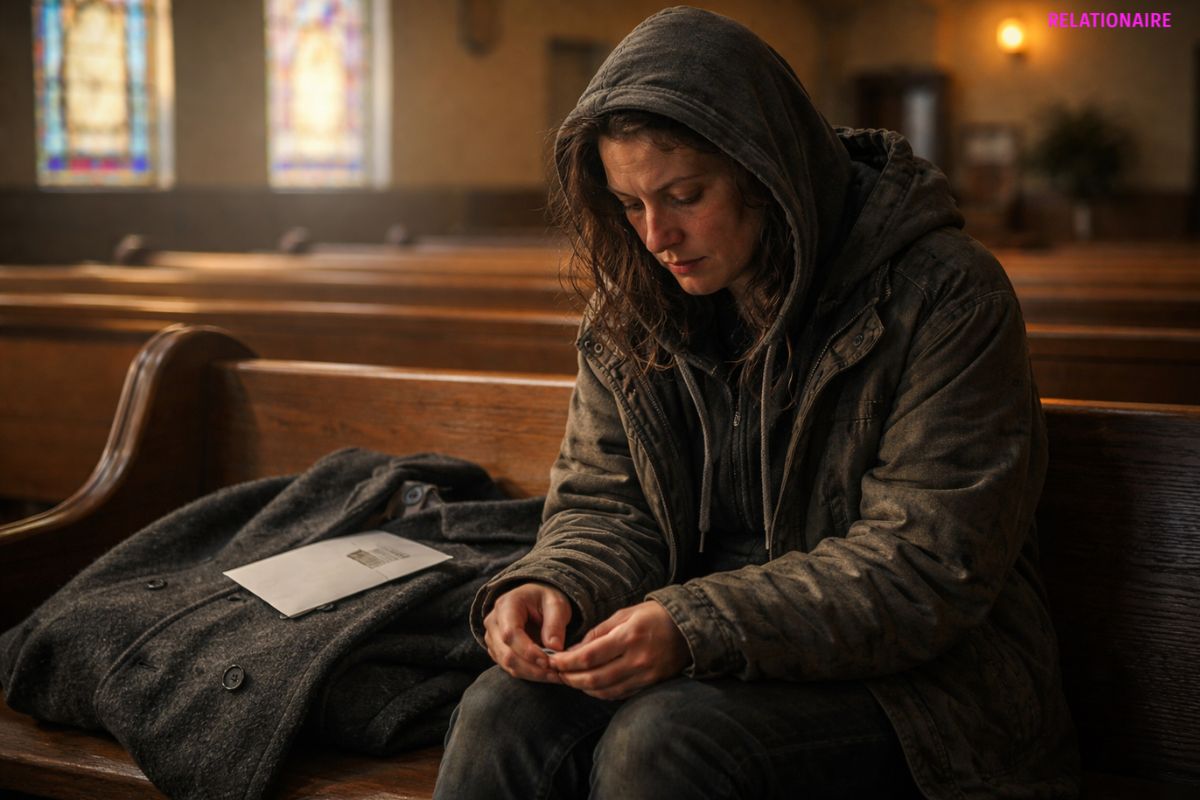
By the time Lena pushed open the side door of Grace Fellowship, her fingers were so numb she had to lean her shoulder into it twice.
The metal handle had burned her skin with cold.
Sunday bells were still ringing somewhere above her, soft and proper and warm, and for one stupid second she almost turned around. She could already picture how she looked in the church window behind her.
Frayed sweatshirt under a thin coat that wasn’t really a coat anymore. Sneakers dark with slush. Hood pulled low. Hair tucked away because it hadn’t seen a mirror or a decent brush in days.
The kind of woman people watched without meaning to stare.
The kind of woman people counted their wallets around.
She slipped inside anyway.
Warm air hit her face so suddenly it hurt.
For a second she had to close her eyes.
The sanctuary smelled like old wood, candle wax, and coffee from the fellowship hall. It smelled like winters from another life. Before motel rooms. Before sleeping upright in a car that had finally been towed three nights ago. Before learning how long you could walk around a grocery store pretending to shop just to stay inside.
The singing had already started.
Lena kept her head down and moved to the very last pew in the back corner, the one half-hidden by a stone pillar. She sat at the edge like she might need to run.
Nobody stopped her.
But people noticed.
She felt it in that awful way you can feel eyes without ever looking up. A pause in a whispered greeting. A coat rustling as someone turned. The quick glance from a woman in pearls. The longer one from a man in a navy blazer.
Lena tucked her hands under her arms and stared at the hymnal rack in front of her.
She wasn’t here for forgiveness.
She wasn’t here for community.
She was here because the shelter on Pine had been full, the bus station had kicked everyone out before dawn, and the wind outside felt mean enough to crack bone.
Up front, a little girl in a red velvet dress sang one line too early and her mother gently pulled her back. A baby fussed. Someone coughed into a handkerchief.
Ordinary things.
The kind that could split a person open when they hadn’t belonged anywhere in too long.
Lena kept her hood up.
The pastor was halfway through a welcome when she noticed him.
He stood near the side aisle by the radiator, broad-shouldered and still, wearing a faded work jacket instead of church clothes. Late thirties maybe. Dark hair. Thick hands. A ring of janitor’s keys hung from one finger.
He wasn’t smiling.
He wasn’t singing.
He looked like the kind of man people asked to handle problems quietly.
Lena’s stomach tightened.
Of course.
Of course this was how it would go.
He’d noticed her wet shoes, her torn cuff, the way she had chosen the farthest seat from everyone else. He was probably waiting for a better moment to tell her she couldn’t stay. Or worse, to tell her kindly.
She knew which version felt more humiliating.
The sermon started. She tried not to listen.
But church had muscle memory. Even when she didn’t want it, the words found old places in her. The rhythm of Scripture. The rise and fall of prayer. The scrape of pages turning in near unison.
Then the congregation stood for a hymn.
Lena stayed seated at first, but something in her chest pulled tight when the organ found the opening notes.
“Be Thou My Vision.”
Tom’s favorite.
She had not heard it in over a year.
Not since the hospice nurse had lowered her eyes and adjusted his blanket and Lena had stood at the side of that rented hospital bed trying not to make a sound.
The first line wavered through the sanctuary.
Voices filled in.
Lena bit the inside of her cheek hard enough to taste blood.
Don’t cry. Not here. Not where people can see.
But when the second verse came, her mouth moved before she could stop it.
Just barely.
Not singing, really.
More like remembering.
The notes slipped out under her breath, cracked and small and still somehow exactly where they belonged.
She saw movement from the side aisle.
The man with the keys had turned his head.
Lena dropped her gaze immediately and shut her mouth.
The rest of the service passed in a blur of heat and shame. Twice she nearly fell asleep sitting up. Once her stomach growled loud enough that a teenager two rows ahead glanced back. She pretended to cough to cover it.
When the final prayer ended, people began to gather coats and children and paper bulletins. The room filled with scraping pews and cheerful voices and invitations to brunch.
Lena stayed still.
She had learned that leaving with a crowd was worse. Too many chances for someone to corner you with concern.
So she waited, hood up, eyes down, until the sanctuary thinned.
A pair of women passed behind her.
“Did you see her come in?” one whispered.
“Hush,” the other whispered back.
That was almost worse.
Lena swallowed hard and stared at the knot in the wood of the pew ahead of her until their footsteps faded.
When she finally lifted her head, the sanctuary was nearly empty.
The man with the keys was gone.
Good, she thought. Good.
She pushed herself to standing, stiff and dizzy.
That was when she saw it.
A coat lay folded on the pew beside her.
Not tossed. Not forgotten.
Left.
It was charcoal gray wool, thick and clean, with a satin lining at the collar and one button replaced with plain black thread. Beside it sat a white envelope with no name on it.
Lena froze.
The heat in the sanctuary suddenly felt unbearable.
Pity, then.
Neat, private, church-approved pity.
A coat for the woman in the back row. Maybe some cash in the envelope. Maybe a prayer card. Maybe a soft little note written by someone who wanted to feel generous without ever having to look her in the eye.
Her jaw tightened.
She should have walked away.
She knew she should have.
But cold has a way of making pride feel expensive.
Lena picked up the envelope first. It wasn’t sealed.
Inside was a single folded note.
She opened it with shaking fingers.
I didn’t leave this because I felt sorry for you.
I left it because it already belongs to you.
Check the right pocket.
—E
She frowned.
Her breath caught.
Slowly, almost angrily, she slipped her hand into the coat’s right pocket.
Her fingers brushed wool. Lining. Then metal.
Something small.
She pulled it out and stared.
A tarnished silver star pin.
Cheap foil faded to gray at the edges. One point bent.
Lena’s knees nearly gave out.
She knew that pin.
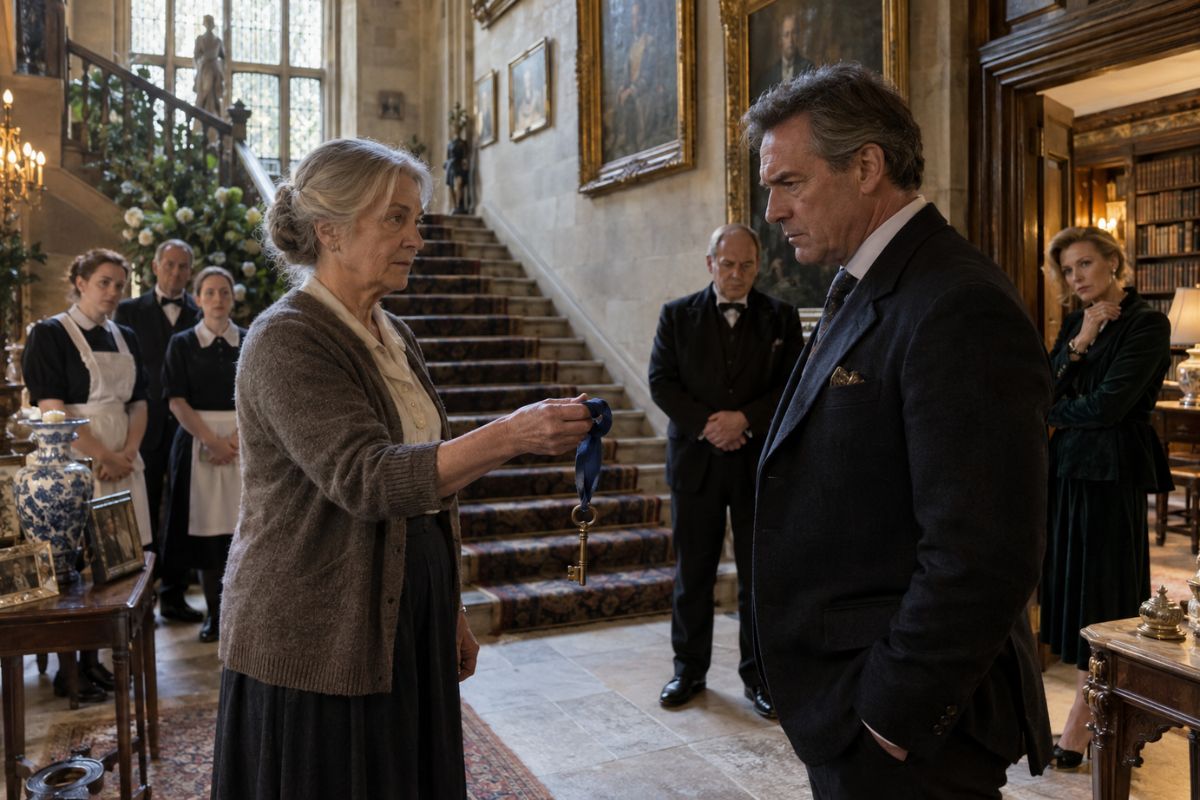
She had fastened it to a frightened twelve-year-old boy in a bathrobe costume on Christmas Eve thirteen years ago, when his hands had been shaking too hard to do it himself. He’d been new to the foster system then, all sharp elbows and lowered eyes, freezing in the church basement because he was too embarrassed to admit his coat had been stolen at school.
She had wrapped her own wool coat around his shoulders that night.
And before she sent him onstage, she had smiled and said, “Nobody sings well when they’re cold.”
Lena looked back at the note.
There was more on the back.
She turned it over.
I recognized your voice before I recognized your face.
Wait for me before you go.
From the front of the sanctuary came the soft jingle of keys.
Lena looked up.
The man in the work jacket was standing in the center aisle now, not blocking her way, not pushing closer.
Just waiting.
And when he finally spoke, his voice was quiet.
“Miss Lena,” he said. “You once saved me with that coat.”
Part 2
For a second, Lena honestly thought she might faint.
Not from the cold this time.
From being known.
She gripped the back of the pew so hard the wood dug into her palm. The silver star pin trembled in her fingers.
The man in the aisle took one careful step closer.
“It’s Eli,” he said. “Eli Warren.”
The name hit her a beat before the face did.
Not the broad shoulders. Not the stubble. Not the work boots. Those belonged to a grown man. But his eyes were the same. Dark and watchful, with that old habit of bracing for the worst before anyone had even spoken.
The boy from the Christmas pageant.
The one who never took seconds unless she put the food straight into his hands.
The one who stood in doorways like he was apologizing for taking up space.
“Oh,” Lena said, and the word came out thin. “Oh my goodness.”
A laugh tried to rise in her chest and broke apart on the way up.
She looked down at the coat again.
Her coat.
Not exactly as it had been then. The left cuff had been mended. One button had been replaced. It had been cleaned better than she ever could have managed in those last bad years. But it was hers.
Or it had been.
She remembered taking it off in the basement hallway because Eli’s lips had gone pale and he kept insisting he was “fine.”
She remembered draping it over him anyway.
She remembered meaning to ask for it back later and then deciding not to when she saw how tightly he held the lapels closed with both hands, like warmth could disappear if he relaxed even a little.
“You kept it,” she whispered.
Eli gave the smallest shrug. “Couldn’t seem to get rid of it.”
That would have sounded casual from someone else. From him, it sounded careful.
As if he knew too much pressure might send her running.
The sanctuary had gone still around them. Somewhere down the hall, someone laughed over coffee. A vacuum started and stopped. Life continuing, ordinary and loud, while Lena stood there feeling like the floor under her feet had shifted.
“I thought…” She swallowed. “I thought somebody left it because I looked cold.”
“You did look cold,” Eli said.
Despite herself, a short sound escaped her. Not quite a laugh.
Then shame came rushing back, hot and fast.
Of course she looked cold. Of course she looked wrecked. He had seen all of it. The hood. The shoes. The days on her face.
She drew the coat tighter against her stomach instead of putting it on.
“I wasn’t here for charity,” she said quickly, hating how defensive she sounded. “I just needed—”
“Warmth,” Eli finished.
He didn’t say it like an accusation.
He said it like a person naming a fact so it wouldn’t have to carry extra humiliation.
Lena stared at him.
“I only came in because I was freezing,” she said.
“I know.”
“I haven’t been…” She looked up at the front cross and back down again. “I haven’t been to church in a long time.”
“I know that too.”
The words should have felt dangerous. Instead they landed gently.
He hooked his keys to a belt loop and nodded toward the side door. “There’s chili in the fellowship hall. They always make too much on Communion Sunday.”
Her first instinct was refusal.
It had become so automatic it almost came out before she thought.
No, thank you. I’m fine. I should go.
Those were the lies people told when the truth made them feel too exposed.
But Eli must have seen it flicker across her face, because he added, “You can eat in the kitchen if you don’t want the hall.”
Not where people could stare.
Not where someone might offer her plastic-wrapped sympathy with their eyes.
The care in that almost undid her more than the coat.
Lena nodded once.
He didn’t smile like he’d won something. He just turned and walked slowly enough that she could follow without feeling herded.
In the kitchen, steam fogged the windows over the sink. A volunteer in an apron was stacking bowls. Eli said quietly, “This is Lena. She’s with me.”
Not she needs help.
Not can we get her something.
She’s with me.
The volunteer, a gray-haired woman with reading glasses on a chain, looked at Lena only long enough to smile and ask, “Cornbread too?”
Lena opened her mouth to say no.
Her stomach made the decision for her.
“Please,” she said.
A few minutes later she sat at a tiny metal table in the corner with a bowl of chili so hot it made her eyes water. Eli leaned against the counter across from her, giving her privacy without leaving.
She ate too fast at first. Then slower, embarrassed. Then slower still, because the warmth spreading through her chest hurt in a different way than hunger.
“You recognized me from a hymn?” she asked finally.
Eli nodded. “From the alto line. You used to tap the beat with your left finger when people drifted flat.”
Lena looked down.
Her left hand was still resting on the table, index finger moving unconsciously against the metal edge.
She curled it into her palm.
“I used to direct the children’s choir,” she said softly.
“I know.”
“And organize the coat drive.”
“I know that too.”
The words landed heavier this time.
Lena set down her spoon.
“Then you also know what happened,” she said.
Eli was quiet.
She hated how much relief there was in finally saying it aloud to someone who remembered the before.
“Tom got sick,” she said. “Then he got sicker. Then every bill became two bills, and every call was somebody else wanting money I didn’t have. I missed work. Lost work. Sold things. Borrowed. Lied. Fell behind. Kept thinking I’d catch up once…” Her throat closed around the rest.
Once he got better.
Only he hadn’t.
She pressed a thumb hard into the heel of her hand and went on.
“After he died, people were kind for a while. Meals. Cards. Church flowers. Then life moved on the way it does. I don’t blame anyone for that. But grief is expensive in ways nobody tells you. It makes you forget things. Miss things. Drop things you shouldn’t.” She laughed once, with no humor in it. “Turns out landlords aren’t moved by heartbreak.”
Eli looked down at the floor for a moment.
“When I was twelve,” he said, “you gave me that coat and a paper sack with peanut butter crackers because you heard my stomach growling before rehearsal.”
Lena blinked.
She had no memory of the crackers.
He did.
“I didn’t eat all of them,” he said. “I took half home for my little sister. You probably didn’t know I had one. Most people didn’t ask questions once they heard the word foster.”
Lena stared at him.
“I kept that star pin in the pocket because it was the first nice thing anybody had ever pinned on me instead of to me.”
Something in her face must have changed, because Eli stopped and rubbed a hand across the back of his neck.
“Sorry,” he said. “That came out strange.”
“No,” Lena said quickly. “No, I understood.”
And she did.
Too well.
He pushed off the counter and reached into his jacket pocket. “There’s one more thing.”
He held out another envelope, older this time, creased at the corners.
“This was in the church office mailbox three weeks ago,” he said. “For you.”
Lena didn’t take it right away.
“For me?”
“It was from Ruth Campbell.”
Lena’s head lifted.
Ruth.
Old Ruth with the smoker’s laugh and the arthritic hands that still played the piano like she was arguing with heaven. Ruth, who used to slip wintergreen mints into the choir folders and call everyone sweetheart, even when she was irritated.
“She asked me to give it to you if you ever came back,” Eli said.
Lena reached for the envelope with numb fingers.
Her name was written across the front in Ruth’s shaky script.
For a moment the kitchen, the chili, the church, the years in between — all of it blurred.
“Is she…” Lena couldn’t finish.
Eli answered gently. “She’s at Haven House now. Rehab turned into long-term care.”
Lena looked at the envelope like it might burn through her skin.
“Why didn’t anyone—”
He stopped her with a look that held no blame, only truth.
“Nobody knew where to find you.”
That hurt because it was true.
Because disappearing had not happened to her. She had done part of it herself. One missed call. Then another. One unopened message because she couldn’t bear the shame of hearing kindness in someone’s voice. Then enough days stacked together that returning felt impossible.
Lena slid one finger under the flap.
Inside was a single folded sheet.
She opened it.
The first line made her inhale sharply.
I am too old to pretend I don’t know the difference between pride and pain.
Her vision blurred before she could read the rest.
Eli looked away to give her privacy.
From the fellowship hall came the muffled sound of chairs being folded, silverware clattering, people talking about weather and football and ordinary groceries.
Lena wiped under one eye, angry at herself for crying over paper.
Then she read the next line.
And then the next.
By the time she looked up, her face had changed.
Eli saw it immediately.
“What is it?” he asked.
Lena pressed the letter to her mouth for one unsteady second.
“She kept them,” she whispered.
“Kept what?”
“My music. Tom’s letters. The box from the apartment.” She swallowed hard. “She paid the storage herself when I lost the place. She wrote that she told the church office not to throw anything away if my name ever came up. She said…” Lena looked back at the page. “She said if I was reading this, then I was still here, and that meant it wasn’t too late to come get my life in pieces.”
Eli was silent.
Then Lena looked at the last line in the letter.
Her fingers tightened.
“She wants to see me today,” Lena said.
Eli straightened.
The kitchen suddenly felt too small for what was happening inside her chest.
The coat lay across her lap.
Ruth’s letter trembled in her hand.
And for the first time in a very long time, the next hour of Lena’s life did not look like an empty stretch she had to survive.
It looked like a door.
Part 3
Haven House smelled like lemon cleaner, canned soup, and something underneath both that Lena couldn’t name without admitting what it was.
Age.
Endings.
The slow soft unraveling of bodies that had carried too much for too long.
Lena almost asked Eli to turn around twice on the drive over.
The church had let her use the staff bathroom before they left. She had washed her face with hand soap, combed her hair with her fingers, and put on the gray wool coat with shaking hands. It hung a little different now, but still knew her shoulders.
At the last second, the volunteer with the reading glasses had pressed a paper cup of coffee into her hand for the road.
Nobody had made a speech.
Nobody had asked her to explain herself.
They had simply made room.
That kindness scared her nearly as much as cruelty used to.
Eli parked near the side entrance and cut the engine.
“You don’t have to do this all at once,” he said.
Lena stared through the windshield at the low brick building.
“I know.”
But she opened the door anyway.
Ruth was smaller than memory.
That was Lena’s first thought when they walked into Room 214.
Smaller, and somehow sharper. The bones of her face stood out more now, and her silver hair had thinned to a soft cloud around her head. But her eyes were still bright and bossy. Her mouth still looked made for saying exactly what needed saying.
“Well,” Ruth said the second she saw Lena in the doorway. “There you are.”
Lena let out a sound that was half-laugh, half-sob.
Ruth lifted one hand impatiently. “Don’t stand there looking guilty. I am too tired to comfort you before I scold you.”
That did it.
Lena crossed the room in three stumbling steps and bent over the bed, laughing and crying all at once while Ruth patted her cheek with a hand that felt like paper.
“You vanished,” Ruth muttered.
“I know.”
“You were impossible to find.”
“I know.”
“You look thin.”
Lena laughed through tears. “That one I definitely know.”
Ruth’s face softened then.
Just for a second.
“I missed you,” she said.
The room went quiet.
Eli stepped back toward the window, giving them space, but Lena saw the way he folded his arms tightly across his chest, like he was holding something in.
Lena pulled a chair close to the bed and sat.
For a while they talked in the uneven rhythm of people trying to bridge too much lost time. Ruth asked practical questions first, as if emotion had to wait its turn.
Where had she been sleeping?
Did she still have her ID?
Was the cough in her chest new?
Had she eaten today?
Lena answered as honestly as she could.
Not every detail. But enough.
Then Ruth pointed to a canvas bag by the dresser.
“Open it.”
Inside were three things.
A rubber-banded bundle of letters in Tom’s handwriting.
A blue choir folder with Lena’s name on the front in black marker.
And a ring of storage-unit keys attached to a wooden tag.
Lena stared down at them until her vision swam.
“I paid through the winter,” Ruth said matter-of-factly. “Couldn’t manage longer than that on my pension, but Eli here has already decided to be useful.”
Lena looked up.
Eli, caught, rubbed the back of his neck.
“The church has a benevolence fund,” he said. “And a few people who can mind their business while still helping.”
Ruth snorted. “Which is my way of saying I told only the ones with sense.”
Lena touched the choir folder first.
The cardboard was softened at the corners from years of use. When she opened it, a wintergreen mint — flattened, ancient, unmistakable — fell into her lap.
She covered her mouth.
“Oh, Ruth.”
“I know,” Ruth said. “I’m sentimental in private. Don’t spread it around.”
Lena laughed again, but this time it came from somewhere deeper.
Then she looked at Tom’s letters.
She had not seen his handwriting in almost a year.
There are griefs so heavy you stop reaching for them, not because they matter less, but because lifting them feels like stepping onto broken ice.
Ruth must have seen the fear in her face.
“You don’t have to read them today,” she said.
Lena nodded.
That mercy felt holy.
They stayed nearly an hour.
At some point a nurse came in with medication and smiled at Eli like she knew him. Later, Lena found out he’d been coming by Haven House on Thursdays to fix a stubborn boiler valve in the laundry wing. Of course he had. Quiet men who carried tools always seemed to know where heat failed first.
When visiting hours thinned and afternoon light slanted pale across the floor, Ruth cleared her throat.
“I have one more selfish thing to ask before I die,” she said.
“Ruth—”
“Oh, stop. I am eighty-two and realistic, not dramatic.” She shifted against her pillows. “Sing for me.”
Lena went still.
The room seemed to narrow around that one request.
“I can’t,” she said immediately.
Ruth lifted an eyebrow. “You mean you won’t.”
“My voice—”
“Is still in there.”
Lena stared down at her hands.
She had not sung since Tom’s last week. Not really. Humming under her breath in church didn’t count. Singing meant opening the room where too much had been locked away. It meant breath and memory and not hiding inside silence anymore.
“I wouldn’t get through it,” she whispered.
Ruth’s expression gentled.
“Then don’t get through it alone.”
The words hung there.
Eli moved from the window.
He didn’t say anything grand. He only stepped to the other side of the bed and rested his hand lightly on the metal rail.
Lena looked from him to Ruth.
Then she looked down at the coat on her own lap, fingers resting over the place where that old star pin had been.
Nobody sings well when they’re cold.
The line came back to her with such force it almost took the breath out of her.
And maybe that had always meant more than weather.
Lena drew in a shaky breath.
The first notes came fragile. Barely there.
“Be Thou my vision…”
Her voice cracked on the second word.
Ruth closed her eyes.
Eli came in softly on the next line, not polished, not perfect, but steady.
Lena tried again.
This time the note held.
By the second verse, she was crying openly and still singing. By the third, Ruth’s lips were moving too, soundless but certain. A nurse paused in the doorway and stayed. Another resident in slippers slowed her walker in the hall.
Nothing about it was pretty in the way concerts are pretty.
It was better than pretty.
It was true.
When the song ended, nobody spoke for a moment.
Then Ruth opened her eyes and said, very softly, “There you are.”
Lena bowed her head and wept.
Not the hard, hidden crying of parking lots and public bathrooms and bus benches.
The other kind.
The kind that comes when your body realizes it does not have to brace every second.
Later, in the parking lot, the air still bit with cold, but it no longer felt like punishment.
Eli unlocked the truck and handed her the canvas bag with the keys and letters and choir folder inside.
“What happens now?” Lena asked.
He leaned against the door.
“Now?” He thought for a second. “Now you come by the church tomorrow morning. Ruth already bullied the office into releasing the storage unit. Marlene in the kitchen knows a woman at the county resource center who can help replace your documents. Pastor Jim’s wife runs the winter shelter downstairs on nights it’s open. And before you say anything—” He lifted a hand. “Nobody is rescuing you. We’re just not pretending not to see you.”
Lena looked away fast.
That sentence had landed exactly where it needed to.
Across the lot, a young mother was wrestling two little boys into puffy coats beside a dented minivan. One of them dropped his mitten. The other wailed because his juice box had spilled. Ordinary life, messy and loud.
Lena clutched the canvas bag to her chest.
“I don’t know how to come back from this,” she said. “From all of it.”
Eli nodded once.
“I know.”
It was the same answer he’d given her all day. Never pushing. Never polishing pain into a lesson.
Just naming what was true and standing there anyway.
He opened the passenger door for her.
The next weeks did not turn magical.
There were forms. Waiting lists. Long mornings. Embarrassing conversations. Two nights when Lena almost disappeared again because asking for help still made her skin crawl. One afternoon in the storage unit when she sat on the concrete between old hymn binders and Tom’s winter boots and cried so hard she couldn’t breathe.
But there was also soup.
There was a cot in a warm basement room with clean blankets folded at the end.
There was Marlene sliding an extra apple into her bag without making it a scene.
There was Ruth’s nurse calling one evening to say she had asked for “the alto with the stubborn streak,” and Lena going straight there.
There was Eli, fixing a broken lock one day and carrying boxes the next, never asking for gratitude, only showing up with that same steady quiet.
And there was music.
Not all at once.
At first Lena only listened when the choir rehearsed upstairs.
Then she sorted sheet music.
Then she corrected a note in pencil on somebody’s tenor line out of pure instinct and got caught.
By spring, she was standing in the back row during Wednesday rehearsal, not leading, not hiding either.
Just singing.
One freezing Sunday months later, Lena was helping stack paper cups after service when she saw a young woman slip into the last pew with her hood still up.
Too thin coat. Wet shoes. Eyes trained downward like looking at people cost too much.
Most of the room never noticed.
Lena did.
She didn’t rush over. She didn’t make a show of it.
She just waited until the sanctuary emptied, then carried a wool coat to the pew and set it down beside the woman with a small white envelope.
Inside, she placed a note.
Not a sermon. Not advice.
Just a few words, simple and careful.
You don’t have to explain being cold.
Before she stepped away, Lena slipped a wintergreen mint into the pocket.
Small things, in the right hands, could become a way back.
Sometimes that was all mercy looked like at first.
And sometimes, if you were lucky, it was enough.