If you’ve already read part 1 of this story on Facebook, go here for Part 2!
“Don’t let that mutt knock anything over.”
The auctioneer didn’t even look down when he said it. He just flipped the tag on an old lantern and lifted it high enough for the front row to see.
Cold morning air slid through the open barn doors and stirred the dust. Somebody near the coffee urn laughed. Somebody else asked if the dog belonged to anyone.
Nobody answered.
The black dog stayed where he was, tucked under a folding chair near the back, ribs showing under dull fur, head low between his paws like he understood he was not wanted but had decided to stay anyway.
The farm was three miles outside town, past the football field and the little cemetery with the rows of flags that always snapped hard in November. Folks had been coming in since sunrise, boots crunching gravel, hands wrapped around foam cups of coffee that smelled burnt and strong. The air carried bacon grease from the food trailer and the damp smell of hay and old wood.
On a table beside the auctioneer sat the life of a man most of them barely knew.
A tackle box.
A shaving kit.
A stack of hunting magazines tied with twine.
A pair of worn leather gloves.
A framed photo facedown.
And off to one side, half under another table like somebody had almost forgotten it, a battered green sea bag with faded black letters nearly rubbed away.
The dog never took his eyes off that bag.
Hank Mercer noticed first.
Hank stood with both hands around his coffee, cap pulled low, jaw set the way it always was. He’d served twenty-two years and still came to these things because he couldn’t stand the thought of a veteran’s belongings being pawed through by people looking for cheap tools and antiques.
“Dog’s watching that duffel,” he muttered.
Jim Rollins, who ran the feed store, snorted. “Dog’s watching for scraps.”
Maybe that should’ve been the end of it. Maybe in another town it would have been.
But not here.
Not with the sea bag sitting there like a last word nobody wanted to hear.
The auctioneer, Earl Timmons, kept the morning moving. He had that fast chant that turned old lives into numbers.
“Who’ll give me ten, ten, now fifteen, fifteen, do I hear twenty—”
A cast-iron skillet sold.
A toolbox sold.
An old watch with a cracked face sold to a teenager who probably only wanted it because it looked old enough to mean something.
The black dog never moved.
He didn’t beg.
Didn’t bark.
Didn’t wag at the kids who drifted too near him.
He just stayed under that chair while strangers bought up pieces of Walter Boone.
That was the dead man’s name. Walter Boone.
Army veteran. Quiet. Kept to himself. Lived in the white farmhouse at the end of the lane with the flag on the porch and the screen door that always creaked twice before it shut. Folks knew he’d lost his wife years ago. Knew he’d stopped coming to the VFW fish fries after his knees got bad. Knew he had no son.
Some said he had a daughter once.
Others said not to pry.
So they hadn’t.
That was how towns like this worked. They left a man his privacy right up until the day they sold his things.
A little boy reached toward the dog’s head.
“Leave him,” Hank said.
The boy’s mother pulled him back, embarrassed. “Sorry.”
The dog didn’t react. Not to the hand. Not to the voices. Not to the rising prices. His eyes stayed fixed on that sea bag as if he were standing watch.
A woman lingered near the rear wall, half-hidden behind a stack of seed sacks somebody had moved out of the barn. She wore a brown coat too thin for the morning and kept her hands shoved in the pockets like she was trying to keep herself from reaching for something. She’d come in late and chosen the back on purpose.
Nobody paid much attention to her.
Town auctions drew strangers sometimes.
Collectors. Resellers. Curious people from the next county over.
Hank noticed her only because once, when Earl lifted the shaving kit, she looked down so fast it felt less like indifference and more like pain.
He watched her a second longer.
Then Jim leaned over and whispered, “Wonder if the old man fed that dog.”
Hank looked at him.
Jim shrugged. “What? Looks half wild.”
Hank didn’t answer. He kept watching.
Earl picked up a folded wool blanket, military green and frayed at the edges. “Who’ll start me at five?”
The dog lifted his head.
Just a little.
Then lowered it again.
Five dollars. Seven. Ten.
Sold.
The morning went on like that. A life divided into lots. People stepped forward, nodded, paid, carried away pieces of a man who wasn’t there to object. The sound of the auctioneer’s voice bounced off the rafters. The chair legs scraped. A thermos lid clattered to the concrete. Somebody coughed. Somebody laughed too loud.
The woman in the back didn’t buy a thing.
She just stood there, face pale, eyes on the tables.
When Earl finally reached for the framed photo, he turned it over without ceremony.
It was a younger Walter Boone in uniform, shoulders straight, expression serious, standing beside a little girl in a summer dress with one hand tucked inside his big calloused grip. At their feet sat a black puppy with oversized ears.
A few people smiled at that.
“Cute dog,” somebody said.
“Must be the same one,” another voice answered.
“No way. Too many years.”
The woman in the back shut her eyes.
Only for a second. But Hank saw it.
Earl held up the photo. “Who’ll give me ten?”
No one spoke.
The barn got strangely quiet.
It wasn’t the kind of photo people bought for decoration. It was too personal. Too heavy. You could feel that much from where you stood.
“Five, then,” Earl said.
Still nothing.
The woman at the back took one step forward.
Then stopped.
Hank set down his coffee and raised a hand. “Five.”
Earl nodded. “Five I got, do I hear ten?”
Nobody did.
“Sold.”
Hank took the frame carefully when it reached him, as if it might crack from more than age. He looked at the little girl again. Yellowing at the edges. Dog at her feet. Walter in his dress uniform. All three staring into sunlight that had happened a lifetime ago.
The woman in the back had turned away.
Outside, a truck started and shut off again. A gust of cold came through the barn and lifted the corner of a tarp. The dog’s nose twitched.
Then Earl moved to the last items.
“Now folks, here’s the old sea bag.”
A few heads turned. Most didn’t.
It looked like nothing special. Stained canvas. Rust on the zipper. One handle repaired with rough stitching. The smell of old canvas seemed to rise even from where people stood, mixed with dust and oil and years.
“Probably clothes,” Jim said.
“Or junk,” someone else added.
Earl bent, got a grip on the strap, and hoisted the bag onto the table.
That was when the black dog stood up.
Not fast.
Not wild.
He rose like a soldier called to attention.
Every sound in the barn seemed to thin out at once. The coffee cups stopped midway to mouths. Hank felt the back of his neck go cold.
The dog stepped out from beneath the chair.
His ears were forward now. His whole body was trembling.
Earl gave a short laugh to cover the strangeness. “Well now. Maybe he wants to bid.”
A few people chuckled.
Then Earl tugged the zipper.
It stuck halfway.
He yanked harder.
The bag opened with a rough tearing sound.
And the dog let out a cry so sharp and broken that the whole barn went still.
It wasn’t a bark.
It was grief.
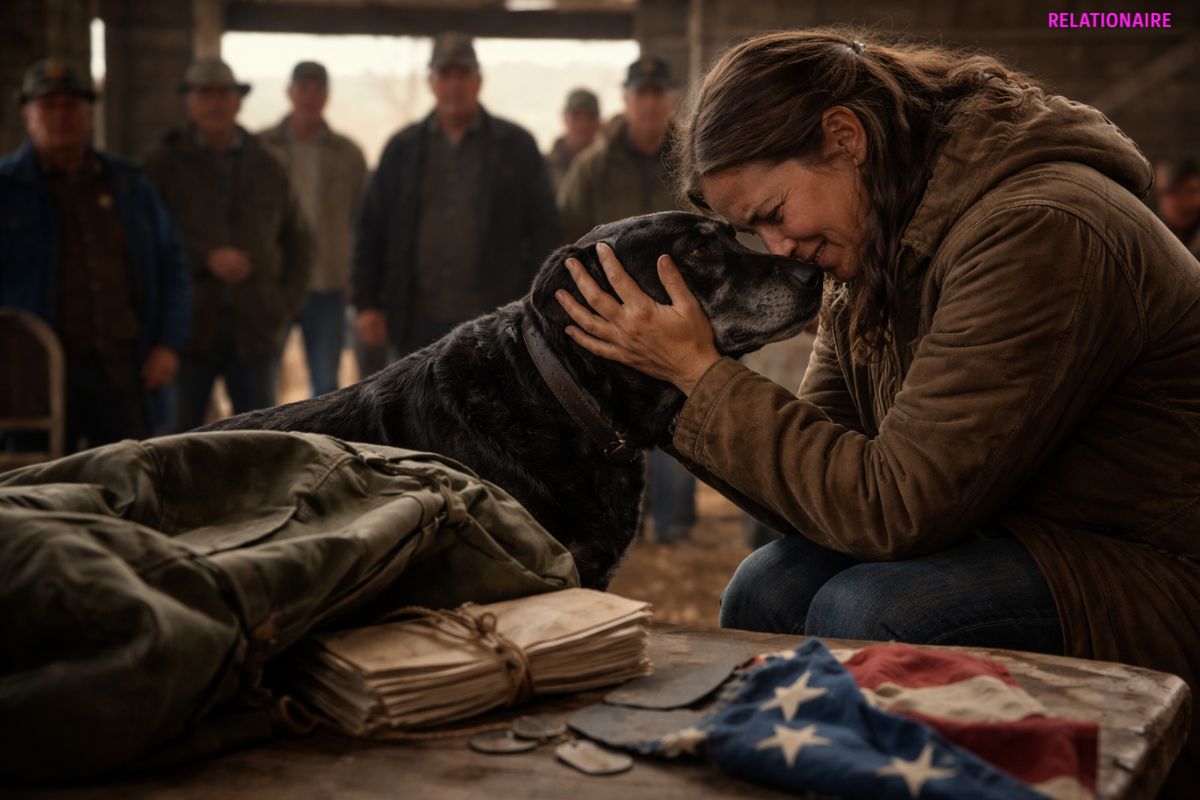
The dog lunged past the rows of folding chairs, not toward the bag, but toward the back wall. Straight toward the woman in the brown coat who had been hiding there all morning.
She gasped as he hit her with both front paws, whining, pressing his face into her stomach, tail beating hard against her legs like time had collapsed on itself.
The woman staggered back and caught his head in both hands.
“Oh, Buddy,” she whispered, voice breaking open. “Oh my God. Buddy.”
Half the barn stared.
Jim lowered his cup.
Hank looked from the dog to the woman to the old photo in his hands.
And for the first time all morning, somebody said what everyone else was thinking.
“That’s not a stray.”
The woman’s shoulders shook once. She pressed her forehead to the dog’s and closed her eyes.
Earl stood frozen behind the table, one hand still on Walter Boone’s sea bag.
The bag lay open now.
Inside, under a folded jacket and an old service cap, something white showed through.
Envelopes.
A whole bundle of them.
And every one had the same name written across the front.
Sarah.
The woman looked up at that.
So did everyone else.
And nobody in that barn said a word.
PART 2
Nobody moved at first.
It was the kind of silence that makes a man aware of his own breathing.
Sarah Boone still had both hands buried in the dog’s neck. Buddy leaned into her like he’d been waiting years for permission to fall apart. His tail kept thudding against her legs, but the sound had gone softer now, almost careful, like even he knew this moment was fragile.
At the front table, Earl cleared his throat.
“You know this dog?”
Sarah looked up at him, eyes red already. She was maybe forty, though grief had a way of adding years in a hurry. There was something of Walter Boone in her face around the mouth and jaw. Not enough for folks to notice right away. Enough that once seen, it could not be unseen.
“Yes,” she said.
Just that.
No explanation.
No apology for being there.
A murmur went through the barn all the same.
Hank stepped forward before it could turn ugly. “Think maybe we ought to slow this down.”
Jim shifted his weight. “If she’s family…”
“If,” somebody muttered.
Sarah heard that. Everybody knew she heard it. Her chin lifted, but only a little.
Buddy left her just long enough to trot to the table and put his paws against the edge of Walter’s sea bag. Then he looked back at her and whined.
Not random.
Not restless.
He was asking.
Hank felt it before he understood it.
“Let her through,” he said.
No one argued with that voice.
The row of bidders parted. Sarah walked forward slowly, boots scraping concrete, Buddy tight against her leg. Up close, folks could see more than they had from the back. The coat was thin, yes. The cuffs were frayed. She wore no ring. Her face looked like someone who had driven a long way without stopping.
Earl took his hand off the bag.
Sarah reached for the top envelope as if it might burn her.
Her name was there in Walter’s handwriting. Blocky. Careful. Faded from age, but steady.
Sarah.
Not Return to Sender.
Not Undeliverable.
Just Sarah.
Her fingers shook.
“I thought…” She stopped.
Nobody rushed her. Even Jim had enough sense not to.
The bundle was tied with an old boot lace. Beneath it lay a child’s red ribbon, a tarnished medal in a small box, and a photograph folded in half so many times the edges had turned soft.
Hank saw Sarah staring at the letters and knew what kind of weight was sitting on that table.
She swallowed. “I thought he threw everything away.”
There it was.
Not the whole truth, but enough to change the air in the barn.
Jim frowned. “Walter Boone had a daughter?”
Hank gave him a look that shut him up.
Sarah untied the first letter. The paper crackled loud as a gunshot in the silence.
Buddy sat at her feet now, eyes fixed on her face.
She read the first line.
And whatever had been holding her together gave way.
Her shoulders folded inward. One hand flew to her mouth. Not dramatic. Not loud. Just a woman being hit by a truth she had spent years building her life around not believing.
Hank stepped closer but did not touch her.
“What is it?” Earl asked, softer than before.
Sarah blinked hard and looked down again. Then, in a voice so thin people had to lean in to hear, she read aloud.
“Sarah girl… I don’t know if this one will reach you either, but I’m writing because silence is doing more damage than the truth ever could.”
The barn stayed still.
She kept reading.
“Your mother asked me not to come after the divorce was final. She said you were angry and I had no right to drag you through one more fight. Maybe I listened because I thought giving you peace was the one good thing left to offer. Maybe I listened because I was a coward. I don’t know anymore.”
A woman near the coffee urn sat down hard in her folding chair.
Sarah looked up, stunned, like she needed somebody there to tell her the page in her hand was real.
“I was twelve,” she said. “My mother told me he left. Said he started a new life and didn’t want us in it.”
No one answered.
Because what answer was there?
She looked back down.
The second paragraph was blotched in places, Walter’s ink running where rain or tears or both had touched it years ago.
“I sent birthday cards. Christmas money when I could. Letters after basic, letters after the hospital, letters after your mama passed. Every one came back or never came at all. I kept writing because a father ought to keep trying, even when he’s failing at it.”
Sarah made a small sound then, the kind people make when pain slips out before pride can stop it.
Buddy pressed against her shin.
Jim removed his cap.
Nobody had asked him to.
Earl stared at the table like he was ashamed of every bid he’d taken that morning.
Sarah sifted through the letters one by one, dates jumping across decades. Some thin. Some thick. Some never opened because they had never been sent. A few had stamps. Many did not. Hidden in the bag with his service things, tied up with that lace like Walter had kept them close and waiting.
The folded photo came next.
Sarah opened it carefully.
It was the same picture Hank had bought, only bigger and clearer. Walter in uniform. Young Sarah smiling at the sun. Buddy as a puppy, all paws and ears.
On the back, in Walter’s hand, were six words.
For when she comes home again.
Sarah stared at that until her lips began to tremble.
Then she laughed once through tears, a broken little sound that hurt worse than crying.
“I thought he hated me,” she said.
Nobody in the barn could quite meet her eyes after that.
Because they’d thought things too.
They had seen the empty farmhouse.
The years of silence.
The auction.
The woman in the back.
And they had done what people do best and worst.
They filled in the blanks.
Hank reached into his coat pocket and pulled out the framed photo he’d bought. He held it out to her.
“This belongs with the rest.”
Sarah looked at him, startled. “I can pay you.”
He shook his head. “No, ma’am.”
She took it with both hands, like it weighed much more than glass and wood.
Then Buddy stood again.
He pawed once at the sea bag. Then once more, impatient now.
“There’s more,” Hank said.
Sarah nodded, wiping her eyes with the heel of her hand. She reached deeper into the bag, under the jacket that still smelled faintly of old canvas and worn leather and time closed up too long.
Her hand struck something stiff.
A notebook.
Inside the front cover was Walter’s name, his unit, and below it, written much later in a shakier hand:
If Sarah ever comes, give her the key in the back pocket.
Earl let out a breath.
Hank took the notebook, opened the rear flap, and slid out a small brass key taped inside.
Sarah frowned. “Key to what?”
Buddy answered before anyone else could.
He turned and headed for the barn door, then looked back.
Waited.
When Sarah didn’t move fast enough, he barked once.
The first real bark anyone had heard from him all day.
Hank looked toward the white farmhouse across the yard, its porch flag hanging slack in the windless cold, screen door tilted a little from age.
“Seems like he wants to show you.”
Sarah looked at the house the way people look at places they’ve spent years avoiding in their own minds.
“I haven’t been in there since I was twelve.”
“Then maybe it’s time,” Hank said.
Earl straightened and pulled off his hat. “Auction’s paused.”
Nobody objected.
Not one bidder complained.
They all watched as Sarah clutched the letters to her chest, the brass key in one hand, and followed the old black dog out into the cold morning light toward Walter Boone’s porch.
The screen door creaked when Buddy pushed through.
And that was when everything changed.
PART 3
The house smelled the same.
Sarah felt it before she could stop herself.
Old coffee.
Pine cleaner.
Worn leather.
And under it all, that faint dry smell of old canvas and closed drawers and winters held inside the walls.
She stopped just past the screen door.
Buddy trotted ahead like he knew every board that still squeaked and every corner where the light fell in the mornings. He paused in the narrow hallway, turned once to make sure she was coming, then headed toward the back bedroom.
Sarah had not crossed this floor in twenty-eight years.
Behind her, boots shuffled softly on the porch. Not crowding. Just waiting. Hank, Earl, Jim, and half the auction had followed to the yard and stopped there out of respect. Public curiosity had carried them across the gravel. Something quieter kept them from barging in.
Private worth.
That was what Walter Boone had left in this house, whether anybody had seen it or not.
Sarah tightened her grip on the brass key and walked on.
Walter’s bedroom was neat in the way lonely people keep things neat. Bed made tight. One lamp. One Bible on the nightstand. A pressed shirt hanging on the closet door. On the dresser sat a folded flag in a triangular case, glass polished clean.
Sarah saw that first and had to look away.
Buddy went to the old cedar chest at the foot of the bed and sat beside it.
Waiting.
Sarah knelt.
The brass key fit the small lock on the side.
For a second she couldn’t turn it. Her hand shook too badly.
Then a large hand appeared beside hers, not touching, just steady.
Hank had stepped inside after all.
“You want me to?”
Sarah swallowed. “No.”
She turned the key.
The lock gave.
When she lifted the lid, the smell of cedar rose up with the scent of old paper and cloth. Inside were things packed carefully, not like storage, but like safekeeping.
A little girl’s patent leather shoes.
A school photograph with a gap-toothed grin.
A blue ribbon from a county fair.
A broken bracelet made of plastic stars.
And beneath them, bundled in twine, dozens more letters.
To Sarah.
From Sarah.
Some in childish pencil, edges worn from being handled. Some unopened, their envelopes wrinkled and stained. Letters she had written to him as a girl. Letters her mother must never have mailed. Letters Walter had somehow gotten later, maybe after her mother died, maybe from a box, maybe from a drawer no one had cleaned out for years.
Sarah touched one like she was touching her own lost voice.
“I wrote him,” she whispered.
Hank looked down. “Seems he kept every one.”
She opened the nearest letter.
The paper was cheap notebook stock, pink lines, third-grade handwriting.
Daddy, Buddy misses you. I do too. Mom says not to ask when you’re coming. I asked anyway.
Sarah bowed her head.
For a long moment there was only the ticking of the hallway clock and Buddy’s slow breathing and the scrape of somebody’s boot out on the porch.
Then she started to cry for real.
Not pretty crying.
Not loud.
Just years coming loose.
She sat on the floor beside that cedar chest with the letters around her knees and her father’s folded flag on the dresser and the old dog leaning warm and steady against her shoulder.
Hank turned away to give her what privacy he could.
But grief has a sound, and the folks on the porch heard enough.
Jim removed his cap again and held it over his heart.
Earl stared out toward the barn and wiped at his eyes like cold wind had caused it.
After a while Sarah found another envelope in the bottom of the chest, larger than the others, sealed and marked in Walter’s hand.
For Sarah. Open when Buddy finds you.
Her breath caught.
She looked at Hank once, then slid a finger under the flap.
Inside was one final letter and a legal document folded with it.
She read the paper first because it looked official and easier to survive.
It wasn’t.
Walter Boone had left the farmhouse, the land, his savings, and Buddy to Sarah Boone, his daughter and only heir.
Not to the county.
Not to the auction house.
Not to distant cousins.
To Sarah.
The auction was never supposed to happen.
Earl took the document when she carried it out to the porch. He read it twice, face gone pale. “This is dated six months ago. Signed. Witnessed. It should’ve stopped the sale.”
“How did it not?” Jim asked.
Hank took the page and checked the attorney stamp. “Probably filed late. Or found too late.”
Earl looked sick. “I sold half that man’s life this morning.”
Sarah’s fingers tightened around the final letter. For a second it seemed like anger might finally take her.
Nobody would have blamed her.
Instead, she looked out across the yard at the tables of Walter’s things, at the people who had come to buy, at the cups and coats and pickup trucks, the whole ordinary machinery of a small town getting something wrong.
Then she shook her head.
“Not half,” she said quietly. “You sold what folks could see.”
That landed harder than shouting would have.
She opened Walter’s last letter.
Her lips moved over the first line before sound came.
“Sarah girl, if Buddy brings you here, then he did what I prayed he would do.”
Her voice broke, but she kept going.
“I never stopped loving you. I just ran out of good ways to prove it. Men like me get praised for service and fail at softer things. I was a better soldier than father for too long. That’s on me. But every birthday I missed hurt. Every Christmas I wrote to an empty address hurt. If you are reading this, then maybe God gave us one more chance, even if it came late.”
Sarah had to stop and press the page to her mouth.
No one on that porch moved.
No one looked away.
After a moment she lowered the letter and finished.
“The house is yours if you want it. Buddy is yours if he’ll have you, though I suspect he settled that himself. In the top drawer is the flag they handed me at your mother’s service because you couldn’t make it in time. It always belonged to you. Don’t carry my silence longer than I did. Lay it down, baby girl. Come home if you can.”
By the end, even Earl was crying openly.
Sarah stood there with the letter shaking in her hand, and something changed in the faces around her.
They had seen a quiet woman in a cheap coat hiding in the back of a barn.
Now they saw a daughter holding the proof that love had been there all along, buried under pride and distance and other people’s choices and too many lost years.
Jim cleared his throat hard. “I bought the tool chest.”
A man from the front row raised a hand. “I got the lantern.”
“The gloves are in my truck,” another called out from the yard.
One by one, people began speaking.
Not loudly.
Not for praise.
Just naming the things they had bought.
Then setting them back on the porch.
Within twenty minutes, Walter Boone’s belongings began coming home.
The skillet.
The blanket.
The watch.
The shaving kit.
The magazines.
Even the cast-iron bell someone had taken for a garden ornament.
Hank brought the photo himself and set it beside the folded flag.
Nobody asked for a refund first.
Nobody made a speech.
That was the dignity of it.
Sarah stood with Buddy pressed against her leg and watched the porch fill up with her father’s life returning piece by piece. At last she covered her face with both hands.
When she lowered them, Hank was standing straight in front of her.
He looked from her to Walter’s flag case, then back again.
Slowly, with the care of a man who understood exactly what it meant, he raised his trembling hand to his forehead and gave Walter Boone a salute.
Jim followed.
Then Earl.
Then the others in caps and work coats and worn boots, there on the porch under the old flag, while the screen door creaked in the cold and the black dog sat watch at Sarah’s side.
Sarah could not salute back.
Her hand was too unsteady.
So she did the only thing she could do.
She took Walter’s letter, pressed it to her heart, and whispered, “I’m home, Dad.”
Buddy leaned against her harder, as if he’d been waiting all these years to hear it.
Sometimes the people we think abandoned us were loving us the only broken way they knew how.
Sometimes what looks like silence is a door someone never stopped hoping would open.
What would you have done if you’d been standing in that barn?