If you’ve already read part 1 of this story on Facebook, go here for Part 2!
“Get that mutt out of the way!”
The shout cracked across the trailer park so sharp it made a baby start crying two lots over.
The dog didn’t move.
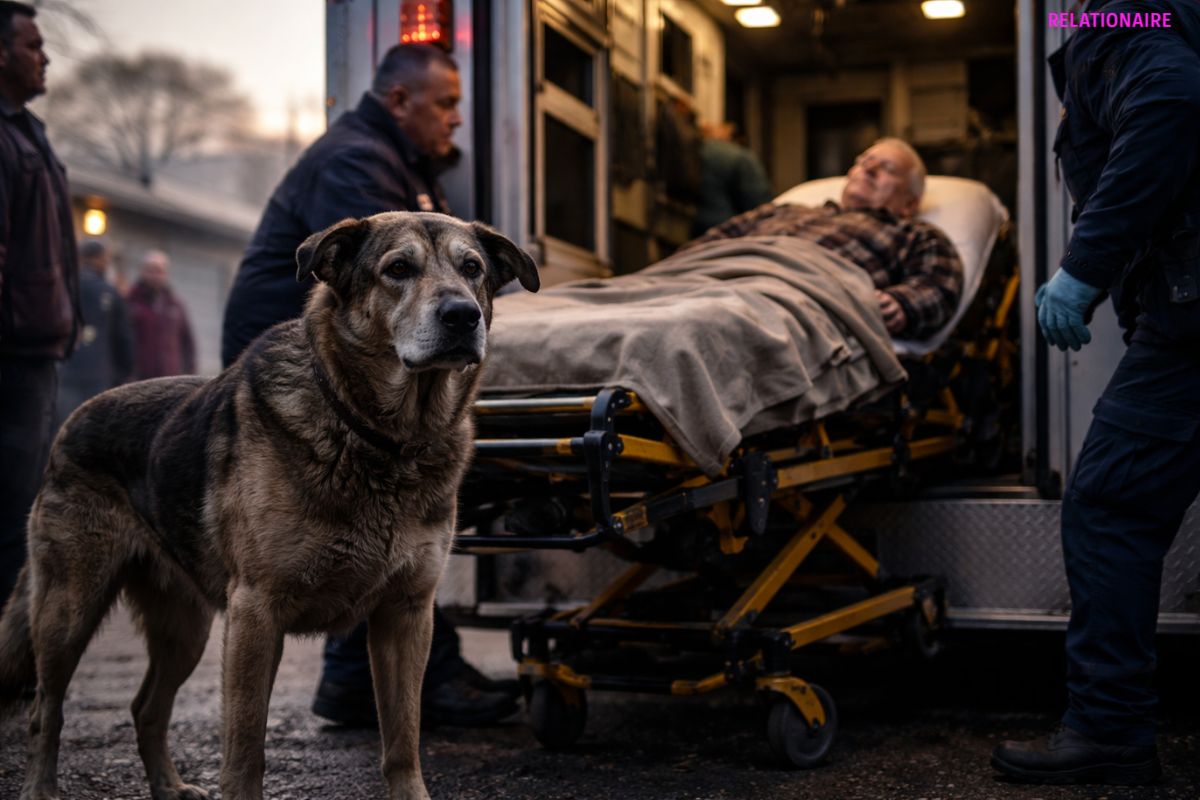
He stood planted at the open back doors of the ambulance, ribs showing under a patchy brown-and-black coat, gray muzzle low, legs locked like fence posts. His lip curled just enough to show he meant it.
On the stretcher, the old man lay still.
One boot had half slipped off his foot. One hand hung over the side, knuckles pale, fingers rough and scarred. The oxygen mask fogged once, then not again.
“Sir, we are losing time,” one of the paramedics snapped, more to the crowd than anybody else. “Back up.”
Nobody backed up.
Folks from the trailer park had gathered in house shoes, work boots, stained T-shirts, church sweatshirts. A woman in pink curlers held her robe shut at the throat. Two teenage boys stood on a bicycle rack whispering like they were at a ball game.
“Dog oughta be put down,” somebody muttered.
“He’s gonna get that old man killed.”
“Call animal control.”
The cold morning air carried the smell of wet dirt, old motor oil, and bacon grease drifting from a trailer window somebody had left cracked open. A screen door creaked somewhere behind the crowd. An American flag on a bent porch pole gave one tired flap, then fell still.
The dog never took his eyes off the ambulance.
Mike Torres, newest EMT on the county crew, came around the side carrying the jump bag.
He’d only been home eight months.
Still woke up some nights ready to grab for gear that wasn’t there. Still noticed exits before faces. Still hated sudden shouting.
His partner, Denny, was red in the face and breathing hard. “You got a catch pole in there?” he asked. “Because I’m done playing with this animal.”
Mike looked once at the dog, then at the old man.
The old man’s name, according to the woman who’d called 911, was Walter Gaines. Lived alone in Lot 14 except for the dog. Collapsed on his porch carrying in groceries. No family anybody saw regular. Paid cash. Kept to himself.
“Animal control’s twenty minutes out,” Denny said. “We don’t have twenty minutes.”
Walter’s dog gave a low rumble, deep in his chest.
Not wild.
Not panicked.
Measured.
Mike felt something go tight behind his ribs.
The dog wasn’t lunging. Wasn’t snapping at the crowd. Wasn’t even looking at the people yelling.
He was watching hands.
Watching distance.
Watching the old man.
Command protection.
The thought hit Mike so fast it made his mouth go dry.
He stepped closer.
“Mike, don’t,” Denny warned.
But Mike kept walking, slow and open, palms out where the dog could see them.
The dog shifted his stance. Not forward. Sideways.
Blocking the opening. Guarding the load point.
Mike had seen that before.
Not here. Not in a broken-down trailer park with rusted grills and sagging steps and kids’ bikes in the weeds.
Somewhere hotter. Louder. Meaner.
The memory came in flashes. Sand in his teeth. A handler’s voice cutting through gunfire. A dog trembling but steady. Someone shouting, “Don’t crowd him—he’s working.”
Mike stopped six feet away.
The dog stared at him.
Around the dog’s neck was an old leather collar, cracked from age and weather. Hanging from it by a worn brass ring was something small and dull under the morning light.
Not a tag.
A medal.
Or part of one.
The crowd kept talking.
“You gonna let that animal run the scene?”
“This is ridiculous.”
“That poor old man don’t stand a chance.”
Mike barely heard them.
He crouched a little, keeping his body turned sideways.
“Easy, boy,” he said softly.
The dog’s ears twitched.
Denny swore under his breath. “He’s not a boy, Mike. He’s a problem.”
Mike ignored him.
The old dog’s gaze flicked from Mike’s empty hands to Walter’s face, then back again.
Protecting unconscious handler.
Maintaining control of access point.
Waiting for release command.
Mike could feel it now with a certainty that made the hairs rise on his arms.
This wasn’t a pet refusing to leave.
This was a dog still doing a job.
“Who’s got the old man’s things?” Mike asked.
Nobody answered at first.
Then the woman in curlers lifted a trembling hand. “I grabbed what fell off the porch when he went down.”
She held up a canvas satchel, faded olive green and stained dark at the corners. Even from ten feet away Mike could smell old canvas, worn leather, and that dry metal scent old gear gets when it has lived too long in closets and truck beds.
Something in his chest tightened again.
“Bring it here,” he said.
Denny stared at him like he’d lost his mind. “You want story time, or you want to save a life?”
“I’m trying to do both.”
The woman came forward one careful step at a time and set the satchel on the ground, then hurried backward.
The dog growled once.
Mike didn’t reach right in.
He let the dog watch him.
Inside the satchel was a folded flannel shirt, a dented thermos, a pair of cracked reading glasses in a case, and a small wooden box.
The box had a brass clasp.
Mike opened it.
Inside lay a Purple Heart ribbon bar, two old military dog tags, and a black-and-white photo worn soft at the edges.
The crowd went quiet in pieces.
Mike picked up the photo.
Five men in desert uniforms stood beside two military working dogs. One of the men had his arm around a younger Mike Torres, twenty pounds leaner and trying too hard not to look scared.
And beside them stood an older man with sun-cut lines in his face and calm eyes under a patrol cap.
Walter Gaines.
Mike’s breath caught.
He heard the blast before he saw the photo clearly.
Not here.
Back there.
A road. A warning bark. A hand on his vest shoving him flat.
His knees nearly gave out.
Denny looked from the photo to Mike. “What is it?”
Mike didn’t answer right away.
The dog was watching him differently now.
Not relaxed.
But searching.
Like he was measuring something old in Mike’s face.
Mike swallowed hard and looked at Walter on the stretcher, the slack mouth, the gray stubble, the same scar near the eyebrow.
Twenty people in that trailer park had called him a nobody in everything but words.
But Mike knew that face.
Knew that voice.
Knew exactly why that dog would die at this ambulance door before letting the wrong hands come near.
“Sir,” Mike said, but his voice came out rough. He tried again. “Sir, I know this man.”
The woman in curlers pressed her hand to her mouth.
Denny frowned. “You know him from where?”
Mike looked down at the medal hanging from the collar, then back at the old man’s still face.
And when he spoke, he said it like he still couldn’t quite believe it himself.
“He’s the reason I came home alive.”
The dog gave one short, sharp bark.
Not at Mike.
At the crowd.
Like a warning.
Like a command.
And then Walter’s hand twitched once on the stretcher.
Just once.
But the dog saw it.
So did Mike.
And suddenly Mike understood the one thing nobody else there did:
The dog wasn’t keeping them from taking Walter.
He was waiting for Walter to tell him who could.
PART 2
Walter’s fingers twitched again.
The movement was small enough most folks there missed it.
But the dog didn’t miss anything.
His head snapped toward Walter’s hand, then back to Mike, body still rigid in the ambulance doors. Waiting. Measuring. Holding the line.
Denny leaned in. “Mike, if you know the guy, then help me. We need that dog clear now.”
Mike nodded once, though his heart was pounding hard enough to shake his breath.
He crouched lower.
The old photo was still in his hand, edges damp now from his grip. Walter stood in that picture younger and stronger, one hand resting on the shoulder of a military working dog with alert ears and eyes like fire. Mike remembered those eyes. He remembered Walter’s steady voice more than anything.
Never crowd a working dog.
Never lie to one.
And never touch his handler unless that dog understands your place.
Mike set the photo where the dog could see it.
The old dog leaned his muzzle forward and sniffed the air.
Not the photo.
Mike.
That was when Mike saw it.
A thin pale scar ran along the dog’s front leg, just above the paw. Buried under old fur, half hidden by age.
Memory hit him so hard he tasted dust.
A kennel tent under bad lights.
Walter kneeling beside a young mixed-breed dog nobody else thought was worth much because he wasn’t purebred, wasn’t pretty, wasn’t standard issue. Walter had laughed that dry laugh of his and said, “Best dogs don’t read the manual.”
The dog had taken to Walter like breathing.
Later, he’d taken to Mike too.
Not because Mike deserved it.
Because Walter said so.
Mike looked at the dog now, really looked.
Gray muzzle.
Bent ear.
Scar on the leg.
Worn leather collar.
“Ranger,” he whispered.
The dog’s ears rose.
The whole scene changed in one breath.
Ranger stopped growling.
He did not wag his tail. He did not soften.
He simply stared at Mike like a locked gate had opened one notch.
Denny heard it. “You know the dog too?”
Mike swallowed. “I think I do.”
A man from the crowd barked out a laugh. “You think?”
Mike stood up slowly and looked at him.
It wasn’t anger in his face that quieted the man. It was something heavier. Something that made the whole crowd realize the shouting part of the morning might be over.
“This dog isn’t confused,” Mike said. “He’s guarding his handler.”
“Handler?” the woman in curlers repeated.
Mike nodded.
Then he stepped closer to the ambulance doors, one careful pace at a time.
“Ranger,” he said again, firmer now. “At ease.”
The dog’s body trembled.
Not with fear.
With effort.
Like he was trying to obey a command buried under years of instinct and grief and duty.
But he didn’t move.
Mike understood why.
Walter had not released him.
Mike turned to Denny. “Give me ten seconds.”
“You have five.”
Mike leaned toward Walter, who still lay pale and half-gone under the thin blanket.
“Walter,” Mike said low. “It’s Torres. Mike Torres. You hear me? It’s okay. I’m here.”
Nothing.
The monitor clicked. The oxygen hissed. Somebody in the crowd sniffed hard like they were trying not to cry though they didn’t even know why.
Mike went closer.
“Staff Sergeant Gaines,” he said, voice tightening. “You dragged me into a ditch outside Marjah and cussed me out for freezing. You told me panic was louder than bullets. You remember that?”
Walter’s eyelids fluttered.
Denny sucked in a breath.
Mike dropped to one knee beside the stretcher.
“You told me if I made it home, I’d better make it count.”
Walter’s mouth moved under the mask.
It was barely a sound.
But Mike heard it.
So did the dog.
“…Ranger…”
The dog stiffened so hard his nails scraped metal.
Mike leaned in. “Walter, I need the command.”
Walter’s lips trembled.
The old man looked like every ounce of strength left in him had to be dug up from somewhere deep and hidden. His hand lifted maybe an inch from the blanket, then fell.
And then, in a voice scraped raw and paper-thin, Walter whispered:
“Stand down.”
Ranger stepped back.
Just one step.
But it was enough.
Denny and the other medic moved fast, lifting, sliding, securing Walter the rest of the way into the ambulance. Ranger did not fight them now. He stood pressed against the bumper, shaking from nose to tail, eyes locked on Walter’s face.
Mike grabbed the satchel and climbed in beside the stretcher.
“Dog can’t ride,” Denny said.
“He rides,” Mike answered.
“This isn’t a pet taxi.”
“No,” Mike said, looking at Walter and then at Ranger. “It’s not.”
Something in his tone ended the argument.
The woman in curlers called out, “I’ll lock up his trailer!”
Mike nodded his thanks. Someone else handed up Walter’s boot. A teenage boy who’d been whispering earlier came forward and said, almost ashamed, “Sir, I’m sorry about what I said.”
Mike only said, “Do better next time.”
Then the doors shut.
Inside the ambulance, the noise of the outside world dropped away.
Just tires over broken pavement. Siren starting up. Monitor beeping. Ranger’s nails tapping once as he settled on the floor near Walter’s feet without being told twice.
Mike sat there holding the canvas satchel in his lap.
Walter’s eyes opened a fraction.
He turned his head enough to see Mike.
For a second, confusion passed through the old man’s face. Then recognition.
Not full.
But enough.
Mike saw it land.
Walter looked at him, then at Ranger, then at the photo Mike held.
One corner of Walter’s mouth tried to move.
“You,” he breathed.
Mike gave a shaky laugh that turned into something dangerously close to tears. “Yeah, it’s me.”
Walter’s hand lifted weakly, searching.
Mike caught it.
That hand was lighter than he remembered, colder too, but the grip was still there. Not strong. Just certain.
Ranger rested his chin on Walter’s bootless foot.
The sight of it made Mike look away for a second.
Back overseas, Walter had been the kind of man everybody trusted and nobody talked much about. The one who did the ugly jobs right. The one who took the extra watch. The one who wrote letters for men whose hands shook too bad. The one who could calm a dog, a private, or a room with the same voice.
Then one day Walter was gone from Mike’s unit.
Medical transfer, they said.
Family matter, someone else said.
Mike never knew which was true.
He just knew he owed the man his life.
And now here Walter was, living alone in a trailer park where neighbors knew him only as the quiet old guy with the shabby dog and the cash envelope for lot rent.
Mike looked down at the dog tags in the satchel.
One set belonged to Walter.
The other was smaller, scratched, attached to a faded strip of green paracord.
There was a name on it.
Not Walter’s.
Mike’s own.
His stomach dropped.
He picked it up like it might burn him.
“I thought I lost this.”
Walter’s eyes closed, then opened again.
A whisper came under the oxygen mask.
“Found… after blast.”
Mike stared.
Walter had kept it all these years.
His tag.
The photo.
The medal ribbon.
All of it packed in old canvas like the weight of memory itself.
And then Mike understood something else.
Walter hadn’t just trained dogs.
Walter had kept watch over what the world forgot.
The ambulance hit a pothole. Walter grimaced. Ranger rose halfway, ready again.
Mike put a hand on the dog’s shoulder.
“Easy. I’ve got him.”
Ranger looked up at Mike.
This time, he believed him.
At the hospital bay, nurses rushed out with a gurney. Bright lights. Fast hands. Questions. Clipboard voices.
And then a woman at intake glanced at Walter’s worn clothes, the old dog, the canvas bag, and said to nobody in particular, “Let’s move him to general and sort the paperwork later.”
It was small.
Almost nothing.
But Mike heard it for what it was.
Just another old man. Just another poor patient. Just another problem to process.
He stepped forward before they could wheel Walter away.
“This man is a combat veteran,” Mike said.
Nobody looked up much.
Then Mike said the next part.
“And he once saved my life.”
That got their eyes.
But not like the truth that followed.
Mike rested one hand on Ranger’s back and heard his own voice change.
“He trained this dog. And unless I’m wrong, this dog just saved his life right now by refusing everybody except the right command.”
The nurse froze.
The orderly looked down at Ranger differently.
Walter opened his eyes one more time and stared up at the bright hospital lights like they were a long way off.
Then his fingers tightened weakly around Mike’s lost dog tag.
And that was when everything changed.
PART 3
By noon, half the trailer park knew Walter Gaines had been a military dog handler.
By one o’clock, the county EMS crew knew.
By three, folks at the hospital who’d walked past him without a second glance that morning were lowering their voices when they said his name.
But Walter himself didn’t seem to know any of that.
He slept under a warm blanket in a small room on the second floor, skin still pale, one hand resting near the rail like he was ready to reach for something even in his dreams.
Ranger lay on the floor beside the bed.
Not asleep.
Watching.
Mike sat in the corner with Walter’s canvas satchel at his boots and a paper cup of burnt coffee gone cold in his hand.
The room smelled like antiseptic and old heat vents, but every time he opened the satchel he caught that other smell again—old canvas, worn leather, dust, a trace of machine oil. It smelled like another life.
He had found more inside.
A folded leash.
A small notebook.
A certificate with Walter’s name on it from a military canine training school, edges gone yellow.
And one letter in an envelope so old the flap had nearly come loose by itself.
Written across the front in careful block letters:
For Mike Torres, if I don’t get the chance.
Mike had stared at it for a full minute before opening it.
Walter’s handwriting inside was plain and steady.
No wasted words.
Torres,
If this gets to you, then things didn’t go like I hoped.
You were green, hardheaded, and scared, which made you normal. Don’t let shame tell you otherwise.
The day on that road, Ranger alerted before any of us saw the danger. You moved late. I moved fast. That’s all. Men spend too much time calling survival a debt. Live decent instead.
If you make it home, be useful. That’s enough for any man.
—Gaines
Mike had read that letter three times.
Each time, the same place got him.
Live decent instead.
Not be great.
Not be important.
Not be loud.
Just decent.
A soft knock came at the door.
Mike looked up.
It was the woman from the trailer park, still in her robe, though now she had jeans on under it and had brushed out her hair. Behind her stood the teenage boy from that morning, holding his ball cap in both hands.
“We brought some things from his trailer,” she said quietly.
Mike stood and took the box from them.
Inside was a folded flannel blanket, Walter’s wallet, a framed picture of a younger soldier in uniform beside Walter, and a metal tin.
The boy stared at Walter in the bed and then at Ranger on the floor.
“I called him a dumb dog,” he said.
Mike nodded once. “I know.”
The boy swallowed. “He ain’t dumb.”
“No,” Mike said. “He isn’t.”
The woman’s eyes shined. “We didn’t know. He never said.”
Mike looked at Walter.
“That sounds like him.”
They didn’t stay long.
Before leaving, the boy crouched—carefully, respectfully this time—and set a hand out for Ranger to sniff. Ranger allowed it.
That was enough to make the boy blink hard and stand back up fast.
Near evening, Walter woke.
The room was dim except for the stripe of sunset light across the far wall. Outside, somebody rolled a cart down the hall. A TV played low in another room. The whole place had that tired hush hospitals get when the day staff is nearly gone and the night hasn’t fully taken over.
Walter opened his eyes and found Mike in the chair.
Then he found Ranger.
His hand trembled as he reached down.
Ranger stood, crossed the floor, and laid his head gently in Walter’s palm.
Walter closed his fingers into the old fur.
Didn’t say anything for a long moment.
Neither did Mike.
Finally Walter rasped, “He still listens better than most people.”
Mike laughed, then had to wipe at his face like he had something in his eye.
Walter noticed, because of course he did.
“You always cry this easy?”
“Only when old men scare me half to death.”
Walter’s mouth twitched.
Mike leaned forward. “You kept my dog tag.”
Walter looked toward the satchel.
“Figured… I’d hand it back someday.”
Mike pulled the chain from his pocket. “You did.”
Walter’s gaze settled there, then moved to Mike’s face.
“You came home.”
“Because of you.”
Walter gave the smallest shake of his head.
“No. Because it was your turn.”
It was such a Walter answer that Mike had to look down again.
A nurse came in to check vitals and stopped short at the sight of Ranger beside the bed.
Before she could object, Walter lifted one weak finger.
“Service dog,” he said.
It was not exactly true by hospital rules anymore maybe.
But it was true in every way that mattered.
The nurse just nodded and kept working.
Later that night, word spread farther than Mike expected.
Not because anybody chased attention.
Because one of the other EMTs had told his wife, and his wife had told her sister, and by morning two men from the local veterans hall came by with coffee in a cardboard carrier and their caps in their hands.
Then a retired sergeant from across town came.
Then a county deputy.
Then a school bus driver who’d served twenty years ago and had heard Walter’s name from someone who knew someone.
No cameras.
No speeches.
Just people showing up.
That was the part that would have meant something to Walter, Mike thought.
Not noise.
Presence.
By afternoon, Walter was sitting up some.
The color had returned to his face. Not much, but enough.
Mike brought him the framed picture from the trailer.
Walter looked at it a long time.
“That was my brother,” he said.
“He serve too?”
Walter nodded.
“Korea.”
Mike set the picture on the table.
Then he opened the metal tin the woman had brought.
Inside was a folded flag, small and tight and careful, its weight surprising in Mike’s hands.
There was also a medal pinned to a scrap of black velvet.
Walter watched Mike take them out.
His eyes went soft in a way Mike had not seen before.
“My wife used to keep those polished,” Walter said. “After she passed, I just… put them away.”
The room was quiet.
Ranger shifted once and settled against the bed.
Mike stood.
Slowly, respectfully, he lifted the folded flag in both hands and held it out.
Walter stared at it.
His fingers rose, trembling.
Not steady enough to take the whole weight at first.
So Mike kept his hands under it until Walter had it.
That was the moment.
Not loud.
Not dramatic.
Just an old man in a hospital bed holding a folded flag against his chest while his hand shook and his dog kept watch at his side.
Walter drew one breath that hitched in the middle.
Then another.
Mike had seen men hold in pain, fear, grief, blood loss, terror.
He had seen all of it.
But the quiet on Walter’s face right then nearly broke him.
Not because Walter cried.
Because he didn’t.
He just looked at that flag and whispered, “Still here.”
Mike stood straighter without meaning to.
Then he raised his hand to his forehead.
A salute.
Clean and sharp.
Walter looked up.
So did the nurse in the doorway.
So did the two veterans hall men who had come back with fresh coffee and stopped when they saw the room.
Walter tried to lift his own hand.
It shook too much.
Mike stepped forward, reached gently, and steadied Walter’s elbow without taking the dignity from him.
Together, they got the hand up.
Walter returned the salute.
Ranger, as if he understood the whole thing down to the marrow, rose slowly and stood between them, head high.
The veterans in the doorway took off their caps.
One after another.
No one said a word.
They didn’t need to.
That evening, when Mike finally walked Walter back from the edge of losing everything, the trailer park woman was waiting with a clean flannel shirt and the teenage boy was holding a new brass nameplate he’d bought with his own money.
It read:
RANGER
The boy held it out awkwardly.
“For his collar,” he said.
Walter looked at the plate, then at the boy.
“Thank you.”
The boy’s face turned red. “Sir… I’m sorry.”
Walter studied him a second, then nodded.
“Do better next time.”
Same words Mike had used.
The boy nodded hard.
“I will.”
A week later, Walter went home.
Not alone.
Folks from the trailer park fixed his steps. Somebody patched the skirting on the trailer. Someone else stocked the fridge. The veterans hall set up a ramp just in case. The deputy arranged regular check-ins. And Mike came by every Sunday afternoon with coffee and dog treats and more things he never announced.
That was how Walter liked it.
Quiet help.
No fuss.
Just decent.
And that old dog?
He still watched the door.
But now, when Mike walked up the porch and the screen door gave its familiar creak, Ranger only gave one look, thumped his tail once, and stood aside.
Sometimes the ones the world overlooks are the very ones who held the line for everybody else.
How many people have we judged too fast just because their sacrifice was quiet?