If you’ve already read part 1 of this story on Facebook, go here for Part 2!
“Come on, boy. Easy now. Just one step.”
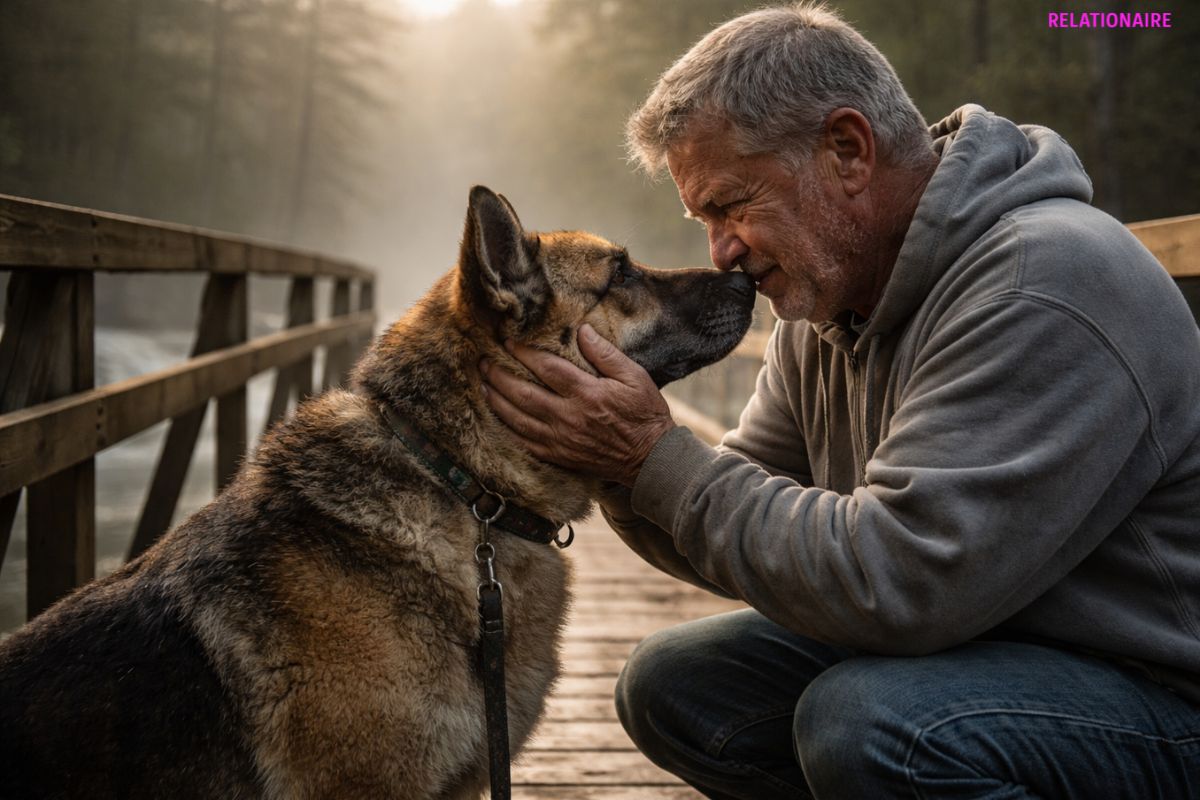
The old shepherd stood at the edge of the wooden bridge like the boards had turned to fire beneath his paws.
Mara kept a loose hold on the leash, though the dog wasn’t pulling.
He wasn’t fighting.
He was locked.
His ears pinned flat. His back legs stiff. His weight shoved so hard to the rear it looked like the years themselves were dragging him backward.
Behind them, a family waiting to cross sighed loud enough to be heard.
A teenage boy muttered, “It’s just water.”
His mother gave Mara a tired smile that wasn’t kind. “Maybe you should take him somewhere else.”
Mara swallowed and nodded like she understood, because she did.
People came to the state park for quiet trails, cold morning air, and a view from the ridge where the trees opened over the river.
They did not come to stand behind a rescue volunteer and her impossible dog.
She crouched beside him.
“Rusty,” she said softly, though that wasn’t the name he’d come in with. The shelter had called him Ranger. Before that, who knew. “Nobody’s making you rush.”
The shepherd didn’t look at her.
He looked through the bridge.
At the narrow planks.
At the dark water moving under it.
At something only he could see.
The leash handle creaked in her hand, worn leather soft from use. She reached into her coat pocket and touched the thing she always carried on walks with him—a brass tag on a frayed red cord.
Not his shelter tag.
The other one.
The one found knotted in his collar the day animal control brought him in.
No owner name. No address.
Just scratched metal and years of wear.
On one side: Scout.
On the other: HM-7.
Nobody at the shelter knew what it meant.
The old shepherd suddenly made a sound deep in his throat.
Not a growl.
Not a whine.
Something smaller. Stranger.
Like a noise trying hard not to become pain.
“See?” said the teenage boy behind them. “He’s terrified.”
Mara stood up before she said something sharp.
“He’s old,” she answered. “That’s not the same thing.”
The boy shrugged.
To him, maybe it was.
An older man sitting on a bench twenty feet away lifted his head.
Mara had noticed him earlier when she came up the trail. Gray hooded sweatshirt. Work jeans. Heavy hands wrapped around a paper cup of coffee. The kind of man who sat still like he’d earned it.
He’d been watching the river, not people.
At least that’s what she thought.
Now he wasn’t watching the river anymore.
He was watching the dog.
Really watching him.
Not the way folks did when they saw a stubborn animal causing a delay. Not with irritation. Not even with pity.
With recognition.
The man set his coffee down beside him and leaned forward slowly, elbows on his knees.
The shepherd’s body went tighter.
Mara felt it through the leash before she saw it.
The dog’s eyes fixed on the bridge railing.
Pinned there.
The planks were old, weathered silver. The handrails were rough-cut timber, waist high, narrow enough to guide but not hold.
Below, the river pushed over stone in a hard spring current, carrying bits of branch and leaf downstream.
It was not a dangerous crossing.
Kids crossed it every day with ice cream on their hands and no fear in their bones.
But the dog stared at it like memory had teeth.
“Ma’am.”
The voice came from the bench.
Mara turned.
The man was already standing.
There was something unsteady in the way he rose, not weak exactly, just careful, like too many years had taught him not to move fast unless it mattered.
“Would it be all right,” he asked, “if I came a little closer?”
The family behind Mara stepped aside, grateful for anything that looked like progress.
Mara looked at the shepherd.
His muzzle had gone gray around the nose. One ear had a notch in it. There was an old scar running under the fur near his shoulder, and another on the front right leg where the hair grew in thin.
She had worked with nervous dogs before.
Abused dogs. Shut-down dogs. Dogs who feared hands, men, loud trucks, broom handles, storms.
This was different.
“Yes,” she said carefully. “But slow.”
The man nodded once.
Then he approached like he knew exactly how to meet a frightened animal.
No reaching hand.
No clicking tongue.
No sweet baby voice.
Just slow steps. Sideways at first. Eyes lowered. Body easy.
When he got within a few feet, he stopped.
The shepherd had gone so still he seemed carved out of wood and old grief.
The man looked at the dog’s feet.
Then the ears.
Then the bridge.
His mouth tightened.
Mara saw the exact moment something inside him gave way.
His eyes shone before he even blinked.
“Oh God,” he whispered.
The words were quiet, but Mara heard them.
So did the dog.
The shepherd’s head lifted a fraction.
The man took in one breath that sounded wrong coming back out.
“He’s not scared of the water,” he said.
Nobody spoke.
The trail, the bridge, the family behind them, the breeze moving through pine—all of it seemed to hold itself still around that sentence.
Mara’s fingers closed around the leash.
“What do you mean?”
But the man didn’t answer her first.
He looked at the dog like a person standing at the door of a house he thought had burned down years ago.
Then, very slowly, he sank to one knee in the dirt.
His hand trembled once against his thigh before he steadied it.
The shepherd’s nose twitched.
The old man’s voice cracked on the first word.
“Scout?”
The family behind Mara fell silent.
The dog did not move.
Not forward.
Not back.
But his eyes changed.
Mara felt it before she understood it.
That blank, trapped look was gone.
In its place came something wider. Deeper.
Not fear.
Shock.
The man swallowed hard.
There were tears on his face now, and he wasn’t even trying to hide them.
“Scout,” he said again, barely louder than the river. “It’s me.”
Mara stared at him.
“You know this dog?”
The man looked up at her, and whatever answer he had was sitting right there in his face long before it reached his mouth.
“I think,” he said, voice shaking, “this dog once saved my life.”
Nobody behind them said a word now.
No sighing.
No muttering.
Just the river under the bridge and the smell of coffee and damp boards in the cold morning air.
Mara looked down at the brass tag in her hand, at the scratched name, at the dog who had frozen like a soldier at the edge of an old battlefield nobody else could see.
The man reached slowly into the front pocket of his sweatshirt.
When his hand came back out, he was holding something small.
A bent silver badge pin.
Fire department issue.
The shepherd made that deep sound again.
Only now it broke clean open.
Not pain.
Recognition.
Mara’s breath caught.
The man’s hand stayed in the air, shaking.
“Buddy,” he whispered. “Where have you been?”
And the dog took one step forward.
Only one.
Then stopped again, staring at the bridge between them like it still held the worst moment of his life.
Mara looked from the dog to the man on one knee.
Whatever this was, it was bigger than fear.
Bigger than a park trail.
Bigger than a rescue volunteer and an old dog with no history.
The man’s eyes never left Scout.
“There was a flood,” he said.
Then he stopped, as if even that was too much to say with strangers listening.
Mara had a hundred questions.
The family behind her had them too.
But the dog gave a low, broken whine and fixed his eyes on the man’s face like he’d been searching for it a very long time.
And the man whispered, “I thought you were gone.”
What had happened on a bridge like this?
Why had this dog been carrying that name all these years?
And how do you cross a place that once took everything from you?
PART 2
The old shepherd stood trembling at the lip of the bridge, his eyes locked on the kneeling man like the whole world had narrowed to that one face.
Mara forgot the waiting family.
Forgot the trail.
Forgot the cold.
The retired firefighter wiped at his eyes with the back of one hand and let out a breath that shook in his chest.
“My name’s Walter,” he said, still staring at the dog. “Walter Hayes.”
Mara nodded, though she barely felt herself do it.
“Mara.”
Walter gave a small, distracted nod, then looked back at the brass tag in her hand.
“Can I see that?”
She passed it over.
He turned it once and let out a sound that was almost a laugh and almost a sob.
“HM-7,” he said quietly. “Hazard boat team. Unit seven.”
He rubbed his thumb across the scratched letters like he was touching a grave marker.
“We called him Scout because he always moved ahead of us. Smartest dog I ever saw.”
The teenage boy behind Mara spoke before his mother could hush him.
“You mean, like, a rescue dog?”
Walter looked up.
“Not official,” he said. “Not on paper. He belonged to a handler at first. Then he sort of belonged to all of us.”
His voice drifted back to the dog.
“Mostly to me.”
The shepherd took another small step, then stopped again so suddenly his nails clicked on the board.
Walter’s face crumpled.
The bridge.
It wasn’t stubbornness.
It wasn’t fear of water.
It was memory.
Mara felt sick for every time she’d tugged gently on the leash and said, It’s all right.
She had been asking him to walk straight into the shape of his worst day.
Walter rose slowly, joints stiff, and moved back from the entrance to the bridge until he stood on solid dirt.
The dog’s posture changed at once.
Not relaxed.
But less trapped.
“There,” Walter whispered. “I know, buddy. I know.”
People who had gathered near the trailhead had stopped pretending not to watch.
A man in a fishing cap.
Two women with trekking poles.
A little girl holding her father’s hand.
Most of them wore that same look people wore when they’d first seen the dog freeze.
A mix of curiosity and impatience.
But now nobody was rushing off.
Walter seemed to notice them all at once and straightened his shoulders.
Years sat on him, but so did something else—old habit, maybe. The kind that makes a man stand up even when memory is trying to put him on his knees.
He handed the tag back to Mara.
“Twelve years ago,” he said, “there was a flood north of here. Not in this park. Small town along the river. Houses half under by dawn. Roads cut off. Folks trapped on roofs.”
The smell of old canvas seemed to rise from nowhere as he spoke, though maybe Mara only imagined it because his words made everything feel near.
“We were pulling people out any way we could. Boats, ropes, ladders. Scout rode with us. He could spot movement before any of us. He’d bark once when he saw someone. Twice if he smelled trouble.”
Walter smiled through the grief.
“He found a kid in an upstairs bedroom that morning. Little girl no more than six. Water already coming through the windows.”
The shepherd’s ears lifted.
Walter’s voice dropped.
“The house next door had a narrow service bridge between the second-floor porches. Just planks and rails. Temporary thing. Bad shape. But it was the only way across without bringing the boat into debris.”
Mara looked at the bridge in front of them.
Same width.
Same rough rails.
Same drop below.
Her chest tightened.
“I went first,” Walter said. “Scout went with me. The girl was on the far side crying for her mama.”
He paused and looked down at his hands.
Big hands. Burn-mark scar near one thumb. Knuckles thick with age and work.
“When we got to her, she wrapped herself around Scout’s neck before she let me touch her. That dog stood there wagging his tail while the water rose under us like it was just another day.”
Walter swallowed.
“The plan was simple. I’d carry the girl. Scout would go ahead. My crew would spot us from the near side.”
His jaw flexed once.
“But simple doesn’t mean safe.”
Nobody moved.
Even the little girl in the crowd stood quiet now.
“A section gave way under the far rail,” Walter continued. “Whole bridge twisted. I got the child against my chest and tried to turn sideways. Scout was in front of me. Then a tree limb hit the support from below.”
His eyes closed.
“That bridge snapped like kindling.”
Mara put her hand over her mouth.
Walter opened his eyes again, but they were far away now.
“I remember cold,” he said. “The kind that empties your lungs all at once. I remember the child screaming. I remember getting one hand on a post. And I remember Scout.”
The dog took another step.
Walter’s voice broke.
“He came back for us.”
A murmur passed through the people listening.
Walter didn’t seem to hear it.
“He could’ve made it to shore. Could’ve gone with the current and lived. But he turned. Jumped back into the water. He got to the girl first. Kept her face above the current long enough for my team to throw a line.”
Walter pressed his fist against his mouth for a second before he could go on.
“I had her. Then the current took me loose. And Scout… Scout came after me too.”
Mara looked at the old shepherd’s scarred shoulder.
At the thin patch on his leg.
At the gray in his muzzle.
At all the years no one had known.
Walter stared at the bridge boards.
“There was a second hit. Debris. I saw him go under. I went under after him. My crew dragged me out downstream. They found the girl alive. Found me alive. Never found Scout.”
The silence that followed was so full it felt like weather.
The fishing cap man took his hat off.
The teenage boy looked at the ground.
Mara felt the leash trembling in her hand.
“Everyone said he was gone,” Walter said. “I believed them because I had to. Went back three days straight. Called for him till I had no voice left. Nothing.”
He looked at the dog.
“But he wasn’t gone.”
The shepherd finally moved again.
One stiff step.
Then another.
Not onto the bridge.
Away from it.
Toward Walter.
His head stayed low. His body shook so hard Mara thought his legs might fail. But he kept coming until he stood close enough to smell the hem of Walter’s sweatshirt.
Walter did not reach for him.
He just stood there with tears running into the lines of his face.
That quiet restraint told Mara more than anything else could have.
Love that old doesn’t rush.
Scout lifted his nose.
Touched it once to Walter’s wrist.
Walter folded in half.
Not collapsing.
Bowing.
He lowered himself with one hand braced on his knee and brought the other up, slow enough not to startle him, until it rested against the shepherd’s cheek.
His hand trembled.
Scout closed his eyes.
There it was.
The delayed recognition.
Not loud. Not dramatic.
Just a man and a dog meeting again in the only language grief leaves behind.
“Oh, buddy,” Walter whispered. “You waited all this time.”
Mara wiped her own eyes and didn’t care who saw.
One of the women with trekking poles was crying openly now.
The little girl asked her father, “Did the dog save him?”
The father answered in a rough voice, “Looks like they saved each other.”
Walter kept his forehead near Scout’s.
“I got married two years later,” he said quietly, maybe to Mara, maybe to himself. “Had a son. Buried my wife five winters ago. Retired after forty years. Whole time… every flood call, every bridge, every bad dream… I saw him go under.”
Scout leaned his weight, slight as it was, against Walter’s chest.
Not much.
Just enough.
A quiet act of dignity.
As if saying, I’m here. Stand up.
Walter did.
Then Mara saw something change in his face again.
Not relief this time.
Worry.
He looked at the dog’s hips, at the clouded eye, at the scars, at the tired stance.
“How long has he been at your shelter?” he asked.
“Three weeks,” Mara said. “Found wandering near the old industrial road. No chip. Bad shape, but improving.”
Walter nodded slowly.
Then he looked at the bridge once more, and the grief in his face sharpened into understanding.
“He didn’t just remember me,” he said. “He remembered where it happened.”
Mara followed his gaze.
The bridge wasn’t just a bridge.
It was a doorway he could not force himself through.
Walter took a breath.
“If he came this far with you, he was trying.”
That hit Mara hard.
Trying, not failing.
Trying.
Walter bent and picked up his paper cup from the bench. It had gone cold. He set it down again without drinking.
Then he looked at Mara with a question already taking shape.
The kind of question that could change both their lives.
And before she could answer, a park ranger came jogging up the trail, radio clipped to his vest, calling out that someone from the shelter had been trying to reach her.
Mara’s phone had no signal down by the river.
The ranger held out his own.
“It’s urgent,” he said.
Mara took it, confused.
Then she heard her manager’s voice, tight and breathless.
“Mara, don’t bring that dog back yet.”
Her stomach dropped.
“Why?”
There was a pause on the line.
Then the answer came.
“Because a family from out of state just arrived claiming he belongs to them.”
And that’s when everything changed.
PART 3
Mara gripped the ranger’s phone so hard her fingers ached.
“A family?” she repeated. “What family?”
Her shelter manager lowered her voice, but not enough to hide the strain in it.
“They drove in this morning after seeing his picture online. Husband, wife, grown son. They say the dog disappeared years ago from property they used to rent near the river. They’re insisting he’s theirs.”
Mara looked straight at Walter.
He stood with one hand resting lightly on Scout’s neck, as if even now he didn’t fully trust the miracle in front of him.
The old shepherd stayed pressed against his leg.
No leash tension.
No panic.
Just stillness.
Mara asked the question already sitting in her throat.
“Do they know his name?”
Another pause.
“They called him Duke.”
Mara shut her eyes.
Scout didn’t react at all.
Not even a flicker.
She opened her eyes and looked at the brass tag again in her hand.
Scout. HM-7.
Not Duke.
Not maybe.
Not close.
Mara gave the phone back to the ranger and thanked him. Then she told her manager she’d be back soon, but not before she understood exactly what was going on.
Walter had heard enough from her face to know the shape of it.
“Somebody wants him,” he said.
“They think he’s theirs.”
Walter nodded once, a man absorbing a blow without making a show of it.
His hand slid away from the dog.
Not because he wanted it to.
Because that’s what decent people do when love runs into duty.
“Well,” he said, voice rough, “then we find out the truth.”
Mara could’ve cried right there for that alone.
No arguing.
No staking a claim.
No grabbing at grace because it had finally returned.
Just dignity.
The crowd around them had thinned, but a few people still lingered. Quiet now. Respectful.
Walter bent and picked up his cold coffee.
Scout looked up at him, then at the bridge, then back at him again.
Walter understood before Mara did.
He set the cup down on the bench and faced the narrow crossing one more time.
“You don’t have to do that,” Mara said softly.
Walter shook his head.
“I know.”
He turned to Scout.
“But maybe I do.”
The old shepherd’s ears tipped forward.
Walter took one step toward the bridge.
Then stopped short of the first board.
“Not for them,” he said, almost under his breath. “For us.”
Mara’s throat tightened.
The river moved under the planks with that same hard sound.
Cold water over stone.
The kind of sound that gets inside memory and stays there.
Walter didn’t touch the dog.
Didn’t pull.
Didn’t call with false cheer.
He just stood at the bridge entrance, shoulders squared, old pain plain on his face.
Then he spoke the way a man talks when every word has been earned.
“You got her out,” he said. “You came back for me.”
His mouth trembled once.
“I’m asking you now what I should’ve asked then.”
Scout looked at the first board.
Walter raised his hand to his forehead.
Not a full salute.
Not yet.
Just the beginning of one.
“If you’re ready,” he whispered, “I’m with you this time.”
Nobody breathed.
Scout stepped forward.
One paw on the wood.
Then another.
His legs shook. His ears pinned. His body remembered every terrible thing.
But he looked at Walter and kept moving.
Walter stepped beside him.
Slow.
Matched.
Board by board.
The old bridge gave a quiet groan beneath their weight.
Mara stood frozen with tears in her eyes.
Halfway across, Scout faltered.
His nails scraped.
Walter stopped with him.
“It’s all right,” he said, voice unsteady but firm. “No water’s taking you today.”
The dog pressed closer to Walter’s leg.
Then together they crossed the rest.
When they reached the far side, Walter bent over hard, one hand on his knee, the other covering his eyes.
Scout stood beside him, facing the river, chest heaving.
The fishing cap man took off his hat again.
This time nobody told him to.
It just felt right.
Mara walked across only after they had a moment.
On the other side, Walter straightened and turned to her. His face was wet. He didn’t apologize for it.
“He’s been carrying that day alone,” he said.
Mara nodded.
“Not alone anymore.”
Back at the shelter, the claimed owners were waiting in the lobby.
A woman with folded arms.
A man doing all the talking.
A grown son scrolling his phone until Mara and Walter walked in with Scout between them.
The dog looked once at the family.
Then looked away.
No tail. No pull. No recognition.
The man stepped forward anyway.
“Duke,” he said brightly, as if saying it louder could make it true.
Scout didn’t move.
Walter stayed quiet.
Mara asked for details.
When did the dog go missing? What vet had seen him? Did they have records? Old photos? Scars? Commands he responded to?
The story unraveled fast.
Dates didn’t match.
The vet name changed twice.
The wife said he hated water.
The son said he used to swim all day.
Then came the real reason.
Not love.
Not grief.
Money.
A local post about the “hero rescue dog reunited with firefighter” had already started spreading. Someone had recognized Walter from years back. The family had seen attention gathering and tried to step into it.
Public interest where private worth had stood ignored for years.
Mara felt something cold settle in her chest.
Walter only looked tired.
The shelter director asked them to leave.
They did, angry and loud.
Scout didn’t even watch them go.
That evening, the lobby went quiet again.
The smell of coffee from the break room mixed with wet dog shampoo and old blankets.
Walter sat in a plastic chair with Scout’s head resting across his worn boot.
Between them on the floor lay the brass tag and Walter’s bent badge pin.
Two pieces of metal.
Two survivors.
Mara finished the paperwork herself.
Temporary foster first. Then adoption, once the hold cleared.
Walter read every page twice. His hands were steady until the last line.
Then the pen paused.
“Thought I’d buried enough in this life,” he said, not looking up. “Didn’t expect to get something back.”
He signed anyway.
A week later, the town filled the VFW hall for a small ceremony that wasn’t announced as much as passed along from porch to porch, diner to diner, one voice to another.
No television crews.
No big speeches.
Just neighbors. Veterans. Firefighters. A few shelter volunteers. Kids who had heard there’d be a brave old dog.
The folded flag on the front table carried that unmistakable weight some rooms understand without speaking of it.
Walter wore a clean work shirt and the badge pin on his pocket.
Scout sat beside him with a new collar but the old tag still hanging from it.
When Walter’s name was called, he rose slow.
When Scout’s was called, the dog rose with him.
A retired marine from the back stepped forward first and saluted.
Then another man did.
Then a woman in firefighter dress blues.
Walter’s chin dipped.
His hand trembled as he brought it to his forehead.
Beside him, Scout sat straight, ears high, eyes fixed ahead.
For one long, quiet moment, nobody in the hall made a sound.
Then Mara saw Walter’s free hand lower to rest on Scout’s neck.
Not to hold him there.
Just to say, We made it.
Afterward, people lined up to shake Walter’s hand, then crouched to meet Scout.
A little girl in a yellow dress asked if he was a hero.
Walter looked down at the dog and smiled in that tired, grateful way of men who know the truth is simpler than any headline.
“He was before anyone noticed,” he said.
Later that night, at Walter’s small house near the edge of town, the screen door creaked as he opened it.
Cold evening air moved over the porch.
An old flag stirred once in the dark.
Inside, Scout paused on the threshold like crossing mattered.
Walter waited.
No pull.
No hurry.
Just patience.
Scout stepped in.
The dog bed sat by the heater, but Scout ignored it. He circled once and settled beside Walter’s chair instead, chin resting on the man’s boot like it had always belonged there.
Walter leaned down and scratched behind the notched ear.
“Home,” he said quietly.
Scout let out one long breath and closed his eyes.
Some losses don’t stay lost forever.
Sometimes what comes back is older, scarred, and slow to trust.
But when it lays its head against your leg, you know grace still remembers the way home.
What’s something you judged too quickly once… and never forgot after learning the truth?