If you’ve already read part 1 of this story on Facebook, go here for Part 2!
By the third Friday, I had already decided what kind of story it was.
A hungry child. A failing home. One of those sad little patterns people notice and then pretend not to.
The boy came in every Friday at 3:42.
Always alone.
Always with a backpack hanging too low on one shoulder and a careful little fist full of crumpled dollar bills he smoothed against my register with both hands, like he was trying to make them look more respectable before he spent them.
Two cheap egg salad sandwiches.
Same brand. Same shelf. Yellow discount sticker on both.
He never asked for chips. Never a drink. Never candy from the lane. Just the sandwiches.
He was maybe nine. Small for his age. Brown hair that never seemed fully combed. Sneakers with the rubber peeling near the toes. The kind of kid who said “ma’am” without sounding coached into it.
The first time, I smiled and rang him up.
The second time, I asked if he wanted a bag.
He said, “No, thank you. It’s easier this way.”
The third time, I noticed his lunchbox clipped to his backpack was empty.
The fourth time, I started feeling angry at people I hadn’t met.
I worked register three at Beller’s Market in a town small enough to know who drank too much, who tipped badly, who was behind on rent, and who had buried somebody that year. You learn to read lives fast in a grocery store. The cuts of meat. The formula brands. The way somebody holds a debit card like it might betray them.
And I thought I was reading his.
I thought there was some sorry excuse for a parent at home who couldn’t be bothered to have bread in the house.
Maybe a mother asleep from working nights.
Maybe a father passed out in a recliner.
Maybe both.
His name, I learned from his after-school pickup list one afternoon when a teacher came through my lane with him standing nearby, was Eli Benton.
“Tell your mom I signed the field trip form,” the teacher said.
“Yes, ma’am,” he answered.
He didn’t look embarrassed. Didn’t look scared. Just quiet. Watchful.
That almost made it worse.
Kids who complain can still afford to be children.
Kids who move through the world that carefully usually know too much.
By the sixth Friday, I couldn’t keep my mouth shut.
“You eating both of these yourself, honey?”
He blinked up at me, not offended, just surprised.
“No, ma’am.”
I nodded like I knew.
“Your mom working late?”
He hesitated. A small pause. Not because he was caught in a lie, I realized later. Because he was deciding how much of himself to hand to a stranger.
“Something like that,” he said.
That answer sat with me all evening.
Something like that.
I told my sister about him over the phone while I washed dishes.
“Maybe call the school counselor,” she said.
“On what? A hunch?”
“On a nine-year-old buying two gas station sandwiches every Friday with dollar bills.”
“It’s a grocery store.”
“You know what I mean.”
I did know.
But there are lines. People in small towns cross them all the time and call it caring.
Still, the next Friday, when I saw him walk in with his backpack damp from rain and his hair stuck to his forehead, I felt that old mean tug of judgment again. At his parents. At life. At every adult who lets a child get too used to managing.
He picked the sandwiches carefully, checking dates.
That got me too.
Nine years old, and already checking expiration dates.
When he came to my register, I slid a banana across the scanner without charging him.
“For you.”
He pushed it gently back toward me.
“Thank you, but that’s okay.”
“It’s free.”
“I know.” He glanced toward the front windows. “But I just need the sandwiches.”
Need.
Not want.
Need.
I lowered my voice. “Sweetheart, are things all right at home?”
His face changed then.
Not fear. Not shame.
Something closer to disappointment.
Like I had stepped on a place he was trying hard to keep clean.
“Yes, ma’am,” he said softly. “They are.”
I rang him up in silence.
After he left, I watched through the glass as he crossed the parking lot instead of heading toward the apartments behind the laundromat like I expected.
He went right.
Toward Main Street.
Toward the old courthouse square.
Toward the benches where men sat smoking in the mornings and no one sat much by afternoon except the ones folks called lonely, difficult, or touched.
I told myself to let him go.
I lasted maybe twelve seconds.
“Patty, watch lane three,” I called to the cashier at customer service.
She frowned. “You’re on break?”
“Something like that.”
Outside, the air smelled like wet pavement and fryer grease from the diner across the street.
Eli walked fast, but not like he was sneaking. More like he had somewhere important to be and no room to waste time getting there. He didn’t look back once.
I kept far enough behind not to spook him.
At the square, he slowed.
There were three benches under the sycamores. Two were empty.
On the third sat old Mr. Larkin.
Everybody in town knew Mr. Larkin, though nobody really knew him.
He wore the same brown coat every winter whether it was cold enough or not. Talked to himself sometimes. Fed crackers to birds. Slept, people said, in the room over the old hardware building until the stairs got too dangerous, then somewhere out near the river or maybe the church basement when they let him. Stories changed depending on who was telling them.
What stayed the same was the way people angled around him.
Too strange.
Too dirty.
Too sad.
Too much trouble for a Friday afternoon.
I had seen him in the store before, counting change for canned soup with hands that shook so hard I wanted to look away for his sake.
Eli walked straight to him.
Mr. Larkin looked up, startled at first, then softer around the eyes in a way I had never seen.
The boy sat down on the bench beside him.
Not close enough to crowd him. Just close enough to say I came on purpose.
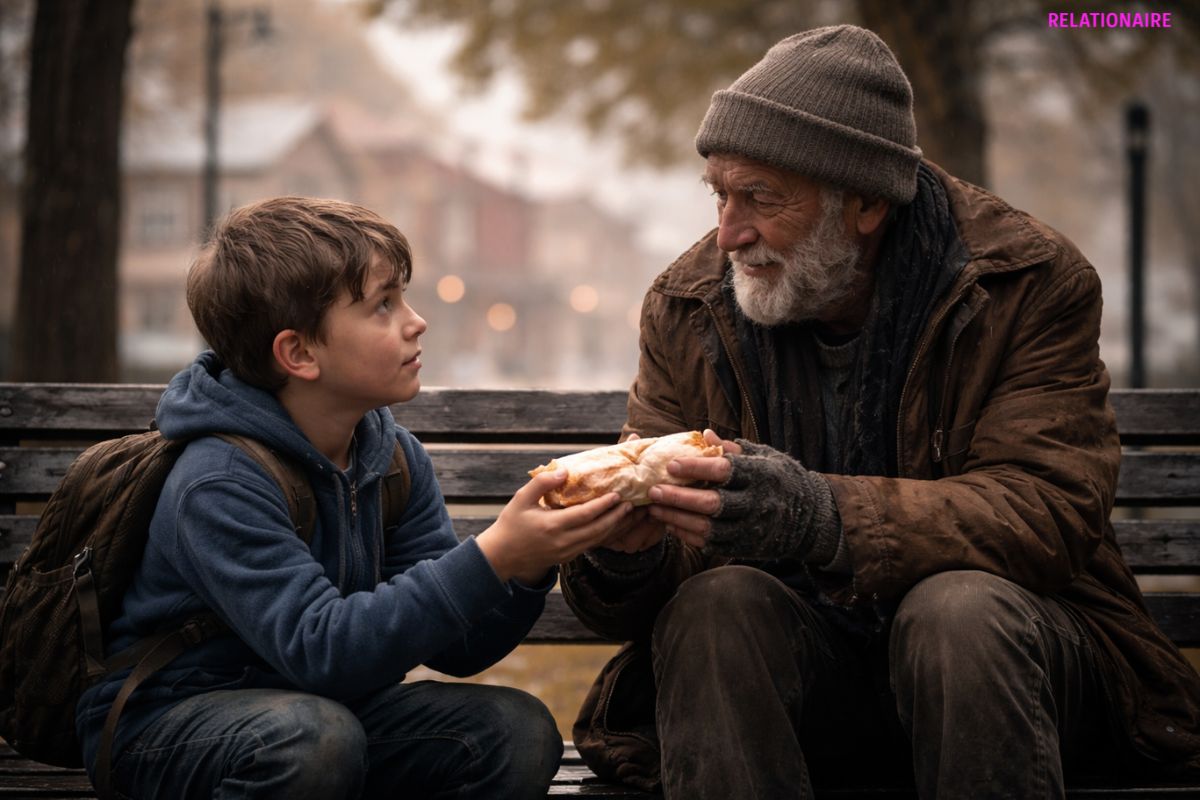
He took one sandwich from his backpack and held it out with both hands.
Mr. Larkin stared at it.
Then at the boy.
Even from where I stood under the pharmacy awning, I could see the old man hesitate.
Pride does not disappear just because a coat gets worn through.
Eli said something too low for me to hear.
Mr. Larkin took the sandwich.
Not greedy. Not desperate. Slow.
Like accepting meant something heavier than lunch.
My chest tightened.
I felt ashamed so quickly it was almost physical.
All week, all those Fridays, all those stories I had built in my head about neglectful parents and hungry children and what I thought I understood.
I had been wrong.
But I still didn’t understand why.
Then Mr. Larkin reached into his coat pocket with trembling fingers and pulled out something small.
A folded piece of paper, soft at the creases.
He handed it to Eli.
The boy didn’t open it.
He just held it and shook his head.
“No, sir,” he said, louder this time.
Mr. Larkin pressed it toward him again.
The boy’s voice wavered, but he didn’t take it.
“I’m not doing this because I feel sorry for you.”
The old man went very still.
So did I.
Eli swallowed hard and looked up at him with those serious little eyes.
“I’m doing it because you fed my granddad when nobody else would.”
And that was the moment I realized this story had never belonged to my assumptions at all.
It belonged to a kindness so old almost everyone in town had forgotten it.
Except one little boy.
Part 2
The rain started again before I found the courage to cross the square.
Not a hard rain. Just that cold, needling kind that makes people tuck their chins down and hurry home.
But Eli stayed on the bench.
So did Mr. Larkin.
The old man held the sandwich in his lap like something handed back from another life.
I walked over feeling clumsy in my own skin.
Eli looked up first. His face didn’t show surprise. Just a quiet, tired acceptance, like he had noticed me following him ten minutes ago and decided not to embarrass me over it.
That nearly undid me.
“I’m sorry,” I said.
It was all I had.
Not enough, but true.
“For following you. And for… thinking I knew.”
He nodded once.
Children know when adults are trying to crawl out from under their own shame.
Mr. Larkin glanced between us, wary.
Up close, he looked older than old. Not just years. Weather. Hunger. Being overlooked for so long it settles into your shoulders.
Eli finally unfolded the paper the man had tried to give him.
It wasn’t money.
It was a photograph.
Black and white. Worn thin at the edges.
Two young men standing in front of a service station I vaguely recognized from before the bypass road moved traffic away from town. One tall and broad-shouldered. The other thinner, grinning sideways at the camera.
The taller one was Mr. Larkin, only decades younger.
The other, even with age and paper blur, I knew from the framed picture on the obituary table two years ago at First Baptist.
Walter Benton.
Eli’s grandfather.
“My papa,” Eli said quietly.
The old man’s lower lip trembled. “Your granddad hated having his picture took.”
Eli smiled a little. “Mama says that too.”
We sat there with the rain ticking through the sycamore leaves.
After a while, the story came in pieces.
Not from Mr. Larkin at first. From Eli.
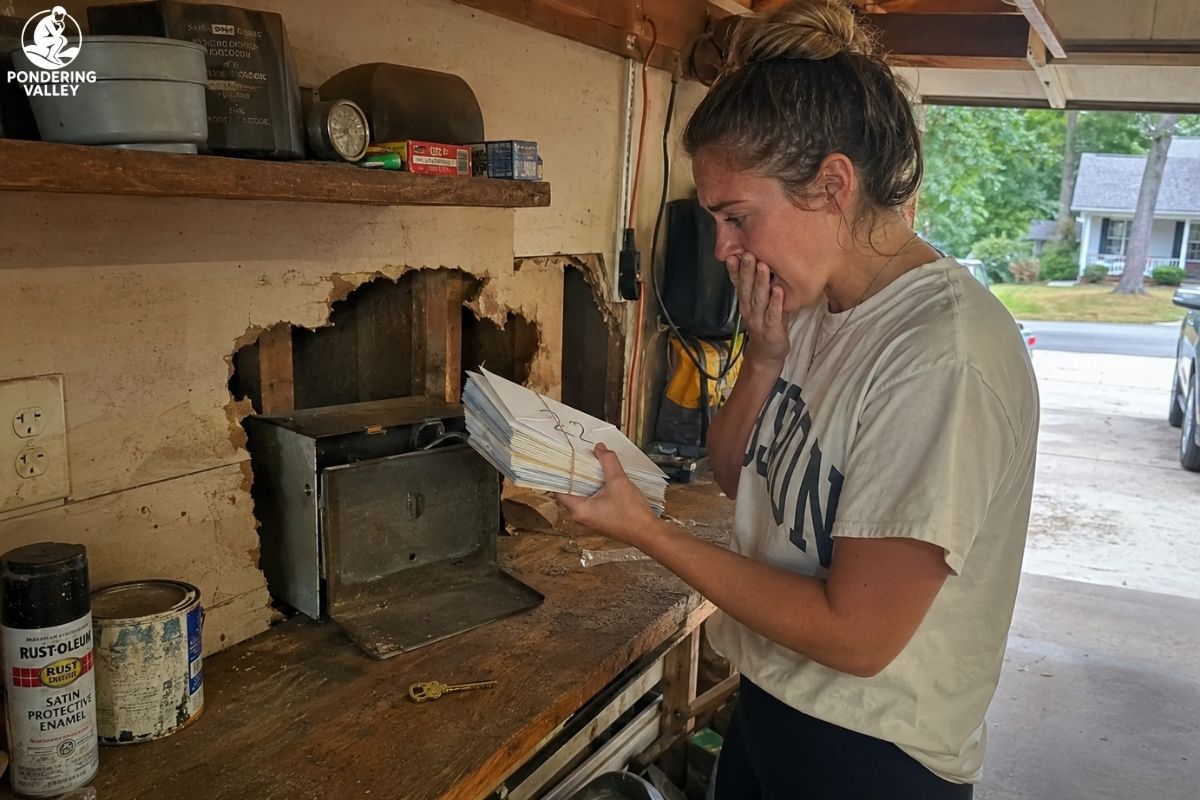
The week after Walter Benton died, his daughter, Claire, had been sorting through the garage with Eli. Tools. Fishing line. Mason jars full of nails. The things a man leaves behind when he never expects his life to fit in boxes.
At the bottom of an old tackle box, Eli found an envelope with his own name on it in his granddad’s careful block print.
Not “open when you’re older.”
Not “for college.”
Just: For Eli.
Inside had been the photograph and a note.
Eli didn’t have the note with him. He had memorized it.
He said it that way children say the Pledge of Allegiance or a prayer they’ve repeated enough to carry in their bones.
“Sometimes a man is hungry in more ways than one,” he recited softly. “And the worst kind is when he thinks nobody sees him.”
My eyes stung.
He kept going.
“Mr. Larkin fed me three Fridays running when I was too proud to tell anybody I hadn’t eaten. That was before your mama was born. Before I got back on my feet. He sat beside me and talked about baseball like it wasn’t charity. That matters, son. If I’m gone before I pay him back, and if he’s still sitting somewhere in this town, don’t hand him pity. Hand him lunch and sit down awhile. A man can live longer on being remembered than on bread.”
When Eli finished, even the square seemed quieter.
I looked at Mr. Larkin.
He kept his eyes on the wet pavement.
“Your granddad talked too much,” he muttered.
But his voice had broken clean through the middle.
That might have been enough for one Friday.
For one story.
But life does not usually stop where it would be neatest.
The next week, Eli came in again.
Two sandwiches.
Only this time, when I tried to slide in an apple and a yogurt, he leaned forward and whispered, “Please don’t make it look like charity.”
That sentence landed harder than anything else he’d said.
Not because it was wise beyond his years.
Because it was simple. Specific. Protective.
He wasn’t protecting himself.
He was protecting the old man’s dignity.
So I nodded and charged him exactly what he expected.
After he left, I bought a fresh turkey sandwich with my own money and tucked it in my purse. I figured maybe there was a way to help without stepping on the shape of what Eli was trying to do.
At the square, the bench was empty.
So was the next one.
And the next.
Eli stood very still under the trees, scanning the corners of the courthouse lawn.
“He’s always here,” he said.
The panic in that small voice tightened everything in me.
We checked behind the library. By the alley near the old feed store. Around the church annex where some of the men slept when the weather turned sharp. No Mr. Larkin.
At last we found him behind Ritchie’s Hardware, sitting on an overturned milk crate by the loading dock with one hand pressed hard against his side.
His face had gone gray.
Eli ran to him.
“Are you hurt?”
“I’m fine.”
He wasn’t.
I crouched down. “Mr. Larkin, I’m calling an ambulance.”
“No.” The word came out rough. “No hospital.”
“You need—”
“No.”
That was not stubbornness for show. That was fear.
Some people have had their choices taken from them so many times they cling even to bad ones.
Eli knelt in front of him.
Not begging. Not panicking.
Just looking straight into the old man’s face.
“Did you tell my papa no when he was hungry?”
Mr. Larkin shut his eyes.
It took a moment.
Then another.
Finally he gave the smallest nod I’d ever seen.
At the hospital, they admitted him for pneumonia, dehydration, and an infection in his leg that had gone bad because he’d ignored it too long.
Claire Benton came after work, still wearing her diner apron. When she heard what her son had been doing every Friday, she put one hand over her mouth and sat down hard in the plastic waiting room chair.
“He never said a word,” she whispered.
Eli shrugged, looking suddenly, painfully young.
“Papa asked me.”
Claire started crying then. Quietly. The exhausted kind, with no drama in it at all.
“I was so busy after Daddy died,” she said. “I thought Eli was just taking his allowance to the comic store. I didn’t even ask.”
Her son climbed into the chair beside her and leaned his head against her arm.
“You were sad,” he said.
Not accusing.
Just true.
That night, after they went home, I stayed a little longer in the waiting room because Mr. Larkin had fallen asleep at last, and the nurse said there was no family listed.
On the tray beside his bed sat the second sandwich Eli had bought.
Untouched.
Not because he didn’t want it.
Because he had saved half for later.
Saved, even now.
As if hunger might come back any minute and punish him for trusting one good day.
The following Monday, word got around town that “the courthouse drifter” was in county hospital.
The usual comments started.
Some kind, but careless.
Some practical.
Some ugly.
“He shouldn’t be loitering downtown anyway.”
“There are services for people like that.”
“Probably refuses help.”
At lunch rush, two women in my lane talked about him like he wasn’t a man at all. Just a nuisance with a coat.
Before I could stop myself, I said, “He fed a hungry man in this town when nobody else noticed. Some of you have been living off kindness you never earned for years.”
They stared.
I didn’t apologize.
By Friday, Mr. Larkin was well enough to leave, but nowhere safe had opened up for him. No room at the church shelter. No county bed till next week. No family willing to claim him.
So discharge meant a paper bag of medication, a bus voucher he couldn’t use, and the same old problem waiting outside the automatic doors.
I stood there with Claire and Eli under the hospital awning while the nurse wheeled him out.
The rain had passed. The sky was clear and cold.
Mr. Larkin looked embarrassed to be seen.
Claire stepped forward first.
“My daddy kept a note for you,” she said.
She held out an envelope.
Mr. Larkin frowned. “For me?”
“It was in his tackle box.”
He took it with shaking hands.
And for the second time in two weeks, I watched a man everyone called strange stare at something like it might split him open.
He slid one finger under the flap.
Then stopped.
Because Eli, standing beside him with his backpack and his too-big heart, said in a small voice:
“He wrote it the year before he died.”
And suddenly none of us were breathing quite right as Mr. Larkin began to open the letter.
Part 3
There are some silences that feel respectful.
And some that feel sacred.
The one under that hospital awning was the second kind.
Mr. Larkin took the letter out slowly, like he was afraid the paper might disappear if he moved too fast. His hands shook so badly Claire reached as if to help, then caught herself. Eli saw that and gently tugged her sleeve down.
Let him.
The letter was only one page.
Walter Benton had never used three words where one would do.
But sometimes the plainest men leave the deepest cuts on paper.
Mr. Larkin read the first line and made a sound I will never forget. Not quite a sob. Not quite a laugh. More like a body remembering grief before the mind can brace for it.
Claire looked away. I did too.
Some private things stay private even when they happen right in front of you.
After a minute, Mr. Larkin cleared his throat and read one part aloud, maybe because he couldn’t carry it alone.
Ben—
So that was his first name. Ben Larkin. Strange how a man can live in a town for forty years and people still only know the version of him they’ve decided to see.
I never paid back the Fridays because you were too smart to let me call it a debt. You called it company. But I knew the difference. A sandwich is food. Sitting down beside a man when he’s ashamed is mercy. I hope somewhere before I die, I get one more chance to thank you proper. If not, maybe this letter can stand in. You kept me from becoming the kind of lonely that hollows a man out. I hope life was kinder to you than you let on.
Mr. Larkin stopped reading.
Pressed the paper to his mouth.
Then Eli stepped closer and did the smallest, most beautiful thing.
He took the old man’s free hand and held it like children hold the hands of adults they trust crossing a street.
No performance.
No tears.
Just contact.
Mr. Larkin looked down at him and whispered, “Your granddad was a good man.”
Eli answered, “He said you were too.”
That should have been enough to break me.
It was not the last thing that did.
Claire had spoken to the social worker that morning. So had I. And maybe the world softens, once in a while, when the right people finally stop assuming somebody else will handle the hard thing.
A room had opened up at the boarding house behind Miller’s Pharmacy. Nothing fancy. Just a narrow bed, a heater that banged in the night, and a shared bathroom at the end of the hall.
It was still more than he’d had.
When Claire offered to drive him, Mr. Larkin refused twice before saying yes.
Not because he didn’t need help.
Because needing it hurt.
That evening, Eli came into the store with his mother and bought only one sandwich.
When I raised an eyebrow, he smiled for the first time since I’d known him.
“He has a fridge now.”
The next Friday, he bought two again.
“One for me,” he explained. “So he doesn’t eat alone.”
After that, it became a ritual.
Not announced. Not posted online. Not turned into one of those town charity things people use to feel decent for six minutes.
Just Fridays.
Sometimes on the bench if the weather was good.
Sometimes at the little table in the boarding house kitchen.
Eli would do homework while Mr. Larkin peeled an orange or drank weak coffee and told stories nobody had asked him for in twenty years.
Stories about the old service station.
About Walter Benton sneaking moon pies off the delivery truck and swearing he’d pay for them next payday.
About the flood of ’78.
About baseball.
Always baseball.
Children know how to listen in a way adults forget. Not waiting to speak. Not arranging opinions. Just leaving room.
And room, it turned out, was what had been missing.
Word shifted slowly in town.
That happens too.
Not all at once. Not with speeches.
Just one person telling another, “That old man on the square? He helped Walter Benton once.”
Then, “Claire Benton’s boy visits him every week.”
Then, “His name’s Ben.”
Names matter.
By Christmas, the church secretary had found him a donated coat that fit. The librarian put aside western novels once she learned he liked Louis L’Amour. Mrs. Alvarez from the diner started sending over soup on cold days but labeled the containers extra made by accident so he could accept them without feeling managed.
And the town, which had been so comfortable calling him strange, began the slower, harder work of calling him by his actual life.
Ben.
One afternoon in February, I stopped by the boarding house with a bag of groceries after my shift. Eli was already there at the kitchen table drawing with a half-dead pack of crayons.
Ben sat across from him wearing reading glasses held together at one hinge with tape.
They were arguing about whether a hot dog counted as a sandwich.
“It does,” Eli insisted.
“It absolutely does not,” Ben grumbled.
“It’s meat inside bread.”
“That is a child’s legal argument.”
I laughed so hard I had to put the groceries down.
Ben looked up, smiling before he could hide it.
There it was.
The face he might have kept if life had not roughed him up so long.
Later, while Eli colored, Ben told me something he had never told Claire.
Years ago, after Walter got back on his feet, he had come looking for him with cash in an envelope. Ben had refused it. Pride then, too.
“But truth is,” he said, staring at the steam from his tea, “I didn’t want the money. I wanted him to sit a spell. He had a wife then. A baby coming. A reason to hurry home.” He rubbed his thumb over the cup handle. “Some folks get busy living and mean no harm by forgetting. Still feels the same, though.”
On the floor beside the table, Eli’s drawing had slipped loose.
I picked it up.
It showed a bench under a tree.
A little boy on one side. An old man on the other.
And between them, on the slats of the bench, two sandwiches.
Above their heads he had written, in crooked block letters:
SO NOBODY EATS ALONE
I looked at him.
“You make that for school?”
He shrugged. “No. Just because.”
Just because.
That was his way.
Not grand.
Not polished.
Just because someone is lonely.
Just because somebody mattered once.
Just because a promise should be kept even when the person who asked for it is gone.
In March, the elementary school held a family heritage night with poster boards and cookies gone stale by six-thirty. Kids were supposed to bring photos and stories about people who came before them.
Some brought military uniforms.
Some brought recipes.
Some brought baby pictures of grandmothers with bows bigger than their heads.
Eli brought the black-and-white photo from the square bench story, tucked safe in a plastic sleeve.
When it was his turn to speak, he stood on the cafeteria riser in a wrinkled blue shirt and said, “This is my granddad and his friend Ben. My granddad said Ben helped him when he was hungry and embarrassed, and he helped him in a way that didn’t make it worse. So I think what gets passed down in families isn’t just eye color or recipes. I think it’s also how you treat people when nobody’s clapping.”
There it was again.
One simple sentence.
Nothing fancy.
Half the room went still.
Claire cried into a napkin.
Ben, sitting in the back wearing his good coat and taped glasses, bowed his head and covered his eyes.
Afterward, people lined up to shake his hand.
Some out of kindness.
Some out of guilt.
He accepted both with the same quiet nod.
Grace is not always clean. Sometimes it lets late people come in too.
That spring, when the sycamores filled back out around the courthouse square, I saw them on the bench again.
Eli had grown a little taller.
Ben looked a little stronger.
Between them sat two sandwiches from Beller’s Market, the cheap kind with the yellow discount sticker, because by then that was part of it too. Not upgraded. Not improved. Kept true.
I watched from across the street for a minute before going back to work.
The boy was talking with his hands.
The old man was listening like it mattered.
And maybe that is what mercy looks like most of the time.
Not saving the world.
Not fixing every sorrow.
Just remembering who fed you when you were ashamed, and making sure the kindness does not die with you.
Some people leave money behind.
Some leave land.
Some leave recipes or watches or names carved inside rings.
And some, if we are lucky, leave us a better way to see each other.
That might be the inheritance that keeps the most people alive.