If you’ve already read part 1 of this story on Facebook, go here for Part 2!
By the time I noticed the little girl in the waiting room, she had already filled three sheets of paper with sunflowers.
Not scribbles. Not the usual crooked circles and stick stems kids draw when they’re bored and trapped somewhere adults dragged them. These were careful. Petal after petal, all the way around, done in yellow crayon pressed so hard the wax had started to break.
She sat in one of our brown vinyl chairs with her small knees tucked up under her black dress, a box of crayons beside her, and a pair of white shoes that were already scuffed gray at the toes.
I run a funeral home in a town small enough that grief almost never arrives alone.
It comes with casseroles, cousins, old church ladies, pickup trucks lined up crooked by the curb, and the low hum of people trying to say the right thing and mostly failing.
That day it had come for a woman named Evelyn Mercer.
Fifty-six. Teacher’s aide at the elementary school for twenty-three years. Choir on Sundays. Volunteer at the food pantry. The kind of woman people described the same way over and over because some people leave behind a shape so clear that everyone reaches for the same words.
Kind.
Steady.
Always remembered birthdays.
Her husband, Thomas, had said almost nothing since dawn.
He had arrived in a dark suit that fit him like he’d borrowed it from a thinner version of himself. He kept one hand pressed flat over his stomach like he was trying to hold himself together there.
I’d seen that before.
Sometimes grief looks like sobbing. Sometimes it looks like a man standing very still because he knows if he moves one inch too fast, he will come apart in public.
The little girl had come with Evelyn’s friend Marisol. I knew Marisol. Everyone did. She worked nights at the nursing home and still somehow showed up to every baby shower, potluck, and benefit supper within twenty miles.
“This is my daughter, Lucy,” she’d told me when they came in. “She’ll stay quiet.”
Lucy had nodded solemnly like this was a serious job she intended to do well.
And she had.
For nearly two hours, she sat by herself in that waiting room while adults drifted in and out carrying flowers, tissues, purse straps, and too much sorrow.
Every now and then someone glanced her way and softened.
Poor baby.
She doesn’t really understand.
At least she’s distracted.
Kids are merciful that way.
I thought the same thing at first.
She looked so small there, swinging one foot now and then, sorting her crayons by color, brow furrowed with the seriousness only children and surgeons seem able to summon over quiet work.
But once I started noticing her, I couldn’t stop.
She wasn’t drawing at random.
Every so often, she would pause, look toward the hallway, and listen.
Not the way children eavesdrop because they’re nosy.
The way they listen when they know something important is happening and nobody thinks to explain it to them.
There’s a difference.
Around noon, I passed through the waiting room with a tray of paper cups and a fresh pot of coffee. Lucy looked up at me.
“Do you have tape?” she asked.
“Tape?”
She nodded toward her stack of drawings. “The clear kind. Not the cloudy kind that rips.”
I almost smiled.
“I think I can manage that.”
She considered me for a moment, then added, “It has to stay flat.”
“All right,” I said. “Something important?”
“Yes.”
That was all.
No fuss. No whining. No fidgeting question about when they could leave. Just yes.
I found her a roll of tape from the office and brought it back. She took it with both hands.
“Thank you, sir.”
“You’re welcome.”
I should have kept walking.
Instead I glanced at the top drawing.
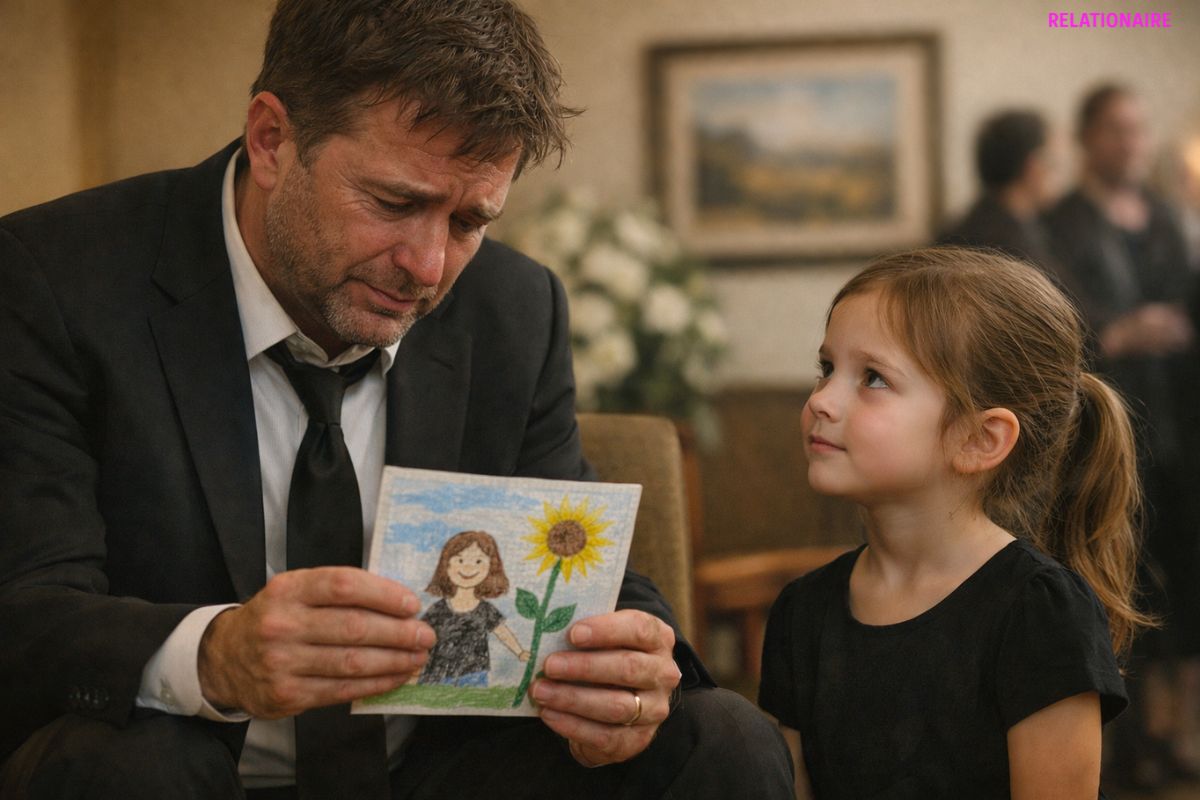
A woman with brown hair stood beside a sunflower taller than she was. The woman was smiling so wide the whole face curved with it. In one corner, Lucy had drawn a bright blue sky and a crooked little sun.
“Who’s that?” I asked.
Lucy set her hand over the page.
“For later.”
Then she went right back to her work.
I felt oddly chastened, like I’d opened a door without knocking.
In the chapel, people had started to gather for the service. Shoes clicked softly over carpet. A baby made one startled sound and was taken outside. Tissue packets crackled open like tiny fires.
When the minister began, the whole building seemed to hold its breath.
From the back, I watched Thomas Mercer in the front row. His sister sat beside him clutching a damp handkerchief. Marisol sat two rows behind, one arm around Lucy when the girl finally joined her, though Lucy wriggled free after a minute and folded her hands in her lap instead.
She didn’t squirm like most children do.
She watched.
That stayed with me.
She watched the casket. Watched the minister. Watched Thomas.
Not with fear. Not confusion.
With a kind of grave attention that made me uncomfortable, because children aren’t supposed to wear expressions like that. It was too old for her face.
The minister spoke about Evelyn’s kindness, her laugh, her casseroles, her church work, her patience with difficult children at school. People smiled softly through tears. A few chuckled.
Then he invited anyone who wished to share a memory.
That’s when the room went sideways.
Three people stood. Then four. Each told a story. Evelyn helping after a flood. Evelyn staying late with a student who had no ride. Evelyn bringing soup when someone’s husband was sick.
Thomas didn’t move.
He sat staring at his hands.
When it was nearly over, the minister looked toward him gently and said, “Tom, would you like to say anything?”
The question landed in the room like a dropped plate.
Thomas stood because people do that sometimes when all the blood has rushed out of them and they mistake motion for strength.
He turned toward the crowd. Opened his mouth.
Nothing came out.
Not one word.
His face changed so fast it made my own chest hurt.
He pressed his lips together, swallowed once, hard, and looked down like the floor might hold him up better than the people could.
Then, in a voice so scraped raw it barely sounded human, he said, “I can’t.”
No one moved.
He gave one small, strangled shake of his head. “I had one thing.”
The room got stiller.
“One story,” he said. “The one I was gonna tell. The one she loved. And now I—”
He stopped.
Put his fist against his mouth.
And sat down so suddenly his sister grabbed his elbow to steady him.
Nobody judged him for it. God knows not. But the grief in that room changed shape after that. It wasn’t just mourning anymore. It was helplessness. The awful knowledge that love can be huge and still fail you at the exact moment you need language most.
After the service, people clustered in low, whispering knots. Some went to the family room. Some to the hallway. Some out to the parking lot for air.
Thomas disappeared into the side lounge where we keep the softer chairs and the dimmer lamps for families who can’t bear the brightness just yet.
A few minutes later, I passed the waiting room again and saw Lucy crouched on the carpet, gathering her drawings into a neat stack. She pressed the clear tape carefully along the back of one page as if mending something precious.
“Your mama ready to go?” I asked.
She looked toward the lounge.
“Not yet.”
I followed her gaze. “That room’s just for family, sweetheart.”
“I know.”
There was no defiance in it. Just information.
Then she stood, smoothing the front of her black dress with her palm. She held one drawing against her chest.
Before I could say another word, Marisol came hurrying down the hall.
“Lucy,” she whispered sharply. “Stay here, baby. Don’t wander.”
Lucy looked up at her mother, then toward the lounge again.
“But he forgot it,” she said.
Marisol blinked. “Forgot what?”
“The sunflower story.”
I felt my skin prickle.
Marisol opened her mouth, probably to hush her, but Lucy was already moving past us, the drawing trembling only slightly in her hand.
I should have stopped her.
Instead I stood there, tape still on the chair beside me, and watched that seven-year-old girl walk straight toward the room where a grown man was breaking in half.
The door to the lounge was half-open.
Thomas was inside with his head bowed, both hands over his face.
Lucy reached the doorway, lifted the drawing, and said, very softly:
“It was the one where she laughed because the sunflower was taller than you.”
Thomas looked up.
And the entire room changed.
Part 2
For one second, nobody breathed.
Not me. Not Marisol behind me. Not Thomas Mercer, frozen in that chair with both hands still half-covering his face.
Lucy stood at the doorway holding out the drawing with the solemn patience children have when they know they are right and adults are still catching up.
Thomas stared at her.
Then at the paper.
Then back at her again.
His mouth opened, but nothing came out.
Marisol reached Lucy first. Her voice was low and embarrassed, the voice of a mother trying to gather up a moment before it spills too far.
“I am so sorry,” she said. “She’s been listening all day, and I told her—”
“No,” Thomas said.
Just that. No.
It stopped her.
He stood slowly, like every part of him had become heavier since morning. His eyes never left the drawing.
“Can I see that?” he asked Lucy.
She nodded and stepped forward.
It was just construction paper and crayon. A woman with Evelyn’s soft brown hair. A sunflower taller than her shoulder. A man beside her, drawn a little too stiff, his tie crooked, his height marked by a penciled line just below the flower head. And over all of it, that enormous smiling face Lucy had given Evelyn, like she was caught in the middle of a laugh.
Thomas took the paper in both hands.
His fingers shook so badly the page rattled.
“How did you know that?” he asked.
Lucy looked at him the way children do when they think the answer is plain.
“Because you tried to say it in church.”
The room went still all over again.
Thomas swallowed.
Lucy went on, quiet and clear. “You said it was the story she loved. And before that, in the hallway, the lady with the red coat said your wife used to make you take pictures by the flowers even when you didn’t want to.”
I remembered that now. I had heard the same conversation in passing. One woman laughing through tears, saying Evelyn had always planted sunflowers “because Tom hated how tall and ridiculous they got.”
But Lucy hadn’t just heard it.
She had kept it.
“And then,” Lucy said, “the man by the coffee said your wife laughed so hard one summer she almost fell in the dirt.”
Thomas made a sound then. Not quite a laugh. Not quite a sob. Something broken between the two.
“She did,” he whispered.
Lucy took one small step closer.
“So I think that was the story.”
Thomas closed his eyes.
When he opened them again, they were full.
Not the quiet wetness people hold in public when they’re trying not to disgrace themselves. Full. Overflowing. A grief too large to stay arranged.
He sat back down because his legs had no say in it anymore.
Marisol put a hand over her mouth.
I had seen a lot of things inside those walls. Fainting. Screaming. Anger. Relief. Old family wounds opening over flower arrangements and prayer cards and who did or didn’t come in time.
But that moment felt different.
Not because it was dramatic.
Because it was exact.
A child had stepped into a place where every adult had been tiptoeing around pain and had gone straight to the center of it with a crayon drawing and one simple sentence.
Thomas looked at Lucy again. “That was the story.”
Her face didn’t brighten with triumph. She didn’t smile the way some children would when praised. She only nodded, as if a puzzle piece had gone where it belonged.
“She grew them behind the garage,” he said, to no one and everyone. “Every year. Said they made the yard look brave.”
His voice trembled. He kept going anyway.
“One summer, one of them got so tall it passed the rain gutter. She dragged me outside to stand next to it because she thought it was the funniest thing she’d ever seen. I told her the neighbors were gonna think we’d lost our minds.”
Now he was crying openly.
“She laughed so hard she leaned into me and got dirt all over my shirt. I told her I wasn’t taking one more picture, and she said, ‘Tom Mercer, one day you’ll be glad I made you stand still for joy.’”
He pressed the heel of his hand to his eyes.
“She said that.”
Lucy listened without interrupting.
That was another thing about her. She wasn’t performing kindness. She was making room for it.
Thomas lowered his hand and looked at the drawing again. “I was supposed to tell them that.”
“You still can,” Lucy said.
No big speech. No child-sized wisdom polished for effect.
Just truth.
You still can.
From behind us, someone began crying harder. Thomas’s sister had come to the door and heard enough to understand.
Within minutes, half the family room had gathered in the hall, drawn there by that odd funeral-home gravity that happens when emotion finally breaks the surface and people feel it before they even know what it is.
Thomas stood again.
This time, he didn’t look like he was trying to survive the next breath. He looked like a man walking back toward something painful because someone smaller and braver had pointed to the path.
“Would you come with me?” he asked Lucy.
Marisol started to protest, then stopped. Lucy looked up at her mother. Marisol gave the smallest nod.
So Lucy took Thomas’s hand.
Her hand vanished inside his.
I followed at a distance as they walked back into the chapel.
People were still lingering in the pews, some rising to leave, some hugging, some gathering purses and coats and folded service programs. But the moment Thomas stepped back to the front, a hush moved through the room.
He didn’t go behind the lectern.
He stood beside the casket with Lucy next to him holding the drawing against her chest until he reached for it.
“I couldn’t say this before,” he said.
His voice shook. Nobody cared.
“My wife loved sunflowers. Loved them more than sense. Grew them so tall every summer they looked like they were trying to climb into heaven.”
A small, broken laugh ran through the room.
Thomas lifted the drawing a little.
“One year, one got taller than me, and she made me stand beside it for a picture. I complained the whole time. She laughed so hard she got dirt on both of us.”
His face crumpled, but he did not stop.
“And she told me… one day I’d be glad she made me stand still for joy.”
This time the room didn’t just listen.
It broke.
Hands covered mouths. Heads bowed. Shoulders shook. The minister cried without hiding it. Even the men who had spent the afternoon swallowing their grief like nails finally looked down and let it show on their faces.
Thomas turned toward Lucy then, in front of everyone.
“I don’t know how you knew what I couldn’t say.”
Lucy answered in the same calm voice she had used all day.
“Because everybody was saying how nice she was.”
He nodded, confused.
“And nobody was saying what made her laugh.”
That line passed through the room like wind through a field.
Nobody moved for a heartbeat.
Then a woman in the third pew whispered, “Oh, Lord.”
Because she was right.
All day they had honored Evelyn’s goodness. Her service. Her steadiness. Her casseroles and church work and patience and practical kindness.
All true.
But grief had polished her into something almost too careful. Something worthy, yes, but incomplete. As if death had already started sanding away the ordinary, living parts of her.
The laugh.
The dirt.
The teasing.
The sunflower taller than her husband.
The joy.
Thomas sank onto the front pew like his bones had gone loose.
And then people began, one by one, to speak.
Not formal eulogies this time. Real things.
“She used to sing in the car with the windows down even when it was cold.”
“She hid candy in her desk drawer for the kids who came to school sad.”
“She burned every batch of cornbread in the same corner and swore it was the pan.”
“She cried at dog food commercials.”
“She once made me pull over on the highway because she saw cows standing in snow and said they looked lonely.”
The room changed shape around those stories.
It warmed.
Not because grief lessened, but because love stopped standing at attention and sat down like itself.
Lucy listened to every one.
At some point she leaned against her mother’s side, finally looking like a seven-year-old who had been carrying a very long day.
Later, when most people had gone and the flower smell had started to turn heavy in the air, I found Marisol buttoning Lucy’s coat in the entry hall.
“I’m sorry if she overstepped,” Marisol said quietly. “Her father died when she was four. She listens when adults think she’s playing. Sometimes too much.”
I looked at Lucy.
She was staring at the drawing now tucked carefully under Thomas Mercer’s arm across the room as he thanked relatives with both eyes still red.
“She didn’t overstep,” I said.
Marisol gave a tired little nod, but there was something behind it. Something I almost missed.
“You know,” she said, “that wasn’t the first one she drew.”
I glanced down at the stack still tucked under Lucy’s arm.
“How many are there?”
Lucy answered before her mother could.
“Six.”
“Six?”
She nodded. “I had to get her smile right.”
Something in that nearly undid me.
I crouched a little so I was level with her. “Why was that so important?”
Lucy looked toward Thomas again.
Then she said, “Because when people are hurting, they forget the face they need.”
I had been in that business seventeen years.
I had dressed the dead. Guided the living. Folded coats over chairs. Straightened memorial cards. Spoken gently in hallways that seemed made of sorrow.
And standing there in that funeral home entry with wet umbrellas by the door and winter light fading blue through the glass, I realized that seven-year-old girl had understood something half the adults in that building had not.
But what she did next would stay with me even longer.
Because when Thomas started toward them, clutching that drawing like it was something breakable and holy, Lucy pulled one more page from her stack.
And on it, in careful block letters across the bottom of another sunflower, she had written words no one had yet seen.
Thomas reached them, looked down, and went completely still.
Part 3
Thomas Mercer took the second drawing in both hands and stared at it so long I thought maybe he hadn’t understood what he was seeing.
Then I saw his lips move.
He was reading.
The sunflower was bigger on this one, the petals crowded thick around a dark center. Evelyn stood beside it again, smiling that bright, open smile Lucy had worked so hard to get right.
And beneath the picture, in a child’s careful printing, were the words:
YOU CAN STILL TELL HER THINGS.
Thomas sat down right there in the funeral home entry.
Not because there was a chair.
Because there wasn’t.
He just folded, slowly, onto the wooden bench by the coat rack, the drawing in his hand and his face bent toward it like a man listening for instructions.
Marisol looked stricken. “Lucy, honey, that might be too—”
But Thomas lifted one hand without looking up.
“No,” he said.
His voice was shaking again, but softer now. Not split open. Open.
“No. It’s all right.”
Lucy stood in front of him with her coat half-buttoned and one sock slipping into her shoe.
“I know she died,” she said.
Nobody corrected her. Nobody hushed her. That was one mercy of the day. Once a child says the true thing plainly, adults usually lose the nerve to cover it back up.
“She can’t answer you with talking,” Lucy went on. “But you can still tell her things.”
Thomas looked up at her then, eyes red and dazed.
“My dad died,” she said, touching her own chest lightly with two fingers, as if she needed to make clear which part was hers. “I still tell him stuff when I miss him.”
The whole room seemed to lean in.
Not because she was loud. Because she wasn’t.
Because children say the most shattering things in the same tone they use to ask for apple juice.
“At night mostly,” Lucy said. “Or when I see something he would like. One time I told him when I lost my front tooth. And one time I told him I was mad because Mama cried in the laundry room and thought I didn’t know.”
Marisol shut her eyes.
Lucy glanced back at her mother and took one small breath.
“I think people can still love you after they die,” she said. “I think maybe they just have to be loved different.”
There are moments when no adult should speak.
That was one of them.
Thomas bent over then, elbows on knees, one hand covering his eyes and the other clutching that drawing so tightly I worried the paper would crease.
But he didn’t sob the way he had before.
He let out one long, ragged breath, like something locked inside his chest had finally found a door.
When he looked up again, he was looking at Lucy the way people look at a stranger who has somehow carried their pain with more care than their own friends knew how to.
“Do you talk to him out loud?” he asked.
“Sometimes.”
“And does it help?”
Lucy thought about it seriously. “Not right away.”
He gave a broken little laugh through the tears.
Then she added, “But it makes the missing less lonely.”
I had to turn away for a second after that. I’m not ashamed to say it. There are jobs where you learn how to stand inside other people’s worst days without making yourself the center of them. That does not mean you are made of wood.
Thomas nodded, slow and deep, as if he were agreeing to something larger than a sentence.
“Your father must have been very proud of you.”
Lucy considered that too, then said, “I hope so.”
Marisol knelt beside her daughter and fixed the loose coat button with trembling fingers. “He is,” she whispered.
Lucy leaned into her mother for just a moment. There it was at last. The child under the unusual steadiness. Tired. Tender. Needing warmth.
Thomas looked at Marisol. “Thank you for bringing her today.”
Marisol gave the kind of smile only exhausted people can manage. “I didn’t know she was bringing herself.”
That made him smile for real. Small, but real.
By then only family and a few close friends remained. The light outside had gone dim and amber, laying long shadows over the foyer tile. Someone had turned on the lamp by the guest book. Someone else was boxing up uneaten sandwich trays from the fellowship room down the hall.
Ordinary things were resuming around extraordinary grief.
That is always how it happens.
The world never pauses as long as the brokenhearted need it to.
Thomas looked down at the two drawings again. “Could I keep these?”
Lucy nodded. “That’s why I made them.”
He swallowed. “Both?”
“Yes. But the first one is for remembering her laugh.”
He looked at the second page.
“And this one?”
Lucy answered without hesitation.
“For later.”
He pressed his thumb to the corner of the paper and nodded like a man receiving instructions from someone he had no reason not to trust.
After a while, people began leaving in ones and twos. Coats on. Hugs exchanged. Promises made about casseroles, phone calls, checking in next week, meaning it now and not knowing whether they still would in three months when grief turned quieter and harder to witness.
Thomas stood near the door shaking hands. He had both drawings tucked inside the memorial folder from the service, careful as if carrying photographs from a fire.
Lucy was almost asleep on her mother’s shoulder by then.
As Marisol headed for the door, Thomas stepped in front of them.
“Wait,” he said gently.
He crouched so he was eye level with Lucy, though his knees clearly hated it.
“I want you to know something.”
Lucy blinked awake.
“I was afraid,” he said. “All morning. I was afraid if I started talking about her, she’d feel more gone. Isn’t that foolish?”
Lucy rubbed one eye with her fist. “No.”
He nodded, grateful even for that.
“But you were right,” he said. “Nobody was saying what made her laugh.”
Lucy rested her cheek on her mother’s shoulder. “Now they are.”
“Now they are,” he repeated.
He reached into his inside jacket pocket and pulled out a folded photograph, the edges worn from years of being moved around in wallets and drawers. He opened it carefully and held it where Lucy could see.
It was old and glossy. Sun-faded. Evelyn stood in a backyard beside a towering sunflower, one hand on her hip, laughing straight at the camera. And beside her, looking faintly irritated and very loved, was Thomas in a crooked tie.
Lucy smiled then. Not big. Just enough.
“I made it right,” she said.
“You did,” Thomas answered.
He looked at Marisol. “Would it be all right if I mailed her something?”
Marisol’s eyes filled. “That would be fine.”
A week passed.
Then another.
Funeral homes are strange that way. One family’s worst day ends, and by morning another family is stepping through the same front door carrying fresh shock. Work continues. Flowers arrive. Chairs are reset. Carpet is vacuumed. Grief never waits its turn.
I might have let the memory settle into that private shelf where I keep the moments that matter if Thomas Mercer hadn’t come back.
It was nearly closing time on a rainy Thursday when I saw his truck in the lot.
He walked in holding a long cardboard tube under one arm.
He looked different.
Not healed. Nothing so tidy. But less hollowed out. Like some small lamp had been lit inside a wrecked house.
“I thought you might want to see this,” he said.
Inside the tube was a photograph, enlarged and mounted.
The sunflower picture.
Evelyn laughing. Thomas trying not to. Summer caught forever in one ridiculous, ordinary, holy second.
At the bottom, in neat script, he’d had a line printed:
She made us stand still for joy.
“I’m hanging it in my kitchen,” he said. “Where I can talk to her stupid flowers every morning.”
I laughed before I could stop myself.
He smiled.
Then he handed me an envelope.
Inside was a copy of the photograph for Lucy.
And another sheet of paper, folded in half. On the front, in Thomas’s rough handwriting, it said:
For the little girl who remembered what grief forgets.
I asked if he wanted me to mail it.
He shook his head. “I brought sunflowers too.”
He had.
A whole bundle of them from the grocery store, awkward and bright and much too big for the weather. We put them in one of the spare vases from the arrangement room until Marisol and Lucy could come by after school.
When they arrived, Lucy walked in with her backpack still on and stopped cold at the sight of those flowers on my front desk.
“For me?”
Thomas stepped out of the hallway, suddenly shy.
“For you.”
She looked from him to the bouquet to the framed photo propped nearby.
He knelt again, slower this time.
“I told her things,” he said.
Lucy’s face grew very serious.
“And?”
He smiled, wet-eyed.
“It made the missing less lonely.”
She nodded like that was exactly what she had expected.
Then he gave her the envelope.
Inside was the photo and a note thanking her for helping him tell the story. At the very bottom he had added one more sentence:
I planted sunflowers again this spring.
Lucy traced the words with one finger.
“I think she’ll like that,” she said.
Thomas looked out through the rain-streaked glass toward the gray evening. “I think so too.”
Marisol put a hand on his arm. Not a grand gesture. Just human. Steady.
And Lucy, seven years old, small as ever in her oversized cardigan and muddy sneakers, carefully lifted one sunflower from the vase and held it like something living deserved to be held.
That’s the thing I think about now when people ask me whether children should be shielded from grief.
Not all grief can be explained to them. Not all rooms are meant for them.
But sometimes they are the only ones still honest enough to walk straight toward sorrow and ask what joy looked like before it was lost.
Sometimes they notice the face everyone forgot to remember.
Sometimes they know that love does not end when language does.
And sometimes, in a waiting room full of whispers and flowers and adults trying very hard not to fall apart, a little girl with broken crayons can hand a grieving man the exact memory that helps him go on.
Not because she fixed death.
Because she made room for love to sound like itself again.
And sometimes that is enough to carry the living one more day.