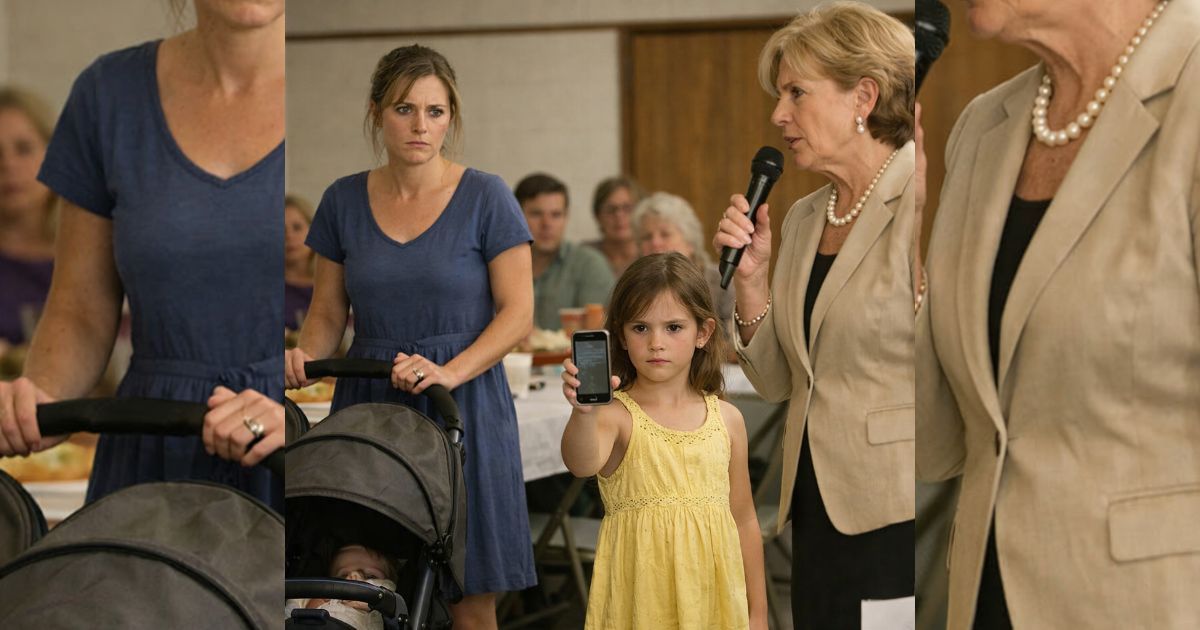
At my twin boys’ church dedication, my mother-in-law called me an unfit mother into the microphone—but before anyone could nod along, my seven-year-old daughter walked forward with an old phone and asked if they wanted to see what Grandma hid inside the baby bottles.
“Some women want the title of mother,” Beatrice said, her voice soft and polished and meant to sound holy, “but not the discipline of it.”
The room went still in that ugly way rooms do when people know they are witnessing something wrong and decide, for one long second, to enjoy it anyway.
I was standing three feet away from her with one twin on each side of me in matching cream outfits, my fingers trembling against the fabric of Beck’s blanket.
The fellowship hall behind the church was full.
Coffee urns in the corner.
A long table of casseroles and fruit trays nobody had touched yet.
Pink-cheeked relatives leaning forward in metal chairs.
Women from the congregation holding paper fans even though the air-conditioning was working just fine.
It was supposed to be a simple dedication luncheon.
A prayer.
A few pictures.
A cake with blue frosting.
A day to celebrate the boys we had waited years to have.
Instead, my mother-in-law had taken the microphone from Pastor John before he could bless the meal, straightened the pearl necklace at her throat, and turned my sons into props for the oldest performance in her life.
Her own righteousness.
“They are beautiful children,” she continued, lifting one manicured hand toward Finn and Beck like she was presenting them to the room. “And every beautiful child deserves peace, structure, and a home led by a steady hand.”
Behind me, somebody murmured, “That’s true.”
Another voice, lower and sharper, said, “She’s been overwhelmed since the twins came.”
I knew that voice.
Grant’s cousin Rhonda.
She had hugged me ten minutes earlier and told me my dress looked nice.
My husband stood beside me in a navy sport coat, his face blank in the way it had become blank more and more often over the last few months.
Not angry.
Not protective.
Not shocked enough.
Just still.
That stillness hurt worse than Beatrice’s voice.
Because Beatrice had disliked me from the day Grant brought me home.
Grant was the one who was supposed to know me.
Grant was the one who had watched me build bottles one-handed while helping our daughter with spelling words.
Grant was the one who had seen me fall asleep sitting up in the nursery chair and wake before either baby cried because my body had learned their breathing.
Grant was the one who knew.
And he was saying nothing.
Beatrice smiled the way women smile when they are not being kind, only neat.
“I tried,” she said, with a little shake of her head. “I tried to help. Tuesdays. Thursdays. Whole days sometimes. I stepped in because I love my grandsons. Because I love my son. Because when a young mother insists she can do everything while a house slips and babies cry and schedules vanish, someone has to be brave enough to tell the truth.”
Now there were more murmurs.
That was the thing about Beatrice.
She never shouted first.
She arranged.
She polished.
She laid each word down like silverware before a meal.
By the time people realized they were swallowing poison, they had already thanked her for serving it.
My mother and father had flown in from Seattle the night before and were sitting three rows back near the dessert table, too far away to hear every word but close enough to feel the shift in the room.
My mother, Winnie, had already half-risen from her chair.
My father’s jaw was locked so hard I could see the muscle jump from across the room.
But before either of them could get to me, I felt a small squeeze in my left hand.
Three quick presses.
Our code.
I love you.
Ellie stood beside me in a pale yellow dress with a ribbon she had tied herself because she no longer trusted anybody else to do it right.
She was seven.
Seven going on forty.
The kind of child who noticed when someone smiled with their mouth and not their eyes.
The kind of child who started watching adults the way some children watch storms.
I squeezed back.
She looked up at me once.
Then at Beatrice.
Then at Pastor John.
Then she let go of my hand.
At first I thought she was just moving closer to the boys.
Maybe checking on Beck, who had started making that restless humming sound he made when too many people were near him.
But Ellie did not turn toward the stroller.
She walked straight toward the front of the room.
Her little white shoes clicked against the church floor, and every single head turned toward her because a child walking with purpose has a way of stopping grown people cold.
Beatrice saw her coming and tried to keep speaking over it.
“Children need calm,” she said more loudly. “They need routine. They need—”
Ellie reached Pastor John, touched the sleeve of his black jacket, and lifted her face.
He bent down immediately.
He had baptized both boys six weeks earlier and still remembered which one kicked hardest when holy water touched his forehead.
He smiled at Ellie first.
Then he heard what she whispered.
I knew the exact second his expression changed.
He went from gentle confusion to stunned stillness so quickly it felt like somebody had cut the power in the room.
“Pastor John,” Ellie said, no longer whispering, her voice clear and bright in the microphone Beatrice had not yet fully stepped away from, “should I tell everyone what Grandma put inside the baby bottles?”
The room did not just go quiet.
It tightened.
Like every person inside it had drawn breath at the same moment and forgotten how to let it out.
Beatrice’s hand froze on the microphone stand.
Grant turned so fast the metal legs of his chair scraped hard against the floor.
My own heartbeat thudded in my throat.
I could not even process the sentence at first.
Inside the baby bottles.
Not in them.
Inside them.
Something old and cold slid through me.
Pastor John straightened.
“Ellie,” he said carefully, “what do you mean, sweetheart?”
Ellie did not look scared.
That was the part I still think about sometimes.
Not because she was fearless.
Because she had been carrying this too long.
“Grandma rolled papers up and pushed them into the clean bottles in the pantry,” she said. “She said that was the safest place because Mommy only checked the bottles in the sink and Daddy never looked in the organized cabinet.”
A sound came out of somebody in the back row.
Not a word.
Just a soft shocked noise.
Beatrice recovered first, of course.
She always did.
“Oh, for heaven’s sake,” she said, giving a tiny laugh and turning to the crowd like this was all a misunderstanding children sometimes invented. “You know how kids imagine things.”
“I took pictures,” Ellie said.
And then, with the calm of a much older person, she opened the little purse hanging across her chest and pulled out my old phone.
The one I had given her months ago to play word games on long drives.
The one I had forgotten had a camera.
The one I had certainly never checked, because seven-year-olds do not usually collect evidence against grandmothers.
Grant took one step forward.
“Ellie,” he said, too quickly, “baby, maybe let me see that first.”
“No,” Ellie said.
It was not loud.
It was not disrespectful.
It was final.
And that word, from a seven-year-old in the middle of a church hall full of adults who had already decided I was unstable, landed like a bell.
“No,” she repeated. “Because you always let Grandma explain first.”
Nobody moved.
Pastor John held out his hand.
Ellie gave him the phone.
He looked down.
His mouth parted.
Then he lifted his eyes slowly to Beatrice.
“What is this?” he asked.
Beatrice’s face held for one brave second.
Then two.
By the third, I saw it crack.
Not with guilt.
With fury.
I started walking.
I do not remember deciding to.
I only remember the sound of blood in my ears and the sight of my daughter standing beneath that microphone with her small shoulders squared like she had decided that if the adults were going to fail her mother, she would not.
By the time I reached the front, Pastor John had turned the phone toward me.
The first photo showed my kitchen.
Sunlight through the over-sink window.
Bottle rack on the counter.
Beatrice in her cream cardigan, back half-turned, rolling a strip of paper tight as a straw and sliding it into a clean baby bottle.
The second photo showed two more bottles on the counter with rolled notes already inside.
The third showed Beatrice opening Grant’s black work tote, the one he carried on regional trips, and pulling out address labels and a small portable label maker he used for sales displays.
The fourth showed a legal pad on my kitchen counter in Beatrice’s handwriting.
Not shopping lists.
Not feeding notes.
Accusations.
Cora left Beck crying 22 minutes while working.
Laundry piled in hallway again.
Bottle left out.
Nursery smelled sour.
Household unstable.
My knees weakened so fast I had to grab the edge of the table behind me.
Ellie reached back without looking and found my hand.
The room began to stir.
Whispers now.
Real ones.
Not the pleased little whispers from earlier.
These had edges.
“These are fake,” Beatrice snapped. “She does not understand what she saw.”
“There are more,” Ellie said.
And before anyone could stop her, she took the phone back, tapped the screen herself, and held it toward Pastor John again.
A video this time.
No sound at first.
Just Beatrice standing in my laundry room on one of the Tuesdays she had “helped,” moving folded towels from a basket onto the floor.
Then opening the nursery door and setting an open burp cloth on the crib rail.
Then walking into the kitchen and lining three used-looking bottles in the sink.
Then lifting her phone and taking photos.
My breath left me in one long, shaking pull.
She had not been finding messes.
She had been making them.
Grant stared at the screen like it was speaking a language he had refused to learn and suddenly understood perfectly.
Rhonda was no longer looking at me.
She was looking very carefully at her own lap.
My mother was already moving down the aisle between chairs.
My father was right behind her.
Beatrice drew herself up.
“If I arranged a few things for photographs,” she said, her voice sharpening, “it was because nobody ever believed me when I described the chaos in that house.”
The whole room changed on that sentence.
Because that sentence was not a denial.
It was a correction.
A proud one.
I felt my fingers lock around Ellie’s hand.
“What photographs?” I asked.
My voice came out rougher than I expected, almost unrecognizable.
Beatrice turned to me slowly.
The false softness was gone.
Not all the way.
But enough.
“The photographs I had to take,” she said, “because my son needed to understand the environment his children were in.”
Grant flinched.
I looked at him then.
Really looked.
And I saw it.
Not knowledge.
Not full knowledge.
But enough knowledge to make my stomach drop.
He had seen something.
Maybe not everything.
Maybe not the bottles.
Maybe not the staged laundry.
But enough.
“Grant,” I said.
Only his name.
That was all I had.
He swallowed.
“I got emails,” he said quietly.
The room was so silent that the hum of the drink cooler in the corner sounded loud as traffic.
“What emails?” I asked.
He still was not looking at me.
“Anonymous ones. Over the last month. With pictures. Notes. Concerns.”
“Concerns from who?” my mother shot back, arriving at my side at last.
Grant finally lifted his head.
“I thought…” He stopped and tried again. “I thought maybe someone from church. Or a neighbor. They said they were worried about how exhausted Cora looked. About the boys. About Ellie doing too much. About the house.”
He was still speaking to the room.
Not to me.
That hurt almost more than the words.
“You got anonymous attacks on your wife,” my father said, each word flat and controlled, “and you did not think to show her?”
Grant rubbed one hand over his mouth.
“Mom said bringing it up would only upset her more.”
There it was.
There she was.
Even inside his answer.
Beatrice gave a little exhale that might have been relief or annoyance that he had been so clumsy.
“I was trying to protect everyone,” she said.
Ellie, still standing straight as a line, opened her purse again.
“I brought one,” she said.
This time she took out a folded strip of paper.
Not wide.
Not even big.
Just a tight little roll held by a rubber band.
“I stole it from the bottle cabinet because Grandma said Mommy never checked there,” she said. “I wanted to know why she kept hiding papers.”
Pastor John took the strip.
He unfolded it slowly.
I watched his face.
Then he handed it to me.
It was a typed note.
A neat block of sentences.
No signature.
No date.
Just poison.
The mother is losing control.
The husband travels and does not know the half of it.
The older child is already being used as a helper because the home is unstable.
Someone should step in before those boys pay the price for their mother’s pride.
I read it twice.
Then a third time.
Not because I needed to understand it.
Because part of me still could not believe anybody had written it about me while eating at my table and kissing my babies’ heads and calling herself family.
The first time I met Beatrice Harlow, she walked straight past me in Grant’s apartment and asked him, not me, whether I was staying long.
That was eight years ago.
I remember because I was holding a pie from a little bakery in Grandview and wearing a new sweater I could barely afford because Grant had said his mother liked things “put together.”
I was twenty-seven.
Working freelance.
Hopeful in that deep and embarrassing way only good people and fools can be hopeful.
Grant had kissed my cheek before opening the door and whispered, “She can be particular. Don’t take it personally.”
That should have warned me.
Not that his mother was difficult.
That he had already built his life around making excuses for her.
Beatrice stood in the middle of his apartment like she had arranged every chair herself.
Perfect blonde bob.
Cream slacks.
Slim watch.
A woman who looked like she kept spare judgments in her handbag the way other women kept lipstick.
Her eyes landed on the pie.
Then on me.
Then on Grant.
“Store-bought?” she asked.
I said, “Technically from a bakery, so yes.”
Grant laughed because he thought wit could smooth anything.
Beatrice did not.
She smiled.
Not warmly.
Just with professional courtesy, the way a bank manager might smile before denying a loan.
“Well,” she said, “it’s always nice when young women try.”
I knew, right then, that life with Grant would not simply mean life with Grant.
It would mean life with a witness.
A judge.
A second woman at every table, even when she was not there.
But I loved him.
And to love someone deeply is sometimes to volunteer for a long season of explaining yourself.
Grant was easy in the ways Beatrice was not.
He laughed with his whole face.
He remembered little things.
The exact tea I liked when I was sick.
That I hated touching raw chicken.
That I always cried at end-of-year school concerts, even before we had children of our own.
He sold equipment and promotional materials for a regional health supplier and spent half his life on the road between Columbus, Cincinnati, Lexington, and small towns in between.
He would come home tired, loosen his tie at the door, and scoop me up like I weighed nothing.
Back then, I thought a man who came home that way would always come home to me.
Not drift.
Not shrink.
Not hand me over, piece by piece, to his mother’s version of reality.
When Ellie was born, Beatrice arrived at the hospital wearing a pastel suit and the expression of someone attending a ribbon-cutting she had personally funded.
“She has Grant’s eyes,” she said, leaning over the bassinet.
Then she turned to me and added, “Let’s hope she gets her discipline from our side.”
I laughed because I thought maybe she was joking.
She was not.
That was the pattern with Beatrice.
She said cruel things softly and relied on your own politeness to make you question whether you had heard them right.
When Ellie turned four, she could already tell when Grandma’s compliments came with hooks in them.
When the twins came, those hooks got sharper.
Their names were Finn and Beck.
Finnegan James and Beckham Lee on paper, though nobody in the house ever called them anything but Finn and Beck.
By the time they were born, I had spent five years trying to get pregnant again.
Five years of negative tests in bathroom trash cans I emptied before anybody else could see them.
Five years of smiling through baby showers for friends.
Five years of Beatrice saying things like, “Ellie needs siblings,” or, “Some women don’t realize how quickly time moves.”
Five years of Grant kissing my forehead and saying, “Ignore her,” while never once telling his mother to stop.
When the nurse placed both boys on my chest in the hospital, all pink cheeks and wrinkled foreheads and warm weight, I cried so hard I shook.
Grant cried too.
He looked at me and said, “We did it, Cor.”
For one bright, stupid, beautiful hour, I thought everything had changed.
I thought maybe the twins had arrived like mercy.
Like proof that long waiting ends and tired marriages bloom again and old women soften when handed miracles in matching blankets.
Then Beatrice visited on day two and asked the nurse whether my feeding plan was “realistic for someone with her temperament.”
I should have known then that miracles do not melt people who are devoted to control.
They only give them more to control.
Our house in suburban Columbus was not fancy, but it was ours.
Two stories.
White shutters.
A swing set out back from Ellie’s fifth birthday.
A kitchen with not quite enough cabinet space and a breakfast nook where morning light always landed first.
I painted the nursery myself while I was pregnant.
Soft blue on the walls.
Cloud stencils on the ceiling.
One of those tiny acts women do when they are trying to paint hope over years of disappointment.
After the boys were born, life became loud and beautiful and tired all at once.
I worked from home doing design projects for small businesses and local nonprofits.
Nothing glamorous.
Logos.
Seasonal flyers.
Social media graphics for garden shops and tutoring centers and one very sweet woman who sold homemade candles at weekend markets.
My laptop lived open on the kitchen table between burp cloths and grocery lists.
I learned how to answer emails while rocking a bassinet with my foot.
How to heat a bottle and help Ellie sound out spelling words without burning toast.
How to tell which twin was fussing just by the shape of the cry.
I was tired, yes.
But not failing.
That part matters.
I was not drowning.
I was swimming hard in a full life.
And I knew the difference.
Tuesdays and Thursdays were the days Grant traveled furthest.
Those were also the days Beatrice decided I needed “support.”
She announced it, not asked.
“You cannot possibly manage three children and a freelance business alone,” she said the second week we were home. “When Grant is away, I’ll come.”
I said, “That’s generous, but I’ve got a rhythm.”
She looked around the room like a housing inspector.
“A rhythm is not the same thing as a system.”
Grant, already knotting his tie in the hallway mirror, said, “Mom’s right, honey. Let her help on the road days.”
I remember the feeling that slid through me then.
Small.
Embarrassing.
Like my own household had been decided by people who did not live in it.
The first Tuesday she came, she let herself in with the spare key Grant had given her without asking me.
I found her in the kitchen moving bottles from one cabinet to another.
“These belong up here,” she said. “You had everything scattered.”
“It wasn’t scattered,” I said. “It was where I could reach it one-handed.”
She closed the cabinet with that neat little click that always meant she was done discussing something.
“Reach is not the same as order, dear.”
By the second week, she was refolding baby blankets I had already folded.
By the third, she was checking the temperature of bottles after I had already checked them.
By the fourth, she was giving me tips on how long babies should cry before being picked up.
“Every sound doesn’t require a rescue,” she’d say, standing in the nursery doorway while I lifted Beck from his bassinet.
“This isn’t rescuing,” I’d answer. “It’s parenting.”
She would smile that little non-smile.
“Those two things are not always the same.”
Ellie saw all of it.
Children always do.
They may not know the adult words for contempt or manipulation or erosion.
But they know what it feels like when the air in a room changes every time one person walks in.
She started asking to stay home from school on Tuesdays and Thursdays.
At first it was stomachaches.
Then headaches.
Then vague little half-truths.
“I just want to help with the babies.”
One night while I was brushing her hair before bed, she looked at me through the mirror and asked, “Why does Grandma talk to you like you’re in trouble all the time?”
I kept brushing.
Because what was I supposed to say?
Because your grandmother is the kind of woman who mistakes control for love?
Because your father still folds himself into the shape she expects when she enters a room?
Because sometimes grown women bully other women in cardigans and pearls and call it concern?
I said, “Grandma has strong opinions.”
Ellie made a face.
“That’s not what it feels like.”
I set the brush down.
“What does it feel like?”
She thought for a moment.
“Like she’s always trying to catch you being wrong.”
That was the exact feeling.
So exact it scared me.
As summer settled in, little strange things began to happen.
Nothing dramatic enough to name.
That was part of what made it so effective.
A bottle I knew I had washed showed up crusted in the sink right before Grant got home.
A basket of folded laundry somehow ended up half-spilled in the hallway after Beatrice had spent twenty minutes “helping” upstairs.
A burp cloth I had just changed would be back on the nursery chair when Grant walked through the door.
A formula scoop left uncapped.
A diaper pail left open.
Each time, Beatrice would say almost nothing.
Just enough.
“I cleaned up what I could before Grant got home.”
Or, “I know you’re trying.”
Or, “Twins expose weak systems very quickly.”
She never had to say more because she had already planted the impression she wanted.
I began defending myself before anybody accused me.
That is when you know someone has started living inside your nerves.
Grant changed slowly.
That may have been the worst part.
If he had become cruel overnight, I would have noticed the border.
Instead he became uncertain.
Then watchful.
Then administrative.
“Mom says the boys need a stricter nap routine.”
“Mom thinks the kitchen would function better if the feeding station were labeled.”
“Mom mentioned Ellie seems to hover too much when you’re busy.”
I’d say, “Why are these all coming from your mother?”
And he’d say, “I’m just passing on ideas.”
But ideas repeated often enough stop sounding like ideas.
They start sounding like verdicts.
The first anonymous email arrived on a Thursday afternoon while Grant was in Lexington.
I only knew about it because I saw the notification pop up on his tablet later that night while he showered.
The subject line read: For the sake of the children.
I should not have opened it.
I know that.
But marriage makes people reach across lines they would never cross anywhere else, especially when the ground under them has already started to tilt.
Inside was a message from a throwaway account.
No name.
No signature.
Just concern.
Concern about a tired mother trying to do too much.
Concern about babies kept in a noisy, disorganized home.
Concern about an older child acting more like a helper than a little girl.
At the bottom were two attached photos.
My kitchen.
My hallway.
Messier than usual.
Enough to sting me.
Not enough to look dangerous.
But enough to build a story.
When Grant came out of the shower, I was sitting on the edge of the bed with the tablet in my lap.
“What is this?” I asked.
He froze.
Then, instead of looking outraged on my behalf, he looked tired.
That told me everything.
“There have been a few,” he admitted.
“A few what?”
“Emails.”
“To you?”
He nodded.
“About me?”
He did not answer.
He did not have to.
I remember standing then because sitting felt too weak.
“How long?”
“Three weeks.”
Three weeks.
Three weeks of my husband getting anonymous attacks on my mothering and never once showing me.
“Why?” I asked.
His answer came too fast.
“I didn’t want to stress you out.”
No.
That was not it.
I knew it the way women know when a glass is about to slip before it falls.
“You believed them,” I said.
He shook his head halfway.
Not yes.
Not no.
The most dangerous answer in a marriage.
“I thought maybe there was some truth mixed in,” he said quietly. “You have been overwhelmed, Cora.”
I laughed then.
A terrible laugh.
The kind that hurts on the way out.
“I am taking care of three children, working from home, and hosting your mother twice a week while she rearranges my life. What part of that would not look overwhelming?”
He rubbed the back of his neck.
“Mom’s been worried too.”
“There it is again,” I said.
He looked at me blankly.
“Your mother,” I said. “Always your mother between us. Always translating me. Evaluating me. Reporting on me.”
“You’re making this bigger than it is.”
I stared at him.
There are sentences a marriage can survive.
That was not one of them.
The next Tuesday, I watched Beatrice more carefully.
Or I tried to.
But watching Beatrice was like trying to catch a thief who only stole in broad daylight while smiling.
She arrived with muffins and hand sanitizer and three new opinions before setting down her purse.
She kissed the boys.
Complimented Ellie’s dress.
Asked whether I had finally organized the feeding station “properly.”
Then she floated through my house like she had partial ownership.
That afternoon, while I was upstairs putting Beck down after a long feed, Ellie came to the nursery door and stood there with her eyes too wide.
“Mommy,” she whispered. “Grandma’s doing something weird.”
I followed her to the kitchen.
Nobody there.
Just sunlight.
A clean counter.
The hum of the fridge.
“What weird thing?” I asked.
Ellie pointed toward the pantry cabinet where I kept the extra sterilized bottles, still lined up in rows from the previous week.
“She was putting tiny papers in the bottles,” Ellie said. “Rolled up.”
I laughed automatically.
Not because it was funny.
Because adult brains are trained to reject strange truths when easier explanations are available.
“She was probably saving labels or coupons or something.”
Ellie didn’t laugh with me.
“She said it was safer than drawers.”
My skin went cold.
I opened the cabinet.
At first, everything looked normal.
Bottles in rows.
Caps on.
Nipples in a separate bin.
Then I lifted one of the back bottles.
Something rattled softly inside.
Not formula.
Not water.
Paper.
I unscrewed the cap.
Tipped the bottle upside down.
A tightly rolled strip slid into my palm.
For one second the whole kitchen seemed to tilt.
Then I heard footsteps in the hall.
I shoved the paper into my pocket before Beatrice rounded the corner carrying a folded blanket.
“What are you doing?” she asked.
“Looking for the wide-neck bottles,” I said.
She smiled.
“Top shelf.”
I kept my face still.
I do not know how.
That night, after she left and after the boys were asleep and after Grant was back from the road, I locked myself in the bathroom and unrolled the paper.
It was another typed note.
Shorter than the email.
More pointed.
The mother is defensive when corrected.
Home appears clean only in parts.
The husband needs to see the full picture before the children’s habits are ruined.
I sat on the edge of the tub with that strip of paper in my hand and felt something inside me harden.
Not rage yet.
Clarity.
The next morning I checked every bottle in the pantry.
Six contained rolled notes.
Six.
I laid them out on my desk like evidence from a life I had not agreed to live.
Some were typed.
Some handwritten.
Some were drafts of anonymous messages.
Some were observations twisted into lies.
Ellie folds laundry while mother works.
Older child reheats her own food.
Bottles not sanitized correctly.
Babies picked up too often.
Household lacks discipline.
There were dates.
Times.
Little check marks.
Like Beatrice was not just criticizing me.
Like she was building a case.
Against what, exactly, I did not yet know.
When I showed Grant that evening, he stared at the notes for a long time.
Then he said the one thing I should have heard as the end of something.
“Maybe she really thought she was helping.”
I looked at him.
At the notes.
At the marriage I had spent years patching around his silences.
“She hid accusations against me in baby bottles,” I said. “In our kitchen. In our home.”
He pressed his hands together like he was in a business meeting that had gone off course.
“She shouldn’t have done that.”
Shouldn’t have.
Not crazy.
Not evil.
Not outrageous.
Just shouldn’t have.
Like using the wrong salad fork.
“Grant,” I said softly, because I was suddenly more tired than angry, “do you hear yourself?”
He sat down hard in a kitchen chair.
“She’s worried, Cora.”
“No,” I said. “She is campaigning.”
He did not answer.
And that silence, again, told me more than any confession could have.
The next week the campaign widened.
Pastor John called and asked if he could “check in.”
Two women from church suddenly dropped off casseroles with the careful faces people wear when they are pretending not to assess your counters.
Grant’s aunt called to ask whether I was “taking enough time for myself.”
An older man from church, a retired counselor with kind eyes and terrible timing, gently suggested that “new mothers of multiples sometimes need more support than they realize.”
I understood then.
The anonymous notes were not just for Grant.
Beatrice was spreading a version of me.
Not loud enough to look vicious.
Just enough to travel.
And in rooms full of polite people, concern can destroy a woman faster than outright cruelty.
Ellie started writing things down.
At first I thought it was schoolwork.
Her teacher always gave little summer prompts and reading logs.
Then one evening I passed her room and saw her cross-legged on the floor, writing furiously in the pink journal my mother had mailed her for her birthday.
“What are you writing?” I asked.
She looked up.
“Stuff I don’t want to forget.”
“Like what?”
She hesitated.
Then she said, “What people really say when they think nobody important is listening.”
That sentence sat between us.
Too old for her age.
Too clear.
I knelt beside her.
“You don’t have to carry grown-up things, baby.”
She looked down at the journal.
“I know,” she said. “But the grown-ups are doing a bad job.”
There are moments when motherhood is not soft.
Not rocking chairs and lullabies and lunchbox notes.
Sometimes it is hearing your child say the truest thing in the house and realizing she said it because you left her in a house where truth had to defend itself.
A few days later, I found the first video.
I was helping Ellie sort crayons at the kitchen table when she said, casually, “I got the part where Grandma made the sink messy too.”
I turned so fast my chair scraped.
“What?”
She shrugged like she was telling me she had finished a math sheet.
“On the phone. Because I knew you’d say nobody would believe me if I just said it.”
Nobody would believe me.
Not you won’t believe me.
Nobody.
She had already learned the grammar of disbelief.
She showed me the video after dinner that night.
Beatrice in the laundry room.
Beatrice moving towels.
Beatrice setting out bottles.
Beatrice stepping back and taking pictures.
All quiet.
All purposeful.
No panic.
No confusion.
Not a grandmother stumbling while helping.
A woman staging evidence.
I copied everything from Ellie’s phone to my laptop and a flash drive and emailed it to myself and my father and, after five full minutes of staring at the screen, to Grant.
He came into my office ten minutes later with his laptop open and the expression of a man who had finally run out of places to look away.
“Why didn’t you show me this first?” he asked.
I laughed in disbelief.
“I just sent it to you.”
He shook his head.
“No. Why didn’t you tell me Ellie was seeing all this? Why didn’t you tell me it had gotten this bad?”
I stood up so suddenly my desk chair rolled back into the wall.
“Because every single time I told you your mother was undermining me, you translated it into stress. Or hormones. Or concern. Or help.”
He opened his mouth.
Closed it.
Then said, “What do you want me to do?”
That question broke something open in me.
Because it came years too late.
“I wanted you to choose your family before your daughter started collecting evidence,” I said.
He sat down like I had struck him.
I did not feel sorry.
Not then.
Not when Ellie was in the next room feeding Beck his bottle and humming to him softly because she had become gentler than the adults around her.
The dedication luncheon was supposed to be a reset.
That was Pastor John’s word.
Reset.
He had gently suggested that after rumors started circulating, maybe the family needed a day rooted in faith and gratitude, not whispering.
He meant well.
Men like Pastor John often do.
They just underestimate the appetite some families have for public humiliation.
The twins had missed their original dedication date because Beck came down with a mild cold and I refused to bring him around a crowd just to satisfy Beatrice’s calendar.
She had acted like I had canceled a state ceremony.
So when Pastor John suggested a small post-service gathering two Sundays later, I said yes mostly because I wanted one clean day for my boys.
One day where they were not being measured.
Not compared.
Not used.
I wore a blue dress Ellie picked out.
Grant wore a sport coat.
The boys wore matching cream rompers from my mother.
Ellie wore the yellow dress because she said blue should belong to the babies.
For an hour that morning, things felt almost normal.
Pastor John dedicated the boys in front of the congregation.
Finn sneezed right as John lifted his hand to pray, and half the church laughed.
Beck clung to my finger through the whole prayer.
Ellie stood tall beside us and took the job of big sister so seriously that two ladies from the second pew smiled at her like she was the picture on a greeting card.
Then we moved to the fellowship hall.
Then Beatrice stood.
Then the room became a courtroom.
And then Ellie became the only honest witness in it.
Back at the front of the church hall, nobody was pretending anymore.
The casserole dishes sat untouched.
Somebody’s coffee had gone cold in a paper cup on the windowsill.
A baby somewhere in the back of the room let out one startled cry and was quickly shushed.
Beatrice looked from me to Grant to Pastor John like she was calculating which person was most likely to crack first.
She chose outrage.
“Those videos prove nothing,” she said sharply. “A grandmother cannot even tidy without being turned into a villain now? Is that where we are?”
“No,” I said, and even I heard how different my voice sounded now. “We’re at the part where you explain why you hid anonymous accusations about me inside my children’s bottles.”
She turned to the room.
That was always her instinct.
Not truth.
Audience.
“I was documenting concerns,” she said. “Because somebody had to.”
“Concerns?” my mother said. “You created the messes in those pictures.”
Beatrice drew in a breath and straightened her shoulders.
“Yes,” she said, shocking half the room. “Because the disorder was constant, and I needed my son to understand the pattern.”
It was almost impressive, the way she stepped over her own exposure and tried to turn it into duty.
She had spent so many years dressing control up as care that she thought she could do it one more time.
Ellie tugged my hand once.
When I looked down, she whispered, “Tell them about the clock.”
I blinked.
“What clock?”
Ellie looked annoyed that I had missed something.
“She changed the oven time before pictures,” she said, still whispering. “To make it look later.”
Pastor John heard.
“So the photos looked like the babies had been left unattended longer,” he said quietly.
Ellie nodded.
Beatrice’s eyes flashed.
For the first time that day, I saw something like panic move across her face and not leave right away.
Grant looked at Ellie.
Then at me.
Then back at Ellie.
“Is that true?” he asked.
Ellie met his eyes for one long second.
“You always ask me that after Grandma talks,” she said.
I watched those words land in him.
Watched them reach a place my anger never had.
Because grown men can dismiss wives.
It is much harder to dismiss daughters who have not yet learned how to lie politely.
Pastor John asked gently, “Ellie, sweetheart, do you have anything else on that phone?”
She nodded.
“A voice one.”
When she played it, the whole room leaned in without meaning to.
You could hear cabinet doors.
Then Beatrice’s voice.
Crisp.
Low.
Not meant for me.
“Your mommy confuses love with indulgence,” she was saying. “That’s why she’s tired all the time. Some women want children, but they don’t have the backbone to raise them. Your daddy deserves peace. One day you’ll understand that.”
Then Ellie’s tiny voice, from farther away.
“Are you sending Daddy more pictures?”
A pause.
Then Beatrice again.
“Good grandmothers do what weak mothers won’t.”
The recording ended.
I do not know who in that room said, “My Lord.”
But somebody did.
Grant sat down suddenly like his knees had gone.
My father stepped in front of me instinctively, not because Beatrice moved toward us, but because fathers know when a room has become unsafe in a different way.
Not violent.
Just stripped.
The masks all off.
Rhonda, who had nodded along to Beatrice ten minutes earlier, now looked sick.
Grant’s sister Melanie was crying silently into a napkin.
Uncle Ray kept rubbing the back of his neck and saying, “I didn’t know. I swear I didn’t know.”
Beatrice looked around the room and saw, at last, that it was gone.
Her control.
Her moral height.
The easy gravity she had enjoyed for years.
Once a room stops trusting a person like Beatrice, they fall fast.
So she did what people like her always do when exposure finally cracks them open.
She blamed the nearest woman.
Me.
“If your house had actually been peaceful,” she snapped, looking right at me now, “there would have been nothing to photograph.”
The air changed again.
Not because anybody believed her.
Because now they could see the engine under everything.
Not concern.
Not faith.
Not family values.
Contempt.
Pure, patient contempt.
I stepped forward.
Closer than Grant had ever let me stand in conflict with her before.
For years I had swallowed responses to keep holidays calm, to keep my marriage functioning, to keep Ellie from seeing a war.
But Ellie had seen it anyway.
And worse.
She had seen me surrender ground inside my own life.
“No,” I said. “If my husband had defended me the first time you insulted me in my own kitchen, if my daughter had not needed to guard my dignity better than the adults in this family, if everybody in this room had been less interested in your polished concern and more interested in the truth, then maybe we would not be standing here.”
Nobody interrupted.
Not even Beatrice.
Because sometimes a room finally senses which voice has earned its silence.
I turned to Grant.
This was the part I had dreaded without knowing I was dreading it.
Not Beatrice exposed.
Grant visible.
“What exactly did you know?” I asked.
He looked wrecked.
Really wrecked.
Not theatrically.
Not gracefully.
Just broken open and late.
“I knew she’d been sending me emails,” he said. “I knew she said she’d started documenting things because she was worried. I told her to stop the emails last week. She said she would.”
He looked at the phone in Ellie’s hand and then at the floor.
“I didn’t know she staged anything. I didn’t know about the notes. I didn’t know Ellie was seeing all of it.”
I listened.
I believed him, mostly.
And somehow that did not comfort me at all.
Because ignorance built on chosen blindness still leaves damage.
“You should have known enough,” I said.
His eyes closed.
Pastor John stepped in then, because pastors are often called to do cleanup after families turn sanctuaries into battlegrounds.
“I think the luncheon is over,” he said softly but firmly. “I’m going to ask everyone except immediate family to head home.”
People moved slowly.
Ashamed people always do.
They gathered purses and casserole dishes and dessert pans like objects could give them something useful to do with their hands.
Nobody met my eyes for long.
A few tried.
A few whispered apologies that were mostly about their own discomfort.
Rhonda stopped in front of me, tears sitting in her lower lashes.
“I’m sorry,” she said. “I really thought—”
“I know,” I said.
That was all I had for her.
Because the sentence I really wanted to say was: that was the whole problem.
You thought.
You never asked.
Within ten minutes the fellowship hall had emptied of everyone except me, Grant, Ellie, the boys, my parents, Pastor John, and Beatrice.
She stood near the coffee station like a queen after a coup, furious and disbelieving that anybody had dared touch her crown.
My mother crossed her arms.
“You are not going back to her house,” she said flatly.
Beatrice laughed once.
“Her house? My son pays that mortgage.”
It was such a small sentence.
Such a common one.
And yet it revealed everything.
Grant lifted his head.
“Mom.”
It was the strongest his voice had sounded all day.
“This ends now.”
She turned to him, stunned more by the tone than the words.
“You’re upset,” she said. “Naturally. But when you calm down—”
“No,” he said.
And because he almost never interrupted her, the word had weight.
“It ends now.”
She stared.
Then her face sharpened into something brittle and ugly.
“So this is because of her?” she asked, pointing at me without quite touching the air in my direction. “Because she finally got you isolated enough to turn you against your own mother?”
My father actually laughed at that.
A hard, humorless sound.
“Lady,” he said, “the only person who isolated anyone is you.”
Pastor John asked me quietly whether I wanted him to call someone from church leadership to witness what had happened.
I said yes.
Not because I still cared what church leadership thought.
Because I was done letting anything happen without witnesses.
That afternoon, while my mother stayed with the boys and Ellie at the house, my father drove me, Grant, and Pastor John back to the church office where we printed every email Grant had received.
Six in total.
Different addresses.
Different names.
All written in the same controlled tone.
All attached to photos I now knew Beatrice had staged.
Pastor John called a friend who worked in IT for the church and knew enough to trace basic account recovery information.
Nothing dramatic.
Nothing cinematic.
Just adult, boring, humiliating truth.
Every recovery email pointed back to the same secondary address.
An address using Beatrice’s initials and birth year.
Not even hidden well.
Because people like Beatrice do not really think they will be caught.
They think they will be protected by the sheer force of the identity they have built.
Church donor.
Elegant hostess.
Widow.
Grandmother.
The kind of woman people call “strong” when they mean “untouchable.”
By evening, we were back at my house with every bottle from the pantry laid across the dining table.
Grant unscrewed them one by one.
Inside almost all of them were notes.
Drafts.
Observations.
Half-written accusations.
A checklist titled If formal intervention becomes necessary.
A page labeled Talking points for Grant.
Another labeled If Pastor John asks questions.
I read that one twice.
Mention fatigue.
Mention older child helping too much.
Use concern, not blame.
Stress the boys’ need for structure.
Do not attack directly. Let others conclude.
That line got me.
Let others conclude.
Because that had been her genius.
She did not need to call me unfit every day.
She only needed to scatter enough concern that other people would do the accusing for her.
Ellie stood at the end of the table with her journal hugged to her chest.
“I have dates too,” she said softly.
Grant looked at her like his heart was breaking in real time.
“What dates, baby?”
She opened the journal.
Not all the way.
Just enough to show pages filled with her careful handwriting.
“When Grandma came. What she said. What she moved. Who she called. When she took pictures.”
My mother sat down hard in one of the dining chairs and covered her mouth.
My father turned away and looked out the window.
I knew why.
Because there are only so many ways a loving adult can bear seeing a child become the archivist of a house that should have protected her.
Grant asked, “Why didn’t you tell me?”
Ellie looked at him with that old, clear sadness children should never wear.
“Because you always looked tired when I said bad things about Grandma,” she said. “And then you’d say maybe I heard wrong.”
Grant put one hand on the table to steady himself.
He had no defense for that.
Neither did I.
The worst truths in a family are often the ones spoken without cruelty.
Just memory.
Over the next week, my house became a place of sorting.
Not of diapers and baby blankets and feeding schedules.
Of reality.
I copied Ellie’s videos to three drives.
Printed every email.
Photographed every note.
Boxed up Beatrice’s forgotten cardigan and casserole dish and sent them back through a courier service because I did not want one more inch of her inside my doorway.
Pastor John met with church leadership.
He did not ask me to keep this quiet for the sake of peace.
That mattered to me.
It mattered more than he probably knows.
Because too often women are asked to hide what harmed them so communities can keep believing in their own goodness.
Church leadership formally removed Beatrice from every volunteer role she held.
That did not heal anything.
But it did tell me, finally, that at least one room had learned not to call manipulation virtue.
Grant moved into the guest room.
Not because I asked.
Because he said he could not share a bed with me while every wall in the house still held proof of what he had allowed.
He started canceling trips.
Started making bottles himself.
Started taking Ellie to school and back.
Started sitting too long in the nursery after the boys fell asleep, as if routine could somehow be offered backward as repentance.
One night, after the house finally went quiet, he knocked on my office door.
I was at my desk surrounded by printouts.
It looked less like work and more like a hearing.
“Can we talk?” he asked.
I almost said no.
But tired marriages are built from too many almosts already.
So I said, “For ten minutes.”
He sat across from me and stared at the notes on my desk.
“I keep replaying all the times you tried to tell me,” he said.
I did not answer.
Because he should.
He kept going.
“I thought if I could keep both of you calm, things would settle. I thought Mom was difficult, not dangerous.”
There it was again.
Dangerous.
He was still measuring danger by whether it left bruises.
Not by whether it hollowed out a woman’s standing in her own home.
“She was dangerous,” I said. “Just not in a way you respected fast enough.”
He looked like I had hit him.
Maybe I had.
With accuracy.
“I know,” he said after a long minute.
“No,” I said. “You know now.”
His eyes filled then.
Not with the dramatic tears of a man finally sorry because he got caught in consequences.
With something smaller.
More shameful.
Recognition.
“I let her define you to me,” he said.
The room was so quiet I could hear the nursery sound machine down the hall.
“Yes,” I said.
He nodded once, as if there were no defense left.
“There’s more,” he said.
My stomach tightened.
“What more?”
He slid his phone across the desk.
On the screen was a screenshot of a text thread with Beatrice from six weeks earlier.
At the top she had written: If you don’t step in soon, I may have to push harder than you’re comfortable with.
Below that: Sometimes men mistake avoiding conflict for protecting their families.
Then later: She won’t change unless she’s cornered.
I read those lines twice.
My mouth went dry.
“Why do you still have these?”
He swallowed.
“Because I knew they were wrong.”
I looked at him for a long time.
The man I had loved.
The man I had built children and routines and grocery lists and doctor appointments and bedtime rituals with.
The man who had known enough to save the texts and still not enough to stop the woman who sent them.
That was the hardest part to explain to anyone later.
Not that Beatrice had tried to ruin me.
That, in some strange way, almost made sense inside her nature.
The hardest part was that Grant had stood in the doorway between me and her for years and kept insisting the weather wasn’t that bad while rain soaked the house.
A few days after the luncheon, a packet arrived in our mailbox.
No return address.
Inside was a copy of a draft letter Beatrice had apparently never mailed.
It was addressed to a family court attorney.
Not sent.
Not signed.
But real enough to make my hands shake.
The letter described me as unstable, disorganized, overextended, emotionally reactive, and dependent on my older child for support.
It proposed “a more structured temporary placement” for the twins and “primary emotional guidance” for Ellie through the paternal side of the family.
At the bottom, in handwriting I knew by heart now, were the words:
Grant will come around once he sees how much calmer the children are with me.
I sat at the kitchen table with that letter and understood, finally, the whole architecture of her plan.
This was not random cruelty.
Not scattered criticism.
Not even just dislike.
It was acquisition.
She did not want to help.
She wanted access.
Authority.
The right to stand at the center of my family and call it rescue.
When I showed the letter to Grant, he did not make excuses.
He just sat down and pressed both hands over his face.
“I did this,” he said.
“You didn’t write it,” I answered.
“But I cleared the road,” he said.
And because it was the first fully honest thing he had said in weeks, I let it stand.
By the end of the month, I had done what I never thought I would do.
I left.
Not dramatically.
No slammed doors.
No screaming in rain.
No last look across a porch while somebody begged.
Life breaks quieter than that most of the time.
I rented an apartment in Seattle ten minutes from my parents.
Small.
Clean.
Third floor.
A little balcony barely big enough for two chairs and a pot of rosemary my mother insisted would “make it feel like a home.”
I took Ellie.
Finn.
Beck.
The cloud mobile from the nursery.
The yellow bowl Ellie liked cereal in.
Boxes of clothes.
My design files.
My grandmother’s quilt.
The boys’ dedication outfits, because I could not leave behind the proof that at least one sacred day had not been taken from them, no matter how ugly the luncheon after it had become.
Grant did not fight me.
That hurt too.
In a different way.
Not because I wanted a fight.
Because I wanted, just once, a man who had waited too long to defend me to do it loudly.
Instead, he said, “You should go where you feel safe.”
Safe.
The word landed like both blessing and indictment.
He stayed in Ohio for a while.
Then transferred west for work.
Not California in some romantic reinvention.
Just a smaller branch office in Oregon where he could be far from his mother and close enough to fly to Seattle for scheduled visits with the children.
He sends support.
Calls Ellie twice a week.
Talks to the boys in that soft voice fathers use with babies when they are trying to build attachment through screens and distance and regret.
I do not stop him.
He is their father.
And I have learned that children should not lose more than adults have already cost them.
Ellie started therapy three weeks after we moved.
Not because she was broken.
Because she had been burdened.
There is a difference.
Her therapist, Dr. Chen, met with me alone after the second session and said, “Your daughter learned early that adults were not organizing truth well enough, so she became its keeper.”
I sat with that sentence for a long time afterward.
Its keeper.
That was exactly what Ellie had become.
Not loud.
Not dramatic.
A keeper.
She had held onto details the way some children hold onto stuffed animals.
For comfort.
For proof.
For survival.
The boys turned one in Seattle.
We had the party at my parents’ house because there was room in the backyard and my father had built the twins a little sandbox with a wooden shade roof that made him absurdly proud.
Ellie helped frost the cake.
Beck smashed his first handful of icing into his hair.
Finn kept laughing every time a balloon tapped his arm.
My mother cried quietly while filling paper cups with lemonade because that is what grandmothers do when children are alive and growing and truth, once spoken, has made room for joy again.
That afternoon, after everybody else had gone inside for coffee, I found Ellie sitting on the back steps with her journal open.
She had a new one now.
Purple cover.
Thicker pages.
The pink one was full.
I sat beside her.
“What are you writing?”
She kept her eyes on the page.
“Good things this time.”
I smiled despite myself.
“Good.”
She nodded.
“Finn laughs before he crawls. Beck pats people when they’re sad. Grandpa pretends he doesn’t like cartoons, but he watches them if the babies are in the room. Grandma Winnie sings the wrong words to songs on purpose so they laugh.”
I listened.
The air smelled like cut grass and cake sugar.
Inside, somebody had turned on music.
One of those old songs my mother loves, all piano and impossible hope.
Ellie looked up at me then.
“Do you think I was mean to Grandma Beatrice?”
Children ask moral questions in the quietest ways.
Straight.
No decoration.
I took a moment before I answered.
“No,” I said. “I think you were brave with someone who counted on everybody else being polite.”
She looked back down at the page.
“I didn’t want to embarrass her.”
That caught in my chest.
Even now.
Even after all of it.
My daughter’s instinct had still been mercy.
“She embarrassed herself,” I said gently. “You just turned on the light.”
Ellie thought about that.
Then she smiled a little and wrote the sentence down.
I started speaking at women’s groups and parent gatherings the next spring.
Not huge conferences.
Not stages with lights.
Just church basements, school auditoriums, community center folding chairs, and one lovely library room that smelled like old paper and lemon cleaner.
I never told the story to punish Beatrice.
Truth does not need embellishment, and revenge is too hungry a thing to build a life around.
I told it because too many women came up to me afterward with the same look in their eyes.
Recognition.
The one that says: I know this house. I know this tone. I know what it is to be translated by someone who does not love you and doubted by someone who should.
I tell them that not all family harm comes crashing through a door.
Sometimes it arrives with casseroles and concern.
Sometimes it takes pictures.
Sometimes it hides notes where you would never think to look.
Sometimes it keeps its voice low and its hair perfect and waits for the room to trust it.
And sometimes the person who saves the whole family is the smallest one in the room.
Beatrice still sends messages now and then through relatives who should know better.
Nothing direct.
Never an apology.
People like her rarely apologize because apology requires them to accept that other people were real all along.
Mostly the messages are versions of the same thing.
She was only trying to help.
She lost control of the situation.
She misses the children.
She is heartbroken by how things turned out.
I no longer answer.
Not because I am unforgiving.
Because I am no longer available for revision.
Pastor John wrote to me once, almost a year after the luncheon.
A real letter.
Handwritten.
He apologized for not seeing sooner how Beatrice used piety as camouflage.
He said the church had changed some of how it handled “family concern” because of what happened to me.
He ended the letter by writing:
Your daughter reminded a room full of adults that truth does not get stronger when it comes from someone important. It gets stronger when someone finally says it out loud.
I keep that letter in the top desk drawer of my apartment.
Not because I need his permission to trust my own memory.
Because I want one written record in my life that tells the story cleanly.
No spin.
No concern dressed as accusation.
No woman’s pain filtered through someone else’s comfort.
Just the thing itself.
The truth.
A few weeks ago, on a gray Seattle afternoon, I pulled out the twins’ dedication outfits to see if either boy might still fit into the little cream caps for a photo.
They did not.
Of course they did not.
Time had done its sweet, ordinary work.
Ellie was sprawled on the living room rug reading while Finn stacked blocks against Beck’s leg and Beck knocked them over with deep personal satisfaction.
Rain tapped the windows.
The radiator clanked once.
Somewhere downstairs a neighbor laughed too loudly at a television show.
Ordinary life.
Do you know how holy ordinary life becomes after you spend long enough living under a person who wants to turn it into evidence against you?
I sat there on the floor holding that cream fabric and watched my children.
Watched Ellie glance up every now and then without even realizing she was checking the room.
Watched Beck crawl into my lap with one sock half off.
Watched Finn clap because his brother had made it there first.
And I realized something that took me years to understand.
Beatrice never only hated me.
She hated the fact that the center of the family was not hers.
That motherhood had placed me in a role she could not inherit, purchase, or perfect herself into reclaiming.
That my children loved me without committee approval.
That the house answered to my rhythms, imperfect as they were, and not to her tidy theories about discipline and order.
She mistook her own exclusion from my center for moral failure on my part.
A lot of women live under that kind of scrutiny and call it tradition because nobody ever gave them better language.
I have better language now.
So does Ellie.
Some nights, when she cannot sleep, she still comes and sits at the foot of my bed with her journal.
Not because she is afraid.
Because writing helps her line things up in her mind.
One night not long ago, she asked, “Do you think Grandma Beatrice knows why nobody believes her anymore?”
I thought about it.
About polished women and private campaigns.
About how long she had gotten away with being the narrator of other people’s lives.
Then I said, “I think people like Grandma don’t notice the exact moment they stop being believed. They just notice the room feels colder.”
Ellie nodded like that made sense.
Then she said, “Good.”
Not mean.
Not gleeful.
Just certain.
Good.
The pink journal, the one she kept during those months in Ohio, lives in a fireproof box in my closet now.
Not because I like reliving any of it.
Because documentation mattered.
Because my daughter was right when she understood that memory needed help.
Sometimes I think about the exact second in the fellowship hall when she walked toward Pastor John.
The yellow dress.
The white shoes.
The way the room parted around her without meaning to.
The way Beatrice still thought, right until the end, that she could manage the story if she just got to speak first.
That is the thing controlling people never learn.
Speaking first is not the same as telling the truth.
And when truth finally does arrive, it often comes without polish.
In the voice of a seven-year-old.
Holding an old phone.
Standing in a church hall full of adults who should have done better.
I do not tell this story because I enjoy what it reveals about my marriage, or my former mother-in-law, or the people who found it easier to believe a neat woman in pearls than a tired mother with spit-up on her shoulder.
I tell it because there are women sitting in kitchens right now defending themselves against accusations wrapped in concern.
There are children noticing more than anyone asks them about.
There are men mistaking avoidance for peace.
There are families calling control love because nobody has yet put better words on the table.
I have better words now.
So I use them.
And when I tuck Finn and Beck in at night and kiss Ellie’s forehead afterward, I think about how close I came to living the rest of my life inside somebody else’s version of me.
The unstable one.
The disorganized one.
The overwhelmed one.
The woman everybody discussed instead of asking.
Then I remember what my daughter did.
She did not scream.
She did not beg.
She did not perform.
She simply held up proof and asked the room whether it wanted to know the truth.
That is the lesson I kept.
Not that evil hides in grand gestures.
Not that family damage always looks dramatic.
The lesson is smaller and harder and far more useful.
Pay attention to the quiet child.
Pay attention to the polished liar.
Pay attention to the notes hidden where nobody thinks to look.
And when the truth finally reaches your hand, do not pass it back to the person who has been rewriting you.
Turn on the light.
Let the room change.
Then leave with what is yours.
I did.
And for the first time in years, the life I live now sounds like my own.
Thank you so much for reading this story!
I’d really love to hear your comments and thoughts about this story — your feedback is truly valuable and helps us a lot.
Please leave a comment and share this Facebook post to support the author. Every reaction and review makes a big difference!
This story is a work of fiction created for entertainment and inspirational purposes. While it may draw on real-world themes, all characters, names, and events are imagined. Any resemblance to actual people or situations is purely coincidenta