The school nurse said my seven-year-old had collapsed from panic, but when Meadow opened her eyes and whispered what she had seen in my bedroom that morning, my marriage and my family ended at once.
The nurse would not look at me when she said Meadow was asking for me.
Not crying.
Not screaming.
Just asking, over and over, in a small cracked voice, whether telling the truth had ruined our family.
I knew that tone.
I had heard versions of it years ago in desert aid tents, when fear made grown people sound like children and children sound older than they should.
I had spent twenty years learning how to keep my face steady when the floor under me gave way.
None of that training helped when I heard my daughter’s name.
None of it helped when I saw her shoes.
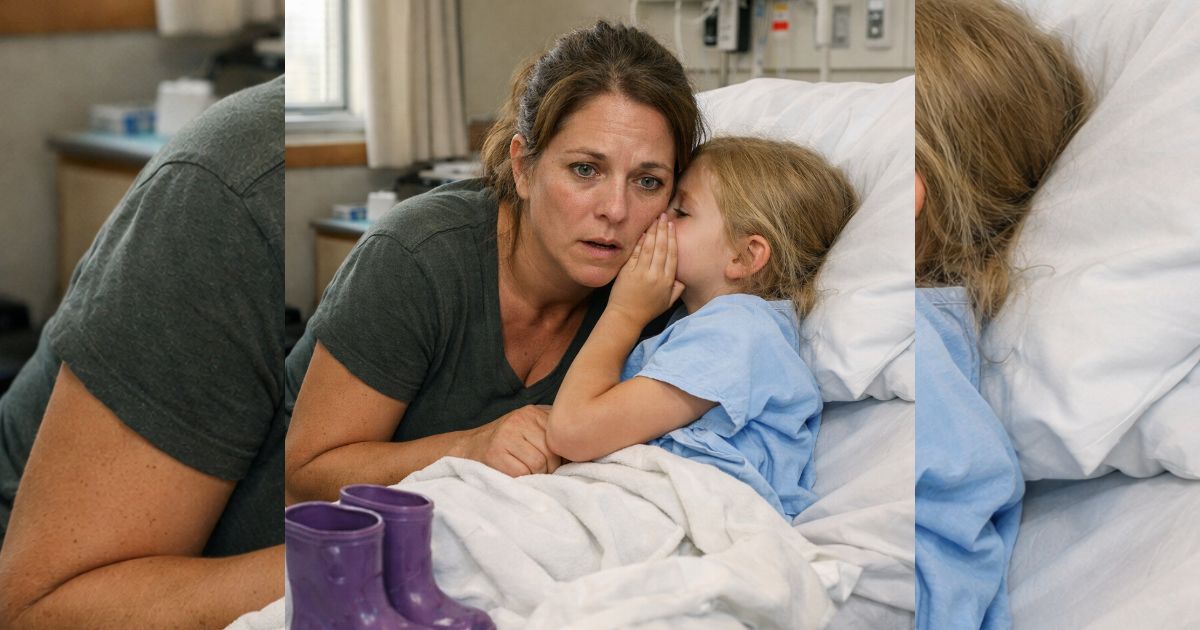
Purple rain boots.
They were set neatly under the chair beside her hospital bed, muddy around the soles, one boot tipped on its side like she had stepped out of childhood in a hurry.
Meadow looked so small under the white blanket that I felt my throat close before I even reached her.
There was no cast.
No bandage.
No machine screaming beside her.
But there was an oxygen clip on her finger, dried salt under her eyes, and that washed-out look children get when their bodies have cried harder than their voices can manage.
The doctor told me she had fainted twice at school.
A panic episode, he called it.
Rapid breathing.
Dizziness.
Dehydration.
A little girl trying so hard to hold in something too big for her chest.
He kept talking.
I heard maybe half of it.
When people said I was calm, they always thought calm meant soft.
It never did.
Calm, in me, had always been the shape shock took when it decided to stand up straight.
I pulled the chair closer and took Meadow’s hand.
Her fingers tightened around mine right away, as if she had been waiting for that exact touch to believe she was safe again.
“Mom?”
“I’m here, baby.”
Her lips trembled.
“I’m sorry.”
I leaned in until my forehead almost touched hers.
“For what?”
Her eyes filled so fast it looked like the tears had been waiting behind them all day.
“For seeing it.”
The room seemed to go silent around us.
People still moved outside the curtain.
Shoes still squeaked.
Phones still rang somewhere down the hall.
But around me, everything narrowed to my daughter’s face.
“What did you see, sweetheart?”
She swallowed hard.
“Dad and Aunt Serena were in your room.”
It was a plain sentence.
A child’s sentence.
Simple.
Direct.
No extra words.
That made it worse.
My mind tried to rearrange it.
Tried to make it mean they were folding laundry or looking for a sweater or wrapping a birthday present.
But Meadow kept talking.
“They were in your bed.”
She shut her eyes when she said it, like even the memory was too bright.
“They were hugging and kissing in the married way.”
The world did not crack.
That would have been too loud.
It folded inward.
Quietly.
Like paper in a fist.
I looked at my daughter’s face and kept my own still because she needed stillness more than she needed honesty in that moment.
Children do not need to carry your first collapse.
They need your hands to stay steady long enough for them to put their own fear down.
“What happened after that?” I asked.
Her breath went shaky.
“I think they heard me.”
My thumb moved over her knuckles.
“You’re okay. Just tell me slowly.”
“I was looking for Mr. Buttons because the field trip got canceled and I wanted him downstairs with me and I thought you were at work and Daddy said he had calls.”
She took another breath.
“I opened your door and they looked at me and Dad got really, really still.”
Not angry.
Not loud.
Still.
Some people do not understand how frightening still can be on the wrong face.
“He came over fast,” she whispered. “Not mean fast. Just… fast. And he said I shouldn’t have come in and that I needed to forget it because grown-up things are private and I’d make everything worse if I talked.”
I felt something cold settle into my bones.
Not fire.
Not rage.
Fire is wild.
This was cleaner than that.
“He said if I told you, you would cry and leave and it would be because I couldn’t keep a secret.”
Her mouth twisted as she said the last word.
“Secret.”
Children know the difference between a surprise and a burden.
They know it in their bodies before adults admit it with words.
“Aunt Serena came after that,” Meadow said. “She put on your yellow robe and knelt down and said nobody wanted to upset me and they both loved me and I had to be a brave girl.”
My yellow robe.
The one my mother gave me the Christmas after I came home for good.
Soft cotton, worn thin at the cuffs, smelling faintly of lavender no matter how many times it went through the wash.
I pictured Serena in it and felt something in me lock into place.
“She said maybe we should all just keep this between us until after the holidays,” Meadow whispered.
It was October.
I stared at the blanket over Meadow’s legs and let that settle too.
Not a mistake then.
Not a sudden stray kiss that had burst into disaster one lonely morning.
A plan.
Maybe not a good one.
Maybe not even a finished one.
But a plan all the same.
“Then what happened?”
“Daddy took me to school late.”
She looked embarrassed when she said it, which cut me in a place I still do not have a name for.
“He said I needed to act normal. He said if I looked upset people would ask questions, and then everybody would be hurt.”
A tear slid down into her hairline.
“I tried, Mom. I really tried.”
I kissed her forehead.
“There was never anything for you to try, baby.”
She shook her head against the pillow.
“In art class they were making paper pumpkins and my hands felt funny and I couldn’t breathe and Mrs. Carter asked if I was sick and I said no but then I started crying and I couldn’t stop.”
That was how my child landed in a hospital bed.
Not because her body had been thrown.
Because her heart had been handed a lie too heavy for seven years old and told to carry it alone.
That, too, can drop a child.
That, too, can take the air right out of them.
“I thought maybe if I said nothing, you could still be happy,” she said.
There it was.
The sentence no parent deserves to hear.
The sentence no child should ever learn.
I pressed her hand to my chest.
“Listen to me very carefully. Nothing about this is your fault. Nothing. Not one little piece.”
She looked at me the way children do when they want to believe you but have already seen enough to know the world does not always tell the truth.
“Promise?”
“I promise on every good thing I have left.”
That seemed to reach her.
Her grip on my hand loosened.
The doctor had said they wanted to keep her a few more hours, maybe overnight, just to be safe.
Safe.
It sounded smaller than the word I wanted.
What I wanted was impossible.
I wanted the morning back.
I wanted my daughter at school coloring a paper pumpkin.
I wanted my house scrubbed clean of every lie that had ever crossed its doorway.
Instead, I sat by Meadow’s bed and stroked her hair until her eyelids grew heavy again.
When she drifted off, I stood and turned.
A woman with silver hair and a soft cardigan was waiting near the curtain.
The school counselor.
She had introduced herself earlier, but my brain had kept only fragments then.
Now I remembered.
Ms. Alvarez.
Kind eyes.
Firm mouth.
The kind of woman who had probably learned how to be gentle without ever once becoming weak.
“She trusts you,” she said quietly.
I nodded because my throat felt too tight for anything else.
“We’ll want to make sure she doesn’t go home to any more pressure tonight.”
“She won’t.”
I heard how flat my voice sounded and softened it a notch.
“She won’t.”
Ms. Alvarez gave one short nod.
“Would you like me to sit with her while you make calls?”
I looked back at Meadow.
Her lashes rested wet against her cheeks.
Her face still held that pinched, exhausted look children wear after fear leaves all at once.
“Yes,” I said. “Please.”
The first person I called was my mother.
Ruth Hawthorne answered on the second ring.
She had the voice of a retired principal and the soul of a woman who had survived enough to never waste time pretending life was simpler than it was.
“Victoria?”
“I’m at the hospital with Meadow.”
The pause on the line was immediate and total.
“What happened?”
I leaned against the hallway wall.
The paint was pale blue, the kind hospitals choose because they think pale colors can keep grief polite.
“She fainted at school,” I said. “She’s physically all right. But she saw Dennis with Serena this morning.”
Another pause.
Longer this time.
Then my mother asked, “Did he deny it?”
“She told me before I even had the chance to ask.”
My mother exhaled once, slowly.
“Do you want me there?”
That is one of the great questions a good mother asks when her child is grown.
Not What did you do.
Not Are you sure.
Not Maybe there’s an explanation.
Do you want me there.
“Yes.”
“I’m leaving now.”
She was there in eighteen minutes.
I know because I checked the clock twice while waiting and once more when I saw her cut across the hospital lobby with the force of weather.
My mother was seventy-one years old, silver-haired and straight-backed, still crisp in everything she wore.
That afternoon she had on a navy sweater, sensible shoes, and the face she used to wear on parent conference nights when people showed up ready to argue and left agreeing to better behavior.
She hugged me once.
Hard.
Then she stepped back and looked at my face.
“Did you cry?”
“Not yet.”
“Do you need to?”
“Not yet.”
She squeezed my shoulder.
“Good. Tears are welcome. But timing matters.”
My mother had a way of saying things like that which could sound cold to anyone who did not know her.
To me, it sounded like love in work clothes.
I told her everything.
The bedroom.
The robe.
The secret.
The guilt put on a child.
I watched her face go from shock to anger to something even quieter.
Disappointment can look so much like grief it is hard to tell them apart.
When I finished, she looked through the glass at Meadow sleeping.
“He told a seven-year-old to protect his lie.”
“Yes.”
“And Serena helped.”
“Yes.”
My mother closed her eyes for one brief second.
When she opened them again, they were clear.
“What are you going to do?”
The honest answer came so fast it surprised even me.
“I’m going home.”
Her jaw tightened.
“Alone?”
“Yes.”
“To scream?”
“No.”
“To throw things?”
“No.”
“To do something I’ll need to explain to a judge later?”
I almost laughed, which in that moment felt close enough to crying that I stepped away from both.
“No.”
She studied me.
“You have that look.”
“What look?”
“The one you had when you came home from your second deployment and found the kitchen flooded and fixed the whole pipe system before you even sat down.”
“This is not a pipe system.”
“No,” she said. “This is worse.”
She was right.
It was worse because a broken pipe never looks ashamed when you catch it.
I told her I wanted to see the house with my own eyes.
I wanted to know whether the lie had already moved into my rooms and made itself comfortable.
I wanted Dennis to look at me without the softness he saved for town dinners and Sunday coffee on the porch.
I wanted Serena to see that there are some lines in a family you do not blur and then explain away with tears.
Most of all, I wanted my daughter’s secret out of the house before she ever stepped back inside it.
My mother did not try to stop me after that.
She had raised me long enough to know the difference between fury and decision.
“Go,” she said. “I’ll stay with Meadow. If she wakes, I’ll tell her you are handling grown-up things.”
I bent over my daughter one more time.
“Mommy will be back soon,” I whispered.
Even half-asleep, she nodded.
That almost undid me.
I drove home slower than I had driven to the hospital.
People imagine rage as speed.
Sometimes it is the opposite.
Sometimes rage is every stop sign obeyed, every turn signal used, every breath counted because control is the only thing standing between you and becoming the kind of person your enemy would love to describe.
Nebraska looked painfully normal that afternoon.
Flat gold light over cut fields.
A flag moving lazily in front of the post office.
Two boys on bikes outside the hardware store.
A woman loading mums into the back of her SUV.
The world had the nerve to continue.
My town had known me as Doc Tori for two years by then.
The woman at the veterinary clinic who took emergency calls, stitched up farm dogs, soothed old couples when it was time to say goodbye to the cat they had loved longer than some marriages lasted.
Before that, I had been Captain Victoria Hawthorne.
Before that, just Tori.
The stubborn one.
The serious one.
The one who liked neat corners and lists and never did anything halfway.
When I came home from overseas for good, people did what small towns do.
They folded me back in.
They brought casseroles.
They waved from trucks.
They called me brave when what I often felt was simply tired.
Dennis had seemed proud of me in those years.
Patient, too.
He knew which grocery aisles I hated because the fluorescent lights hummed too loud.
He knew I slept better with the bedroom door cracked.
He knew how to hand me coffee without talking on the mornings after bad dreams.
That was what made betrayal complicated.
Not that the good had been fake.
It was that the good had existed right beside the selfishness and somehow had not stopped it.
Dennis was the kind of man people trusted on sight.
Tall, tidy, bank manager polished.
The kind of father who remembered school-theme days and knew how Meadow liked her grilled cheese cut.
He coached tee-ball once.
Brought doughnuts to Sunday school on rotation weeks.
Shook hands like eye contact mattered.
Serena was sunshine where I was structure.
Three years younger.
Pretty in that easy way some women are without trying.
Always a bright scarf, a bright laugh, a bright story about a listing or a closing or a client who cried when they got their keys.
She sold houses and seemed built for open windows and fresh starts.
Growing up, people used to say we balanced each other.
Serena softened me.
I grounded her.
Maybe that had even been true once.
Maybe that was the part that hurt most.
Not only that she had crossed the line.
That she had known exactly where the line was because she had been standing beside me when I drew it.
By the time I turned onto our street, the sky had taken on that late-afternoon amber that makes every porch look like a postcard.
Dennis’s sedan was in the driveway.
Serena’s white SUV was behind it.
So Meadow had been right.
They had not even left.
I sat with both hands on the wheel and looked at my house.
The trim needed painting before winter.
One shutter still hung a little crooked from a storm in spring.
The mums on the front steps were mine.
The little chalk pumpkin by the door was Meadow’s.
It said WELCOME in wobbly block letters, and the O was shaped like a cat because she said even pumpkins got lonely.
I took one breath.
Then another.
Then I got out.
I did not slam the car door.
I did not march.
I walked up my own front path like a woman returning to a place she still fully intended to own.
I let myself in with my key.
The smell hit first.
Whiskey.
Vanilla.
My lemon hand soap.
The three scents together made me feel like the air itself had become dishonest.
Voices drifted from the kitchen.
Low.
Uneasy.
When I stepped through the archway, both of them turned.
Dennis stood by the island in his shirtsleeves, tie gone, collar open.
Serena was in a sweater I recognized from one of her Sunday showings, curled around a mug like warmth had any right to belong to her.
No one spoke.
Then Dennis said the most foolish possible thing.
“Tori, I was just about to call you.”
There are sentences so insulting they clear your head.
That was one.
“Do not,” I said, “start with a lie.”
His mouth shut.
Serena stood up too quickly and almost knocked the mug over.
Her lipstick was gone.
Her hair was pulled into a rushed knot.
She looked less glamorous than usual and somehow more offensive for it, because plainness did not make her innocent.
“It isn’t what it looks like,” she said.
I looked at her for one full second.
Then I looked at Dennis.
Then back at her.
“It looks like my husband and my sister put a secret on my child so heavy she collapsed at school.”
Neither of them had an answer for that.
I set my purse down on the counter.
Slowly.
Very carefully.
The kind of careful that makes other people nervous because it tells them chaos has not won the room.
“Meadow told me everything.”
Dennis paled first.
Serena’s hand flew to her mouth.
He moved before she did.
One step toward me.
Not aggressive.
Not tender.
Just instinct.
“Is she okay?”
That was when I understood something important.
He cared.
He truly cared.
And he had still done it.
Sometimes the worst people are not the ones who feel nothing.
They are the ones who feel enough to want forgiveness and not enough to have stopped themselves in time.
“She had a panic episode,” I said. “She thought if she told me the truth, I would leave and it would be her fault.”
Serena sat down hard in the nearest chair and started crying.
I had loved that sound once because it meant my little sister still trusted me enough to fall apart in front of me.
That afternoon it sounded like water on stone.
Dennis rubbed both hands over his face.
“I never meant for her to carry it like that.”
The sentence was so selfish I almost admired its efficiency.
Not I never meant to betray you.
Not I never meant to drag a child into this.
I never meant for her to carry it like that.
As if the only failure had been weight distribution.
“You will not talk to me,” I said, “as if the problem is packaging.”
He dropped his hands.
“Tori—”
“No.”
I held up one finger.
Then I looked around the kitchen.
Two mugs.
One bottle.
Serena’s purse on the stool Meadow used when she helped me bake.
A receipt near Dennis’s elbow.
A dry-cleaning slip.
An envelope from a family law office.
My gaze stopped there.
Dennis saw it too late.
He reached for it at the exact moment I did.
I was closer.
I picked it up.
Plain cream envelope.
His name typed neatly across the front.
Consultation summary.
My pulse did not change.
That was the alarming part.
Inside was a packet.
Notes.
Appointment time.
Initial questions.
Division of property.
Temporary custody considerations.
Language so polished it almost glowed.
One line had been underlined.
Document concerns regarding spouse’s emotional unpredictability in advance of filing.
I looked up at Dennis.
Then at Serena.
Then back down.
There it was.
Not just betrayal.
Preparation.
Not just a secret affair.
A story they had been shaping around me.
A neat one.
A practical one.
A respectable one.
Bank manager husband seeking stability.
Cheerful aunt helping with after-school routines.
Veteran wife still struggling, maybe not fully herself, maybe in need of rest, maybe not best positioned for primary custody in the first weeks after separation.
They had been building it with clean hands.
Or thought they had.
I set the papers on the island and opened the rest.
Calendar printouts.
A budget worksheet.
An apartment inquiry email.
And then a set of printed messages.
Apparently Dennis still trusted office printers more than passwords.
Serena had sent him one three weeks earlier.
If she has another rough patch, you need to be ready to move fast. Meadow will need someone stable.
Someone stable.
I looked at my sister.
She had the decency to look down.
The next message was from him.
I know. I hate this. But I can’t keep living in limbo.
Another from Serena.
Then don’t. We can do this carefully. No drama. No one has to get hurt.
No one has to get hurt.
I laughed then.
Just once.
A short, unbelieving sound.
Both of them flinched.
“Carefully,” I repeated.
Dennis tried again.
“You weren’t supposed to see those.”
There are moments in a marriage when a person reveals their true center so completely that no amount of later regret can cover it back up.
That was his.
Not I am sorry.
Not I was wrong.
You weren’t supposed to see those.
My child had seen enough for all of us.
“Sit down,” I said.
Neither moved.
I did not raise my voice.
I did not need to.
“Both of you. Sit.”
They sat.
I remained standing.
I did not do it for power.
I did it because if I sat, I might suddenly feel the floor.
And I could not afford the floor yet.
“How long?”
Dennis looked at Serena.
I noticed that too.
That reflex.
That little shift toward the person who had already been helping him build a second life.
“Eight months,” Serena whispered.
Eight.
I did the math.
It started during my hardest stretch after coming home, when sleep turned slippery and crowded rooms made my skin hum and I had needed more help than I wanted to admit.
Serena had come by often then.
Extra casseroles.
Extra school pickups.
Extra concern.
Dennis had kissed my forehead every morning and told me we were a team.
The paper packet on my counter told a different story.
“What did you tell yourselves?” I asked. “That loneliness makes this noble? That my daughter would somehow thank you later for reorganizing her life behind my back?”
Dennis stood halfway again, sat again.
He looked less like the good man from church potlucks and more like what he was now: a tired, selfish man caught in the middle of his own polished language.
“We did not set out to hurt you.”
“No,” I said. “You set out not to inconvenience yourselves.”
Serena started crying harder.
“I loved you,” she said to me, as if that sentence could live in the same house as what she had done.
“I still do.”
I turned to her fully then.
“You do not get to use the present tense with me.”
She shut her mouth.
I should say that I was not only angry.
I was humiliated.
People do not like to admit that part because it sounds vain, but humiliation is not vanity.
It is the shock of realizing a private life was being rearranged in rooms where you were still setting the table.
It is learning you were being discussed as a problem while still washing everyone’s coffee mugs.
It is hearing your own hard years turned into strategy points.
That kind of humiliation can make a person loud.
In me, it made everything very quiet.
I asked question after question.
When had it started?
Who made the first move?
How many times had Serena used her emergency key?
Did they ever plan to tell me before filing?
Had Dennis really been talking to a family lawyer before he bothered speaking honestly to his wife?
The answers came in pieces.
A night in the kitchen after I had gone to bed early.
A conversation that became comfort.
Comfort that became justification.
Justification that became routine.
Serena admitted she had been in my house more afternoons than I knew.
Dennis admitted the lawyer had been his second consultation, not the first.
He admitted he had spoken about my “episodes.”
My episodes.
Not my nightmares.
Not my therapy.
Not the work of healing after two decades of service.
Episodes.
A word neat enough to fit in a file.
A word cold enough to strip a whole person down to an inconvenience.
I let that one sit in the middle of the kitchen awhile.
Then I asked the question I already knew mattered most.
“When Meadow saw you, why didn’t you tell me that day?”
Dennis’s eyes dropped to the table.
“We panicked.”
I hated that answer more than any other.
Panic always arrives dressed like innocence.
As if fear excuses damage.
As if being startled makes selfishness smaller.
“She is seven,” I said. “She should never have been the safest person in this house.”
No one argued with that.
Outside, a dog barked somewhere down the block.
A truck rolled by.
An ordinary day kept moving right outside my window while my marriage came apart in my kitchen with a family law packet and two cooling cups of coffee between us.
I looked at the papers again.
Then at Dennis.
“This was the plan?”
He rubbed the back of his neck.
“I wanted a clean separation.”
A clean separation.
He said it like he was discussing office files.
Like there is any clean way to split a child’s trust down the middle and ask her to keep loving both sides.
“You wanted a story in which you looked careful,” I said. “You wanted to move me out of the center of my own life without ever having to say the ugly part out loud.”
“That is not fair.”
I stared at him.
There is a useful thing about betrayal.
Once it becomes visible, the old rules about politeness stop mattering.
“Fair?” I said. “You told my child her truth would break this family. Then you sat in my kitchen with my sister and printed custody notes from a lawyer.”
His face changed then.
Not into guilt.
Into defensiveness.
That was when I knew whatever softness I still carried for him as my husband had ended for good.
“You have to understand,” he said, “living with you has not always been easy.”
There it was.
The line every coward reaches for when honesty has become expensive.
Not I chose wrong.
You were difficult enough to make my wrong understandable.
I did not let him have that.
“Living with me meant living with a woman who worked for every inch of peace she has now,” I said. “A woman who built a career, loved her child, paid bills, showed up, kept promises, and trusted the wrong people inside her house. If that was too hard for you, the honest thing was a conversation. Not this.”
Serena made a sound like a hiccup and a sob together.
“I told him to tell you.”
I believed she had.
I also believed she had kept coming over.
People like Serena often mistake hesitation for morality.
She had probably said We should tell her while still staying for coffee.
We should be honest while still accepting the key.
We should stop this after the next time.
Moral language means very little when your feet keep walking in the same direction.
I picked up the packet, squared the pages, and slid them back into the envelope.
Then I set it in front of Dennis.
“Here is what happens now.”
Both of them looked up.
“You leave this house tonight.”
Dennis opened his mouth.
I did not let him speak.
“You do not come back without arranging it through counsel. You do not call Meadow. You do not text her. You do not ask her to comfort you. You do not ask my mother, my neighbors, my friends, or anyone in this town to carry your explanation for you.”
His jaw tightened.
“This is my house too.”
“It was,” I said. “Until you turned it into a meeting room for my replacement.”
That landed.
I could see it.
Not because it was cruel.
Because it was true.
Serena stood up slowly.
“I’ll go.”
For one flicker of a second I saw the little sister who used to sneak into my room after bad dreams and ask if she could sleep on the floor by my bed.
Then I remembered her in my robe.
“I am not saying this for drama,” I told her. “I am saying it because you need to hear a plain sentence. You are not safe for my daughter right now. Whatever story you tell yourself about love or timing or loneliness, you helped put an adult burden on a child. That ends today.”
She nodded like the words were blows.
I did not enjoy that.
That may surprise people.
But revenge is usually less satisfying in real life than stories make it sound.
Mostly it feels tired.
Mostly it feels like watching something collapse that you wish had never needed collapsing at all.
Dennis tried a different tack then.
“What do I tell people?”
I looked at him for a long moment.
That question.
Of all questions, that one.
Not what does Meadow need.
Not how do I repair what I did.
What do I tell people.
I almost smiled.
Not from amusement.
From clarity.
“You tell them the truth,” I said. “For once.”
He laughed once without humor.
“And what is that?”
“That you betrayed your wife. That you betrayed your daughter’s trust. That you mistook secrecy for strategy and kindness for weakness. Start wherever feels natural.”
He looked away.
I left them in the kitchen after that and walked upstairs.
The bedroom door was half open.
The bedspread was wrinkled.
One of my pillows had fallen to the floor.
My yellow robe was draped across the bench at the foot of the bed as if it belonged to no one.
I picked it up with two fingers and stood very still.
Some women would have thrown it away.
I washed it.
Twice.
Not because it fixed anything.
Because I refused to let them claim one more ordinary object in my life.
In the bathroom, Serena’s perfume still lingered over the sink.
I opened every window in the room and let the October air pour through.
By the time I went back downstairs, Serena was gone.
Dennis was standing alone by the island with the envelope in his hand.
He looked older.
Smaller too, though his body had not changed.
That is another thing betrayal does.
It shrinks people into the size of their worst choice.
“Are you really doing this tonight?” he asked.
“You already did this,” I said. “Tonight is just when I found out.”
He looked like he wanted sympathy for that distinction.
He did not get it.
“I love Meadow.”
I believed him.
That was the tragedy.
Not enough.
But truly.
And yet the love had not been sturdy enough to make him tell the truth before my child had to stumble into it.
“Then start acting like it,” I said. “Leave her in peace.”
He packed one bag.
I stood in the doorway to the hall and watched without speaking.
Not because I thought he would steal anything.
Because endings deserve witnesses too.
When he passed me on the way out, he stopped.
“Tori.”
I did not answer.
“I never wanted it to happen like this.”
I looked him straight in the face.
“Then you should have wanted something better sooner.”
He left.
The front door shut.
And just like that, the house sounded enormous.
There is a strange hour after catastrophe when the body looks around as if expecting applause for remaining upright.
Mine did that.
I stood in the entryway with one hand on the banister and listened to the silence.
The refrigerator hummed.
The clock over the stove ticked.
A leaf skittered across the porch outside.
I was alone.
Not lonely.
Not yet.
Just alone in the oldest, plainest sense.
I went through the house room by room.
Not hunting.
Resetting.
I gathered Serena’s forgotten scarf from the couch and placed it in a bag by the door.
I took the spare key off the hook and changed its label from SERENA to OLD LOCK.
I unplugged the home tablet from the kitchen counter and brought it to the table.
That was when the second betrayal arrived.
Not because I did not already know enough.
Because evidence has its own cruelty.
The tablet was synced to our family cloud account.
Shared calendar.
Shared shopping list.
Shared photo stream.
There were deleted message previews still cached in a notification folder Dennis had clearly forgotten about.
One by one, I opened them.
Serena: Is she in therapy again this week?
Dennis: Yes. Thursday evening.
Serena: Then Thursday is safer.
Another.
Dennis: Meadow adores you. That helps.
Another.
Serena: We need to be careful. If this turns ugly, she’ll say I manipulated you.
Another.
Dennis: I can handle the legal part. I just need you not to panic.
Legal part.
Manipulated.
Safer.
I sat down and kept reading because once truth opens, stopping halfway is just another form of fear.
There were apartment websites in his search history.
A draft budget with my salary excluded.
A note titled Meadow schedule if transition happens before Christmas.
Transition.
As if marriage were a train platform and not the place where a child learned what trust felt like.
In the photo stream I found nothing explicit.
Just banal, devastating proof.
A selfie reflection in a restaurant window with Serena’s hand near his sleeve.
A coffee cup on a dashboard with the caption surviving another Monday.
A photo of the lake outside town taken at dusk.
No people in it.
Only two shadows faintly visible at the bottom edge.
Evidence does not need to be dramatic to be final.
Sometimes it is the ordinary tone that kills the most.
I printed copies.
Neatly.
Stacked them.
Put them in a folder.
Then I called a locksmith.
Then I called my clinic manager and told her I would be out the next day.
Then I texted three people.
My mother.
Mrs. Carter at Meadow’s school.
And my attorney.
By then it was dark.
I went back to the hospital with clean clothes for Meadow, her toothbrush, Mr. Buttons, and the yellow robe folded in my bag because, even washed, I did not yet trust it alone in the house.
My mother looked up from the recliner when I entered.
She saw my face and said nothing.
That is another kind of love.
I handed her a paper cup of coffee and put Mr. Buttons beside Meadow’s pillow.
Even asleep, Meadow’s hand found him.
My mother’s eyes softened.
“How did it go?”
“They left.”
“Any shouting?”
“No.”
“Any smashed dishes?”
“No.”
She nodded once.
“Good. Those cost money.”
That made me smile for real, small as it was.
Then I told her about the packet.
The notes.
The messages.
The transition plan.
When I finished, she looked at Meadow for a long time.
“They were not just dishonest,” she said. “They were preparing to make you the problem.”
“Yes.”
My mother took a slow sip of coffee.
“People do that when the truth about themselves feels too ugly. They spread it around.”
That line stayed with me for months.
They spread it around.
That is what Dennis and Serena had done.
Taken the ugliness of their choice and tried to distribute it into language about stability and timing and concern.
People like that do not always lie with facts.
They lie with framing.
Meadow woke near midnight.
She saw Mr. Buttons and smiled weakly.
Then she saw me and her face crumpled.
I got into the bed as carefully as I could and let her tuck herself against my side.
“They’re not at the house, are they?”
“No.”
“You promise?”
“I promise.”
Her body loosened at once.
Children believe promises with their whole nervous system.
You can feel it.
She fell back asleep with one hand gripping my shirt.
I did not sleep at all.
I watched the hallway light under the door change from gold to blue to morning gray and thought about all the ways a family can end long before anyone says the words out loud.
The next few weeks were not cinematic.
No dramatic court scene.
No sobbing speech on a courthouse lawn.
Just paperwork.
Schedules.
Conversations said twice because the first time your own ears are too tired to trust themselves.
That is the truth nobody puts in the stories.
Sometimes survival looks like printer ink and school forms and changing the emergency contact list one blank at a time.
My attorney was a woman named Claire Benton.
No nonsense.
Forty-something.
Sharp suit.
Soft voice.
She read the packet, the printed messages, and my written summary of Meadow’s statement without interrupting.
When she finished, she folded her hands on the desk.
“You did the right thing by documenting everything while it was fresh.”
I appreciated the sentence because it did not ask me to become smaller in order to sound reasonable.
She told me what came next in clear, plain language.
Temporary parenting structure.
Communication only through documented channels.
No discussion of adult matters with Meadow.
No private visits until emotional safety could be assessed.
No games.
No side doors.
That first meeting lasted two hours.
When I walked out, I did not feel better.
I felt oriented.
Sometimes that is the most you can hope for.
Dennis moved into a furnished apartment near the edge of town for exactly twelve days.
Then, apparently unable to stand the grocery-store glances and church-lobby silence, he requested a transfer opportunity through the bank’s regional office and left the state before Thanksgiving.
He wrote that it would “reduce strain.”
I did not answer that line.
Serena sent one email.
Subject line: I Never Meant to Become This Person.
I stared at it for a long time before opening it.
Inside were six paragraphs of sorrow that still somehow managed to leave her slightly blurred around the edges.
She talked about loneliness.
Chemistry.
Mistakes.
Complicated timing.
How she had always felt second to me growing up, though she said she knew that was unfair.
How she had thought Dennis saw parts of her nobody else did.
How ashamed she was that Meadow had become part of it.
That was the only honest sentence in the whole message.
I wrote back three lines.
Whatever you felt for him is yours to carry.
What you asked a child to carry is not.
Do not contact Meadow again.
Then I blocked her.
At home, I turned small ordinary acts into anchors.
Cereal at the same time.
Bath after dinner.
Story before bed.
Friday pizza from the little place off Main where the owner always cut Meadow’s slices into squares because she said triangles made the cheese slide off.
I took her to school every morning for a while, even after the counselor said it was not necessary.
Maybe it was not.
Maybe it was for me as much as for her.
But there was comfort in buckling her seat belt, hearing her tell me which spelling words were silly, seeing her carry her backpack into the brick building while I waited until she got through the doors.
At the clinic, animals kept needing me.
That helped.
A beagle swallowed half a sock.
An old ranch dog needed stitches after tangling with barbed wire.
A college kid cried over a guinea pig with pneumonia.
Pain, when it belonged to bodies and had charts and medicine and follow-up appointments, felt strangely merciful compared with betrayal.
Pain of that kind at least admitted it was pain.
The town did what towns do.
It noticed.
It speculated.
It pretended not to notice.
I learned who looked away at the grocery store and who squeezed my hand by the produce without asking nosy questions.
I learned which women at church had known more than they said.
I learned that sympathy, like gossip, travels fastest where people are bored.
But I also learned that dignity can be louder than rumor if you keep it long enough.
I did not tell everyone everything.
I told the truth where it mattered.
School.
Attorney.
Therapist.
My mother.
A handful of people who earned the story by how they held it.
The rest got a simple version.
Dennis and I are separating.
There were serious breaches of trust.
Meadow’s well-being comes first.
Some people were disappointed by how little entertainment I offered.
That was their problem.
Meadow started seeing a child therapist twice a week.
Dr. Martinez had warm hands and a room with a basket of smooth stones children could hold while they talked.
The first day, Meadow refused to say much.
The second, she colored a house with three windows and then drew a line through one of them so hard the crayon snapped.
The third, she asked if secrets could make you sick.
Dr. Martinez later told me that children often understand their bodies long before they understand adult motives.
Of course they do.
Bodies are honest.
Adults work hard not to be.
I went back to my own therapist too.
That mattered more than I wanted to admit at first.
I had spent years learning how to live with the echoes of service.
The nights.
The vigilance.
The way too much noise could make my heart race before my thoughts caught up.
I did not want Dennis’s betrayal folded into those old injuries.
I did not want him to get to occupy one more room in me than he already had.
So I sat in my therapist’s office and told the truth without editing it to sound noble.
I told her I was furious.
Humiliated.
Ashamed that I had missed signs.
Ashamed that I had turned my own healing into something they could apparently discuss like weather.
I told her I hated the phrase emotional unpredictability so much I wanted to tear the words in half.
She let me speak until I was empty.
Then she said, “Their ability to misuse your pain does not define your strength. It only defines their character.”
That sentence did not heal me.
Healing is slower than one good sentence.
But it gave me a place to stand.
There were hard moments.
Of course there were.
The first time Meadow asked why I changed the code on the garage.
The first Sunday I went alone to the pumpkin patch fundraiser where Dennis usually handled the hayride line.
The first school concert where Meadow scanned the audience, found only me and my mother, and then sang anyway.
I have never been more proud of anyone.
She wore a paper scarecrow hat crooked over one eye and mouthed half the words because she was busy checking if I was still watching.
I was.
I would have watched if the roof had come off.
One evening in November, Dennis asked for a video call with Meadow.
Claire advised keeping it short and structured.
I set the tablet on the coffee table and stayed in the room, not hovering, just present.
When his face appeared, Meadow went still.
Not frightened.
Just careful.
Children become careful around people who ask them to manage adult comfort.
“Hi, bug,” he said.
She used to love that nickname.
That evening she only nodded.
“How was school?”
“Good.”
“What did you learn?”
“Fractions.”
He smiled too brightly.
“Sounds hard.”
“It isn’t.”
The conversation lasted four minutes.
At the end he said, “Daddy misses you very much.”
Meadow looked at the screen.
Then at me.
Then back at him.
“You should have told the truth yourself.”
The room went quiet.
Even the radiator seemed to pause.
Dennis blinked.
So did I.
Dr. Martinez later said Meadow had started developing language for boundaries.
In the moment, all I saw was my little girl sitting in pink socks with one braid half-undone, handing adulthood back to the man who had dropped it on her in the first place.
He tried to recover.
“I know. I’m sorry.”
She nodded once.
Then she said, “Okay.”
Not forgiveness.
Not absolution.
Just acknowledgment.
Children can be cleaner than courts.
After the call, she curled against my side on the couch.
“Was that mean?”
“No.”
“Was it rude?”
“No.”
“Was it true?”
“Yes.”
She thought about that a while.
Then she asked if we could make cinnamon toast.
So we did.
That became one of the strangest lessons of that year.
Catastrophe can sit in your chest at noon and by six o’clock you are still buttering bread because the child in front of you wants extra cinnamon and life, rude as ever, keeps requiring dinner.
At Thanksgiving, it was just me, Meadow, and my mother.
We ate at my house.
Turkey, mashed potatoes, green beans, and the pecan pie my mother always claims is too sweet even as she takes a second slice.
For a moment, standing at the sink afterward while Meadow made place cards for imaginary guests and my mother wrapped leftovers in foil, I felt the cleanest grief of all.
Not for Dennis.
Not for Serena.
For the family shape I had thought we were building.
That porch-light, Sunday-barbeque, school-play, ordinary-life shape.
The one I had believed in enough to fight for every time my own mind got noisy.
My mother came to stand beside me.
“You’re mourning the right thing,” she said.
“Am I?”
“Yes.”
“What if I miss what was never real?”
She dried her hands on a dish towel and looked at me.
“It was real enough while it lasted. Do not let their failure steal every good memory too. That gives them more reach than they deserve.”
I leaned against the counter and let that settle.
My mother has a gift for cutting knots instead of tugging at them.
That winter was the first one Meadow and I spent as a two-person household.
Snow along the fence line.
Boots by the radiator.
School forms signed with one parent line instead of two.
The first time I wrote emergency contact: Ruth Hawthorne instead of Dennis Hawthorne, my pen paused.
Then it kept going.
That is how most hard things happen.
Pause.
Continue.
Pause.
Continue.
There were Christmas concerts and therapist appointments and one stomach bug that sent us both into pajamas for two straight days.
There were also good things.
Quiet good things.
Meadow learned to tie her shoes without help.
The clinic adopted out a three-legged hound to a retired mail carrier.
I repainted the crooked shutter before the first freeze.
My house stopped smelling like old fear.
By January, the legal paperwork was moving.
Dennis’s attorney sent a proposal clearly shaped by the evidence my attorney had already shared.
No dramatic contest.
No attempt to make me look unstable.
No theatrical concern for the child he had expected to keep quiet.
Just signatures.
Terms.
Distance.
When Claire called to tell me the final settlement had been accepted, I sat in my truck outside the feed store and stared at the steering wheel.
Relief is not always warm.
Sometimes it is just space where pressure used to be.
I thought I would celebrate.
Instead I drove to school and picked Meadow up early for hot chocolate.
We sat in a booth at the diner on Highway 12 with whipped cream mustaches and cold noses.
She told me about a classmate who had insisted penguins were mammals.
I let her talk and talk and talk.
That, too, was healing.
A child who has learned that speaking can be dangerous often has to relearn that talking about nonsense is safe.
By spring, the question I had dreaded finally came.
We were at the park.
The same little neighborhood one with the duck pond and the peeling red swing set and the picnic table that always leaned a little to one side.
Meadow was pumping her legs hard on the swing, hair flying, rain boots replaced now by sneakers she could finally get dirty without complaint.
She dragged her feet to stop and looked at me.
“Mom?”
“Yeah?”
“Why did they do it?”
I knew exactly who they were.
There are betrayals so large names become unnecessary.
I sat on the bench and motioned her over.
She climbed beside me, pressing close enough that our shoulders touched.
“That answer has a few parts,” I said.
“Okay.”
“The first part is that adults can make selfish choices even when they know better.”
She nodded slowly.
“The second part is that sometimes people tell themselves a nice story so they do not have to look straight at the ugly thing they are doing.”
She frowned.
“Like saying it was a secret instead of a lie?”
I looked at her.
Children hear everything.
“Yes,” I said. “Exactly like that.”
She picked at the bench paint with one thumbnail.
“Was it because of me?”
There it was.
The old question wearing a new sweater.
I turned fully toward her.
“No. Not then. Not now. Not ever.”
“But Dad said—”
“I know what he said.”
I kept my voice gentle.
“And he was wrong. Grown-ups sometimes say wrong things when they want to protect themselves. That does not make the wrong thing true.”
She watched my face like she was checking for cracks.
“Then why did I feel like it was true?”
“Because you love people hard,” I said. “And when you love people hard, their words can feel big inside you. But feeling big is not the same as being right.”
She thought about that.
Then she asked, “Can somebody love you and still do something bad?”
I took a breath.
This was the kind of question no one wants their child needing at seven.
“Yes,” I said. “They can.”
“That’s confusing.”
“It is.”
“Do you still love Dad?”
Children have a fearless way of stepping directly into the center of adult weather.
I chose my answer carefully.
“I care that he is your father,” I said. “I care that he tells the truth now. I care that he learns to be less selfish than he was. But no, I do not love him the way I used to.”
She nodded like that made sense.
Then she leaned against me.
“I’m glad you believed me.”
I wrapped an arm around her shoulders.
“There was never a world where I would not.”
She breathed out and laid her head on my arm.
For a long time we just sat there watching the pond ripple.
Then she said, “You know what Dr. Martinez says?”
“What?”
“She says secrets are heavy when they’re the wrong kind.”
“She’s smart.”
“She also says brave is telling the truth to a safe person.”
I kissed the top of her head.
“She’s right about that too.”
A goose honked somewhere near the water.
A toddler dropped crackers two benches down.
The sky looked almost spring-blue.
Meadow squinted up at me.
“Are we okay now?”
The answer was no and yes.
No, because okay is too small a word for the work of rebuilding trust after it has been cracked in your own home.
Yes, because we were no longer inside the lie.
That matters more than people think.
“We’re getting okay,” I said.
She seemed satisfied by that.
Children respect honesty when you give it kindly.
That night, after she fell asleep, I stood in her doorway longer than necessary.
The night-light shaped like a moon cast soft gold across her quilt.
Mr. Buttons lay upside down near her feet.
One hand was tucked under her cheek.
The same child.
The same room.
And yet not the same life.
I went downstairs and made tea.
Then I stood at my kitchen sink and looked out at the dark backyard where the porch light touched the grass in a pale square.
I thought about the version of me from a year earlier.
The woman who still believed patience could save anything if she offered enough of it.
The woman who blamed herself too quickly when a marriage felt strained.
The woman who saw distance and assumed she needed to become easier to love.
I wanted to reach back through time and tell her something simple.
A marriage is not healed by making yourself smaller.
A family is not protected by swallowing what feels wrong.
And being difficult to betray is not the same thing as being impossible to betray.
That last part matters.
People do terrible things to good people every day.
Not because the good people are naive.
Not because they lack strength.
Because trust is how homes function.
No one survives by living like every smile might be a trap.
The point is not to become untrusting forever.
The point is to learn what truth sounds like when it finally arrives, and then honor it.
That is what I did.
Not dramatically.
Not perfectly.
But fully.
I honored my daughter’s truth.
I honored my own eyes when the paper trail proved the lie had grown roots.
I honored the part of me that still knew how to stay calm without going numb.
Months later, when people in town looked at me with that mixture of pity and curiosity, I stopped shrinking from it.
Let them look.
I had done the harder thing.
I had chosen not spectacle, but steadiness.
Not revenge, but boundaries.
Not silence, but clean language.
That is not as flashy as people expect.
It is also what saved us.
There is one more thing I know now.
Everybody talks about protection as if it is always loud.
As if protecting your child means charging into a room and breaking something.
Sometimes it means the opposite.
Sometimes it means sitting beside a hospital bed and keeping your face soft enough for a little girl to tell the truth.
Sometimes it means opening an envelope with steady hands.
Sometimes it means calling a lawyer, a counselor, a locksmith, and your mother before you ever call your rage by its first name.
Sometimes it means making cinnamon toast after a hard conversation because children still need snacks while their world rearranges.
Sometimes it means saying, over and over, I believe you, until the child starts to believe herself.
My name is Victoria Hawthorne.
In town, most people call me Doc Tori.
I fix torn ears on farm dogs.
I help old cats breathe easier.
I still wake some nights at three in the morning and need a minute to remember what year it is.
I still keep my back to walls in crowded restaurants if I can.
I still like lists and corners and clear exits.
Those things are true.
Other things are true too.
I am the woman my husband underestimated when he mistook restraint for weakness.
I am the sister my sister lost when she confused access with love.
And more than any title I have ever worn, I am Meadow’s mother.
That is the one that mattered in the hospital room.
That is the one that mattered in the kitchen.
That is the one that matters now, when I braid her hair for school and check her lunchbox and listen for the hidden weight in her questions.
I did not destroy Dennis and Serena.
The truth did that on its own.
All I did was open the blinds and let it in.
Thank you so much for reading this story!
I’d really love to hear your comments and thoughts about this story — your feedback is truly valuable and helps us a lot.
Please leave a comment and share this Facebook post to support the author. Every reaction and review makes a big difference!
This story is a work of fiction created for entertainment and inspirational purposes. While it may draw on real-world themes, all characters, names, and events are imagined. Any resemblance to actual people or situations is purely coincidenta