If you’ve already read part 1 of this story on Facebook, go here for Part 2!
The first note fell out of a family-size box of Honey Oats and landed at Daniel Mercer’s shoe like it had chosen him.
He almost threw it away.
He was standing in aisle seven at 6:12 in the morning, tie crooked, coffee gone cold, staring at a pallet of cereal his night crew had stocked badly enough to make him tired in his teeth. The overhead lights were too bright. The floor still smelled faintly of bleach. Somewhere up front, a register was already beeping.
Daniel bent, picked up the folded square of notebook paper, and opened it with one hand.
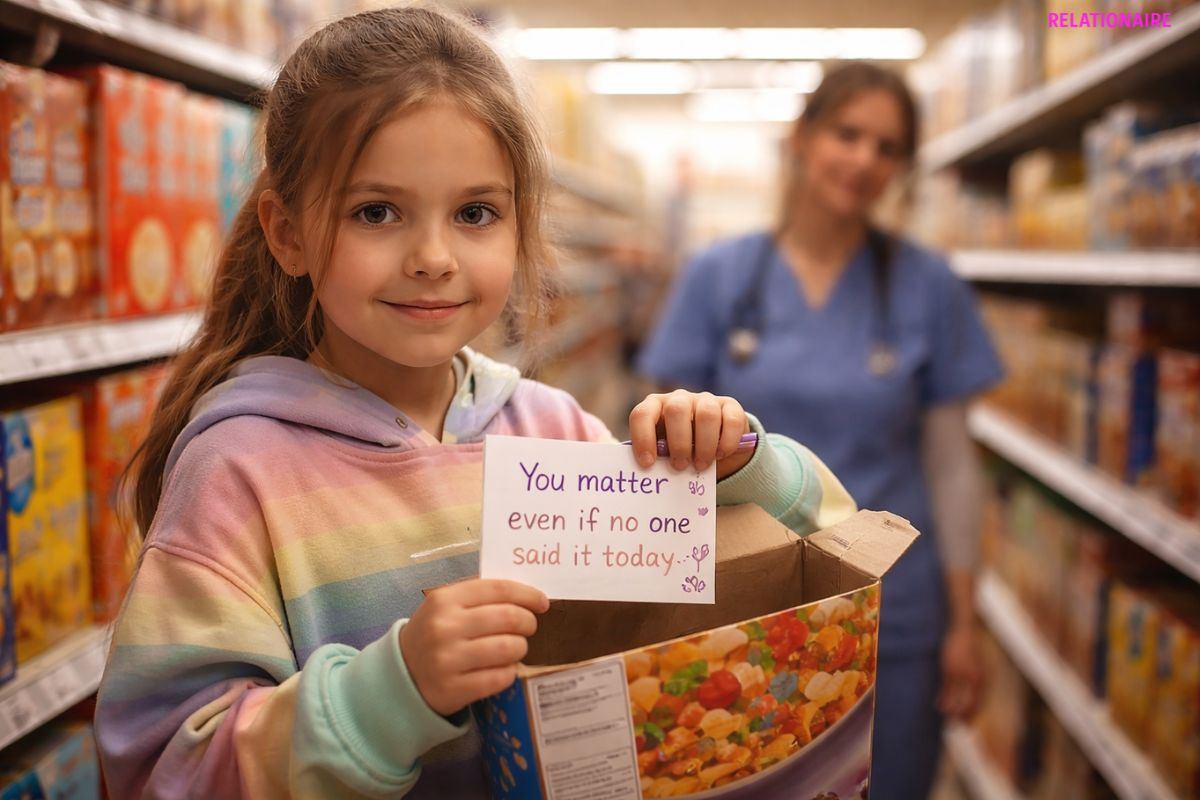
You matter even if no one said it today.
That was it.
No name. No joke punchline. No store promo. Just neat, careful handwriting in purple marker, rounded like a child’s, but steady.
He looked around the empty aisle as if someone might jump out laughing.
Nobody did.
He crumpled the note halfway, then stopped.
For some reason, he smoothed it back out.
By noon, they found three more.
One tucked behind a granola box.
One slid into a stack of instant oatmeal.
One balanced inside a cereal display so perfectly that when a customer reached for the box, it floated down like a leaf.
You’re doing better than you think.
I hope something good happens to you today.
In case nobody told you, I’m glad you’re here.
By the end of the shift, the front-end supervisor was calling it “the breakfast aisle poet,” and the stock boys were grinning like they had a mystery to solve. Tasha from register three thought it was sweet. Luis in produce thought it was creepy. Donna, who had worked there twenty-two years and trusted nobody under forty, said it was either teenagers filming a prank or some church group trying to be clever.
Daniel said very little.
He carried the notes in his shirt pocket all day, folded into a hard little square that pressed against his chest when he bent to lift things.
That night, at home, he emptied his pockets onto the kitchen table beside a utility bill, two receipts, and the hearing aid his father refused to wear.
The apartment was quiet except for the television in the next room, where his father sat half-asleep in a recliner with the volume up too high. A baseball game flickered blue across the walls. The sink was full. A photo of Daniel’s wife, Mara, still sat on the windowsill because he had never figured out where grief was supposed to go when it stopped looking fresh and started looking permanent.
She had been dead eighteen months.
People stopped bringing casseroles after two weeks.
Stopped checking in after two months.
Stopped saying her name after six.
Daniel still reached for his phone some nights to text her something small and stupid, like Did you pay the water bill? or You should see your father pretending not to like this soup.
He unfolded the cereal note again under the yellow kitchen light.
You matter even if no one said it today.
His father shuffled in behind him in socks and one of Daniel’s old flannel shirts.
“What’s that?” the old man asked.
“Nothing.”
His father squinted. “Doesn’t look like nothing.”
Daniel slid the paper aside. “Just something from the store.”
His father nodded like that made sense, then looked around the kitchen with the lost, searching expression that had started happening more lately.
“Forgetting something?” Daniel asked, softer now.
His father rubbed one hand over his mouth. “I thought your mother was in here.”
Daniel didn’t answer right away.
His mother had been gone twelve years.
The old man looked down, embarrassed by his own mind. Daniel hated that look more than the forgetting itself.
“She’s not,” Daniel said gently. “But I made soup.”
His father nodded again, twice this time, and sat down slowly.
Daniel put the note face down.
The next morning there were five more.
Now customers were finding them too.
An older woman brought one to customer service with tears in her eyes and said she’d had a doctor’s appointment she was scared to go to and didn’t know why a note in a cereal box made her cry in the middle of Market Fresh, but there she was crying anyway.
A delivery driver found one tucked near protein bars and laughed when he read it, but then he put it carefully in his wallet.
By Thursday, somebody posted a blurry photo of one online, and people started coming in asking if this was “the note store.”
Daniel should have shut it down.
Technically, random paper hidden in merchandise was a policy issue. Tampering. Liability. Unapproved items in product. He knew the language because district managers loved language that sounded clean when life wasn’t.
Instead, he had maintenance check for staples or anything dangerous.
There weren’t any.
Just folded scraps of paper from a school notebook. Torn carefully. Written slowly.
Staff kept guessing.
“Teen girl,” said Tasha.
“No, old lady,” said Luis. “That cursive on the Y? Old-lady move.”
“It’s not cursive,” said Tasha.
“Church lady,” Donna corrected.
Daniel finally said, “Enough. We’ll review the cameras.”
He heard his own voice and knew he sounded harsher than the moment deserved.
But he had slept four hours. His father had wandered outside at 2 a.m. in slippers because he thought he was late for a shift at a machine shop that had closed in 1998. Daniel had found him at the curb, shivering, confused, apologizing.
At work, Daniel lived by routines because routines did not cry in the bathroom or forget where home was.
Aisle seven camera footage took a while to pull. The image was grainy, the angle not great. Daniel stood in the cramped back office with Tasha and the assistant manager, Greg, while the video dragged across the screen.
Morning shoppers.
A mom with a toddler.
A man in paint-stained clothes.
An elderly couple arguing over bran.
Nothing.
Greg leaned back. “Told you. Prank. Probably staff.”
“Keep going,” Daniel said.
Then Tasha touched the screen.
“There,” she whispered.
A girl appeared on the monitor.
Small. Maybe ten. Brown curls pulled into a messy ponytail. Oversized sweatshirt with a fading rainbow on it. Sneakers with the toes scuffed white. She pushed a cart too big for her with both hands while a woman walked beside her staring at a phone and rubbing her temple like the day had already beaten her.
The girl paused at the cereal.
She looked up and down the aisle once.
Not sneaky, exactly.
Careful.
Then she reached into the front pocket of her sweatshirt, took out a folded note, and slipped it between two boxes with the delicate concentration of someone tucking a blanket around a sleeping person.
Daniel frowned.
Greg gave a short laugh. “Well, there’s our criminal mastermind.”
But the girl didn’t move on right away.
She stood there a second longer, fingers still resting against the box. Her mouth moved.
Tasha rewound it.
“No audio,” Greg said.
“I know,” Tasha said.
They watched again.
The girl slid the note in.
Then her lips formed words so clearly Daniel felt, absurdly, that he could hear them.
A tiny private sentence.
Like she was speaking to the box.
Or to whoever would find it.
The woman with her—thirty maybe, drawn face, pharmacy scrubs under a coat too thin for the weather—called something from the endcap. The girl startled a little, nodded, and hurried after her.
Greg snorted. “So what now? Ban children from breakfast foods?”
Tasha didn’t laugh.
Daniel kept staring at the paused frame.
The girl’s hand.
The too-big sleeve fallen back from her wrist.
The seriousness on her face.
Not mischief.
Not a prank.
“She comes in with that woman a lot,” Tasha said quietly. “I’ve seen them on Tuesdays. The woman buys ramen, juice boxes, microwave dinners. Always looks dead on her feet.”
“That doesn’t make this okay,” Greg said.
“No,” Daniel said.
But his voice had changed.
That afternoon, he stayed late to review more footage.
He watched the girl on three separate days.
Always the same pattern.
Shopping with the tired woman.
Waiting until the woman turned away.
Slipping notes into cereal boxes, oatmeal canisters, pancake mix displays.
Once, near the employee hall, the girl stopped cold.
The camera caught her head turning toward the break-room door.
Toward the place where, on Monday, Daniel had heard someone crying softly during lunch and had kept walking because the freezer invoice was late and because grown-ups got good at pretending not to hear things that might ask something of them.
The girl stood there listening.
Then she reached into her pocket and touched the stack of folded notes like she was checking they were still there.
Daniel sat very still.
At 7:43 that evening, Tasha knocked on the office door and stepped in with one last note someone had found tucked behind a box of cornflakes.
“This one’s different,” she said.
Daniel opened it.
The handwriting was the same. Purple marker. Careful block letters.
But this time it didn’t say You matter or I’m glad you’re here.
It said:
I heard the lady crying by the room with the microwave. Grown-ups walk around sad like they have to hide it. So I’m leaving these where they’ll be found.
Daniel felt something in his chest go sharp and hollow all at once.
Because he knew exactly who had been crying in that break room.
And because below that, in smaller letters, the note said:
My aunt says some people are carrying more than you can see. I think maybe you are too.
He read that line twice.
Then a third time.
Behind him, Tasha said, very softly, “Daniel…”
But he was already reaching for his keys.
Because the girl and her aunt had just walked back into the store.
And for the first time all week, Daniel realized he had been wrong about almost everything.
Part 2
By the time Daniel reached the front of the store, his heart was beating hard enough to make him feel foolish.
He was not a man who chased children through grocery aisles.
He was forty-two, tired all the time, responsible for eighty-three employees, one aging father, a two-bedroom apartment that always needed something fixed, and a grief that still rose in him at stupid times when he saw a yellow raincoat, when he passed canned peaches, when somebody in the parking lot laughed with Mara’s exact shape of joy.
And still he stood near the automatic doors, scanning carts and coats and faces like something important might disappear if he blinked.
Tasha was right.
The woman in scrubs was here.
Same thin coat. Same tired shoulders. Same hand pressed briefly to the back of her neck as though even holding her own head upright had become work.
The girl walked beside her, not skipping, not whining, not asking for candy. Just staying close. One hand on the cart. One hand stuffed into the pocket of her rainbow sweatshirt.
Daniel saw the notes before he saw her face.
A corner of notebook paper peeked out from that pocket.
He started toward them, then stopped.
He did not want to embarrass her in the middle of the store. He did not want to accuse a child of kindness like it was shoplifting. So he waited until they reached the cereal aisle, then came around the endcap slowly enough not to startle them.
The girl saw him first.
Her whole body went still.
The woman looked up a second later and gave him the quick, defensive expression people gave managers when they expected bad news.
“Can I help you?” she asked.
Daniel kept his voice gentle. “I hope so. I’m Daniel. I run the store.”
The woman’s hand tightened around the cart handle.
The girl’s fingers disappeared deeper into her sweatshirt pocket.
“I’m not in trouble, am I?” the woman asked immediately. “My card went through last time. If this is about the coupon machine, I know it jammed, but…”
“No,” Daniel said. “Nothing like that.”
He looked at the girl. “I think I need to ask about the notes.”
The woman blinked. “What notes?”
The girl lowered her eyes.
Daniel wished, instantly, that he’d found a better first sentence.
The woman turned to the child. “Mia?”
So that was her name.
Mia swallowed.
“You put papers in the boxes?” her aunt asked, voice still calm but thinning at the edges. “Mia, did you do that?”
Mia nodded once.
The aunt shut her eyes for a second, exhausted all the way through. “I am so sorry. I’m so, so sorry. She’s a good girl. She just… she writes things. I didn’t know she was putting them in merchandise. Mia, honey, you can’t do that.”
“It’s okay,” Daniel said quickly.
“No, it’s not,” the aunt said. “I understand. We’ll leave.”
She looked mortified already, gathering her purse, reaching for the cart like the only thing worse than being poor in public was being poor and troublesome.
Mia’s face changed then.
Not defiant. Not dramatic.
Just stricken.
“They needed them,” she said quietly.
The aunt looked down at her. “You don’t know that.”
“Yes, I do.”
People say children are loud when they’re sure of something. Sometimes they aren’t. Sometimes certainty comes out small.
Daniel felt it then in the way she said it.
Not stubbornness.
Witness.
He said, “Can we talk for one minute?”
The aunt hesitated. “We really don’t want problems.”
“You’re not in trouble,” he said again. “I promise.”
He led them to the little employee seating area near the customer service desk, away from the main flow of traffic. Tasha brought three bottles of water without being asked. Greg walked by, saw the scene, and kept going when Daniel gave him a look.
Up close, Mia was smaller than she’d seemed on camera. Ten, maybe just turned. Freckles across the nose. A tiny ink stain on the side of one finger. The kind of child who looked as if she read every sign in every waiting room.
Her aunt sat stiff-backed beside her.
“I’m Renee,” she said. “Her aunt.”
Daniel nodded. “I appreciate you stopping.”
Renee gave a tired laugh with no amusement in it. “Didn’t feel like I had much choice.”
Mia twisted the hem of her sleeve.
Daniel took one of the notes from his pocket and set it on the table.
“I found this one today.”
Mia looked at it, then at him.
Renee looked too, and Daniel saw the exact moment she understood there was more to this than a child being odd in aisle seven.
Her eyes moved over the words once.
Then again.
“I heard the lady crying by the room with the microwave…”
Renee inhaled slowly.
Daniel said, “Why did you start leaving them?”
Mia glanced at her aunt first, asking permission without asking it aloud. Renee gave the smallest nod.
So Mia answered.
“Because grown-ups don’t tell the truth when they’re sad.”
No one spoke.
Mia went on, still looking at the note instead of at them.
“They say they’re tired. Or fine. Or they smile with their mouth but not their eyes.” She pressed her lips together for a moment. “I heard somebody crying when we came for groceries last week. Near the room with the microwave. Aunt Renee didn’t hear her because she was talking to the insurance lady on the phone.”
Renee winced a little at that, not from blame but recognition.
“I wanted to see if the crying lady was okay,” Mia said. “But Aunt Renee says people deserve privacy when they’re hurting. So I thought maybe if I put nice notes where people find food, then maybe the crying lady would find one. Or someone sad like her.”
Her voice was matter-of-fact, almost practical.
As if this had been the most reasonable solution.
Daniel asked, “Why cereal boxes?”
Mia finally looked up.
“Because people touch a lot of them before they pick one.”
That landed harder than it should have.
Daniel had spent years learning how customers moved through aisles. Endcaps, eye-level shelves, price breaks, product placement.
This child had mapped sorrow with the same logic.
Renee rubbed at her forehead. “Her mom used to leave notes in lunch boxes. On napkins. Back of receipts. In library books. Little things. ‘You can do hard things.’ ‘I’m proud of you.’ Stuff like that.” Her mouth trembled, but only once. “After my sister died, Mia started writing them herself.”
Daniel said nothing.
Renee looked embarrassed for having said it out loud.
“She was eight,” Renee said. “Brain aneurysm. Just… dropped in the kitchen. Mia found her before I got there.” She swallowed. “Ever since then, she notices everything. I mean everything. If somebody’s voice sounds wrong, if a waiter is pretending not to limp, if a cashier smiles too fast. You can’t hide much from her.”
Mia stared at the cap of her water bottle.
Daniel felt ashamed of how close he had come to calling it tampering and having security watch for her.
“I’m sorry,” he said, and meant more than one thing.
Renee gave a short nod like sorrow had become something people handed each other in paper cups.
“I work nights at St. Anne’s,” she said. “Medical billing, mostly. Extra shifts when they’ll let me. My husband left two years ago. My son’s with my mother most afternoons. Mia comes with me because I can’t always afford a sitter and because…” She glanced at the girl. “Because she doesn’t like being left too much.”
Mia’s hand slid quietly toward hers under the table.
Renee covered it without looking.
Daniel had to clear his throat before he trusted his own voice. “The person crying in the break room… it was one of my cashiers.”
Mia looked up right away. “Is she okay?”
He almost said the adult thing. She’s fine. She’s managing.
Instead he told the truth.
“She was trying to be.”
Tasha, standing nearby pretending to organize receipt paper, turned her face away for a second.
Renee said, “We really are sorry. She shouldn’t have done it without permission.”
Mia’s eyes filled instantly, but she did not cry. She looked as if she had accepted a sentence.
Daniel saw it—the child bracing not for punishment, but for the moment kindness would be treated like damage.
He leaned forward.
“Mia,” he said, “I need you to hear me carefully.”
She nodded once.
“What you did broke a store rule.”
Her face dropped.
“But it may also have mattered more than you know.”
She stared at him.
Renee stared too.
Daniel reached into his pocket and laid out the other notes, one by one, across the little break-room table like cards.
The older woman who cried.
The driver who kept one in his wallet.
The cashier who found one during a panic attack in the restroom and stood there breathing over it until her hands stopped shaking.
He told them all of it.
Not names. Just truths.
Mia listened without moving.
When he finished, she whispered, “So they worked?”
Daniel almost laughed, and almost cried, which was a miserable feeling.
“Yes,” he said. “They worked.”
For the first time since he’d sat down, Mia smiled.
It was not triumphant.
It was relief.
Pure relief.
As if the world had been heavy on one side and now, for one second, it balanced.
Then Tasha stepped closer and said softly, “Daniel… you should tell her the rest.”
He looked at Tasha.
She looked back at him in that steady way of hers, the one that tolerated no cowardice from men in management positions.
So Daniel turned back to Mia.
“The cashier you overheard,” he said carefully, “was Tasha. And the note she found…” He paused. “It was on a day she was trying to decide whether to walk out and never come back.”
Renee inhaled.
Mia’s eyes moved to Tasha.
Tasha knelt beside the chair so they were eye level. “My son has been in and out of the hospital since January,” she said. “Nothing dramatic tonight. He’s okay tonight. But money’s bad, sleep’s bad, everything feels bad some days. I was in that room crying because I didn’t think I could smile at one more stranger without falling apart.”
Mia was so still she barely seemed to breathe.
Tasha reached into her apron pocket and unfolded a wrinkled scrap of paper so soft at the corners it had clearly been opened many times.
It was one of Mia’s notes.
In case nobody told you, I’m glad you’re here.
“I kept this,” Tasha said. “I keep it with me every shift.”
Mia’s chin trembled.
Renee pressed a hand over her own mouth.
Daniel thought the moment had already broken him open enough.
Then Mia asked the question that changed everything.
Very quietly, with total sincerity, she looked at Tasha and said:
“Did it help enough for you to stay?”
And nobody in that little employee corner breathed until Tasha answered.
Part 3
Tasha cried before she said a word.
Not loudly.
Not dramatically.
Just one hand over her mouth, shoulders shaking once, then twice, as though the question had found the exact place in her she had been trying all year not to touch.
Mia’s face crumpled immediately.
“I’m sorry,” she whispered. “Was that too much?”
Tasha shook her head fast.
“No, baby,” she said, laughing through tears now. “No. That was exactly enough.”
She looked down at the note in her hand, smoothing it with her thumb.
“Yes,” she said. “It helped enough for me to stay.”
Mia let out a breath so deep it sounded like she’d been holding it for days.
Renee closed her eyes.
Daniel looked away for a moment, because there are some private human things you witness by pretending you’re not witnessing them.
Around them, the store kept moving.
Carts rolled.
A child somewhere asked for cookies.
The doors sighed open and shut.
An announcement crackled overhead for a price check in frozen foods.
And in the middle of all that ordinary noise, a ten-year-old girl sat in a folding chair near customer service and learned that her small act had kept one hurting adult from stepping all the way out of her own life.
It would have been enough.
For another story, that would have been enough.
But pain has a way of linking arms in places like grocery stores.
Renee wiped under one eye and said, almost apologetically, “She does this at home too. Leaves notes in my purse. In my coffee mug. In the pocket of my scrubs. Last month I found one taped to the gas gauge because it was on empty.”
Mia looked embarrassed. “You were crying at the gas station.”
“I was not crying,” Renee said automatically.
Mia gave her a look.
Renee laughed through her tears. “Fine. I was crying at the gas station.”
Daniel smiled before he meant to.
It felt strange on his face. Underused.
“She doesn’t do it because she thinks she can fix everything,” Renee said. “I need to say that. People hear about a child like this and they make her into something… shiny. She’s not shiny. She’s ten. She forgets homework. She hates socks. She lies about brushing her teeth.” She squeezed Mia’s hand. “She just can’t stand the thought of somebody hurting alone if she can reach them.”
Mia leaned gently into her aunt’s shoulder.
That sentence stayed with Daniel.
She can’t stand the thought of somebody hurting alone if she can reach them.
He thought about Mara in the hospital, smiling at nurses so they wouldn’t feel awkward. He thought about his father asking for his dead wife in a kitchen that smelled like soup. He thought about the break-room door he had passed while Tasha cried behind it. He thought about how often adulthood looked like swallowing pain because there was produce to stock, bills to pay, rides to arrange, soup to heat, shifts to cover.
And how a child had seen through all of it in one week.
Daniel said, “Would you both wait here a minute?”
Renee stiffened. “For what?”
“Trust me.”
He went to the back office and did something he almost never did without corporate approval.
He ignored policy.
Then he ignored it again.
He came back out with a shallow cardboard produce tray, a pack of index cards from the office supply cabinet, three marker sets from seasonal, and a small handwritten sign he had made in thick black ink.
He set them on the table.
Mia read the sign out loud.
TAKE A NOTE. LEAVE A NOTE. FOR ANYONE CARRYING MORE THAN YOU CAN SEE.
Her eyes went wide.
Renee stared at Daniel like she wasn’t sure whether to thank him or stop him.
“This’ll probably get me an email from district,” he said. “Maybe two.”
Tasha laughed wetly.
Daniel looked at Mia. “No more hiding notes in merchandise. That part really does have to stop.”
Mia nodded quickly. “Okay.”
“But,” he said, tapping the sign, “if you want, we can do it this way.”
For one suspended second, she did not seem to understand.
Then she did.
And when she did, her whole face lit from the inside with something so pure it made Daniel think of sunrise through thin curtains.
“Really?”
“Really.”
She looked to Renee again, because even joy in children often checks the room before it lands. Renee was crying openly now, but smiling too.
“Really,” her aunt echoed.
So Mia picked up a purple marker.
Of course it was purple.
She bent over the first card with the solemn concentration of someone beginning sacred work. Tasha sat beside her and wrote one too. Then Renee. Then, after standing there like an idiot pretending he was above this sort of thing, Daniel took a card himself.
He stared at the blank space longer than he expected.
He had not written anything by hand that wasn’t a schedule correction or grocery list in months.
Finally he wrote:
Some days surviving is the brave thing. It still counts.
He almost hid it before anyone saw.
Instead, he laid it in the tray.
By evening, there were twenty-seven notes.
Customers paused.
Read.
Smiled.
Cried in embarrassing little public ways.
Wrote their own.
A teenager in a marching-band hoodie left one that said, Your tired does not make you lazy.
An older man with mechanic’s hands wrote, Some of us are still here because somebody was kind at the right time.
A nurse on her lunch break wrote, I know you’re scared. Me too. Keep going.
The tray filled. Then overflowed.
Daniel moved it to a small folding table near the front with a cleaner sign and a clip display of pens.
Over the next week, people started coming in just to read them.
Not in a viral, ridiculous way. Not crowds with ring lights and hashtags. Just regular people moving slower than usual past customer service. A school bus driver. A widow in a blue raincoat. A man in work boots who pretended to browse gum while slipping a card into his jacket pocket.
Mia and Renee came every Tuesday.
Sometimes they bought groceries.
Sometimes almost nothing.
Sometimes just milk and bananas and whatever was on sale.
Mia never made a show of the note table. She would straighten cards, read a few, add one of her own, then drift to help Renee compare prices on cereal as if she hadn’t changed the emotional temperature of the whole building.
Daniel learned things in those Tuesdays.
That Mia still slept with the hallway light on.
That Renee drank coffee too strong and forgot to eat when stressed.
That Mia’s mother used to sing while packing lunches, badly and loudly.
That Daniel’s father had good days and frightening ones.
That grief looked different in each house but recognized itself everywhere.
One Tuesday, Mia handed Daniel a folded card and said, “This one’s for you, but you have to read it later.”
He nodded like that was normal, though his throat tightened immediately.
He waited until closing.
His father was asleep in the recliner when Daniel got home. The apartment was dim except for the stove light. On the kitchen table sat a bowl with two hard candies in it, placed there by hands that often forgot the decade but still remembered Daniel liked peppermint.
Daniel took off his jacket, sat down, and opened Mia’s note.
The handwriting was neat as ever.
You look like somebody who got used to carrying everybody. I hope somebody carries you sometimes too.
He stared at it a long time.
Then he laughed once, sharp and broken, because it was too accurate to be anything but mercy.
He cried after that.
Not the clean movie kind.
The real kind.
Face in his hands.
Shoulders bowed.
Quiet because his father was sleeping in the next room.
He cried for Mara.
For his father.
For bills and paperwork and loneliness.
For the break-room door.
For the way he had almost punished tenderness because it arrived in a form he did not know what to do with.
When he was done, he folded the note carefully and slid it into his wallet behind his driver’s license.
Weeks passed.
Then months.
The note table stayed.
District did send emails. Daniel answered them with words like community engagement and customer goodwill and local morale initiative until they got tired and moved on to more measurable problems.
Winter began to loosen.
One Tuesday near spring, Daniel’s father had a bad morning and an even worse afternoon. By six, he was agitated, asking for his wife, refusing dinner, accusing Daniel of hiding things that no longer existed. Daniel nearly called out of his closing shift.
But there was nobody to cover.
So he brought his father with him for the last hour and sat him in the office with a blanket and an old baseball game playing softly on a tablet.
His father hated being fussed over. He also hated being alone.
Mia found him there by accident while looking for Daniel.
She stood in the doorway, quiet.
The old man looked up, confused. “You work here?”
“No,” she said. “But I’m here a lot.”
He considered this. “All right.”
Daniel started to apologize for him, for the awkwardness, for the whole untidy burden of it.
Before he could, Mia walked in and held out a card.
“I wrote this one for someone who misses people,” she said.
His father took it with trembling fingers.
He read slowly now. Painfully. But he read.
Then he looked at her over the top of the card with wet, astonished eyes.
“What a thing,” he murmured.
Daniel swallowed hard.
Later, after they were home and the apartment was quiet, his father tapped the note against the kitchen table and said, in one of his clearer moments, “That little girl knows something.”
“Yes,” Daniel said.
His father nodded.
“Most folks spend a whole life learning what she already knows.”
Daniel looked at the note in the old man’s hand.
At the careful purple letters.
At the slight shake in the fingers holding it.
At the tired kitchen made tender for one moment by being understood.
“What’s that?” his father asked suddenly, pointing toward Mara’s photo on the sill.
Daniel opened his mouth, prepared for the familiar ache.
Then his father smiled softly.
“That’s your wife,” he said. “Pretty girl.”
And for the first time in a long time, the grief did not knock the breath out of Daniel.
It just sat beside him.
Warm. Sad. Bearable.
He looked out toward the dark window, where his own reflection hovered faintly over the kitchen, and thought about cereal boxes and break rooms and the million invisible ways people pass one another every day without knowing who is barely holding on.
Sometimes all the grand things fail.
The speeches.
The advice.
The plans.
And what remains is smaller than anyone expects.
A folded note.
A child’s handwriting.
A sentence left where a hurting person might find it.
Sometimes that is not everything.
Sometimes it is just enough.
And sometimes just enough is what carries a person through.