If you’ve already read part 1 of this story on Facebook, go here for Part 2!
By the time I saw him shove the blanket into his backpack, I had already decided what kind of kid he was.
That is the part I can’t forgive in myself.
It was late afternoon at Mercy Paws Shelter, that dead hour between the school rush and closing, when the whole place smelled like bleach, wet fur, and tired hope. The barking had settled into little bursts. A radio played low behind the front desk. Someone had left a half-drunk coffee beside a stack of intake forms, and the coffee had gone cold a long time ago.
I was in the adoption room, folding laundry that never stayed folded.
Tiny plaid dog sweaters.
A faded towel with cartoon bones on it.
Three blankets from the senior kennel, all worn soft from washing.
That was when I noticed the boy.
He had come in with no adult, which happened sometimes. Kids from the apartments across the road liked to walk through and look at the dogs pressed against kennel doors. Most of them wanted puppies. Most of them got loud near the glass and had to be told three times not to tap.
This boy was different.
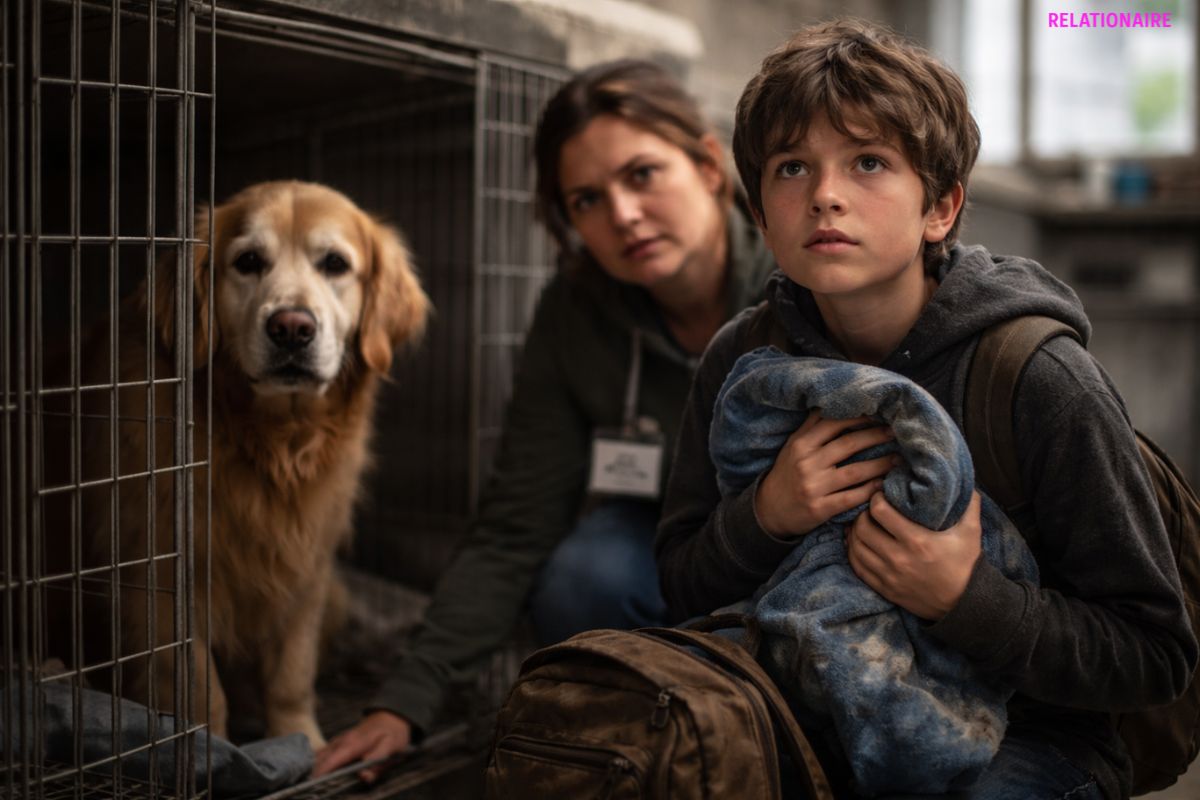
He was maybe eleven. Small for his age. Dark hoodie zipped all the way up though the day was warm. Backpack hanging off one shoulder. Mud on the toes of his sneakers. He didn’t bounce from kennel to kennel or ask if anything was free. He moved slowly, like he was in church.
He stopped at the senior dog room.
Not the puppies.
Not the big young shepherd mix everybody wanted.
The senior room.
I watched him kneel in front of kennel seven.
Buddy lifted his head from the blanket and thumped his tail once.
Buddy was the kind of dog people called “sweet” right before they passed him over. A twelve-year-old golden retriever with cloudy eyes, a stiff back leg, and the patient sadness of an animal who had already loved one family for most of his life and didn’t understand why he was here now.
His owner had gone into long-term care three months earlier.
No family had come for Buddy.
No one wanted an old dog with medication, arthritis, and a face that looked too much like goodbye.
The boy put his fingers through the bars.
Buddy pushed his nose against them and closed his eyes.
I remember that part because it looked like relief.
“Hey there, honey,” I called, keeping my voice light. “You can pet him through the gate, but don’t open anything, okay?”
The boy nodded without looking at me.
I went back to folding, but I kept an eye on him.
He stayed with Buddy a long time. Longer than most adults did.
He whispered something I couldn’t hear.
Then he looked over his shoulder.
Quick.
Careful.
The kind of look people make when they don’t want to be seen.
I straightened.
He opened the kennel latch just enough to slip inside.
“Hey,” I said, sharper now. “You need to come out of there.”
He froze, one knee on the concrete floor. Buddy didn’t move. Just rested his head against the boy’s arm like he knew him.
The boy reached for the blanket.
Not the whole thing at first. Just a corner. He rubbed it between his fingers, then lifted it toward his face.
His shoulders tightened.
Then, fast as a match strike, he folded the blanket in half, then half again, and stuffed it into his backpack.
I dropped the towel.
“Excuse me?”
He jerked so hard he hit the kennel gate with his elbow.
I crossed the room before I could talk myself calmer.
“Take that out.”
His face drained. He clutched the backpack straps with both hands.
“I was just…”
“No,” I said. “You were stealing.”
The word landed hard.
Buddy gave a low whine.
The boy looked from me to the floor.
He couldn’t hold still. His hands shook against the straps. Not defiant. Not angry. Just scared.
I had seen every kind of lie in that shelter. People swearing they’d return for a surrendered pet. People claiming they’d “found” a purebred they were clearly trying to dump. Teenagers slipping collars or toys into coat pockets because they thought animal shelters were some kind of free-for-all.
So yes, I judged him.
His backpack.
His trembling hands.
The way he wouldn’t meet my eyes.
I held out my hand. “Now.”
For one second, I thought he might run.
Instead, he slowly unzipped the bag.
The blanket was right there on top.
It was old blue fleece, worn almost white in the middle, with one frayed corner Buddy liked to mouth when he slept. I knew that blanket well. We all did. When Buddy first arrived, he refused every clean blanket we gave him. He only wanted that one. The one he came in with. The one that still smelled like home.
The boy touched it like it was breakable.
“I was gonna bring it back,” he whispered.
“That isn’t the point.”
His throat moved.
He looked too young all of a sudden.
“Do your parents know where you are?” I asked.
He said nothing.
I tried again. “Who brought you here?”
“Nobody.”
“Nobody?”
“I walked.”
“From where?”
He hesitated, then said, “St. Agnes.”
The hospital across the highway.
I stared at him.
“Why were you at St. Agnes?”
His chin trembled once. Just once. Then he pressed his lips together like he was trying to hold something inside with his teeth.
I softened a little, but not enough.
“You can’t take things from here,” I said, quieter now. “Especially not from one of the dogs. That blanket belongs to Buddy.”
The boy finally looked at me.
His eyes were red-rimmed, not from being caught.
From before.
“I know,” he said.
There was no attitude in it. No excuse. Just pain.
Buddy struggled to his feet inside the kennel and nosed the bars again, tail brushing the blanketless floor.
The boy saw it and flinched like he’d been hit.
That was the first crack in what I thought I knew.
Kids who steal for fun don’t look guilty toward the dog.
They look guilty toward the adult.
“Then why would you take it?” I asked.
He swallowed hard.
The room had gone strangely still around us. Even the barking from the back seemed farther away. I could hear the old wall clock ticking above the lost-and-found shelf.
He reached into the side pocket of his backpack and pulled out a folded paper. Not a note. A drawing.
It was done in crayon, the kind kids make in waiting rooms when they’ve been sitting too long.
A hospital bed.
A window with a yellow sun in the corner.
A boy standing beside the bed.
And next to the bed, drawn bigger than everything else, was a golden retriever with a crooked smile and one front paw lifted like he used to do when he wanted attention.
Across the top, in shaky block letters, it said:
FOR GRANDPA SO HE REMEMBERS TO WAKE UP
Something cold moved through me.
I looked up.
The boy’s voice came out so thin I almost missed it.
“He won’t open his eyes for me anymore.”
My hand dropped to my side.
He rubbed at his nose with the heel of his palm and kept going, because once a child starts telling the truth, sometimes it all comes at once.
“They said he gets tired and mixed up now. They said not to ask too much because it makes it harder. But when I said Buddy’s name this morning…” He stopped, trying to breathe. “He opened his eyes a little.”
I said nothing.
I could feel myself getting smaller inside.
The boy held the blanket tighter.
“He used to belong to my grandpa,” he whispered. “Buddy did.”
And just like that, the whole room changed.
The dog.
The blanket.
The hospital.
The way Buddy had pressed against him like he already knew his hands.
My mouth opened, but no words came.
The boy looked at the blanket, then back at me, tears standing in his eyes but not falling.
“He knows that smell,” he said. “It’s the only thing that still makes him look at me.”
I stared at him, and for the first time since I had stopped him, I understood that I had not caught a thief.
I had interrupted a grandson.
And then he said one more thing that made my heart stop.
“My mom doesn’t know I came,” he whispered. “Because if she sees what’s written on the paper in my pocket, she’ll have to tell me if it’s true.”
I heard my own voice before I even knew what I was asking.
“What paper?”
His fingers moved to the front pocket of his backpack.
Slowly.
Carefully.
He pulled out a folded hospice form with his grandfather’s name on it.
And at the bottom, under a line of medical notes, was one sentence partly visible before he opened it all the way.
Expected to remain unresponsive until..
Part 2
I took the paper from him with hands that didn’t feel steady anymore.
Not because I had a right to.
Because he was a child, and children should not have to read sentences like that alone.
The hospice form had been folded so many times the edges were going soft. One corner was damp, like it had sat in a sweaty palm all day. At the bottom, beneath words no eleven-year-old should have been trying to decode, it said his grandfather was not expected to regain meaningful awareness.
I hated that phrase the moment I saw it.
Meaningful awareness.
As if whoever had written it had never been loved by a man who taught a boy how to cast a fishing line or warm up a truck in winter or whistle through his teeth while buttering toast.
The boy watched my face.
“You can just say it,” he said.
His voice was flat now. Too flat.
That scared me more than the crying would have.
I crouched down so I wasn’t towering over him. Buddy shifted inside the kennel and let out a low sound, almost like a sigh.
“What’s your name?” I asked.
“Eli.”
“I’m Nora.”
He nodded once.
“Eli,” I said gently, “where did you find this paper?”
“On the chair by the window. My mom went to get coffee and my aunt was outside on the phone.”
He said it without shame. Just facts.
“Did someone explain it to you?”
He shook his head.
“But you think you know what it means.”
His jaw tightened.
“It means they think he’s leaving.”
I looked down at the paper again, then folded it shut.
There are moments when adulthood feels less like wisdom and more like being the person who has to stand nearest to the pain. This was one of them.
Buddy had come in with a box of things.
A leash.
A stainless-steel bowl with the name BUDDY scratched into the bottom.
Two pill bottles.
A tennis ball gone bald.
And that blue blanket.
The intake note said the owner, Walter Bennett, had been transferred from rehab to hospice after complications from a second stroke. No immediate family able to take the dog. Shelter requested to hold for seventy-two hours. After that, standard intake.
I remembered the day because Buddy had refused food until evening.
I also remembered Walter’s daughter signing the surrender papers with a face so tight and pale I had mistaken her for cold.
Maybe she had just been breaking in public.
“Your grandfather’s name is Walter?” I asked.
Eli nodded fast. “Walter Bennett. But everybody calls him Walt. Or Grandpa Walt. Buddy sleeps by his chair at home. Or slept.” His voice snagged on the last word.
I closed my eyes for half a second.
“Why didn’t your family tell us?” I said, though really I was asking myself why I had never looked deeper than the paperwork.
Eli wiped his face. “My mom said we couldn’t bring Buddy where Grandpa is. She cried when she said it. So I didn’t ask again.”
“Then why come here today?”
He looked toward Buddy.
“He opened his eyes when I said Buddy’s name.”
It came out almost angry now, not at me.
At the world.
“At breakfast, my mom was telling Aunt Rachel that maybe he could still hear us, and I said maybe if Buddy barked, Grandpa would wake up. And Aunt Rachel started crying and said, ‘Honey, that’s not how this works.’”
He swallowed.
“But they don’t know him.”
I could not argue with that.
Not when he said it like that.
Not when children are sometimes the only ones stubborn enough to keep loving past what adults can bear.
“So you came for the blanket,” I said.
He nodded.
“Because it smells like Buddy.”
Another nod.
“And you thought if your grandpa smelled it…”
“He’d know home.”
That line hit me so hard I had to look away.
Home.
Not medicine.
Not prognosis.
Not numbers on a chart.
Home.
A dog at his feet.
Old fleece warmed by years of naps.
The smell of fur and laundry soap and porch dust and the life he had lived before hospital rooms taught everybody how small a person could become.
I stood up and looked at Buddy.
Old dog. Stiff dog. Good dog.
He was watching Eli the way some dogs watch only one person in the world.
I made a decision before I had fully thought it through.
“Wait here.”
Eli’s eyes widened. “Are you calling my mom?”
“Not yet.”
I went to the office and pulled the intake file. Then I called St. Agnes hospice.
The nurse who answered sounded tired in the kind way nurses often do, worn thin but still trying. I explained who I was, stumbled through the strange story, and asked if Walter Bennett had family present.
“Yes,” she said carefully. “His daughter has been with him most of the day.”
“I think her son is with me.”
Silence.
Then, “Oh, sweetheart.”
Not to me.
To the whole situation.
Two minutes later, Walter’s daughter was on the line.
Marianne Bennett.
Same last name as the surrender form.
Same clipped voice I remembered from the intake desk, except now it was raw around the edges.
“You have Eli?” she asked.
“He’s safe.”
I heard her exhale like she had been braced for something worse.
Then I told her the truth.
Not all of it at first. Just enough.
He had come to see Buddy. He had tried to take the blanket. He had read the paper. He thought the smell might help his grandfather open his eyes.
There was a long, terrible pause.
When Marianne spoke again, her voice sounded cracked open.
“He shouldn’t have seen that form.”
“I know.”
“He’s been listening to everything.” She made a sound halfway between a laugh and a sob. “He keeps asking questions like he’s the parent and I’m the one hiding.”
I glanced through the glass.
Eli was sitting cross-legged outside Buddy’s kennel now, one hand through the bars, the blanket draped over his lap. Buddy had laid his head over the boy’s wrist.
“Ms. Bennett,” I said softly, “did your father love that dog?”
The answer came fast.
“More than anything after my mother died.”
Something in me settled into place.
I asked the question I probably should not have asked without policy, permission, or proper shelter procedure.
“Could you get here?”
She hesitated.
“I’m not sure I can leave him.”
“What if,” I said, and kept going before fear could stop me, “what if Buddy came to him?”
The silence on the other end this time was different.
Not shock.
Hope so sudden it hurt.
“You can do that?”
“No,” I said honestly. “Not exactly. Not usually. But I can ask.”
I hung up and found my manager in the back, elbow-deep in canned food donations. Dana had worked rescue twenty-two years. She trusted dogs faster than people and policies more than tears, which was usually wise.
Usually.
I told her everything.
Every last piece.
When I got to the part about the blanket, she crossed her arms. When I got to the hospice form, her face changed. When I said I wanted to take Buddy to St. Agnes, she said, “Absolutely not.”
I had expected that.
“Dana—”
“No, Nora. Liability alone—”
“This dog belonged to that man.”
“He was surrendered.”
“On paper.”
“That paper matters.”
I almost said so does love, but it sounded too easy for the mess we were standing in.
So I tried again.
“He’s dying. The grandson thinks the dog is the only thing that still reaches him.”
Dana rubbed her forehead. “You don’t know that.”
“No. I know the kid walked across a highway for a blanket that smells like home.”
That landed.
Not enough, but some.
Dana looked through the window into the adoption room.
At Eli.
At Buddy.
At the blue blanket pooled across the boy’s knees.
Then she said quietly, “You know what happens if we bend rules for every heartbreaking story.”
I did know.
Shelter work was full of heartbreak. If you let every story rewrite the rules, the place would come apart.
But some moments do not arrive looking fair.
They arrive looking human.
I turned to answer her, but before I could, Eli appeared in the doorway.
He had clearly heard enough.
He was holding the blanket in both hands, clutching it to his chest so tightly his knuckles had gone white.
His voice shook, but he lifted his chin anyway.
“You can keep the blanket,” he said. “I know I wasn’t supposed to take it.”
Dana’s face softened a fraction.
Eli kept going.
“I just need to ask one thing.”
He looked at me, then at Dana, then down at Buddy standing beside his leg now, pressing against him.
And when he spoke again, there was a kind of heartbreaking care in it no child should have to carry.
“If Grandpa can’t come home,” he whispered, “could Buddy at least be there when he leaves?”
Part 3
There are questions adults spend whole lives learning how to avoid.
That was not one of them.
That question walked straight into the room in muddy sneakers and a too-big hoodie and asked for mercy with both hands open.
Dana turned away first.
That was how I knew we were close.
She pretended to check a clipboard on the wall, but her jaw had tightened. I had seen that look before. It was the look she got when a dog nobody wanted finally got adopted by exactly the right person and she had to act like paperwork was the reason her eyes went red.
“Eli,” she said, still facing the clipboard, “go sit with Buddy for a minute.”
He didn’t move.
“Please,” I added.
After a second, he nodded and went back to the adoption room.
Dana waited until he was gone.
Then she looked at me.
“If we do this,” she said, “we do it properly.”
I almost laughed from the relief of it.
Instead I just said, “Yes.”
She lifted one finger.
“Temporary transport form.”
A second finger.
“Written permission from family.”
Third finger.
“Vet clearance.”
Fourth.
“And I am driving, because if this ends with anybody yelling at us, it should be me.”
I covered my mouth with my hand.
Dana frowned at me. “Don’t make a big thing out of it.”
“You’re literally making the biggest thing out of it.”
“Go call the vet.”
The next hour moved like panic and prayer mixed together.
Our vet confirmed Buddy was stable enough for a short ride.
Marianne Bennett called back crying before I even finished leaving a message, saying yes, yes, of course yes, she would sign whatever needed signing.
Dana printed forms.
I found Buddy’s old red leash in the storage bin where surrendered belongings waited too long for miracles.
Eli sat in the adoption room with one hand buried in Buddy’s fur, whispering things too low for us to hear. At one point I walked past and caught only one sentence.
“I found him, Grandpa. I really did.”
By the time we loaded Buddy into Dana’s dusty shelter van, the sky had gone the pale gray-blue that comes right before evening gives up. Eli climbed in beside the kennel crate, blanket in his lap. He looked scared again, but it was a different kind of fear now.
Not getting caught.
Getting there too late.
Hospice smelled like hand sanitizer, paper cups, and the soft hum of things people don’t notice until they’re listening for bad news. The front desk nurse recognized Eli immediately and came around the counter before he reached her.
“Oh, baby,” she said, pulling him into a hug.
He stood stiff for a second, then folded.
Not all the way.
Just enough.
Like he had been holding himself together with strings.
Marianne met us at the room door.
She looked ten years older than the woman from the surrender paperwork. Her hair was half-fallen out of its clip. There was a coffee stain on the sleeve of her sweater. Her face did that terrible thing grief does where it makes someone look both young and exhausted at once.
She hugged Eli so tightly he made a small sound against her shoulder.
“I’m sorry,” he whispered.
“No,” she said at once, pulling back to hold his face. “No, sweetheart. I’m sorry.”
Then she saw Buddy.
Whatever Marianne had been bracing herself with all day broke right there.
She covered her mouth and started crying.
Not loud.
Not dramatic.
The kind of crying people do when something tender enters a room they thought only pain could fit inside.
Buddy stepped forward slowly on his stiff leg, nails clicking against the tile. He looked past all of us and toward the bed.
Toward Walter.
The room got very still.
Walter Bennett lay small beneath a white blanket, the kind hospitals tuck too tightly. His face was gray with the effort of breathing. One hand rested palm-up on the sheet, loose and thin, with a hospital bracelet hanging from his wrist. His eyes were closed.
Machines blinked quietly nearby.
The television was on mute.
A paper cup of melted ice sat on the table by the bed beside a folded prayer card and a pair of reading glasses nobody had the heart to put away.
Eli stopped at the foot of the bed.
All the brave drained out of him at once.
He looked like a little boy again.
“What if it doesn’t work?” he asked.
Marianne knelt in front of him.
Then she did something I think she had been trying not to do all week.
She told him the truth.
Not all of death. Not every cruel inch of it.
Just the part a child can hold.
“It still matters,” she said. “Even if it doesn’t wake him up. It still matters that you came.”
Eli nodded, but his mouth quivered.
Dana gently unclipped Buddy’s leash.
The old dog did not rush.
He walked to the bed like he already knew exactly where to go, slow and careful, and laid his head against Walter’s hanging hand.
I heard Marianne gasp.
Walter’s fingers did not move at first.
Then they twitched.
Just once.
Then again.
Eli looked at me with huge eyes.
I stepped back so far I hit the wall.
Buddy gave one soft huff and leaned harder into the bed.
Walter’s hand curled into the fur at Buddy’s neck.
It was small.
Weak.
But it happened.
Marianne made a choking sound and pressed both hands over her mouth. Dana looked straight down at the floor. I had tears running down my face before I even felt them.
Eli went to the side of the bed slowly, as if he was approaching a deer that might startle.
“Grandpa?” he said.
Walter’s eyelids fluttered.
Once.
Twice.
Then opened a narrow, cloudy slit.
Not fully.
Not the way movies do it.
Just enough.
Enough to see.
Enough to know.
His gaze moved badly at first, wandering. Then it landed on Buddy.
And stayed there.
The change in his face was almost too slight to call a change at all.
But I saw it.
Everyone did.
Recognition.
Relief.
Home.
Eli grabbed the blue blanket from his arms and spread it carefully over Walter’s chest and Buddy’s back, making a bridge between them.
The dog sighed and settled his weight against the mattress.
Walter’s cracked lips parted.
No sound came.
Eli leaned closer. “What, Grandpa?”
Again, no sound.
Just breath.
Marianne bent in too, tears falling freely now.
Walter tried once more.
This time the word came out broken and thin as tissue paper.
“Boy.”
Eli started sobbing.
Not loud.
Not wild.
The kind that shakes out of a child when love and fear finally hit the same place.
“I’m here,” he said. “I’m here. And Buddy’s here too.”
Walter’s fingers moved in Buddy’s fur, then lifted a fraction toward Eli. The boy put both hands around that frail hand like he was warming it back to life.
For the next twenty minutes, nobody in that room talked much.
There was no grand speech.
No miracle recovery.
Walter drifted in and out, eyes opening only a few times, but every time they did, they went first to Buddy, then to Eli.
Once, Marianne stroked her father’s forehead and whispered, “You stubborn old man.”
Once, Dana stepped into the hallway and stayed there longer than necessary.
Once, Eli looked at me over his grandfather’s bed and mouthed, thank you, like he was afraid saying it aloud might break the spell.
Later, when the nurse came in and dimmed the lights, Marianne told me something she had not put in the surrender paperwork.
Her father had gotten Buddy the same week Eli was born.
“Dad said every boy should grow up with one good dog,” she said, smiling through tears. “He always told Eli that Buddy was part dog, part brother.”
I looked at the bed.
At the old man.
At the old dog.
At the blue blanket stretched between all that love.
And I thought about how close I had come to reducing this child to a backpack and a bad assumption.
We stayed until visiting hours stopped meaning anything.
When it was finally time to go, Eli did something that undid me all over again.
He took the blanket from the bed, folded it once, and handed it back to me.
I stared at him. “Honey, you can keep it.”
He shook his head.
“No,” he said softly. “Buddy still needs it.”
That was the kind of child he was.
Even then.
Especially then.
Walter died the next morning with Marianne holding one hand and Eli holding the other. Buddy had been there again, with special permission and Dana’s stubbornness carrying the rest.
Two weeks later, Marianne came back to the shelter.
She didn’t come to surrender anything.
She came with adoption papers.
Buddy went home.
Not to the old home.
To the apartment by the highway where Eli slept with schoolbooks stacked beside his bed and a drawing taped above his desk. In it, a golden retriever lay under a window with a sun in the corner, and an old man sat in a chair nearby.
No hospital bed this time.
No goodbye.
Just home.
I still work at Mercy Paws.
I still fold blankets that smell like bleach and second chances.
And every now and then, when I catch myself deciding too quickly who someone is, I think of a small boy in muddy sneakers holding a stolen blanket like it was the last bridge left in the world.
Sometimes it is not wisdom that changes a room.
Sometimes it is a child refusing to believe that love stops working just because adults have run out of words for it.