If you’ve already read part 1 of this story on Facebook, go here for Part 2!
By ten-thirty on a Thursday morning, the lost-and-found box in the front office already looked like a small, sad yard sale.
A mitten with no match.
A lunchbox with a cracked latch.
A little pink sneaker that could have belonged to any one of forty girls in second grade.
And at the very bottom, half-hidden beneath a wrinkled hoodie and a bent flute case, there was a small white envelope with FOUND written across the front in blue marker.
Marlene Pierce almost threw it away.
She was the school secretary at Willow Creek Elementary, and after nineteen years behind the front desk, she had developed a reflex for sorting what mattered from what didn’t. Permission slips mattered. Inhalers mattered. Notes from angry parents absolutely mattered.
Unmarked envelopes in the lost-and-found usually did not.
But this one felt heavier than paper.
So she opened it.
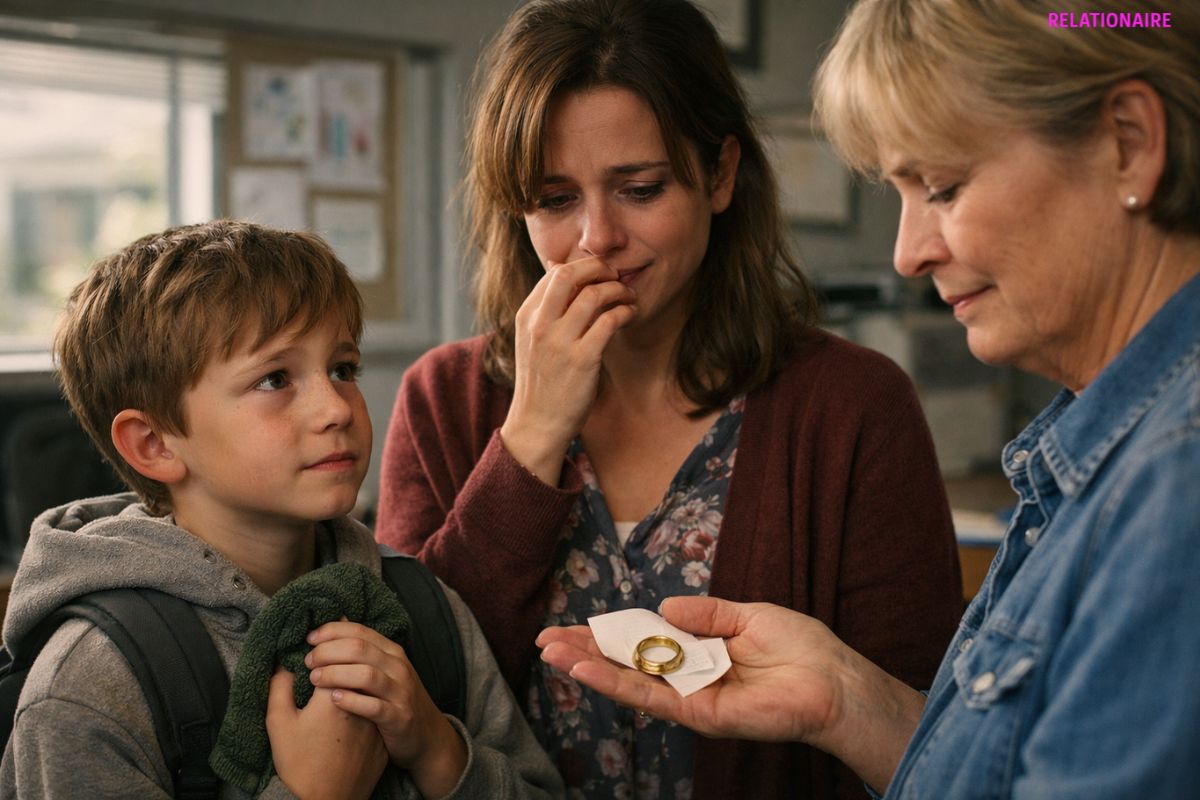
A wedding ring slipped into her palm.
It was old-fashioned, plain gold, worn thin along the bottom like it had lived a full life on somebody’s hand. It wasn’t shiny. It wasn’t expensive-looking. But it had that unmistakable feeling of being important.
There was also a folded note inside.
The handwriting was large and uneven, the kind children used when they were trying very hard to be careful.
If this belongs to someone who misses somebody, I hope it helps.
Marlene read it twice.
Then a third time.
“Now what in the world,” she whispered.
She turned the ring over in her fingers. Inside the band, faintly scratched by time, was an engraving:
Eleanor + Joseph
June 14, 1968
She stared at those names like they might explain the rest.
They did not.
By eleven o’clock, she had shown the ring and note to both of the front office aides, the vice principal, and Coach Benny, who had come in looking for a confiscated phone charger and stayed for the gossip.
“It’s a prank,” Coach Benny said immediately.
“It doesn’t sound like a prank,” Marlene said.
“It sounds exactly like a prank. Kids are weird now.”
“Kids have always been weird,” Marlene muttered.
Still, the note bothered her.
Not because it was cruel. It wasn’t.
Because it felt sincere.
That was what made it strange.
Most children who left notes in the lost-and-found were trying to be funny. Or dramatic. Or annoying.
This didn’t feel like any of those.
It felt like somebody meant it.
At lunch, Marlene carried the ring down the hallway to the teachers’ lounge, where the microwave always smelled faintly of burnt popcorn and tomato soup. A few teachers were eating in exhausted silence, shoulders bent, eyes on their phones.
She held up the ring.
“Anybody lose this?”
No one answered at first.
Then Ms. Alvarez, a fourth-grade teacher with tired eyes and a half-eaten yogurt, looked up and said, “That’s not one of ours, is it?”
“Found in the lost-and-found with a note.”
“What kind of note?”
Marlene handed it over.
Ms. Alvarez read it, and something in her face changed. Not much. Just enough for Marlene to notice.
The teacher handed it back too quickly.
“That’s odd,” she said.
“Odd how?”
She shrugged. “Just odd.”
Marlene might have let it go, except she had spent years reading people the way other women read weather. She noticed the details. The way Ms. Alvarez kept a smile on when a parent was being impossible. The way she rubbed the inside of her wrist when she was anxious. The way lately—just lately—she had been lingering after dismissal at her desk with the classroom lights off.
Marlene had also noticed, three times in the past two weeks, that Ms. Alvarez’s eyes looked red.
She said nothing now.
But the thought tucked itself away.
That afternoon, Marlene made an announcement over the intercom.
“If anyone is missing a sentimental item, please come to the front office and identify it.”
She did not say wedding ring.
She did not mention the note.
Within the hour, four children came to claim things that were not remotely theirs, two parents called about missing water bottles, and one first grader tried to trade her a smooth rock for a glitter headband.
No one came for the ring.
By the end of the day, Marlene should have dropped it into the office safe and gone home.
Instead, she sat at her desk after the buses pulled away and studied the note again.
If this belongs to someone who misses somebody, I hope it helps.
Not if you lost this.
Not here is your ring.
The child who wrote it hadn’t been trying to return something.
They had been trying to give it.
That was worse somehow.
Or sadder.
Or both.
The next morning, she started asking questions.
Not enough to make a spectacle of it. Just careful little ones.
Did any teacher recognize the handwriting? No.
Had any student been seen near the office lost-and-found before school? Maybe, probably, always.
Had any parent called about a missing family ring? No.
By second period, Marlene had narrowed exactly nothing.
By third, she was irritated with herself for caring so much.
By fourth, she saw the boy.
He was standing at the drinking fountain outside the office, waiting patiently while two louder boys shoved each other and sprayed water on the floor. He was small for fifth grade. Thin wrists. Backpack too big for his shoulders. Dark hair that looked like someone had cut it at home with kitchen scissors and done their best.
Eli Brennan.
Marlene knew him mostly the way secretaries know children—through scraps.
Frequent late pickups.
A grandmother listed as emergency contact.
Once, a permission slip signed in shaky cursive.
Quiet. Polite. Never trouble.
He stood aside so the other boys could race off, then bent without complaint and wiped the spilled water with the cuff of his sleeve before taking his drink.
Marlene watched him through the glass.
A moment later, Ms. Alvarez came down the hallway carrying a stack of math packets. She looked tired again. More than tired.
Something passed over Eli’s face when he saw her.
Not fear.
Not guilt exactly.
Recognition, maybe.
The kind that made Marlene straighten in her chair.
Eli waited until Ms. Alvarez disappeared into her classroom. Then he turned toward the office.
“Mornin’, Mrs. Pierce,” he said softly.
“Morning, Eli.”
He nodded toward the basket by the wall. “Did anybody find a green scarf? My grandma says she maybe left it when she picked me up Tuesday.”
“I’ll check.”
Marlene rose, went to the rack, and found the scarf almost immediately—a faded green knit thing with one loose tassel. When she handed it over, Eli smiled with visible relief.
“Thank you.”
“You’re welcome.”
He started to leave.
“Eli?”
He stopped.
Marlene didn’t know why she did it this way. Maybe because a hard question asked gently still feels hard to a child. Maybe because he already looked like someone carrying too much.
She held up the envelope.
“Have you seen this before?”
His eyes flicked to it.
That was all. A flick.
But it was enough.
He went still in the doorway.
Marlene felt the room change around them.
The copy machine humming in the back office.
A phone ringing once, then stopping.
Somewhere down the hall, a teacher laughing too brightly.
Eli’s fingers tightened around the scarf.
“It was in lost-and-found,” Marlene said carefully. “With something important inside.”
He looked at the floor.
“Eli,” she said, gentler now, “do you know anything about it?”
For a long moment, he didn’t answer.
Then he gave the tiniest nod.
Marlene’s stomach sank.
Not because she thought he was a bad child.
Because good children sometimes did heartbreaking things for reasons adults didn’t understand yet.
“Did you take the ring from home?” she asked.
Another pause.
Then, barely above a whisper: “Yes, ma’am.”
She closed her eyes for one second.
When she opened them again, he was blinking fast, not defiant, not sneaky, just bracing.
“Why would you put your grandmother’s wedding ring in the lost-and-found?” Marlene asked.
Eli swallowed.
His voice came out small.
“It wasn’t for a game.”
“I didn’t say it was.”
“I know.”
He looked toward the hallway, toward Room 14 where Ms. Alvarez taught reading and fractions and kept her blinds half-closed these days.
Then he said the sentence that made Marlene realize, all at once, that she had been wrong about almost everything.
“I put it there because my grandma doesn’t remember my grandpa anymore,” he said, “and I thought maybe Ms. Alvarez still remembers hers.”
Marlene stared at him.
The ring sat in her hand, suddenly heavier than gold.
And before she could say a single word, footsteps came down the hall, stopped outside the office door, and Ms. Alvarez’s voice said, unsteady and close:
“Mrs. Pierce… is that my husband’s ring?”
Part 2
For one strange second, nobody moved.
Not Marlene behind the desk.
Not Eli in the doorway, holding that loose green scarf like a lifeline.
Not Ms. Alvarez standing just outside the office, one hand still on the frame, as if she had walked there without meaning to and only realized too late what she was seeing.
Marlene looked from the ring in her palm to the teacher’s face.
“Your husband’s?” she repeated quietly.
Ms. Alvarez nodded once.
Then again, harder, like she needed her own body to believe her.
“It looks like his,” she said. “Or—” Her breath caught. “No. It is his.”
Her voice thinned on that last word.
Marlene had known grief in the broad, ordinary ways people know it. She had buried her mother. She had watched a marriage end in long silences and boxes. She had sat beside friends at funerals and handed them tissues and casseroles and all the helpless little things people offer when there’s nothing big enough to help.
But there was something about the way Ms. Alvarez looked at that ring that made grief feel less like sorrow and more like impact.
Like being struck.
Marlene came around the desk.
“Come sit down.”
Ms. Alvarez didn’t.
She stepped inside instead, eyes fixed on the ring.
Eli had gone pale.
He looked like he wanted to disappear into the floor.
“Eli,” Marlene said softly, “why don’t you wait right there a minute?”
He nodded but didn’t lift his head.
Ms. Alvarez finally looked at him then. Really looked.
Not the way teachers glance at students in passing. Not the practiced, sweeping attention of a woman responsible for twenty-six children at once.
This was different.
This was human before it was professional.
“Did you… bring that here?” she asked.
Eli’s lips pressed together. Then he nodded.
Marlene saw the teacher’s confusion sharpen.
She reached for the back of the chair by the desk, gripping it the way people do when the room tilts.
“I don’t understand.”
Neither did Marlene. Not fully.
Not yet.
But the pieces were beginning to press against each other.
She turned the ring over again. The engraving still read Eleanor + Joseph.
Not Alvarez. Not David. Not any name Marlene had heard Ms. Alvarez mention.
Which meant one of two things.
Either grief had made her mistaken.
Or the ring meant something different than anyone realized.
Marlene lifted her eyes. “Why do you think it’s your husband’s ring?”
Ms. Alvarez laughed once, and it sounded like a break.
“Because I buried him in one just like it.”
That landed in the room with awful softness.
Marlene knew, in fragments, that Ms. Alvarez had lost her husband. The school knew in the vague, respectful way workplaces know tragedy. Meals had been delivered. Cards had been signed. Her classes had been covered for two weeks in the fall.
But death at a school gets folded quickly into routine.
Spelling tests still happen.
Attendance still has to be entered.
Children still need help with shoelaces and subtraction and who took whose eraser.
Pain becomes background if it stays long enough.
“When he died,” Ms. Alvarez said, staring at the ring, “the hospital gave me his things in a plastic bag. Wallet. Watch. Wedding band. I kept all of it in my dresser for months. I couldn’t…” She swallowed. “I couldn’t decide what to do. Then one morning I thought maybe I should wear his ring on a chain. Just to keep him near.”
Her thumb rubbed hard against the chair.
“But I couldn’t find it.”
Marlene frowned. “You lost it?”
“I thought I did.”
“You never said anything.”
Ms. Alvarez looked at her with tired disbelief. “To who? The world was already so full of people saying I was strong.”
That shut the air out of the room.
Eli was still standing there, motionless.
Marlene looked at him now with a tenderness edged in worry. “Honey, can you tell us what happened?”
He took a breath that trembled.
“My grandma has a box in her dresser,” he said. “She keeps old stuff there. Buttons. Pictures. A church fan. A watch that don’t work. The ring was in there.”
Ms. Alvarez’s brow creased.
“My grandma don’t always know what things are anymore,” Eli went on. “Sometimes she asks where my grandpa is, and sometimes she says he already went to work and he’ll be home for supper. Sometimes she looks at his picture and says he seems kind.”
No one interrupted.
“She lets me sit in her room when she gets scared,” he said. “I was there Sunday, and she had the box out. She was taking things out and putting them back like she was trying to remember how her life went.”
His fingers tightened around the scarf again.
“She held the ring and asked if it was mine.”
Marlene pressed a hand to her mouth.
“I told her no, ma’am, it was hers. She said, ‘From what?’”
His voice was matter-of-fact in the careful way children speak when they have gotten used to things adults still find unbearable.
“I said, ‘From being married.’ She laughed and said, ‘To who?’”
Ms. Alvarez turned her face away.
For a second, Marlene thought the room might be too cruel to hold all this at once.
Eli kept going, because children will often walk straight through truth when adults would rather circle it.
“She wasn’t mean,” he said quickly. “She just didn’t know.”
“I know,” Ms. Alvarez whispered.
“I took the ring because…” He stopped there.
Because why?
Because he was ten, and ten-year-olds don’t always have language big enough for the weight inside them.
Marlene crouched a little so he wouldn’t have to speak up into adult faces.
“Because of the note?” she asked.
He nodded.
Then he finally looked at Ms. Alvarez.
“I saw you crying.”
The teacher closed her eyes.
Eli rushed on, embarrassed now, words tripping.
“Not big crying. I know teachers don’t like kids seeing. But one day I came back for my folder and you were at your desk and your hand was over your mouth. And another day you were looking in your drawer and shutting it real fast.”
Ms. Alvarez put a hand to her chest.
“I thought maybe you lost your person too,” he said.
The office went utterly still.
Marlene felt every small sound around them—the buzz of fluorescent lights, a distant classroom door, the tick of the wall clock—become almost sacred.
“So you gave away your grandmother’s ring?” she asked softly.
Eli shook his head so fast it almost hurt to watch.
“No, ma’am. I was gonna put it back.”
“When?”
“After she remembered him.”
The sentence was so impossible, so heartbreakingly child-shaped, that Marlene had to look down.
He noticed her silence and rushed to explain.
“Not all the way. I know that ain’t how it works.” He swallowed. “I just thought maybe if somebody else needed it first, and if Grandma didn’t know whose it was, maybe it could help for a little while.”
Ms. Alvarez made a sound then—half sob, half laugh, the kind grief drags out of people against their will.
“Oh, sweetheart.”
He looked stricken, as if that was the wrong thing to say.
“I wasn’t stealing,” he said. “I know it sounds like stealing.”
“No,” she said immediately, kneeling now in front of him. “No, it sounds like you were trying to fix something no child should have to fix.”
His face crumpled a little.
And there it was.
Not mischief.
Not some strange schoolyard game.
A boy standing in the doorway between two kinds of grief—his grandmother’s vanishing memory and his teacher’s fresh widowhood—trying, with the only thing he thought might matter, to hand one ache to the other and hope it became lighter.
Marlene had spent all yesterday thinking about rules.
Property.
Pranks.
Appropriate consequences.
Now those things looked very small.
But the story was still not whole.
She looked at the ring again.
“Eli,” she said gently, “how did you know to think of Ms. Alvarez specifically?”
He hesitated.
Then, from the front pocket of his backpack, he pulled out a folded drawing paper, creased at the corners and smudged with pencil.
“I found this by the trash can outside her room,” he said.
He handed it to Marlene.
She opened it.
It was a child’s classroom worksheet. At the top, in block letters, students had written: Draw someone you miss.
Most of the page held the beginning of a picture in black pencil.
A man with glasses.
A woman beside him.
A little girl between them.
And across the middle, in a different handwriting, darker and shakier, someone had written only one sentence:
I still reach for him in my sleep.
Marlene felt cold from the inside out.
Ms. Alvarez stared at the page and covered her mouth.
“That wasn’t supposed to—” she said, then stopped.
Eli looked terrified now.
“I’m sorry. I know I shouldn’t have read it.”
Ms. Alvarez shook her head, but tears were already running down her face.
“No,” she whispered. “No, honey.”
She took the page from Marlene with trembling hands.
For a moment it seemed the whole school had narrowed to this office, this ring, this note, this child who had seen too much and still chosen kindness.
Then Marlene heard footsteps in the hall.
Fast ones.
A voice she recognized.
“Eli?”
He turned.
His grandmother stood in the doorway in her green coat, one hand gripping the wall, her face bewildered and frightened.
Her eyes landed on the ring in Marlene’s hand.
And in a voice suddenly clear as glass, she said:
“Why are you holding my husband?”
Part 3
No one breathed.
Eleanor Brennan stood in the office doorway with her purse hanging open at her elbow and one house slipper peeking out from beneath her coat hem, as if she had come in a hurry and left home unfinished.
Her gray hair was pinned on one side and loose on the other.
Her eyes, usually cloudy with that searching, drifting distance dementia leaves behind, were sharp now. Present. Piercing.
She wasn’t looking at the ring as jewelry.
She was looking at it as memory.
At her husband.
At a whole life pressed into a circle of gold.
Eli made a sound Marlene would remember for a long time—something between “Grandma” and a cry.
He ran to her at once.
“I’m sorry,” he said, grabbing both her hands. “I’m sorry, I was bringing it back.”
Eleanor looked down at him, confused for just one beat.
Then her face softened, not because she understood everything, but because she knew him.
Knew him the way love sometimes survives when names do not.
“This child,” she murmured, touching his cheek. “Always carrying things bigger than him.”
Ms. Alvarez turned away and cried silently into her hand.
Marlene stepped forward slowly.
“Mrs. Brennan,” she said, keeping her voice low and calm, “would you like to sit down?”
Eleanor ignored the chair.
She walked instead to the desk and held out her palm.
Marlene placed the ring there.
Eleanor closed her fingers around it, and for a second her shoulders straightened. The years seemed to gather themselves back into place.
“Joseph worked at the mill,” she said, almost to herself. “He used to come home with sawdust in his cuffs and pretend he hadn’t tracked it all over my clean floor.”
Eli stared at her.
Marlene did too.
“He never could lie worth a dime.” Eleanor smiled faintly. “He’d stand there with his boots in his hands like that fixed anything.”
Then she rubbed the ring with her thumb and added, “He asked me to marry him behind Saint Luke’s because he was too nervous to do it in the diner. Said if I turned him down, fewer people would see.”
A laugh escaped Ms. Alvarez through tears.
The sound seemed to steady the room.
Eleanor looked over then, really noticing her for the first time.
“You’ve been crying,” she said.
There was no accusation in it. Only recognition.
Ms. Alvarez gave a watery little nod.
“My husband died last year.”
Eleanor’s face changed. Not with surprise. With understanding so old and deep it seemed to rise from someplace beneath memory itself.
“That’s a fresh wound,” she said.
And there it was again—that strange, humbling thing grief sometimes does. It clears a path through the fog for exactly one moment, long enough for one hurting person to see another.
Ms. Alvarez pressed her lips together to stop them shaking. “Yes, ma’am.”
Eleanor looked at the ring in her hand, then at Eli.
“Did he think this might help?”
No one answered.
He didn’t need them to.
She already knew.
Eli’s eyes filled. “I wasn’t trying to be bad.”
“I know that.”
“I just thought maybe she missed somebody too.”
Eleanor cupped the back of his head. “Baby, everybody misses somebody.”
The words fell into the room with the weight of prayer.
Marlene saw Ms. Alvarez break then—not loudly, not dramatically, just enough. Her shoulders bowed. Her face crumpled. Months of holding herself together in front of children, in faculty meetings, in grocery store lines, in the long dark after bedtime—it all gave way.
Eleanor opened one arm.
A tiny gesture.
But clear.
Ms. Alvarez stepped forward like a person walking toward warmth after a winter too long to explain.
The old woman put her free hand on the back of the younger one’s neck, and for a moment they simply stood there, widow and widow-not-by-age-but-by-fact, joined by a little boy who had tried to bridge two losses with one ring.
Marlene looked away then, because some moments feel holier if you don’t stare straight at them.
The bell rang down the hallway.
Children’s voices burst loose in distant classrooms.
A copier started up again.
Life, rude and ordinary, kept moving.
But something had changed in that office.
After a while, Marlene made tea in paper cups from the little machine in the lounge because it was the only comfort she could provide on short notice. Ms. Alvarez sat beside Eleanor. Eli sat on a plastic chair, exhausted by relief.
They pieced the story together slowly.
Eleanor had taken out the keepsake box the Sunday before, just as Eli said. Some afternoons she remembered enough to know she had forgotten something important. Those were the hardest days.
On one of those days, Eli had seen her holding Joseph’s ring and asking whose it was.
The question had frightened him more than he told anyone.
Because forgetting a face was one thing.
Forgetting you had ever been loved was another.
At school that week, he had noticed Ms. Alvarez more carefully than adults ever guessed children noticed anything. He saw the way she paused when students wrote about fathers. The way she stared too long at family forms before filing them. The way she once sat at her desk after dismissal with a photograph face down beside her gradebook.
He had not understood widowhood in an adult sense.
But he understood missing.
He understood waiting for someone who was not coming through the door.
He understood how his grandmother stood by the window around five o’clock some evenings, smoothing her sweater, saying, “Your grandpa’s late.”
So when he found the classroom worksheet in the hallway trash—the one with Ms. Alvarez’s private sentence written across a child’s assignment—something in him connected.
He had gone home.
He had taken the ring.
He had written the note.
Not because he thought objects were magic.
But because children are often the only people brave enough to treat pain plainly.
Somebody misses somebody. I hope it helps.
That was his whole theology.
By the time the final bell rang, Marlene had called Eli’s uncle to explain there had been “a misunderstanding, but everything is all right now.” She did not say dementia, widowhood, grief, ring, tears. Some stories belong first to the people inside them.
Before leaving, Ms. Alvarez knelt in front of Eli.
“I need to tell you something,” she said.
He looked nervous again.
“What?”
“What you did was not okay in the rule-book sense.”
His face fell instantly.
She touched his knee.
“But it was full of love. And I know the difference.”
He blinked up at her.
“You can never take someone’s family things without permission,” she said gently. “Even to be kind.”
“I know.”
“I believe you do.”
He nodded, ashamed and relieved at once.
Then she reached into her cardigan pocket and pulled out a thin silver chain.
“I started wearing this after my husband died,” she said. “Not because it fixed anything. Just because sometimes it helped to hold something when the missing got too loud.”
She threaded Joseph Brennan’s ring onto it carefully, then handed the chain to Eleanor.
“I think it belongs close to the heart,” she said.
Eleanor looked at it for a long moment, then at Eli.
“Would you help me put it on?” she asked.
His fingers trembled as he fastened the clasp behind her neck.
The ring came to rest against her blouse, over the place where memory sometimes fails but love keeps beating anyway.
Eleanor patted it once and smiled.
“There,” she said. “Now if I forget, maybe my body will remember.”
Marlene had to turn away and pretend to organize field trip forms.
The next Monday, Ms. Alvarez changed the writing prompt on the board for her students.
It did not say Draw someone you miss.
It said:
Write about something small that helped when you were sad.
Some children wrote about dogs and blankets and macaroni and grandpas who told bad jokes. One little girl wrote about the smell of her mom’s coat. One boy wrote about the green night-light in his hallway.
Eli drew a circle on a chain.
Underneath it, in careful fifth-grade printing, he wrote:
Sometimes helping doesn’t make the hurt go away. It just lets people know they don’t have to hurt by themselves.
Ms. Alvarez kept that paper.
Not on the wall.
Not in a file.
In the top drawer of her desk, where she used to cry with the lights off.
Weeks later, Marlene would still think about the note that started it all.
Not because it was polished or wise in the way adults like to call wise things wise.
It was wiser than that.
It was plain.
Plain enough to miss if you weren’t paying attention.
A child had looked at two kinds of sorrow and, instead of turning away, had tried to set one small human thing in the middle of them.
Not to solve it.
Not to erase it.
Just to say: here. Hold this. You are not the only one.
And maybe that is all grace ever looks like when it first arrives.
Not grand.
Not tidy.
Just a small hand, offering what it can.