If you’ve already read part 1 of this story on Facebook, go here for Part 2!
Nobody liked getting in Mrs. Grier’s line.
If your milk tipped, she sighed like you’d ruined her life. If you took too long choosing peaches or pears, she snapped, “Keep it moving.” If your tray rattled too loud, her eyes lifted sharp and tired, and the whole line went quiet.
By October, the second graders had turned her into a kind of legend.
Don’t ask for extra ketchup.
Don’t forget your lunch number.
Don’t smile at her. She won’t smile back.
At Cedar Hollow Elementary, kids feared a lot of ordinary things in oversized ways. Fire drills. Pop quizzes. The dark under the stage in the multipurpose room.
But Mrs. Grier, with her stiff white apron and hairnet and voice that sounded like a drawer slamming shut, had become something else.
A daily dread.
The cafeteria smelled like tomato soup and bleach and warm rolls. It echoed with scraping chairs and shouted reminders and the shrill little collisions of children being children.
And every day, behind the stainless-steel counter, Mrs. Grier stood with the same tight mouth and the same tired eyes, handing out trays as if joy were a privilege this room had not earned.
“Next.”
“Take one.”
“No, not that spoon. The clean ones.”
The teachers had theories.
“She’s just not a people person,” said Ms. Adler, the art teacher, pouring coffee in the staff lounge.
“She’s overwhelmed,” the school secretary offered once. “The district cut her helper’s hours again.”
“She could at least try not to scare the little ones,” another teacher muttered.
Nobody said any of this to Mrs. Grier.
They just adjusted around her. Kept things moving. Lowered expectations. Warned new students quietly.
Then there was Maisie Bell.
Maisie was seven, small for her age, with two uneven braids and the kind of face that stayed open even when the world didn’t deserve it. She wore a purple backpack with one broken zipper and often forgot to pull her socks all the way up. She asked too many questions in class and cried when a worm dried out on the sidewalk.
She also, much to everyone’s confusion, kept choosing the table closest to Mrs. Grier’s station.
Not once.
Every day.
At first, her teacher thought it was random.
Then she thought it was performance.
Maisie had that kind of child-energy adults sometimes misunderstood. The kind that looked like attention-seeking when it was really just full-heartedness with nowhere to go.
“Why do you keep sitting there, honey?” her teacher, Mrs. Holloway, asked one Tuesday as they walked in from recess.
Maisie shrugged.
“I just do.”
“But she’s not very friendly.”
Maisie looked up. “Maybe she’s tired.”
Mrs. Holloway gave the soft, patient smile adults use when they think a child is being sweet and wrong at the same time.
“Well,” she said, “eat your lunch, okay?”
Maisie did eat her lunch.
She also talked.
Not loudly. Not enough to be disruptive.
Just little offerings, the way some children leave flowers on porches or line up pebbles on windowsills.
“My mom burned the toast this morning, but we still ate it.”
“We’re growing beans in a cup in science and mine looks like hair.”
“My goldfish died last year, but I still think about him when I see orange.”
Mrs. Grier rarely answered.
Sometimes she grunted.
Sometimes she said, “Finish your applesauce.”
Sometimes she didn’t look at Maisie at all.
But the girl came back anyway.
Every day she carried her tray past louder tables and open seats and the magnetic pull of her friends, and chose the one near the napkin dispensers, close enough to the serving line that she could look up and see the lunch lady between customers.
It began to bother people.
Not because Maisie was doing anything wrong.
Because she kept doing it.
There’s something unsettling about a child being gentle where adults have already decided not to bother.
One Thursday, a boy named Trevor dropped his fork and it clattered against the floor. Mrs. Grier turned so fast the ladle in her hand knocked the edge of the steam tray.
“For heaven’s sake,” she snapped. “Can anybody in here hold onto something for five minutes?”
Trevor’s face went red. A few kids laughed the way children do when they’re relieved it wasn’t them.
Maisie slid off her bench, picked up the fork, and brought it to the trash without a word.
Then she returned to her seat and looked toward the counter.
Mrs. Grier didn’t apologize. She didn’t soften. She just turned back to the mashed potatoes and kept serving.
That afternoon, on cafeteria duty, Coach Henley saw Maisie linger by the tray return.
“Move along, kiddo.”
Maisie nodded, then looked up at him. “Does Mrs. Grier live alone?”
He blinked. “What?”
“Nothing.” She picked at the edge of her paper napkin. “I was just wondering.”
“Why?”
Maisie hesitated. “Because she looks like somebody who has to do things twice.”
Coach Henley stared at her.
“Go on to class, Maisie.”
She did.
But later, when Mrs. Holloway heard about it, she sighed and pinched the bridge of her nose.
“She’s imaginative,” she said. “Very sensitive. Sometimes she invents meanings where there aren’t any.”
Still, she started paying closer attention.
The next Monday, chicken patty day, the cafeteria was louder than usual. One of the milk coolers had gone down, so kids were being rerouted to the far end. Someone spilled corn. A kindergartner cried because his carton wouldn’t open. Two fifth-grade boys argued over a brownie.
And through all of it, Mrs. Grier moved like a woman stitched together too tightly.
Quick hands. Sharp voice. No extra words.
Then Maisie got to the front of the line.
Mrs. Grier set a tray down in front of her without looking up. “Fruit.”
“Thank you,” Maisie said.
No answer.
Maisie didn’t move.
The line behind her shifted.
“Fruit, child,” Mrs. Grier repeated.
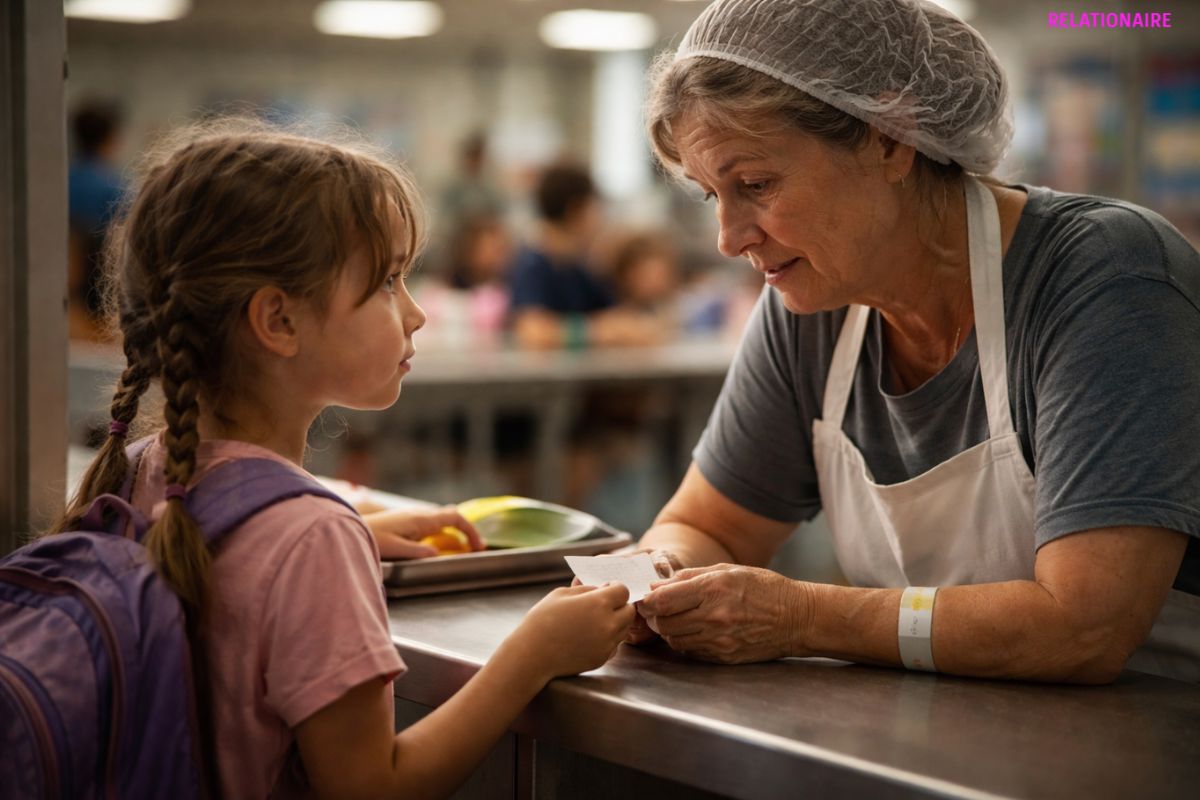
Maisie looked at the woman’s wrist.
The cuff of her serving glove had ridden up just a little, and under the pale skin, under the sleeve of the cafeteria shirt, something white peeked out. Plastic. Printed. Familiar.
A hospital bracelet.
Mrs. Grier noticed where she was looking and yanked her sleeve down so fast the tray rattled.
“Move.”
Maisie moved.
But something in her face changed.
At lunch, she didn’t chatter the way she usually did. She peeled her orange carefully, laying each strip of rind beside her tray in a neat little curl. Her best friend Lila kept trying to get her attention from another table, but Maisie only waved once.
Mrs. Holloway, watching from the teachers’ end, felt a strange prickling at the back of her neck.
After the lunch period, she found Maisie in the hallway outside the classroom, kneeling by her cubby.
“Everything okay?”
Maisie looked up.
Her eyes were serious in a way that made her seem suddenly older and much smaller at the same time.
“Mrs. Holloway?”
“Yes?”
“Do hospital bracelets mean somebody’s sick?”
The teacher paused.
“Usually, yes.”
Maisie lowered her voice. “Bad sick?”
“Sometimes.” Mrs. Holloway crouched beside her. “Why are you asking?”
Maisie picked at the frayed strap of her backpack.
“My daddy wore one when he stayed with Nana before she died.”
The hallway seemed to quiet around them.
Mrs. Holloway knew Maisie’s grandmother had passed the year before. She had not known the child remembered details like the bracelet.
“Did you see one today?” she asked gently.
Maisie nodded.
“On who?”
But Maisie didn’t answer that.
Instead she whispered, “I think everybody’s being wrong about her.”
That evening, after dismissal, Mrs. Holloway stopped by the cafeteria office under the harmless excuse of dropping off a field trip form. Mrs. Grier was there alone, sitting on a metal chair beside a shelf of canned peaches, staring at nothing.
Without the apron and hairnet, she looked older. Not old exactly. Just worn in a way that made age irrelevant. Her face had the hollowed-out look of someone who hadn’t properly exhaled in weeks.
Mrs. Holloway almost said something.
Almost asked if she was all right.
But Mrs. Grier stood the second she noticed her, all sharp edges again.
“You need something?”
“No. Sorry. Just this form.”
“Leave it there.”
The teacher did.
As she turned to go, she saw a canvas tote bag on the floor beside the chair. It had fallen open just enough to show a pill bottle, a folded discharge paper, and the corner of a greeting card with a child’s handwriting on the front.
Mrs. Grier followed her gaze and nudged the bag shut with her foot.
The next day, Maisie brought something to lunch folded inside her napkin.
She waited until the rush slowed. Waited until the other kids had mostly sat down. Waited until Mrs. Grier was refilling the stack of spoons with that same exhausted concentration.
Then she stood, walked to the counter, and slid the folded paper toward her.
“It’s for later,” Maisie said.
Mrs. Grier frowned. “You need to sit down.”
“It’s not bad.”
“Maisie,” Mrs. Holloway called from across the room, already halfway over.
But the girl stayed where she was, looking up at the lunch lady with her small, steady face.
Mrs. Grier stared at the folded note.
Then, slowly, she wiped her hand on her apron and picked it up.
“What is it?”
Maisie swallowed.
“A picture,” she said. “And something I know.”
Mrs. Grier’s fingers froze on the paper.
The whole room seemed to tilt toward that counter without knowing why.
“What do you know?” she asked.
Maisie lifted her chin, and when she answered, her voice was soft enough that only the adults nearest them heard it.
“I know hospital bracelets don’t stay on the healthy person.”
Mrs. Holloway stopped walking.
Mrs. Grier went white.
And then, with trembling hands, she opened the note.
Part 2
Inside the folded paper was a drawing.
Not the quick, careless kind most second graders made while waiting for the bell. This one had been pressed into with intention, colors layered and retraced until the wax looked almost shiny.
It showed a woman standing behind a lunch counter.
Her hair was tucked up. Her apron was white. Her mouth was a straight line.
Beside her, drawn much smaller, was a bed.
In the bed was another woman with gray hair and blue blankets pulled up to her chin.
Above them, in careful, uneven letters, Maisie had written:
You look like my daddy did when he was scared for Nana.
People talked mean because they didn’t know he was hurting.
I think maybe you are hurting too.
For one long second, nobody moved.
The cafeteria noise carried on at the far tables, but near the counter it thinned into something fragile. A spoon dropped somewhere. A chair scraped. The low hum of the milk cooler kicked on.
Mrs. Grier stared at the page as if it might disappear if she blinked.
Mrs. Holloway reached the counter first. “Maisie,” she said quietly, not scolding exactly, but with the careful alarm adults use when a child has stepped into something bigger than they understand.
Maisie’s hands were clasped together against her shirt.
“I wasn’t being rude,” she said.
“I know.”
Mrs. Grier’s throat worked once.
Then she folded the paper with shocking care. Not in half. Along the creases Maisie had already made, as if preserving them mattered.
“Who told you?” she asked.
“No one,” Maisie said.
“How did you—”
“I saw your bracelet.”
Mrs. Grier closed her eyes.
When she opened them again, the hardness in them was gone. Not replaced with warmth. There wasn’t enough room yet for that. Just stripped bare down to something more honest.
“I have to finish lunch service,” she said, but the sentence came out thin.
Mrs. Holloway stepped closer. “I can have someone cover the room.”
Mrs. Grier gave a short shake of her head, almost angry at the idea of being helped, but her hands were trembling too badly now to hide it.
“Mrs. Grier,” the teacher said softly.
That did it.
Not the drawing. Not the bracelet. Not the child’s impossible little sentence.
The gentleness did.
Mrs. Grier put down the serving spoon, pressed both palms flat against the stainless-steel counter, and bowed her head.
When she spoke, her voice sounded like something old cracking open.
“It’s my daughter,” she whispered.
Mrs. Holloway felt the words land before she understood them.
“Adult daughter?”
Mrs. Grier nodded once.
“Thirty-two.” She swallowed. “Breast cancer. They sent her home for now. They said there are things they can still do, but…” Her mouth twisted. “I’m with her nights. Hospital in the morning when she has appointments. Here by ten-thirty because if I lose this job, I lose the insurance that’s keeping half her medicine paid for.”
Maisie didn’t move.
Neither did Mrs. Holloway.
“She has a little boy,” Mrs. Grier went on, looking not at either of them but at the industrial floor. “Four years old. He cries when I leave. My daughter says not to tell him too much. Says let him be little while he still can.” Her breath hitched. “And I come in here and children spill things and argue over pudding cups and ask me for extra ranch like the world isn’t ending.”
She pressed her lips together hard.
“I know that’s not their fault.”
The last part came out almost ashamed.
“I know it.”
Mrs. Holloway had no words big enough for the room all of a sudden.
Only the ordinary ones.
“I’m sorry.”
Mrs. Grier let out a brittle laugh at that. “Yeah.”
Maisie finally spoke.
“Is she the sick one?”
Mrs. Holloway glanced at her, startled by the directness.
Mrs. Grier looked down at the child.
“Yes.”
“Is she going to die?”
There it was. The question adults circle in coats and euphemisms and casseroles. The question children step straight into because the dark is always darker when no one names it.
Mrs. Holloway almost interrupted. Almost said, Maisie.
But Mrs. Grier answered.
“I don’t know.”
The words seemed to cost her.
Maisie nodded once, as if uncertainty itself were an answer she recognized.
“My Nana died,” she said. “Before that, everybody talked like she was maybe-not-dying. But she was.”
Mrs. Holloway closed her eyes for half a beat.
“Maisie,” she said gently, “why don’t you go sit down?”
But Mrs. Grier lifted a hand.
“No.” Her gaze never left the girl’s face. “It’s okay.”
Maisie leaned one elbow on the counter. “Did your daughter like school lunch when she was little?”
Mrs. Grier blinked.
The question was so sudden, so strangely placed, it almost forced a smile. Almost.
“She hated the green beans.”
Maisie’s mouth softened. “I hate the green beans too.”
That did it.
A real smile didn’t appear, not quite, but something in Mrs. Grier’s face loosened enough that you could imagine one had once lived there.
The bell rang for the next transition.
Children stood. Trash barrels filled. The room swelled back into motion.
Mrs. Holloway guided Maisie toward her table, but the girl looked over her shoulder once more.
“I’m sorry people were being wrong about you,” she said.
Mrs. Grier opened her mouth, closed it, then said the only thing she could manage.
“Eat your lunch before it gets cold.”
It became, for a few days, a quiet secret.
Teachers noticed a change before they knew why. Mrs. Grier still wasn’t cheerful. She still moved quickly, still kept things orderly, still had no patience for milk-carton battles or shrieking fifth graders. But the sharpness no longer had the same sting.
It was pain now, not contempt.
That difference mattered.
Once you knew pain was standing where meanness had seemed to be, the whole room rearranged itself around it.
Mrs. Holloway told the principal in confidence. The principal called district HR to ask about leave. The school nurse quietly left a bag of microwavable meals in the cafeteria office fridge. The custodian fixed the wobbly chair in the back room without being asked.
Nobody announced any of it.
Adults prefer help that lets them keep their dignity.
Maisie kept sitting at the same table.
Only now, sometimes, Mrs. Grier answered her.
“My grandson likes trucks.”
“My daughter used to wear socks that never matched.”
“You need to eat something besides crackers, child.”
Maisie absorbed these fragments like treasures.
Then one Friday, things got worse.
The school was serving pizza rectangles and canned pears, which meant the line moved fast and the room got loud fast too. A group of third-grade boys started chanting about trading crusts. Someone knocked over chocolate milk. A teacher stepped out to take a phone call.
Mrs. Grier was halfway through the second lunch wave when the office aide entered the cafeteria carrying the cordless phone.
Every adult in the room noticed her expression first.
The carefulness.
The look of someone walking toward a place she didn’t want to go.
She came straight to the counter. “Marlene?”
Mrs. Grier’s face changed before a word was said.
That was the thing about people living on the edge of bad news. They recognize its footsteps.
“What?”
“It’s the hospital.”
The room did not go silent all at once. Silence came in ripples.
Mrs. Grier took the phone.
“Hello?”
Mrs. Holloway would remember that voice for years. Not what came from the other end. Just Mrs. Grier saying hello as though the world might still, if handled carefully enough, remain standing.
Whatever she heard next took the color from her face.
“No,” she said immediately. Then again, louder, “No.”
Children had started noticing now. Nearby tables turned. A few stopped eating.
Mrs. Holloway moved toward the counter.
“Marlene—”
But Mrs. Grier held up one shaking hand.
“No, I’m coming,” she said into the phone. “I’m coming right now. Don’t— just don’t let him see if—” Her voice broke. “I said I’m coming.”
She handed the phone back blindly and grabbed for the edge of the counter.
For one terrifying second, Mrs. Holloway thought she might fall.
Instead Mrs. Grier straightened with visible effort, untied her apron with clumsy fingers, and looked across a cafeteria full of watching children who suddenly seemed too young for the size of the moment in front of them.
“I have to go,” she said to no one and everyone.
The principal appeared as if summoned by dread itself. “We’ve got it covered. Go.”
Mrs. Grier nodded, but she wasn’t moving.
Her tote bag was in the office. Her keys were somewhere. Her mind was clearly already in another building, another room, beside another bed.
And then Maisie was there.
She had left her seat without permission again, tray abandoned, little sneakers squeaking on the cafeteria floor.
Mrs. Holloway opened her mouth to stop her and then didn’t.
Maisie reached up and took Mrs. Grier’s hand.
It was such a small hand.
Such a child’s hand.
Mrs. Grier looked down, disoriented, as if she had forgotten children could offer comfort too.
Maisie’s voice was barely above a whisper.
“Go fast,” she said. “She needs her mom more than we need our lunch lady.”
Mrs. Grier made a sound that was almost a sob and almost a laugh and not enough of either to survive being named.
Then she squeezed the girl’s hand once, hard, and hurried out.
The cafeteria doors swung shut behind her.
For the rest of lunch, nobody complained about cold pizza.
Nobody asked for extra ranch.
Even the loud boys ate quietly.
That night, Cedar Hollow became a chain of phone calls and casseroles and worried text messages between staff. Mrs. Holloway slept with her phone on the pillow beside her.
But no update came.
Not that night.
Not Saturday morning.
Not Saturday afternoon.
By Saturday evening, Maisie sat cross-legged on the living room carpet coloring on the coffee table while her mother folded laundry and pretended not to keep checking her phone.
“What if Mrs. Grier’s daughter died?” Maisie asked.
Her mother froze with one of Maisie’s socks in her hand.
“Honey…”
Maisie kept coloring. “I’m not trying to be bad. I’m just thinking.”
Her mother sat beside her on the floor.
“I don’t know,” she said honestly.
Maisie drew for another minute in silence. Then she looked up.
“If she did, then people can’t act normal to Mrs. Grier on Monday.”
Her mother blinked. “What do you mean?”
Maisie pressed purple crayon hard into the page until it snapped.
“I mean they can’t just ask for ketchup.”
On Sunday evening, Mrs. Holloway finally got the text.
Three words first.
She made it through.
Then another.
For now.
And then, after a long pause:
But they found more.
Monday morning came with rain.
By lunchtime, the sky outside the cafeteria windows was the dull gray of old dishwater. Children came in damp and hungry and loud, carrying the ordinary weather of an ordinary day into a room that no longer felt quite ordinary at all.
Mrs. Grier was back behind the counter.
Same apron. Same hairnet.
But thinner somehow. Smaller inside the fabric.
Most of the children stared and then looked away. Adults did the same. Nobody knew what shape kindness should take in a lunch line.
Then Maisie stepped forward with her tray, reached into the front pocket of her backpack, and pulled out a folded stack of papers tied with red yarn.
“What’s that?” Mrs. Grier asked, her voice rough.
Maisie held it out.
“A book.”
Mrs. Grier frowned. “A what?”
“A book for your grandson. So if his mom has to be in bed, he can still hear school voices.”
Mrs. Grier took the bundle slowly.
The top page had a crayon cover.
WHEN SOMEONE YOU LOVE IS SICK
by Room 12
Mrs. Grier looked up sharply.
Behind Maisie, the entire second-grade class was standing there in line, each child holding a page.
And Mrs. Holloway, from the back of the line, said softly:
“Turn the first one over.”
Mrs. Grier did.
On the inside was a note in blocky, careful handwriting from Maisie.
We didn’t know how to help, so we listened to the girl who did.
Part 3
For a long moment, Mrs. Grier just stood there with the little homemade book in her hands while the lunch line bent around the moment and waited.
The red yarn shook between her fingers.
Each page was different.
Some had drawings of superheroes sitting beside hospital beds.
Some had crooked hearts and misspelled comfort.
One child had drawn a woman sleeping while a little boy played with blocks on the floor beside her.
Another had written, in wide uncertain letters: When my brother was sick I hated everybody laughing in the next room.
One page simply said: You can be scared and still be nice.
Another: If he cries, tell him grown-ups cry too.
Mrs. Grier pressed her lips together so tightly they lost color.
The principal, who had been passing through with a clipboard, stopped near the doorway and took in the whole scene without interrupting. So did the school nurse. So did Coach Henley, carrying a crate of milks.
No one told the line to keep moving.
No one rushed the children.
Sometimes a room knows something sacred is happening before anybody has named it.
Mrs. Grier turned another page.
At the back, tucked in carefully, was a final sheet from Maisie.
No drawing this time.
Just words.
Dear Mrs. Grier,
You don’t have to smile when your heart hurts.
But you also don’t have to hurt by yourself.
Love,
Maisie
When Mrs. Grier looked up, her face had changed so completely it startled people.
Not because she looked happy.
Because she looked seen.
There is a kind of relief so painful it resembles breaking.
She reached across the counter, not minding the food, not minding the line, and laid her hand over Maisie’s small shoulder.
“Thank you,” she said.
It was the first time most of those children had ever heard tenderness in her voice.
Several of them stared as if a statue had spoken.
Maisie nodded like thank you was enough.
Then, because she was still seven, she asked, “Will your grandson like the page with the dinosaur in the MRI machine?”
A strange sound rippled through the adults nearest the counter.
Laughter.
Quiet, helpless, needed laughter.
Mrs. Grier let out one shaky breath that almost turned into one too. “He might,” she said.
That afternoon, Mrs. Holloway found a yellow sticky note on her desk.
No signature. Just four words in neat, strained handwriting.
Thank you for believing her.
It changed things after that.
Not all at once, and not in some syrupy movie way where grief becomes glowing and everyone learns the same lesson by Friday.
Mrs. Grier’s daughter was still sick.
The tests still came back with words no one wanted.
There were hospital days and infusion days and days when the grandson, Owen, refused to leave his mother’s bedroom floor. There were insurance battles and pharmacy delays and nights too short to deserve being called sleep.
But now the school knew.
Not every detail. Mrs. Grier was too proud for that, and too private.
Just enough.
Enough to stop mistaking pain for cruelty.
Enough to shift the weight a little.
The cafeteria ladies from the middle school sent over frozen casseroles. The church across the street dropped off gas cards anonymously, though everyone knew exactly who had organized it. The principal rewrote schedules so Mrs. Grier could leave early on treatment days without losing hours. Coach Henley started repairing things at her daughter’s apartment on Saturdays—sticky doors, a broken porch light, a faucet that wouldn’t stop dripping.
No one made a speech about community.
They just showed up where the ache was.
And in the middle of it all was Maisie, who kept doing what children do best when adults haven’t yet taught them to stop.
She continued sitting at the table nearest the counter.
She continued talking.
Only now, some days, Mrs. Grier answered with stories.
About her daughter, Tessa, who used to collect smooth rocks from creek beds and keep them in old jelly jars.
About Owen, who could name every construction vehicle on sight and believed orange popsicles had healing powers.
About how Tessa, at eight years old, once hid a baby bird in her sock drawer for half a day because she thought the quiet might help it live.
“Did it?” Maisie asked.
“No,” Mrs. Grier said, and then, after a pause, “but Lord, she meant well.”
Maisie smiled. “I like people who mean well.”
By December, the first real cold had settled in.
Kids came in with red noses and damp cuffs. The cafeteria smelled like chili and cinnamon apples. Paper snowflakes hung in the windows, all slightly lopsided because children value effort more than symmetry.
Mrs. Grier still wasn’t soft in the ordinary ways.
She still told children not to throw peas.
She still had no patience for line-cutting.
She still sounded brisk when she reminded them to take napkins only if they were actually going to use them.
But she smiled now.
Not all the time.
That would have been a lie.
But enough that children began taking risks they never had before.
A first grader waved at her and got a wave back.
Trevor—the fork-dropping boy—asked for seconds one day and nearly fainted when she said yes.
The rumor among the students shifted.
She’s strict, but she likes you if you say thank you.
Don’t waste food in her line.
She has a grandson.
If she looks tired, be patient.
Children build theology out of scraps. This was theirs now: meanness revised into sorrow, sorrow revised into personhood.
Then, just after New Year’s, the school held its winter literacy night.
Families crowded the halls in coats and boots, balancing cookies on paper plates while students showed off classroom projects. In Room 12, Mrs. Holloway had hung the pages from WHEN SOMEONE YOU LOVE IS SICK along one bulletin board with parents’ permission, each page laminated so the crayons shone under fluorescent light.
A small typed note explained that the class had made the book for someone in their school community who was caring for a sick family member.
No names.
No dramatics.
Just truth in plain clothes.
Parents stopped and read every page.
Some smiled.
Some cried without expecting to.
One father stood with his hand over his mouth for nearly a minute before kneeling to read the pages again at his daughter’s height.
Mrs. Grier came late, still in work shoes, with Owen asleep against her shoulder and Tessa walking slowly beside her in a knit cap, cheeks pale but eyes bright.
Mrs. Holloway saw them from across the room and felt the breath leave her.
Tessa looked young. Younger than her illness had any right to allow.
But she was here.
Here.
That mattered.
Maisie, who was helping pass out hot chocolate, spotted them and went very still.
Then she set the cup tray down and walked over.
“This is your daughter,” she said to Mrs. Grier, though everyone knew it now.
“Yes.”
Maisie looked up at Tessa with solemn curiosity, the way children regard people they’ve prayed for without being told how prayer is supposed to look.
“Hi,” Tessa said softly.
“Hi.”
Owen lifted his sleepy head from his grandmother’s shoulder and noticed the dinosaur MRI page hanging on the wall.
“That’s mine,” he murmured.
Maisie’s face lit. “I knew it.”
Tessa’s eyes moved over the bulletin board slowly.
She read her mother’s name nowhere, and yet she knew.
Of course she knew.
By the time she reached Maisie’s note, her hand was covering her mouth.
Mrs. Grier stood beside her, suddenly unable to pretend strength in front of the one person who had inherited it from her.
“I didn’t tell them everything,” she said quickly, almost apologetically.
“I know,” Tessa whispered.
“I just…” Mrs. Grier looked at the pages. “I was trying to keep working. I thought if I kept working, it would all hold.”
Tessa turned to look at her mother fully.
The room around them went blurry for Mrs. Holloway after that, not from distance but from the ache of seeing something too private and too human to witness cleanly.
“You were there,” Tessa said.
It wasn’t loud.
It didn’t need to be.
“You were there every day,” she said again. “You cooked. You drove. You sat up with me. You learned all the medicines. You made Owen think this was normal enough to survive. Mom…” Her voice shook. “You were there.”
Mrs. Grier’s face crumpled.
Not elegantly.
Not quietly.
Like a woman who had been holding bricks in her chest and finally understood she could put some of them down.
Owen squirmed free and reached for the red-yarn book, which Mrs. Grier had brought in her tote bag, its corners already softened from use.
“We read it lots,” he informed Maisie.
“You did?”
He nodded. “The page that says grown-ups cry too is my mom’s favorite.”
Tessa laughed through tears. “It is.”
Maisie considered that and then stepped closer to Tessa.
“My Nana died,” she said gently. “So I know people say weird things when they’re scared.”
The adults nearby went still.
Maisie reached into the pocket of her cardigan and pulled out a small polished stone painted with a crooked purple heart.
“I keep this for brave days,” she said. “You can borrow it.”
Tessa stared at the stone.
No grand speech could have touched her the way that did.
She took it with both hands.
“Thank you,” she whispered.
Maisie shrugged, suddenly shy. “Just give it back if you don’t need it anymore.”
Winter moved on.
Then spring.
Tessa did not get a miracle.
That was not this kind of story.
Her cancer did not vanish because a child was kind. The bills did not disappear. The fear did not turn into easy hope. Some weeks were better. Some were terrible. There were setbacks, and hospital stays, and one awful stretch in March when everyone thought the ending had arrived early.
But Tessa lived long enough to see daffodils come up beside the school sign.
Long enough to watch Owen turn five.
Long enough to sit on a folding chair in Cedar Hollow’s cafeteria in May while children sang off-key songs for Teacher Appreciation Week and someone from the PTA served sheet cake on flimsy paper plates.
Long enough, most importantly, to laugh one afternoon when Owen spilled his milk and froze in horror, then looked up at Mrs. Grier.
His grandmother sighed on instinct.
The whole table went silent.
And then she said, “Accidents happen. Grab some napkins.”
Owen grinned.
Tessa laughed so hard she cried.
By June, when school let out, Mrs. Grier had the red-yarn book tucked into her purse like a prayer card.
On the last day, after the buses loaded and the halls emptied, she found Mrs. Holloway stacking chairs in Room 12.
“Maisie forgot this,” she said, holding out a single worksheet.
Mrs. Holloway smiled. “She forgets everything.”
Mrs. Grier lingered in the doorway.
“There’s something else.”
From her bag, she pulled a photo.
It showed Owen in a hospital waiting room, feet dangling from a vinyl chair, holding the class book open on his lap. Beside him sat Tessa, thinner than before but smiling, the purple heart stone visible in her hand.
On the back, in careful writing, were the words:
For the girl who knew the difference between mean and hurting.
Mrs. Holloway looked up too quickly to hide the tears in her eyes.
“How is she?” she asked.
Mrs. Grier’s gaze dropped to the photo.
“Still here,” she said.
And because sometimes that is the holiest answer available, it was enough.
That fall, when school started again, the new kindergarteners arrived with stiff backpacks and nervous faces. The lunch line was as chaotic as ever. Milk still spilled. Peas still rolled. Somebody still cried over the wrong flavor of yogurt.
And from behind the counter, Mrs. Grier—still brisk, still tired, still carrying things nobody could fully see, looked at those small uncertain children and said, not warmly exactly, but not coldly either:
“Take your tray carefully, baby.”
Across the room, now in third grade and taller by an inch and a half, Maisie heard it and smiled to herself.
Some people are not changed by kindness into easier versions of themselves.
Some are simply returned to their own buried tenderness.
Sometimes that is the miracle.
And sometimes it takes a child to notice the difference between a hard heart and a hurting one before the rest of us remember to look twice.