He Was One Delivery Away From Losing His Bed, But When He Stopped for a Confused Old Woman at a Lonely Bus Stop, He Pedaled Straight Into the Family He Never Thought He’d Have
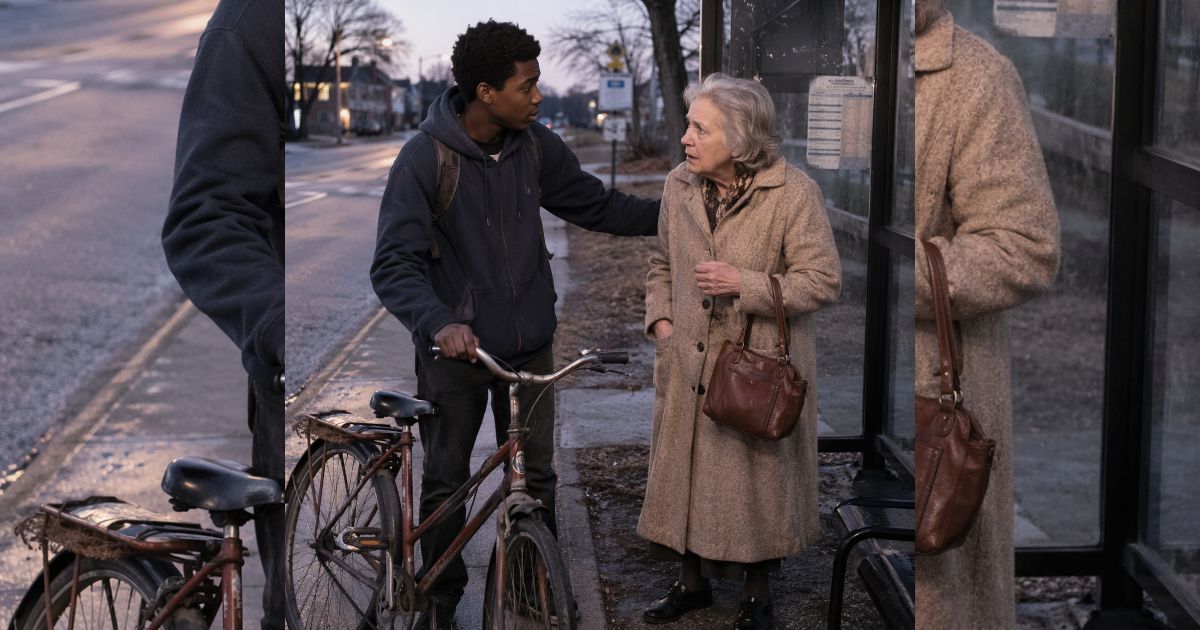
“Ma’am, you’re going to get hurt if you step off that curb.”
The words left his mouth before he had fully decided to say them.
The old woman had already leaned forward again, peering down the road as if the answer to her whole evening might appear in headlights.
A bus stop sign rattled above her.
Nobody else slowed down.
Cars rolled by.
A man with two grocery bags looked straight through her.
A teenage girl in earbuds walked past without lifting her eyes.
And eighteen-year-old Marcus Reed stood there with one hand on the handlebar of his mother’s old bike and the other wrapped around the strap of a delivery bag that suddenly felt heavier than it had a minute ago.
He had one stop left.
One.
If he made it before eight, he got paid.
If he got paid, he could hand over the rent he still owed.
If he handed over the rent, his landlord might let him keep the room one more week.
That was how his life worked now.
Not in months.
Not in plans.
Not even in full days.
In tiny distances.
In one more stop.
In one more chance.
In one more night indoors.
The woman turned toward him, blinking slowly, like she was trying to place him from a dream she had half forgotten.
“I’m looking for the Number Twelve,” she said. “It was supposed to come already.”
Her voice shook around the edges.
Marcus glanced down the road.
There was no bus coming.
There barely ever was out here after dark.
“This route doesn’t run much this late,” he said gently.
She frowned at the sign, then at the street, then at her own shoes.
“That can’t be right,” she murmured. “I was just… I was just at Willow something. Or maybe Garden. I know the turn when I see it.”
She smiled after saying it, but it was the kind of smile people used when they were trying to hide fear from themselves.
Marcus knew that look.
He had worn it plenty.
The town around them sat quiet under the last thin light of evening. The sidewalks were cracked. The bare trees along the road looked like dark veins against the sky. A cold wind slipped through the sleeves of his faded jacket and made him pull his shoulders tighter.
He should have been riding.
He should have been gone already.
Instead, he moved closer.
“Do you know your address?” he asked.
She opened a worn leather purse with careful, uncertain fingers.
Inside was a little storm of things that did not help.
Loose coins.
A lipstick.
A folded tissue.
Old receipts.
A pair of reading glasses in a soft case.
A church bulletin.
A bus transfer.
No ID card on top.
No address card.
No note.
She searched longer than she needed to, then stopped and looked up at him like she had forgotten what the purse was for in the first place.
Marcus felt something sink in his chest.
“Do you have anybody I can call?” he asked.
“My husband would know,” she said.
Then her face changed.
Small.
Distant.
“No,” she said softly. “No, he wouldn’t.”
For a second Marcus did not know what to say.
He noticed then the silver chain around her neck, tucked partly beneath the collar of her coat. A small oval pendant rested there, worn smooth from years of being touched.
“Ma’am,” he said, pointing politely, “is that engraved?”
She looked down, confused, then lifted it for him with both hands.
The back held a name and address in neat script.
Evelyn Carter.
48 Oak Hill Lane.
North Ridge.
Marcus let out a breath.
He knew North Ridge.
Everybody knew North Ridge.
It sat on the far edge of town where the roads widened, the fences got taller, and the houses stood back from the world like they had something to protect.
On a bike, from here, it was a long ride.
A very long ride.
He looked at the bus stop sign.
He looked at the road.
He looked at the time on the cracked screen of his phone.
7:18.
If he left now and rode fast, maybe he could still squeeze in the delivery, then figure out what to do about her.
But as soon as that thought came, it died.
Because Evelyn Carter had already stepped toward the curb again, still chasing a bus that was never coming.
Marcus reached out quickly and steadied her elbow.
She looked up at him with sudden trust that hit him so hard it almost hurt.
“You’re kind,” she said.
Not dramatic.
Not grand.
Just simple.
You’re kind.
It landed in him deeper than it should have.
He thought of his mother saying that people usually showed you exactly who they were when helping cost them something.
Then he thought of the rent note his landlord had shoved under the door that morning.
FINAL NOTICE.
NO EXCUSES.
Marcus shut his eyes for half a second.
Then he opened them.
“All right,” he said. “Oak Hill’s a hike, but I can get you there.”
“You can?”
“Yes, ma’am.”
“On that bicycle?”
He glanced back at the bike.
It was old enough to have stories.
Black once, now mostly rust and memory.
The chain clicked when he pedaled too hard.
The rear rack leaned slightly to one side.
The left grip had been wrapped with electrical tape after cracking apart the year before.
It had belonged to his mother.
After she died, it became the one thing he had that could still carry him somewhere.
He gave Evelyn a small smile.
“It won’t be pretty,” he said. “But it’ll do.”
She let out the faintest laugh.
“Most good things in life are not pretty,” she said.
He liked her at once.
He helped her onto the back rack, then took off the extra scarf from his neck and folded it over the metal seat bar so it would not bite into her through the coat.
He draped his own jacket around her shoulders.
“What about you?” she asked.
“I’ll be fine.”
“You don’t look fine.”
“I rarely do.”
That made her laugh again, a little stronger this time.
He waited until she held the sides securely.
“All right,” he said. “Hold on. We’ll go slow.”
And then he pushed off.
The first hill nearly reminded him why this was a terrible idea.
Marcus stood on the pedals, legs already sore from a full day of deliveries, and forced the bike forward one stubborn yard at a time. The cold pressed against his face. The wind cut through his sweatshirt. Behind him Evelyn hummed under her breath, low and absentminded, like the tune had wandered in from another year.
They crossed out of the older part of town where the houses sat close together, with porches and chain-link fences and patches of winter grass.
They passed the closed diner near the railroad tracks.
They passed the laundromat with half its lights out.
They passed the little church on the corner where the nativity scene was still standing even though Christmas had come and gone.
The sky deepened from steel gray to blue-black.
Streetlights thinned.
The town opened.
Marcus kept pedaling.
Every now and then Evelyn asked where they were.
He answered every time.
“Still on the way.”
“Still heading north.”
“Still doing just fine.”
A few minutes later she would ask again as if it were the first time.
He answered again.
He never let impatience into his voice.
He had seen enough people in hard moments to know when dignity was hanging by a thread.
At a four-way stop near the highway access road, Evelyn leaned forward a little.
“You remind me of someone,” she said.
Marcus smiled without turning.
“Is that good or bad?”
“Good,” she said. “Very good.”
“Who?”
“My grandson.”
He felt her hands tighten just a little against the sides of the rack.
“He used to walk too fast for everybody else. Like the world might close if he didn’t get there in time.”
Marcus swallowed.
“That does sound familiar.”
“He also had awful shoes,” she added.
Marcus laughed out loud for the first time all day.
He looked down at his worn sneakers, both toes scuffed pale.
“Then yes,” he said. “That really does sound familiar.”
At a small gas station near the county road, he pulled over because Evelyn was shivering.
The clerk inside barely looked up when Marcus came in. He bought one tea with the last dollar and eight cents he had in his pocket.
When he handed the paper cup back to Evelyn outside, she tried to give it to him first.
“You drink it,” she said.
“You need it more.”
“You’re the one doing the work.”
“You’re the one freezing.”
“So are you.”
He smiled.
She smiled back.
Then she took a sip and sighed like it had reached all the way down into her bones.
“Perfect,” she whispered.
Marcus did not tell her his stomach had been empty since noon.
He just got back on the bike.
The road to North Ridge rose in long cold stretches with houses scattered farther apart and mailboxes standing alone beside driveways like little sentries.
By the time they turned onto Oak Hill Lane, his thighs burned.
His fingers had gone stiff on the handlebars.
His shoulders throbbed.
But when he saw the address number on the stone pillar by the gate, relief hit so hard his vision blurred for a second.
They had made it.
The house beyond the gate was huge without showing off.
White brick.
Tall windows.
A wraparound porch.
Warm light spilling from half a dozen rooms.
The kind of place that looked quiet even when it was worried.
Marcus coasted up the drive, stopped at the front steps, and helped Evelyn down carefully.
Before he could knock, the front door opened so fast it banged lightly against the wall.
An older man in a navy robe stood there, eyes wide.
“Miss Evelyn.”
His voice broke on the name.
Then a second woman appeared behind him, then another man, then somebody farther down the hall calling, “Did you find her?”
“We did,” the older man shouted back, still staring.
He stepped outside at once.
“Miss Evelyn, where have you been? We’ve been calling hospitals.”
Evelyn blinked up at the house like she was seeing it fresh.
“Oh,” she said. “Home.”
Then she turned to Marcus with a soft smile so trusting and thankful it made him look away for a second.
“This young man brought me.”
The older man pressed a hand to his own chest.
“Son,” he said, “thank you.”
Marcus shrugged, suddenly awkward in the bright porch light and painfully aware of his worn clothes, his bike, the delivery bag still hanging across him like proof of what he was.
“She was at the bus stop out by Miller Road,” he said. “Seemed turned around.”
The man nodded too quickly.
“Yes. Yes. Thank you.”
A younger woman in house slippers appeared with a coat around her shoulders. Her eyes were red.
“We were terrified,” she said.
Evelyn patted her hand like she was the calm one now.
“No harm done,” she said. “I had company.”
The older man turned back to Marcus.
“Please, come in. Let us get you something warm. At least coffee. Soup. A ride home.”
Marcus almost said yes to the warmth before remembering the time.
The delivery.
The rent.
The room.
Too late now for all of it, most likely.
But still he shook his head.
“I should get back.”
“At least let us drive you.”
“No, sir. I’ve got my bike.”
“That’s a long way.”
“I know.”
There was a pause.
The older man studied him with the kind of careful look older folks used when they were trying not to embarrass a young person by seeing too much.
“What’s your name?”
“Marcus.”
“Marcus what?”
“Marcus Reed.”
“Do you have a phone number?”
Marcus dug in his pocket, found an old receipt from the bottom of his delivery bag, and scribbled the number with a cheap pen he carried.
“In case she gets turned around again,” he said.
The woman in slippers took the paper like it was something more serious than that.
Evelyn reached for his hand before he stepped back.
Her grip was cool and small, but steady.
“You got me home,” she said.
“Yes, ma’am.”
“That matters.”
He nodded once.
Then he got back on the bike and rode away before any of them could say more.
The cold seemed sharper on the way back.
The road had fewer lights now.
His body had run out of extra.
Every hill felt steeper.
Every mile longer.
The delivery was already lost. He knew that. There was no point racing anymore, but he still pushed hard out of habit, out of worry, out of the stubborn refusal to fully surrender until the proof of failure was in front of him.
By the time he reached the boarding house, it was past nine-thirty.
The place looked the same as always.
Peeling paint.
Crooked steps.
One dead porch bulb.
A wind chime that had lost half its tubes and clinked out of tune.
Marcus leaned his bike against the railing and reached for his key.
Not there.
He checked the other pocket.
Then the side one.
Then the inside seam of his delivery bag.
Then all over again.
Nothing.
He knocked.
Once.
Twice.
Harder the third time.
No answer.
Then he saw the plastic grocery bag sitting by the door.
A T-shirt.
A towel.
His phone charger.
A paperback workbook from school.
His extra socks.
Everything he owned that did not already fit in his backpack.
There was a note taped to the door in thick black marker.
PAST DUE. DOOR LOCKED.
Marcus stood there staring.
He did not know how long.
The cold climbed through the soles of his shoes and into his legs.
His chest felt hollowed out.
He thought about knocking again.
About shouting.
About sitting on the porch until morning.
About none of it changing anything.
After a while he picked up the grocery bag.
He tied it to his handlebars.
Then he got back on the bike.
The town after ten o’clock belonged to different people.
Night shift workers.
A few teenagers cutting through alleys.
The occasional couple hurrying to their car.
Delivery drivers trying to squeeze one more hour out of the app.
Marcus rode with no destination for almost twenty minutes because motion felt better than standing still.
Finally he turned down the alley behind Parker’s Market.
Mr. Parker had let him unload produce trucks there a few times when help was short.
The older man was gruff, broad-shouldered, and permanently unimpressed by the world, but he was fair.
Marcus knocked on the metal back door and waited.
A light came on.
The door opened.
Mr. Parker stood there in flannel pajama pants, boots, and a sweatshirt, holding a mug that smelled like burnt coffee.
He took one look at Marcus, then at the grocery bag tied to the bike.
“Didn’t make rent?”
Marcus shook his head.
Mr. Parker sighed without surprise, just irritation at the universe in general.
“Thought so.”
Marcus started to say he was sorry for bothering him.
Mr. Parker stepped aside before he could.
“Storage room’s dry,” he said. “There’s a cot behind the soda pallets. Don’t knock over the cider boxes, and don’t die in my store, because paperwork annoys me.”
For one second Marcus could not speak.
Then he nodded.
“Thank you.”
Mr. Parker grunted like gratitude was unnecessary and a little suspicious.
“Lock your bike inside.”
The back room smelled like cardboard, oranges, dust, and old heaters.
To Marcus it smelled better than any place he had ever rented.
He laid his few things by the cot.
Sat down.
Then lay back without removing his shoes.
The silence pressed in around him, but it was a different kind of silence than the one outside his landlord’s door.
This one had mercy in it.
He closed his eyes and saw flashes of the night like little lanterns.
Evelyn’s silver pendant.
The steam rising from the paper cup.
Her voice saying, You remind me of someone.
The way the big house had glowed at the end of that dark road.
He wondered if she was safe and warm now.
He wondered if she remembered him already.
He wondered if one good thing could ever stay.
By the time sleep pulled him under, he was too tired to answer himself.
Across town, in a quiet bedroom on the second floor of the house on Oak Hill Lane, Evelyn Carter sat awake in a high-backed chair by the window.
The night had settled around the house.
Her caretaker had gone to bed.
The kitchen lights were off.
The hall clock kept time in a low patient tick.
In her lap lay the coat she had worn out that afternoon.
In her hand was the torn receipt with Marcus’s number.
She had asked for it twice after coming home.
The first time no one thought much of it.
The second time they realized her voice had changed.
The fog was gone from it.
So they brought it to her.
Now she traced the ink with one finger.
“Marcus Reed,” she whispered into the dark.
And for the first time in years, something in that enormous house felt less empty.
Morning came pale and slow.
Marcus woke to a crick in his neck, the rattle of the old refrigerator compressor, and the sound of Mr. Parker opening the front of the store.
He sat up too fast and regretted it instantly.
Every muscle complained.
He folded the blanket neatly because some habits had dignity attached to them.
When he came out front, Mr. Parker slid a banana and a cup of coffee toward him without comment.
Marcus took both.
“Thanks.”
“You smell like cardboard,” Mr. Parker said.
“I slept with cardboard.”
“Fair.”
Marcus stood by the window sipping coffee hot enough to hurt. Outside, school kids moved along the sidewalks with backpacks and puffy coats. A mail truck rolled by. Somewhere down the block a dog barked twice.
It looked like an ordinary morning.
Until the black sedan pulled up.
The car did not belong on Maple Street. It was too clean, too quiet, too polished for the row of brick storefronts and patched asphalt.
A tall man stepped out wearing a charcoal coat and leather gloves.
He checked a small slip of paper in his hand.
Then he looked through the window directly at Marcus.
Marcus felt his shoulders tense.
The bell over the door chimed.
The man stepped inside with the kind of ease that said he had spent most of his life in rooms where people made space for him.
“Excuse me,” he said. “Are you Marcus Reed?”
Marcus nodded slowly.
“That depends who’s asking.”
The man’s face softened.
“My name is Charles Bennett. I work for Miss Evelyn Carter. She asked me to find you.”
Mr. Parker paused while stocking gum by the register and turned one inch in their direction.
Marcus lowered the coffee cup.
“Is she okay?”
“She is,” Charles said. “Very much so. In fact, she remembers last night clearly, and she is quite determined to thank you in person.”
Marcus let out a breath he had not realized he was holding.
“That’s not necessary.”
Charles gave a very small smile.
“She was specific on that point. It is necessary.”
Marcus looked down at his clothes.
Same jeans.
Same old hoodie.
Still carrying the wear of yesterday.
He glanced toward the back room where his grocery bag sat on the cot.
“I’ve got work.”
Mr. Parker did not even look up when he spoke.
“You stack shelves for me sometimes. That is not the same as having work.”
Marcus almost smiled.
Charles held up the receipt with Marcus’s number.
“She asked me to bring you if you were willing.”
Marcus hesitated.
He thought of the distance to Oak Hill.
He thought of the bright house.
He thought of walking into a world that would notice every frayed thread on him.
Then he thought of Evelyn at the bus stop, turning in slow circles while everybody else kept moving.
“All right,” he said. “I’ll go.”
Mr. Parker made a dismissive noise.
“Good,” he said. “Your banana money’s not enough for rent anyway.”
The drive to Oak Hill in daylight felt unreal.
Everything looked shorter by car.
The hills that had nearly broken his legs the night before now rolled by in silence.
Charles drove with both hands on the wheel and the calm of a man who believed in smooth roads and clear plans.
Marcus sat rigid in the passenger seat, trying not to touch anything.
“You helped Miss Carter a great deal,” Charles said after a while.
“I just got her home.”
Charles gave him a sidelong glance.
“Sometimes that is a great deal.”
The house looked even bigger in daylight.
Not flashy.
Just old and settled and very sure of itself.
A woman in her fifties opened the side door before Charles even reached it. Her name, he said, was Helen. She wore a cardigan and sensible shoes and had the warm, watchful face of someone who had spent years quietly keeping other people’s lives from falling apart.
“Marcus,” she said softly. “Come in.”
The kitchen smelled like cinnamon and coffee.
Sunlight touched the polished wood table.
A kettle hissed faintly on the stove.
It all looked so normal that his nerves sharpened instead of relaxing. Wealth, he had learned from the outside, often looked less like gold and more like ease.
Helen led him down a hallway lined with family photographs.
He did not stop to study them, but he noticed one thing.
Evelyn appeared in many of them.
The same smile.
The same posture.
The same eyes.
And in several frames beside her stood a young man with dark skin, bright eyes, and a grin too quick to belong to a stiff family portrait.
At the end of the hall Helen opened a sitting room door.
Evelyn was there by the window in a pale blue sweater, hair pinned neatly, glasses on, a blanket folded over her knees though the room was warm.
She looked up.
And smiled like sunlight had entered with him.
“There you are,” she said.
Marcus stood still.
The woman from the bus stop was in front of him and not in front of him.
This Evelyn looked entirely present.
Her eyes were clear.
Her voice steady.
Her posture elegant without effort.
The distance between lost and found had never looked so dramatic.
“Yes, ma’am,” he said.
She held out both hands.
“Come here.”
He did.
She took his hands as if they belonged in hers.
“You brought me home,” she said, and her voice trembled only once. “You treated me with patience when I had very little of myself to offer you in return. I remember the hills. I remember the tea. I remember you answering me again and again like I had not already asked the same question. I remember your jacket around my shoulders.”
Marcus felt heat rise to his face.
“I just didn’t want you out there alone.”
Her grip tightened.
“That is never a small thing.”
He looked down because he did not know where else to put his eyes.
She noticed.
“Have you eaten?”
He almost answered automatically with the kind of half-lie he had used for years.
Helen saved him from it.
“He has not had a proper breakfast,” she said from behind him.
Evelyn shot her a look filled with old friendship.
Then she turned back to Marcus.
“Sit.”
There was no sharpness in the word.
Only care.
He sat.
Helen brought a plate with toast, eggs, and fruit.
Marcus tried not to devour it too fast.
He failed.
Evelyn pretended not to notice, which was its own kindness.
When he had eaten enough to breathe normally again, she asked, “Where do you live, Marcus?”
He swallowed.
“At the moment? Nowhere permanent.”
Evelyn’s face changed.
Not with pity.
Something quieter.
More focused.
“Your parents?”
“My mom passed two years ago. My dad wasn’t around before that.”
Evelyn was silent.
Helen looked toward the window.
Charles, standing by the bookshelf, lowered his gaze respectfully.
Marcus wished instantly that he had not said any of it.
He hated rooms going soft around him.
“I’m okay,” he added too quickly. “I work deliveries. I pick up shifts where I can.”
Evelyn leaned back in her chair and studied him for a long moment that made him feel seen in a way he was not used to.
Then she said, “You are not okay. You are surviving.”
The truth of it hit him like a hand to the chest.
He let out a slow breath.
“Maybe.”
She nodded once.
Then she reached to the side table and picked up a folded piece of thick stationery.
“I asked you here to thank you,” she said. “But also because I would like to make you an offer.”
Marcus stiffened on instinct.
The room seemed to feel it.
Evelyn noticed that too.
Her voice softened further.
“No tricks. No contract. No debt. Just an offer.”
She handed him the paper.
His fingers hesitated before taking it.
Inside, in her careful handwriting, were a few simple lines.
A room at the house, if he wanted it.
Meals.
Temporary help until he got steady again.
And beneath that, one sentence that made his throat tighten.
If you still wish to finish school, I would like to help you do that.
Marcus read it twice.
Then a third time.
He looked up.
“I can’t take this.”
“You can.”
“I didn’t help you for this.”
“I know.”
“That matters.”
“Yes,” Evelyn said. “It matters very much. It is the reason I trust you.”
He shook his head.
The room felt too warm.
His chest too full.
“People don’t just offer things like this.”
“Sometimes they should.”
He stood up before he meant to.
“I’m not looking for charity.”
Evelyn did not flinch.
“Neither am I.”
He looked at her, confused and defensive and suddenly ashamed of both.
She folded her hands in her lap.
“I am an old woman in a large house,” she said quietly. “I have staff I value, neighbors who wave, invitations I decline, and more rooms than I can use. What I do not have is enough truth around me. Last night a young man with every reason to keep riding stopped anyway. I recognize character when I see it, Marcus. I am not offering alms. I am offering shelter, respect, and a chance for two lonely people to help each other.”
The room went very still.
Marcus stared at her.
Nobody had ever spoken to him like he had something rare in him instead of something broken.
He did not know how to hold it.
He set the paper carefully on the side table.
“That’s kind,” he said. “Really kind. But I need to think.”
Evelyn smiled.
“Then think.”
She did not press.
She did not plead.
She just nodded to Helen, who wrapped a plate of food for him, and to Charles, who drove him back to Maple Street.
Before Marcus got out of the car, Charles said, “She does not make impulsive offers.”
Marcus looked at the house shrinking in the side mirror.
“Then why me?”
Charles rested both hands on the steering wheel.
“Because some people wait until they are comfortable to become generous. Others are generous while uncomfortable. Miss Carter notices the difference.”
Marcus carried those words all day.
He tried to work.
Tried to sweep.
Tried to help Mr. Parker restock canned soup and bread.
But his mind kept circling back.
A room.
A bed.
School.
Not forever.
Just enough to stand up straight again.
It should have been an easy answer.
It wasn’t.
Because easy things had fooled him before.
That afternoon a girl from his old school came into the market with her little brother. She recognized him at once.
“Marcus? I thought you transferred.”
He shook his head.
“Just took a break.”
She smiled sadly in that way people do when they know more than you wanted them to.
When she left, Mr. Parker stacked oranges in silence for nearly a minute before saying, “You were good at school?”
Marcus kept arranging soup cans.
“Good enough.”
“Wanted to go back?”
He shrugged.
“Wanting and doing are different.”
Mr. Parker snorted.
“That they are.”
Another minute passed.
Then the older man said, “That woman see something in you?”
Marcus paused.
“I think so.”
Mr. Parker set down the orange in his hand.
“Then don’t insult her by pretending that means nothing.”
Marcus looked at him.
Mr. Parker shrugged one shoulder.
“I know what it costs people to ask for help. I also know what it costs decent people when their help gets refused out of pride. Figure out which pain you actually need.”
That night Marcus slept in the storage room again.
But he did not sleep much.
He kept hearing Evelyn’s voice.
Not charity.
Recognition.
He had lived so long in the language of scraps that it felt dangerous to be addressed in the language of worth.
The next morning, before he could change his mind, the black sedan returned.
This time Evelyn came with it.
No grand entrance.
No fuss.
Just her, wrapped in a shawl and carrying that same small leather bag.
When the bell chimed, Mr. Parker glanced up, nodded respectfully, and retreated on purpose to the stockroom, leaving the front of the store to them.
Evelyn walked slowly toward Marcus.
“I hope you don’t mind my coming in person.”
“I don’t mind.”
“I thought you might try to disappear if I sent only Charles.”
Marcus almost smiled.
“I considered it.”
“I know.”
She stood at the counter and looked around at the narrow aisles, the fluorescent lights, the coffee station near the register.
Then back at him.
“My husband built businesses,” she said. “He respected numbers. Efficiency. Growth. I respected people. We loved each other, but we understood the world differently. After he passed, everyone assumed I would spend the rest of my life being managed. Protected. Scheduled. Advised.” She gave a gentle, dry smile. “I let them, for a while.”
Marcus listened.
“Then I got older,” she said, “and grief got older with me. It softened in some places and sharpened in others. My grandson used to visit every week when he was younger. He had your same stubborn face when he thought he was hiding his feelings. He moved away as an adult. We lost time. Then I lost him too, in the quieter way families sometimes lose one another. No court. No headlines. No big scandal. Just distance. Pride. Delay. A thousand missed chances disguised as ordinary days.”
Her eyes did not leave his.
“When I was at that bus stop, I was afraid. More than I let anyone see. Then you appeared. A tired young man with cracked shoes and an old bicycle. And you looked at me as if I still mattered. Do you understand what kind of gift that is?”
Marcus’s throat worked before his voice did.
“My mom used to say everybody wants to be noticed before they want to be fixed.”
Evelyn’s face softened completely.
“She was right.”
A long silence passed between them, but it was not empty.
Finally Marcus said, “If I came… it would just be temporary.”
“Of course.”
“I’d want to work.”
“Good.”
“I don’t want to feel like some project.”
“You won’t.”
“I mean it.”
“So do I.”
He looked down.
Then back up.
And for the first time in a long while, he let himself want something without apologizing for it first.
“All right,” he said. “I’ll come.”
Evelyn closed her eyes briefly like a prayer had been answered.
When she opened them, they shone.
“Good,” she said. “Very good.”
Mr. Parker reappeared with a paper bag already packed.
“Sandwiches,” he muttered. “Since apparently everybody’s having an emotional day.”
Marcus laughed.
It startled him how good that felt.
He packed his things in ten minutes because there was not much to pack.
One backpack.
The grocery bag.
His mother’s old paperback Bible with notes in the margins.
Two shirts.
His school folder.
A framed photo of his mom that had lost one corner of the glass.
Mr. Parker carried the bike out to the car himself.
When Marcus thanked him, the older man waved him off.
“You come by and visit,” he said. “Rich people food gets boring. You’ll need a proper sandwich eventually.”
Marcus nodded.
“I will.”
Then he got into the car.
And left survival behind by inches.
Life at the Carter house did not change overnight.
That surprised him most.
There was no dramatic music in the walls.
No magical feeling that all pain had been erased.
He still woke too early the first week, heart racing for no reason he could name.
He still folded every blanket too neatly.
He still saved half his dinner rolls the first few nights without thinking, tucking them in a napkin for later.
Helen noticed on the third evening.
She did not call attention to it.
She simply began sending a covered plate to his room every night “in case you get hungry while reading.”
That was the sort of mercy the house specialized in.
Quiet.
Specific.
Dignified.
Marcus’s room sat on the second floor overlooking the back garden.
It was not flashy.
Just warm.
A real bed.
A desk.
A quilt.
Curtains that moved softly when the window cracked open.
The first night he stood in the doorway for a long time before stepping in.
He had slept in places.
He had stayed in places.
This was the first room in a very long time that seemed to say, You may exhale here.
Evelyn never hovered.
That mattered.
She invited him to breakfast, not required him to attend.
She asked if he liked tea, not assumed.
She told him where the books were, where the laundry room was, which cabinet held extra blankets.
On his third day, she handed him a schedule card with the Wi-Fi password written on the back in careful block letters and said, “Every house has its mysteries. That one should not be among them.”
He smiled.
The house itself ran on the steady hands of people who had been there long enough to become part of its bones.
Helen kept everything human.
Charles kept everything orderly.
A gardener named Luis nodded to Marcus each morning like he had always expected him to appear eventually.
A cook named Denise acted stern and then slipped him extra pie.
Marcus did not know what to do with people being kind to him for more than one day in a row.
So he helped.
He carried boxes.
He shoveled a walkway after a light snow.
He organized the basement storage shelves after noticing nobody had touched half the old files in years.
He walked with Evelyn in the greenhouse when she felt strong.
He sat with her in the afternoons while she read or sorted old letters.
Sometimes her mind was clear as glass.
Sometimes a little mist wandered in.
When that happened, Marcus did for her what he had done on the bike.
He answered gently.
Again if needed.
Never with impatience.
A week after he moved in, Evelyn asked if he still wanted to finish high school.
Marcus stared at the question longer than he should have.
“Want to?” he said. “Yes. Think I can? I don’t know.”
She tilted her head.
“Do you believe intelligence vanishes because life interrupted it?”
“No.”
“Then we proceed.”
It turned out he had only a few credits left.
The school counselor, a tired-eyed woman named Mrs. Lopez, nearly cried when she realized he was serious about returning.
“We kept your file open longer than policy says we should,” she admitted. “I’m glad we did.”
Evelyn never marched in beside him like a savior.
She sat in the car while he handled the forms himself.
She paid the fees quietly through the front office after asking what was needed.
When Marcus found out, he protested.
She lifted one hand.
“I did not save you,” she said. “I removed a barrier. Do not confuse the two.”
He had no comeback for that.
So he went to class.
At first it was brutal.
He was older than some in the room and more tired than all of them.
His brain felt rusty in places.
His pride flared whenever he had to ask for help.
But he was good.
Better than he remembered.
English came back fastest.
History next.
Math took more work.
At night he studied at the desk in his room until his eyes blurred.
Sometimes Evelyn would pass the open door and see him bent over a notebook.
She never interrupted.
She just left a cup of tea on the desk and kept moving.
It was in those weeks that Marcus began to notice the fracture lines in Evelyn’s life.
Not the money.
The family.
Her niece, Dana Whitcomb, arrived one Sunday afternoon with a smile that never made it into her eyes.
Dana was elegant in a way Marcus associated with magazines in doctor’s offices.
Perfect coat.
Perfect hair.
Perfect posture.
She greeted Evelyn with practiced warmth.
Then noticed Marcus pouring tea.
Something flickered across her face.
Not surprise.
Calculation.
“And who is this?” she asked.
Evelyn answered before Marcus could.
“This is Marcus Reed. He is staying with us.”
Dana’s brows rose almost invisibly.
“How lovely.”
The word landed cold.
Marcus knew that tone.
It was the tone people used when they intended to be polite in public and cruel in private later.
Dana sat for an hour, asking harmless questions that were not harmless at all.
How long had Marcus been there?
Was he related to anyone on staff?
How had Evelyn met him?
Was this arrangement temporary?
Did Charles think it was wise?
Evelyn answered lightly at first.
Then with steel.
Finally, when Dana said, “You know people may talk,” Evelyn set down her teacup.
“Then let them tire themselves out.”
Dana smiled without warmth.
“Of course. I only meant that people can misunderstand generosity.”
Evelyn’s eyes sharpened.
“Generosity is often misunderstood by people who prefer inheritance to character.”
The room went still.
Marcus pretended to be very interested in the tea tray.
Dana left soon after.
In the hallway Marcus heard her low voice to Charles.
“You cannot possibly think this is appropriate.”
Charles replied so evenly Marcus almost missed the force in it.
“My thoughts on appropriateness are not the issue, Ms. Whitcomb.”
That night Marcus sat in his room longer than usual, staring at a worksheet while Dana’s expression replayed in his mind.
He knew what she had seen when she looked at him.
A poor kid in a rich house.
A complication.
A threat, maybe.
Even if no one said the word, he knew it hovered.
Gold digger.
Opportunity seeker.
Street kid who got lucky.
He had feared those names before anyone spoke them.
The next morning he told Evelyn he thought maybe he should move back to town and just keep the room arrangement shorter than planned.
She knew at once what had prompted it.
“Dana upset you.”
He looked out at the garden.
“She’s your family.”
Evelyn gave a dry little laugh.
“Family is a broad category.”
“I don’t want to make trouble.”
“You are not making trouble. Trouble arrived in a designer coat and called itself concern.”
Marcus tried not to smile.
It half-worked.
She leaned forward.
“Listen to me carefully. If you leave this house because you have decided it is best for your own spirit, I will respect it. If you leave this house because someone with shallow motives wants you ashamed of being helped, I will be furious.”
He looked at her.
She meant it.
“I’m not ashamed,” he said.
“Good,” she answered. “Stay that way.”
He stayed.
Over the next month the shape of their life settled into something steady and almost ordinary.
School during the day.
Homework at night.
Tea with Evelyn in the late afternoon when her energy was best.
Saturday visits to Parker’s Market because Marcus refused to vanish from the life that had kept him alive.
Mr. Parker would grunt and ask too many questions while pretending not to care.
“So they feeding you?”
“Yes.”
“Real food?”
“Yes.”
“Not little fancy bites?”
Marcus laughed.
“Real food.”
“Good.”
Sometimes Evelyn came with him and bought produce she did not need just to support the store.
She and Mr. Parker developed a mutual respect built mostly from bluntness.
“You throw your weight around quietly,” Mr. Parker told her once.
“I find it more effective,” she replied.
Marcus also started helping Helen sort old boxes in the attic and basement.
That was how he found the ledgers.
They were stacked in banker’s boxes with dates across four decades.
Household accounts.
Charitable donations.
Correspondence from local nursing homes, shelters, school programs, community clinics.
And beneath them, folders filled with Evelyn’s notes in the margins.
Questions.
Ideas.
Concerns.
What if transportation were easier for seniors?
Could scholarship interviews be community-based, not paper-only?
No one should lose housing over one missed payment.
Marcus sat cross-legged on the basement floor reading them for nearly an hour.
Helen found him there.
“She’s been planning ways to help other people longer than most of us knew,” Helen said softly.
“Why didn’t she do it?”
Helen smiled sadly.
“Because grief can turn intention into delay. Because people around wealth often become experts at caution. Because once you start listening to advisors who say, ‘That sounds nice, but,’ you can lose ten years without realizing it.”
Marcus looked down at the pages.
“She still wants to.”
Helen’s expression warmed.
“Yes. I think she does.”
That evening Marcus carried one of the boxes to the sitting room.
Evelyn looked at it and then at him.
“You found the cemetery of my unfinished ideas.”
He sat across from her.
“They’re good ideas.”
“They are old ideas.”
“Still good.”
Evelyn sighed and touched the lid.
“Your grandfather in spirit,” she said, meaning her husband in tone if not in blood, “believed charity should be strategic. Controlled. Efficient. He disliked emotional decision-making. After he died, Dana and the rest kept saying the same thing in softer words. I grew tired. Then I grew older. Then I started forgetting things at the wrong times and everyone grew even more careful around me, as if I had become fragile in every way.”
Marcus thought of the bus stop.
Of the panic beneath Evelyn’s smile.
“You’re not fragile,” he said.
“Some days I am.”
“Not in the ways that count.”
She looked at him for a long moment.
Then she smiled very slowly.
“Would you help me?” she asked.
“With what?”
“With finally doing something.”
That was how the Willow Light idea began.
Not as a grand public announcement.
Not as a flashy gala.
As two people at a table with tea gone cold, old notes spread out between them, talking seriously about what pain looked like when it came dressed as paperwork.
Housing insecurity.
Elder confusion.
Students falling out of school because life did not pause for them to catch up.
Dignity.
That word kept returning.
Evelyn said it one night while tapping a pencil against a yellow notepad.
“Too many systems assume people lose dignity when they lose stability. I want anything we build to move the other direction.”
Marcus wrote that down.
Then circled it.
The work gave them both something.
For Evelyn, it was purpose sharpened into motion.
For Marcus, it was the strange new experience of not merely being rescued but being useful within the rescue.
He met with local counselors.
Talked to Mrs. Lopez about students close to dropping out.
Spoke with a pastor who knew half the town’s quiet needs and none of its gossip.
Visited a senior center where one staff member admitted transportation failures were causing people to miss appointments, meals, even simple social routines that kept them oriented.
Marcus listened.
Took notes.
Came back and told Evelyn everything.
She listened harder than anyone he had ever met.
That spring Dana returned.
This time with a lawyer’s smile and a folder in her hand.
Marcus was in the library cataloging donated books for what they hoped would become a reading room at the future center when he heard raised voices in the front parlor.
He did not intend to eavesdrop.
Then he heard his own name.
He stopped.
Dana’s tone was smooth, which made it worse.
“I am simply asking you to be careful. You are rewriting estate intentions while under the influence of a young man you scarcely knew six months ago.”
Evelyn’s reply came sharp as cut glass.
“I am rewriting my own intentions because I have finally remembered that I am allowed to have them.”
“There will be questions.”
“There are always questions when money stops traveling the route people expected.”
Dana lowered her voice, but Marcus still caught enough.
“What will people say if a black teenager from nowhere suddenly becomes central to your planning?”
Marcus went still.
The silence after that sentence felt enormous.
Then Evelyn said, each word separate and clear, “People who still measure human worth by race, address, or inheritance have forfeited their right to advise me.”
Marcus shut his eyes.
He had heard uglier things in his life.
He had heard louder things.
But something about hearing himself reduced so neatly, inside the house that had become safe, hit deeper than the old familiar wounds.
He turned away from the doorway before anyone saw him.
Later Evelyn came to find him in the greenhouse.
He stood by the tomato seedlings pretending to care about the watering schedule.
She came beside him and did not speak for a moment.
Then she said, “I am sorry you heard that.”
He nodded once.
“It’s not the first time.”
“I know,” she said. “That may be the worst part.”
He stared at the rows of green.
“I don’t want your life harder because of me.”
She drew in a long breath.
“My life was made harder by cowardice long before you arrived. At least now the difficulty has a purpose.”
He laughed softly despite himself.
Then the laugh vanished.
“She thinks I’m here for your money.”
“She thinks everybody is secretly here for something.”
Marcus looked at her.
“What if she’s not the only one who thinks it?”
Evelyn’s answer came quickly.
“Then more people are wrong.”
He let the silence sit.
Then he admitted the thing he hated most.
“Sometimes I worry I’ll start thinking it too. Like maybe I only said yes because I was tired enough to take anything. Like maybe that makes all of this less clean.”
Evelyn turned fully toward him.
“Oh, Marcus,” she said, so gently his chest tightened at once. “Need does not make you manipulative. Being tired does not make you false. Survival is not a stain.”
He looked away fast.
Not because he disagreed.
Because he did not know how to stand there while those words healed places that had been braced for years.
She touched his sleeve lightly.
“The world often praises self-reliance in ways that are very convenient for people who never had to be desperate,” she said. “But human beings were not built to survive alone. You said yes because help was offered and needed. That is not shameful. That is honest.”
He nodded once, hard.
It was the best he could do.
Graduation came in June.
Marcus had not wanted much fuss.
He certainly had not wanted a party.
What he got was worse, in the best possible way.
Helen cried through the ceremony.
Mr. Parker showed up in a button-down shirt that looked personally offended to be worn.
Evelyn wore a navy dress and sat in the front row with both hands folded over her cane, eyes fixed on Marcus as if the diploma had been something they had both earned.
When his name was called, the applause from their little cluster sounded louder to him than the whole gym.
Afterward, outside under the summer trees, Mrs. Lopez shook his hand and said, “You were always capable. I’m glad life finally gave you room to prove it.”
Marcus looked over at Evelyn then.
She was talking with Helen.
Laughing at something.
Alive in a way that had nothing to do with age and everything to do with purpose.
That evening at the house, Denise set out fried chicken, cornbread, greens, macaroni, and a cake that said WE KNEW YOU COULD.
Marcus stood in the doorway of the dining room and stared.
“This is too much.”
“No,” Denise said. “This is dinner.”
Mr. Parker snorted.
“Boy still doesn’t understand celebration.”
Evelyn patted the chair beside her.
“Sit down and learn.”
He did.
A week later Marcus found out Evelyn had quietly established a scholarship in his name for local students who had left school due to housing or family instability.
He was angry at first.
Not because it existed.
Because she had used his name without asking.
He brought it to her, heart pounding.
“You should’ve told me.”
She blinked, surprised.
“You dislike it?”
“No. I just…” He struggled for words. “I don’t want people thinking my life is some story to hold up like a poster.”
Evelyn listened.
Then nodded slowly.
“That is fair. I should have asked.”
Marcus exhaled.
The anger loosened a little.
She continued, “The reason I used your name is not because your life is a poster. It is because names matter. Abstractions make people comfortable. Real names make them responsible. But if it feels like too much exposure, we can change it.”
He sat down across from her.
After a minute he said, “Maybe not change it. Just… make sure it helps people without turning them into speeches.”
A smile warmed her face.
“Now that,” she said, “is exactly why it should keep your name.”
By late summer the old community building on Willow Street was purchased and cleared.
It had once held a daycare, then sat half-empty for years.
The roof needed work.
The windows leaked.
The back offices smelled like mildew and old disappointment.
Marcus loved it immediately.
He and Luis hauled broken shelving out to the curb.
Mr. Parker donated food for volunteer days.
Mrs. Lopez connected them with retired teachers willing to tutor students.
The senior center sent staff to advise on transportation and memory-friendly design.
Evelyn stood in the middle of the dusty main room one afternoon, sunlight cutting through the grime, and said, “This is what hope looks like before it is cleaned up.”
Marcus laughed.
Then he wrote it down.
Willow Light became more than an idea.
A drop-in office for students at risk of losing school placement.
A transportation desk for seniors who needed reliable rides.
A pantry.
A quiet room.
Tutors.
Social workers.
Nothing flashy.
Everything practical.
Everything rooted in one stubborn principle.
A missed step should not end a life.
Local interest grew.
So did resistance.
Not everyone liked the center.
A few people muttered that it would attract “the wrong kind of need” to the neighborhood.
Marcus heard that phrase and smiled bitterly. Need, he had learned, was always acceptable from a distance and suspicious up close.
Dana opposed the center in polished language.
She never attacked it directly.
She merely raised concerns about “financial stewardship” and “public optics.”
Evelyn heard her out once at a family meeting, then said, “Public optics matter less to me than private conscience.”
Charles, who almost never showed personal opinion, later told Marcus, “That was as close to a slammed door as Miss Carter ever gets.”
Marcus grinned.
But he also saw the toll all this took on Evelyn.
Her energy came in waves.
Some afternoons she was sharp, decisive, funny.
Other days words drifted out of order or a memory slipped just beyond her reach and frustration tightened her shoulders.
On those days Marcus stayed close without hovering.
They sat in the greenhouse.
He read aloud from the newspaper.
They walked the back garden one slow path at a time.
Once, after she forgot the name of a flower she had planted for twenty years, she pressed her lips together and said, “This is what I hate. Not forgetting. Being watched while I do it.”
Marcus looked at the flower bed.
“Then I’ll stop looking like I’m watching.”
She glanced at him.
He shrugged.
“I’ll just be here.”
That answer pleased her more than comfort would have.
Autumn came again.
The kind of autumn that made the air smell like leaves, wood smoke, and distant football games.
One afternoon Marcus rode his mother’s bike into town on purpose.
He still kept it tuned as best he could.
The Carter car was easier.
The bike kept him honest.
He stopped at the old bus stop on Miller Road.
The sign still rattled.
The bench still leaned.
Traffic still passed too fast.
He stood there with one foot on the curb and let the year fold back on itself.
One missed delivery.
One cold evening.
One choice that made no sense on paper.
He thought about all the ways life could turn while you were busy calculating smaller fears.
When he got back to the house, Evelyn was waiting on the porch with two mugs of tea.
“You’ve been sentimental,” she said at once.
He blinked.
“How do you know?”
“Your face gets quieter.”
He sat beside her.
“I went to the bus stop.”
She nodded as if she had expected that too.
“Hard to believe it started there.”
“Harder to believe how many people walked past,” she said.
Marcus held the warm mug between both hands.
“I used to think lives changed in big movie moments. Speeches. Miracles. Crazy luck.”
“And now?”
He looked out over the lawn.
“Now I think they change when somebody notices something other people decided not to see.”
Evelyn smiled into her tea.
“Yes,” she said. “That sounds right.”
The Willow Light Center opened three months later.
No ribbon cut by famous hands.
No television trucks.
No glossy campaign.
Just folding chairs.
A borrowed podium.
A crowd made up of people who had already been doing the hard work quietly for years.
Seniors from the center.
Teachers.
Store owners.
Church volunteers.
Counselors.
Students.
Neighbors.
Mr. Parker wore the offended button-down again.
Denise brought enough food for half the town.
Helen handled the guest list with military grace.
Charles managed parking as if the Republic depended on it.
Evelyn insisted Marcus speak.
He resisted for days.
Then lost.
Standing at the podium, he looked out and saw people who had known him at different stages.
The poor kid on the bike.
The quiet student who disappeared.
The young man in Evelyn Carter’s house.
The one who came back.
He drew in a breath.
Then told the truth.
About instability.
About how quickly one late payment or one missed ride or one lost job could pull the floor out from under someone.
About how shame often did as much damage as hunger.
About how the center existed not to rescue people from weakness, but to meet people with dignity before hardship hardened into collapse.
When he finished, the applause rose slowly and stayed.
He stepped back from the podium in a blur.
Evelyn took the microphone last.
She did not use notes.
“My husband once taught me that good investments should compound,” she said. “He was right. What he did not live long enough to see was that kindness compounds too. One act of patience at a bus stop became meals, schooling, work, friendships, and now this place. If you want to know what changes a town, it is not speeches. It is people refusing to look away from one another.”
There were tears in more eyes than just Helen’s that day.
Including Marcus’s, though he denied it later.
For nearly a year after the opening, Willow Light settled into its rhythm.
Students came for tutoring and emergency support.
Seniors came for rides, paperwork help, and a room where no one treated confusion like embarrassment.
Families came for pantry support during lean months.
Volunteers came because once a community sees a workable good thing, more people than you expect want to protect it.
Marcus enrolled in community college part-time and took courses in social work and public administration because he had discovered he was good at both listening and systems.
Evelyn joked that he was becoming dangerous.
“Competent and compassionate,” she said. “That combination unnerves lazy people.”
Dana attended fewer family meetings after realizing opposition was not slowing anything down.
She remained polite.
Which was fine.
Some victories do not require affection.
Then came the winter Evelyn got worse.
Not all at once.
In glimmers.
A forgotten hallway.
A missed date.
A name placed gently in the wrong slot.
The doctors used careful language and practical suggestions.
Nothing dramatic.
Nothing cruel.
Just the slow, steady truth that memory had become a landscape with more holes in it than before.
Marcus took the news badly in private and well in public.
Evelyn saw through him instantly.
“You’re doing that thing where you become too calm,” she said one evening.
He sat by her chair, hands clasped tight.
“I’m fine.”
“No, you’re not.”
He let out a breath.
“I hate this.”
She nodded.
“So do I.”
He looked at her.
Then away.
“I can’t lose you too.”
The words hung there.
He had not planned to say them.
Her face softened in a way that nearly undid him.
“You are not a boy at a locked door anymore,” she said quietly. “Whatever happens, that matters. Hold on to that.”
He pressed his hands together harder.
“I know.”
“But?”
“But I still don’t like it.”
“Neither do I.”
They sat with that honesty awhile.
No fixing.
Just truth.
Then she smiled faintly.
“Well,” she said, “if we cannot control time, we might at least boss it around a little.”
He laughed through the ache.
She leaned back.
“You should know something. I revised the estate last spring.”
Marcus groaned at once.
“Evelyn.”
“Hush. Listen.”
“I don’t want—”
“I am not leaving you a palace and a chandelier, Marcus. Stop panicking.”
He closed his mouth.
Barely.
She continued. “The center is protected. Helen and Charles are protected. The staff are protected. A substantial portion is held in trust for Willow Light’s work long after either of us are gone. And you—” She lifted one brow. “You have a role if you choose it. Leadership. Stewardship. Not ownership in the vulgar sense. Responsibility. Because you understand the mission from both ends.”
Marcus stared at her.
“That’s too much.”
“That is precisely why it belongs with someone who thinks so.”
He rubbed a hand over his face.
“You really do just bulldoze me with logic.”
“It is one of my remaining pleasures.”
He shook his head, smiling despite himself.
Years later he would remember that conversation more clearly than entire months.
Because love, he learned, often sounded like being entrusted rather than indulged.
The last Christmas Evelyn remained mostly herself, the house filled with a kind of quiet joy Marcus would never stop missing.
There were no giant parties.
Just lights on the banister.
Music in the kitchen.
Mr. Parker pretending he did not like carols while humming them anyway.
Helen baking too much.
Denise baking even more.
Marcus and Luis bringing in boxes of donated coats for the center’s winter drive.
Evelyn sitting by the tree with a blanket over her knees and a smile that moved through the room like warmth.
At one point she called Marcus over and handed him a small wrapped box.
Inside was a watch.
Not flashy.
Simple leather band.
Clean face.
Old enough to be meaningful.
“It was my grandson’s,” she said.
Marcus froze.
“I can’t take this.”
“Yes, you can.”
Her eyes were steady.
“He and I lost each other through distance, pride, and the dangerous assumption that later is always waiting. I won’t repeat that mistake by hoarding memory in drawers. I want it worn by someone who knows what time costs.”
Marcus could not answer right away.
When he finally did, his voice was rough.
“I’ll take care of it.”
“I know.”
He wore it every day after that.
In the years that followed, Evelyn moved in and out of clarity more often.
Some mornings she knew every detail of a past Christmas from forty years earlier and could not place the month they were in now.
Some afternoons she would look at Marcus and say his name with perfect certainty.
Others she would study him, smile, and say, “You are the nice young man from the bicycle.”
The first time that happened, it broke him a little.
He hid it well.
Afterward, in the pantry, Helen found him standing still beside sacks of flour.
“She remembers what mattered,” Helen said quietly. “Even when the order shifts.”
Marcus nodded because he could not trust his voice.
He began answering Evelyn the way he had at the bus stop.
Always gentle.
Always like it was the first time.
Yes, ma’am.
We’re home.
You’re safe.
I’m Marcus.
It’s Tuesday.
Tea is on the table.
The center’s doing well.
Yes, we still have the greenhouse.
And some days, in the middle of that fog, she would suddenly look at him with complete clarity and say, “I knew you were worth stopping for.”
Then the whole room would brighten.
When she finally passed, it happened in the house on Oak Hill with spring rain tapping softly at the windows.
No chaos.
No spectacle.
Helen was there.
Charles was there.
Marcus was there, holding her hand.
Earlier that day she had drifted in and out, but once, only once, she opened her eyes fully and looked at Marcus the way she had in the sitting room the morning after the bus stop.
Clear.
Present.
Certain.
“You came back,” she whispered.
“Always,” he said.
She smiled.
Then rested.
The grief afterward moved through the house like weather.
Mr. Parker sent casseroles and insults to anyone who offered sympathy the wrong way.
Helen folded and unfolded dish towels because hands needed work.
Charles handled legal details with a face like carved stone and red eyes he did not discuss.
Marcus walked every room that first night because being still felt impossible.
He ended up in the sitting room by the window where Evelyn had first offered him a future.
On the side table lay one of her old yellow notepads.
On the top page, in shaky late handwriting, were four words.
Dignity must arrive early.
He sat down and cried harder than he had since his mother died.
Then he breathed.
Then he stood up.
Because grief, he had learned twice now, did not only ask to be felt.
It asked to be carried forward in the shape of what the lost person loved.
The reading of the estate changed less than outsiders expected and more than shallow people liked.
Dana received what Evelyn had chosen for her.
No less.
No more.
The staff were secure.
The center was secure.
Marcus was named executive director of Willow Light after finishing college, with a board structure that ensured the work stayed accountable and community-rooted.
People talked, of course.
They always did.
But by then the center’s impact had become too visible to dismiss.
Students graduated.
Seniors stayed connected.
Families got through crises without losing everything.
The town had tangible proof.
And proof, when it sticks around long enough, outlives gossip.
On the first anniversary of Evelyn’s passing, Marcus rode his mother’s bicycle back to the old bus stop.
The bike was repaired better now.
Still imperfect.
Still itself.
He stood there in the late afternoon with Evelyn’s grandson’s watch on his wrist and thought about every version of himself that had existed since that first night.
The boy counting delivery minutes.
The boy with a locked door.
The boy in the market storage room.
The young man in a borrowed room trying not to eat bread too fast.
The student.
The advocate.
The man people now called when a family was one crisis away from collapse.
He looked down the road.
Cars passed.
A bus actually came this time, hissed, then pulled away.
The sign rattled in the wind just as it always had.
Marcus smiled.
Because he understood something now that he had only felt dimly before.
Home was never only a place.
Not a room.
Not a deed.
Not even a person, exactly.
Home was what happened when somebody saw you clearly at the moment the world would have preferred to reduce you to a problem.
Home was being offered dignity before you had earned your way back into comfort.
Home was being remembered not for what you lacked, but for what you carried.
He touched the watch on his wrist.
Then he got back on the bike.
He rode past Parker’s Market, where the old man still complained about everything and kept extra apples for the kids from the center.
He rode past the school, where Mrs. Lopez had retired and still volunteered twice a week because she said peace and quiet were overrated.
He rode past Willow Light, where the front windows glowed gold in the early evening and a handwritten sign in the lobby still carried the first sentence he and Evelyn had circled on that notepad years before.
DIGNITY FIRST.
Inside, people moved with purpose.
A teenager filling out college aid forms.
A grandfather waiting for his ride home.
A single mother meeting with a housing counselor.
A tutor bent over fractions with a frustrated sixth grader.
Nobody looked glamorous.
Nobody looked like a miracle.
That was what Marcus loved most.
Real help rarely did.
He stood in the doorway for a second, taking it in.
Then he heard his name.
One of the volunteers waved him over.
A new student needed help.
An older man was anxious about his paperwork.
A delivery had come in wrong.
The heat in the back room was acting up again.
Marcus smiled and stepped inside.
Because sometimes a life changes in a single night.
And sometimes the true miracle is what that one night teaches you to build for everyone who comes after.
Thank you so much for reading this story!
I’d really love to hear your comments and thoughts about this story — your feedback is truly valuable and helps us a lot.
Please leave a comment and share this Facebook post to support the author. Every reaction and review makes a big difference!
This story is a work of fiction created for entertainment and inspirational purposes. While it may draw on real-world themes, all characters, names, and events are imagined. Any resemblance to actual people or situations is purely coincidenta