She Counted Her Last Forty-Seven Dollars, Fed Fifteen Frozen Bikers Anyway, And By Sunrise The Parking Lot Outside Her Colorado Diner Was Packed With People Carrying Stories She Never Knew She’d Written Into Their Lives
Sarah Williams was reaching for the light switch when the sound rolled out of the storm.
Not thunder.
Not a plow.
Something deeper.
Something that shook the windows in a slow, steady rhythm and made the coffee in the pot tremble like it was afraid, too.
She stopped with her hand still in the air.
For one second, the diner was so quiet she could hear the heater coughing behind the kitchen wall.
Then the rumble came again.
Closer this time.
Outside, the snow was coming down so hard the whole world looked erased. The gas pumps had disappeared under white drifts. The road beyond the parking lot was gone. The old neon DINER sign buzzed in the window like it was hanging on by pure stubbornness.
Sarah stepped closer to the glass and pressed her fingertips against the cold.
At first, she saw nothing.
Then the lights came through.
One.
Three.
Six.
More.
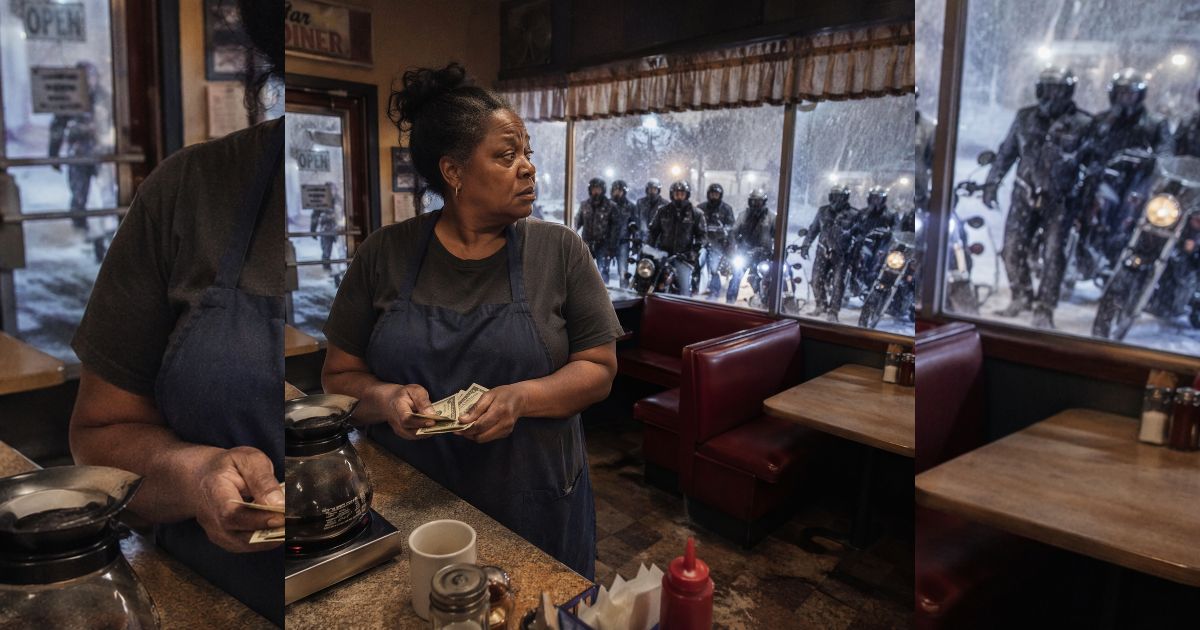
Headlights cut through the white storm in a staggered line, low and bright, moving like a pack of something alive. Big motorcycles. Heavy ones. The kind built for long miles and hard roads. They came in slow, careful formation, engines growling against the wind, until they turned into her lot and spread across the snow in a row of dark shapes and chrome.
Sarah counted them before she meant to.
Fifteen.
Her hand drifted back toward the lock on the door.
The little diner on Route 70 had already given her everything it had. Tonight it had given her silence, empty booths, stale coffee, and the hard little pile of bills sitting open in the register.
Forty-seven dollars.
That was all she had left after the electric payment, after the fuel delivery, after the broken freezer repair she still hadn’t finished paying off.
Forty-seven dollars and a folded final notice from the bank tucked under the register tray.
Seven days.
Seven days before they came for the diner.
Seven days before she lost the last thing her husband had ever truly built with her.
The riders shut off their engines one by one.
The sudden quiet felt almost louder.
They climbed off their bikes slowly, stiff from the cold, shoulders hunched under leather and denim and road salt and snow. Big men, most of them. Thick gloves. Heavy boots. Patches on their jackets from a dozen states. A road club, clearly. The kind people stared at twice in daylight and avoided at night.
Sarah had seen men like that in movies.
She had never had fifteen of them stop at her door during a blizzard.
The lead rider took off his helmet.
Gray in his beard. Weather in his face. A hard jaw. Tired eyes.
Not young. Not reckless-looking.
Just worn.
He looked toward the diner, and even through the glass Sarah could feel the weight of that look.
Then he started walking to the door with a slight limp.
Sarah’s fingers touched the lock.
She could leave it.
She could flip the sign to CLOSED, kill the lights, and pretend no one was inside.
Nobody would blame her.
A woman alone in a near-empty diner on a buried stretch of mountain road didn’t owe shelter to fifteen strangers in club colors.
But when the man reached the door, he didn’t yank it.
He didn’t pound.
He lifted his hand and gave three quiet knocks.
Respectful.
Almost careful.
Sarah looked over her shoulder at the register.
Forty-seven dollars.
At the final notice.
Seven days.
At booth number four.
Robert’s booth.
Even after two years, she could still see him there if she let herself. Elbows on the table. Coffee mug in both hands. Smile soft and tired after a twelve-hour day of fixing whatever had broken in the kitchen or on the old fuel pumps outside.
“We keep the light on,” he used to tell her. “That’s the whole point of this place. Folks get lost. Folks get tired. We keep the light on.”
Sarah closed her eyes for half a breath.
Then she turned the lock.
The wind hit the door so hard when she opened it that it nearly pulled it from her hand. Snow burst inside in a wild spray and skittered across the worn linoleum.
The man on the threshold was covered in white from his boots to his shoulders.
Up close, he looked even bigger, but not meaner.
Just exhausted.
“Ma’am,” he said, voice rough from cold and road. “I know it’s late. I know you’re probably closing. But the pass is shut down behind us. We’ve been riding through this mess for hours, and a couple of my guys are about done in. We’ve got cash. We just need coffee, something hot if you can spare it, and a place to sit until the storm eases up.”
Sarah looked past him.
The other riders were standing beside their bikes, stamping feeling back into their boots, rubbing gloved hands together, bending stiff shoulders. One of them was so young he looked out of place among the rest. Another leaned against his bike with his head bowed as if he was fighting dizziness.
They looked intimidating.
They also looked cold enough to break.
“How many?” Sarah asked.
“Fifteen.”
“That all of you?”
“Yes, ma’am.”
She studied his face.
He didn’t seem like a man who lied out of convenience.
“What’s your name?”
“Jake Morrison.”
He tipped his head back toward the others. “We’re with the Iron Riders Road Brotherhood. Different chapters. We were headed home from a memorial ride down near Denver when the weather turned mean. Didn’t expect it to close in this fast.”
Sarah caught the words memorial ride and something inside her softened before she could stop it.
Behind Jake, one of the riders sneezed hard enough to double over.
Another laughed and clapped him on the shoulder.
Small, ordinary sounds.
Not the sounds of danger.
The sounds of people who had reached the edge of their strength.
Sarah stepped back and pulled the door wider.
“Come on in,” she said. “All of you. Before you freeze out there.”
The relief on Jake’s face was so immediate it almost embarrassed her.
“Thank you,” he said quietly. “You don’t know what this means.”
The men filed in one by one.
Snow shook loose from jackets and beards and boot soles. Leather creaked. Cold air rushed through the room in waves. The diner, which had felt dead ten minutes ago, suddenly felt too small, too bright, too alive.
Sarah braced herself for noise, swagger, trouble.
Instead, the riders moved carefully.
One held the door for the rest.
Two took off their boots at the mat and knocked packed snow loose before stepping farther in.
An older rider apologized when melted snow dripped near the front booth.
Another asked, “You mind if we set helmets there, ma’am?” before touching an empty table.
The youngest one murmured “thank you” so softly Sarah almost missed it.
“Sit wherever you can,” she said, moving behind the counter on instinct. “Coffee’s fresh enough if you don’t ask rude questions.”
That got a few tired smiles.
Jake let out the first real laugh she’d heard all night.
“Best offer we’ve had in fifty miles.”
Sarah reached for the mugs.
Her hands still shook a little, though she tried not to show it.
The men spread out through the diner, filling the red vinyl booths, lining the counter stools, draping wet jackets over chair backs. Without the storm around them, they looked less like a wall and more like fifteen different lives that had ended up on the same road by accident and loyalty.
There was the young one near the window, maybe twenty-three, dark hair stuck flat from his helmet, cheeks pink with cold, fingers trembling as he wrapped both hands around a mug.
A broad-shouldered older man with a face like carved oak and a mustache gone mostly gray.
A tall Black rider with kind eyes and a stitched patch over one chest pocket that read MARCUS.
A woman in her forties with her braid tucked under a knit cap, road grime across one cheek, and a steady calm that made the others shift around her with easy respect.
A heavyset man who looked like he might cry over the first sip of hot coffee.
The club patches were different from the ones Sarah had feared at first glance.
Not threatening.
State names. Memorial ribbons. Years of service. Chapter bars. A small emblem of a steel wing around a road marker. Serious-looking, yes. Fierce-looking, maybe. But not ugly.
Not lawless.
Just proud.
Jake settled onto a stool at the counter and cupped his mug between both hands.
“You got anything to eat?” he asked. “Doesn’t have to be fancy.”
Sarah looked toward the kitchen.
The answer in her head was almost nothing.
Out loud, she said, “Depends how much dignity you’re willing to sacrifice.”
That pulled a rough little laugh from the far booth.
“Ma’am,” said the older rider with the gray mustache, “we’ve been chewing convenience store peanuts and cold jerky since noon. We are way past dignity.”
“All right,” Sarah said. “Then I can probably work miracles.”
She turned toward the kitchen and opened the old cooler.
What she had wasn’t much.
A pack and a half of sausage.
Three onions.
A little shredded cheese.
Two bags of potatoes with more soft spots than she liked.
A dozen eggs.
Some flour.
A few canned tomatoes.
The end of a loaf of sandwich bread.
And a freezer with enough leftovers to make a person either creative or ashamed.
She rested one hand on the steel counter and stared at the shelves.
Fifteen people.
Forty-seven dollars.
No grocery run possible tonight.
No knowing how long they’d be stranded.
This was the exact kind of moment a sensible woman should have said she could only offer coffee and warmth.
Instead she started pulling things out.
Because the truth was, Sarah had built her whole life around one dangerous habit.
If somebody looked hungry, she fed them.
Robert used to tease her for it.
“You’d give away our last biscuit if the right face showed up.”
“You say that like it’s a flaw.”
“It is,” he’d say, grinning. “That’s why I married you.”
The memory hit her so clean and sudden she had to stop and brace both hands against the counter.
For one raw second, grief rose in her throat like a hand.
She saw Robert at the grill. Robert with his apron tied wrong. Robert humming old soul songs under his breath while he cleaned the flat top. Robert sitting in booth four late at night with the books spread out, pretending not to worry whenever a bad month rolled in.
Then she blinked, and it was just the kitchen.
Old tiles.
Buzzing light.
One almost-empty cooler.
Fifteen strangers in the dining room.
And no Robert.
Sarah drew in a breath and got to work.
She chopped onions.
Cubed potatoes.
Cracked eggs into a metal bowl.
Set the sausage on the grill and listened to it hiss.
The sound brought the room together. Conversation began in low patches. Chairs shifted. Mugs clinked. Someone asked for cream. Someone else thanked her again. The heater rattled, then seemed to gather itself and blow a little warmer.
More alive, the diner seemed to tell her.
You’re more alive with people in it.
As she cooked, Sarah listened.
That was another habit she could never quite break. People talked around food as if the meal itself unlocked something. Maybe they got tired of carrying their own thoughts. Maybe a warm room made honesty feel safer.
Jake was telling the rider beside him that the road west was probably closed until morning.
Marcus was explaining to the young one near the window how to warm his hands properly without burning the skin.
The woman rider—someone called her Lena—was passing around dry gloves from her saddlebag like a mother with too many children and not enough patience.
The heavyset rider was on the phone speaking gently to somebody named Ruth, promising he was safe and had found “the kind of place your grandma used to pray you’d find on a night like this.”
Sarah plated what she could.
Skillet hash with sausage and potatoes.
Scrambled eggs folded with cheese.
Toast browned in butter.
A pot of tomato soup stretched with water, onions, and seasoning until it smelled like more than it was.
She set the first plates out and the men fell quiet.
Not wolfish.
Not greedy.
Just grateful.
“You sure about this?” Jake asked when she placed his plate in front of him.
“No,” Sarah said. “But I’m doing it anyway.”
He looked down at the food, then back at her.
“We’ll pay.”
“We’ll see.”
“No, ma’am. We will.”
Sarah said nothing and went back for more plates.
By the time the last dish hit the tables, the diner smelled like grease and coffee and toasted bread and old hope.
It smelled like itself again.
For the first time in months.
The riders ate hard for the first few minutes, the way cold people do when they finally stop shaking. Then the pace softened. Conversation rose. Someone complimented the potatoes. Someone else asked if she had hot sauce. Lena said the coffee tasted like it could wake the dead.
Sarah almost smiled.
“Good,” she said. “I need it to wake the heat, too.”
The younger one by the window—Dylan, she heard somebody call him—lifted his head from his plate.
“Ma’am?”
“Yes?”
“This is the best thing I’ve had in my life.”
Laughter moved through the room.
Sarah pointed a spatula at him. “Then you need to travel better.”
He smiled for the first time, and suddenly he looked exactly his age. Not tough. Not trying. Just young.
When the room settled again, Jake looked around once as if taking inventory.
“All right,” he said to his people. “We eat, we rest, we keep the place clean, and nobody gives this lady one extra ounce of trouble. Understood?”
Fifteen voices answered in some version of yes.
Sarah stared at him.
He noticed. “What?”
“You always run a room like that?”
“When I need to.”
“And do you usually need to?”
A faint smile touched one corner of his mouth. “Not as much as people assume.”
She nodded once, not sure what to do with that.
An hour passed.
Then another.
The storm got worse instead of better.
The radio in the corner coughed to life twice with highway updates that were mostly static and bad news. The county plows had been pulled back. Visibility was near zero. No estimated reopening. Travelers were urged to shelter in place.
Shelter in place.
Sarah looked around her diner at fifteen people doing exactly that.
One rider had stretched across a booth and fallen asleep with his arms folded over his chest.
Two others were playing cards with a deck so soft at the edges it looked older than their friendships.
Lena was rinsing mugs without being asked.
Marcus had fixed the wobble in a counter stool using something from his tool roll.
Dylan had started nodding off at the table, chin dropping, then jerking back up.
Jake noticed and draped a folded jacket behind the kid’s head before he could crack his skull on the window.
The tenderness of it caught Sarah off guard.
These were not men and women the world usually imagined with tenderness attached to them.
Maybe that was the problem with the world.
“Got a back room?” Jake asked after a while.
“Storage and an office too small for regret.”
He smiled.
“We’ll stay out here. Booths are fine.”
“You don’t have to ask my permission to sit.”
“Wasn’t asking to sit. Was asking to stay until daylight.”
Sarah looked toward the windows.
The snow was still slamming sideways against the glass.
“If daylight ever gets here,” she said.
Jake took a slow drink of coffee.
“It’ll get here.”
The way he said it made it sound like he was talking about more than the sun.
Sarah wiped the counter though it didn’t need wiping.
She hated that she knew what he had seen.
The final notice was still peeking out from under the register tray.
She’d shoved it down once already, but paper had a mean way of showing itself.
Maybe sorrow did too.
Jake looked at the notice, then at her, but to his credit he didn’t ask.
Not then.
Instead he said, “How long have you had this place?”
Sarah kept wiping.
“Fifteen years.”
“You and your husband built it?”
“Bought it and rebuilt half of it. The roof leaked. The grill barely worked. There were raccoons in the ceiling.”
“Sounds promising.”
“He said it had character.”
Jake’s eyes drifted toward booth four.
“And was he right?”
Sarah followed his gaze.
“He usually was.”
Jake let the silence sit. It wasn’t an empty silence. It was the kind that gives a person room to say more if they want to.
That made it worse somehow.
“His name was Robert,” Sarah said at last. “He drove trucks before we bought this place. Knew every bad stretch of road in three states. He always said somebody needed to keep a warm light on out here because the highway could humble anybody.”
“Smart man.”
“He died two years ago.”
Jake lowered his mug.
No theatrics.
No pity face.
Just quiet respect.
“I’m sorry.”
Sarah gave a tiny shrug that cost her more than it should have.
“I kept trying after that. Thought I could carry it the same way he did. For a while maybe I did. Then fuel went up. Then tourism went down. Then the old freezer gave out, then the roof again, then the bank stopped pretending patience was kindness.”
Jake’s gaze dropped to the paper under the register.
“How long?”
She should have lied.
She should have said it was none of his business.
Instead the truth slipped out because she was tired, because grief makes fools of proud people, because a storm changes the shape of a night.
“Seven days.”
Jake was still.
Behind him, somebody laughed at something from the card table.
The sound felt miles away.
“Seven days until what?”
“Until they take it.”
His jaw shifted once.
“How far behind?”
Sarah hated the shame that came with saying numbers out loud. Hated how debt became more real each time you put it in the air.
“Three months on the note. Plus fees. Plus legal filing. The letter says a little over fourteen thousand if I want to stop the process.”
Jake let out a low breath through his nose.
“That’s a mountain.”
“It’s one I’m not climbing.”
“You don’t know that.”
“I do.”
She opened the register, pulled out the crumpled bills, and set them flat on the counter in front of him.
“Forty-seven dollars. That’s what the owner of this proud establishment is working with tonight.”
Jake looked at the money.
Then at the plates she had fed them on.
Then back at her.
“You fed fifteen people with your last forty-seven dollars.”
Sarah straightened the bills into a neat stack because not crying in front of strangers sometimes comes down to giving your hands a job.
“I fed fifteen cold people with food I already had.”
“With money you cannot spare.”
“You looked like you needed it.”
Jake’s voice softened.
“So do you.”
Sarah laughed once, but there was no humor in it.
“That’s the trouble with me. I always seem to run this place like mercy is free.”
Jake looked around the diner.
At the clean plates.
At the sleeping riders.
At the storm clawing at the windows.
Then he said, “Maybe it isn’t free. Maybe it just doesn’t disappear the way people think it does.”
Sarah frowned.
“What’s that supposed to mean?”
Jake leaned back on the stool.
“Means roads are long. People remember who helped them when they were cold or scared or broken down and too proud to say so. Means kindness travels farther than money. Usually takes longer, too.”
“That sounds nice on a calendar.”
A smile flickered in his beard.
“It also sounds true.”
Before Sarah could answer, a sharp noise came from the booth near the window.
Dylan jerked awake so fast his mug nearly tipped.
Marcus was already beside him.
“Easy, kid,” Marcus said quietly. “You’re here.”
Dylan blinked hard, breath coming quick, eyes unfocused at first.
Then he saw the diner again.
Saw the lights.
Saw the coffee.
Saw the people around him.
He exhaled and sank back against the booth.
“Sorry,” he mumbled.
“No apology needed,” Lena said from the sink. “You snore less when you’re scared.”
That earned another low ripple of laughter.
Dylan rubbed both hands over his face.
“Same dream,” he said, mostly to the table. “Bike dead. Road empty. No lights anywhere. Just me standing there like an idiot with nowhere to go.”
Sarah stood still.
It was such a simple picture.
And such a lonely one.
Marcus slid back into the booth across from him.
“Well,” he said, “good thing you woke up here.”
Dylan nodded.
“Yeah.”
Sarah looked away because something in her chest had gone tight.
She thought of the years this diner had stood here, small and lit and stubborn beside a hard road.
Truckers.
Families.
College kids.
Salesmen.
Tired moms.
Runaways.
Newlyweds.
Widowers.
People whose names she forgot five minutes after they drove off and people whose faces stayed with her for reasons she never understood.
How many had walked in carrying something invisible and walked out a little less alone?
How many had mattered without her ever knowing they mattered?
Jake was watching her again.
Not invading.
Just seeing.
“What?” Sarah asked quietly.
He nodded toward the booths.
“That look on your face.”
“What look?”
“The one people get when they realize their life has been bigger than their bank statement.”
Sarah held his gaze for a second too long.
Then she looked down.
At midnight, the storm still hadn’t eased.
The riders settled into the long wait the way road people always do. Some slept. Some talked in low voices. Some called home. One polished his glasses with a napkin. Another stood by the front window and checked on the bikes every twenty minutes like they were tied horses in the old days.
Sarah brewed fresh coffee.
She found blankets in the supply closet from the days when snowed-in travelers weren’t rare.
Lena helped her spread them across two booths.
Marcus took the floor by the jukebox and said he had slept in worse places in worse weather and with worse music.
The jukebox didn’t work anymore.
Sarah almost told him that, but she liked the line too much to ruin it.
Around one in the morning, when the room had gone hushed and amber and tired, Jake stepped outside with his phone.
He stood in the snow by the bikes, pacing, talking, trying to hold the signal long enough to be heard. Every few minutes he moved to a different spot in the lot, lifting the phone higher, turning toward the highway, then toward the pumps, then toward the road sign like somehow the mountain itself might decide to help.
Sarah watched him through the window while she wiped down clean counters for the second time.
He stayed out there a long time.
Long enough that his shoulders collected a fresh layer of white.
Long enough that she nearly opened the door to call him back in.
When he finally came in, his beard had frozen again and his gloves were stiff.
Marcus looked up from his booth.
“Well?”
Jake took off one glove with his teeth and slid his phone into his pocket.
“They heard me.”
Sarah set down the rag.
“Who heard you?”
Jake looked at her.
“People.”
“That’s not an answer.”
“It’s the only one I’ve got tonight.”
She crossed her arms.
“You always this mysterious?”
“When the roads are bad and the timing matters? Yes.”
“What timing?”
Jake smiled into his mug.
“You’ll see.”
Sarah stared at him.
It was an unreasonable thing to say to a woman whose life was coming apart in seven days.
And yet his face held no showmanship.
No grin of a man enjoying his own drama.
Just certainty.
That was somehow worse.
By two in the morning, stories had started.
Not all at once.
Just in bits.
Marcus was the first.
He had been staring at Sarah off and on for half an hour with the look of a man trying to catch a name floating just beyond memory. Then he snapped his fingers so loud three people turned.
“I know you,” he said.
Sarah raised an eyebrow.
“I really doubt that.”
“No, I do. Or I know this place. Something about you. Something about the way you walk around the room.”
“That would be my glamorous limp from thirty years of waitressing.”
Marcus leaned forward.
“You ever help a truck driver named Tommy Patterson?”
Sarah went still.
The name came back in pieces.
A giant red-bearded man. Pale with pain. Half-collapsed beside his rig. One hand pressed hard to his chest while snow came down in ugly wet sheets outside. Robert shouting for the keys. Sarah calling emergency services from the office landline because there hadn’t been decent cell service yet. A blocked road. A delay. Sarah driving Tommy herself halfway to the county clinic because waiting had felt like gambling with a man’s life.
She swallowed.
“Yes.”
Marcus slapped the table once.
“That’s it. That’s why you looked familiar. Tommy’s my brother-in-law.”
Sarah stared.
“Tommy’s alive?”
Marcus laughed.
“Alive, married, louder than ever, and still telling that story every Thanksgiving like it happened yesterday.”
Something warm and stunned moved through her.
“I haven’t seen him in years.”
“He never forgot you. Said an angel in an apron kept him talking all the way to the clinic so he wouldn’t pass out.”
Sarah looked down at the coffeepot.
“I just did what needed doing.”
Marcus snorted.
“Funny thing about decent people. They always call it that.”
He leaned back and looked around at the others.
“Y’all hearing this? This is the woman.”
Heads turned.
Questions started.
Jake watched without interrupting.
Then another rider spoke up. A broad man from a Utah chapter named Reed.
“Wait. Was this the place where a woman gave me a paper map with a route marked in blue pen because the pass was closing and my daughter was in labor in Grand Junction?”
Sarah blinked.
There had been so many maps.
But then she remembered the panic in his voice. The way his hands shook while he held the pay phone receiver. The sandwich she’d wrapped in wax paper and shoved at him because he was too worried to eat.
“Your daughter was having a baby?”
“Twin girls,” he said, smiling. “They’re in middle school now.”
A small laugh escaped her before she could stop it.
Lena raised her hand from the booth like a student.
“Did you once sit with a woman in this very diner while she waited on a tow truck and cried because her husband had just left and she had no idea where to drive next?”
Sarah turned.
The face was older now, stronger, but the eyes were the same.
It hit her so hard she grabbed the back of a chair.
“You.”
Lena nodded.
“You gave me coffee and let me cry for three hours without making me feel foolish. Then you called your cousin in Pueblo and found me a room above her bakery for a week.”
“I remember the purple suitcase.”
Lena laughed, then wiped at one eye.
“Still got it. Still ugly.”
The room had changed.
Sarah could feel it.
A diner full of strangers had become a room full of people connected by threads she had never seen while she was tying them.
One by one, the stories came.
A rider from Arizona whose carburetor had frozen in the lot and Robert had helped him fix it by flashlight.
A school bus driver who wasn’t even in the club anymore but had once stopped there with three exhausted children after a detour and found free hot chocolate waiting because Sarah had read the room before anyone asked.
A widower from New Mexico who had sat at the counter after his wife’s funeral and eaten pie he couldn’t taste while Sarah talked to him about weather and tire chains and grief without naming it once.
Then Dylan spoke.
Quietly.
So quietly the room leaned toward him.
“You may not remember me,” he said.
Sarah looked at him.
Now that his face was fully warm and awake, something about him did stir at the edges of memory. A thinner version. Hollow-eyed. Shoulders curled inward like he was apologizing for existing.
“Maybe,” she said. “Tell me.”
“Three years ago. End of summer. I came in here with a bike that sounded like loose silverware in a washing machine.”
That made Marcus bark a laugh.
“Still does.”
Dylan smiled faintly, then looked back at Sarah.
“I had five dollars. Maybe not even that. I’d left school. Lost my apartment. Burned bridges with my family. I was riding west because I didn’t know what else to do, and I remember I was so embarrassed when I looked at the menu because I knew I couldn’t pay for anything real.”
Sarah remembered him then.
The way he had looked at the pie case like it was behind glass in a museum.
The way he had tried to sit small.
The way loneliness had come off him like heat.
“I gave you meatloaf,” she said.
His face opened in surprise.
“You remember.”
“You looked hungry.”
“I was more than hungry.”
Sarah waited.
Dylan took a breath.
“I was done, Sarah. Not in a dramatic way. Just empty. I didn’t think there was anything ahead worth reaching. Then you sat down across from me for maybe four minutes while the kitchen was slow, and you said, ‘You don’t have to know where you’re going tonight. You just have to keep moving until you find one place that feels less dark than the rest.’”
Sarah felt her mouth part.
She had said that.
Probably without thinking.
Probably because it was what she needed to hear that year too.
Dylan’s eyes shone in the warm light.
“Then you wrote down a number on the back of a receipt. A guy in Salt Lake who needed help in his garage. Said he was patient with people who were still becoming themselves.”
Sarah remembered the name.
Earl.
Big hands. Gentle laugh. Knew engines better than he knew his own children’s birthdays, but tried hard at both.
“Earl hired you?”
“He did. Let me sleep in a room above the garage for two months. Taught me how to rebuild an engine. Helped me finish classes online. Introduced me to these people.”
He looked around at the room.
“At the time, I thought you had just fed me because you felt sorry for me. Now I think maybe you fed me because that’s who you are. And I need you to know that one meal can change a person’s direction. One sentence can, too.”
The diner had gone very still.
Even the heater seemed to pause between breaths.
Sarah gripped the counter edge and looked at all of them.
Her instinct was to reject it.
To laugh it off.
To say people were being sentimental because storms do that.
But grief had stripped too much from her lately. She no longer had the strength for false modesty. Not the dramatic kind. Not the proud kind either.
So she just stood there with tears rising and did the only honest thing left.
She let herself believe them a little.
Jake broke the silence softly.
“Those calls I made weren’t random.”
Sarah turned toward him.
“Who did you call?”
“People whose lives crossed this place. People who owe their marriage, their job, their sobriety, their second start, or just one less terrible night to a woman who didn’t keep score.”
Sarah shook her head.
“You can’t call people in a blizzard and expect—”
Lights swept across the windows.
Every head turned.
Sarah’s pulse jumped.
One vehicle pulled into the lot.
Then another.
Then three more.
Headlights cut through the snow in long white beams. Tires crunched over packed drifts. Car doors opened. Truck doors slammed. Shapes hurried through the storm toward the diner entrance.
“What did you do?” Sarah whispered.
Jake’s answer was quiet.
“I told the truth.”
The door burst open and cold air rushed in.
The first man through it was huge and red-bearded and grinning so wide it seemed impossible on a face that weathered.
Tommy Patterson.
Older.
Heavier.
Very much alive.
For half a second Sarah could only stare.
Then Tommy crossed the room in three big steps and wrapped her in a hug so fierce it nearly took her off the ground.
“Sarah Williams,” he said, voice thick. “I have been trying to pay you back for thirteen years.”
She laughed and cried at the same time, which felt undignified and right.
“Tommy,” she said against his coat. “Lord, look at you.”
“That’s what my doctor keeps saying.”
The room erupted.
Not in chaos.
In reunion.
More people came through the door. A couple from Wyoming carrying a bakery box. A rancher from Utah. A woman in scrubs from Grand Junction who said Sarah had once sat with her son while she fixed a tire in the snow. Two former truckers. A sheriff’s dispatcher off duty. A teacher with tears already in her eyes.
Some Sarah remembered instantly.
Some took a second.
Some she never would have known if they hadn’t started telling her exactly when, exactly why, exactly what she had said or done on a night she herself had forgotten the second after it happened.
A man from western Kansas said she had once paid for his fuel when his card failed and he was driving his mother home from surgery.
A woman from Glenwood Springs said Sarah had let her use the office phone to call her sister after a bad breakup and had sent her back on the road with a slice of pie wrapped in foil.
An older Black couple told Sarah they stopped every anniversary because she had once taken their photo in front of the diner sign twenty years ago when they were young and broke and driving west with nothing but hope and gas station sandwiches.
One by one, the room grew louder and warmer and stranger.
People shook snow from their coats and added themselves to a living history Sarah had never realized she was keeping.
By three-thirty in the morning, the parking lot looked like the world’s most unexpected homecoming.
Cars.
Pickups.
A livestock trailer.
Three more motorcycles from the nearest chapter.
A delivery van with chains on the tires.
And people.
So many people.
They brought things.
A box of cinnamon rolls.
A pot of chili still warm from a crock.
Two bags of groceries.
A sack of coffee beans.
A case of eggs.
Cash folded into Sarah’s hand and left under sugar jars and tucked beside the register when she wasn’t looking.
She tried to refuse at first.
Tried hard.
Tommy wouldn’t hear it.
“No,” he said, pushing an envelope back toward her. “You don’t get to be proud now. You used up that right when you fed fifteen frozen riders with your last groceries.”
“It’s too much.”
“It’s not enough.”
A woman named Carol, who drove over from forty miles away because Jake had reached her brother who reached her, stood at the counter and said, “There is a difference between charity and return. Let people return something.”
Sarah had no answer for that.
By four, somebody started a legal pad list.
Not Jake.
Not Sarah.
Lena.
She pulled a pad from behind the counter, clicked a pen, and said in the voice of a woman who had organized chaos before, “All right. If this place is going to stay open, we’re not doing this as a dramatic pile of cash and tears. We’re doing it with names, numbers, and a plan.”
That changed everything.
The room leaned in.
Tommy wrote his amount first.
Then Reed.
Then Marcus.
Then the teacher.
Then the nurse.
Then the rancher.
Then the dispatcher.
Sarah watched the page fill with pledges while the storm still beat at the glass.
Not fantasy promises.
Real ones.
Cash now.
Checks tomorrow.
An electrician offering labor.
A roofer offering materials at cost.
A mechanic offering to tune the generator.
A county clerk’s husband saying he could help Sarah understand the paperwork as long as nobody asked him for magic.
Lena drew columns.
Immediate amount due.
Utility arrears.
Repairs.
Operating cash.
A reserve fund.
Sarah laughed through tears when she saw it.
“Is this what happens when road people organize?”
Jake looked at the neat legal pad with satisfaction.
“This is what happens when gratitude gets tired of being abstract.”
By dawn, the storm had finally slowed.
Not stopped.
Just loosened its grip enough for the first gray light to show the outline of the mountain and the crowded lot beyond the diner windows.
Sarah hadn’t slept at all.
Neither had most of the people inside.
But nobody seemed to care.
The room had crossed past tired and into something like holy momentum.
She stood behind the counter as the first real light of morning touched the top of the coffee machine.
Jake came to the register carrying a thick stack of envelopes and folded bills held together with two rubber bands.
He laid them down carefully.
Sarah stared.
“What is that?”
“The first count.”
“I don’t want to know.”
“Yes, you do.”
“No, I truly don’t. Not yet. I think if I hear a number, I’ll pass out face-first into the pie case.”
Jake’s mouth twitched.
“Fair.”
Lena walked over with the legal pad.
“We counted twice,” she said. “Then Tommy counted once because he doesn’t trust anybody. Then Marcus counted because he doesn’t trust Tommy. Then I counted because I don’t trust either of them.”
Tommy lifted a hand from the booth.
“Good management is built on healthy suspicion.”
Sarah laughed helplessly.
Lena slid the pad over.
The number was circled at the bottom.
Sarah read it once.
Then again.
Then put her hand over her mouth.
It was enough.
Not just enough to stop the foreclosure.
Enough to pay the overdue note, cover the fees, settle the utilities, repair the freezer, patch the roof, and leave something small but real for the next bad month.
The room blurred.
She blinked hard, but tears still spilled over.
“It can’t be.”
“It is,” Lena said.
“This is too much.”
Jake shook his head.
“It’s finally proportionate.”
Sarah looked at all of them.
At the riders in road jackets and working hands.
At the people from neighboring towns and old road memories.
At the legal pad, the envelopes, the steaming mugs, the snowy windows, the booth where Robert used to sit.
Her voice came out broken.
“I don’t know what to say.”
Tommy answered first.
“You say yes.”
Marcus lifted his mug.
“You say you keep the doors open.”
Dylan smiled from the window booth.
“You say the light stays on.”
Sarah cried then.
Not elegantly.
Not quietly.
The kind of crying grief had denied her for months because survival had been too loud.
Lena came around the counter and held her.
Then, because that seemed to break the last barrier in the room, half the diner got up to hug her too.
By eight in the morning, the mountain road was still half-buried, but the county had started limited clearing and folks were finally able to come and go in careful stretches.
Nobody left fast.
That was the funny part.
Once the emergency had passed, people stayed.
They cleaned.
Organized.
Fixed.
Marcus and Reed pulled the loose panel off the back steps and reattached it properly.
Tommy and Jake shoveled a path from the door to the pumps.
Lena sat in the office with Sarah and helped sort the envelopes into piles labeled BANK TODAY, UTILITIES, REPAIRS, DEPOSIT, and DON’T YOU DARE MISPLACE THIS.
A quiet man named Howard, who turned out to own a construction company two towns over, walked the roofline from the outside and came back in saying, “You’re not dying from the snow. You’re dying from neglect. Lucky for you, neglect is repairable.”
The county clerk’s husband studied Sarah’s foreclosure letter and tapped the page.
“They were banking on you being overwhelmed,” he said. “Never let paper talk louder than people.”
By ten, the little diner that had nearly closed the night before looked like the headquarters of a small rebellion built entirely on decency.
There were extension cords across one corner of the room.
Three ladders in the lot.
A table full of donated groceries.
A handwritten sign by the register that said:
COFFEE ON.
LIGHT ON.
BE KIND OR KEEP DRIVING.
Dylan made that sign.
Sarah kept it.
Somewhere near noon, when the rush of work eased for the first time, Jake sat in booth four.
Robert’s booth.
Sarah noticed and froze for a second with a tray in her hands.
Jake saw the look on her face and half-rose.
“Sorry. I can move.”
“No,” she said quietly. “It’s okay.”
She set the tray down and slid into the seat across from him.
For a moment neither spoke.
The booth held memory heavily, but not painfully. Not today. Today it felt full rather than haunted.
Jake folded his hands on the table.
“He sat here, didn’t he?”
Sarah nodded.
“Always. Said he could see the whole room from this spot.”
“Could he?”
“Yes.”
Jake looked out over the diner, where Tommy was arguing cheerfully with Marcus about the correct ratio of onions in hash browns while Lena counted invoices and Dylan tried to carry too many boxes at once.
“He was right.”
Sarah smiled through the ache.
“I think he would’ve liked you.”
Jake gave a low laugh.
“Your husband had questionable taste.”
“He married me, so yes.”
That made him grin.
Then the grin faded and his face turned serious again.
“There’s something I should tell you.”
Sarah straightened.
“What?”
“When I first knocked on your door last night, I saw the notice under the register before you even opened up. I knew right then you were in trouble.”
Sarah looked down at the table.
“I figured.”
“I also knew there was a chance you’d still let us in. Some people are like that. They can be standing on the edge themselves and still pull another person close.”
She met his eyes.
“That’s not always wise.”
“No,” he said. “But it’s rare. And rare things deserve backup.”
Sarah let that settle.
Then she asked, “How did you know all those people? All those stories?”
Jake leaned back.
“Road life is smaller than it looks. Truckers, riders, mechanics, dispatchers, tow operators, state-line diners, church kitchens, county garages. Folks talk. Places get reputations. Good ones are uncommon enough that word sticks.”
“And this place had a reputation?”
He looked almost surprised she still didn’t know.
“This place had a legend.”
Sarah shook her head.
“That’s ridiculous.”
“I’ve heard riders talk about the woman on Route 70 for years. The diner with coffee hot enough to save a marriage and a waitress who could tell when a person was lying about being all right.”
“I was not a waitress. I owned the place.”
Jake nodded solemnly.
“Forgive me. A queen, then.”
She laughed.
Real laughter this time.
The kind that shook loose the last cold bit of fear lodged in her ribs.
That afternoon the bank received payment.
Not a promise.
Not a partial.
Full certified funds.
Sarah drove them in herself with Lena and Tommy behind her in separate vehicles because everyone had suddenly decided she should not carry important money alone even to the next town over.
The woman behind the desk at the lending office blinked three times when Sarah laid the cashier’s checks down.
Then she straightened every single paper clip on her desk before saying, “Let me update the file.”
Sarah almost asked if there was any chance the file itself could look embarrassed.
She didn’t.
Lena did it for her.
On the drive back, Sarah cried again in the car.
Not because she was sad.
Because the body doesn’t always know the difference between terror ending and joy beginning. Sometimes it just floods.
The days after that became a blur.
Not magical.
Work.
Real work.
The roof got patched.
The freezer got replaced with a used commercial unit donated by a restaurant two towns over that was renovating.
The wiring under the pie case got fixed.
Someone pressure-washed the outside sign.
Someone else repainted the trim.
Howard’s crew reinforced the porch.
Tommy brought in stools from a diner closing in Wyoming.
Marcus replaced half the dead bulbs in the overhead fixtures.
Lena helped Sarah open a fresh business account and create three folders labeled NOW, NEXT MONTH, and STOP IGNORING PAPERWORK.
Dylan came back the following weekend and rebuilt the old jukebox with an electrician named Wes who cried every time he heard Patsy Cline.
People kept showing up.
Not because a miracle had happened.
Because once a person had remembered the diner, they wanted to touch the story with their own hands.
They bought lunch.
They tipped too much.
They brought supplies.
They stayed to stack chairs or scrub windows or sand the splintered edge of the front railing.
The Iron Riders became steady faces in the room.
Not every day.
But often enough.
They stopped in on runs.
Checked on the place during storms.
Brought travelers who needed a decent meal and didn’t have enough cash.
Sarah made them pay when they could.
Fed them when they couldn’t.
Exactly as before.
Only now the giving moved both directions so naturally that nobody had to perform gratitude about it.
A month later, Jake rode in on a bright blue morning with a rolled-up set of drawings under one arm.
Sarah was at the counter slicing pie.
She looked at the paper.
“That better not be expensive.”
“It’s free,” Jake said.
“That’s how expensive trouble starts.”
He spread the drawings out anyway.
They were plans.
Not huge ones.
Sensible ones.
A sheltered side area for motorcycles out of the worst winter wind.
A small repair bay off the back lot where stranded road travelers could get basic help.
More booth space.
Better storage.
An upgraded radio room.
And a sign over the side entrance that read ROAD ROOM.
Sarah stared at it.
“What am I looking at?”
“A future where your diner doesn’t nearly die every winter because it’s doing three jobs with one tired kitchen.”
She traced one line with her finger.
“You did this?”
“Friend of mine draws things. Owes somebody here his marriage, I think.”
Sarah looked closer.
There, scribbled in one corner, was a note.
For the light-keepers.
Her throat tightened.
“I can’t turn this place into a circus.”
Jake shook his head.
“That’s not what this is. It stays your diner. It just becomes what it’s already been for years on purpose instead of by accident.”
Sarah sat down hard on a stool and studied the plans again.
He was right.
The diner had always been a refuge.
They were just finally naming it.
The renovations took time.
Not because money was missing, but because real life is slower than hope.
Still, by spring, the changes were visible.
The new covered parking area stood behind the diner, sturdy and practical.
The repair bay was modest but useful.
The radio room had been restored with help from three retired truckers and one woman who had once run emergency dispatch and bullied every wire into obedience.
The booth upholstery got redone in the same shade of red Robert had loved.
Sarah kept booth four exactly as it was.
Same view.
Same table.
Same tiny burn mark in one corner from a dropped cigarette back in 2012 when smoking was already banned and Robert had grumbled for a week.
She never put a RESERVED sign there.
She didn’t need to.
People seemed to know.
Sometimes Jake sat there.
Sometimes Tommy.
Sometimes Sarah did when the room was empty.
It became the booth where hard truths could be told without shame.
The booth where travelers got looked in the eye.
The booth where no one was hurried.
By summer, the diner had found a second life.
Not glossy.
Not trendy.
Better.
Bikers came through, yes, but so did families, truckers, retirees in campers, road crews, nurses between shifts, college kids on bad road trips, and people who had heard some version of the story and wanted to see whether the place felt real.
It did.
That was the surprise.
The story was huge now.
But the place stayed honest.
Coffee hot.
Pie good.
Floors worn.
Kindness practical.
No performances.
No gift shop nonsense.
Just a sign by the register that read:
IF YOU’RE TIRED, SIT.
IF YOU’RE HUNGRY, ASK.
IF YOU’RE LOST, YOU’RE NOT THE FIRST.
That was Dylan’s second sign.
Sarah kept that one too.
Six months later, the first heavy snow of the season came early.
Not brutal.
Just enough to remind the mountains who was boss.
Sarah stood at the front window that evening, watching flakes gather in the yellow pool under the sign.
The diner was full.
Not crowded.
Comfortably full.
Boots by the mat. Steam on the windows. The soft low sound of people eating and talking and thawing.
Lena was at a booth with two women on touring bikes from New Mexico.
Marcus was helping a family from Kansas figure out the safest morning route west.
Dylan, now sturdier in himself, was under the hood of a stranded pickup out back with the repair bay lights on.
Jake was at booth four, drinking coffee and pretending not to watch over the whole room.
Sarah dried her hands on a towel and looked at the register.
This time when she opened it, there was enough.
Enough for payroll.
Enough for bills.
Enough for next month.
Enough to breathe.
She closed it again, then rested her palm on top for a second.
There had been a time, not long ago, when this box had felt like a judge.
Now it was just a drawer.
Money mattered.
It did.
But it was no longer the loudest thing in the room.
The front door opened and a gust of cold air came in with a young couple, both snow-dusted and apologizing at once.
“Sorry,” the man said. “We saw the sign and weren’t sure if you were still open.”
Sarah looked at the road behind them.
At the tired car.
At the woman rubbing her gloved hands together.
At the uncertainty in both their faces.
Then she smiled.
“We keep the light on,” she said. “Come in.”
They stepped inside and the door swung shut behind them.
Warmth closed around the room again.
Somewhere from the back, the old CB radio crackled.
A familiar voice came through in static and laughter.
“Breaker, breaker. Anybody copy the lady at the mountain diner?”
Sarah reached for the microphone without thinking.
“This is Sarah,” she said.
A cheer answered from the other end.
“How’s the road room tonight?”
She looked around.
At the food.
At the riders.
At the travelers.
At booth four.
At the sign in the window reflected over all of them like a promise.
Then she smiled into the mic.
“Light’s on,” she said. “Coffee’s hot. Plenty of room for anybody who needs a place to land.”
Jake lifted his mug from the booth.
Tommy pounded the counter once in approval.
Lena laughed.
The family from Kansas looked up and smiled even though they didn’t understand the history behind the words.
The young couple by the door did not know they had stepped into a place built as much from remembered mercy as lumber and paint.
They just knew it felt safe.
And maybe that was enough.
Outside, snow drifted across the dark road.
Inside, the diner glowed.
Not because money had saved it.
Not because strangers had done something dramatic.
Not even because one storm had changed everything overnight.
It glowed because for fifteen years, a woman had kept opening the door when tired people knocked.
It glowed because kindness, given away in small ordinary pieces, had traveled the highways and back roads and lives of more people than she ever knew.
And when the night came that Sarah Williams stood on the edge of losing everything, all that kindness came home at once.
Not as a miracle.
As a return.
As proof that a warm room matters.
A hot meal matters.
A sentence spoken at the right moment matters.
A light in the window matters.
Sarah stood very still behind the counter and felt, for the first time since Robert died, not like a woman preserving ashes.
But like a woman tending fire.
The kind that keeps people alive in ways no ledger can measure.
The kind that doesn’t ask who you were before you got cold.
The kind that says sit down first, explain later.
The kind that outlasts storms.
The kind that calls people home.
Thank you so much for reading this story!
I’d really love to hear your comments and thoughts about this story — your feedback is truly valuable and helps us a lot.
Please leave a comment and share this Facebook post to support the author. Every reaction and review makes a big difference!
This story is a work of fiction created for entertainment and inspirational purposes. While it may draw on real-world themes, all characters, names, and events are imagined. Any resemblance to actual people or situations is purely coincidenta