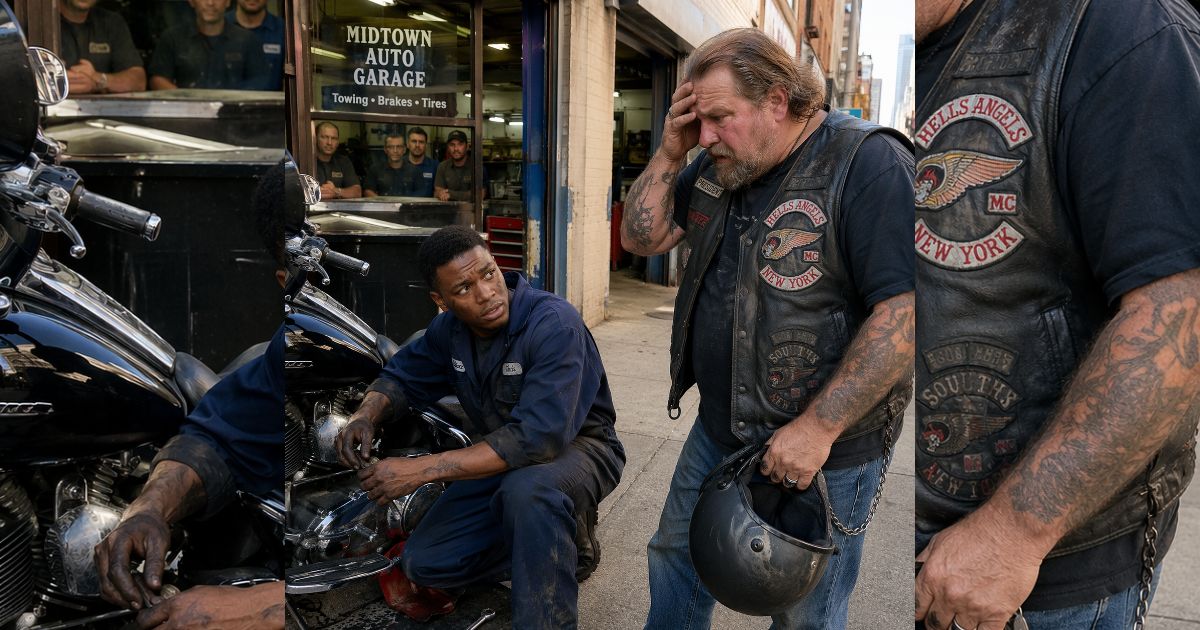
A tattooed biker ran into a Midtown garage begging for ten minutes to reach his daughter’s hospital bed, and the youngest mechanic helped him anyway, even after his manager told him it would cost everything.
“Please,” the man said, breathless at the front counter, one hand still wrapped around his helmet. “My bike died half a block away. My daughter’s in surgery uptown. I just need enough help to get there.”
The room did not go quiet.
That was the worst part.
The impact guns kept rattling in the bays. A coffee maker hissed in the break corner. Someone laughed at something on a phone. A customer in a camel coat looked up once, took in the leather vest, the tattoos, the heavy boots, and then looked back down as if the man standing there was not a father in trouble but a spill on the floor.
The receptionist barely lifted her eyes.
“We’re backed up,” she said. “You can take a seat and fill out a form.”
The biker blinked like he had not heard her right.
“I don’t have time to sit,” he said. “I can pay. I’m not asking for anything free. Just a jump, a wire, whatever gets me moving.”
She clicked her keyboard.
“Then you can wait standing up.”
At the far end of Bay Three, Malik Carter slid out from under a lifted sedan and froze with a wrench in his hand.
He was twenty years old, grease on his forearms, work boots split at the toes, and sweat cooling at the back of his neck. He had heard thousands of voices in that garage over the last two years. Voices bored, rude, hurried, entitled, fake polite, loud with money, thin with panic. He knew the difference between anger and fear.
This man was afraid.
Malik stood, wiped his hands on a rag, and looked again.
The biker was big, broad through the shoulders, his graying beard trimmed close, his leather vest sun-faded and creased from years on the road. Ink ran up both arms. A patch on his back marked him as part of a riding club. Nothing about him looked soft.
Everything about his eyes did.
They kept darting to the door like he could already see the distance between himself and that hospital room getting wider by the second.
One of the older techs leaned against a tool chest and muttered, just loud enough for the guys around him, “Always a scene with people like that.”
Another one snorted.
“Bet the bike’s not even registered right.”
A customer near the waiting chairs stood and moved closer to his wife.
“I’d rather not have that guy hanging around in here,” he whispered, not quietly enough.
Malik felt something in his chest go hard.
Not because the words shocked him.
Because they did not.
He had worked at Harbor Line Auto for two years, and he knew the rhythm of judgment the way he knew the sound of a stripped bolt. Sometimes it came smiling. Sometimes it came in jokes. Sometimes it came wrapped in company language like protocol and liability and standards. But underneath it was always the same thing.
Some people got grace.
Some people got suspicion.
Malik had been on the wrong side of that split his whole life.
“Hey,” he said, stepping toward the front. “What kind of problem are you having?”
The biker turned fast, almost startled that anyone had spoken to him like a person.
“Engine won’t catch,” he said. “Lights come on, but when I hit the starter, it just clicks. I parked right outside the garage doors.”
Malik nodded.
“Could be battery. Could be starter relay. Could be a loose ground. I can look.”
The receptionist looked up then.
“No, you can’t,” she said sharply. “You’re on assigned work.”
Malik did not look at her.
“It’ll take five minutes to know what we’re dealing with.”
“Malik.”
Now the warning was real.
He turned his head a little. She had that look on her face, the one that said trouble could become paperwork if he kept going. Around the room, people were watching without pretending not to. A few with curiosity. A few with irritation.
A few with that familiar little satisfaction people get when they think they are about to see someone lower on the ladder put back in his place.
The biker lifted a hand.
“It’s all right,” he said. “I shouldn’t have come in here looking like this and expecting—”
“Looking like what?” Malik asked.
The man did not answer.
He did not need to.
Malik crossed to a mini fridge near the staff sink, pulled out a bottle of water he had brought from home, and handed it over.
“You look like a dad having the worst morning of his life,” Malik said. “That’s what you look like.”
Something moved in the man’s face.
Not relief exactly.
More like surprise so deep it almost hurt.
He took the bottle with both hands. “Thank you.”
Malik grabbed his diagnostic bag and headed for the door.
Behind him, one of the senior mechanics gave a low laugh.
“Look at Junior playing roadside hero.”
Malik kept walking.
Outside, Manhattan roared around them.
Delivery trucks nosed through traffic. Steam lifted from a grate at the corner. Horns stacked over one another in impatient bursts. The biker’s machine sat crooked at the curb, a dark touring bike with saddlebags and road dust still clinging to the frame. It was not junk. It was cared for. That told Malik something too.
He crouched by the side panel, listening as the man tried the ignition.
Click.
Then nothing.
“Name?” Malik asked.
“Ray.”
“Malik.”
Ray nodded once. “Appreciate this, Malik.”
Malik popped the seat, checked the battery terminals, then ran his fingers to the cable connection point. Loose. Not by much, but enough.
“You hit a pothole?”
“Back by the tunnel.”
“That’ll do it.”
Malik reached for a wrench.
Ray watched him with the tight stillness of a man trying not to ask how long, how much, what if this does not work, what if I lose more time, what if she wakes up and I am not there.
Malik knew that kind of silence too.
His mother had worn it for years.
After Malik’s father left when he was nine, his mother, Denise, had worked nights at a city hospital laundry unit, then mornings cleaning offices, then whatever else she could stack on top of that without falling over. She had gotten very good at swallowing fear before it reached her face. Rent due. Light bill high. Shoes too small. Fever. Bus late. She could hold all of it in her jaw and keep moving.
Malik had learned from her that panic did not always scream.
Sometimes it stood very still and tried not to break in public.
“You got kids?” Ray asked suddenly.
Malik tightened the connection and shook his head.
“No, sir.”
Ray gave a dry breath that was almost a laugh and almost not.
“Good. Keep sleeping as long as you can.”
Malik smiled without looking up. “That bad?”
Ray stared down the avenue.
“My girl’s sixteen. Smart mouth. Big heart. Thinks she’s indestructible. This morning she fainted at school, and now I’m hearing words from doctors I never wanted to hear. I was halfway across the river when I got the call.”
He swallowed.
“I’ve spent my whole life acting like I can fix anything with enough time and a tool in my hand. Then your kid is in a hospital bed, and suddenly all you can do is beg strangers.”
Malik set the wrench aside.
“I know the feeling,” he said softly.
Ray glanced at him.
“You got family in there too?”
“My mother’s worked in hospitals long enough for me to know the look people get when they’re headed toward bad news.”
Ray looked at him for a long second, then nodded.
There it was.
Recognition.
Not the cheap kind people put on like a costume. The real thing. The quiet understanding between two men who, on paper, should have had nothing in common at all.
Malik told him to try the ignition again.
The engine caught at once.
Ray’s eyes shut for half a second. His shoulders dropped. He put one hand over his face and drew in a breath that came out shaking.
“You did it.”
“It was a cable,” Malik said. “You should still get the whole system checked once this settles down.”
Ray reached into his back pocket.
“How much?”
Malik stood and wiped his hands.
“Don’t worry about it.”
Ray stared at him.
“No.”
“It took two minutes.”
“That’s not the point.”
Before Malik could answer, the front door of the shop banged open.
“Exactly what do you think you’re doing?”
Manager Travis Dean strode onto the sidewalk with his clipboard still in one hand, his tie loosened, his expression already sharpened for a fight. He was in his late forties and built like a man who had once been athletic and now preferred authority to effort. His hair had gone silver at the temples, which only made him seem more sure that he was the adult in every room.
He stopped in front of the bike, took in Malik crouched beside it, Ray with the vest and the tattoos, and the running engine.
Then he looked at Malik like he had finally caught him being exactly who he always suspected he was.
“You went outside on company time,” Travis said. “You touched an unregistered customer vehicle with no ticket, no waiver, no approval, and you did it in the middle of an active shift.”
“He needed help,” Malik said.
Travis laughed once through his nose.
“That is not your call.”
Ray stepped forward. “I offered to pay.”
Travis turned to him.
“This is private property,” he said. “And right now I need you to leave.”
Ray’s expression changed, not into anger, but into that older, harder thing some men carried when they had spent years getting dismissed by people who mistook contempt for professionalism.
“I am leaving,” he said. “Because I have somewhere to be.”
Travis ignored him and went back to Malik.
“You want to play hero, do it off the clock. Not in my shop.”
Malik could feel people watching through the front windows.
He did not need to turn to know that every face inside was aimed at them.
Every mechanic.
Every customer.
Every set of eyes waiting to see whether he would fold.
“He was desperate,” Malik said. “Nobody else even tried.”
Travis’s mouth tightened.
“Nobody else violated policy either.”
Malik looked at him, really looked at him, and saw what he had seen in different forms since his first week there. Not simple meanness. That would have been easier. What Travis carried was something smoother. Something dressed up. A habit of deciding who counted and then calling it standards.
If a banker came in sweating through a pressed shirt, Travis called it urgency.
If a father in a leather vest came in scared out of his mind, Travis called it a disruption.
If Malik stayed late to fix a problem no one else wanted, Travis called him dependable.
If Malik took one human step without permission, Travis called him reckless.
It was always the same trick.
Same hands.
Different gloves.
“If this were a man in loafers with a dead luxury SUV and a watch bigger than my paycheck,” Malik said, keeping his voice steady, “you’d have rolled a red carpet to the curb.”
Inside the shop, the room seemed to flinch.
Travis’s face went still.
“You need to think very carefully about your next sentence.”
“I already did.”
Ray looked from one man to the other. “Kid, let it go.”
Malik kept his eyes on Travis.
“No. I’ve let enough go in here.”
Travis stepped closer.
“There are ten people on payroll inside that building,” he said quietly. “Nine of them understand there is a chain of command for a reason. One of them keeps mistaking attitude for integrity.”
Malik felt heat rise in his chest.
“For two years, I’ve taken every dirty job, every late car, every mess nobody else wanted. I’ve covered weekends. I’ve fixed mistakes that weren’t mine. I’ve kept my mouth shut when people talked around me like I wasn’t standing there. And the one time I help a man get to his daughter, suddenly I’m the problem?”
Travis did not blink.
“You’re done here,” he said. “Turn in your locker key. Leave the uniform shirts. Payroll will mail your final check.”
Ray made a sound in his throat, low and frustrated.
“That’s because of me.”
“No,” Malik said, before Travis could. “It’s because of him.”
The city noise rushed in around the silence that followed.
A bus sighed to the curb across the street. Someone shouted for a cab. A siren rose in the distance and then slid away.
Travis pointed to the door.
“Inside. Now. Or I call security from the building desk.”
Malik almost laughed at that.
Security.
As if he were the one who had made the place unsafe.
He looked at Ray.
“Go,” Malik said. “Your daughter needs you more than I need this job.”
Ray stood there for a second too long. Then he reached out his hand.
Malik took it.
The grip was quick, rough, real.
“I won’t forget this,” Ray said.
Malik nodded. “Go.”
Ray swung onto the bike, pulled into traffic, and was gone.
Travis stood stiffly on the sidewalk until the taillight disappeared between a delivery van and a city bus. Then he turned back to Malik.
“You happy now?”
Malik looked at him.
“No.”
He walked inside before Travis could say another word.
The garage swallowed him the way it always did.
Oil stains on concrete. Fluorescent lights buzzing overhead. Tool drawers slamming shut. Somebody in Bay One pretending to focus very hard on a brake job. The receptionist chewing gum like she was trying to prove she had not just watched a man lose his livelihood for helping someone.
No one said sorry.
No one said anything.
Malik went straight to his bay and set down his diagnostic bag. The half-finished repair on the lifted sedan still sat waiting, wheels off, undercarriage exposed, as if time had paused only for him. He stared at it for a second and almost reached automatically for the wrench.
That was the cruel part of being good at a job people used to diminish you.
Your body kept wanting to serve even after the room had decided you were disposable.
“Man,” said Owen, one of the older techs, from two bays over, “that was not worth it.”
Malik turned slowly.
Owen shrugged, palms out, like he was offering wisdom instead of cowardice.
“I’m just saying. You don’t throw your job away over some stranger.”
Some stranger.
Malik thought about Ray’s face when the engine turned over.
Thought about the way his hands had shaken around that water bottle.
Thought about all the times strangers had looked at Malik’s mother like she was in the wrong neighborhood when she wore scrub pants and discount sneakers after night shift. All the times people had watched Malik too closely in stores. All the times a teacher had called on someone else even when Malik’s hand had been up first.
People loved the word stranger when what they meant was not one of us.
Malik picked up the wrench from the floor, set it carefully back into his toolbox, and said, “That’s the problem.”
Owen frowned. “What?”
“You heard me.”
He walked toward the hallway that led to the lockers.
Behind him, no one followed.
The locker room smelled like soap, metal, and old sweat. A tired fluorescent tube flickered overhead. Malik opened his narrow gray locker and looked at the row of folded shirts, the extra gloves, the family-size pain reliever bottle for long shifts, the photo tucked in the corner of himself and his mother at Coney Island three summers earlier, both of them smiling like money was not always waiting at home to make them smaller.
He sat on the bench and let the room settle around him.
He should have been panicking.
Rent was due in eleven days.
His mother’s hours had been cut twice that winter.
The transmission on her old sedan had started making a noise that sounded expensive.
He should have been counting every disaster already.
Instead, what he felt first was something quieter.
Not relief.
Not pride exactly.
Just the strange clean feeling that came when the worst thing happened and he still recognized himself afterward.
For a long time Malik had confused survival with success.
Keep your head down.
Do not react.
Work harder.
Smile a little.
Be useful.
Maybe then the room will decide you belong in it.
But sitting there in that locker room, listening to the muffled hum of a place that had taken his labor and denied his humanity in the same breath, he understood something he should have understood sooner.
Belonging offered on those terms was never belonging at all.
The door creaked open.
Jonah Reyes, the newest tech besides Malik, stepped in halfway and paused. He was twenty-three, quiet, from the Bronx, always smelling faintly of peppermint gum and metal shavings.
“Hey,” Jonah said.
Malik looked up.
Jonah shifted his weight. “That was rough.”
Malik gave a tired half smile. “That one way to say it.”
Jonah came in farther and lowered his voice.
“For what it’s worth, I thought you were right.”
Malik studied him.
Jonah held the look.
It was not grand. Not brave. Not enough to change anything in that room. But it was honest.
That counted for something.
“Thanks,” Malik said.
Jonah rubbed the back of his neck. “I should’ve said something out there.”
“Maybe.”
“I just…” Jonah glanced toward the door. “People watch who speaks up around here.”
Malik nodded.
“Yeah,” he said. “They do.”
Jonah looked at the duffel on the bench. “You got somewhere to land?”
Malik shrugged. “Home, I guess.”
“I mean work.”
Malik let out a breath.
“No.”
Jonah leaned against the lockers, uneasy. “You’re the best tech in this place.”
Malik laughed softly.
“That and a subway card get me downtown.”
Jonah looked like he wanted to say more, but he did not.
That was another thing Malik had learned young.
Some people were kind in private because it cost less there.
Jonah pushed off the locker and nodded toward the shop floor.
“They moved Brandon into your bay already.”
“Fast.”
“Yeah.”
Malik zipped his bag.
“Places like this don’t leave footprints,” he said.
He stood, slung the bag over his shoulder, and walked back through the garage with his head up.
The same men who had watched him get fired watched him leave.
Some looked away when he met their eyes.
Some did not.
The receptionist tapped her nails against the desk and asked without warmth, “Need anything signed?”
Malik stopped long enough to look at her.
“No.”
Then he stepped outside.
The cold hit first.
Then the noise.
Then the strange weightless feeling that came after humiliation, when the body had not yet caught up to the future that had just changed.
He started down the block without a plan.
At the corner, he almost walked right past the man leaning against the brick wall of the deli next door.
Ray.
The biker straightened when he saw him.
“I waited.”
Malik frowned. “I thought you’d be at the hospital.”
“I was.”
Malik stared.
Ray held up his phone. “My sister-in-law texted. My daughter came through surgery. She’s in recovery. Stable.”
The word landed like a hand on the back of Malik’s neck.
Stable.
He did not know the girl. Did not know what kind of fall, what kind of illness, what kind of morning had put her under bright hospital lights with tubes in both arms and a father begging strangers for ten minutes.
But stable mattered.
“She okay?” Malik asked.
Ray looked out toward traffic. “Looks like she will be.”
They stood side by side for a moment, letting that sit.
Then Ray looked at Malik’s bag.
“They fired you.”
“Yeah.”
Ray’s jaw tightened.
“I’m sorry.”
Malik shook his head. “You didn’t do that.”
Ray turned toward him fully.
“I know the difference between somebody paying a price because of me and somebody paying a price because of what people see when they look at me,” he said. “Today was both.”
Malik did not answer.
Ray took in the shop windows, the men moving inside, the whole polished little machine of a place.
“I’ve been judged by cleaner rooms than this one,” he said. “Never gets old.”
There was no bitterness in the words.
That made them land harder.
Malik looked at him. “You said your daughter’s sixteen?”
Ray nodded. “Lena.”
“Pretty name.”
“She’d hate that you said that.”
Malik smiled.
Ray almost did too.
Then Ray reached into his vest pocket, pulled out a folded card, and handed it to him. It was thick stock, plain, no flashy logo. Just a name, a phone number, and an address in Queens for a repair and custom fabrication shop called East River Cycle Works.
“You ever need work,” Ray said, “call me.”
Malik looked down at the card.
“You own this?”
Ray shrugged. “Part of it.”
Malik lifted one eyebrow. “Part of it sounds like all of it.”
Ray gave him a sideways look. “You fixing motorcycles now too?”
“I can.”
Ray nodded once as if filing that away.
“Then call me.”
Malik slipped the card into his pocket.
“I appreciate it.”
Ray pushed off the wall. “Good men don’t stay unemployed long if the right people know they’re out there.”
Malik watched him.
“Is that something you tell everybody?”
Ray pulled on his gloves.
“No,” he said. “Just the ones who help me when I’m trying not to fall apart in public.”
He swung onto his bike and settled his helmet.
Before he started the engine, he looked back once.
“Take care of yourself, Malik.”
Then he pulled away into traffic and was gone.
Malik stood there a long moment with one hand in his pocket, fingertips against the business card like it might turn into something else if he checked it again.
Then he started the long trip home.
The train ride uptown felt both too short and too long.
A little girl in a bright red coat kept staring at the grease under his nails. Two teenagers argued over a sports clip on one phone. An old man fell asleep with a newspaper open across his lap. Ordinary city life carried on around Malik with its usual indifference, and he sat in the middle of it trying to picture how he was going to tell his mother that the job she thanked God for every Sunday evening was gone by Monday afternoon.
By the time he climbed the stairs to their apartment, the sky had turned the color of cold metal.
Their building in Harlem was narrow, old, and tired in the ways working buildings got tired. The front door dragged at the bottom. The hallway smelled like somebody was frying onions two floors down. The mailboxes never closed cleanly. None of that had ever embarrassed Malik. Home was not supposed to impress strangers. It was supposed to hold the people who lived there.
He unlocked the apartment and stepped inside.
His mother was at the stove in her work scrubs, one sneaker untied, shoulders slumped with the kind of exhaustion that seemed permanent now. She turned when she heard him and smiled too fast.
“You’re early.”
Malik set his bag down gently.
“Yeah.”
She watched him for half a beat.
Then her eyes dropped to the duffel again.
She knew.
Not details maybe, not the whole story, but mothers who had raised sons through rent notices and bus delays and school calls and other people’s assumptions learned to read posture the way doctors read scans.
“What happened?” she asked.
Malik moved to the sink and washed his hands longer than necessary.
“There was a guy,” he said. “His bike died. His daughter was in the hospital. Nobody would help him.”
His mother did not interrupt.
“I fixed it. Travis fired me.”
The burner clicked softly beneath the pot.
Outside, someone in the alley laughed. A siren went by three blocks over. Somewhere upstairs a television blared a game show.
Inside their kitchen, everything narrowed down to the space between Malik and his mother.
Denise took off her glasses and set them on the counter.
“Tell me all of it.”
So he did.
He told her about Ray rushing in. The receptionist brushing him off. The customers getting nervous because a man in leather had entered their clean little morning. The way the room watched. The way Travis talked about policy like policy had a soul. The way Malik had stood there with a choice between silence and himself and, for once, had picked himself.
His mother listened with both hands flat on the counter.
When he finished, she let out a slow breath.
“I’m scared,” she said.
Malik nodded. “Me too.”
She came around the counter and stood in front of him. There was flour on one sleeve of her scrub top. Her hairnet mark still faintly ringed her forehead from the hospital laundry unit. She looked older in that moment than she had that morning, and stronger too.
“But I’m not disappointed,” she said.
Malik looked at her.
“Not even a little.”
He swallowed.
“Mom, I know we need—”
“We need a lot of things,” she said softly. “Money. Rest. A landlord with mercy. A car that doesn’t sound like it’s begging the Lord for one more week.” She touched his cheek with work-rough fingers. “But I did not raise you to leave a father stranded on the sidewalk because a man with a clipboard might get upset.”
Something sharp and hot hit the back of Malik’s throat.
He laughed once to keep it from becoming something else.
“She really made it through surgery,” he said. “The daughter.”
Denise nodded. “Then you already know what mattered most today.”
They ate a late dinner at the small table by the window.
Rice, greens, leftover chicken reheated with onions. Denise asked practical questions because that was how she loved: Did he still have access to his online payroll account? Had he signed anything? Did he think Jonah might serve as a reference? Did he still have the phone number for the instructor at trade school who kept saying he should move into advanced diagnostics?
Malik answered what he could.
Then, after a long quiet stretch, Denise said, “What was the man’s name?”
“Ray.”
“You trust him?”
Malik thought about that.
“Not enough to hand him my social security number.”
That got a laugh out of her.
“But enough to believe he meant what he said.”
She nodded.
“Sometimes that’s where new doors start.”
That night Malik lay awake in the room he had slept in since he was eleven, staring at the faint streetlight shadow across the ceiling. He thought about bills. About pride. About Travis Dean probably sleeping just fine. About Ray’s daughter in recovery. About the business card in his pocket on the chair by the bed. About what it meant to do the right thing when the right thing came with consequences and no applause.
Around two in the morning, he finally slept.
He dreamed of engines that would not turn over and doors that opened too late.
The next morning he woke before his alarm.
The apartment was quiet except for the hum of the fridge. His mother had already left for an early shift. She had placed a note beside the cereal box in her neat careful handwriting.
Whatever happens next, don’t shrink.
He folded the note and put it in his wallet.
Then he sat on the edge of the bed for a long minute, elbows on knees, listening to the city wake up outside.
He needed the rest of his tools from the garage.
He also needed, though he hated admitting it, to see the place one more time. Not because he belonged there. Maybe because he needed proof that he was done waiting for it to become something it was never going to be.
By eight-thirty he was standing outside Harbor Line Auto again.
Morning traffic poured through Midtown in impatient waves. The glass front of the shop reflected taxis and office towers and a delivery truck double-parked in the bike lane. From outside, nothing looked different. Same polished sign. Same waiting chairs arranged to look more expensive than they were. Same fake calm.
He pushed open the door.
The bell above it chimed.
Nobody greeted him.
The receptionist looked up, blinked, and then returned to her screen as if former employees materialized every day carrying duffel bags and unfinished humiliation.
The garage floor was already alive.
Air hoses hissed. Tires rolled. A vacuum whined somewhere in the back. Brandon, who had barely passed his last performance review, was standing in Malik’s old bay pretending confidence over a diagnostic tablet Malik knew he did not fully understand.
Malik felt the tug of anger and let it pass through him.
He had not come for a scene.
He walked straight toward the lockers.
Halfway there, Travis’s voice caught him.
“You’re not scheduled.”
Malik turned.
Travis stood near the office door in a pressed shirt and company fleece, holding a travel mug. He looked rested. Even amused. Like firing a young mechanic yesterday had improved his sleep.
“I came for my tools,” Malik said.
Travis nodded toward the back. “Five minutes.”
Malik started to move again.
“And Malik?”
He stopped.
Travis took a sip from the mug.
“You brought this on yourself.”
The words landed without surprise.
That was almost worse.
Malik turned slowly.
“For helping a father get to the hospital?”
“For refusing instruction,” Travis said. “For grandstanding in front of customers. For making this business look unstable.”
Malik stared at him.
The thing about people like Travis was that they often believed their own edits. By the time they told the story back to themselves, cruelty had become procedure and courage had become insolence.
Malik kept his voice level.
“What made this place look unstable was a room full of grown adults acting like a scared man was contagious.”
A few heads lifted on the floor.
Travis smiled without warmth.
“And there it is. Still performing.”
Malik thought of saying ten things.
How easy it was to call honesty a performance when you had spent years rewarding silence. How protocol somehow always bent around money and image but never around human need. How men like Travis loved structure because structure kept their favorites safe and their targets tired.
Instead he said, “I’m done explaining basic decency to you.”
He walked away before Travis could answer.
In the locker room, he packed the last of his tools into foam-cut trays and canvas rolls. The socket set his uncle had given him when he finished trade school. The multimeter he had bought used and repaired himself. The stubby ratchet he preferred for impossible angles. The wrench with electrical tape on the handle because he had cracked the grip on a winter job in an unheated bay.
Tools were not just tools when you came from people who fixed things because replacing them cost too much.
They were proof.
You could build a future with your hands.
You could.
Even if other people did not clap for it.
The door opened behind him.
He expected Jonah.
It was Travis.
He leaned in the doorway with the travel mug still in one hand.
“You know what your problem is?” Travis asked.
Malik did not turn around right away.
When he did, he saw the same smug little certainty in the manager’s face that had hovered there yesterday. The certainty of a man convinced he would always be backed by the building, the company, the culture, the room.
“No,” Malik said. “Tell me.”
“You confuse effort with entitlement,” Travis said. “You do solid work, and suddenly you think that buys you the right to question how this place is run.”
Malik looked at him a long moment.
“For two years,” he said, “I have done the jobs nobody wanted. I stayed late. I came in early. I covered for mistakes and kept quiet when people made little comments and acted like I was too sensitive if I noticed. I did all of that because I thought if I proved myself enough, eventually this place would treat me like I belonged.”
Travis gave a small shrug.
“That’s life.”
“No,” Malik said. “That’s your version of life.”
He zipped the final bag.
“I am not angry because I lost this job. I’m angry because you really think the lesson here is that I should’ve been smaller.”
Travis took another sip, then lowered the mug.
“The lesson,” he said, “is that grown men follow policy.”
Malik slung the duffel over his shoulder.
“The wrong men always hide behind that word.”
He brushed past him and headed back toward the floor.
The shop had gone quieter than usual.
Not silent.
Just thinner.
Enough people had heard enough to understand the edges of what was happening.
The receptionist suddenly became very interested in paper clips. Brandon kept his face buried in the tablet. Owen stared at a tire pressure gauge like it contained scripture.
Malik walked through the middle of all of them with his bags in both hands.
No one stopped him.
No one apologized.
At the front door he paused, not for them, but for himself.
To mark the moment.
To tell his own body that this was done.
Then he stepped outside into the cold and let the door close behind him.
He did not head home right away.
His feet took him south first, then west, then farther than he had meant to go. Past office workers carrying coffee and stress in equal measure. Past street vendors setting out pretzels and fruit cups. Past men in work boots unloading drywall from a truck. Past women walking fast in sneakers, heels in tote bags for later.
At some point he realized he was headed toward the hospital district.
He told himself it was coincidence.
It was not.
He found a bench across from the emergency entrance and sat there with his duffel at his feet. Ambulances came and went. Families clustered under awnings with paper cups and terrible patience. Nurses in scrubs moved like people with too much to do and not enough time to feel it.
Malik did not know which building Ray’s daughter was in.
He did not need to.
He sat there and watched fathers carry overnight bags. Watched mothers make phone calls they did not want to make. Watched a young man in a school jacket cry into both hands while an older woman rubbed his back in slow circles.
Hospitals stripped everybody down to the same small truths.
Who do you love.
Who are you waiting for.
Who do you need to get there in time for.
He thought about Ray all over again then. Not the leather vest. Not the tattoos. Not the whispers that had followed him into the garage.
Just the way his face had looked when the engine started.
Malik sat on that bench until the cold started creeping through his jacket.
His phone buzzed once.
A text from Jonah.
They moved Brandon into your bay for real. Also corporate was in earlier. Never seen Dean this tense.
Malik stared at the screen.
Corporate?
Harbor Line had a downtown office and a regional office in Jersey, but top people did not drift through Midtown bays on random Tuesday mornings. Not unless there was a problem big enough to threaten image or money.
He typed back, What happened?
A minute passed.
Then: Don’t know. Dean got called into conference room. Receptionist looked like she swallowed a battery.
Malik read the message twice.
He almost smiled.
Not from revenge.
Just from the small dark part of him that wanted, for one second, the room to feel watched from above.
Still, he put the phone away.
Whatever storm might be moving through Harbor Line, it had nothing to do with him anymore.
Or so he thought.
By late afternoon he was back in Harlem, climbing the stairs with sore shoulders and a mind that still had not decided whether today felt like an ending or a hallway.
There was a folded note taped to his apartment door.
His name was written across the front in thick black marker.
Malik.
He peeled it off, opened it, and read the message inside.
Come back to the shop. CEO is here and asking for you.
No signature.
No explanation.
For a moment he honestly thought it was a joke.
Then he looked at the handwriting again.
Not Travis’s.
Not anyone he knew.
Neat, rushed, deliberate.
He unlocked the apartment, set down his bags, changed his shirt, splashed water on his face, and stared at himself in the bathroom mirror.
He looked tired.
Young.
Angrier than he wanted to.
He also looked, in some quiet way, steadier than he had yesterday morning before all of this started.
He grabbed the business card from the chair and slid it into his wallet beside his mother’s note.
Then he headed back downtown.
Dusk had settled by the time he reached Harbor Line.
The shop windows glowed brighter than usual against the early evening. Inside, the mood had changed so sharply Malik felt it before he understood it. The place was too orderly. Too upright. No loose laughter. No phones out. No careless slouching by the coffee machine.
A corporate storm had passed through here.
He stepped inside.
The receptionist looked up so fast her chair squeaked.
“You’re here.”
It came out more like relief than annoyance.
Malik frowned. “That’s usually how coming through the door works.”
She did not react to the joke.
Before she could say anything else, the conference room door at the back opened.
A man’s voice called, “Malik Carter?”
Malik recognized him at once from framed photos in the employee hallway and occasional company newsletters printed in glossy ink nobody on the floor had time to read.
Richard Ellison.
Chief executive officer of Harbor Line Auto.
He was taller than Malik expected, mid-fifties, trim, clean-shaven, his sleeves rolled to the forearms, tie gone, face drawn with the kind of fatigue money could not erase. He did not look like a man stopping by for optics. He looked like a man who had cut through the day like a blade and arrived where he meant to arrive.
“Come in,” Ellison said.
The floor went still in that careful way people use when pretending not to eavesdrop.
Malik walked toward the conference room.
As he passed, he saw Travis standing near Bay Two with his hands clasped too tightly in front of him. No clipboard. No travel mug. No smooth expression.
He looked pale.
Good, Malik thought.
Then, because he was not proud of the thought, he let it go.
Inside the conference room sat Ray.
No vest this time. Just a dark thermal shirt under his leather jacket, helmet on the table, hands folded, eyes tired but clear.
Malik stopped in the doorway.
For one strange second, all the pieces in his head shifted and did not fit.
Ray gave him the smallest nod.
“You made it.”
Ellison closed the door behind Malik and gestured to a chair.
“Sit down, please.”
Malik sat.
His heart was pounding now, not from fear exactly, but from the dizzying confusion of finding yesterday’s desperate stranger seated beside the CEO of a company that had just chewed him up and spit him onto the sidewalk.
Ellison remained standing at the head of the table.
“I’ll get straight to it,” he said. “What happened here yesterday should not have happened.”
Malik glanced once at Ray, then back to him.
“I figured that out.”
Ellison gave a tired almost-smile that vanished quickly.
“My brother came into this location yesterday in an emergency. Most of my staff treated him with suspicion. One treated him with contempt. One of my managers escalated a situation instead of solving it. And the only person in the building who acted with urgency, judgment, and humanity was you.”
Malik stared.
Then looked at Ray again.
Ray lifted one shoulder.
“Surprise.”
For a second Malik did not trust his own hearing.
“Your brother?”
Ellison nodded.
“Ray Ellison.”
Malik leaned back in the chair.
“You’re telling me I got fired for helping the CEO’s brother.”
Ray spoke quietly.
“You got fired for helping a father everybody else was too comfortable dismissing.”
That landed deeper.
Malik looked down at his hands.
Grease still marked the lines of his knuckles, no matter how much he had washed.
Ellison sat at last, folding himself into the chair across from Malik.
“I wasn’t here yesterday,” he said. “I was at our regional office in Jersey when my sister-in-law called. She told me Ray had gotten to the hospital shaken up and furious. Not because his bike died. Because of how people treated him when he asked for help.”
Ray said nothing.
He did not need to.
Ellison continued.
“He told me one employee stepped forward anyway. Young Black mechanic. Kept his head. Diagnosed the problem in minutes. Got him moving. Then got punished for it.”
Malik swallowed.
“I didn’t know who he was.”
“I know,” Ellison said. “That’s the point.”
A long silence settled in the room.
Outside the glass wall, shapes moved past. Someone rolled a cart of tires. A phone rang once at the desk and was silenced quickly. Harbor Line kept pretending to be Harbor Line while something underneath it had clearly cracked open.
Ellison slid a thin folder across the table.
“I spent the last six hours reviewing your file, this location’s write-ups, customer feedback, internal staffing notes, and security audio from the floor.”
Malik looked at the folder but did not touch it yet.
Security audio.
Of course they had it.
All that time.
All those jokes muttered just below formal complaint level.
All those little moments that never became records because the room agreed not to record them.
Ellison read his face.
“Yes,” he said. “And before you ask, no, I don’t like what I learned.”
Ray leaned back in his chair, jaw tight.
Ellison opened the folder and turned it toward Malik.
There were printouts inside. Performance summaries. Customer survey remarks. Technician efficiency rankings. Shift notes. Attendance reports.
Malik saw his name again and again.
Exceeded target hours.
Highest diagnostic accuracy in region for entry-level technicians.
Volunteered for emergency closing shift.
Customer specifically requested him for follow-up.
No formal complaints.
He blinked.
“I’ve never seen this.”
“I know,” Ellison said.
“Why not?”
Ellison held his gaze.
“Because this company has been very good at measuring talent and not always as good at honoring it.”
That was the cleanest corporate sentence Malik had ever heard.
It was also true.
Ellison turned another page. This one held manager notes. Fewer compliments. More coded language.
Promising but sometimes rigid.
Needs stronger alignment with chain of command.
Can be overly intense when advocating for his own judgment.
May struggle with fit in client-facing escalation environments.
Malik stared at the page until the words blurred.
He almost laughed.
Same work.
Two different records.
One written by numbers.
One written by a man annoyed that Malik had a spine.
Ray muttered, “There it is.”
Ellison nodded grimly.
“There it is.”
Malik looked up.
“So what happens now?”
Ellison folded his hands.
“Travis Dean is no longer employed here.”
Even expecting something, Malik had not expected the sentence to come that clean and fast.
“He’s fired?”
“Effective this afternoon.”
Malik sat very still.
“For yesterday?”
“For yesterday,” Ellison said. “And for a pattern that yesterday finally forced into the light.”
He tapped the folder lightly.
“This was not one bad moment. It was a culture problem. A values problem. A leadership problem. Yesterday simply gave it a witness I happened to trust with my life.”
Ray’s eyes flicked toward his brother, then back to Malik.
“We built our first shop in a drafty warehouse with one lift and a coffee pot that tasted like burnt mud,” he said. “Back then, if somebody came in desperate, you helped first and sorted the invoice later. Somewhere along the line, the place got bigger and forgot what made it worth walking into.”
Ellison did not argue.
That told Malik more than any speech could have.
“You built this company too?” Malik asked.
Ray gave a small snort.
“He signed the paperwork. I kept the doors open when the first shop couldn’t afford enough staff.”
Ellison’s mouth twitched.
“That is one version of events.”
“It’s the correct one.”
For the first time since entering the conference room, Malik smiled.
It surprised him.
Maybe it surprised them too.
Because the room softened a little after that.
Ellison leaned forward.
“I am asking you to come back.”
Malik’s smile faded.
“As what?”
“As lead technician for this location.”
The words hung there.
He heard them.
He understood them.
He still did not trust them.
Ellison kept going.
“Immediate pay increase. Full benefits eligibility moved up. Direct reporting line to regional operations for the next ninety days while we rebuild management here. Authority to help train junior technicians. Input on customer intake triage so emergencies don’t get buried under image and bias. And if you accept, this shop changes tonight, not eventually.”
Malik stared at him.
Yesterday he had walked out carrying a duffel bag and no plan.
Now the man at the top of the chain was offering him the bay, the title, the authority, maybe even the apology the building itself was too brick and glass to give.
It should have been simple.
It was not.
“You can’t buy me off,” Malik said quietly.
Ray’s brows lifted.
Ellison nodded once, slowly.
“I know.”
Malik looked between them.
“I helped him because he needed help. Not because I thought there was some reward hiding behind it.”
“That is exactly why you’re sitting here,” Ellison said.
Malik stood and walked to the glass wall. Out on the shop floor, he could see them pretending not to watch. Brandon. Owen. The receptionist. Jonah, farther back, worry written all over him. The same place. The same lights. The same concrete stained with years of leaks and labor.
And yet it looked different now because he finally understood something about power.
Power loved to act invisible when it was working in its own favor.
Then one day it walked into the room with a family face attached to it and suddenly everybody remembered they had values.
Malik turned back around.
“If I say yes,” he said, “then I’m not saying yes to a title. I’m saying yes to changing this place. And I’m not interested in being the smiling face you put in a company newsletter while everybody goes back to doing the same thing.”
Ellison did not flinch.
“Good.”
Malik frowned slightly.
“Good?”
“You think I came here looking for someone easy?” Ellison asked. “I came here looking for the one person in this building who proved he could be trusted under pressure.”
Ray chuckled under his breath.
“Told you.”
Malik let out a breath and looked back at the floor through the glass.
He thought of his mother’s note in his wallet.
Don’t shrink.
He thought of the manager notes calling him intense when he trusted his own judgment.
He thought of Ray walking in desperate and getting reduced to a jacket.
He thought of the younger version of himself at sixteen, washing tools after class in a training bay, believing skill would protect him if he just sharpened it enough.
Maybe skill alone would never be enough.
Maybe that was exactly why he had to decide what to do with the rest.
He turned back.
“I have conditions.”
Ray smiled openly this time. “There he is.”
Ellison nodded. “Say them.”
Malik counted on his fingers because he did not want pretty language. He wanted clarity.
“First, Jonah stays on under me in training rotations. He’s got talent, and this place buries quiet people if nobody notices them.”
Ellison said, “Done.”
“Second, any emergency walk-in gets evaluated before reception turns them into a scheduling problem. Doesn’t mean free work. Doesn’t mean chaos. It means human judgment.”
“Done.”
“Third, I want every technician’s performance file reviewed by someone above store level. If there are coded notes hurting people while metrics say something else, I want that fixed.”
Ellison’s expression changed then. More serious. More impressed maybe.
“Done,” he said after a beat. “And overdue.”
“Fourth,” Malik said, “I’m not managing culture alone. If somebody says something sideways on that floor, it gets addressed by leadership. Not by me being expected to be patient and professional forever.”
Ray leaned back like a man enjoying somebody finally saying out loud what he had known for years.
Ellison gave a firm nod.
“Yes.”
Malik hesitated on the last one.
Then said it anyway.
“And my mother needs surgery on her knee this summer. She keeps putting it off because we can’t afford for her to miss work. I’m not asking you for money. I’m saying if I take this job, I need the schedule and benefits to mean what you say they mean.”
Ellison’s face softened just a fraction.
“They will,” he said. “We’ll have human resources walk you through every detail before you sign a thing.”
Malik held his gaze another second, looking for the slickness, the dodge, the corporate smile that promised the world and delivered a brochure.
He did not see it.
What he saw instead was a tired man who had spent one hard day getting shown the distance between the company he thought he ran and the culture some of his managers actually practiced.
That did not make Ellison a savior.
It made him accountable.
That was enough for now.
Malik looked at Ray.
“You really came back.”
Ray shrugged.
“Told you I would.”
“No,” Malik said. “Most people say things like that because it sounds good. You came back.”
Ray considered that.
“My daughter came out of surgery asking where I was,” he said quietly. “I got to tell her I made it in time. That mattered. I know exactly why it mattered.”
That closed something in Malik’s chest that had been open since yesterday morning.
He nodded once.
Then he looked at Ellison.
“I’ll take the job.”
Nobody in the room made a speech.
Ray just slapped the table once with his palm and said, “Good.”
Ellison stood and offered his hand.
Malik took it.
The handshake was not symbolic to him.
It was practical.
A grip. A pressure. A decision made in the body as much as the mind.
When they sat back down, Ellison opened another folder and began walking him through specifics. Compensation. Benefits. Interim reporting structure. A formal announcement that would go to staff within the hour. Mandatory bias and escalation retraining for the whole location, including reception. A regional operations manager coming in temporarily while a permanent store manager search began.
Malik listened carefully.
Asked questions.
Refused vague answers.
Ray stayed mostly quiet through that part, arms folded, occasionally grunting approval when Malik pushed back on wording that sounded too polished.
When they were done, Ellison closed the folder.
“One more thing,” he said.
He reached beneath the table and set Malik’s old navy work shirt on the surface. Cleaned. Folded. Name patch visible.
“I had this pulled from processing,” Ellison said. “Whether you keep wearing this one is up to you. But I wanted you to have the choice.”
Malik looked at the shirt a long time.
Then he touched the name patch.
Malik.
The letters were slightly frayed at one edge.
He thought of every shift inside that fabric. Every insult swallowed. Every small victory nobody saw. Every repair done right because doing it right mattered even when the room did not.
He thought of his mother doing laundry for people who never saw the bodies inside the uniforms.
He thought of the fact that names were not minor things.
People either made room for them or tried to make them disappear.
He picked up the shirt.
“I’ll wear it,” he said. “But not for the same reason.”
Ray’s grin flashed.
“That’s a line right there.”
Ellison stood. “Then let’s go tell them.”
They stepped out onto the shop floor together.
Conversations snapped shut.
Phones disappeared.
Even the air seemed to straighten.
Ellison did not raise his voice.
He did not need to.
“Everybody listen up,” he said.
The room gathered itself.
Mechanics drifted toward the center. The receptionist stood. A couple of customers in the waiting area looked over with open curiosity. Jonah came forward from the back, eyes flicking from Malik to Ray to Ellison as if still trying to process what story he was standing inside.
Ellison kept it simple.
“Yesterday, this location failed a customer in urgent need. More importantly, it failed a basic standard of humanity. One employee did not fail. Malik Carter acted with professionalism, skill, and integrity under pressure. Because of that, effective immediately, Malik returns to Harbor Line as lead technician for this shop.”
Shock moved through the room in waves.
Some faces blank.
Some embarrassed.
Some openly disbelieving.
Ellison continued.
“Also effective immediately, Travis Dean is no longer with this company.”
That hit like a dropped tool in silence.
The receptionist’s mouth parted.
Owen looked straight down at the floor.
Brandon’s eyes widened so hard Malik thought they might stay that way.
Jonah, who had probably known something was coming, still looked stunned.
Ellison did not let the room settle.
“This company was not built to reward cowardice dressed as policy,” he said. “If you do not know the difference between safety and bias, learn it. If you do not know the difference between procedure and basic decency, learn that too. Training begins this week. Expectations change tonight.”
He turned slightly toward Malik.
“Questions about the shop floor go through him until interim management is finalized.”
Then, without another word, he stepped back.
All eyes shifted to Malik.
This was the moment stories usually turned unreal. The triumphant speech. The perfect line. The part where the wounded man suddenly discovered he had been secretly eloquent all along and the whole room transformed because truth had finally been spoken in the right tone.
Real life was not like that.
Malik’s palms were a little damp.
His pulse was loud.
His voice, when he found it, was steady because he chose steady.
“I’m not here to embarrass anyone,” he said. “I’m here to work. Same as I was yesterday. Same as I was every day before that.”
He looked around the room.
“But if we’re going to keep calling this place professional, then professionalism means seeing the person in front of you before you decide the story about them. It means doing the job, not hiding behind each other. It means nobody in crisis gets treated like an inconvenience because they don’t fit the picture in your head.”
He let that sit.
Then he added, “And if you think respect only matters when it’s moving upward, you’ve been doing this wrong for a long time.”
Nobody clapped.
Good.
He had not wanted applause.
What happened instead was more useful.
People looked at him differently.
Not all of them kindly.
Not all of them with understanding.
But differently.
The floor had shifted.
That was enough for one night.
Ellison checked his watch, exchanged a few low words with Ray, and then moved toward the office to finish paperwork. Before he went, he paused by Malik.
“Your mother’s name?”
Malik blinked. “Denise.”
Ellison nodded once. “Tell Denise her son changed this place.”
Then he was gone.
Ray lingered.
The room started breathing again around them. People drifted back toward stations, though nobody quite returned to normal. Not yet. Maybe not for a while.
Ray stood with his helmet tucked under one arm.
“She’d probably rather hear you changed your own life,” he said.
Malik smiled. “Maybe.”
Ray glanced toward the office, then lowered his voice.
“Lena asked about you.”
Malik looked surprised. “She doesn’t know me.”
“She knows a mechanic she’s never met got her old man where he needed to be.” Ray’s expression warmed. “She thinks that’s pretty heroic.”
Malik shook his head.
“No heroes.”
Ray nodded.
“Fine. But she still wants to thank you when she’s out.”
He pulled a folded hospital visitor sticker from his pocket, looked at it, then laughed softly at himself and tucked it back away.
“I should get back,” he said. “They’ll keep her overnight.”
Malik hesitated, then asked, “She really okay?”
Ray’s face changed in that immediate father way.
Open. Vulnerable. Proud. Frightened all at once.
“She’s gonna be fine.”
Malik let out a breath he had not realized he was holding.
“Good.”
Ray held out his hand again.
Third time.
Different now.
The first had been gratitude under pressure.
The second had been a promise.
This one felt almost like kinship.
Malik took it.
“You ever want to talk motorcycles on purpose instead of by emergency,” Ray said, “you got my number.”
“I might take you up on that.”
Ray nodded toward the bay floor. “Go run your kingdom, lead tech.”
Malik laughed despite himself.
Then Ray headed for the door, leather jacket creaking softly, boots heavy on the concrete.
A few people in the room watched him go.
This time nobody whispered.
That mattered too.
The next hour was strange.
Not magical. Not easy. Just strange.
Brandon kept trying too hard to look helpful. The receptionist suddenly adopted a tone of professional concern with everyone who approached the desk. Owen avoided Malik completely. Jonah, however, came over carrying a scan tool and asked in a quiet voice, “So… where do you want me?”
Malik looked at him and saw what might come next if this place really did change even a little. Younger workers who had talent but needed someone to tell them their judgment was worth developing, not sanding down.
“Bay Three,” Malik said. “We’ve got a sedan throwing phantom electrical faults. Let’s start there.”
Jonah nodded quickly, almost smiling.
For the first time, Malik gave instructions in that shop without having to apologize for sounding sure.
The work steadied him.
Engines had reasons.
Diagnostics had logic.
Even complicated systems could be traced if you respected the pattern instead of forcing the answer.
By closing time, he was tired in a different way than yesterday.
Not hollowed out.
Used.
That felt better.
When he finally stepped onto the sidewalk with his duffel over one shoulder and the folded work shirt tucked under his arm, the city had gone blue with evening. Office windows shone high above the avenue. Headlights slid in ribbons down the street. Somewhere nearby a saxophone was drifting out of a subway entrance, thin and beautiful and a little lonely.
Malik stood there breathing it in.
Twenty-four hours earlier he had walked out of that same door unemployed and unsure if doing the right thing had changed anything except the numbers in his bank account.
Now he stood under the same sign knowing something larger had shifted.
Not because the powerful had rescued him.
That was not the story.
The story was that he had been tested in a small ugly moment with no reward in sight, and he had not abandoned himself there.
Everything after that had come from that first choice.
When he got home, his mother was sitting at the kitchen table in a robe with one hand wrapped around a mug of tea. She looked up the moment the door opened.
Malik had meant to say it calmly.
He did not.
“They gave me the shop.”
Denise blinked.
“The what?”
He laughed, set down his bag, and then told her the whole thing in a rush that got faster as it went. The note on the door. The CEO. Ray being the CEO’s brother. The file review. Travis being fired. The promotion. The conditions. The speech on the floor. The shirt.
By the time he finished, Denise had both hands over her mouth.
Then she cried.
Not delicate movie tears.
Tired mother tears.
The kind that come from fear leaving the body too fast.
Malik sat beside her and let her cry against his shoulder.
“I was so worried,” she whispered. “I was trying not to be. But I was.”
“I know.”
She pulled back and held his face between both hands like she had when he was small and sick and needed to be anchored back into himself.
“I am proud of you,” she said. “Do you hear me? Not because of the title. Not because of the money. Because when the moment came, you were exactly who I prayed you would be.”
He nodded, eyes stinging now too.
“I had your note in my wallet.”
She smiled through tears.
“Good. Then my handwriting finally did something useful.”
They laughed until they both felt silly and lighter and hungry again.
That weekend, Malik visited Ray’s daughter.
He almost did not go.
The invitation came by text on Friday morning.
Lena is bored, cranky, and insisting she needs to meet “the mechanic with a conscience.” Visiting hours till four.
Malik stared at the message for a full minute before replying, I’m off at three. I can stop by.
When he arrived at the hospital Saturday afternoon carrying a small bag of candy his mother said a sixteen-year-old would either love or find hopelessly uncool, Lena was propped up in bed wearing a faded school hoodie, her hair piled messily on top of her head, an IV in one arm, a stack of homework untouched on the tray table.
Ray stood when Malik came in.
“There he is.”
Lena squinted at Malik.
“You look younger than I expected.”
Malik laughed. “That’s rude on your part.”
She grinned.
“Dad said you fixed his bike in like two minutes and then got yourself fired.”
“Temporarily,” Malik said.
Ray muttered, “Kid leaves out a few chapters.”
Lena rolled her eyes.
“He leaves out everything. It’s his favorite hobby.”
The room felt warm in a way Malik had not prepared for.
Not because it was dramatic.
Because it was ordinary.
A family in relief mode. Hospital flowers on the windowsill. Bad television playing softly. A father trying too hard not to fuss. A teenage daughter determined to act tougher than the IV pole beside her.
Malik handed Lena the candy.
She looked inside the bag and nodded solemnly.
“All right,” she said. “You’re not a terrible person.”
“High praise.”
Ray leaned against the wall with his arms folded, watching them with that quiet grateful expression men often tried to hide and almost never succeeded at around their children.
Lena explained that she had collapsed from a hidden issue the doctors said should be fully treatable now that they had caught it. Ray interrupted twice to tell the story more carefully. She corrected him both times. Malik listened and let their bickering wash over him like proof of life.
When he stood to leave, Lena said, “Dad says you run the shop now.”
“Not exactly.”
“Close enough.” She tipped her head. “You should still put up a sign that says Don’t be a jerk.”
Malik looked at Ray. “Honestly, that might save time.”
Ray shook his head.
As Malik reached the door, Lena called after him.
“Hey.”
He turned.
“Thanks,” she said, and for the first time her voice held no jokes in it at all. “For getting him there.”
Malik nodded once.
“You’re welcome.”
He left the room with his chest full.
Not of triumph.
Of proportion.
This was what all the paperwork and promotions and meetings had been orbiting from the start.
A father made it in time.
A daughter woke up and found him there.
Everything else was noise around that truth.
Back at Harbor Line, change came the way real change always came.
Not in one speech.
In repetition.
In who got corrected and who did the correcting.
In which jokes stopped earning laughs.
In whether emergency walk-ins got triaged like humans or liabilities.
In whether Jonah got listened to the first time he said a sensor reading looked off.
In whether Malik had to choose every day between being respected and being silent.
The first few weeks were rough.
Some people adapted.
Some resented him quietly.
One tech transferred to another location and called it a commute issue. The receptionist became very polished and very careful, which Malik found preferable to careless and cruel. Regional operations sent down new protocols for urgent cases that were, to Malik’s surprise, actually useful.
Ellison checked in twice personally.
Not with corporate cheer.
With real questions.
What still needs fixing?
Who keeps getting overlooked?
What am I not seeing from where I sit?
Malik respected that more than any speech.
Ray dropped by once on a sunny Thursday with Lena, now walking slower but smiling wider, and brought coffee for the floor and pastries nobody admitted they wanted until the boxes opened.
Owen, awkward as a man trying on his own conscience for size, approached Malik that day near closing.
“I was wrong,” he said.
Malik looked up from the alignment rack.
Owen shifted uneasily.
“About that day. About a lot of days probably.”
Malik let the silence stretch just enough to make the moment honest.
Then he said, “What are you going to do different?”
Owen blinked.
Maybe he had expected forgiveness to arrive quicker than self-examination.
“Listen more,” he said finally. “Assume less.”
Malik nodded.
“That’s a start.”
He did not need the room to love him.
He needed it to work differently.
That was better anyway.
By the time spring edged toward summer, Harbor Line no longer felt like a place Malik survived.
It felt like a place he shaped.
He made sure younger techs rotated through diagnostics instead of getting buried forever in oil changes and tire work just because nobody trusted them yet. He insisted reception keep a short emergency checklist at the desk. He wrote up customer concerns plainly and trained others to do the same. He started a board in the back hallway with anonymous wins from the week—good catches, generous acts, quiet problem-solving—because he wanted people to see that culture was built as much by small repeated respect as by big dramatic moments.
Jonah flourished.
That made Malik proud in a way titles never could.
Denise got her knee surgery scheduled.
That mattered more than any office parking space ever would.
And sometimes, when the shop got loud and the day got long and somebody walked in carrying urgency on their face, Malik would remember the exact sound of Ray’s bike clicking dead at the curb and feel again how close a life could come to changing on something as small as whether the room chose fear or compassion.
Years later, if somebody asked Malik when everything turned, he knew the story people would want.
They would want the reveal.
The CEO’s brother.
The firing.
The promotion.
The manager escorted out with his cardboard box and his certainty finally dented.
They would want justice to arrive in one clean, satisfying scene.
But that was never the true center of it.
The true center was simpler and harder.
A man in leather walked into a garage carrying panic.
A room full of people decided what he meant before they asked what he needed.
One young mechanic, tired of the old rules that made kindness feel risky, chose not to look away.
That was it.
That was the hinge.
Everything else swung from there.
And on some evenings, when the last car was gone and the bays had fallen quiet and the city outside was glowing under a darkening sky, Malik would stand by the front glass with grease on his hands and his mother’s note still folded in his wallet and think about how close he had once come to believing that becoming smaller was the price of staying employed.
He knew better now.
Some jobs fed you.
Some choices build you.
And when the two finally met in the same place, under the same lights, with your name on the shirt and your voice still your own, that was not luck.
That was becoming.
That was a life turning over clean at last, like an engine catching after one long terrible click.
Thank you so much for reading this story!
I’d really love to hear your comments and thoughts about this story — your feedback is truly valuable and helps us a lot.
Please leave a comment and share this Facebook post to support the author. Every reaction and review makes a big difference!
This story is a work of fiction created for entertainment and inspirational purposes. While it may draw on real-world themes, all characters, names, and events are imagined. Any resemblance to actual people or situations is purely coincidenta