He Thought Paying Fair Wages Meant He’d Done Right by His Workers—Then He Followed His Quietest Employee Home and Watched Two Children Wait for Dinner Like It Was a Miracle
“I saw you last night.”
The words landed between them like something heavy set down too hard on a wooden table.
Naomi Hayes did not blink right away.
She sat in the chair across from Malcolm Reed’s desk with her hands folded so tightly in her lap that the knuckles had gone pale. She had come up to the executive floor expecting a schedule change, maybe a question about inventory numbers, maybe another request to cover a weekend shift.
She had not come up here for this.
“I’m sorry?” she said.
Malcolm held her gaze.
He was a man who usually spoke with the clean certainty of someone used to being obeyed. Warehouse leads listened when he talked. Managers took notes. Drivers straightened in their chairs. Even people who disliked him admitted one thing about Malcolm Reed.
He did not waste words.
“I followed you home,” he said.
For one brief second, her face opened.
Confusion first.
Then disbelief.
Then the kind of anger that rises without heat, cold and sharp and private. The kind that comes from being cornered when you are already tired beyond reason.
“You what?”
He should have eased into it. He knew that even as the sentence left his mouth. But there was no gentle version of what he had done, and Malcolm had never been a man who believed much in dressing hard truths in softer clothes.
“I saw you in the cafeteria after closing,” he said. “I saw you ask Ray for food. Then I saw your apartment. I saw your children.”
Naomi pushed back in her chair so fast the legs gave a short scrape against the floor.
For a moment Malcolm thought she might stand and walk out.
Instead she stayed seated, though barely. Her spine went rigid. Her chin lifted. Something defensive and proud settled over her expression like armor she’d put on too many times before.
“You had no right.”
“You’re right,” Malcolm said.
That answer seemed to catch her off guard.
She had probably expected excuses. A lecture. Maybe concern wrapped in control. Maybe the careful polished pity people gave when they wanted credit for feeling bad.
Instead he just said, “You’re right. I didn’t.”
Naomi swallowed.
Malcolm could see the exhaustion in her now in a way he had not truly seen before. Not just in the faint shadows under her eyes. Not just in the way her shoulders curved inward like they had spent too long carrying too much.
It was deeper than that.
It was in how little surprise she seemed to have left for anything.
“I come here every day,” she said quietly. “I do my job. I stay late. I do not cause problems. And now I find out my boss followed me home.”
Her voice did not shake.
That somehow made it harder to sit there and hear.
“I know how it sounds,” Malcolm said.
“It sounds exactly like what it is.”
He nodded once.
There was silence after that. Not empty silence. The kind that fills up a room until even the air feels crowded.
Naomi glanced toward the door.
Malcolm knew that look. She was measuring the distance. Calculating whether leaving would cost her the job she needed to keep two children fed. Whether anger was a luxury she could afford.
That thought alone made him feel ashamed in a way he had never quite felt before.
“I’m not going to fire you,” he said.
Something flickered across her face.
She hated that he knew the first fear in her mind.
“I didn’t ask for anything from the company,” she said. “I didn’t steal from anyone. Ray was throwing the food out. He offered it before. I never took anything that wasn’t already headed for the trash.”
“I’m not accusing you of anything.”
“Then why am I here?”
Because the answer had broken something in him.
Because twelve hours earlier Malcolm Reed had still believed the world worked in straight lines. Work hard. Show up. Stay disciplined. Get rewarded. He had built his whole life on that belief like a man laying brick with his bare hands.
And then he had watched Naomi split one takeout container between two children and tell them breakfast would come somehow, even though her own stomach was empty.
Because of that, nothing looked straight anymore.
He leaned back slowly in his chair.
Outside the glass wall of his office, the top floor of Reed Freight & Distribution moved with its usual clean rhythm. Phones ringing. Steps on polished floors. Assistants carrying folders. The quiet machinery of management.
Down below, where the real work happened, forklifts hummed and pallets moved and men and women in safety vests kept the day alive.
For years Malcolm had looked at it all and seen proof that his system worked.
Now it felt like a question he had never properly asked.
The night before had started like most nights.
With numbers.
Malcolm trusted numbers more than feelings. Numbers told the truth if you knew how to read them. They did not complain. They did not dramatize. They did not ask to be comforted.
They either held or they did not.
He had been in his office a little after nine, jacket off, sleeves rolled, tie loosened, reviewing quarterly performance reports under the glow of his desk lamp. Reed Freight & Distribution had begun twenty-three years earlier with one used truck, a borrowed loading dock, and a promise Malcolm had made to himself in a cracked apartment over a tire shop.
He would build something no one could take from him.
No inherited money had helped him.
No family business had opened a side door.
He had worked nights, slept in cabs, taken jobs other men turned down, and learned early that the world respected results more than intention.
Eventually one truck became four. Then a regional route. Then warehouses. Contracts. Expansion. Offices with glass walls and his name on the door.
People called him disciplined.
People also called him hard.
Both were true.
He paid on time. He expected excellence. He believed in rewarding effort. If someone wanted extra shifts, he made them available. If someone rose through the ranks, Malcolm noticed. He liked people who kept moving.
Especially people who did not complain while they did it.
Naomi Hayes had been one of those people for nearly three years.
He knew her file better than he knew her face. Excellent attendance. Few absences. Strong performance reviews. Willing to cover unexpected shifts. Fast with scanning and dispatch prep. Never late with end-of-day reports.
The kind of employee managers described with relief.
Reliable.
Steady.
No trouble.
At 9:17 that night, he looked up from his screen because something moved in the break room down the hall.
Most of the office staff had gone home by then. A few supervisors remained. The cleaning crew had started their rounds. The cafeteria lights were dim except for the warmer glow near the serving counter.
Naomi stood there in her warehouse hoodie, oversized tote over one shoulder, looking like she was trying to take up less space than she actually did.
Malcolm watched her without really meaning to.
Ray, the evening cook, was wiping down the counter. Naomi said something Malcolm could not hear through the glass. Ray paused. Looked at her. Looked away. Then bent down and reached under the counter for a white takeout container.
He hesitated before handing it over.
That hesitation lodged itself in Malcolm’s mind.
Naomi took the container quickly, almost with embarrassment. She thanked him, tucked it deep into her bag, then glanced once over her shoulder like she was hoping no one had seen.
Malcolm should have looked back at his screen.
He did not.
He sat there staring at the empty break room long after Naomi had walked away.
He told himself maybe she had forgotten her dinner.
Maybe she was saving money for something.
Maybe she just did not want food to go to waste.
All possible.
All reasonable.
And yet none of those explanations settled the discomfort rising in him.
Naomi worked more overtime than half the people on her shift. If hard work paid off the way Malcolm had always said it did, then why did his most dependable employee have to ask the cafeteria cook for leftovers after closing?
Why did she take that container like a person hiding something precious?
He went back to his spreadsheet.
He read the same row three times and remembered none of it.
By the time he stood and grabbed his coat, he was annoyed with himself.
Following an employee was not just unusual. It was inappropriate. Reckless. The kind of impulsive thing Malcolm usually criticized in other people.
But his feet moved anyway.
Outside, the parking lot lights cast long white pools over the asphalt.
Naomi did not head toward a car.
That surprised him first.
He knew her pay scale. Knew her overtime average. Knew what her monthly take-home should roughly be. He had assumed, without ever checking, that she drove something plain but dependable like most of the warehouse team.
Instead she crossed the lot on foot and kept going toward the bus stop at the edge of the road.
No car.
No ride waiting.
Just her and that bag and a tiredness Malcolm could see even from a distance.
When the bus pulled up, Naomi got on.
Malcolm hesitated only once.
Then he got on too.
The driver barely looked at him.
He took a seat near the back, far enough away not to draw attention, close enough to keep her in view. Naomi sat halfway up the aisle by the window, head turned toward the dark glass. She never once looked around to see whether she was being followed.
That bothered him more than it should have.
It made her look practiced in being alone.
The bus rolled out of the business district and deeper into the city.
At first the route was familiar. Bright gas stations. Fast-food drive-thrus. A diner with a glowing red sign. Apartment towers with lit balconies. The ordinary nighttime pulse of Atlanta.
Then it changed.
Not all at once.
Just gradually enough for Malcolm to feel the shift before he fully named it.
The sidewalks got rougher. Streetlights thinned out. Storefronts wore metal grates. Some buildings looked tired in a way fresh paint could never fix. The porches grew smaller. The fences leaned. The windows darkened.
It was still the same city.
Same map.
Same taxes.
Same economy Malcolm had bragged about understanding for years.
And yet it might as well have been another country.
Naomi never checked her phone.
Never pulled a book from her bag.
Never seemed impatient.
She sat with the stillness of someone who had done this exact ride so many times her body no longer wasted energy resisting it.
That was what Malcolm could not stop seeing.
Not drama.
Not crisis.
Routine.
The bus finally hissed to a stop in a neighborhood Malcolm had probably passed in daylight without ever really looking at. Naomi got off. Pulled her jacket tighter. Adjusted the strap of her bag.
Malcolm followed at a distance.
Rain had fallen earlier. The pavement smelled damp. Somewhere a dog barked behind a fence. A porch light blinked on and off two buildings down like it was losing the will to keep going.
Naomi turned into a worn apartment complex with rust on the railings and paint peeling from the stair posts.
She climbed to the second floor.
Unlocked one of the units.
And stepped inside.
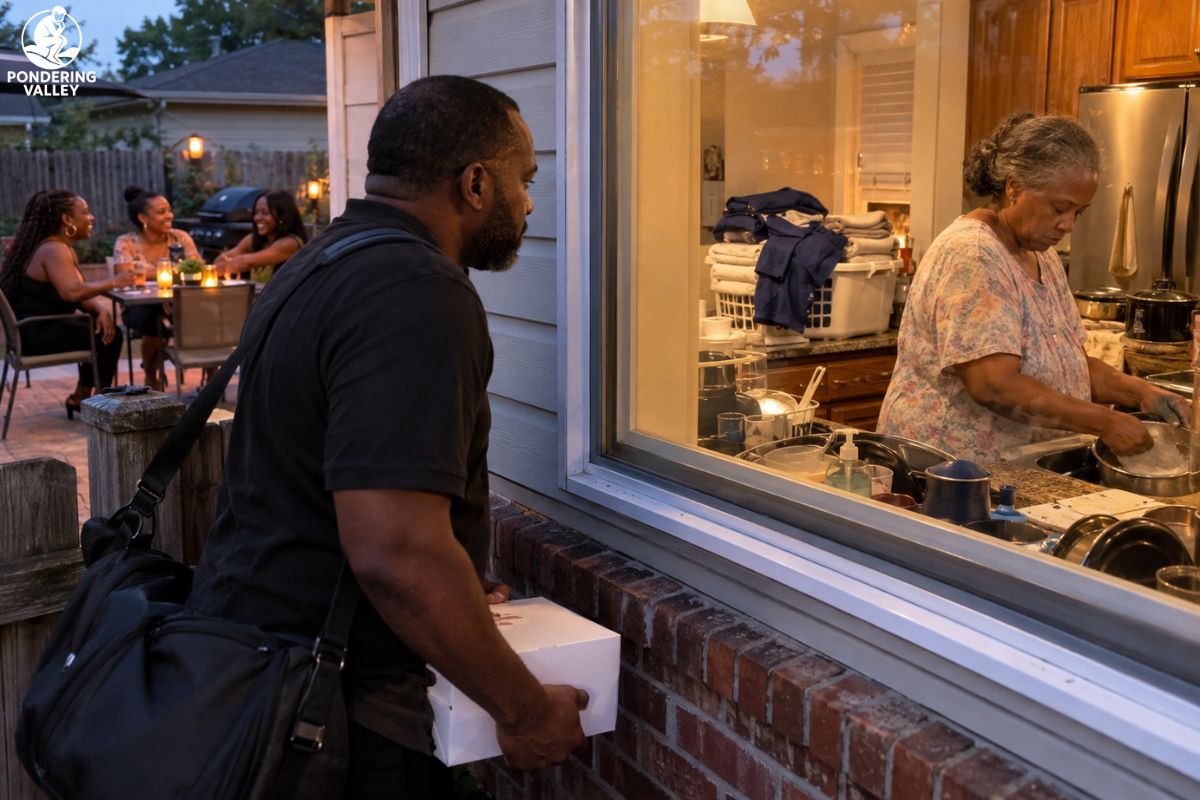
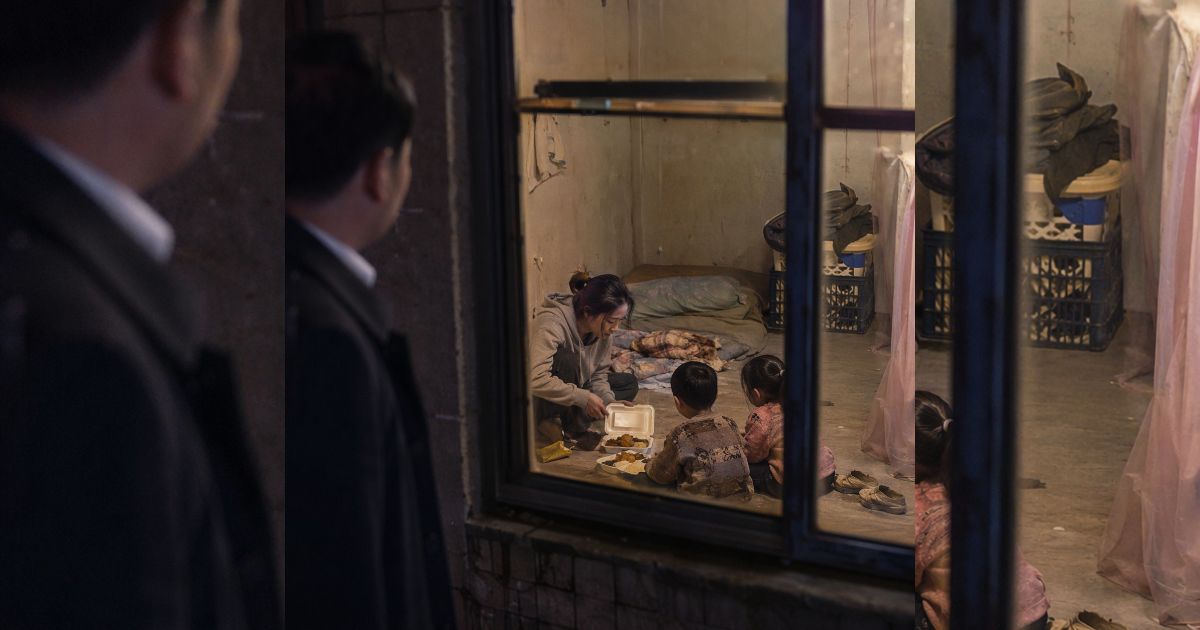
Malcolm stopped below the window where the curtain did not quite close all the way.
He did not mean to look.
He looked anyway.
The apartment was almost empty.
That was the first thing.
Not tidy-minimal. Not sparse-by-choice. Empty in a practical, exhausted way. A mattress on the floor. Two blankets folded at the foot of it. A plastic crate holding neatly stacked clothes. A second crate turned upside down beside the wall, serving as a table.
No couch.
No dining set.
No framed photos.
No extra anything.
Then two little heads popped up from behind the mattress.
A boy and a girl.
Young enough that they still had roundness in their cheeks.
Old enough to know how to wait quietly.
Malcolm felt his whole body go still.
Naomi knelt right away.
The change in her happened in an instant. Her shoulders softened. Her face, tight with end-of-shift fatigue a moment before, opened into something gentler. Not carefree. Never that. But warm. Intent. Present.
She took the container from her tote bag and opened it slowly.
The children moved toward her with a speed that was too quick to be casual.
Malcolm knew the difference the second he saw it.
This was not children getting excited over a treat.
This was children who had been watching the clock.
Naomi divided the food evenly. Careful. Deliberate. Making sure one little portion did not look bigger than the other. The boy leaned over his food immediately. The girl looked up first, as if checking whether it was truly all right to begin.
Naomi smiled.
Then she gave both children the same lie all good parents tell when there is too little of something.
“I’m not hungry, baby. You eat.”
She did not take a bite.
Malcolm stayed there much longer than he should have.
He would hate himself for that later.
But at the time he could not move.
He had spent half his life telling people effort solved things. That wanting something badly enough mattered. That discipline was the dividing line between those who rose and those who stayed stuck.
And here was Naomi.
Working doubles. Taking extras. Never asking for anything. Doing every single thing a man like Malcolm said a person was supposed to do.
Yet the floor under her children was bare wood and dinner had arrived in a leftover takeout box.
Then the little girl asked, “Mommy, are we having breakfast tomorrow?”
It was a soft question.
Almost cheerful.
Like she had asked whether they were going to the park.
Naomi brushed a curl back from the child’s forehead.
“Of course we are,” she said. “I’ll figure it out.”
Malcolm had heard confidence before.
He had given it.
Sold it.
Built a company on it.
But he had never heard anything quite like that sentence.
Because it was not confidence.
It was love wearing confidence so a child could sleep.
He stepped back then.
Really stepped back.
The metal railing at the bottom of the stairs was cold against his palm. He stood there in the dark while something uncomfortable and humbling moved through him with slow force.
This was not an isolated sad story in a city full of them.
This was one of his employees.
One of his best.
If this was what survival looked like after she clocked out, then what exactly had Malcolm been paying attention to all these years?
The next morning he woke before dawn and did not go running.
He always ran.
Five miles. Black coffee. Shower. Office by seven.
Routine had carried him through bad years and good ones. It had steadied him when he was broke. It had sharpened him when success started to soften other people.
That morning the idea of routine felt almost offensive.
He sat in his kitchen with untouched coffee going cold beside him and stared out through the windows of a house too large for one man.
It was a beautiful house.
Clean lines. Wide porch. Hardwood floors that gleamed even in low morning light. A kitchen stocked well enough that he could have fed a family of six without planning for it.
He had once looked around at all of it and felt vindicated.
I earned this.
Now all he could think of was a second-floor apartment and a child asking whether breakfast would exist in the morning.
At 7:40 he called his assistant and told her to ask Naomi to come to his office if she was on-site.
At 8:12 she walked in.
And now here they were.
Back in the office. Back in that airless silence.
Naomi looked at him like she was trying to decide whether he was dangerous, foolish, or both.
“I don’t need pity,” she said finally.
Malcolm nodded.
“I know.”
“I mean it.”
“I know.”
Her mouth tightened.
People did not usually repeat her like that unless they were trying to calm her down. Naomi did not want calming down. She wanted dignity. Malcolm could see that much now.
He folded his hands on the desk.
“I’m not going to sit here and tell you I understand what your life is like,” he said. “I don’t. But I saw enough last night to know this company has blind spots. And if the people keeping it alive can still go home to that kind of fear, then I’ve been congratulating myself too early.”
Naomi looked down for one brief second.
It was enough to tell him the sentence had reached her, even if she hated it.
She lifted her face again.
“My life is my business.”
“Yes.”
“So let it be.”
“Normally, I would.”
A bitter little laugh escaped her before she could stop it.
“Normally.”
Malcolm took that without reacting.
“I crossed a line,” he said. “I’m not going to defend that. But I’m not going to pretend I didn’t see what I saw either.”
Naomi’s eyes flashed then.
“You saw one night.”
“One night was enough.”
“You don’t know anything.”
“Then tell me.”
She went still.
Malcolm knew he had pushed too far. He saw it the second the door in her expression started closing again.
So he changed direction.
“What would happen,” he asked more quietly, “if something went wrong this month? If one of your kids got sick and you had to miss two shifts. If the bus route changed. If rent went up again. What cushion do you have?”
Naomi let out a breath that sounded more like surrender than anger.
“That isn’t a real question.”
“It is to me.”
Her eyes drifted to the window behind him.
Warehouse roofs stretched beyond the glass. Loading bays. Trucks in motion. Men in neon vests moving like pieces of a machine large enough to swallow individual lives whole.
“My son needed new shoes in February,” she said.
Malcolm said nothing.
“I bought those instead of paying the electric bill on time.”
The office seemed to get quieter.
“He outgrew his last pair in the middle of a growth spurt. He was trying not to tell me his toes hurt.” She gave a short, almost embarrassed shake of her head. “Kids think they’re slick. He was walking funny, pretending it was a game.”
Malcolm felt his jaw tighten.
Naomi kept her voice level, but now it had that distant quality people get when they are not really speaking to you anymore. They are walking back through a memory and you are just standing nearby while they do it.
“I paid the bill a week late. Then daycare changed its rates. Then my daughter got sent home with a class project that needed supplies. Not expensive supplies. Just the kind you don’t notice until you have to choose between them and groceries.” She pressed her lips together. “That’s how it works. Not one big disaster. Just a hundred little ones.”
Malcolm listened.
Not the way executives say they listen while already planning their answer.
He actually listened.
Naomi leaned back in the chair and looked suddenly very tired.
“The apartment I used to rent got sold last year,” she said. “New owners came in. New rates. New fees. They put fresh paint in the hallway and suddenly called it upgraded.” Her voice stayed calm, but her eyes did not. “I moved because I had to. This place costs less, but the bus takes longer, and the kids share a corner, and every month I tell myself if I can just get through one more overtime cycle, I’ll catch up.”
“Do you?”
She looked at him.
That was answer enough.
He opened the top drawer of his desk and pulled out a thick envelope.
Naomi’s whole posture changed when she saw it.
“No.”
“This is not a handout.”
“It looks like one.”
“It’s immediate support.”
“I didn’t ask.”
“I know.”
She stood up this time.
Actually stood.
Malcolm did not.
He stayed seated so she would not feel physically cornered.
“I cannot take money from my boss because he followed me home and saw something sad,” she said. “Do you understand how that feels?”
“Yes.”
“Do you?”
He did.
Or at least he did more than he had yesterday.
“It feels like someone saw you at your worst and decided they know what your dignity should cost,” he said.
Naomi stared at him.
A muscle moved in her jaw.
Malcolm slid the envelope closer but did not touch it again.
“This is not your dignity,” he said. “This is me admitting I have built a company that rewards stamina without asking what that stamina is costing people off the clock. That is on me.”
Naomi looked at the envelope as if it might burn her.
Then back at him.
“What’s in it?”
“Enough to cover groceries, shoes, utilities, and breathing room for a little while.”
Her throat worked.
She hated that the list had probably named exactly what she needed.
“And then what?” she asked. “I smile and say thank you and go back downstairs and pretend I’m the reason this happened?”
“No.” Malcolm leaned forward. “Then you help me change the parts of this place that make good employees live like this in the first place.”
She frowned slightly.
For the first time since walking in, she looked more confused than angry.
“What are you talking about?”
“I’m talking about wages that do more than sound fair on paper. I’m talking about emergency assistance people can ask for without begging. I’m talking about schedules stable enough that parents can plan childcare without crossing their fingers. I’m talking about transportation help, meal support, a real ladder up, and people from the floor helping me build it instead of executives guessing from behind glass.”
Naomi stared at him as if she had not yet decided whether he had lost his mind.
Malcolm almost understood that.
Men like him did not wake up on a Tuesday and start questioning the ideas that had made them rich.
But men like him also did not usually stand in the dark outside an apartment window and feel a child’s question about breakfast rearrange their entire sense of what success meant.
“Why?” Naomi asked.
It was a tired question.
A bare one.
Not suspicious so much as worn thin by disappointment.
Malcolm looked at her and answered the only way he could.
“Because I was wrong.”
The room held still.
He had spent years being respected partly because he was rarely unsure and almost never publicly wrong.
He had once believed leadership meant certainty.
Now, sitting across from Naomi Hayes, he said the thing that mattered more.
“I thought if I paid above average and offered overtime, that was enough. I thought if people worked hard, they’d find their footing eventually because that’s what happened to me.” He took a slow breath. “I never stopped to consider how much luck was mixed into that story. Or timing. Or the fact that I only ever had to carry myself.”
Naomi’s eyes filled so quickly she looked irritated by it.
She blinked hard.
“I don’t need saving,” she said softly.
“I know.”
“You keep saying that.”
“Because I do.”
He let the next words come carefully.
“I’m not asking you to be grateful. I’m asking you to let me stop pretending I don’t have a responsibility here.”
She sat back down.
Not because her pride had vanished.
Because sitting was easier than holding yourself upright when life had taken too much out of you.
Her fingers hovered over the envelope.
Then pulled back.
Then hovered again.
Malcolm could almost see the war inside her. Need on one side. Pride on the other. Behind both of them, the cold fact that children could not eat self-respect.
“My kids’ names are Eli and Rosie,” she said suddenly.
Malcolm waited.
“Eli is six. Rosie just turned five.” Naomi swallowed. “Eli pretends he likes hand-me-down sneakers because he thinks it makes me feel better. Rosie hides crackers in her coat pocket for later. She thinks I don’t notice.”
The last word nearly broke.
Malcolm looked away for one second to give her that mercy.
When he looked back, she had picked up the envelope.
Not opened it.
Just held it against her lap with both hands, like she still wasn’t sure whether it belonged there.
“All right,” she whispered.
Then, because she had to protect something even now, she added, “But I’m not your project.”
“No,” Malcolm said. “You’re not.”
When she left his office a few minutes later, she walked differently.
Not lighter.
Not yet.
But steadier.
As if allowing herself help had not weakened her after all. As if maybe it had only made room for one breath she had not taken in a very long time.
Malcolm watched the door close.
Then he sat there alone and felt the full weight of what came next.
An envelope was not a solution.
It was triage.
Necessary.
Immediate.
Still nowhere near enough.
He picked up the phone and called the one person who would understand both the scale of the problem and the size of the fight ahead.
Lisa Carter answered on the second ring.
“Tell me this is good news,” she said.
Lisa had been with him for nineteen years.
Before the title Chief Financial Officer, before the sharp blazers and quarterly briefings and investors who respected her even while fearing the speed of her mind, Lisa had been a young accountant in a borrowed office with a folding table and a calculator that clicked too loudly.
She knew the company down to its bones.
She also knew Malcolm well enough to hear the difference in his breathing when something mattered.
“It’s not good news,” he said. “But it might end up being necessary news.”
Silence on the line.
“Go on.”
“We need to talk about wages. Benefits. Emergency support. Real support, not the kind we write into a brochure and hope nobody asks about.”
That got her attention.
He could almost hear her sitting down straighter.
“What happened?”
Malcolm looked out at the floor below his office.
A forklift moved past the loading bay. A man in gloves waved another worker into place. Two women at a packing station leaned close over a tablet, solving some small problem that would never make it into a board presentation.
“I finally saw something I should have seen years ago,” he said.
Lisa was quiet for a second.
Then she said, “All right. Tell me everything.”
He did.
Not every private detail.
Not names beyond what was needed.
Not the personal pieces Naomi had entrusted to him.
But enough.
Enough that Lisa stopped interrupting.
Enough that the silence on the other end of the call turned from skepticism into focus.
When he finished, she let out a slow breath.
“And you’re serious,” she said.
“I am.”
“About how serious?”
“Serious enough to start a fight with anyone who thinks this is optional.”
Lisa made a small sound that was either a laugh or disbelief.
“Now I know you’re serious.”
“I want proposals by end of day.”
“You’re asking for a redesign of core compensation structure, Malcolm.”
“I know.”
“You want wage increases, emergency assistance, childcare help, transportation support, meal security, more predictable scheduling, and probably a dozen things you haven’t thought of yet.”
“Yes.”
“You do realize investors are not going to hear that and clap?”
“Then they can stop clapping.”
Lisa was quiet.
Then he heard the clicking of keys.
Fast.
Familiar.
It had always been one of her gifts, that ability to move from shock to strategy without wasting time in between.
“All right,” she said. “I’ll start with turnover, absenteeism, training costs, recruitment loss, missed productivity from burnout, and supervisory inefficiency tied to unstable staffing. If we frame this as long-term operational strength instead of moral awakening, we have a better shot.”
“It is a moral awakening.”
“I know,” Lisa said. “But numbers are the language the board pretends is neutral. So I’ll speak it.”
By noon she was in his office with three spreadsheets, a yellow legal pad full of notes, and the expression she wore when she was half impressed and half annoyed.
“You’ve got a case,” she said, dropping the folders on his desk. “Not an easy one. A real one.”
Malcolm stood as she spread the pages out.
“We lose more money to turnover than most of the board realizes,” Lisa said. “Not just hiring and training. I mean hidden losses. Slower lines. Mistakes from fatigue. New people paired with exhausted people. Supervisors always plugging holes. Morale dragging performance down quietly where nobody credits it.” She tapped a row with her pen. “If we increase wages meaningfully and reduce churn, we recover part of the cost. Maybe not in quarter one. But by year two? It gets interesting.”
“How interesting?”
“Interesting enough that if you weren’t suddenly acting like a man who got hit by conscience, I’d say this was one of the smartest business moves you’ve made in years.”
Malcolm almost smiled.
“Almost?”
Lisa gave him a look.
“I’m still waiting to find out whether you plan to blow up your own compensation package in a dramatic speech.”
He said nothing.
Lisa froze mid-page.
“Oh no.”
He leaned against the desk.
“If that’s what it takes.”
She closed her eyes briefly.
“Of course it is.”
“I mean it.”
“I know you do. That’s what worries me.”
By late afternoon they had the bones of a proposal.
Meaningful hourly wage increases across warehouse and logistics operations.
An emergency assistance fund that employees could access through a confidential review process without public humiliation.
Transportation stipends for workers relying on buses or long shared commutes.
Predictable scheduling windows posted earlier so parents and caregivers could actually plan.
A meal program for late-shift employees and a grocery support option during emergencies.
Childcare partnerships with two local providers near major warehouse sites.
A modest education and advancement fund for people wanting certifications, dispatch training, or management tracks.
And, at Malcolm’s insistence, an employee advisory group made up of actual workers from the floor.
“Don’t say culture committee,” Lisa warned him. “If you say culture committee, I’m walking out.”
“It won’t be a culture committee.”
“It better not be.”
For the next four days, Malcolm did something he should have done years ago.
He walked the floor without entourage, without manager summaries, without pretending visibility was the same thing as presence.
He stood beside loading stations and asked how often schedules changed at the last minute.
He asked drivers what fuel reimbursement delays did to their week.
He asked single parents how many backup plans they had before a missed shift became lost income.
He asked quiet people.
Not just the loudest ones.
Not just the ones polished enough to speak comfortably to executives.
He asked the people who looked down first and answered cautiously because experience had taught them that honesty in a workplace was dangerous if it landed in the wrong ears.
He learned more in four days than he had in ten years of reports.
One man had been sleeping in his cousin’s garage after a rent increase, showering at the truck stop before dawn routes.
A woman in dispatch kept granola bars in her desk drawer not because she liked them but because on certain weeks they were dinner on the drive home.
A forklift operator with near-perfect attendance was paying more for last-minute childcare than he had ever admitted because his posted schedule shifted so often that regular arrangements kept falling apart.
None of it made headlines.
That was the point.
Misery rarely arrived dramatic enough for board members to notice.
It came in overdraft fees.
Outgrown shoes.
Late bills.
Skipped meals.
Long bus rides taken without complaint because complaint wasted energy.
The proposal expanded.
So did Malcolm’s anger.
Not at employees.
Not even at the city or the economy in some vague, safe way.
At himself.
Because the signs had always been there.
He had simply built a life high enough above them that he could call that distance objectivity.
On the fifth day, Naomi knocked on his office door again.
This time she entered with less fear in her face and more caution.
“How are your children?” Malcolm asked.
The question came out gentler than he expected.
Naomi noticed.
“They’re okay.”
Just okay.
Yet there was something different in her too.
Color back in her face, maybe. Or maybe just the absence of immediate panic.
“I bought groceries,” she said after a moment. “Real groceries. Not just enough for tonight.”
Malcolm nodded once.
“I’m glad.”
“I also paid the light bill. And got Eli those shoes in the right size instead of one size up to make them last longer.”
There was a small shame in how carefully she admitted even that. As if relief itself might be judged extravagant.
“Good,” he said.
Naomi shifted her weight.
“I didn’t come up here to thank you.”
“I didn’t expect you to.”
“I came because you said you wanted help doing this right.”
“I did.”
She pulled a folded piece of paper from her pocket and set it on his desk.
Malcolm opened it.
It was a list.
No decoration. No rambling. Just practical, direct items written in neat handwriting.
Schedules posted earlier.
A way to swap shifts without going through three supervisors.
Emergency grocery cards that didn’t feel like begging.
A quiet room for parents waiting on childcare pickups.
Advance notice for overtime.
Bus pass assistance.
Late-shift meal boxes people could take without asking a cook in private.
More cross-training so workers could move into higher-paying roles.
At the bottom, underlined once, were the words:
Ask people what they need before deciding for them.
Malcolm looked up.
Naomi’s chin lifted a little.
“This isn’t everything,” she said. “It’s just what I know from my shift. And from listening.”
Listening.
The thing he had mistaken for weakness because he was so busy admiring command.
“It’s a good list,” he said.
“It’s an honest one.”
He nodded.
“Then it’s better than good.”
For the first time, Naomi let herself smile.
It was brief.
Tired.
Still beautiful because of how hard-won it looked.
The board meeting was set for Monday morning.
Lisa spent Sunday refining numbers.
Malcolm spent Sunday night awake.
Not pacing.
He was not a pacer.
He sat in his study with legal pads full of notes and crossed out the polished phrases every consultant would have recommended. He did not want clean corporate language. He did not want to hide behind terms like workforce optimization and retention strategy, even though those mattered.
He wanted the room to hear the truth.
Monday came bright and cold.
The boardroom at Reed Freight & Distribution was designed to impress. Glass walls. Long table. City view. Bottled water set out at exact angles. The kind of room where important people liked to feel even more important.
Malcolm took his seat at the head of the table and realized, not for the first time, how often architecture existed to flatter the people least connected to actual labor.
Lisa sat to his right, papers stacked in careful order.
Across from them were investors and board members in good watches and expensive shoes.
Catherine Doyle was there, silver-haired, seventy if a day, with a calm face that gave away very little. She had been with the company through three expansion phases and never spoke without purpose.
Daniel Mercer sat two chairs down, long-time investor, sharp suit, sharper opinions. He believed deeply in efficiency and mildly in human beings as long as they stayed inside forecast models.
Others filled out the table.
Malcolm looked around and understood that half of them had already decided to dislike whatever came next.
Good.
Let them decide early.
He began anyway.
“I’m proposing a full revision to how this company supports its operations workforce,” he said. “That includes wage increases, more stable scheduling, transportation support, emergency assistance, meal security, childcare partnerships, advancement funds, and an employee advisory structure.”
Daniel leaned back before Malcolm was halfway through.
“That’s a lot of expensive compassion for one morning.”
Lisa’s eyes did not leave her papers.
Malcolm did not react.
“It’s expensive to keep pretending turnover is normal too,” he said.
A few people shifted.
One board member flipped through the summary packet with the distracted look of a man planning his objection before he reached page two.
Daniel steepled his fingers.
“Let me save us time. We are not a charity.”
“No,” Malcolm said. “We’re a company built by people who work hard enough to keep product moving every hour of the day. Which is exactly why this matters.”
Daniel gave a thin smile.
“Our employees are already paid competitively.”
“Competitively for what?” Malcolm asked. “For surviving? For staying too exhausted to leave? For accepting instability because every other place is unstable too?”
The room went quieter.
Daniel’s smile vanished.
Lisa slid a packet toward the center of the table.
“These are our turnover losses over the last four years,” she said. “These are training costs. These are productivity gaps tied to constant replacement. These are error spikes linked to fatigue and inconsistent staffing. This plan costs money up front. Not doing it is already costing us money now.”
A board member on the far end adjusted his glasses.
“You’re saying this is operational.”
“I’m saying it’s operational and human,” Lisa replied. “The board can choose which word makes it easier to approve.”
Catherine Doyle almost smiled at that.
Daniel skimmed the packet and frowned.
“You can’t seriously expect us to believe wage increases fix all of this.”
“I don’t,” Malcolm said. “That’s why the plan isn’t just wages.”
He stood.
Not for drama.
Because sitting suddenly felt too passive.
“For years I’ve told myself this company rewarded effort,” he said. “And on paper, I could prove it. Overtime available. Pay above certain averages. Promotion tracks. Bonus structures. The kind of things that let men like us feel principled.”
He let the words hang.
“Then I looked closer.”
No one interrupted.
“I’m not talking about laziness. I’m not talking about poor decisions. I’m talking about employees who show up, stay late, cover gaps, train others, and still go home one inconvenience away from crisis.”
Daniel made an impatient sound.
“This is anecdotal.”
Malcolm turned to him.
“It stopped being anecdotal when I saw how many of our people are held together by nothing but stamina.”
He did not use Naomi’s name.
He did not tell the room about the bare apartment or the child asking for breakfast. That story belonged to people who had lived it, not to a board meeting.
But the truth of it sat underneath every word he said.
“You want numbers,” Malcolm said. “Fine. We have numbers. But let’s stop pretending numbers excuse ignorance. The only reason this company performs the way it does is because people on the ground absorb the risk we don’t.”
Silence.
Then Daniel asked, “And if this plan hurts margins?”
Malcolm had been waiting for that.
“Then I take the hit first.”
Heads lifted.
Lisa turned toward him slowly.
Daniel narrowed his eyes.
“What does that mean?”
“It means if we need room, I cut my salary. We reduce executive bonuses before we reduce this plan.”
That landed harder than any spreadsheet.
The room broke into murmurs.
One board member actually laughed under his breath as if he thought Malcolm was posturing.
He was not.
Catherine Doyle set down her pen.
“You would do that?”
“Yes.”
“You already decided that before this meeting?”
“Yes.”
Daniel leaned forward.
“This is emotion talking.”
“No,” Malcolm said. “Emotion is what I should have felt years ago. This is responsibility.”
No one spoke.
Lisa looked at him with open annoyance now, but beneath it was something else. Respect, maybe. Or resignation that he had chosen the most difficult honest path in the room and left her no choice but to stand beside it.
Catherine opened the packet again.
For a long minute she read in silence.
Then she said, “I’ve sat at tables like this for more years than I care to count. Every few years someone claims labor costs are the threat. Every few years we trim too close and act shocked when loyalty disappears.” She looked up. “I think Mr. Reed is late to this realization. But I do not think he is wrong.”
Daniel turned to her.
“You’re comfortable setting precedent like this?”
“I’m comfortable recognizing when a company confuses short-term control with long-term strength.”
She placed her vote.
Yes.
One by one the rest followed.
Not cleanly.
Not unanimously.
But enough.
Enough to pass.
Enough to change the shape of the company.
When the meeting adjourned, Daniel closed his folder with visible displeasure.
“I hope your conscience performs as well as your warehouses,” he said.
Malcolm met his gaze.
“For the first time in a while, I’m betting they might be connected.”
In the hallway outside, Lisa stopped walking and turned on him.
“You really waited until the meeting to announce your salary cut?”
“Yes.”
“You enjoy chaos more than I thought.”
“It worked.”
She stared another second, then gave a sharp breath that was almost a laugh.
“It did.”
Below them, through the high interior windows, the warehouse floor moved like it always had.
Pallets.
Scanners.
Routes.
Calls.
Work did not stop because a board voted.
That was what Malcolm kept thinking as he stood there beside Lisa.
Decisions made upstairs only mattered if they changed what happened downstairs.
“All right,” Lisa said, crossing her arms. “We have approval. Now comes the part people love to underestimate.”
“The rollout.”
“The part where nobody believes us.”
She was right.
By Tuesday afternoon, rumors had already started.
People on the warehouse floor heard executive movement before official announcements. They sensed tension like weather. Somebody saw Lisa carrying binders. Somebody heard a supervisor mutter about meetings. Somebody noticed Malcolm walking the floor again.
By Wednesday, three different versions of the story were circulating.
That layoffs were coming.
That automation was coming.
That a site closure was coming.
When Malcolm heard that, he told Communications to stop drafting polished internal statements and instead book time on the floor for a company-wide meeting.
“I’ll tell them myself,” he said.
The meeting happened Friday at the main Atlanta facility.
They cleared space near the loading area and rolled in portable microphones that squealed twice before settling. Workers gathered in clusters, some still in gloves, some with dust on their sleeves, some looking irritated to have been pulled from tasks without explanation.
Naomi stood near the back beside two women from dispatch and a man from receiving.
Malcolm noticed her immediately.
Not because she was trying to stand out.
Because now that he had actually seen her, he realized how often before he had looked through people like her and called it management.
He took the microphone.
The room was loud until it wasn’t.
The silence that fell over a workforce when the owner took the floor had its own texture. Suspicious. Guarded. Tired.
Malcolm did not smile.
He did not begin with corporate gratitude.
He did not say We’re a family.
He hated when companies said that.
He looked at the room and said, “Most of you know me as the man who asks for results.”
A few glances passed between employees.
Good.
At least they knew he wasn’t pretending.
“For years,” he continued, “I have believed that if this company offered decent pay, extra hours for those who wanted them, and room to move up, then we were doing our part.”
He let that sit for a moment.
“I was wrong.”
That got their attention.
Not all at once.
But visibly.
Some people straightened.
Some frowned.
Some looked at one another the way people do when they suspect they misheard something important.
Malcolm went on.
“I’ve spent the last week listening more closely than I should have had to. And what I learned is this: too many people here are doing everything right and still living one emergency away from the edge. That is not strength. That is not loyalty. That is a system asking workers to carry more risk than leadership does.”
No applause.
No cheer.
Just listening.
That was fine. Better than fine.
Trust did not arrive clapping.
“So here is what changes,” he said.
He laid it out clearly.
Wage increases effective next pay cycle.
Emergency assistance fund available confidentially.
Transportation stipends for qualifying employees.
Late-shift meal access without special requests or embarrassment.
Earlier schedule posting and a simpler shift-swap process.
Childcare support partnerships.
Certification and advancement funds.
An employee advisory group built from every major department.
As he spoke, the room stayed very still.
Not because they were moved.
Because they were measuring.
Searching for the hidden hook.
The catch.
Malcolm knew that look.
A man near the front raised his hand before Malcolm even finished.
“What’s the trade?”
There it was.
Malcolm appreciated the directness.
“No trade.”
The man snorted softly.
“With respect, sir, there’s always a trade.”
Murmurs of agreement rippled.
Malcolm nodded once.
“In most places, yes. Here’s the only trade I’m asking for: honesty. If something in this plan doesn’t work, you say so. If a manager makes it harder than it should be, you say so. If you want this place to run stronger, you help build it stronger.”
A woman from packing called out, “Why now?”
He looked toward her.
Because a child asked if breakfast was coming.
Because the answer to that question had followed him into every room all week.
Because he had confused survival with success for years and could no longer bear the sound of it in his own mouth.
But he did not say any of that.
Instead he said, “Because I finally looked close enough.”
That, more than anything, seemed to land.
Not perfectly.
Not enough to erase years in a sentence.
But enough to quiet the room for a different reason.
At the back, Naomi stood with her arms folded.
She did not smile.
Yet Malcolm saw the way her face softened when he mentioned the late-shift meals.
She knew exactly why that mattered.
After the meeting, people did not rush him with gratitude.
They came in cautious pairs.
Asking practical questions.
When does it start?
Who qualifies?
What paperwork?
What if a manager blocks it?
That was good too.
People with actual bills do not celebrate promises before they see them on paper.
By the following month, the first changes began to take shape.
The cafeteria set up a clearly marked late-shift meal station near closing, no questions asked, no whispering at the back counter. Employees could pick up packaged meals the same way office staff picked up catered leftovers after meetings, only without shame attached to it.
Bus stipends rolled out first at the Atlanta site, then at two others.
Schedules posted earlier.
Not perfectly at first. Some supervisors dragged their feet. One claimed the new process was “too soft” and would make workers expect special treatment.
Malcolm called him into his office.
The supervisor sat down with the confidence of a man expecting a polite conversation.
He left thirty minutes later understanding two things very clearly.
First, that predictability was not softness when your childcare provider charged by the minute.
Second, that anyone treating basic stability like a favor was free to do so elsewhere.
Word traveled fast after that.
So did the applications for the emergency fund.
That part unsettled Malcolm more than he expected.
Not because people were misusing it.
Because so many had needed it the whole time.
The requests were not dramatic.
Tires.
Utility shutoff notices.
Prescription co-pays without which a parent would miss work.
Deposit gaps after forced moves.
Temporary hotel nights after plumbing failures.
School uniform costs.
Funeral travel for close family.
The ordinary fragile edges of working life.
Each approved file felt like proof of how narrow people’s margins had been while executives talked about resilience.
Naomi joined the employee advisory group reluctantly.
She tried to refuse twice.
The first time because she said she was too busy.
The second because she said she did not want people thinking she had become management.
Lisa, who had far less patience for self-protective avoidance than Malcolm did, told her, “That is exactly why you should be in the room.”
Naomi came.
So did a driver named Luis from the overnight route, a receiving clerk named Tasha, a veteran forklift operator named Ben, a dispatcher named Shanice, and three others from different facilities dialing in on video screens.
The first meeting was awkward.
No one trusted the structure yet.
Workers sat like they were waiting to be studied.
Executives sat like they were trying hard not to look like executives.
Lisa opened the session and, true to form, cut through the nonsense within five minutes.
“This will fail if everyone in here speaks like they’re auditioning for a brochure,” she said. “So let’s save time. What’s still not working?”
That broke the room open.
Transportation support helped, but some routes still ran too late for parents with strict pickup times.
The meal program worked at the main site, but not all facilities had staff to manage it well.
One site’s supervisor was quietly making employees feel guilty for using the emergency fund.
Training materials for advancement opportunities were buried online where people without regular computer access never saw them.
Shift swap requests got lost when managers went on leave.
Naomi said less than others at first.
Then more.
By the third meeting, she had become one of the clearest voices in the room.
Not loud.
Not performative.
Just exact.
“If the form asks for too much detail, people won’t use it,” she said about emergency applications. “If a worker feels like they have to write an essay about their hardship to deserve a grocery card, they’ll just skip meals instead.”
Lisa looked up from her notes and changed the requirement that day.
Another time Naomi said, “You keep saying opportunity. That means nothing if workers can’t get to the class because their shift ends after the daycare closes.”
So Malcolm approved paid training blocks during work hours for select certification programs.
Piece by piece, the system became less theoretical.
More human.
At home, Naomi’s life did not transform into some glossy miracle.
That was never how real relief worked.
Problems did not vanish.
But they loosened.
That mattered.
She moved the children from the mattress on the floor to two secondhand twin beds she found through a church resale program and could finally afford to pick up. Eli stared at his new bed like it was a hotel room. Rosie spent two whole evenings arranging and rearranging a borrowed stuffed rabbit near her pillow.
Naomi bought a folding kitchen table with four metal chairs from a yard sale in a better neighborhood.
The table was scratched.
One chair wobbled.
It was still the first place her children had eaten dinner sitting up together in over a year.
One evening she stood in the doorway of their apartment, grocery bag hanging from her wrist, and watched Eli do homework at that table while Rosie colored beside him with fierce concentration.
No drama.
No violin music.
Just a table.
And because she had spent so long living without one, Naomi put the groceries down and cried quietly in the kitchen where the kids could not see.
The next advisory meeting, when Lisa asked how things were going, Naomi answered honestly.
“Better,” she said. “Not easy. Better.”
Malcolm held onto that word.
Better was real.
Better meant the distance between disaster and daily life had widened enough for someone to breathe.
Better meant a child could ask for seconds without a mother feeling panic behind her ribs.
Better meant shoes that fit and breakfast that existed before bedtime promises had to invent it.
One evening, a little over two months after the board vote, Malcolm stayed late again.
This time not because he was lost in performance reports.
Because he had started making it a habit to walk through the building after most executives had gone home. Not as theater. Not to be seen. Just to see.
The cafeteria lights glowed softly.
Workers from the late shift moved through the line, picking up boxed meals and fruit cups and sandwiches. No whispering. No one hovering until the room emptied. No cook slipping containers under counters with that awkward mix of kindness and shame.
Everything was out in the open.
Ordinary.
That was what Malcolm had wanted.
Dignity often looked a lot like making help feel normal.
He saw Naomi there.
She was zipping Rosie’s little jacket while the child leaned sleepily against her side.
The childcare partnership site near the warehouse had hosted a family open house after work, and Naomi had brought both kids over so they could see where Rosie would go some afternoons once the schedule changed next month.
Eli held a paper cup of apple slices.
Rosie clutched a cookie with both hands like it was treasure.
Naomi looked up and saw Malcolm watching.
For one second the old awkwardness flickered.
Then she walked over.
Rosie peeked around her mother’s leg.
“This is Mr. Reed,” Naomi told the kids.
Eli, who was old enough to understand adult significance but not yet old enough to hide curiosity, looked up at Malcolm and asked, “Are you the boss-boss?”
Malcolm almost laughed.
“I guess I am.”
Eli considered that.
Then he asked the question Malcolm did not expect.
“Do bosses eat cafeteria cookies too?”
Naomi looked horrified.
“Eli.”
But Malcolm crouched a little to the boy’s height and said, “The smart ones do.”
That made Eli smile.
Rosie studied him for another second, then held up her cookie solemnly as if showing proof of existence.
Malcolm straightened and looked at Naomi.
She looked tired, yes.
But not hollow.
Not frayed down to the last thread.
The difference was subtle enough that someone careless might miss it.
He no longer considered himself careless.
“Thank you,” she said quietly once the kids had wandered a few steps toward the fruit basket.
He looked at her.
She shook her head slightly.
“Not for the envelope,” she said. “For not making it stop there.”
Malcolm glanced around the cafeteria.
A driver laughing with two loaders.
A woman from dispatch taking two meal boxes, one clearly for later.
A tired father buckling his daughter into a coat before the ride home.
He thought of the version of himself from three months earlier. The man who believed fairness was something you could calculate from a salary table and call done.
“I should have started sooner,” he said.
“Yes,” Naomi replied.
There was no cruelty in it.
Only truth.
Malcolm nodded.
“I know.”
By winter, other facilities were asking for the same programs.
Managers from out-of-state sites called Lisa wanting templates. A regional operations head in Tennessee admitted turnover had already slowed. One supervisor who had privately opposed the changes sent Malcolm a short email saying he had been wrong after one of his best workers used the advancement fund to complete dispatch certification instead of leaving for a competitor.
Investors watched the numbers.
Daniel Mercer remained predictably unimpressed in tone, though even he stopped using phrases like expensive compassion once the retention metrics started shifting in Malcolm’s favor.
Catherine Doyle sent Malcolm a handwritten note after the second quarter closed.
It said:
People often mistake hardness for seriousness. They are not the same thing.
He kept the note in his desk.
Naomi, meanwhile, did something Malcolm had not expected.
She began to rise.
Not because Malcolm handed her a title out of guilt.
He would never insult her that way.
Because once survival stopped taking every last ounce of her energy, the intelligence that had always been there had room to show itself in larger ways.
She helped redesign intake checklists that reduced shipping errors.
She proposed a simple change in shift communication that cut confusion during handoffs.
She trained new hires with a patience people trusted because she had actually stood where they stood.
When a lead position opened in operations support, Lisa suggested Naomi before Malcolm did.
“That matters,” Lisa said. “It means this isn’t charity in your head either.”
Malcolm appreciated that.
Naomi accepted the role after two days of thinking and one long conversation with her children at the folding kitchen table.
“What if it means you get home before bedtime more?” Eli asked.
That settled part of it.
On the evening she got the offer, Naomi took the bus home carrying a grocery bag and a folder full of onboarding materials for the new role.
She stepped into the apartment and found Rosie sitting cross-legged at the table coloring houses with bright roofs in impossible colors.
“What are you drawing?” Naomi asked.
Rosie looked up.
“Our next place maybe,” she said.
Naomi set down the bag slowly.
There had been a time not long ago when a sentence like that would have landed like pressure.
More rent. More unknowns. More risk.
Now it landed like possibility.
A few weeks later, on a Saturday morning, Malcolm stopped by a community field day the company had quietly sponsored for employees and their families. No banners with his face. No speeches. Just food tables, games, a bounce house, information booths from childcare partners and community training programs, and a lot of tired adults looking strange and younger in weekend clothes.
He almost did not go.
Public events like that made him feel clumsy.
He went anyway.
Naomi was there with Eli and Rosie.
Eli was trying to win a cheap stuffed bear at a ring toss booth with the seriousness of a man negotiating freight contracts. Rosie had face paint on one cheek and grass stains on both knees.
Naomi stood near a picnic table holding paper plates with pancakes and fruit.
Pancakes.
The sight of them hit Malcolm harder than it should have.
Because he remembered another breakfast.
The one that had not existed yet. The one Naomi had promised into being with nothing but love and determination and not enough money.
Now Rosie was asking for syrup with the high delight of a child who expected abundance in at least this one small moment.
Naomi caught Malcolm looking.
This time her smile did not flicker away.
“You want a plate?” she called.
He walked over.
The morning sun was thin and cool. Children shouted from across the grass. Somewhere a speaker was playing old Motown low enough not to annoy anyone.
Malcolm took the plate she held out.
Rosie looked up at him with sticky fingers and asked, “Mr. Reed, did you have breakfast today?”
He glanced at Naomi.
She glanced back.
And because both of them heard the echo of another question in that one, they almost laughed.
“I did,” he said.
Rosie seemed satisfied.
“Good,” she replied. “Breakfast is important.”
Naomi looked down at her daughter and had to press her lips together to keep from crying in front of everyone.
Malcolm pretended not to notice.
That was dignity too.
Late that fall, Malcolm stood again in his office at the end of a long day and watched the floor below through the glass.
The view had not changed.
Not really.
Still trucks.
Still pallets.
Still scanners and schedules and deadlines.
Still a company.
Still work.
He had not become soft.
He still demanded a lot.
He still believed in discipline.
He still believed effort mattered.
But now he understood something he had once been too proud to see.
Hard work is not a miracle cure.
Not when the floor beneath a person is already cracked.
Not when one late fee becomes three.
Not when a parent’s entire month can tip because a child needs shoes.
Not when the only thing standing between dignity and hunger is whether a cook has leftovers after closing.
Work can build a life.
But only if the work leaves enough life in a person to build with.
That was the part he had missed.
The cost of survival.
The unpaid labor happening off the clock in kitchens, on buses, in laundromats, in dark apartments where mothers divide food and call it enough because children are watching.
He thought of the old version of himself often.
Not with nostalgia.
With discomfort.
That man had not been evil.
He had just been certain.
And certainty, Malcolm had learned, could be one of the most expensive blind spots a powerful person ever carried.
There was a soft knock at his door.
Lisa stepped in holding a folder.
“You’ll enjoy this,” she said.
He took it.
Quarterly retention report.
Lower turnover.
Fewer missed shifts.
Higher internal promotion interest.
Better productivity.
Nothing magical.
Nothing dramatic.
Just evidence.
Malcolm looked up.
Lisa leaned against the frame with the faintest smile.
“Well,” she said, “it turns out people do better when they’re treated like their lives continue after they leave the building.”
He almost smiled back.
“Imagine that.”
She nodded toward the floor below.
“Naomi wrapped up the new lead training an hour ago. Half the room stayed after to ask her questions. She’s good.”
“She is.”
Lisa studied him for a second.
“You know what the strangest part of this is?”
Malcolm waited.
“You built this place on grit,” she said. “And somehow, after all this time, you finally figured out grit is not supposed to be the whole compensation package.”
When she left, Malcolm stood alone again.
Below him, people were clocking out.
Some to buses.
Some to cars.
Some to children waiting at home.
Some to lives still complicated and expensive and imperfect.
He knew better now than to think a company could fix everything.
It could not.
But it could stop pretending it had no hand in the gap between effort and stability.
It could stop calling bare survival success.
It could stop admiring exhaustion like it was proof of character.
A movement in the parking lot caught his eye.
Naomi was crossing toward the bus stop with her tote over one shoulder.
Only this time she was not alone.
Eli and Rosie were beside her, both bouncing with that loose, happy energy children get when they know the day ahead contains something good.
Rosie waved at the building even though she likely had no idea whether anyone could see.
Malcolm lifted a hand anyway.
Far below, too small to hear through glass and distance, Naomi bent toward her daughter and said something that made both children laugh.
Then the three of them kept walking.
Not rescued.
Not transformed into a fairy tale.
Just moving forward with more ground under their feet than before.
Malcolm stayed at the window until they disappeared from view.
Then he turned back toward his desk, toward the work still waiting, and for the first time in his life, the phrase he had built himself on no longer sounded complete.
Work hard, yes.
But build a world where hard work has somewhere decent to land.
That was the part he would spend the rest of his life trying to earn.
Thank you so much for reading this story!
I’d really love to hear your comments and thoughts about this story — your feedback is truly valuable and helps us a lot.
Please leave a comment and share this Facebook post to support the author. Every reaction and review makes a big difference!
This story is a work of fiction created for entertainment and inspirational purposes. While it may draw on real-world themes, all characters, names, and events are imagined. Any resemblance to actual people or situations is purely coincidenta