If you’ve already read part 1 of this story on Facebook, go here for Part 2!
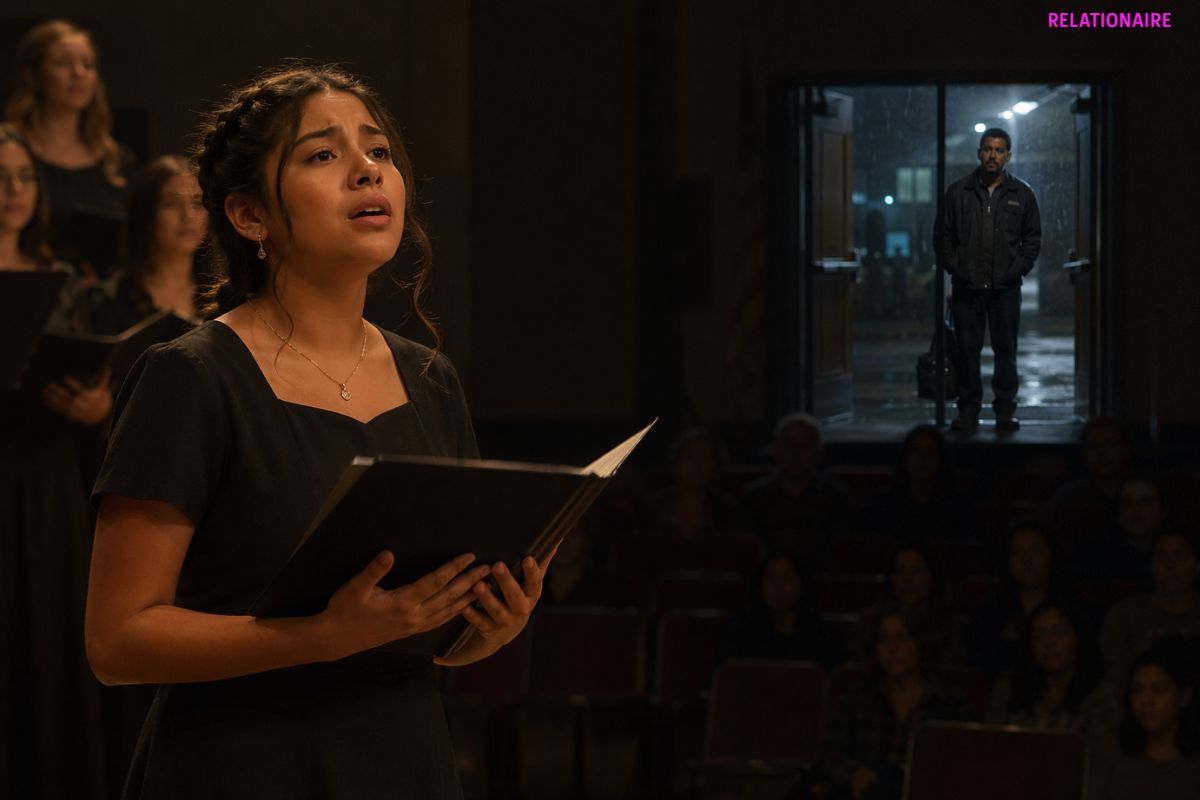
By the time Lena saw her father slip through the auditorium doors, the last solo was already halfway over.
He came in the way he always did—quiet, late, trying not to be seen.
Dark work jacket still on. Shoulders hunched. Standing in the very back near the exit like he was just passing through instead of coming for her.
Lena kept singing because she had to.
Because Mrs. Hargrove was conducting.
Because the lights were hot in her face.
Because there were two hundred people in the crowd and half the front row was filled with the kinds of parents who brought flowers and cameras and whole-body excitement with them.
But inside, something in her dropped.
Again.
When the song ended, applause filled the room. Her choir smiled, bowed, and shuffled into place for the closing announcement. Lena didn’t smile much. She kept looking past the crowd, past the shiny heads and raised phones, to the back wall.
Her father was still there.
He always stood like that—arms folded tight, face tired, as if he wasn’t sure he belonged with the cheering people.
Then, before the principal even finished thanking everyone for coming, he was gone.
Just like always.
Ava leaned into Lena as they filed offstage. “Was that your dad?”
Lena yanked the choir folder harder against her chest than she meant to. “Yeah.”
“At least he made it.”
Lena gave a laugh that wasn’t really a laugh. “He always makes it late.”
Ava glanced back toward the doors. “Maybe traffic?”
“Every time?”
Ava didn’t answer.
Lena didn’t want her to.
Because the truth was worse when someone else tried to make it gentle.
Outside the dressing room, girls were squealing over bouquets and photos. Parents hugged their kids in the hallway. One dad had brought a giant poster board with his daughter’s face on it. Another was balancing three carnations, a teddy bear, and a purse while his wife took pictures.
Lena stood by the cinderblock wall with her garment bag over one shoulder and her choir makeup starting to itch.
No flowers.
No waiting parent.
Just a text from her father sent twenty minutes earlier.
Running late. Proud of you.
That was it.
She stared at the words until they blurred.
Then she shoved the phone into her pocket.
Her mother used to come early. Before she left, before the moving boxes and the quiet excuses and the promise to call more than she actually did, she used to sit near the front and wave both hands if Lena found her in the crowd.
That had been years ago.
Now it was always her father.
Late. In the back. Gone first.
At first Lena had defended him.
He works a lot.
He’s tired.
He’s doing his best.
But after the fifth concert, the seventh, the district showcase, the winter recital, the spring fundraiser—after every night ending the same way—something hard had begun to build inside her.
Other dads clapped too loud.
Other dads embarrassed their daughters with flowers and corny jokes and pictures from bad angles.
Her father stood by the exit like there was somewhere better to be.
On the ride home from her sophomore winter concert, she had finally asked him.
“Why do you even come if you’re just going to leave?”
He had kept both hands on the steering wheel.
The heater in the old minivan had whined like it was in pain.
“What do you mean?”
“You know what I mean.”
“I came, didn’t I?”
That answer had made her so angry she stared out the window the rest of the ride, watching store signs smear into lines through the cold.
Tonight was supposed to be different.
Tonight was the regional choral showcase. The biggest performance she’d ever had. She had a featured solo. Mrs. Hargrove had told her not to undersell it.
“This is one people remember,” she’d said.
Lena had wanted, stupidly, for her father to remember it too.
Not from the back.
Not from the doorway.
Not like someone clocking in and out of her life.
In the hallway, Ava’s mom wrapped Ava in a hug so big it lifted her slightly off the ground.
“You were incredible,” she said.
Ava caught Lena’s eye over her mother’s shoulder and gave her a small apologetic look.
Lena looked away first.
By the time she got outside, the rain had started.
Not a storm. Just that cold, steady kind that made the parking lot shine black under the lamps.
Parents hustled kids into cars. Dress shoes splashed through puddles. Someone laughed too loudly near the curb.
Lena scanned the lot for the minivan.
It wasn’t there.
Of course it wasn’t.
She pulled her thin cardigan tighter over her concert dress and stood beneath the shallow awning near the side entrance. Her garment bag dragged against her leg. Water dripped through a crack in the gutter overhead, landing beside her in a steady, annoying tap.
Mrs. Hargrove came out carrying a stack of programs in one arm and an umbrella in the other.
“You were beautiful tonight, Lena.”
“Thank you.”
“I mean that. You found something in the solo.”
Lena nodded.
Mrs. Hargrove softened a little. “Your dad came?”
Lena swallowed. “For a minute.”
“That’s something.”
Lena knew she should let that be kind.
Instead she said, “Not really.”
Mrs. Hargrove studied her face like maybe she understood more than Lena wanted.
Then she handed Lena one of the leftover programs from the stack.
“Keep this. You earned it.”
Lena took it and whispered thanks.
When the teacher disappeared into the rain, Lena tucked the program into her garment bag and checked her phone again.
No new text.
She imagined him forgetting.
She imagined him getting pulled into another shift.
She imagined him halfway across town, not even thinking about the fact that his daughter was standing in the rain in concert shoes that pinched her toes.
The worst part wasn’t the anger.
It was that hope kept showing up anyway.
A pair of headlights swung into the lot. Lena straightened, but it wasn’t the minivan. Just another family leaving late.
She sat down on the low bench by the wall and dropped her bag beside her.
A little girl in a sparkly headband walked past holding her father’s hand and asked, “Did you hear me in the second song?”
He smiled down at her. “I heard only you.”
Something in Lena’s chest went tight and mean.
She looked at the wet concrete until the family disappeared.
Her phone buzzed.
She snatched it up too fast.
Not her father.
A message from her friend group.
You were AMAZING tonight
That solo???
Literal chills
Ava added a heart and then, a second later:
Did your dad ever come back?
Lena stared at the question.
Her thumbs moved before she could stop them.
He came. Did his usual thing. Back of the room. Left early.
The typing bubble appeared. Disappeared.
Then:
I’m sorry.
Lena locked the phone.
Sorry was a terrible word. Too small. Too clean.
It didn’t touch the part where she’d spent the whole final song looking for one face instead of being inside the music.
It didn’t touch the part where she had started telling people he was “busy” with a voice that sounded calm while something ashamed curled under it.
It didn’t touch the fact that she had once seen him in the grocery store staring at a calculator on his phone before putting milk back.
Or the stack of overdue envelopes rubber-banded in the kitchen drawer.
Or the way he always said, “We’re okay,” too fast.
At 9:43, she finally saw the minivan pull in.
It jerked crookedly into a spot by the curb.
Her father climbed out almost before the engine stopped.
For a second, Lena stayed where she was.
He looked worse than late.
Rain soaked through his jacket. His hair was plastered to his forehead. He was breathing hard, like he’d run from somewhere. One sleeve—his left—looked darker than the rest.
He started toward her, then slowed when he saw her face.
“I’m sorry,” he said.
Lena stood.
“Don’t.”
“Lena—”
“No, it’s fine.” Her voice came out sharper than she meant, but once it started, she couldn’t pull it back. “You came for your two minutes. You stood in the back. You left. Same as always.”
He opened his mouth, then closed it.
Rain tapped the hood of the van.
She hated how tired he looked. Hated that it still made her want to cry.
“Why do you keep doing this?” she asked. “Why do you even bother showing up if you’re just going to disappear?”
He glanced down at his sleeve.
And that was when Lena saw it clearly.
Not just dark from rain.
Blood.
A small streak near the cuff. Another higher up, smeared into the fabric.
Her anger stumbled.
“What happened?”
“Nothing.”
“That’s blood.”
“It’s not—”
“Dad.”
He looked toward the empty lot, then back at her. Like he was measuring something. Like he was deciding how much truth he could afford.
Lena’s heart began to pound for a completely different reason.
“Were you hurt?”
“No.”
“Then whose blood is that?”
He shut his eyes for one brief second.
When he opened them again, there was something in his face she had never seen before.
Not anger.
Not exhaustion.
Something closer to being caught.
“Get in the van,” he said quietly. “I need to show you something.”
And for the first time in her life, Lena realized she might have been wrong about her father.
PART 2
The envelope was in the glove compartment.
Old. White. Soft at the edges from being opened too many times.
Her father pulled it out with wet fingers and held it for a second without speaking.
Rain streaked the windshield. The wipers dragged back and forth with a tired rubber groan.
Lena sat in the passenger seat with her damp garment bag at her feet, watching him under the weak parking lot light. Up close, the blood on his sleeve looked mixed with rust and dust, like it had come from somewhere dirty.
“What is it?” she asked.
He kept looking at the envelope.
“Open it.”
She took it from him.
Inside was a folded notice from the apartment office. Late payment warning. Final reminder.
The amount due was circled in blue pen.
At the bottom, under a line about nonpayment and possible eviction proceedings, was a date from three months ago.
Lena looked at him. “Why do you have this?”
He gave a hollow laugh with no humor in it. “Because I keep needing to remember the number.”
She didn’t understand.
Then she did.
Not all at once. Not neatly. Just enough for the air inside the van to change.
“How many jobs are you working?”
He leaned back against the seat and rubbed his face hard with one hand.
“My regular shift at the school district warehouse in the mornings,” he said. “And maintenance at St. Catherine’s hospital at night.”
Lena stared at him.
“At night?”
He nodded.
“Every night?”
“Most.”
“And you still came tonight?”
He looked at her then, really looked at her, with rainwater still shining on his face.
“Of course I came tonight.”
The words should have comforted her.
Instead they landed in the sorest place.
“Then why do you always leave?”
He gripped the steering wheel.
“For the same reason I’m late. I’m covering for another guy half the time. If I leave too long, people notice. If people notice, I lose the extra hours. If I lose the extra hours…” He glanced toward the envelope in her lap.
The sentence didn’t need finishing.
Lena looked back down at the paper. Final reminder. Possible eviction.
She thought of the rent conversation she’d overheard in January. Her father’s low voice in the kitchen. The apartment manager saying, “I can only hold this off so long, Marcus.”
She had been making cereal barefoot, pretending not to hear.
She remembered the calculator in the grocery store.
The milk put back.
The way he’d said, “We’re okay.”
Her throat tightened.
“You left work,” she said.
“Every time.”
“For my concerts?”
“For every one I could.”
She felt suddenly hot despite the cold.
“But you were always late.”
His hand stayed on the wheel. Big, rough, cracked around the knuckles.
“The hospital’s across town. My shift starts before your performances usually end. Sometimes I can get out for twenty minutes. Sometimes forty. Depends what’s going on.”
“And then you go back?”
“Yes.”
“All the way back?”
“Yes.”
The rain seemed louder now.
A memory surfaced so fast it hurt: seventh-grade spring concert, scanning the crowd and finding him at the back in the same dark jacket. Her resentment had bloomed right there onstage. She’d sung the whole final song with it sitting heavy in her chest.
He had left before she found him after.
Gone before the hallway emptied.
Gone before she could say a single mean thing she’d prepared all through the applause.
“You never told me,” she whispered.
He looked out through the windshield. “You’re fifteen. You shouldn’t be carrying rent notices.”
“I’m sixteen.”
A tiny tired smile touched one corner of his mouth. “Sixteen.”
Then it disappeared.
“I didn’t want you worrying every time I said yes to something. Choir dress. Field trip. New shoes. I didn’t want you measuring yourself against bills.”
Lena thought of the black concert flats she had begged for because the old pair pinched her heels.
He’d bought them two weeks later with a receipt still folded in the bag.
She had complained they weren’t the brand she wanted.
Shame moved through her so sharply she looked down.
“What happened tonight?” she asked, nodding at his sleeve.
He exhaled.
“Storage room accident. One of the supply carts tipped when I was trying to get back in place before the charge nurse came through. Cut my arm on a busted bracket. It looks worse than it is.”
“Did you get it checked?”
“I cleaned it.”
“That’s not what I asked.”
He smiled again, but this time it was weary and sad. “No.”
Lena swallowed the anger that rose up, because now it had nowhere clean to go.
At him for hiding it.
At herself for not seeing it.
At the whole humiliating math of grown-up life, where a father could stand in the back of an auditorium still wearing his work boots and his daughter could mistake devotion for indifference because it wasn’t wrapped in flowers.
She touched the edge of the rent notice.
“How long has it been like this?”
He was quiet for so long she thought he wouldn’t answer.
“Since your mom left for Dallas,” he said finally. “Longer, really. But harder since then.”
Lena turned her head toward the side window.
She had spent two years telling herself she was old enough not to care that her mother remembered birthdays late and called when it suited her new schedule. She had gotten good at saying, “It’s fine,” in the same voice her father used.
Some things must have sounded inherited.
“She said she’d help,” Lena said.
“She helps when she can.”
That answer told her everything.
They sat in silence while a few last cars pulled out of the lot.
Then Lena said the thing she had never said aloud.
“I told people you didn’t care.”
His face didn’t change much, but something in it seemed to fold inward.
“Lena—”
“No. I did.” Her voice shook now. “I told Ava. I told people you just stood in the back and left because you didn’t really want to be there.”
He looked down at his hands.
For a moment she thought maybe he was angry.
Instead he said, very softly, “I figured.”
That hurt more than if he had snapped.
“You knew?”
“I know what it looks like.”
Lena pressed her lips together hard.
She wanted him to fight with her.
To say she was unfair.
To tell her she should have known better.
But he didn’t.
That was the problem with quiet people. Sometimes they left you alone with the full shape of what you’d done.
“You could’ve told me,” she said again, smaller now.
He nodded once.
“I could have.”
“Then why didn’t you?”
This time he answered without hesitation.
“Because I never wanted you singing for a man you felt sorry for.”
That did it.
Lena turned away and covered her mouth.
The tears came fast and humiliatingly hot.
He didn’t touch her right away. He had always been careful with other people’s sadness, as if it might startle and run.
Finally, he rested his hand lightly on the middle console between them.
Not on her.
Just there.
An offering.
Lena looked at it.
The cracked nails. The deep line of grime no amount of soap fully erased. The knuckles reddened from work and winter and years of carrying more than one person should.
She set her hand over his.
“I’m sorry,” she said.
He nodded again, eyes still on the windshield.
Then, after a moment: “I know.”
That almost broke her more.
On the drive home, she noticed things she had trained herself not to notice.
How slowly he accelerated to save gas.
How he flexed his left arm once and winced.
How he pulled into their apartment complex and sat for a second before turning off the ignition, like he was gathering enough strength to climb the stairs.
Inside, the apartment smelled faintly of laundry detergent and old radiator heat.
A dish towel still hung over the oven handle. Her backpack was where she’d dropped it that morning. On the fridge, held by a chipped magnet, was the printed program from her middle-school choir debut.
She had never asked who put it there.
Her father moved toward the bathroom cabinet, probably for bandages, but Lena stopped him.
“Sit down.”
“I’m fine.”
“Dad.”
Maybe it was the way she said it.
Maybe it was because he was more tired than stubborn.
He sat at the kitchen table.
Under the harsh yellow light, the cut in his arm looked longer than he’d made it sound. Not terrible. But enough.
Lena brought the first-aid kit, warm water, clean cloths.
He watched her work with an expression she couldn’t read.
She cleaned the dried blood from his sleeve and skin.
“You should’ve gone to urgent care.”
“We don’t have urgent care money.”
The words were plain.
Not self-pitying. Just true.
Lena taped fresh gauze over the cut with hands that trembled anyway.
Then she noticed something else on the table beside him.
A folded sheet of paper, damp at the edge from rain.
She picked it up.
It was tonight’s program.
Her program.
And next to her name, beside the featured solo, he had written in careful block letters:
She was the one in blue.
Lena looked up.
Her father’s eyes shifted away, almost embarrassed.
“In case I got there after it started,” he said. “I didn’t want to miss which one was you.”
Lena held the paper like it might tear.
Every concert.
Every late arrival.
Every silent figure at the back.
And suddenly she understood something worse than not being loved.
She had been loved all along.
She had just never known what it cost.
PART 3
The next morning, Lena woke up before her alarm.
For a second, she lay still under the thin blanket, listening.
The apartment was quiet except for the hum of the refrigerator and the pipes knocking somewhere in the wall. Pale light edged the blinds.
Then she smelled coffee.
She got up and found her father in the kitchen already dressed for work.
Same worn jacket.
Same steel-toe boots by the door.
Same careful, tired way of moving, like every motion had to be budgeted.
His fresh bandage showed beneath his sleeve.
“You should be asleep,” she said.
He turned, surprised. “So should you.”
He had made toast.
One piece sat on a plate for her.
The butter hadn’t melted all the way.
Something about that nearly made her cry again.
Instead she sat down and said, “What time did you get home from the hospital?”
His pause was brief, but she caught it.
“Late.”
“That’s not a time.”
“After midnight.”
“And you leave here before six.”
He poured coffee into the travel mug with the broken lid.
“Usually.”
Lena looked at the unpaid electric bill tucked under a grocery flyer near the fruit bowl. At the loaf of bread with only three slices left. At his lunch container, packed with leftovers from two nights ago.
Ordinary things.
That was the awful part.
How suffering could sit right in the middle of ordinary things and almost disappear.
“You can’t keep doing this,” she said.
He screwed the lid on the mug. “I can for a little while.”
“No, you can’t.”
He gave her that patient look parents use when they think a child is standing at the edge of an adult conversation.
Yesterday, she might have backed away from it.
Today, she didn’t.
“You’re barely sleeping. You’re hurt. And you’re still pretending we’re fine.”
He leaned one hand on the counter. “Lena.”
“No.” She heard the force in her own voice and kept going. “You don’t get to do that thing where you make everything smaller so I don’t feel it. I live here too.”
He looked at her for a long moment.
Then he sat down across from her.
Not because he agreed.
Because he was listening.
That mattered.
“I’m trying to get us through this lease,” he said. “That’s all.”
“How much?”
His jaw tightened.
“How much, Dad?”
He told her.
The number hit like cold water.
She knew they were struggling. She hadn’t known it had a shape that exact. A cliff that close.
She thought about her choir trip fund.
About the sweatshirt she’d wanted from the spring catalog.
About the money she’d spent on coffee after school because everyone else did.
Her father must have seen the math running across her face, because he said quietly, “None of this is your fault.”
Maybe that was true.
But it was theirs now.
At school, the world felt weirdly normal.
Lockers slammed. Someone complained about algebra. The cafeteria pizza smelled like cardboard and tomato sauce. Ava met her by second period and grabbed her arm.
“So?”
Lena hesitated.
Not because she didn’t trust Ava.
Because the truth felt too private at first. Too tender.
Then she said, “I was wrong about my dad.”
Ava’s expression changed instantly.
They sat on the low wall near the gym before class, and Lena told her enough. Not the rent notice. Not every detail. Just enough.
That he had been coming straight from another job.
That he’d been leaving to go back.
That none of it meant what Lena thought it meant.
Ava went quiet.
Then she said, “That’s… wow.”
“Yeah.”
“I’m sorry.”
This time the word didn’t sound too small. Just honest.
Lena nodded. “Me too.”
At lunch she opened her phone and stared at the choir booster group page. Parents had already posted pictures from the showcase. There she was in blue, mouth open in song, eyes lifted toward the lights.
In one photo, taken from the back of the auditorium, there was a shadowed figure near the exit.
Anyone else would have missed him.
Lena didn’t.
That afternoon she went to Mrs. Hargrove before rehearsal.
“Can I ask you something weird?”
The teacher looked up from sheet music. “Those are usually the important questions.”
Lena almost smiled.
“If someone needed to step back from the summer choir trip… would the scholarship go to someone else?”
Mrs. Hargrove’s expression shifted, careful now. “It would. But I hope this is hypothetical.”
Lena looked down at the scuffed toe of her shoe.
“No,” she said. “I think I need to give mine up.”
Mrs. Hargrove waited.
Lena appreciated that. No rushing in. No false brightness.
Finally she said, “My dad needs help more than I need Nashville.”
Mrs. Hargrove’s eyes softened in a way that made Lena feel seen and embarrassed at once.
“Are you sure?”
No.
But also yes.
That was the thing about family decisions, Lena was starting to learn. Sometimes being sure wasn’t the point.
“I am.”
That night, after dinner, Lena spread papers across the kitchen table.
Her choir trip forms.
The program from the showcase.
The grocery receipt from yesterday.
Her father came in from the bathroom toweling his hair after a shower and stopped.
“What are you doing?”
“Budgeting.”
He actually laughed. “No, you’re not.”
“Yes, I am.”
He sat down slowly, wary already.
Lena took a breath.
“I’m not going on the choir trip.”
His whole face changed. “No.”
“I’m serious.”
“No, Lena.”
“It’s too much money.”
“We’ll figure it out.”
“You’ve been figuring it out alone.”
His mouth tightened. “This is not your job.”
“Neither is bleeding through your shirt in a hospital supply room because you’re trying to make it to my solo.”
The silence after that was so complete she could hear the radiator click.
Her father looked down.
When he spoke, his voice was rougher.
“I never wanted you to carry this.”
“I know.”
“And I never wanted you giving things up because of me.”
She leaned forward.
“I’m not giving this up because of you. I’m doing it for us.”
He looked like he wanted to argue again.
Then didn’t.
Maybe because he was too tired.
Maybe because something in him understood that love had changed shape now.
Not parent to child in one direction.
But back and forth. Imperfect. Human. Shared.
A week later, Lena asked him not to miss Thursday rehearsal pickup.
“Can’t Ava’s mom take you?”
“No. I need you there.”
He frowned but said okay.
When he pulled into the school parking lot that evening, still in his work jacket, Lena was waiting on the curb with her choir folder.
“Come inside,” she said.
“For what?”
“Just come.”
He followed her into the auditorium looking deeply uncomfortable, like a man who trusted toolboxes and boilers more than spotlighted spaces.
The choir room lights were dimmed except for the stage.
Mrs. Hargrove stood near the piano with the other students gathered behind her.
Ava smiled when Lena and her father entered.
Lena led him all the way down the aisle.
Not to the back.
To the third row.
“Sit,” she said.
“Lena—”
“Please.”
He sat.
Confused. Guarded. Still half-ready to leave.
Mrs. Hargrove cleared her throat. “Mr. Reyes, your daughter asked if we could do one more piece for an audience of one.”
He looked at Lena.
Lena was already backing toward the risers, heart hammering.
The choir lifted their folders.
Mrs. Hargrove gave the downbeat.
It was the song from the showcase. The one with Lena’s solo.
Only this time, when her part came, she wasn’t searching the back of the room.
She was looking straight at her father in the third row.
At the man in work boots and a clean bandage under his sleeve.
At the man who had crossed town in the dark again and again just to stand where she could still see him.
He sat very still through the whole song.
Hands folded.
Eyes locked on her.
When it ended, the silence held for one breath, then two.
Her father stood up slowly.
He clapped once.
Then again.
Not loudly. Not like the other parents whooped and shouted in phone videos.
Just steady.
Like a man trying to hold something together inside his chest.
After the others slipped out, Lena came down from the stage.
For one second they just stood there facing each other in the aisle.
Then he opened his arms.
She stepped into them so fast she almost laughed through the tears.
He smelled like soap, coffee, and the cold air from outside.
“I’m sorry,” she whispered into his jacket.
“For what?”
“For not knowing.”
He held the back of her head the way he hadn’t since she was little.
“You know now.”
She pulled back enough to look at him.
“You can come to the front next time.”
A tired smile touched his mouth.
“We’ll see.”
“No,” she said, with the first real lightness either of them had had in weeks. “We won’t see. You’re coming to the front.”
He laughed then. Soft, surprised, real.
And later, when they walked to the van under a sky finally clear of rain, Lena realized the thing she would remember most was not the hurt of being wrong.
It was this.
How love had been there the whole time, doing hard, unglamorous work in the shadows.
How sometimes the people who seem furthest away are the ones holding the line the hardest.
How family love is not always loud enough to notice at first.
Sometimes it is just a tired man at the back of an auditorium, showing up the only way he can, again and again, until someone finally understands what it cost him to be there at all.