If you’ve already read part 1 of this story on Facebook, go here for Part 2!
The first time Marisol found the sandwich in the trash, she told herself it was just one of those things kids did.
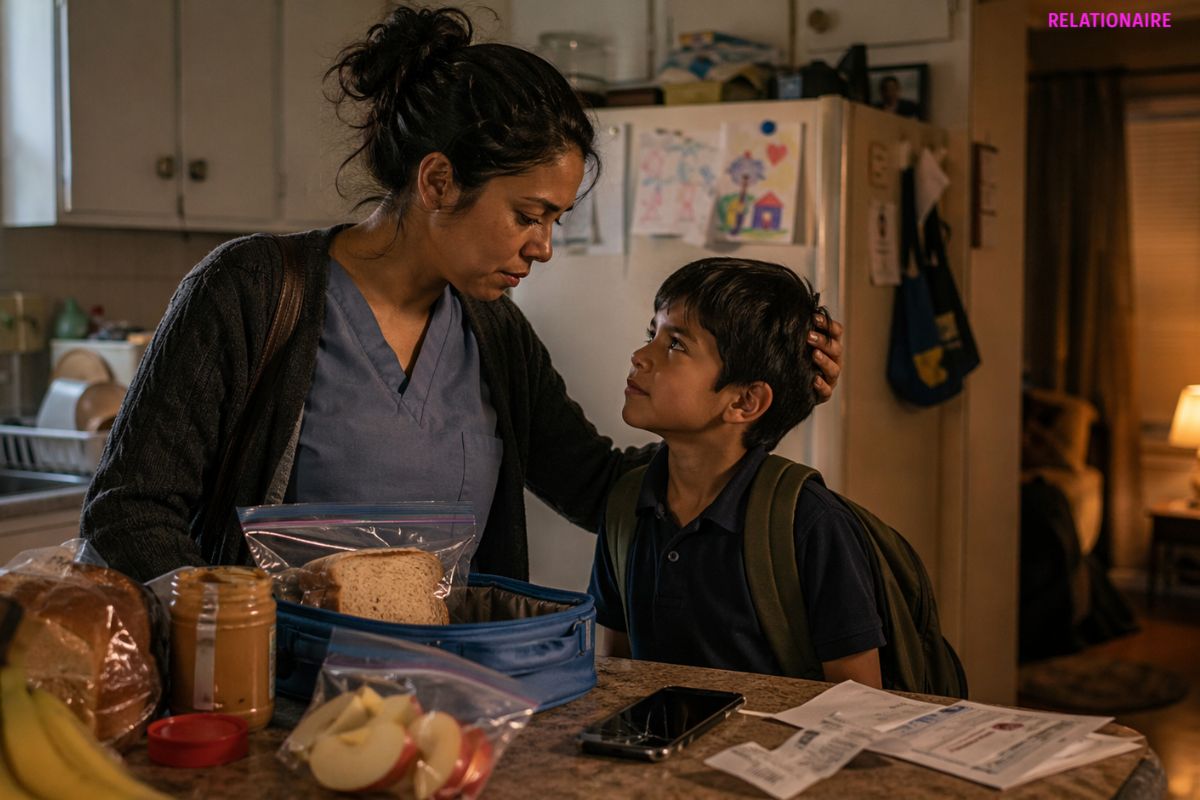
Peanut butter on wheat. Apple slices in a bag. Four crackers she’d counted out while standing barefoot in a cold kitchen at 6:12 in the morning, trying to stretch one loaf of bread through the week.
Her son Mateo was eight, skinny as a rail, always moving, always hungry.
So when she opened the kitchen garbage that night and saw the sandwich folded into a paper towel, untouched except for one bite, something sharp moved through her chest.
“Mateo,” she called.
He was on the living room floor doing math homework with a golf pencil he’d found somewhere. “Yeah?”
“Why is your lunch in the trash?”
He looked up too fast. “I wasn’t hungry.”
She stared at him.
He never wasn’t hungry.
There were nights he scraped the rice pot so hard she thought the spoon would crack. Mornings he asked if there was anything else after cereal, even when there wasn’t much cereal to begin with.
She wanted to ask more, but her phone buzzed with a reminder that the rent was due in five days, and the ache behind her eyes came roaring back.
“Next time, tell me,” she said.
He nodded and went back to his worksheet.
That should have been the end of it.
But it wasn’t just once.
Three days later, she found the apple slices, soft and brown in the bottom of his backpack.
The next week, it was half a ham sandwich wrapped back up in foil.
Then crackers.
Then a cheese stick.
Not all of it. Just enough to make her stomach drop every time.
At first she thought maybe someone at school was giving him snacks. Then she thought maybe he was trying to lose a loose tooth and didn’t want to chew. Then she wondered if he was trying to fit in with other boys who tossed food to look tough or careless or older than they were.
But every afternoon when she picked him up from after-school care, he climbed into the old Corolla with that same hollow look in his face.
Hungry.
Not dramatic-hungry. Real hungry.
The kind that made him quiet for the first five minutes until she handed him the emergency pack of saltines she kept in the glove box.
He’d eat them so fast she had to tell him to slow down.
And still, every morning, she packed a lunch.
Because that was what a mother did when she had almost nothing.
She made sure her child had food anyway.
Marisol worked mornings at a dentist’s office answering phones and afternoons cleaning a church daycare two bus rides away. By the time she picked Mateo up, her back throbbed and her knees felt hot and swollen.
She smiled anyway.
She smiled when the electric bill came.
She smiled when Mateo asked if they could get the cereal with the cartoon tiger and she had to say, “Not this time, baby.”
She smiled when the sole of her right shoe peeled halfway off in the church parking lot and she pushed it back down with duct tape from the janitor’s closet.
She smiled because children noticed more than adults liked to believe.
And Mateo noticed everything.
He noticed when she said she wasn’t hungry and pushed the last tortilla onto his plate.
He noticed when she sat at the kitchen table after he went to bed, adding numbers on the back of grocery receipts.
He noticed when she held her breath before opening the mailbox.
So when the lunch kept coming home half-eaten, it didn’t just feel wasteful.
It felt personal.
Like the one thing she kept managing to do for him was the one thing he didn’t want.
On Thursday afternoon, she stood in the checkout line with a cart that looked more full than it was. Bread. Bananas. Generic cereal. Pasta. Peanut butter. Milk. A bruised pack of grapes marked down with a yellow sticker.
The woman in front of her had two little girls begging for gum, and Marisol watched her toss it onto the belt without checking the price.
She looked down at the total on her own screen climbing higher and started putting things back before the cashier even finished.
The grapes.
The cheese sticks Mateo liked.
The yogurt cups on sale two for one.
When she got home, she unpacked the bags slowly, shoulders tight.
Mateo came in from the bedroom in sock feet. “Did you get the strawberry yogurt?”
She didn’t mean to answer sharply.
“I got what I could get.”
He flinched.
And the guilt hit so fast it almost made her dizzy.
She touched his cheek. “I’m sorry, mijo.”
“It’s okay.”
But it wasn’t okay. None of it felt okay lately.
That night she packed his lunch at the counter while he colored a spaceship at the table. Turkey sandwich. Baby carrots. Half a granola bar in a little bag.
He looked over once, then away.
Something about that made her pause.
“Mateo.”
“Hmm?”
“If you don’t like what I’m packing, you can tell me.”
He kept coloring. “I like it.”
“Then why do you keep bringing it home?”
His crayon stopped moving.
For a second she thought he might answer.
Instead he shrugged. “I just do.”
Marisol let out a breath through her nose. “That’s not an answer.”
He bent lower over the paper.
She looked at the top of his head, at the cowlick that never laid flat no matter how much water she smoothed over it in the morning.
Exhaustion made everything feel louder than it was. The hum of the fridge. The dripping faucet. The scratch of his crayon. Her own heartbeat, hard and irritated and ashamed.
“Do you know how early I get up to make that lunch?”
He didn’t speak.
“Do you know I skip coffee some mornings so I can buy the turkey you like?”
Still nothing.
And then the worst thing of all—he gave that small shrug again, like it didn’t matter.
Something in her snapped.
“Fine,” she said, louder than she meant to. “If you’re going to keep throwing food away, I won’t keep wasting money on lunches you don’t even eat.”
Mateo finally looked up.
His face changed in a way that made her regret it instantly.
Not angry.
Not defiant.
Wounded.
Like she had reached into his chest and grabbed the wrong thing.
“I’m not wasting it,” he said.
His voice was so quiet she almost missed it.
Marisol swallowed. “Then what are you doing?”
He pressed his lips together.
“Mateo.”
His eyes dropped to the table.
She waited.
He said nothing.
That silence made her feel more tired than yelling had.
She turned back to the counter, wrapped the sandwich too tightly, and put the lunchbox in the fridge harder than necessary.
Neither of them said much the rest of the night.
In the morning, he got dressed without being told twice.
At school drop-off, he leaned over from the back seat to kiss her cheek the way he always did, but it was quick, distracted.
She wanted to say, I’m sorry.
She wanted to say, I’m just tired. I’m scared all the time. I’m trying.
Instead she said, “Have a good day.”
He nodded and got out, his backpack hanging crooked off one shoulder.
All day, his face stayed with her.
Not the hurt exactly.
The restraint.
Like he had been holding something in his small body for longer than she understood.
At 3:47, while she was wiping down the toddler tables at the daycare, her phone rang.
The screen said Maple Street Elementary.
Her stomach dropped so fast she had to grip the edge of the table.
“Hello?”
“Ms. Alvarez?” the school secretary said. “Hi, this is Denise from the front office. Mateo is fine, so don’t panic.”
Which, of course, made her panic anyway.
“What happened?”
“There’s no emergency,” Denise said gently. “But the counselor was checking backpacks because one of the students lost an inhaler, and they found something unusual in Mateo’s bag. We think you should come in.”
Marisol’s throat went dry. “Unusual how?”
There was a pause.
Then Denise said, “It looks like he’s been saving pieces of his lunch. Every day. And there are notes in there too.”
Marisol stared at the tiny plastic chairs, at the sunlight on the church floor, at a blue crayon ground into the tile.
“Notes?”
Another pause.
“Yes,” Denise said. “To another child. Ms. White would rather explain in person.”
Marisol’s fingers tightened around the phone.
And for the first time, a terrible thought moved through her—not that Mateo was wasting her food.
That he had been feeding someone else.
Someone she knew nothing about.
Someone who had needed him enough that he’d kept it secret.
She closed her eyes.
“Who?” she whispered.
The secretary lowered her voice.
“It’s about a little boy in his class,” she said. “His father was taken to the hospital yesterday. And Ms. Alvarez…”
Marisol opened her eyes.
“Yes?”
“I think you’re going to want to hear what Mateo wrote in those notes.”
PART 2
By the time Marisol got to Maple Street Elementary, the office was almost empty.
The late buses had already left. The halls were quieter than a school should ever be, all that noise folded away behind classroom doors and janitor carts and fading light.
Mateo was sitting outside the counselor’s office with his backpack in his lap.
The second he saw her, he stood.
She expected fear on his face.
Instead she saw something harder to bear.
Worry.
For her.
Like he thought she might be upset and he was already bracing himself to help carry that.
Marisol crossed the hallway in three quick steps and knelt in front of him.
“Are you okay?”
He nodded.
She touched his hair, his cheek, his shoulder. “Did anyone scare you?”
“No.”
“Did you get in trouble?”
He hesitated. “I don’t know.”
The counselor, Ms. White, opened the door.
“Come in,” she said softly.
Her office smelled like tea and old books. On the low table near the window sat Mateo’s lunchbox, half-open, and beside it a neat stack of folded napkins, sandwich bags, and little square notes written in pencil.
Marisol sat down slowly.
Mateo stayed close enough that his knee touched hers.
Ms. White didn’t rush.
“That missing inhaler turned up in the nurse’s office,” she said. “So this was accidental. But when we opened Mateo’s backpack, we found several lunches divided into separate bags. Some wrapped with notes.”
Marisol looked at her son.
He stared at his shoes.
“Mateo,” she said carefully, “were you giving your food to someone?”
He nodded once.
“Who?”
“Eli.”
The name meant nothing to her at first. Then she remembered a blond boy from the class Valentine’s photo, standing in the second row with a crooked paper heart on his shirt.
“Why didn’t you tell me?”
Mateo twisted the strap of his backpack around his fist. “Because you’d stop.”
The answer was so direct it knocked the breath out of her.
“Stop what?”
“Putting extra stuff in.”
She blinked.
“I wasn’t putting extra stuff in.”
He looked up then, and there was no attitude in his face. Only plain confusion.
“But you always do.”
Marisol opened her mouth, then closed it.
To him, even one apple slice and four crackers might have looked like extra.
Ms. White slid one of the notes across the table.
“I think you should read this.”
The paper was from a little notepad Marisol kept near the phone for grocery lists and message slips. Mateo must have torn off the corners to make them smaller.
She unfolded it.
The handwriting was crooked and careful.
You can eat the crackers first because they don’t get wet.
That was all.
Her vision blurred.
She reached for another.
My mom says juice tastes better if you drink slow.
Another one.
Don’t tell because people get weird when they know things.
The fourth note made her press her hand to her mouth.
It’s okay if your dad is in the hospital. My mom says people come back different sometimes but they still come back.
For a moment, the room disappeared.
All Marisol could see was her own tiny kitchen. Mateo at the table pretending to color while she told her sister on the phone, very late one night, that she was afraid his father wouldn’t stay sober this time.
Afraid he’d drift in and out of Mateo’s life until the boy stopped expecting anything good.
She had thought Mateo was half-asleep.
She had thought he wasn’t listening.
Children noticed everything.
Ms. White spoke gently. “Eli’s father had a medical emergency two nights ago. He collapsed at work. His mother has been with him at the hospital and things have been hard at home this week. Eli hasn’t been bringing much lunch.”
Marisol looked down at the notes.
“He told you this?”
Mateo shook his head. “No. He cried in the bathroom.”
The counselor smiled sadly. “Another student mentioned it. Mateo pieced the rest together.”
Marisol turned to him. “So you gave him your food?”
“He said he wasn’t hungry,” Mateo said.
The words sat between them.
Not dramatic. Not accusing. Just repeated back to her exactly as he’d heard adults say things children were not supposed to understand.
Marisol felt the shame rise hot and sudden.
She had said those same words so many times.
At the sink.
At the table.
At eleven-thirty at night, standing over a pan she pretended she’d already eaten from.
“I’m not hungry.”
And Mateo had believed her enough to copy it.
“He only takes some,” Mateo said quickly, as if trying to protect everybody at once. “I still eat part.”
“I know,” Ms. White said. “You were very thoughtful.”
Mateo frowned. “But am I in trouble?”
That did it.
Marisol reached for him so fast the chair legs scraped the floor.
“No,” she said, and her voice broke. “No, baby.”
He came into her arms stiff at first, then all at once.
He smelled like pencil shavings and playground dust and the grape shampoo she bought when it was on clearance.
She held him against her and closed her eyes.
“I’m sorry,” she whispered into his hair.
“For what?”
For being too tired to see you clearly.
For thinking the worst before I asked the right question.
For forgetting that kindness had been living in this house long enough for you to learn it from the cracks.
But she could not say all that without making him carry her feelings too.
So she just held him tighter.
When they got home that night, the apartment felt smaller than usual.
The sink held two breakfast bowls. A pair of Mateo’s socks lay under the coffee table. The mail sat unopened on the counter.
Ordinary things.
But something had shifted.
Mateo put his backpack down and stood there quietly, watching her.
“Are you mad?”
“No.”
“Even a little?”
She smiled through a face that still wanted to cry. “I’m overwhelmed. That’s different.”
He considered that.
Then he nodded like he understood more than he should.
She crouched in front of him. “Why didn’t you tell the teacher Eli needed food?”
He looked embarrassed.
“Because he’d be ashamed.”
That answer came from somewhere older than eight.
“Did he ask you not to tell?”
“No.”
“Then how do you know?”
Mateo glanced toward the window. “Because when people need something, they make their face normal.”
Marisol sat back on her heels.
The apartment went very still.
When people need something, they make their face normal.
How many times had he seen her do exactly that?
How many mornings had he watched her smiling with unpaid bills in the drawer?
How many dinners had he noticed the empty side of her own plate?
That night she made scrambled eggs and toast for dinner because it was quick and cheap and all she had strength for.
She put equal portions on both plates.
When Mateo looked at hers, she took a bite first.
Big enough for him to see.
He watched her chew.
Something in his shoulders loosened.
After dinner, while he showered, Marisol opened his lunchbox on the counter.
There were crumbs in the corners. A folded napkin. The smell of apples and bread.
She sat down at the table and cried where he couldn’t hear.
Not loud.
Just the quiet kind that bends your body forward and makes you cover your mouth with both hands.
She cried because he had gone hungry with such gentleness.
Because he had learned generosity from scarcity.
Because her boy had seen more of her struggle than she had meant him to.
And because tomorrow morning, there would still be rent, and buses, and work, and groceries that did not stretch far enough.
Kindness did not magically fix any of that.
But it did change the shape of the room.
The next day, Marisol asked Ms. White if the school had a way to help Eli’s family without embarrassing them.
By lunch, she learned there was a weekend food bag program run through the church across the street.
By afternoon, she had signed up to volunteer one Saturday a month, even though she had no idea where she would find the energy.
Maybe because sometimes energy came after the decision, not before.
That evening, she picked Mateo up and he climbed into the car with the usual hollow look.
Without a word, she handed him a banana and the last two crackers from the glove box.
He ate half, then held the rest.
“Can I save some for Eli tomorrow?”
Marisol looked at him in the rearview mirror.
She thought of saying yes immediately.
She thought of saying no, because he was still a child and children should not be solving hunger for each other.
What came out instead was, “Tomorrow, we’ll pack enough for both of you.”
Mateo’s eyes widened. “Really?”
She nodded.
He smiled then.
Not big. Not wild.
Just bright and relieved, like something in him had been waiting for permission to stay soft.
For the first time in weeks, the drive home felt easier.
At a red light, he said from the back seat, “Mom?”
“Yeah?”
“You do that too.”
“Do what?”
“Give people things and don’t tell them.”
She tightened her hands around the steering wheel.
He was looking out the window when he said it, like the truth felt safer that way.
“At church,” he continued. “And when Mrs. Keller upstairs forgot her wallet, and when you left that bag by Mr. Ruiz’s door after his surgery.”
Marisol swallowed.
Those had felt like tiny things. A soup container. A grocery bag. An envelope with twenty dollars and no name on it.
Things done quietly because people deserved dignity.
Things she had not known were being stored away in her son like instruction.
When they got home, there was a message slipped under the apartment door.
Not a bill.
Not a warning.
A folded note from their neighbor, Mrs. Keller, in shaky handwriting.
I heard about what Mateo did for that little boy. Your son has a beautiful heart. You should know where he got it. Check your mailbox.
Marisol stared at the note.
Then she opened the mailbox in the dim hallway.
Inside was an envelope with her name on it.
No return address.
Just four words on the front, written in careful block letters:
For lunches this month.
She froze with her fingers under the flap, suddenly unable to breathe, because for the first time in a very long while, help had arrived before she had asked for it.
And she had no idea how much grace was waiting inside.
PART 3
There were sixty-three dollars in the envelope.
Three twenties, three ones, and a little note folded around them.
Marisol stood in the apartment hallway under the weak yellow light and read it twice before the words settled.
You fed half this building when nobody was looking. Let somebody feed you back. — A friend
For a second she had to lean against the wall.
Sixty-three dollars was not a miracle in the way people used the word.
It would not solve the rent.
It would not fix the check-engine light.
It would not make Mateo’s father suddenly become the kind of man who kept promises.
But sixty-three dollars could buy bread and fruit and turkey and yogurt and enough little things to stop doing division in her head every time she packed a lunch.
Sometimes relief came looking almost small.
Sometimes it was enough to make your knees shake anyway.
When she went back inside, Mateo was on the couch with one sock on, trying to finish a library book before bed.
She tucked the envelope under the dish towels for the moment and sat beside him.
“What are you reading?”
He turned the cover toward her. It was about whales.
“Cool,” she said.
He nodded, then glanced up. “You okay?”
That was becoming his question now.
Her sweet, worried boy.
She took a breath. “I’m okay.”
Then, because she was trying to learn something from him, she added, “Actually, I’m grateful.”
He smiled a little. “For what?”
“For people being kind.”
He thought about that and returned to his book.
The next morning, Marisol went to the grocery store before work with the envelope folded deep in her wallet.
She moved slower than usual.
Not because she suddenly had plenty, but because she did not have to put everything back.
Bread.
Peanut butter.
Two apples.
A bunch of bananas.
Turkey.
Crackers.
A box of granola bars.
Strawberry yogurt.
And because grace has a way of making room for one more thing, she bought a bag of the little chocolate chip cookies Mateo always looked at and never asked for twice.
That afternoon, she packed two lunches side by side on the counter.
Two sandwiches cut in halves.
Two bags of carrots.
Two juice boxes.
Two cookies each.
Mateo stood on a chair beside her, solemn with concentration as he folded napkins.
“For Eli,” he said, writing the name carefully on one paper bag.
Then he looked up. “Should I still do notes?”
Marisol smiled.
“Yes,” she said. “But maybe kinder ones than adults write.”
He grinned.
He wrote for a long time, tongue caught at the corner of his mouth.
When he finished, he folded the note so small it nearly disappeared into his hand.
The next week, things began to move in quiet ways.
The school counselor connected Eli’s mother with the weekend food program.
Mrs. Keller started “accidentally” cooking too much soup on Sundays.
Mr. Ruiz downstairs, still moving slowly after surgery, fixed the loose cabinet hinge in Marisol’s kitchen and refused payment.
At church, the director offered Marisol an extra five hours a week helping with the infant room, not glamorous work but steady.
None of it erased strain.
The rent was still tight.
The car still coughed in the mornings.
She still lay awake some nights doing numbers in the dark.
But the loneliness changed.
That mattered more than she expected.
One Friday, Mateo climbed into the car at pickup with a pink slip in his hand.
Marisol’s heart kicked once.
“Is that from school?”
He nodded.
She braced herself. Missing assignment. Behavior note. Fundraiser she couldn’t afford.
Instead, it was an invitation to a family breakfast the following Thursday: pancakes in the cafeteria, students allowed to bring one grown-up.
“Do you want me to come?” she asked, trying to sound easy about it.
He looked offended. “Obviously.”
She laughed, and for one whole block they felt like a family not standing on a fault line.
Thursday morning she took the late bus to work so she could sit on a folding chair in the school cafeteria eating pancakes that tasted mostly like syrup and steam.
Mateo sat beside her, serious as a businessman, cutting his food into exact squares.
Across the table, Eli sat with his mother.
She looked younger than Marisol expected, with tired eyes and a hospital visitor sticker still stuck to the inside of her purse. There was gratitude in her face, but also embarrassment, the kind that makes people straighten their back too much.
When Mateo and Eli ran off toward the book fair tables, the woman touched Marisol’s arm.
“I’m Jenna,” she said.
“Marisol.”
Jenna’s eyes filled almost immediately. “I didn’t know,” she said. “About the lunches. Eli only told me after the counselor called. He kept saying, ‘Mateo knew before anyone else knew.’”
Marisol looked toward the boys.
Mateo was showing Eli a dinosaur eraser like it was treasure.
“He’s a good kid,” Marisol said softly.
“So is yours,” Jenna answered, and that simple sentence nearly undid her.
Jenna dabbed at her eyes and laughed at herself. “My husband’s doing better now. He’s home, but he can’t work for a while. Everything got scary very fast.”
Marisol nodded.
She understood that kind of speed.
Jenna opened her purse, then stopped. “Eli wanted me to give you this.”
It was one of Mateo’s notes, flattened carefully.
On the back, in uneven pencil, Eli had written his own reply.
My dad came home. Thank you for not making a big deal.
Marisol held the note like it was something breakable.
She thought about all the ways children tried to protect dignity with the tiny tools they had.
A folded napkin.
A half sandwich.
A sentence.
That night, after Mateo fell asleep on the couch with his socks still on and cookie crumbs on his shirt, Marisol carried him to bed.
He was getting long and heavy, all elbows and warm breath and childhood slipping forward faster than she could stand.
When she laid him down, he stirred.
“Mom?”
“I’m here.”
His eyes barely opened. “Did Eli like the cookies?”
She smiled in the dark. “Very much.”
He let out a sleepy little sigh.
Then, with one hand fisted in the blanket, he murmured, “I knew you wouldn’t be mad forever.”
The words went through her like light through a cracked window.
She sat on the edge of his bed and brushed his hair back.
“I shouldn’t have snapped at you,” she whispered.
He was already halfway to sleep.
“It’s okay,” he mumbled.
No.
Not just okay.
Forgiven.
Children did that sometimes before adults felt worthy of it.
A week later, Marisol was cleaning out his backpack when she found a folded receipt tucked in the front pocket.
Not from a store.
From the school breakfast.
On the back, in Mateo’s cramped pencil, were words clearly meant for no one else to see:
When I grow up and my mom is old, I’m going to make sure she eats first.
Marisol sat down at the kitchen table because her legs would not hold her.
The apartment was quiet except for the humming fridge and the distant sound of someone’s television through the wall.
She looked at the receipt for a long time.
All those months she had been afraid her son only noticed what she could not give.
The cheap bread.
The old car.
The tiredness.
The times she said no too quickly because there was no softer way to say it.
But that was not what had stayed with him.
What had stayed was the way she kept dividing what little there was and calling it enough.
The way love moved around the edges of shortage and still found a place to land.
She folded the receipt carefully and slipped it into her wallet behind the bus pass and the grocery coupons.
Years from now, she knew she would still carry it.
Because sometimes the proof that you were loved is not grand.
It is not a speech or a holiday or a perfect life.
Sometimes it is half a sandwich.
A note in pencil.
A mother taking the first bite so her child will know she’s eating too.
And sometimes, if you are very lucky, the kindness you thought was too small to matter comes back to your door wearing your child’s handwriting.
Family love does not always look gentle when you are living inside it.
Sometimes it looks tired.
Sometimes it sounds sharp.
Sometimes it is held together with grocery receipts and bus schedules and one parent trying not to break in front of a child.
But when it is real, it keeps showing up.
And children, even when we think they only see our failures, are often learning love from the quietest things we do.