If you’ve already read part 1 of this story on Facebook, go here for Part 2!
The first time Noah told his teacher he didn’t want to live with his mother anymore, Elise was in the grocery store holding a carton of eggs she could not afford to drop.
Her phone buzzed in her coat pocket.
She looked down and saw the school’s number.
For one tiny, selfish second, she almost let it go to voicemail.
Then she answered.
“Elise?” Mrs. Parker said gently. Too gently. “Do you have a minute?”
Elise glanced at the eggs, the store brand bread, the two cans of soup in her cart, and the crumpled grocery list written on the back of a court document.
“Is Noah sick?”
“No. He’s safe.”
Safe.
That word had become a knife lately.
Mrs. Parker paused.
“He had a hard morning. He pushed another student during recess. When I asked what was wrong, he said…” She stopped again, like she was trying to choose the least damaging version of the truth. “He said he doesn’t want to live with you anyway.”
Elise closed her eyes.
The grocery store kept moving around her.
A cart wheel squeaked. A toddler cried near the cereal aisle. Somewhere, an employee announced a sale on rotisserie chicken.
Elise held the eggs with both hands.
“What exactly did he say?”
Another pause.
“He said, ‘My mom doesn’t even like me anymore.’”
For a moment, Elise could not speak.
Because the terrible thing was, she understood why he thought that.
For three weeks, she had been living with her jaw clenched.
Three weeks of calls from her attorney during dinner. Three weeks of court forms spread across the kitchen table where Noah used to build Lego cities. Three weeks of whispering in the hallway with her mother, then stopping when Noah walked by.
Three weeks of saying, “Not now, baby.”
Three weeks of “I said brush your teeth.”
Three weeks of “Please don’t start.”
Three weeks of forgetting to laugh.
And Noah, who was seven and still slept with one sock on and one sock off, had noticed all of it.
That afternoon, when Elise picked him up from school, he climbed into the back seat without looking at her.
His backpack thumped against the floor.
“Buckle up,” she said.
He did, hard enough that the buckle snapped like he was angry at the car.
Mrs. Parker stood near the school doors with her arms folded, not judging exactly, but watching.
Elise felt the eyes of other parents too.
She imagined what they saw.
A tired mother in the same black pants she’d worn yesterday.
A little boy with untied shoes and a red mark on his cheek from pressing his face into his desk.
A woman too sharp with her child.
Maybe they were right.
Halfway home, Noah kicked the back of her seat.
“Stop,” Elise said.
He kicked again.
“Noah.”
Kick.
“Noah, I mean it.”
“I don’t care.”
The words were small, but they filled the car.
Elise gripped the steering wheel.
“You don’t care about what?”
“Anything.”
She pulled into the apartment parking lot and turned off the engine. Rain tapped lightly against the windshield, making the whole world look blurry.
“Noah, look at me.”
He stared out the window.
“Noah.”
“I don’t want to live here,” he said.
Elise felt something inside her sink.
Their apartment was not much. Second floor. Thin walls. A kitchen drawer that stuck. A heater that rattled before it worked. A couch with a blanket covering the tear in the arm.
But it was theirs.
She had fought to keep it.
She had worked double shifts to keep it.
She had skipped lunches and smiled at landlords and signed payment plans with trembling hands to keep it.
Still, all Noah saw was the mother who snapped when he spilled milk.
The mother who fell asleep during his dinosaur documentary.
The mother who no longer got down on the floor to draw aliens and rocket ships with him.
He finally turned toward her.
His eyes were wet, but angry too.
“Daddy says you’re always tired because you don’t want me.”
Elise went still.
There it was.
The sentence she had been afraid of.
Her ex-husband, Marcus, had always been careful around adults. Polite. Calm. The kind of man who said hurtful things softly so other people thought he was reasonable.
In court papers, he called Elise unstable.
Overworked.
Emotionally unavailable.
Unable to provide a consistent home environment.
In person, he called her “dramatic” whenever she cried.
And now Noah was using words that did not belong to him.
Elise swallowed hard.
“That is not true.”
Noah crossed his arms.
“You don’t play anymore.”
“I’ve been busy.”
“You don’t laugh anymore.”
That one hit harder.
Because she had not noticed.
At least, not until he said it.
Elise looked at her son in the rearview mirror. His hair was sticking up on one side. His lower lip trembled with the effort of staying mad.
“I’m trying to make sure we’re okay,” she said.
“You always say that.”
“Because I am.”
“No, you’re not.” His voice cracked. “You’re just mad all the time.”
She turned around then.
“Noah, I am doing everything I can.”
He flinched.
Not because she yelled.
Because she sounded like she might break.
For a second, they stared at each other in the quiet car.
Then he grabbed his backpack, shoved the door open, and ran through the rain toward the apartment stairs.
Elise sat there with the keys in her lap until her phone buzzed again.
A text from her attorney.
Reminder: hearing tomorrow at 9:00. Bring all documents, income records, school notes, and communication logs.
Elise looked up at the apartment window.
Noah’s bedroom light was already on.
She wanted to go upstairs and sit beside him. She wanted to say, I’m sorry I’ve been different. I’m sorry grown-up fear made me forget how small you are.
But there were documents to organize.
There were screenshots to print.
There were pay stubs to find.
There was a custody hearing in the morning.
So she went upstairs, made him grilled cheese, burned one side, cut it into triangles anyway, and placed it beside him at the small kitchen table.
He did not eat.
He drew instead.
Hard, angry lines with a blue crayon.
“What are you drawing?” she asked.
“Nothing.”
“Noah.”
“I said nothing.”
She should have sat down.
She should have looked.
Instead, her phone rang again.
Her attorney.
Elise stepped into the hallway with one hand over her ear and said, “Yes, I found the school attendance records. No, I don’t have the childcare receipts before March. I can check again.”
When she came back, Noah was gone from the table.
The blue crayon had rolled onto the floor.
The next morning, Elise woke before the alarm.
The apartment was gray and cold.
She dressed in her only good blouse, the cream one with a tiny coffee stain near the cuff. She tied her hair back so tight her scalp hurt. She checked on Noah, who was asleep curled around his stuffed turtle, one hand tucked under his cheek.
For the first time in weeks, he looked peaceful.
Her mother arrived at 7:15 to take him to school.
Noah would not hug Elise goodbye.
He stood in the kitchen with his backpack on and stared at her court folder.
The black one.
The one she had been carrying like a shield.
“Are you going to tell them I’m bad?” he asked.
Elise froze.
“What?”
“At court.”
Her mother looked away.
Elise crouched in front of him.
“No, baby. Never.”
“But I got in trouble.”
“That doesn’t make you bad.”
He stared at the floor.
“Then why do you write everything down?”
Elise did not have an answer that a seven-year-old could carry.
So she touched his sleeve and whispered, “Because grown-ups make things harder than they should be.”
He pulled his arm away.
Then he walked out with her mother.
No goodbye.
No hug.
Just the sound of his sneakers on the stairs.
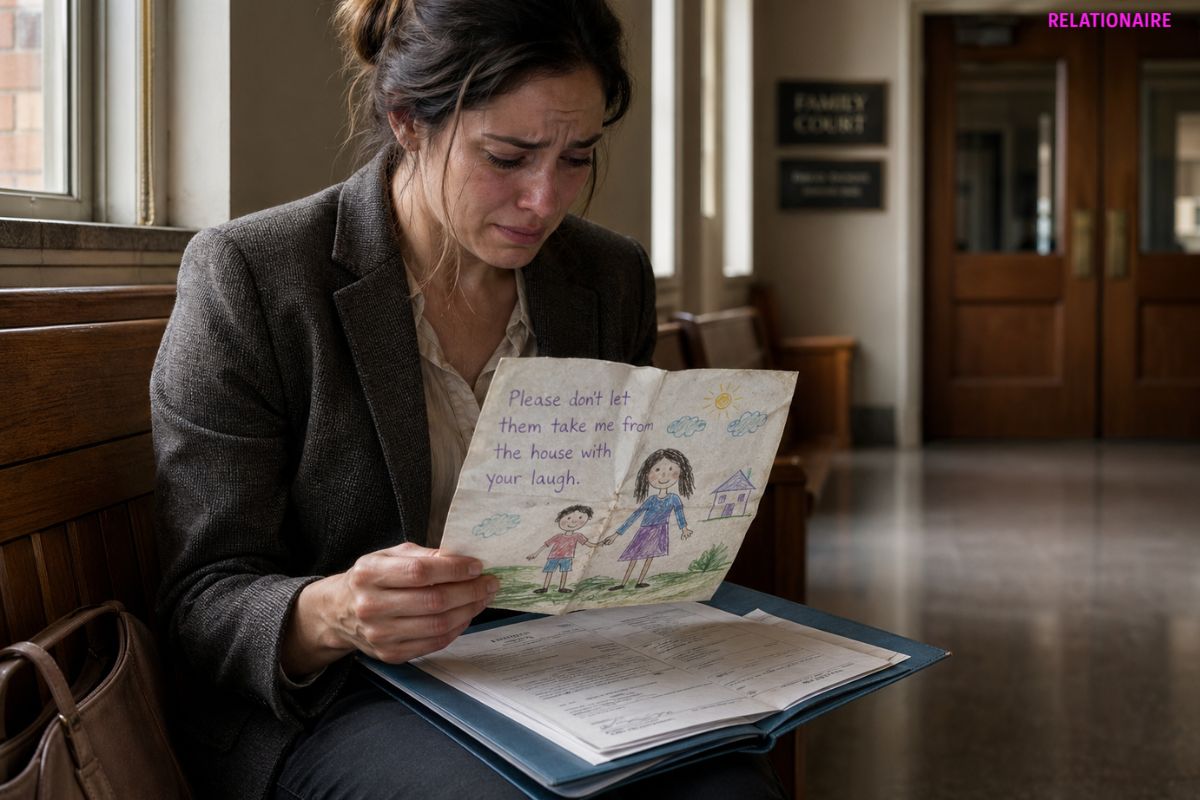
By 8:42, Elise sat on a wooden bench outside Courtroom 3B with her folder in her lap.
Her attorney was late.
Marcus sat across the hall in a navy suit, clean-shaven, calm. He nodded at her like they were two coworkers waiting for a meeting.
Elise looked down because if she looked too long, she might cry, and she could not afford to cry in front of anyone today.
She opened the black folder to check the documents one more time.
Income records.
Lease agreement.
School emails.
Medical forms.
Printed texts.
Her hands shook as she lifted the first stack.
Then something slipped loose and fluttered to the floor.
A folded piece of paper.
Not legal paper.
Not white.
Construction paper.
Pale yellow, creased down the middle.
Elise stared at it.
A blue crayon mark showed through the fold.
Her breath caught.
She bent down slowly and picked it up.
Across the hall, Marcus looked over.
The courtroom door opened.
“Elise Walker?” the clerk called.
Her attorney hurried down the hall, whispering, “That’s us.”
But Elise did not move.
Because she had just unfolded the paper.
And there, in blue and green and shaky red crayon, was a drawing of two people holding hands in front of a small crooked house.
Underneath, in Noah’s uneven seven-year-old letters, was one sentence.
“Please don’t let them take me from the house with your laugh.”
PART 2
Elise forgot how to stand.
For three weeks, she had thought her son was pulling away from her.
For three weeks, she had heard his angry words and believed them because exhaustion has a cruel way of making every fear sound true.
I don’t want to live here.
You’re always mad.
You don’t laugh anymore.
My mom doesn’t even like me.
She had taken those words like evidence against herself.
Now she sat on the court bench with the folded drawing trembling in her hands and realized he had been trying to say something else.
Not I don’t want you.
But I’m scared you’ll disappear.
Not I hate this home.
But I’m afraid someone will decide it isn’t mine anymore.
Not you don’t love me.
But I can’t find the mother I know.
Her attorney touched her shoulder.
“Elise. We need to go in.”
Elise looked up.
“I didn’t know,” she whispered.
Her attorney’s expression softened when she saw the paper.
Across the hall, Marcus stood and adjusted his jacket.
“Elise,” the attorney said gently, “bring it.”
The courtroom was smaller than Elise expected.
No dramatic witness stand. No movie-like shouting. Just a judge, two tables, fluorescent lights, and the strange coldness of a place where families were discussed in files.
Elise sat on one side.
Marcus sat on the other.
The drawing lay inside her folder now, tucked between her lease and Noah’s school report, like a tiny heartbeat hidden among proof.
The hearing began with schedules.
Pickups.
Overnights.
Work hours.
School distance.
Words that sounded clean until they touched real life.
Marcus’s attorney spoke first.
He described Marcus’s home as stable. Two bedrooms. A fenced yard. A flexible work schedule.
Then he described Elise’s home.
Small apartment.
Irregular shifts.
Recent school behavior concerns.
Emotional strain.
“Elise Walker loves her son,” the attorney said, in a tone that made the words feel like a courtesy before the wound. “But love alone does not create stability.”
Elise stared at the table.
Love alone.
The phrase rang in her ears.
Was that all she had?
Love and late rent.
Love and boxed pasta.
Love and a couch blanket hiding a tear.
Love and a laugh she had somehow misplaced.
When it was Marcus’s turn to speak, he was calm.
That had always been his gift.
He said Noah needed consistency.
He said Noah had expressed discomfort at Elise’s apartment.
He said Noah had told multiple people he didn’t want to live with her.
Elise felt the courtroom shift around those words.
There it was again.
Her son’s pain turned into a weapon neither of them knew how to hold.
She wanted to shout, He is seven. He says he hates broccoli and then cries when it falls on the floor.
But she stayed still.
The judge took notes.
Marcus continued.
“I’ve tried to be respectful. But Noah is acting out because he doesn’t feel secure. I think the best thing is for him to live primarily with me.”
Elise pressed her nails into her palm.
Primarily.
Such a tidy word for missing bedtime.
Such a tidy word for his toothbrush no longer beside hers.
Such a tidy word for coming home to an apartment where the silence had his shape.
Then the judge looked at Elise.
“Ms. Walker, would you like to respond?”
Her attorney leaned close.
“Stick to facts,” she whispered.
Facts.
Elise had brought facts.
Pay stubs.
Attendance records.
A calendar of meals, pickups, doctor visits.
Screenshots showing Marcus canceling weekends.
Receipts for shoes, medicine, school supplies.
She had spent nights building a paper wall to prove she was a good mother.
But suddenly the facts felt too small.
Not useless.
Just incomplete.
She opened her folder.
Her fingers touched the drawing.
She thought of Noah standing in the kitchen that morning.
Are you going to tell them I’m bad?
And she understood then.
He had seen her writing.
He had seen the folder.
He had watched his mother collect every hard moment and thought she was collecting proof against him.
The pushing at school.
The angry words.
The uneaten dinner.
The slammed bedroom door.
He thought she was taking his worst days to court.
Elise’s throat tightened.
She looked at the judge.
“My son has been angry,” she said.
Her voice shook, but she kept going.
“He has been scared. And I misunderstood some of that fear because I was scared too.”
Marcus shifted in his chair.
Elise did not look at him.
“I have been under stress. That’s true. I work long hours. That’s true too. And I have not always handled it the way I wish I had.”
Her attorney went very still beside her.
“But Noah is not unstable. He is not difficult. He is not a problem to solve.”
The judge’s pen paused.
“He is a little boy who heard adults talking about where he belongs and started wondering if belonging was something he could lose.”
The room went quiet.
Elise reached into the folder and pulled out the yellow construction paper.
“I found this in my folder this morning. He must have slipped it in last night.”
Marcus’s eyes narrowed slightly.
Elise unfolded it, careful not to tear the crease.
“I know this is not legal evidence,” she said. “Maybe it doesn’t belong here. But I think it explains something better than I can.”
The judge extended a hand.
Elise gave the drawing to the clerk, who carried it forward.
The judge read it.
Her face did not change much, but her hand softened on the paper.
“Please don’t let them take me from the house with your laugh,” she read aloud.
Elise looked down.
Hearing the words in that room nearly broke her.
Because she could hear Noah in them.
His missing front tooth.
His serious face when he tried to spell big feelings.
His belief that a house could be made safe by one sound.
Marcus looked away.
For the first time all morning, he did not look calm.
The judge asked, “Ms. Walker, what do you think he meant by this?”
Elise wiped under one eye quickly.
“I think he meant he’s afraid of losing both homes,” she said. “But especially the part of mine that feels like me.”
She swallowed.
“And I think I made him afraid because I stopped being myself around him.”
Nobody spoke.
So she continued.
“When Noah was little, he used to hide behind the couch and throw socks at me. I would pretend I didn’t know where he was. He would laugh so hard he’d hiccup. We called it the sock monster game.”
A small, sad smile moved across her face.
“We haven’t played in weeks.”
The courtroom stayed quiet.
“I thought protecting him meant handling everything where he couldn’t see. But all he saw was that I was tired and sharp and writing things down. He thought I was building a case that he was bad. I was trying to keep him. And somehow I made him feel like he had to ask not to be taken.”
The judge looked at Marcus.
“Mr. Reed?”
Marcus cleared his throat.
His attorney leaned toward him, but he lifted a hand slightly.
“Noah told me he didn’t want to live with her,” Marcus said.
His voice was quieter now.
“I believed him.”
Elise turned.
For once, she did not see the man from the court papers.
She saw Noah’s father.
Flawed. Proud. Hurt. Afraid too.
Marcus looked at the drawing on the judge’s desk.
“I may have… asked him too many questions.”
Elise closed her eyes.
There it was.
Not a confession big enough for movies.
But enough for a mother’s chest to crack open.
The judge ordered a short recess.
Elise stepped into the hallway with her attorney, but she could barely hear what was being said.
Her mind was at school.
Noah in his classroom.
Noah wondering whether the folded drawing had been found.
Noah believing a judge might decide whether he still got to hear his mother laugh in the kitchen.
Marcus came out a minute later.
He stood a few feet away, hands in his pockets.
For a long time, neither of them spoke.
Then he said, “I didn’t know he wrote that.”
Elise looked at him.
“You knew he was scared.”
Marcus flinched.
She expected him to argue.
Instead, he looked toward the courtroom doors.
“I thought if I got more time, he’d be okay.”
“And if I lost him?”
His jaw tightened.
“That’s not what I meant.”
“But it’s what you asked for.”
The words sat between them.
Not cruel.
Just true.
Marcus rubbed both hands over his face.
“He asked me last week if your apartment would still have his dinosaur sheets if he moved.”
Elise’s breath stopped.
“You didn’t tell me?”
“I thought he was asking because he wanted to leave.”
“No.” Elise’s voice broke. “He was checking if he could still come home.”
Marcus looked at her then.
Really looked.
And whatever fight had carried them into that courthouse seemed, for one moment, smaller than the boy standing unseen between them.
The courtroom door opened again.
The clerk called them back.
Elise picked up her folder.
This time, the drawing was on top.
Not hidden.
Not folded away.
And as she walked back into the room, she knew the hearing might decide custody.
But what happened next would decide whether Noah spent the rest of his childhood thinking love was something adults could argue him out of.
PART 3
The judge did not make a dramatic speech.
Real life rarely gives families clean lines at the exact moment they need them.
She spoke carefully.
She said both parents clearly loved Noah.
She said the conflict between them was beginning to harm him.
She said children should never feel responsible for adult fear.
Then she made a temporary order.
Noah would remain primarily with Elise during the school week.
Marcus would have expanded weekend time.
Both parents would attend a co-parenting session.
Neither parent was to question Noah about where he wanted to live or use his words in court without professional guidance.
The judge looked at both of them when she said that.
Elise nodded.
Marcus nodded too.
But the part that stayed with Elise came at the end.
The judge slid the drawing back across the desk.
“Keep this somewhere safer than a court folder,” she said.
Elise held the paper to her chest.
Outside the courthouse, rain had started again.
Marcus stood beside her under the awning.
For years, silence between them had meant anger.
This silence felt different.
Tired.
Ashamed.
Maybe honest.
“I shouldn’t have said those things around him,” Marcus said.
Elise watched the rain hit the steps.
“No. You shouldn’t have.”
“I was angry.”
“I know.”
“That’s not an excuse.”
“No.”
He nodded slowly.
Then he said, “You used to laugh all the time.”
Elise almost snapped back.
Something sharp rose automatically, because old hurt is always ready.
But then she looked down at the drawing in her hands.
Two stick figures.
One crooked house.
A sentence too heavy for a child.
“I know,” she said.
Marcus exhaled.
“I don’t want him thinking he has to choose.”
Elise looked at him.
“Then we stop making him feel chosen is the same as stolen.”
For the first time in a long time, Marcus had no answer.
That afternoon, Elise picked Noah up from school herself.
She saw him before he saw her.
He was sitting on the curb near the pickup line, backpack hugged to his chest, his stuffed turtle sticking halfway out of the zipper even though he always claimed he was too old to bring it.
Mrs. Parker stood nearby.
When Noah spotted Elise, he froze.
His eyes went straight to her hands.
The folder.
He looked terrified of it.
Elise’s chest ached.
She crouched beside him right there on the wet sidewalk, even though her good pants touched a puddle.
“Hey, bug.”
He did not answer.
She took the yellow paper from the folder and held it out gently.
“I found your drawing.”
His face changed.
Not relief.
Not yet.
First came panic.
“Are you mad?”
Elise shook her head.
“No.”
“Did the judge see it?”
“Yes.”
He stared at his shoes.
“Was I in trouble?”
That question nearly undid her.
She reached for his hands, then stopped, giving him the choice.
After a moment, he put his small fingers in hers.
“Noah, listen to me. You are not in trouble for being scared. You are not in trouble for being sad. You are not in trouble for saying angry things. Grown-ups are supposed to help you carry big feelings, not make you hide them.”
His lip began to tremble.
“I didn’t mean I don’t want to live with you.”
“I know.”
“I just thought…” He swallowed. “I thought if I said it first, it wouldn’t hurt as bad if they made me go.”
Elise closed her eyes.
There it was.
The deeper truth in a child’s logic.
Say the heartbreak first.
Pretend it was your idea.
Maybe then it won’t crush you.
She pulled him into her arms.
He came stiffly at first, then all at once, collapsing into her coat with a sound that was not quite a sob and not quite a breath.
“I’m sorry I got mad,” he cried.
“I’m sorry I got so quiet,” she whispered into his hair.
“You didn’t laugh.”
“I know.”
“I thought I broke it.”
Elise held him tighter.
“Oh, baby. You did not break my laugh.”
He cried harder then, like that had been the fear underneath everything.
Not court.
Not school.
Not apartments or schedules.
His mother’s laugh.
The proof that home was still home.
Mrs. Parker wiped her cheek and pretended to look at the buses.
That night, Elise did not open the court folder.
Not once.
She put it on top of the refrigerator, where Noah could see it was away from the table.
Then she made spaghetti.
Not good spaghetti. The cheap kind, with sauce from a jar and too much garlic powder because Noah dumped it in while trying to help.
They ate at the kitchen table.
For the first few minutes, neither of them knew how to be normal.
Noah twirled noodles around his fork and glanced at her, like he was checking the weather inside her face.
Elise noticed.
So she picked up one long noodle, held it under her nose like a mustache, and said in a deep voice, “Good evening, sir. I am Professor Spaghetti.”
Noah blinked.
Then he let out one startled laugh.
Small.
Careful.
But real.
Elise kept the noodle mustache in place.
“I have come to inspect this apartment for suspicious turtles.”
Noah’s mouth twitched.
“Mom.”
“What? Is there a turtle here?”
“No.”
She looked slowly at his backpack.
The stuffed turtle’s head peeked out.
Noah followed her eyes.
Then he laughed again.
This time, it cracked open the room.
It was not a huge laugh.
It did not erase the court hearing.
It did not pay the bills or fix the custody schedule or make Elise suddenly less tired.
But it changed the air.
Noah slid off his chair, ran to the couch, grabbed two socks from the laundry basket, and stood behind the torn armrest.
Elise froze.
One sock flew over the couch and hit her shoulder.
Then another.
A tiny voice shouted, “The sock monster is back.”
Elise covered her mouth.
For one second, she saw all the evenings she had missed while trying to save the life they were standing inside.
Then she gasped dramatically.
“Oh no. Not the sock monster.”
Noah ducked, giggling.
She stood slowly, grabbed a dish towel like a cape, and tiptoed toward the couch.
“Where could he be?”
Noah’s laugh filled the apartment.
There it was.
The sound he had been trying to protect.
The next few months were not perfect.
Marcus came late once and apologized instead of blaming traffic.
Elise forgot a school form and cried in the car afterward, but that night she told Noah, “I messed up today,” and he said, “That’s okay, grown-ups can have big feelings too.”
They went to the co-parenting sessions.
Some were awkward.
Some were painful.
In one of them, Marcus admitted he had been afraid Noah would grow up closer to Elise because she had always known how to make ordinary things feel warm.
Elise admitted she had been so busy proving she was strong that she had stopped letting anyone see she needed help.
No one became perfect.
But they became more careful.
And careful, in a wounded family, can be a kind of love.
The yellow drawing was framed in a cheap white frame from a discount store.
Elise hung it in the hallway near the kitchen, low enough for Noah to touch.
For years, visitors thought it was just a child’s drawing.
A crooked house.
Two stick people.
Big hands.
Bad spelling.
They did not know it had once sat in a court folder between pay stubs and custody papers.
They did not know it had stopped two angry adults long enough to remember the child between them.
They did not know it had taught Elise that children do not always ask for love in clear words.
Sometimes they misbehave.
Sometimes they say the thing they don’t mean.
Sometimes they push, slam, refuse, hide, or draw one sentence in blue crayon because their hearts are too small to hold adult fear.
Years later, when Noah was taller than Elise and his voice had changed, he found the drawing still hanging there.
He laughed softly.
“I spelled laugh wrong,” he said.
Elise stood beside him, holding a basket of laundry.
“You spelled the important part right.”
He looked at her.
Then, almost shyly, he reached out and squeezed her hand.
Not long.
Just enough.
The way children do when they are older and still need you, but don’t know how to say it without feeling small again.
Elise squeezed back.
The apartment was quieter now.
The couch had been replaced.
The folder was long gone.
But the drawing stayed.
Because some homes are not saved by winning.
Some are saved by finally hearing what the smallest person in the room was trying to say.
And sometimes love is not the loud promise that nothing will ever change.
Sometimes it is a tired mother learning to laugh again, so her child knows there is still a place in the world where he belongs.