If you’ve already read part 1 of this story on Facebook, go here for Part 2!
By the third inning, everybody in the bleachers knew my grandfather was mine.
Not because he was sitting close to my mom.
Not because he wore my old Little League cap, the one with the bent brim and faded eagle stitched crooked across the front.
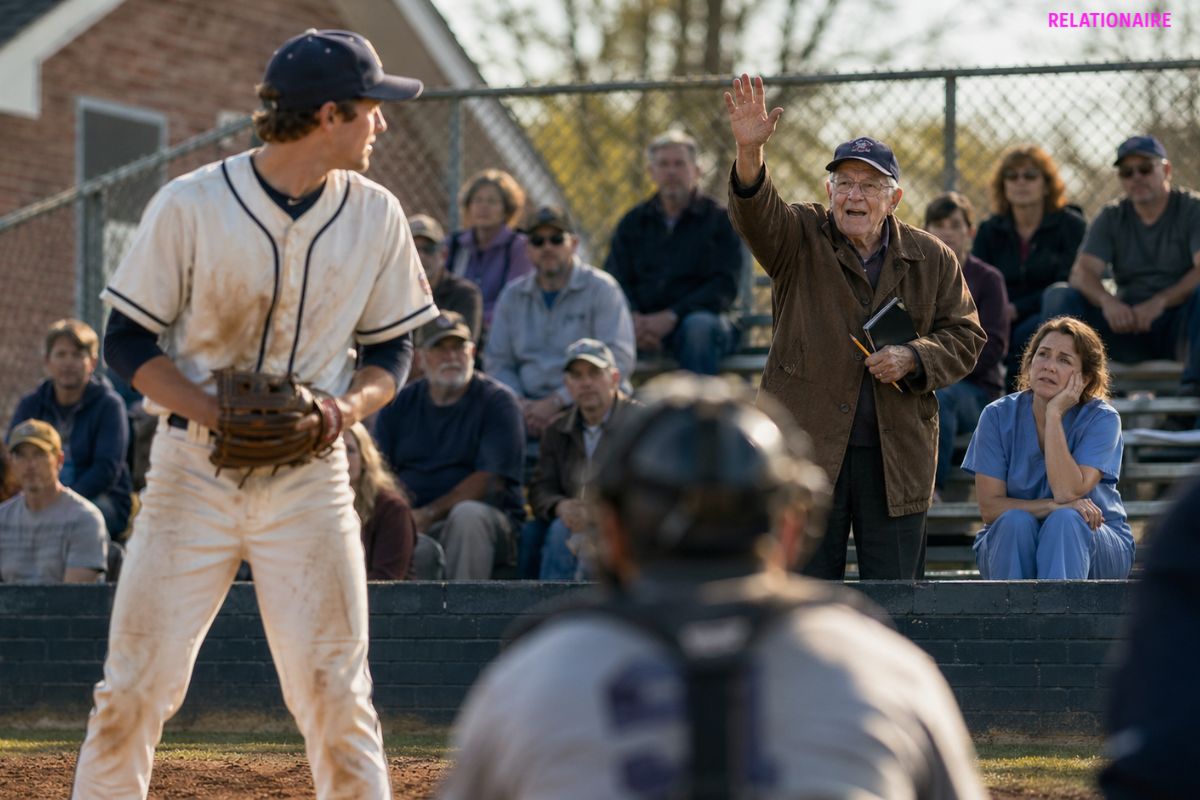
Because every time I threw a pitch, he stood up in that ancient brown coat and shouted the wrong thing.
“Kick it hard, Eli!”
The first time, a few parents laughed.
The second time, my catcher turned his face into his glove.
By the third time, one of the boys from the other dugout yelled, “This ain’t soccer, Grandpa!”
I felt my face burn under my cap.
I was sixteen. Varsity. Starting pitcher. Scouts from the community college were supposed to be there that day, or at least that was what Coach Merrill had said to keep us serious. I had spent all week thinking about my arm slot, my curveball, my breathing.
And then there was Grandpa Joe, sitting right behind home plate in a coat older than some of the parents, yelling like I was still five years old chasing a plastic ball in the backyard.
“Run, Eli! Run!”
I wasn’t running. I was standing on the mound.
Mom looked over at him gently. She touched his sleeve. He sat down for a minute, smiling like he’d just done something wonderful.
Then, when I struck the next batter out, he leapt back up.
“That’s my boy! Good goal!”
The whole left side of the bleachers laughed that time.
I hated them for laughing.
Then I hated him for giving them a reason.
When I got back to the dugout, my best friend Caleb tried to make it lighter.
“Your grandpa’s got spirit,” he said.
“Shut up.”
He did.
I could feel Grandpa still watching me from the bleachers. I didn’t look over. I kept my glove in front of my face like it could hide me from my own family.
The thing was, Grandpa Joe had not always been like that.
When I was little, he was the strongest person I knew. He built our back porch steps after Dad left. He taught me how to tie my cleats, even though he tied them with double knots so tight I needed scissors. He used to toss balls to me in the driveway until the sun went down and Mom stood at the kitchen door saying, “Daddy, let him come inside before his arm falls off.”
He would wink at me and whisper, “One more.”
Always one more.
Back then, he knew every rule. Every player. Every story. He could listen to a game on the radio and tell you what the pitcher should throw next. He could watch my stance for half a second and say, “Your front shoulder’s flying open.”
Now he called strikes “points.”
He called my glove a “basket.”
He once asked the umpire why nobody was wearing helmets “on the grass part.”
At first, I laughed with everyone else because it felt safer than being scared.
Then I stopped laughing.
Because people at school noticed.
Because the boys on the team noticed.
Because I was trying to become somebody, and Grandpa kept showing up like proof that I was still a little kid with a family that didn’t quite fit in.
We didn’t have matching folding chairs or those personalized baseball blankets other parents brought. Mom worked double shifts at the pharmacy and came to games in her blue scrubs when she could. My cleats had a crack across the right toe. Our car made a high whining sound when it started.
And Grandpa always wore that coat.
Brown. Heavy. Too warm for spring. One missing button near the collar. The left pocket sagged because he stuffed it with peppermints, pencils, and folded napkins he swore he needed.
When the game ended that day, we had won by one run.
I should have been happy.
I had struck out nine.
Coach clapped my shoulder and said, “Good work, Hale. Keep your head steady like that.”
For about four seconds, I felt tall.
Then I heard him.
“My Eli won the touchdown!”
Somebody behind me snorted.
I turned around.
Grandpa was walking toward me with that wide, proud smile, his arms slightly open like he wanted to hug me right there in front of everyone.
I stepped back before he reached me.
His smile faltered.
Not gone. Just smaller.
“Good game, kiddo,” he said.
I looked at the ground. “Thanks.”
He held out a peppermint.
I didn’t take it.
Mom saw. Her mouth tightened.
“Eli,” she said quietly.
“What?”
Grandpa lowered his hand and tucked the candy back into his pocket.
“I saved it from the restaurant,” he said, like that explained everything. “The soft kind. Your favorite.”
“It’s fine,” I muttered.
But it wasn’t fine.
Everything in me felt hot and embarrassed and tired. I had worked so hard not to be the boy people felt sorry for. Not the kid whose dad didn’t come. Not the kid whose mom counted coupons in the grocery line. Not the kid whose grandpa shouted nonsense from behind home plate.
On the ride home, nobody said much.
Mom drove. Grandpa sat in the back because he said he liked the view better there. His scorebook sat on his lap. He kept one hand pressed over it.
At a red light, he leaned forward.
“Did Eli pitch today?” he asked.
The car went quiet.
Mom’s fingers tightened around the steering wheel.
I stared out the window.
“Dad,” she said softly, “we just came from his game.”
“Oh,” Grandpa said.
I could see his reflection in the window. He looked down at the scorebook on his lap, blinking slowly, like he was trying to find a door in his own mind and couldn’t remember where he’d put the key.
Then he smiled again, smaller than before.
“Well,” he said, “I bet he did good.”
Something in Mom’s face broke for half a second.
I saw it. Then she fixed it.
“He did,” she said. “He did really good.”
When we got home, Grandpa went to his room to lie down. Mom started heating leftovers. I stood in the kitchen, still in my uniform, gripping my cap so hard the brim bent.
“You have to tell him to stop coming,” I said.
Mom turned from the stove.
She looked more exhausted than angry. Her hair was slipping from its clip. There was a pharmacy receipt stuck to the bottom of her shoe. She had probably not eaten since breakfast.
“What did you say?”
“I said you have to tell Grandpa to stop coming to my games.”
She stared at me.
“Eli.”
“I mean it.” My voice cracked, which made me angrier. “He doesn’t even know what’s happening. He yells weird stuff. Everyone laughs. I can’t focus.”
Mom turned the burner off.
“That man has been at almost every game you’ve ever played.”
“Yeah, and now he doesn’t even remember them.”
Her face changed.
I knew I had said the wrong thing, but I didn’t take it back.
Because part of me meant it.
Because part of me hated that he could forget things I needed him to remember.
Mom wiped her hands on a dish towel. She walked closer, but not too close.
“You think this is easy for him?”
“I think it’s embarrassing.”
The second the word left my mouth, I wished I could grab it and shove it back down my throat.
Mom looked past me toward Grandpa’s closed bedroom door.
When she spoke again, her voice was low.
“Your grandfather sold his truck so you could play travel ball two summers ago.”
I froze.
“What?”
She shook her head once, like she had not meant to say it. Like the truth had slipped out because she was too tired to hold it.
“He told me never to tell you.”
My chest tightened, but pride made me hard.
“That doesn’t mean he has to come and make everybody laugh at me.”
Mom’s eyes filled, but she did not cry.
“No,” she said. “Maybe it doesn’t.”
She walked to the hallway and picked up Grandpa’s old brown coat from the chair where he had left it. One of the pockets was turned slightly inside out.
Something fell from it.
A small black notebook.
It hit the floor and opened near my cleats.
Mom bent quickly, but I was closer.
On the first page, written in Grandpa’s shaky handwriting, were the words:
Eli’s games. Don’t forget. Important.
Mom whispered, “Eli, don’t.”
But I was already staring down at the open notebook.
And underneath today’s date, written three times in dark pencil, were the words:
Ask him if he is proud of me.
PART 2
I didn’t pick up the notebook at first.
I just stood there in the kitchen with my cleats leaving little half-moon dirt marks on Mom’s linoleum, staring at those words like they had been written by somebody else’s grandfather.
Ask him if he is proud of me.
Not, Tell him I’m proud.
Not, Eli pitched well.
Not, Remember baseball terms.
Ask him.
Like Grandpa had been afraid to forget the question.
Mom reached down and closed the notebook softly.
“Give it to me,” she said.
Her voice wasn’t sharp. That made it worse.
I handed it over.
For a long second, neither of us moved. The leftover spaghetti sat cooling on the stove. The house smelled like tomato sauce and old coffee. From down the hall, Grandpa’s TV murmured quietly, though he was probably asleep already.
“How long?” I asked.
Mom held the notebook against her chest.
“How long what?”
“How long has he been writing stuff down?”
She looked at me, and I knew from her face that the answer was going to hurt.
“A while.”
That was how adults said things when the truth was too heavy for a kitchen.
I pulled out a chair and sat down.
Mom sat across from me. For once, she looked less like my mother and more like someone’s daughter. Small. Tired. Scared.
“Last year,” she said, “he forgot where he parked at the grocery store. Then he forgot he’d already bought milk and came home with three gallons. Then he started calling me by your grandma’s name sometimes.”
Grandma had died when I was six. I mostly remembered her hands and her laugh.
“He didn’t want you to know,” Mom continued. “He said you had enough on you.”
I almost laughed, but nothing came out.
I was sixteen. My whole life felt like pressure. Grades, pitching, workouts, trying not to care that Dad sent birthday texts two days late and called it effort. I thought nobody understood that.
But Grandpa had been losing pieces of himself and still worrying about what was on me.
Mom opened the notebook again, but she kept it turned toward herself.
“There are rules,” she said. “Doctor’s appointments. Names. Directions to the ball field. Your schedule. Things you like. Things you don’t.”
I swallowed.
“What things?”
She hesitated.
Then she read quietly.
“Eli hates being called kiddo around the team. Don’t do that near boys.”
My eyes stung.
I looked away.
Mom turned another page.
“Eli likes blue Gatorade after hot games, not red. Don’t buy red.”
I remembered being annoyed two weeks earlier because Grandpa had handed me a blue one after a game and said, “Lucky guess.”
Another page.
“Eli’s father not coming makes him quiet. Do not bring up unless he does.”
The room blurred.
Mom closed the notebook again, but the words had already gotten inside me.
“All this time,” she said, “he was trying not to embarrass you.”
I pressed my palms against my eyes.
“Well, he did.”
The words came out small now. Not angry. Just honest.
Mom nodded once.
“I know.”
That surprised me.
“I know it’s hard,” she said. “I know you’re young and you want things to feel normal. I know you don’t want people laughing. I don’t want that for you either.”
Her voice trembled.
“But Eli, he is not trying to take something from you. He is trying to hold on to what he has left.”
I didn’t know what to say to that.
So I said the worst thing.
“Why didn’t you tell me?”
Mom’s face tightened.
“Because I’m your mother,” she said. “And mothers make stupid choices when they’re scared.”
She looked down at her hands.
“I thought if I kept it quiet, you could just be a kid a little longer. You already lost one man who should have stayed. I didn’t want you watching another one disappear.”
That was the first time I understood that Mom had not been hiding Grandpa from me.
She had been trying to hide grief until it was absolutely necessary.
The next game was on Thursday.
I told myself I didn’t care if Grandpa came.
That was a lie.
All day at school, I thought about the notebook. I thought about his handwriting. I thought about the words Don’t forget. Important. I thought about the way his hand had hovered with that peppermint after the last game.
When I walked onto the field that afternoon, I looked at the bleachers before I meant to.
Mom was there, still in her scrubs.
Grandpa was beside her.
Same coat.
Same old cap.
Same scorebook tucked against his knee.
But he wasn’t shouting.
He was bent over the book, writing carefully before the game even started.
I felt something twist in my chest.
Caleb followed my eyes.
“He came again,” he said.
“Yeah.”
“You okay?”
I nodded.
I wasn’t.
The first inning went badly.
My fastball was high. My curveball hung over the plate like a gift. Their leadoff hitter doubled. The next guy walked. Coach came to the mound and told me to breathe.
From behind home plate, I heard Grandpa’s voice.
Not loud.
Just loud enough.
“Eli!”
I closed my eyes.
Here it comes, I thought.
The laugh. The wrong word. The heat in my face.
But Grandpa stood there gripping the fence with both hands.
And he shouted, “Front shoulder!”
My eyes snapped toward him.
He tapped his own shoulder with a trembling hand.
“Front shoulder, Eli!”
For one second, he looked like the old Grandpa. Driveway sun behind him. Baseball in one hand. Smile crooked. Saying one more.
I stepped back onto the mound.
The next pitch was a strike.
Then another.
Then a groundout.
When I got back to the dugout, I looked toward the bleachers.
Grandpa was sitting again, breathing hard like standing had cost him something. Mom had one hand on his back.
He looked down at his scorebook and wrote for a long time.
We lost that game.
I gave up four runs.
Afterward, I dragged my feet toward the parking lot, half ashamed, half relieved it was over.
Grandpa was waiting near the car.
He held out a blue Gatorade.
I took it.
His face brightened.
“You did good,” he said.
I stared at the bottle in my hand.
“We lost.”
He frowned, like he was trying to remember if that mattered.
Then he said, “Did you quit?”
I looked at him.
“No.”
“Then you did good.”
For some reason, that nearly broke me.
In the car, he fell asleep before we left the parking lot. The scorebook lay loose on his lap.
This time, Mom didn’t stop me when I reached for it.
I opened to today’s page.
The handwriting was shaky. Some words were crossed out. Some lines slanted downward.
But I could read them.
Eli looked at me today.
Under that:
He took the blue drink.
Under that:
He listened when I said shoulder. I remembered. Thank God.
I sat in the front seat and tried not to make a sound.
Mom drove in silence.
At home, Grandpa woke confused. He asked if we were late for church. Mom helped him inside.
I carried his scorebook.
I didn’t mean to read more.
But when I set it on the kitchen table, a folded paper slipped from the back cover.
It was old. Soft at the creases. My name was written across it in Grandpa’s handwriting.
Not shaky this time.
Strong.
From years ago.
For Eli, when he is old enough to understand.
Mom saw it at the same time I did.
Her face went pale.
I looked at her.
“What is this?”
She whispered, “That was supposed to stay with his papers.”
But I already had my thumb under the fold.
And for the second time in one week, Mom said my name like she was trying to stop a door from opening.
PART 3
The paper felt thin in my hands.
Not because it was fragile.
Because suddenly I was.
Mom sat down across from me at the kitchen table, but she didn’t reach for the letter. She just watched me with red eyes and the kind of helplessness I had only ever seen on adults in hospital waiting rooms.
“Read it,” she said finally.
So I did.
Eli,
If your mother gives you this, it means I either got too stubborn to say it right, or my head started playing tricks on me. Knowing me, probably both.
I laughed once, but it came out broken.
There are things a boy should hear from the men who love him. Your dad should have said some of them. Maybe he did in his own way. Maybe he didn’t. That is between him and the mirror.
I looked up.
Mom was crying silently now.
I kept reading.
So I am writing mine down, because paper has a better memory than an old man.
You were never a burden. Not when your mother came home with you wrapped in that blue blanket and scared out of her mind. Not when you cried through the night. Not when your cleats cost more than my electric bill. Not when you needed rides, gloves, fees, food, patience, or another chance.
Loving you was never the hard part. Watching you think you had to earn it was.
The words blurred.
I wiped my face with the back of my wrist, angry at myself for crying and too tired to stop.
I went to your games because that is where I could see you become yourself. I liked the winning. I liked the strikeouts. But mostly I liked the way you looked back at the dugout after a bad pitch and still got ready for the next one. That is a thing a man needs. Not a perfect arm. Not applause. The courage to stand there again.
I pressed the page flat on the table.
If I forget the score, forgive me. If I call the wrong thing, forgive me. If I say something that makes people laugh, I hope you remember I am trying to be there, even if I don’t always arrive with all of myself.
That sentence emptied the room.
Mom covered her mouth.
I thought about every time I had looked away from him. Every time I had pretended not to hear. Every time he walked toward me with a peppermint, and I acted like tenderness was something to be ashamed of.
One day, you will understand that showing up is not a small thing. Some people love loudly because they are afraid time is running out. Some people write things down because forgetting feels too much like leaving.
I do not want to leave you before I have to.
I stopped reading.
I couldn’t breathe right.
The hallway light was on. Grandpa’s bedroom door was half open. I could hear him moving around, opening and closing a drawer.
Mom whispered, “He wrote that after his first appointment.”
“Why didn’t you give it to me?”
“Because he asked me to wait.”
“Until when?”
She looked toward the hallway.
“Until you were old enough not to mistake his love for embarrassment.”
That landed harder than any fastball I had ever missed.
I folded the letter carefully.
Then I stood.
Grandpa was sitting on the edge of his bed in his undershirt and dress pants, holding two socks that didn’t match. His old coat hung on the chair beside him.
When he saw me, he smiled with uncertainty.
“Do we have a game?” he asked.
My throat tightened.
“Not tonight.”
“Oh.” He looked disappointed for a second, then embarrassed, like he knew he had lost something but not what it was.
I walked into the room and sat beside him.
His scorebook was on the nightstand. A pencil lay across it. The pages were thick with my life.
I picked it up.
“Can I see?”
He hesitated.
“Messy,” he said.
“That’s okay.”
He watched my hands as I opened it.
There were years inside.
Little League games where the letters were strong and neat.
Eli hit ball past third. Lost tooth same day. Brave.
Middle school games.
He was mad today. Let him be. Boys need room but not too much.
Freshman year.
Dad did not come. Eli looked at parking lot twice. Do not mention. Take him for fries.
There were pages about Mom too.
Mara tired. Buy eggs. Don’t let her pay me back.
Mara cried in laundry room. Pretend not to know. Fix porch light.
I sat there reading the quiet ways he had loved us.
Not speeches.
Not big moments.
Eggs. Porch lights. Fries. Blue Gatorade. A peppermint saved in a coat pocket.
Grandpa pointed to one page.
“That your game?”
“Yeah,” I said.
“Did you win?”
I looked at the page.
It was from last spring. We had lost badly. I had thrown my glove at the dugout wall after Coach pulled me.
Grandpa had written:
Eli angry. Sat beside him. Said nothing. He leaned close anyway.
I smiled through tears.
“No,” I said. “We lost.”
He nodded.
“Did you quit?”
I shook my head.
“No.”
He patted my knee.
“Then you did good.”
I leaned into him then.
Not a quick side hug.
Not the kind boys give when they’re afraid someone will see.
I put my head on his shoulder and held on.
His hand came up slowly, unsure at first, then rested on the back of my neck.
For a moment, I was five again. Cleats untied. Sun going down. Grandpa saying one more.
The next Saturday was our last home game of the regular season.
Grandpa almost didn’t come.
He woke up confused and angry, insisting his own father was waiting for him at work. Mom tried to calm him, but she looked worn thin, like one more hard morning might split her right open.
I went to his room in my uniform.
He was sitting in the chair, gripping the arms, frightened underneath the frustration.
“Grandpa,” I said.
He looked at me.
For a second, I wasn’t sure he knew me.
Then his eyes moved to my jersey.
“Baseball,” he said.
“Yeah.”
He swallowed.
“Do I go?”
I knelt in front of him.
“I want you there.”
His face changed slowly, like sunrise behind clouds.
“You sure?”
I nodded.
“And wear the coat.”
Mom turned away and wiped her face.
At the field, people noticed us walking in together.
I carried his scorebook.
He wore the brown coat even though the sun was warm. The missing button was still missing. Peppermints filled one pocket. Pencils filled the other.
Before the game started, I walked over to the bleachers in front of everyone.
Grandpa looked startled.
I handed him the scorebook.
“Can you keep track for me?”
His fingers closed around it.
“I can try,” he said.
“That’s enough.”
In the second inning, I gave up a hit.
Then another.
The old heat rose in my chest. The kind that said everybody was watching. Everybody was judging. Everybody knew exactly where I came from and what I lacked.
Then Grandpa stood.
A few people turned.
I waited.
He gripped the fence and shouted, loud enough for both dugouts to hear:
“That’s my Eli!”
The words were simple.
Not a baseball term.
Not advice.
Just mine.
This time, nobody laughed.
Maybe they felt something in his voice.
Maybe they saw me take off my cap, look straight at him, and tap my glove to my chest.
Maybe they finally understood what I was only beginning to learn.
I struck out the next batter.
We won that game by two.
Afterward, I didn’t wait for Grandpa to come to me. I ran to him.
He hugged me so hard his pencil fell out of his pocket.
“Good game,” he said.
“Thanks.”
He pulled back and studied my face.
For one terrifying second, his eyes went cloudy.
Then he asked, very softly, “Are you proud of me?”
The question from the notebook.
The one he had been afraid to forget.
I looked at my mother standing behind him, crying in her pharmacy scrubs. I looked at that old coat, that scorebook, those shaking hands that had written my life down so love would not lose its place.
Then I put both hands on his shoulders.
“Grandpa,” I said, “I’ve never been prouder of anyone.”
He nodded like that answer could carry him a long way.
Years later, I still have the scorebook.
The pages are worn now. Some pencil marks have faded. The cover is soft at the corners from all the times I opened it when I needed to remember who had been there.
Grandpa forgot many things before the end.
Names. Dates. Rooms. Seasons.
But even on the days he couldn’t place me right away, he would sometimes look at my face and smile like his heart recognized me first.
And maybe that is what family love is, when everything else gets hard.
Not perfect memory.
Not perfect words.
Just someone showing up with what they have left, trying with all their heart not to forget you.