The Poor Diner Waitress Opened Her Cabin Door During a Blizzard—Then Found Out the Freezing Stranger Was the Man Who Could Change Everything
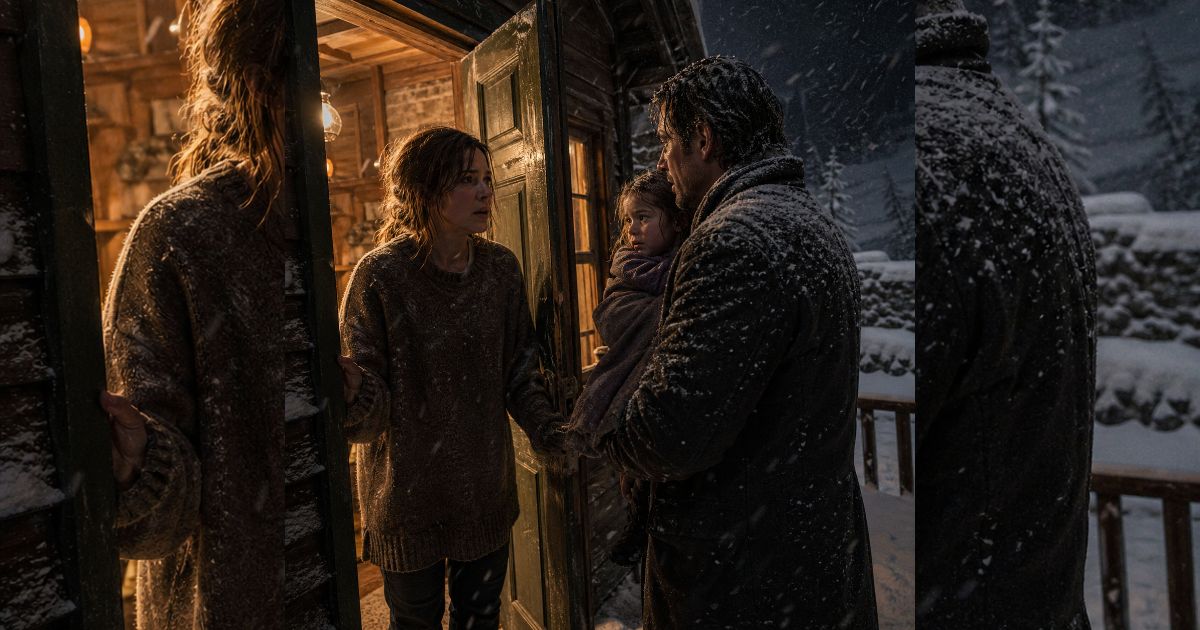
“Please,” the man begged through the storm. “My little girl can’t make it another hour out here.”
Mara Harper stood behind her cabin door with one hand on the deadbolt and the other pressed flat against her chest.
The wind was screaming so hard the old windows rattled in their frames.
Snow blew sideways across the porch.
Through the frosted glass, she could see only shapes.
A tall man.
A child tucked against him.
Both of them shaking.
“No,” Mara called out, though her voice cracked. “I don’t open my door to strangers.”
There was a pause.
Then came a cough.
Small.
Wet.
Painful.
The kind of cough that did not belong out in a mountain storm.
The man leaned closer to the door, but not too close.
“I understand,” he said. “I swear I do. But my daughter is six. Our car died down the road. There’s no cell service. I saw your light from the trees.”
Mara closed her eyes.
The fire behind her popped.
Her small cabin in the Blue Ridge foothills had always been her hiding place. One bedroom. One porch. One narrow kitchen. One woodstove that complained every winter but never quit.
She had built a quiet life there because quiet had never asked much from her.
Quiet never lied.
Quiet never took.
Quiet never smiled at you while planning how to leave.
“Please,” the man said again, lower this time. “Just for her. I’ll stay on the porch if I have to.”
The child coughed again.
Mara looked at the little shape pressed against his coat.
She thought about every bill on her kitchen table.
Every shift at the diner she could not miss.
Every cold night she had survived by telling herself not to need anyone.
Then she thought about a child freezing five feet from her door.
Her hand moved before her pride could stop it.
The deadbolt turned.
The chain slid free.
When Mara opened the door, the storm shoved its way inside like a living thing.
Snow swirled across her old braided rug.
The man stood there soaked through, his dark hair plastered to his forehead, his face pale from cold and worry.
In his arms, a little girl had her cheek pressed against his shoulder. Her lips trembled. Her eyes were half-open, glassy with fever.
Mara’s whole body tightened.
“Get in,” she said.
The man did not waste a second.
“Thank you,” he breathed.
“By the fire,” Mara told him. “Sit there. Don’t wander around. Don’t touch anything.”
He nodded like every word made perfect sense.
He carried the girl straight to the worn green couch near the fireplace and lowered her down with a care that made Mara’s throat pull tight.
Then he took off his own coat and wrapped it around her small body, though his shirt underneath was soaked too.
Mara shut the door and locked it again.
Her cabin felt suddenly smaller.
Too full.
Too alive.
“What’s your name?” she asked.
“Evan,” he said. “Evan Carter. This is Lily.”
The little girl’s lashes fluttered.
“Hi,” she whispered.
Mara’s face softened before she could stop it.
“Hi, Lily.”
The girl tried to smile, but another cough folded her forward.
Mara crossed the room and touched the back of her hand to the child’s forehead.
Too warm.
Far too warm.
“You walked through a blizzard with a feverish child?” Mara asked, turning on Evan. “Are you out of your mind?”
His jaw flexed.
“Our car slid into a ditch about a mile back. I couldn’t call anyone. I tried to keep the heat running, but the battery gave out.”
“You should’ve stayed with the car.”
“I did,” he said. “For as long as I could. Then she started shaking harder.”
Mara stared at him.
His voice had no excuses in it.
No performance.
Just fear.
A tired father holding himself together with both hands.
She turned away before her face could give her up.
“I’ve got canned chicken noodle soup,” she said. “Some crackers. Dry towels. That’s it.”
“That’s more than enough,” he said.
She went to the kitchen and lit the gas burner with a match because the power had been out for hours.
The flame caught blue and small.
Her hands shook while she opened the can.
Not from fear exactly.
From the old ache that came whenever kindness asked something from her.
She had learned young that people took advantage of soft hearts.
Her mother had called it being generous.
Her father had called it being foolish.
Mara had called it surviving when she finally stopped opening the door.
But now there was a child on her couch, trembling under a stranger’s coat.
So she poured soup into a pot and set it over the flame.
When she came back with towels, Evan was sitting on the floor near the couch, rubbing warmth back into Lily’s little hands.
He looked up at Mara.
“I can pay you,” he said quietly.
The words landed wrong.
Mara’s face hardened.
“I didn’t open that door for money.”
“I know. I didn’t mean—”
“Then don’t say it again.”
He nodded.
The room went quiet except for the storm and the fire.
Mara handed him a towel.
Then she handed another to Lily, but the little girl was too weak to hold it.
Mara hesitated only a second before she crouched down and began drying the ends of Lily’s hair herself.
Lily looked up at her.
“You smell like cinnamon,” the child whispered.
Mara blinked.
“I work at a diner,” she said. “Probably pancakes.”
Lily’s mouth twitched.
“I like pancakes.”
“That makes two of us.”
Evan watched them with something on his face Mara could not name.
Gratitude, yes.
But also grief.
Like he was seeing something he had not expected to see again.
Mara stood quickly.
“Soup’s almost ready.”
She brought three mugs because bowls took longer to wash, and she was practical even in emergencies.
She gave Lily the biggest portion and cooled each spoonful before letting her sip.
Evan tried to refuse his.
Mara gave him a look.
“You fall over on my floor, I’m not dragging you anywhere.”
For the first time, he almost smiled.
“Yes, ma’am.”
“I’m thirty-four, not eighty.”
“Yes, Mara.”
She paused.
She had not told him her name.
He glanced at the mail stacked on the side table.
“Sorry,” he said. “Envelope.”
She followed his eyes to the pile of overdue notices and diner schedules.
Something hot crawled up her neck.
She turned the envelopes facedown.
He looked away at once.
Not pretending he hadn’t seen.
Not making a show of politeness.
Just giving her dignity.
That bothered her more than if he had stared.
Lily managed half her soup before sleep pulled her under again.
Her small hand stayed curled around the edge of Evan’s sleeve.
Mara found an old quilt in the closet, then stopped.
It was her grandmother’s quilt.
White cotton with tiny blue flowers stitched by hand.
Mara only used it when the winter got mean enough to make pride useless.
She looked at the cheap fleece blanket below it.
Then back toward the living room.
Lily coughed in her sleep.
Mara took down the quilt.
When she returned, Evan had found one of her clean dish towels and dampened it with cool water.
He folded it neatly and pressed it against Lily’s forehead.
His lips moved softly.
Not a prayer.
Not exactly.
Just father words.
“I’m here, baby. I’ve got you. We’re warm now.”
Mara froze in the doorway.
There was no audience for him.
No one to impress.
He was just loving his child when he thought nobody was watching.
Something in Mara’s chest shifted.
Small.
Unwanted.
Real.
She stepped into the room.
“Here,” she said, holding out the quilt.
Evan looked at it, then at her.
“That looks special.”
“It’s warm.”
“I don’t want to ruin it.”
“Then don’t.”
He accepted it carefully, like she had handed him something holy.
Their fingers brushed.
Mara pulled her hand back fast and sat in the chair across from the fire.
Evan tucked the quilt around Lily.
The little girl sighed and sank deeper into sleep.
For a while, nobody spoke.
The fire threw orange light across the walls.
Outside, the storm tried to bury the mountain.
Inside, the cabin seemed to breathe.
“You live out here alone?” Evan asked.
Mara gave him a sharp look.
“That’s not a question a strange man should ask.”
“You’re right. I’m sorry.”
The apology came so quickly it disarmed her.
He looked toward the fire.
“I only meant it must take a lot to keep this place going.”
“It does.”
“I can tell.”
She waited for the pity.
It did not come.
Instead he said, “It’s a good home.”
Mara stared at the flames.
“It’s old.”
“So are a lot of good things.”
She almost smiled.
Almost.
“Where were you headed?” she asked.
“My mother’s place, two towns over. Lily’s been asking to see her.”
“And her mother?”
The second the words left Mara’s mouth, she wished she could take them back.
Evan’s face changed.
Not dramatically.
Just a shadow crossing a window.
“She passed away three years ago,” he said.
Mara looked down at her hands.
“I’m sorry.”
“Thank you.”
Lily shifted in her sleep.
Evan smoothed the quilt.
“She loved storms,” he said quietly. “My wife did. Said they made the whole world stop long enough for people to remember what mattered.”
Mara swallowed.
“And now?”
“Now storms just make me nervous.”
“That makes sense.”
He looked at her then.
Really looked.
“Has anyone ever told you that you sound hard, but you’re not?”
Mara’s back went stiff.
“You don’t know me.”
“No,” he said. “I don’t.”
His voice stayed gentle.
“That wasn’t an insult.”
She wanted to snap back.
Instead she looked at Lily.
The child’s cheeks had a little more color now.
Her breathing sounded less sharp.
Mara let the silence answer for her.
Later, when the candles burned low and the wind finally softened, Evan leaned against the couch with his daughter asleep beside him.
Mara stayed in the chair.
She had no intention of sleeping.
But sometime before dawn, her eyes closed.
When she woke, gray light filled the cabin.
For one strange second, she forgot there were people in her house.
Then Lily laughed.
Small.
Hoarse.
But a laugh.
Mara sat up.
Evan was kneeling near the fireplace, adding a log.
Lily was awake on the couch, wrapped in the flowered quilt, holding one of Mara’s old teddy bears.
The bear had belonged to Mara when she was a child.
She did not remember giving it to Lily.
“I found him on the shelf,” Lily whispered. “Is he yours?”
Mara rubbed her eyes.
“He was.”
“What’s his name?”
“Benjamin.”
Lily hugged him.
“He looks like he knows secrets.”
Mara’s mouth twitched.
“He does.”
Evan looked toward the window.
“The roads are still buried.”
Mara stood and went to the door.
She opened it just enough to see the porch.
Snow came up past the bottom step.
The driveway had vanished.
The world was white and silent.
She closed the door.
“Nobody’s driving today.”
Evan’s shoulders dropped.
“I’m sorry.”
“It’s not your fault.”
“I can help. Whatever needs doing.”
Mara almost refused.
Then she looked at the stack of firewood by the wall.
It was low.
The back door had been leaking cold air all month.
The kitchen shelf sagged if she put more than six cans on it.
She had been fixing her life with duct tape and stubbornness for years.
“You know how to repair things?” she asked.
Evan looked around the cabin.
“I’ve had a lot of practice.”
That day, a rhythm settled over the cabin like it had been waiting for them.
Evan brought in wood from the covered shed and stacked it neatly by the stove.
He found the draft near the back door and sealed it with weather stripping Mara had bought months ago but never put up.
He tightened the loose kitchen shelf.
He fixed the latch on the pantry.
He asked before touching anything.
Every single time.
“May I move this?”
“Do you want this kept here?”
“Is this okay?”
Mara noticed.
She wished she did not.
People who had taken too much from her in life had never asked permission.
They simply reached.
Evan did not reach.
He waited.
Lily stayed tucked on the couch with Benjamin the bear, sipping honey tea Mara made on the stove.
At first, Mara told herself she was only being practical.
The girl was sick.
The storm was dangerous.
No decent person would throw them out.
But by afternoon, she was sitting on the floor beside Lily, reading from an old library book about a brave little rabbit who got lost in the snow.
Lily listened with wide eyes.
Evan stopped repairing the pantry door and stood in the hallway, watching.
Mara lowered her voice for the rabbit.
Lily giggled.
The sound went straight through the cabin.
Straight through Mara.
Straight through the places she thought had closed for good.
“You read good,” Lily said.
“Well,” Mara corrected softly.
“You read well.”
Lily nodded seriously.
“You read well.”
Evan smiled.
Mara tried not to see it.
That evening, the storm picked up again.
The power stayed out.
Mara made biscuits in a cast-iron skillet and stretched a can of soup with rice, carrots, and a little cream she had been saving.
It was not fancy.
But Lily called it the best dinner she had ever had.
Mara pretended not to tear up.
After dinner, Evan made paper animals from old receipts Mara had stuffed in a drawer.
His rabbit looked like a crumpled napkin.
His dog looked like a shoe.
Lily laughed until she coughed.
Mara gave him a dry look.
“Maybe don’t quit your day job.”
Evan looked up.
“What makes you think I have one?”
“You fold paper like a man who sits through long meetings.”
He laughed then.
A real laugh.
Warm and surprised.
Mara felt it in her chest.
Lily pulled out the colored pencils Mara had given her and began drawing on the back of an old grocery list.
She worked with fierce concentration, tongue tucked against her cheek.
When she finished, she held up the paper.
It showed a little cabin buried in snow.
A tall man stood on the porch holding a little girl.
A woman stood in the doorway, drawn in yellow and orange, with light behind her.
“That’s you,” Lily told Mara.
Mara stared at the picture.
The woman in the drawing looked like she was made of fire.
“I don’t look like that,” Mara whispered.
“Yes, you do,” Lily said.
Evan’s voice was quiet.
“She sees things clearly.”
Mara looked away.
The room felt too warm.
Too full.
Too dangerous in a way she could not explain.
Lily taped the drawing to the wall beside the fireplace.
“This is our second home,” she announced.
Mara’s lips parted.
No words came.
Evan looked at her with something deeper than thanks.
Something careful.
Something that stood at the door and waited to be invited in.
By the next morning, the storm had finally passed.
Sunlight came weak through the clouds.
Snow glittered across the trees.
Mara stood at the kitchen counter, tying her diner apron around her waist.
She had missed two shifts already.
Missing a third could cost her hours she could not afford to lose.
Evan was asleep on the couch with Lily tucked under his arm.
For a moment, Mara stood there and watched them.
She hated herself a little for wanting them to still be there when she got back.
She wrote a note and left it on the counter.
Back by four. Soup in the pot. Help yourselves.
Then she added another line.
Lily can keep Benjamin until she feels better.
She stared at that sentence.
Then left before she could cross it out.
At the diner, the whole morning felt wrong.
The bell above the door kept ringing.
Mara kept looking up.
Every time, it was someone else.
Truck drivers.
Regulars.
A retired couple who always split pancakes.
A mother with two teenagers who wanted hot chocolate after sledding.
Not Evan.
Not Lily.
Mara poured coffee and smiled when she was supposed to smile.
But her mind stayed in the cabin.
She wondered if Lily’s fever had eased.
She wondered if Evan had found the tea.
She wondered if he had noticed she left extra biscuits wrapped in a towel.
At four, she took off her apron so fast her coworker laughed.
“Got somewhere to be?”
Mara paused.
“No,” she said.
The lie tasted strange.
By the time she reached the cabin, the sun was low.
Her boots crunched through fresh snow.
The porch was quiet.
No small footprints.
No laughter.
No smoke from Evan’s careful hand feeding the fire.
Mara opened the door.
The cabin was clean.
Too clean.
The dishes were washed and stacked.
The quilt was folded on the couch.
Benjamin the bear sat on top of it.
The fire burned low, but alive.
They were gone.
Mara stood there with her hand still on the doorknob.
She had told herself all day that she wanted her quiet back.
Now the quiet felt like a room after music ends.
On the table sat Lily’s drawing.
Beside it was a folded note.
And beneath the note was a black card.
Sleek.
Heavy.
Plain.
No company name.
No bank logo.
Just a chip and a strip of numbers.
Mara picked up the note first.
Her hands were already shaking.
Thank you for opening the door when you had every reason not to.
Thank you for feeding us, sheltering us, and giving my daughter comfort without asking who I was or what I could give you.
There are people who talk about goodness.
You live it.
I will never forget this.
Below it, in smaller handwriting, was one more line.
You helped more than you know.
No signature.
No phone number.
No explanation.
Mara sat down slowly on the couch.
She stared at the black card.
Then at the drawing.
Then at Benjamin.
The ache came so fast it shocked her.
She pressed the note to her chest and let herself cry.
Not loudly.
Not the kind of crying that asks to be heard.
Just a quiet breaking.
Because for two days her cabin had been more than a place to survive winter.
It had been a home.
And now the people who made it feel that way had vanished like tracks under new snow.
The next morning, Mara took the black card into town.
She stood in line at the only bank on Main Street with the card tucked in her coat pocket like it might burn through the fabric.
When her turn came, she placed it on the counter.
“I found this,” she said. “I need to return it.”
The teller, a woman with silver glasses and kind eyes, picked it up.
Her expression changed.
Just slightly.
“Where did you get this?”
“It was left at my house.”
The teller typed, paused, typed again, then lowered her voice.
“I can’t disclose private account information.”
“I don’t want information,” Mara said quickly. “I don’t want money. I just want it returned.”
The teller looked at her for a long moment.
“Whoever left this with you must trust you very much.”
Mara’s throat tightened.
“I don’t even know who he really is.”
The teller slid the card back gently.
“I’m sorry. I can’t take it without authorization.”
Mara left with more questions than answers.
She put the card in an old coffee tin behind the flour jar and did not touch it again.
Days turned into weeks.
The snow melted from the roof.
Mud returned to the road.
Mara went back to working breakfast shifts at the diner and two afternoons a week at the small county library.
She told herself life was normal.
But normal had changed shape.
She still looked at the door when the wind rattled it.
She still made too much soup.
She still found herself glancing at Lily’s drawing taped beside the fireplace.
One evening, she picked up Benjamin the bear and held him in her lap.
“You didn’t even leave me an address,” she whispered, feeling ridiculous.
The bear, loyal as ever, kept Lily’s secret.
Then March came hard.
First, the diner cut hours.
Not just Mara’s.
Everybody’s.
Business had been slow, and the owner looked sick with guilt when he posted the new schedule.
Mara lost three shifts a week.
She told herself she would be fine.
Then the library closed.
A white paper sign appeared on the door.
County funding paused until further notice.
Mara stood in front of that sign for a full minute with her tote bag hanging from her shoulder.
Inside, her supervisor was packing books into boxes.
“I’m sorry, honey,” the woman said. “I fought for it.”
“I know,” Mara said.
She did know.
That made it worse.
By the end of that week, Mara’s savings had fallen to nineteen dollars and forty-three cents.
She counted it twice.
Then a third time.
As if numbers might grow kinder if watched closely.
They did not.
The woodpile was low.
The pantry was thinner than she wanted to admit.
The roof near the back corner had started dripping into a pot when it rained.
Mara sat at the kitchen table with bills spread out before her and Lily’s drawing glowing in the firelight.
She thought about the black card in the coffee tin.
She did not touch it.
Not once.
Pride was a foolish blanket.
But it was the only one she had left that still felt like hers.
The letter arrived on a Wednesday.
Not in the mailbox.
Not with the regular bills.
It was slid under her door in a thick cream envelope.
Her name was written by hand.
Mara Harper.
The handwriting was clean and careful.
Her pulse jumped before she opened it.
Inside was a single sheet of paper on elegant letterhead.
No real company name she recognized.
Only a simple line at the top.
Carter Community Initiatives.
Dear Ms. Harper,
You are invited to interview for the position of Director of Rural Outreach and Family Support.
We are seeking someone with rare character, practical wisdom, and proven compassion under pressure.
Your name was personally recommended.
Travel arrangements have been made.
Sincerely,
Evan Carter
Chief Executive Officer
Mara read it once.
Then again.
Then a third time, slower.
Chief Executive Officer.
She sat down hard.
The cabin seemed to tilt around her.
Evan Carter.
The soaked man on her porch.
The father who dried his daughter’s hair by firelight.
The stranger who fixed her pantry latch and made ugly paper rabbits.
A CEO.
Mara laughed once.
It came out cracked and breathless.
Then she pressed the letter flat on the table and stared at his name until her eyes blurred.
He had not forgotten.
The next morning, a hired car came up the mountain road.
Mara almost did not get in.
She stood on the porch in her only good coat, holding her purse, feeling like the whole world was waiting to see if she would believe in something bigger than survival.
The driver stepped out.
“Ms. Harper?”
“Yes.”
“Mr. Carter asked me to make sure you were comfortable.”
Mara nearly turned around.
Comfortable.
That word did not belong to her.
But Lily’s drawing fluttered behind the window when the door moved.
Mara took a breath.
Then she got in the car.
The drive into Asheville felt like crossing into another life.
The road changed from mountain curves to busy streets.
Small gas stations gave way to office buildings and hotels.
By the time the car stopped in front of a tall glass building downtown, Mara’s palms were damp.
She looked down at her outfit.
A navy dress from the thrift store.
A cardigan with one button that did not quite match.
Boots polished until they almost looked new.
She lifted her chin.
“Well,” she whispered. “Here we go.”
The lobby was bright and quiet.
Marble floors.
Soft lights.
People moving quickly with badges clipped to expensive jackets.
Mara walked to the front desk with the invitation in her hand.
The receptionist smiled.
“Ms. Harper. We’ve been expecting you.”
That made Mara more nervous, not less.
“Mr. Carter will meet you on the thirty-second floor.”
“Of course he will,” Mara murmured.
The elevator rose so smoothly she barely felt it.
Floor numbers blinked upward.
Ten.
Fifteen.
Twenty.
Her heart beat harder with every number.
At thirty-two, the doors opened into a quiet hallway with wide windows overlooking the city.
A woman in a gray suit greeted her.
“This way, please.”
Mara followed.
Her boots made small sounds against the polished floor.
At the end of the hallway, the woman opened a glass door.
Evan stood near the window.
He wore a charcoal suit.
His hair was neatly combed.
He looked like someone used to being obeyed.
Then he turned and saw her.
And for one second, the suit disappeared.
He was just Evan again.
The man in her cabin.
The father with snow in his hair.
“Mara,” he said softly.
She stopped in the doorway.
“Evan.”
He smiled, but there was nerves in it.
“I was hoping you’d come.”
“You sent a car.”
“I was still hoping.”
That almost broke her.
She stepped inside.
The office was large but not cold.
There were books on the shelves.
A child’s framed drawing on the wall.
Mara saw it and froze.
The cabin.
The snow.
The woman made of yellow light.
“You framed it,” she whispered.
Evan looked at the drawing.
“Lily insisted.”
“How is she?”
“Better. Much better. She asks about you all the time.”
Mara looked at him.
“You could’ve told me who you were.”
“I know.”
“Why didn’t you?”
He took that without defense.
“At first, because I was scared for my daughter and nothing else mattered. After that night, because I didn’t know how to explain it without making what you did feel smaller.”
“Smaller?”
“You helped us because we needed help. Not because I had money. Not because I had a title. Not because you expected anything.”
Mara crossed her arms.
“You left a black card on my table.”
His mouth tightened.
“I panicked.”
“You panicked like a rich man.”
That made him smile, but only for a second.
“You didn’t use it.”
“No.”
“I know.”
Her eyes narrowed.
“How?”
“The account never registered a charge. After a week, I understood what that meant.”
“It meant I’m not for sale.”
His face grew serious.
“I never thought you were.”
The room went quiet.
Mara could hear the soft hum of the building.
Evan picked up a folder from his desk and held it out.
“This is the position.”
She did not take it.
“I don’t have a degree for whatever this is.”
“I’m not looking for a degree.”
“I’ve waited tables. Shelved books. Cleaned cabins in the summer. Delivered groceries to old folks when the road washed out.”
“That’s exactly why I asked you here.”
Mara frowned.
Evan set the folder on the table between them.
“Our company has money moving through communities we barely understand. We fund programs. We write checks. We make announcements. But too often, the people making the choices have never had to choose between heat and groceries.”
Mara went still.
He continued.
“I want to build something that actually listens. Rural outreach. Family support. Education. Emergency home repairs. Job training. Food access. Not charity for applause. Real help with dignity.”
His voice lowered.
“You understand dignity, Mara.”
She looked away.
He had aimed straight for the part of her she guarded most.
“And you want me to run it?”
“Yes.”
“That’s a big risk.”
“I know.”
“What if I fail?”
“Then we fix it.”
“We?”
“Yes,” he said. “We.”
She hated how much that word mattered.
Mara finally opened the folder.
There was a salary number on the first page.
She closed it immediately.
“No.”
Evan blinked.
“No?”
“That’s too much.”
“It’s the approved compensation for a director role.”
“I don’t care what it is. I can’t take that.”
“Mara—”
“I said no.”
He watched her for a moment, then sat across from her.
“Tell me why.”
“Because I opened a door. I made soup. I did what anybody decent should do.”
“No,” Evan said gently. “You did what many people talk about doing. Then you kept doing it when it cost you something.”
She shook her head.
“This feels like payment.”
“It’s not.”
“It feels like it.”
“Then make it service.”
Mara looked up.
He leaned forward.
“Take the job. Build something that helps people like the ones you served at the diner. People like your library families. People who live far from offices like this and still deserve to be seen.”
Mara’s fingers rested on the folder.
She thought about the library closing.
The little kids who came in after school because their houses were too loud or too cold.
The older men who read newspapers every afternoon just to be around people.
The single mothers who printed forms and asked quietly for help because everything online made them feel small.
She thought about her cabin.
About the storm.
About Lily coughing in the dark.
Then she opened the folder again.
“I’ll do it,” she said.
Evan exhaled slowly.
“But not because you rescued me,” Mara added.
His eyes softened.
“I know.”
“And not because of that card.”
“I know.”
“I’ll do it because somebody should.”
Evan nodded.
“That’s why I asked you.”
Mara’s first month in the glass building felt like learning to breathe different air.
Everything was polished.
Everything was scheduled.
People used phrases like strategic alignment and stakeholder value as if normal human words had been outlawed.
Mara kept a notebook full of plain translations.
Strategic alignment meant people agreeing in the same room.
Resource allocation meant deciding who got help first.
Community engagement meant showing up and listening before talking.
She learned fast.
But not everyone wanted her there.
Some smiled too long.
Some spoke slowly, as if she might not understand.
Some asked where she had worked before and looked disappointed when she told the truth.
The worst was Martin Price.
Senior vice president.
Silver hair.
Perfect suits.
A voice smooth enough to make an insult sound like table manners.
At her first executive meeting, he glanced at her report and smiled.
“This is heartfelt,” he said. “Very personal.”
Mara knew that tone.
It meant small.
It meant cute.
It meant not serious.
She smiled back.
“Thank you. I also included regional cost analysis, staffing projections, and a three-year impact model on page seven.”
Martin’s smile tightened.
Evan, seated at the head of the table, looked down at his papers to hide his own smile.
Mara saw it anyway.
That helped.
A little.
The real test came six weeks later.
A group of outside partners wanted the company to cut its local support teams and move the work to a cheaper call center far away.
On paper, it saved money.
In real life, it meant hundreds of workers in small towns would lose steady jobs.
Mara sat beside Evan in a conference room colder than a grocery freezer.
Across from them sat three men and one woman in tailored suits.
Their leader, Robert Voss, barely looked at Mara.
Evan opened the meeting.
“You’re proposing we move support operations out of the region.”
Robert nodded.
“It’s efficient.”
“It removes jobs from four counties.”
“It reduces expense,” Robert said. “This is not personal. It’s business.”
Mara felt something old and hot wake in her chest.
Not personal.
She had heard that phrase when the diner cut hours.
When the library closed.
When landlords raised rent and called it market adjustment.
When families were told to understand decisions made by people who would never meet them.
She leaned forward.
“May I ask something?”
Robert looked at her as if he had just noticed she was in the room.
“And you are?”
“Mara Harper. Director of Rural Outreach.”
“Ah,” he said. “The community program.”
He made it sound like a bake sale.
Mara kept her smile calm.
“You said it’s not personal. Have you met any of the employees whose jobs you want to move?”
Robert adjusted his cuff.
“That isn’t how these decisions are made.”
“Maybe that’s the problem.”
The room went still.
Evan did not interrupt.
Robert’s eyes sharpened.
“Ms. Harper, we are discussing operational efficiency.”
“Good,” Mara said. “Then let’s discuss it.”
She slid a packet across the table.
“This is your savings estimate. It looks strong for eighteen months. After that, turnover rises, retraining costs rise, customer complaints rise, and local contracts weaken because people notice when a company drains a town and calls it progress.”
Robert opened the packet.
Mara continued.
“Page three shows the cost of losing experienced workers. Page five shows regional response times. Page eight shows what happens when customers stop trusting a company that used to employ their neighbors.”
She tapped the table once.
“Your plan saves money fast and loses value slow. Slow loss is still loss.”
Nobody spoke.
Robert flipped pages now.
So did the woman beside him.
Mara sat back.
“I’m not asking you to grow a conscience in a conference room,” she said. “I’m asking you to read the whole math.”
Evan finally spoke.
“We’ll be declining the proposal as written.”
Robert looked at him.
“That’s final?”
“Very.”
After the meeting ended, Mara gathered her papers with steady hands.
Evan waited until the room emptied.
“You were excellent.”
“I was annoyed.”
“Both can be true.”
She looked at him.
“You knew I’d say something.”
“I hoped you would.”
Mara shook her head.
“You’re dangerous.”
Evan smiled.
“I’ve been called worse.”
Over time, the program began to grow.
Mara traveled to mountain towns, old mill towns, farming counties, and forgotten places with two stoplights and churches older than the courthouse.
She sat at folding tables in community rooms.
She drank burnt coffee from paper cups.
She listened to school bus drivers, retired nurses, diner owners, librarians, mechanics, grandparents, and tired parents who apologized before asking for anything.
Mara hated that.
How people apologized for needing.
She made a rule.
Nobody had to perform gratitude to receive help.
Nobody had to tell their saddest story for a roof repair.
Nobody had to feel small in order for someone else to feel generous.
The program fixed furnaces.
Reopened a reading room.
Funded after-school meals through local partners.
Helped train workers for steady support roles that stayed in their own counties.
The company loved the good press.
Mara cared more about the quiet results.
A grandmother whose porch ramp got rebuilt.
A teenager who got bus fare to a training program.
A library table full of kids again.
Evan backed her every time the board questioned the cost.
But the more the program worked, the more uncomfortable some people became.
Especially Martin Price.
He had spent years building influence inside the company.
Mara’s success made him polite in public and sharp in private.
One afternoon, he stopped her near the elevators.
“You’re moving quickly,” he said.
“I walk fast.”
He smiled.
“I mean professionally.”
“Then say that.”
His eyes cooled.
“Some people here believe you’ve been given unusual trust.”
Mara held his gaze.
“Some people here are right.”
The elevator doors opened.
She stepped in.
Before they closed, Martin said, “Trust is fragile, Ms. Harper.”
Mara smiled.
“So is ego.”
The doors slid shut.
She told herself not to worry.
But two weeks later, everything cracked open.
Mara had just returned from a meeting with county leaders when Evan’s assistant, Claire, hurried down the hall toward her.
Claire was usually calm.
Now her face was pale.
“Mara,” she said. “We need to talk.”
“What happened?”
Claire handed her a printed email.
Mara read the first line and felt the floor drop.
Confidential budget files had been sent outside the company.
Attached to the email was Mara’s name.
Her login.
Her department.
Her stomach turned cold.
“This isn’t mine,” Mara said.
“I know,” Claire whispered. “But the board has seen it.”
Mara looked down at the paper again.
The words blurred.
All those careful smiles.
All those people waiting for proof she did not belong.
Now they had something to point at.
“Where’s Evan?”
“In his office.”
Mara walked there without knocking.
Evan was standing behind his desk, the same printed email in his hand.
His face was unreadable.
That hurt more than anger would have.
Mara placed both hands on the edge of his desk.
“I did not send that.”
“I know.”
She froze.
“You know?”
“Yes.”
Her breath came out hard.
The fear did not leave, but it changed shape.
“The board doesn’t,” he said.
“Of course they don’t.”
“Mara—”
“No. Let me guess. The mountain waitress got too close to real power, and now suddenly confidential files walk out under her name.”
His jaw tightened.
“That is exactly why we have to be careful.”
“I am tired of being careful.”
“I know.”
“No, Evan. You don’t.”
Her voice trembled, but she did not let it break.
“You walk into rooms and people assume you belong there. I walk into rooms and have to prove I didn’t sneak in through a side door.”
Evan was quiet.
Not defensive.
Listening.
That kept her from walking out.
Finally, he said, “Then we prove who opened the wrong door.”
Mara stared at him.
“We?”
“Yes. Claire is already pulling system logs. I’ve paused any board action until we review the access trail.”
“And if they demand I resign?”
“They can demand anything they want.”
His voice stayed calm.
“They will not get it from me.”
Mara looked at the man in the expensive suit.
Then she saw the father from the cabin underneath it.
The one who had whispered to his child in the dark.
The one who understood fear and stayed gentle anyway.
“All right,” she said.
“Then let’s find the truth.”
They worked until the city lights blurred against the windows.
Claire traced login times.
Mara reviewed access records.
Evan called in the internal audit team and told them to follow facts, not favorites.
By midnight, they found the first crack.
The email had not originated from Mara’s computer.
By two in the morning, they found the second.
Her login had been accessed from a restricted executive floor while she was speaking at a community center sixty miles away.
By dawn, the trail led to an administrative account tied to Martin Price’s office.
Claire found the final piece.
A calendar entry.
A file transfer.
A message from Martin to an outside consultant suggesting the program’s budget could be “restructured once current leadership loses credibility.”
Mara read that sentence three times.
Current leadership.
That meant her.
She did not feel satisfied.
She felt tired.
There was a special exhaustion in being proven innocent only after someone tried so hard to make you look guilty.
At nine o’clock, the board gathered in the main conference room.
Mara entered before anyone could summon her.
She wore the same navy dress she had worn to her interview.
Not because she had to.
Because she wanted to remember exactly where she started.
Martin sat near the end of the table, looking smooth and bored.
That bored look faded when he saw the folder in Mara’s hand.
One board member cleared his throat.
“Ms. Harper, given the seriousness of the matter—”
Mara placed the folder on the table.
“Yes,” she said. “Let’s be serious.”
The room went silent.
She opened the folder.
“These are access logs. These are location records. These are file timestamps. And this is the message discussing what would happen after I lost credibility.”
Martin’s face drained.
“This is being misrepresented,” he said quickly.
Mara looked at him.
“No. It is being read.”
Evan stood at the head of the table.
His voice was steady.
“The review shows Ms. Harper did not send the files. Her credentials were misused from an executive access point connected to Mr. Price’s office.”
Martin pushed back his chair.
“This is absurd.”
Claire, standing near the wall, spoke for the first time.
“We confirmed it through three independent system checks.”
Martin’s mouth opened.
No words came.
Mara did not smile.
She did not gloat.
She had no interest in looking powerful at someone else’s lowest moment.
She only wanted the truth to stand where lies had stood.
Evan turned to the board.
“Mr. Price is removed from his role effective immediately pending final review. Ms. Harper will continue leading the program with full authority.”
A few board members looked uncomfortable.
Good.
Mara hoped they stayed uncomfortable long enough to learn something.
After the meeting, she walked out into the hallway.
Evan followed.
“Mara.”
She stopped.
He looked like he wanted to say ten things and trusted none of them.
Finally, he said, “I’m sorry.”
“For what?”
“For making you stand in rooms where people should have known better.”
She looked toward the windows.
Down below, the city moved like nothing had happened.
“That’s the thing,” she said. “A lot of people should know better. Knowing better doesn’t matter unless they do better.”
Evan nodded slowly.
“Then we do better.”
She looked back at him.
“We?”
His answer came without hesitation.
“We.”
That spring, Lily graduated from first grade.
She wore a yellow dress and white sneakers with glitter on the sides.
Her hair was curled at the ends because she had insisted it made her look “official.”
Mara sat beside Evan in the school auditorium, holding a bouquet of daisies.
When Lily walked across the little stage to receive her certificate, she looked into the crowd and waved with her whole arm.
“Mara!” she called.
Half the room turned.
Mara waved back, laughing through tears she had no chance of hiding.
Afterward, Lily ran straight into her arms.
“You came!”
“I promised, didn’t I?”
“Daddy said promises matter.”
Mara looked over Lily’s head at Evan.
“He’s right.”
Lily pulled back.
“Are you coming for pancakes?”
Mara glanced at Evan.
“Pancakes?”
“At the diner,” Evan said. “Lily chose.”
“Because that’s where Mara smells like cinnamon,” Lily said proudly.
Mara laughed.
“I suppose I can make time for pancakes.”
At the diner, they sat in a red vinyl booth by the window.
The same diner where Mara had poured coffee while wondering if Evan and Lily would ever come back.
Lily colored on the paper placemat.
Evan drank coffee that was definitely too weak for him but did not complain.
Mara watched them and felt something settle in her.
Not a fairy tale.
Not some perfect ending wrapped in a bow.
Something better.
A life being built piece by piece.
Trust by trust.
Meal by meal.
Door by door.
Months passed.
Then a year.
Then two.
The community program became bigger than anyone expected.
Not because of fancy speeches.
Because Mara refused to let it become fancy.
She kept the office open late twice a week.
She made executives visit the towns they discussed.
She banned pity language from public materials.
She hired people who knew what it meant to stretch groceries, patch roofs, and translate paperwork for neighbors.
Evan let her lead.
When he disagreed, he did it privately.
When others questioned her, he backed her publicly.
And Lily remained Lily.
Bright.
Curious.
Too honest at the worst possible moments.
One summer evening, during a community center ribbon cutting in Mara’s hometown, Lily tugged Mara’s sleeve.
“Are you and Daddy family now?”
Mara nearly dropped the scissors.
Evan coughed into his hand.
The county mayor pretended not to hear.
Mara bent down.
“What makes you ask that?”
Lily shrugged.
“You show up. He shows up. I show up. That sounds like family.”
Mara looked at Evan.
He looked back.
Neither of them laughed.
Because the child had said the simple thing adults had been walking around for months.
Mara touched Lily’s cheek.
“Family is partly who you’re born to,” she said. “And partly who keeps choosing the chair beside you.”
Lily thought about that.
“Okay,” she said. “Then save me a chair.”
Mara smiled.
“Always.”
Years later, Mara stood on the porch of the new Carter-Harper Community Center as the sun lowered behind the Blue Ridge mountains.
The building was not fancy.
That had been her rule.
Warm brick.
Wide doors.
A reading room with soft chairs.
A kitchen big enough for shared meals.
A repair desk where families could request help without shame.
A training room filled with secondhand computers that worked just fine.
On the wall near the entrance hung a framed copy of Lily’s old drawing.
The cabin in the snow.
The man.
The little girl.
The woman opening the door.
Beside it was a small plaque.
Everything good began with warmth.
Mara stood in front of it for a long time.
She was no longer the woman who counted nineteen dollars at a kitchen table and called it a plan.
She was a director now.
A leader.
A woman whose name people knew.
But deep down, she was still the person who almost did not open the door.
That truth kept her humble.
It also kept her honest.
Evan came up beside her.
“You okay?”
Mara nodded.
“Just thinking.”
“About?”
“The storm.”
He looked at the drawing.
“I think about it too.”
Lily, now taller and full of teenage confidence, appeared with a plate of cookies from the refreshment table.
“You both look emotional,” she said. “Do I need to give a speech?”
Mara laughed.
“Please don’t.”
“I could. I’m very inspiring.”
Evan smiled.
“She is.”
Lily handed Mara a cookie.
Then she looked at the drawing.
“I still remember that night.”
Mara’s voice softened.
“You were very sick.”
“I remember the fire,” Lily said. “And Benjamin. And soup. And you opening the door.”
Mara looked out toward the mountains.
“I almost didn’t.”
Lily leaned against her.
“But you did.”
Those three words stayed with Mara long after the ceremony ended.
But you did.
Not perfect.
Not fearless.
Not certain.
Just willing.
Sometimes that was enough to change a life.
Sometimes it changed three.
And sometimes, years later, it became a warm building with open doors, where tired people could come in from their own storms and hear the words Mara once needed herself.
Get inside.
You’re safe here.
Thank you so much for reading this story!
I’d really love to hear your comments and thoughts about this story — your feedback is truly valuable and helps us a lot.
Please leave a comment and share this Facebook post to support the author. Every reaction and review makes a big difference!
This story is a work of fiction created for entertainment and inspirational purposes. While it may draw on real-world themes, all characters, names, and events are imagined. Any resemblance to actual people or situations is purely coincidenta