When Three Men Humiliated a Young Artist in a Wheelchair, a Quiet Biker Stood Up for Her—Then the Police Arrived and Called Him Doctor Hayes
“Maybe if she keeps rolling around like that, she’ll draw herself a little ramp out of town.”
The words floated across Sunny’s Diner like smoke.
Maya Robinson kept her eyes on the menu, even though she had already read it three times.
Her hands rested on the rims of her wheelchair.
Not moving.
Not shaking.
Not yet.
The three young men in the back booth laughed into their plates like they had said something clever. One of them leaned back so far his shoulders touched the red vinyl seat. Another dragged his sneaker across the tile, making a long, squeaking sound.
It sounded too much like the wheels on her chair.
That was the point.
Maya stared at the breakfast specials and told herself not to react.
She was twenty-two years old.
She had survived more than a diner full of cowardly silence.
Still, her chest tightened.
Still, her face burned.
Still, she felt seven years old again, sitting in a hospital room while grown-ups whispered over her bed like she was already gone.
The waitress, Tammy, stood behind the counter with a coffee pot in her hand.
She heard.
Everybody heard.
The older man at the counter stirred his coffee until the spoon clicked against the mug in a nervous rhythm. A woman near the window lifted her newspaper higher. Two retirees in the corner booth stopped talking and looked down at their toast.
Nobody said a word.
Maya had come in for coffee, eggs, and thirty quiet minutes before her online art class.
That was all.
She had chosen the little table by the window because the morning light was good there. She liked how it fell across paper. She liked drawing hands, faces, the soft wrinkles around people’s eyes when they thought no one was looking.
She liked catching the truth of people.
But that morning, the truth in Sunny’s Diner was ugly.
One of the young men cupped his hands around an invisible steering wheel and pretended to roll it.
His friends snickered.
“Careful,” he said, loud enough for every booth to hear. “Don’t block the aisle. Some of us can still walk around here.”
Maya’s fingers tightened on the menu.
She swallowed once.
Then again.
Her throat felt full of stones.
She was a Black woman in a small southern town that liked to call itself polite. Polite meant people smiled at church potlucks and said “bless your heart” when they meant something else. Polite meant they would hold a door open for her and then stare at her chair like it had offended them.
Polite meant nobody wanted trouble.
So they let trouble sit in the back booth and laugh.
Maya had been in that chair since she was eight.
A truck had run a red light on a wet county road outside Pine Hollow, Alabama. Her mother had been driving her home from a school art show. Maya still remembered the red ribbon pinned to her shirt for the picture she had drawn of their front porch.
She remembered rain.
Headlights.
Her mother’s hand flying across the seat to protect her.
Then white hospital lights.
Her mother survived with a scar above her eyebrow and a limp she tried to hide. Maya survived with damage the doctors described in calm voices and words her family had to learn the hard way.
After that, people always looked at the chair first.
Not at her sketches.
Not at her laugh.
Not at the way she could draw a face from memory after seeing it once.
Just the chair.
And sometimes, in a town like Pine Hollow, they looked at her skin next.
As if both things together gave them permission to decide she was smaller.
Maya had learned to shrink before anyone asked her to.
She hated that most of all.
A shadow fell across her table.
For one fast, startled second, she thought one of the young men had come closer.
Then she saw black leather.
Boots.
A gray-streaked beard.
A man standing beside the empty chair across from her.
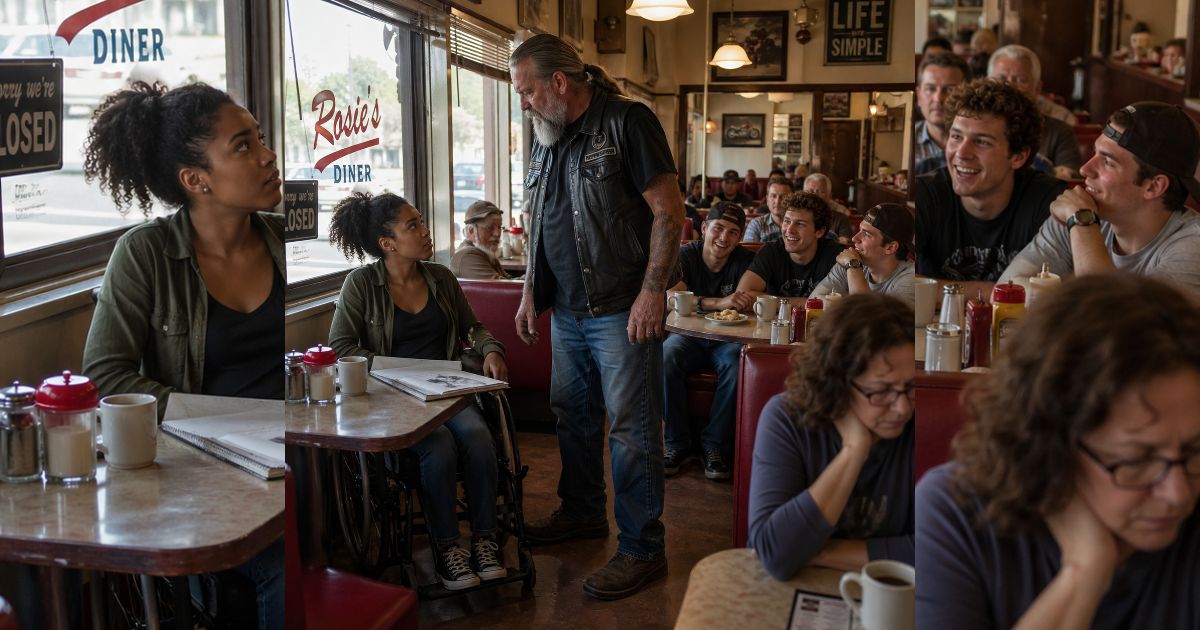
He was tall, maybe in his late fifties, with broad shoulders and a weathered face that looked like it had spent more years in hard sun than soft rooms. His leather riding vest was worn at the edges. A patch on the front read Iron Ridge Riders, Pine Hollow Chapter.
Not a company.
Not a badge.
Just a local motorcycle club name stitched over his heart.
His eyes were pale gray, steady, and tired in a way Maya understood before he ever spoke.
He did not stare at her chair.
He looked at her face.
“Miss,” he said quietly, “are they bothering you?”
Maya opened her mouth.
No sound came out.
Her first instinct was to say no.
It was always no.
No, I’m fine.
No, don’t worry.
No, please don’t make this worse.
The man waited.
He did not rush her.
He did not lean too close.
He rested one hand on the back of the chair across from her and lowered his voice.
“I know that look,” he said. “That look people wear when they’re trying to disappear in a room full of folks who should know better.”
Maya felt something crack inside her.
Not loudly.
Just enough.
“They’ve been saying things,” she whispered.
The man nodded once.
His jaw tightened.
“What’s your name?”
“Maya.”
“I’m Elias Hayes.”
Then, before she could ask anything else, Elias pulled out the chair across from her and sat down like he had been expected.
The chair gave a small groan under his weight.
The diner went even quieter.
The young men in the back booth saw him now.
Really saw him.
The tallest one, a blond man with a college sweatshirt and a jaw set in lazy arrogance, tilted his head.
“Well, look at that,” he called. “She got herself a bodyguard.”
The second one laughed.
The third tapped his fork against his plate.
Elias did not turn right away.
He kept his eyes on Maya.
“You don’t owe me an answer,” he said softly. “But I’m going to ask one question. Do you want me to speak, or do you want me to sit here until they get bored?”
Maya looked down at her sketchbook.
The worn brown cover sat beside her coffee cup.
Inside were pages full of people from this town. Tammy pouring coffee. Mr. Wilkes asleep on a bench outside the courthouse. A boy tying his little sister’s shoe outside the grocery store.
She had drawn them gently.
Even when the world had not been gentle with her.
She looked back at Elias.
Her voice came out thin, but clear.
“I want them to stop.”
Elias nodded.
Then he stood.
He turned toward the back booth with no rush at all.
No raised hands.
No shouting.
Just a man standing up in a room where everyone else had stayed seated.
“All right, boys,” he said.
His voice carried without effort.
“In this diner, people eat in peace. You don’t mock a woman because she came in here different from you. You don’t make a show out of somebody’s body. You don’t turn breakfast into a stage for cruelty.”
The blond one laughed first.
“Who made you sheriff?”
Nobody laughed with him at first.
So he laughed harder.
His friend leaned forward and smirked.
“You lost, old man? Bike night’s not till Friday.”
The third one glanced at Maya and muttered, “Some people sure do bring attention on themselves.”
Elias’s expression did not change, but something in the room changed around him.
The air tightened.
Tammy set the coffee pot down too hard.
A spoon clattered against the counter.
Elias took one step closer to the aisle, still several feet from the booth.
“You get one chance to apologize,” he said. “Not to me. To her.”
The blond one’s smile thinned.
“Or what?”
“Or you leave knowing every person in this room watched you fail at being decent.”
That landed harder than a threat.
Maya saw it in the young man’s face.
His eyes flicked around the diner.
For the first time, he seemed to notice all the people who had been pretending not to watch.
The woman with the newspaper lowered it half an inch.
The older man at the counter stopped stirring.
The cook leaned into the pass window with his spatula frozen in his hand.
The blond one hated that.
His cheeks flushed.
He pulled his phone from the table and stood up.
“You know what?” he said. “Let’s call someone who actually matters.”
His friends shifted behind him.
“Good idea,” one said, though his voice had lost some strength.
The blond one tapped his screen and lifted the phone to his ear.
“Yes, I need officers at Sunny’s Diner on Main,” he said loudly. “There’s a motorcycle guy in here threatening people. He’s making everyone nervous.”
Maya’s stomach dropped.
She knew this part too.
The story could turn on one sentence.
One person says “threat.”
Another says “dangerous.”
Then the whole room forgets what actually happened.
Elias did not move.
He did not reach for the phone.
He did not argue.
He just turned back to Maya and returned to the chair across from her.
His hands rested flat on the table.
Calm.
Steady.
Like a man who had made peace with waiting for storms to pass.
“I’m sorry,” Maya whispered.
Elias looked surprised.
“For what?”
“For this.”
“This was already here before I walked in,” he said. “I just stopped pretending it wasn’t.”
Outside, traffic moved slowly along Main Street.
A pickup truck rolled past.
Someone on the sidewalk paused near the window, peered in, then kept walking.
Inside, nobody spoke above a whisper.
Maya could hear the old refrigerator humming behind the counter.
She could hear her own breath.
She could hear the blond young man still talking into his phone, polishing the lie.
“He came at us,” he said. “He was aggressive. We didn’t do anything.”
One of his friends nodded too hard.
The other stared down at his pancakes.
Maya wanted to shout.
She wanted to tell the phone, the diner, the whole town, that they had laughed first. That they had picked at the softest parts of her in front of strangers. That she had done nothing except roll through a door and ask for coffee.
But her voice stayed trapped behind her ribs.
Elias noticed.
“You don’t have to prove pain to people who watched it happen,” he said quietly. “The truth is in this room.”
Maya looked around.
Was it?
The truth had been in the room before he came in.
Nobody had touched it.
A siren sounded in the distance.
Soft at first.
Then closer.
Maya’s hands curled around the edge of her sketchbook.
Elias followed her gaze to the window.
The first patrol car turned onto Main Street.
Then another.
Red and blue lights flashed over the diner glass, over the sugar shakers, over the faces of people who had suddenly found plenty to look at.
The blond young man stood near his booth with his chest lifted.
His confidence was coming back.
The kind that fed on uniforms and paperwork and people believing the first loud voice.
The door opened.
Two officers stepped inside, followed by a third.
Their boots hit the worn tile.
The bell above the door gave a weak little ring.
The first officer scanned the room.
“Who made the call?”
The blond man lifted his hand fast.
“I did. That’s him.”
He pointed straight at Elias.
“He threatened us. Got in our faces. We were just eating.”
Maya’s mouth went dry.
The officer turned toward Elias.
But before he could take a full step, the third officer stopped dead near the door.
He was older, with a square face, a salt-and-pepper mustache, and a sergeant’s stripes on his sleeve.
His eyes fixed on Elias.
Then his whole expression changed.
“Dr. Hayes?”
The name hit the diner like a dropped plate.
Maya blinked.
The officer near Elias paused.
The blond man’s pointing hand lowered a few inches.
Elias looked toward the sergeant.
“Morning, Carl.”
The sergeant let out a breath that sounded almost like a laugh, but not quite.
“Well, I’ll be,” he said. “Didn’t know you were back in town.”
“Just for a little while.”
The younger officers glanced between them.
The blond man frowned.
“Dr. Hayes?” he repeated, like the words tasted wrong.
Sergeant Carl Whitaker turned his head slowly.
“This man is Dr. Elias Hayes,” he said, his voice filling the room. “Retired heart surgeon. Former medical director over at the regional clinic. He patched up half this county one way or another.”
A murmur moved through the diner.
Tammy’s eyes widened.
The cook whispered, “That Hayes?”
The older man at the counter sat straighter.
The sergeant kept going, not loudly, but clearly enough that nobody could miss a word.
“He is also the son of Ruth and Samuel Hayes, the folks who helped fund the community art room, the senior lunch program, and those scholarships at the high school. His sister runs the literacy center.”
The blond man’s face changed color.
Not all at once.
Slowly.
Like heat draining from a stove.
Maya looked at Elias.
He had not told her any of that.
He sat in a worn leather vest with scratched boots and gray in his beard, and the whole room had decided who he was before he opened his mouth.
Just like he said.
The sergeant’s eyes moved around the diner.
His expression cooled.
“Now,” he said, “why don’t we stop performing and find out what actually happened?”
The blond man stepped forward.
“I told you what happened.”
“And I heard you,” the sergeant said. “Now I’ll hear everyone else.”
Nobody volunteered.
Not at first.
The same silence came back.
Only now it looked worse.
Heavier.
Because the truth had been invited into the room, and still people hesitated to open the door.
Sergeant Whitaker turned toward Tammy.
“Is there security footage in here?”
Tammy’s lips parted.
She glanced toward the manager, Mr. Bell, who had appeared from the back office with his apron tied too tight around his middle.
He looked pale.
“We’ve got cameras,” Mr. Bell said. “They run to a recorder in the office.”
“Good,” the sergeant said. “Let’s see it.”
The blond man shifted.
“Why do we need that? We said what happened.”
Elias looked at him then.
Not angrily.
Almost sadly.
“Because saying something first doesn’t make it true.”
Maya felt those words settle into her bones.
Mr. Bell disappeared into the back office with one of the officers.
The diner held its breath.
The sergeant began taking statements.
He spoke first to the young men.
They stood together near the wall, no longer lounging, no longer laughing. Their voices had changed. They used careful words now.
Misunderstanding.
Joking.
No harm meant.
He overreacted.
Maya listened, her hands folded so tightly in her lap that her fingertips ached.
When the sergeant came to her table, he crouched slightly so he was not towering over her.
“Maya Robinson, right?”
She nodded.
“I know your mother. She used to bring pie to the volunteer dinners.”
Maya managed a small smile.
“She still does when her back isn’t bothering her.”
The sergeant’s face softened for a second.
Then he became professional again.
“Tell me what happened.”
Maya looked past him at the room.
Every person seemed to be listening while pretending not to.
Her voice almost failed.
Then Elias leaned back, giving her space, not rescuing her from the moment but reminding her she was not alone in it.
Maya took a breath.
“They started when I sat down,” she said. “The sounds. The jokes. They mocked my wheelchair. They made comments about me drawing people in town. They wanted me to hear.”
The sergeant nodded slowly.
“Did Dr. Hayes threaten them?”
“No.”
“Did he touch them?”
“No.”
“Did he shout?”
“No. He told them to stop. He told them to apologize.”
Her voice grew steadier with each answer.
The sergeant wrote it down.
Across the diner, the blond man stared at the floor.
Mr. Bell returned with a small drive in his hand.
His fingers trembled when he passed it to the officer.
A few minutes later, the little television mounted above the counter switched from morning talk to a grainy gray picture of the diner.
The screen showed the booth.
The aisle.
Maya’s table by the window.
The time stamp glowed in the corner.
Nobody moved.
On the screen, Maya rolled in.
She saw herself from above and behind, smaller than she felt, moving carefully between tables that had not been placed with someone like her in mind.
She watched heads turn.
She watched Tammy approach with a pad and leave quickly.
She watched herself open the menu and touch the edge of her sketchbook like a nervous habit.
Then the three young men appeared more clearly.
They leaned together.
One nodded toward her.
Another made the wheel motion with his hands.
A third dragged his foot along the floor.
There was no sound, but nobody needed it.
The body language was enough.
Maya watched her own shoulders curl inward.
That hurt most.
Not their laughing.
Not even the imitation.
Seeing how small she had made herself in that moment.
Seeing proof that cruelty did not always need sound to be loud.
A woman near the door covered her mouth.
The man at the counter looked down.
Tammy’s eyes filled with tears she tried to blink away.
The video continued.
Elias entered.
He paused at the door.
He looked toward Maya.
Then toward the back booth.
He sat across from her.
Spoke.
Stood.
Turned to the young men.
His hands stayed low.
His posture firm, not threatening.
He never rushed their table.
He never crowded them.
He simply stood in the space between cruelty and its target.
The blond man on the video pulled out his phone, face sharp with performance.
The footage showed him lifting his chin, speaking loudly, pointing once toward Elias.
Then the video ended.
The screen went black.
For a long moment, there was no sound except the ceiling fan clicking overhead.
Sergeant Whitaker turned slowly toward the three young men.
“I believe we have what we need.”
The blond man tried to speak.
“Sir, it wasn’t—”
The sergeant lifted one hand.
“Enough.”
The word was quiet.
That made it stronger.
“You made a public scene out of humiliating someone who was minding her own business. Then you made a false report about the man who asked you to stop. That is not a misunderstanding. That is a choice.”
The young man’s friends looked sick.
The sergeant continued.
“You will be removed from this diner today. The owner can issue a ban if he chooses. There will be formal statements taken, and you will be referred to the town’s community accountability board. You’ll also be hearing from your school, your parents, or whoever still believes you know better than this.”
The blond man’s mouth opened.
Closed.
For once, he had no line ready.
Mr. Bell stepped forward, twisting his rag in both hands.
“They’re banned,” he said, voice shaking. “Six months. All three of them. Longer if they give anyone trouble.”
The sergeant nodded.
The three young men were walked outside.
No handcuffs.
No flashing scene.
No spectacle.
Just consequences, quiet and real.
The door closed behind them.
The bell above it gave another weak little ring.
That sound felt bigger than it should have.
Maya exhaled.
She had not realized she had been holding her breath.
Mr. Bell came toward her table.
His face looked older than it had twenty minutes before.
“Miss Robinson,” he said.
Maya looked up.
His hands worried the rag until it bunched between his fingers.
“I owe you an apology,” he said. “Not just because they acted wrong. Because I heard it, and I waited for someone else to be brave.”
The diner stayed silent.
Mr. Bell swallowed.
“That was my place. My floor. My counter. My staff. I should have protected the peace in here before Dr. Hayes ever had to stand up.”
Maya did not know what to say.
Part of her wanted to accept the apology because she was tired.
Part of her wanted to tell him that free breakfast could not fix a room full of people treating her pain like background noise.
So she told the truth.
“Thank you for saying it,” she said softly. “But I need you to understand something. I shouldn’t have had to be rescued by someone important for people to believe I deserved respect.”
Mr. Bell’s eyes dropped.
“You’re right.”
Elias said nothing.
But Maya felt him watching, not with pride exactly, but with recognition.
Like he knew what it cost her to say that.
Tammy came from behind the counter with fresh coffee.
Her eyes were red.
“I’m sorry too,” she whispered. “I stood there holding that pot like it was more important than you.”
Maya looked at her for a long second.
Tammy’s face crumpled a little.
Maya knew that look too.
Shame.
The useful kind, maybe.
The kind that could grow into something better if a person did not run from it.
“Next time,” Maya said, “please don’t wait.”
Tammy nodded fast.
“I won’t.”
The words were simple.
They did not fix everything.
But for once, they did not feel empty.
The diner slowly began breathing again.
Chairs scraped.
Coffee poured.
Silverware resumed its small music against plates.
But nothing felt the same.
People looked at Maya differently now.
That should have comforted her.
Instead, it made her ache.
Because their eyes held respect only after they learned Elias’s name.
After the sergeant called him doctor.
After the town remembered his family.
After the camera proved what Maya already knew.
She wondered what would have happened if Elias had been just another biker passing through, with no title and no roots in Pine Hollow.
She wondered what would have happened if there had been no camera.
She wondered how many people had been swallowed by silence because nobody important stood beside them.
Elias seemed to know where her thoughts had gone.
He tapped one finger lightly on the table.
“May I see your sketchbook?”
Maya hesitated.
Then she slid it toward him.
He opened it carefully, like it mattered.
The first page showed Tammy pouring coffee, her face tired but kind.
Another showed the old courthouse steps.
Another showed a little boy at the farmers market holding a peach with both hands.
Elias turned pages slowly.
His rough fingers looked strange against the soft paper.
“These are good,” he said.
Maya gave a small, reflexive shrug.
“I’m still learning.”
“We all are.”
He stopped on a sketch she had made of her mother asleep in a recliner, one hand over an unfinished crossword puzzle.
Elias studied it for a long time.
“You don’t just draw faces,” he said. “You draw what people are carrying.”
Maya looked down.
Nobody had ever said it like that.
“My professors say I should apply for a summer illustration workshop in Atlanta,” she said. “But I don’t know. Stuff like today makes me feel like maybe I’m fooling myself.”
Elias closed the sketchbook gently.
“Today should tell you the opposite.”
“How?”
“Because this town tried to make you small,” he said. “And you still made something beautiful while sitting right in the middle of it.”
Maya’s eyes burned.
She blinked quickly.
Elias leaned back.
“Don’t let cruel people become the loudest editors of your life.”
For the first time all morning, Maya smiled.
Not much.
But enough.
A man at the counter stood up slowly.
He was the one who had stirred his coffee while she sat there shaking.
He took two steps toward her table, stopped, and removed his ball cap.
“I should’ve said something,” he said.
Maya looked at him.
His face was lined and sunburned, his hair flat from the cap.
“I got a granddaughter your age,” he continued. “That’s no excuse. Maybe it makes it worse. I just froze.”
Maya did not answer right away.
The whole room seemed to lean toward her, waiting to see whether she would bless them all with forgiveness so they could feel better.
She would not give them that.
Not cheaply.
“Freezing is human,” she said. “Staying frozen is a choice.”
The man nodded as if she had handed him something heavy.
“Yes, ma’am.”
He returned to his stool.
One by one, the people who had looked away seemed to sit differently.
Straighter.
Quieter.
As if their chairs had become witness stands.
The patrol cars left after statements were taken.
Sergeant Whitaker paused beside Maya before he went.
“I’m sorry this happened,” he said. “And I’m sorry it took lights in the window for some folks to find their voice.”
Maya looked toward the black television screen.
“At least the camera didn’t look away.”
The sergeant gave a sad smile.
“No, ma’am. It didn’t.”
After he left, Mr. Bell insisted breakfast was on the house.
Maya accepted the eggs and toast, not because it fixed anything, but because she was hungry and tired and done pretending pain made her above ordinary needs.
Elias ordered black coffee and a biscuit.
They sat across from each other while the diner moved around them.
For a while, they said very little.
Then Maya asked the question that had been sitting between them since the sergeant said his name.
“Why didn’t you tell me you were a doctor?”
Elias tore the biscuit in half.
“Because it shouldn’t have mattered.”
“But it did.”
“Yes,” he said. “That’s the problem.”
Maya watched him.
“You still ride with that club?”
“When my knees allow it.”
She laughed before she could stop herself.
It came out small and surprised.
Elias smiled faintly.
“My late wife used to say I looked like a retired preacher who took a wrong turn into a motorcycle garage.”
“She sounds funny.”
“She was.”
His face softened.
There was grief there, old but not gone.
Maya knew enough about grief not to touch it too hard.
So she looked down at her coffee.
“My dad used to ride,” she said. “Before he passed.”
Elias grew quiet.
“I’m sorry.”
“He had this old blue motorcycle,” Maya continued. “Loud enough to wake the whole street. Mama hated it. But when he picked me up from school on it, I felt like every kid in the world was watching.”
She smiled at the memory.
“I was proud.”
“You still like bikes?”
“I like drawing them.”
“That counts.”
Maya shook her head a little.
“I don’t think I’d fit in with motorcycle people.”
Elias raised an eyebrow.
“Most motorcycle people don’t fit in with motorcycle people. That’s why they find each other.”
She laughed again.
This time, it stayed longer.
A few customers glanced over.
Not with pity.
With something warmer.
By noon, the story had already begun moving through Pine Hollow.
A customer had recorded the security footage playing on the diner television. Another had filmed part of the sergeant’s remarks. By evening, clips were being shared in local groups with captions that ranged from angry to embarrassed to proud.
Some people praised Elias.
Some apologized to Maya under posts she had not asked to be part of.
Some argued about whether the young men deserved public shame.
Others asked why nobody had stepped in before the man in leather did.
Maya did not read all the comments.
She tried once and closed her phone after three minutes.
Strangers turned people into symbols too quickly.
Hero.
Victim.
Bully.
Town disgrace.
Town redemption.
Nobody fit neatly inside those boxes.
Not even Elias.
Especially not Maya.
That night, she sat at her small desk in the rental house she shared with her mother and opened her sketchbook.
Her mother, Denise, stood in the kitchen washing a mug that had already been clean for several minutes.
Denise had watched the video twice.
The first time, she cried.
The second time, she got very still.
That stillness worried Maya more than tears.
“Mama,” Maya said.
Denise turned off the faucet.
“I’m all right.”
“You always say that.”
“So do you.”
Maya smiled faintly.
Denise came to the doorway and leaned against it. She was fifty-one, with tired eyes, silver beginning at her temples, and a scar above her left eyebrow that caught the kitchen light.
“I keep thinking,” Denise said, “if I had been there, I would’ve torn that diner apart with my voice.”
“I know.”
“But I wasn’t there.”
“Mama.”
Denise’s chin trembled.
“I hate that the world keeps asking you to be strong in places where people should just be kind.”
Maya looked down at the blank page.
Her pencil rested between her fingers.
“I hate it too.”
Denise came over and kissed the top of her head.
“What are you drawing?”
Maya hesitated.
Then she began.
Not the young men.
Not the diner.
Not the moment she shrank.
She drew Elias’s hand resting lightly on the back of the chair across from her table.
Not grabbing.
Not claiming.
Just there.
A simple anchor.
The next morning, Mr. Bell called.
Maya let it go to voicemail.
Then he called her mother.
Then he left a message saying the town council wanted to hold a community meeting on kindness, respect, and making local businesses safer for everyone.
Maya almost laughed at that.
Kindness sounded too soft for what happened.
Respect sounded better.
Accountability sounded better still.
Her mother listened to the message with one hand on her hip.
“You don’t have to go,” Denise said.
“I know.”
“You don’t owe this town your face so they can feel forgiven.”
“I know.”
But Maya kept thinking about the diner.
About the woman behind the newspaper.
About the old man with the coffee spoon.
About Tammy holding that coffee pot like fear had turned her into furniture.
She kept thinking about Elias’s question before he stood up.
Do you want me to speak, or do you want me to sit here until they get bored?
He had asked.
He had given her a choice.
Maybe the meeting could be her choice.
Two days later, the community center was packed.
Folding chairs filled the room in uneven rows.
People lined the walls.
The ceiling fans turned slowly overhead, pushing warm air around without cooling much of anything.
Maya sat in the second row with her sketchbook in her lap.
Her mother sat beside her.
Denise held her purse with both hands and scanned the room like she was daring anyone to breathe wrong near her daughter.
Elias stood near the side wall.
That evening, he did not wear the leather vest.
He wore a navy blazer over a plain white shirt, but the boots were the same. Polished, worn, stubborn.
When he saw Maya, he walked over.
“How are you holding up?” he asked.
“Like a person who became a town discussion without applying for the job.”
Elias’s mouth twitched.
“That’s a fair answer.”
Denise stood.
“You’re Dr. Hayes.”
“Elias, please.”
Denise looked him up and down.
Then she extended her hand.
“Thank you for seeing my daughter.”
Elias shook her hand gently.
“She was always there to be seen.”
Denise’s eyes shone.
She looked away fast.
The mayor stepped to the podium, a short woman named Carol Bennett who had taught fourth grade before she ran for office. She tapped the microphone twice.
A high squeal cut through the room.
People winced.
“Sorry,” she said.
A few nervous laughs followed.
Then the room quieted.
The mayor spoke about community.
About dignity.
About not letting one ugly morning define Pine Hollow.
Maya listened, but the words floated past her.
Not because they were bad.
Because they were safe.
Too safe.
Then Elias stepped up.
The room shifted.
Not loudly.
But everyone seemed to sit a little straighter.
Elias placed both hands on the podium and looked out at the faces before him.
He did not smile.
“A few mornings ago,” he began, “I walked into a diner and saw a young woman being humiliated while a room full of decent people stayed quiet.”
The silence sharpened.
Maya felt her mother’s hand find hers.
Elias continued.
“I’m not here to talk about how bad those three young men were. That part is easy. Condemning cruelty after it is caught on camera is the easiest moral work in the world.”
A rustle moved through the crowd.
Someone coughed.
Elias looked from face to face.
“I’m here to talk about the harder part. The people who heard it. The people who saw it. The people who knew it was wrong and hoped somebody else would handle it.”
Maya’s throat tightened.
This was not the safe speech.
Good.
“I have been praised more than I deserve these past two days,” Elias said. “People have called me brave. People have called me a hero. But what I did should not be rare enough to be heroic.”
The room was completely still now.
“I need to say something plainly. I was protected that morning by things Maya did not have. My name. My title. My history in this town. My family’s reputation. When the officers arrived, one of them recognized me. That changed the temperature in the room.”
He paused.
Nobody moved.
“But ask yourselves this. If I had been a stranger with no title, wearing the same vest and boots, would you have believed me? If Maya had spoken before I entered, would you have believed her? If there had been no camera, whose story would have been called reasonable?”
Maya looked down at her hands.
Her mother squeezed tighter.
Elias’s voice did not rise.
It did not need to.
“Justice should not depend on a last name. Respect should not depend on a job title. Truth should not need a security camera before people are willing to stand beside it.”
A woman in the third row wiped her eyes.
The old man from the diner sat near the back with his cap in his hands.
Tammy stood against the wall, crying openly.
Elias looked toward Maya, only briefly.
Then back at the crowd.
“This town has good people in it. I believe that. I was raised by some of them. But good people can still fail loudly by staying quiet.”
The words landed hard.
Not cruelly.
Cleanly.
Like a bell.
“We do not fix that by making speeches and then going back to normal. We fix it in small rooms. At lunch counters. In church basements. At school games. In stores. On sidewalks. We fix it the first time someone is made small in front of us.”
His hands tightened slightly on the podium.
“And we fix it by asking the person harmed what they need, instead of deciding our apology should be enough.”
Then he stepped back.
No dramatic ending.
No raised fist.
Just truth, placed on the table.
The applause started slowly.
A few people clapped.
Then more.
But it was not the roaring kind of applause people use to avoid thinking.
It was cautious.
Heavy.
Almost ashamed.
Maya preferred that.
The mayor returned to the microphone and invited Maya to speak if she wished.
Denise stiffened beside her.
“You don’t have to,” she whispered.
Maya knew.
That was why she could.
She rolled toward the front slowly.
The room parted for her chair.
Not dramatically.
Just people moving their knees, shifting bags, making space.
The ramp to the small stage was on the left side, half hidden behind a stack of folded tables. Someone hurried to move them.
Maya waited.
That small delay said more than any speech could.
The community center had hosted meetings for years.
Nobody had thought about the ramp being blocked until the woman in the wheelchair needed it.
A man moved the tables with a red face.
“I’m sorry,” he whispered.
Maya nodded once and rolled up.
At the microphone, she looked out at the room.
So many faces.
Some kind.
Some guilty.
Some curious.
Some uncomfortable.
All watching her now.
For most of her life, attention had felt like a spotlight she wanted to escape.
That evening, she let it stay.
“My name is Maya Robinson,” she said.
Her voice shook.
She kept going.
“I’m not here because I want to be the girl from the diner video.”
A few heads lowered.
“I’m an artist. I’m a daughter. I’m a neighbor. I like black coffee with too much sugar. I draw people when they think they’re not interesting. I remember faces better than names. I have a mother who still checks if I ate lunch even though I’m grown.”
A soft laugh moved through the room.
Denise covered her mouth.
Maya breathed in.
“And yes, I use a wheelchair. And yes, I am Black. And yes, both of those things shape how people see me before I speak.”
The room held still.
“I don’t need people to feel sorry for me. I need people to stop confusing silence with peace.”
That sentence seemed to surprise even her.
She felt Elias watching from the side.
Steady.
“I have been in rooms where someone said something cruel, and everyone else suddenly became very interested in their coffee, their phone, their napkin, the floor. That silence does something. It teaches the cruel person they are safe. It teaches the person being hurt that they are alone.”
Tammy wiped her face with both hands.
Maya looked toward the old man from the diner.
He met her eyes.
Did not look away.
“Dr. Hayes asked me what I wanted before he spoke. That mattered. He didn’t make himself the center of my pain. He made room for me to have a choice.”
She looked down at her sketchbook, then held it up.
“I draw people. That’s what I do. And the hardest thing about drawing people is being honest without being cruel.”
A few people leaned forward.
“So here is my honest drawing of Pine Hollow. We are not as kind as we tell visitors we are. Not yet. But we are also not beyond learning. Not if we stop waiting for perfect heroes and start becoming ordinary witnesses.”
Her voice steadied.
“I don’t want those three young men ruined. I want them changed. I want them to sit with what they did long enough that the next time they see someone different from them, they remember that person is not a joke. I want the people who watched to remember too.”
She swallowed.
“And I want to walk into a diner next month, or next year, and just be a woman ordering breakfast.”
The room stayed silent for one long second.
Then Denise stood.
She clapped once.
Then again.
Others joined.
This time, the applause felt different.
Not for a hero.
Not for a rescue.
For a woman who had named the wound without letting it own her.
Maya rolled back down the ramp.
Her mother hugged her so tightly Maya laughed into her shoulder.
“You did good,” Denise whispered.
“I was scared.”
“I know. You still did good.”
After the meeting, people came up to Maya in small groups.
Some apologized.
Some thanked her.
Some stumbled through words that needed work but seemed sincere.
Maya accepted some.
She let others hang there.
She did not rush to comfort every person who felt bad.
That was new for her.
Elias stood nearby, speaking with Sergeant Whitaker and Mr. Bell.
Mr. Bell looked like a man who had not slept well.
Good, Maya thought, then felt a little guilty.
Then she decided maybe guilt was not always a bad thing either.
Mr. Bell approached her when the crowd thinned.
“I’m making changes at the diner,” he said. “Not just saying it. We’re moving tables so the aisles are better. I’m putting up a respect policy by the door. Staff meeting tomorrow. If someone harasses a customer, we handle it immediately.”
Maya studied him.
“Good.”
“I’d like to ask if you’d draw something for the wall. Something about everyone having a seat at the table.”
Maya almost said yes automatically.
Then she stopped.
“Paid?”
Mr. Bell blinked.
Then nodded quickly.
“Of course. Paid.”
Denise made a small satisfied sound behind her.
Maya smiled.
“Then maybe.”
Elias chuckled softly.
Mr. Bell smiled too, sheepish but real.
“That’s fair.”
Across the room, Tammy was speaking with the old man from the diner. Both looked over at Maya, then away, not from shame this time, but because they were talking seriously.
Maybe that was a start.
Outside, evening settled over Pine Hollow in gold and soft blue.
Main Street looked the same as always.
Brick storefronts.
Hanging flower baskets.
The barber pole near the corner.
The diner sign glowing red down the block.
But Maya felt different moving through it.
Not because the town had changed overnight.
It had not.
Not because cruelty had disappeared.
It never worked that way.
She felt different because, for the first time in a long time, the room had not swallowed her voice.
Elias walked beside her down the sidewalk while Denise went ahead to bring the car around.
“You know,” he said, “that workshop in Atlanta would be lucky to have you.”
Maya looked at him sideways.
“You read minds too?”
“No. Your mother told my sister, and my sister told half the literacy center before I got coffee.”
Maya laughed.
“That sounds like Pine Hollow.”
“It does.”
She slowed near the curb.
“I’m afraid to apply.”
“Good.”
She frowned.
“That’s your advice?”
“I don’t give advice. I give observations.”
“All right, Doctor. What’s the observation?”
Elias looked down Main Street, then back at her.
“Fear usually stands guard in front of something that matters.”
Maya was quiet.
A car passed slowly.
Somewhere nearby, a dog barked.
The diner sign buzzed.
“I keep thinking about what you said,” she admitted. “About not letting cruel people become the loudest editors of my life.”
“They’re terrible editors,” Elias said. “No taste.”
Maya laughed again, harder this time.
Then she looked at the sketchbook in her lap.
“I drew your hand,” she said.
“My hand?”
“On the chair. At the diner.”
“Why?”
“Because it was the first thing that morning that didn’t feel like it wanted something from me.”
Elias’s face changed.
The humor softened.
He looked away for a moment.
When he spoke again, his voice was rougher.
“My wife used to tell me hands say more than mouths.”
“She was right.”
“Yes,” he said. “She usually was.”
Denise pulled up in their old sedan, the passenger window rolling down with a squeak.
“You two solving the world?”
“Trying,” Maya said.
“Leave some for tomorrow.”
Elias opened the car door for Maya, then stepped back while she transferred herself with practiced strength. He folded her chair and placed it carefully in the trunk when Denise asked.
Before he closed it, Maya called his name.
He turned.
“Thank you,” she said. “Not for saving me. For standing with me.”
Elias nodded.
“That’s the only kind of standing that counts.”
The next week, Maya applied for the illustration workshop.
She did it at midnight, wearing an old college sweatshirt, with her mother asleep in the next room and a half-eaten bowl of cereal beside her laptop.
Her hands shook when she clicked submit.
Not because she thought everything would be easy now.
Because it mattered.
Two days after that, Mr. Bell called again.
This time, Maya answered.
He wanted to commission the drawing for Sunny’s Diner.
A real commission.
A fair price.
Maya spent three evenings sketching ideas.
She refused the obvious ones.
No angelic woman in a wheelchair.
No heroic biker looming like a statue.
No dramatic light beam through a diner window.
Instead, she drew a long table.
At it sat all kinds of hands.
Old hands.
Young hands.
Dark hands.
Pale hands.
A waitress’s hand holding a coffee pot.
A biker’s hand resting near a mug.
A mother’s hand folded around another hand.
And at the center, an empty chair pulled out.
Waiting.
Underneath, in small lettering, she wrote:
There is room here, if we make it.
When Mr. Bell saw it, he cried.
Not loudly.
Just one hand over his eyes in the back office while Tammy pretended to organize napkins.
“It’s perfect,” he said.
“No,” Maya said. “It’s honest.”
The drawing went up near the entrance two weeks later.
By then, the three young men had each written apology letters through the town’s accountability program. Maya read them alone.
Two sounded like someone had told them what to say.
One did not.
The quiet one, the one who had stared at his pancakes near the end, wrote that he had laughed because he was scared not to. He wrote that it made him feel weak to admit that. He wrote that seeing himself on camera made him sick.
Maya did not forgive him on paper.
She did not owe him that.
But she believed him enough to hope he became better.
That was something.
One Saturday morning, Maya returned to Sunny’s Diner.
Not for a meeting.
Not for a statement.
Not for anyone else’s lesson.
For breakfast.
The bell rang above the door.
The same smell of coffee and cinnamon greeted her.
The same counter.
The same red booths.
But the tables had been moved.
The path to the window seat was wider now.
Not perfect.
Better.
Tammy looked up from the counter.
Her smile was nervous for half a second.
Then it settled into something real.
“Morning, Maya. Your table’s open.”
Maya rolled toward the window.
Nobody stared too long.
A few people nodded.
The old man at the counter lifted his mug.
“Morning.”
“Morning,” Maya said.
She placed her sketchbook on the table.
Sunlight fell across the cover.
For once, it felt like light and not a spotlight.
A few minutes later, the door opened again.
Boots on tile.
A worn leather vest.
Gray beard.
Elias Hayes walked in with a folded newspaper under one arm.
He saw Maya and paused.
“Seat taken?”
Maya looked at the empty chair across from her.
“Depends. You buying your own coffee this time?”
He smiled.
“I suppose I can manage.”
Tammy brought two mugs without being asked.
Then she hesitated.
“Everything okay here?”
Maya looked around the diner.
At the drawing on the wall.
At the wider aisle.
At the people who were trying, awkwardly and imperfectly, to become the kind of people they claimed to be.
Then she looked at Elias.
“Yeah,” she said. “It is.”
She opened her sketchbook.
This time, she did not draw the moment someone stood up for her.
She drew the diner as it was now.
Not healed.
Not perfect.
But awake.
And that mattered.
Because sometimes a town does not change in one grand moment.
Sometimes it changes when one person refuses to look away.
Then another person admits they should have spoken.
Then a waitress learns to set down the coffee pot.
Then a manager moves the tables.
Then a young woman who once tried to disappear rolls through the front door, lifts her chin, and takes her place by the window like she belonged there all along.
Because she did.
Thank you so much for reading this story!
I’d really love to hear your comments and thoughts about this story — your feedback is truly valuable and helps us a lot.
Please leave a comment and share this Facebook post to support the author. Every reaction and review makes a big difference!
This story is a work of fiction created for entertainment and inspirational purposes. While it may draw on real-world themes, all characters, names, and events are imagined. Any resemblance to actual people or situations is purely coincidental