A homeless teen carried a lost blind girl ten miles through freezing rain, returned her to a gated mansion, then walked away before her father learned his name.
“Don’t call anyone yet,” the little girl whispered against Malik’s shoulder. “Please.”
Malik stopped under the busted awning of a closed check-cashing place and tried to catch his breath.
Rain slid down his face and into his mouth.
His hoodie was soaked through.
His sneakers made a tired squeak every time he shifted his weight.
On his back, Ava tightened her arms around his neck, not enough to choke him, just enough to say she was scared.
Malik was sixteen.
He had three dollars in change, a cracked water bottle, one dry napkin folded inside his pocket, and no home to take her to except a tarp shelter behind an old gas station.
But when a blind seven-year-old girl begs you not to leave her, you don’t leave.
Not if there is still something human left in you.
“Okay,” he said, breathing hard. “I won’t call anybody yet.”
Her small cheek rested against the back of his wet hoodie.
“I want my dad,” she said.
“I know.”
“I don’t know where he is.”
Malik looked down the street.
Downtown Cincinnati glowed in the rain like a place made for other people.
Office workers rushed under umbrellas.
Cars hissed past the curb.
A bus pulled away with warm yellow windows, full of faces that never turned toward him.
Nobody looked twice at the skinny Black kid carrying a little girl through the storm.
They never looked twice at Malik.
That was how he had survived.
He knew how to move at the edge of things.
Beside buildings.
Behind restaurants.
Under bridges.
Past cameras without staring at them.
Past security guards without giving them a reason.
He knew which bakeries tossed out bread at night.
Which church basements served soup on Tuesdays.
Which corner stores let him warm up for five minutes, and which ones told him to get moving before he even stepped inside.
He knew hunger like a second language.
But he did not know what to do with a lost child.
Especially one who held onto him like he was the only safe thing left in the city.
He had found her less than an hour earlier behind a small bakery on Jefferson Street.
He had been looking for dinner.
That was the honest truth.
The bakery closed at six.
By six-thirty, the back door opened and somebody usually dropped a black trash bag beside the dumpster.
Most of it was useless.
Wet lettuce.
Coffee grounds.
Napkins stuck to frosting.
But sometimes there was bread wrapped in paper.
Sometimes a day-old muffin.
Once, a whole box of rolls that were only hard on the edges.
Malik waited until the kitchen lights went off.
Then he slipped into the alley.
His backpack hung off one shoulder.
It held everything he owned.
A gray sweatshirt.
A picture of his mother from before she got sick.
A plastic comb missing three teeth.
Two church flyers.
A pencil.
A folded napkin he saved because it was clean.
Clean things mattered when you had almost none.
He lifted the dumpster lid with his sleeve.
Steam and old food smell rushed out.
He turned his face, dug carefully, and found a wrapped turkey sandwich inside a brown bag.
Not from the bakery.
Probably from someone’s lunch.
Still sealed.
Still good.
He stared at it for a second, almost smiling.
That sandwich felt like a miracle.
Then he heard the sound.
Not a scream.
Not even a cry.
Just a little broken breath behind the stacked cardboard.
Malik froze.
Every part of him knew to run first and ask questions later.
Alleys were not places where good surprises waited.
He lowered the sandwich and listened.
There it was again.
A tiny hiccup.
A sniff.
Then a whisper.
“Mom?”
Malik stepped around the cardboard slowly.
A little girl sat on the concrete with her knees pulled to her chest.
Her pink dress was dirty at the hem.
One sock was missing.
Her hair, thick and curly, had come loose from two little braids.
Her hands were open in front of her, touching the air like she was trying to read it.
But it was her eyes that made Malik’s throat tighten.
They were open.
They were shining.
But they did not follow him.
She turned only when his shoe scraped the ground.
“Who’s there?” she whispered.
Malik lifted both hands even though she couldn’t see him.
“I’m not gonna hurt you.”
“You’re not supposed to say that,” she said.
“What?”
“People say that when they want you to trust them.”
Malik swallowed.
She was little, but not foolish.
“Fair,” he said. “I’m Malik.”
She pulled her knees closer.
“I’m not supposed to talk to strangers.”
“Then don’t,” he said softly. “I’ll just sit over here.”
He sat down a few feet away on an upside-down milk crate.
The rain had not started yet, but the air smelled like it was coming.
The girl turned her head toward him.
“Are you still there?”
“Yeah.”
“Why?”
Malik looked at the sandwich in his hand.
Because you’re seven, he thought.
Because your feet are bare.
Because nobody else stopped.
Instead he said, “You hungry?”
She did not answer.
Her lips pressed together.
That was answer enough.
Malik opened the brown bag.
The sandwich was still wrapped in plastic.
Turkey, cheese, lettuce that had not gone brown yet.
The kind of food people tossed away because they knew there would always be another one.
He leaned forward and placed it on the cardboard between them.
“I’m gonna slide it over,” he said. “You can take it or not.”
She reached out carefully.
Her fingers touched the plastic.
Then she lifted it with both hands like it might disappear.
“What is it?”
“Turkey sandwich.”
“Is there mustard?”
“I don’t know.”
“I don’t like mustard.”
Malik almost laughed.
Not because it was funny.
Because the world had turned so strange.
A lost blind girl sat behind a dumpster, and she still cared about mustard.
That meant she was still somebody’s child.
Somebody had packed lunches for her.
Somebody knew her little rules.
Somebody had once cut crusts off bread and wiped her face and told her not to talk to strangers.
“I can check,” he said.
He opened it.
“No mustard.”
She took a bite.
Then another.
Then she stopped and held the sandwich close to her chest.
“You want some?”
Malik’s stomach twisted.
He had not eaten since morning.
“I’m good.”
“You sound hungry.”
“I always sound like that.”
She tilted her head.
“What does hungry sound like?”
Malik leaned back against the cold brick.
“Quiet.”
She thought about that while she chewed.
“What’s your name?” he asked.
“Ava.”
“You got a last name?”
She hesitated.
“My daddy says don’t give all my name unless it’s a safe person.”
“Smart daddy.”
“He is.”
“You know where you live?”
She shook her head.
“I know my house has big steps. And a gate. And Mama’s roses. And the kitchen smells like cinnamon on Sundays.”
Malik looked down the alley toward the street.
Big steps.
A gate.
Roses.
That could be a hundred houses in the rich part of town.
Or none.
“How’d you get here, Ava?”
Her small fingers tightened around the sandwich.
“I was at the park with Mr. Paul.”
“Who’s Mr. Paul?”
“He works for Daddy.”
Malik waited.
She rubbed her thumb over the plastic wrapper.
“He was talking on the phone. I heard music from a cart. Then somebody bumped me. Then too many feet. Then I couldn’t hear him anymore.”
Her voice thinned.
“I called and called.”
Malik felt his jaw tighten.
“You walked all the way here?”
“I don’t know.”
“How long have you been outside?”
“I slept somewhere that smelled like tires.”
A garage, maybe.
A parking lot.
A bus stop.
He did not ask more.
Ava took the last bite of sandwich and folded the empty wrapper with careful fingers.
“My mom would be upset that I ate without washing my hands.”
“Mine too,” Malik said.
“You have a mom?”
He looked at the wet brick wall.
“I used to.”
Ava went quiet.
Then she reached toward the sound of his voice and held out the folded wrapper.
“Thank you, Malik.”
Nobody had said his name like that in a long time.
Not like it belonged to a person.
Not like it was worth remembering.
The first drops of rain began to fall.
Malik looked up at the narrow strip of sky between the buildings.
“We should get you somewhere dry.”
“I can’t go with you,” Ava whispered.
“You don’t have to. I can sit here with you.”
“In the rain?”
“I’ve done worse.”
Her chin trembled.
“You really won’t leave?”
“No.”
The rain grew colder.
Ava hugged herself.
Malik stood and slipped off his outer hoodie.
It smelled like pavement and smoke and old laundry, but it was warmer than the thin little sweater she had on.
“I’m gonna put this around your shoulders,” he said. “Okay?”
She nodded.
He stepped closer slowly, moving like he was approaching a scared bird.
He draped the hoodie over her.
It swallowed her.
The sleeves hung past her hands.
She pulled it tight.
“My place is not a real place,” Malik said. “But it’s dry. You can rest. Then I’ll help you find your dad.”
Ava lifted her face.
“Promise?”
Malik hated promises.
Promises were what adults made right before life proved them wrong.
But this one came out before he could stop it.
“Promise.”
He guided her through the alley, one step at a time.
“Curb,” he said.
“Puddle.”
“Broken bottle to your left.”
“Step up.”
She listened carefully.
She trusted his voice.
That scared him more than anything.
His shelter sat behind a closed gas station, tucked between a chain-link fence and a brick wall covered in old flyers.
It was made of plywood scraps, a blue tarp, two milk crates, and a sheet of plastic he had tied down with rope.
It leaned a little.
It leaked when the rain came sideways.
But tonight, it held.
Malik helped Ava crawl inside.
“Watch your head.”
She touched the tarp roof.
“This is where you live?”
He waited for pity.
Kids were honest.
Sometimes cruel without meaning to be.
But Ava only said, “It sounds small.”
“It is.”
“Small can be safe.”
Malik looked at her.
“Yeah,” he said. “Sometimes.”
He clicked on his battery lantern.
A weak yellow glow filled the shelter.
Ava sat cross-legged on the folded blanket.
He gave her the cleanest part and sat near the opening, where the wind slipped in.
The rain began falling harder.
It tapped on the tarp, soft at first, then steady.
Ava listened.
“I like rain when I’m inside.”
“Me too.”
“Are we inside?”
Malik looked around at the plywood, the plastic, the gap near the ground where water could snake in if the storm got mean.
“Tonight we are.”
She smiled a little.
That small smile did something to him.
It made the shelter feel less like proof of what he didn’t have.
More like something he could offer.
He pulled another sweatshirt from his backpack and folded it into a pillow.
Ava lay down slowly.
Her face was pale with exhaustion.
Her hands still searched the blanket edges, checking where the world ended.
Malik sat beside her, knees up, arms wrapped around them.
For a while, they listened to the rain.
Then she whispered, “Malik?”
“Yeah?”
“Do you know any stories?”
He almost said no.
Stories belonged to people with couches and bedtime.
People with lamps and parents who came back after turning off the light.
But then he remembered his mother.
Her voice soft in their old apartment.
Her hand rubbing slow circles on his back when the world felt too big.
“Maybe one,” he said.
“Tell me.”
He looked at the lantern.
“Once there was a girl who could hear colors.”
Ava turned toward him.
“She couldn’t see with her eyes, but she could hear the whole world better than anybody. She knew when the wind was blue because it moved slow through the trees. She knew when a dog was yellow because its tail made happy sounds. She knew when a person was gray because their shoes dragged.”
“What color are you?” Ava asked.
Malik blinked.
“I don’t know.”
She listened to him breathe.
“You sound brown.”
“Brown?”
“Like warm toast.”
He smiled despite himself.
“I’ll take that.”
“What happened to the girl?”
“She got lost one day,” Malik said. “Far from home. Everybody was too busy to hear her. Everybody except a boy who was used to being invisible.”
“Was he brown too?”
“Maybe.”
“Did he help her?”
“He tried.”
“Did she get home?”
Malik looked at the rain dripping near the entrance.
“I’m still working on that part.”
Ava was quiet for a long moment.
Then she said, “I think he does.”
Her breathing slowed.
Within minutes, she was asleep.
Malik stayed awake.
He watched the lantern dim.
He listened to the city groan around them.
A truck backed up somewhere nearby.
A door slammed.
Somebody laughed under the overpass.
Water ran along the curb.
He should have slept.
He was cold.
He was hungry.
His bones felt too old for sixteen.
But every time his eyes closed, he saw Ava in that alley, holding the sandwich like kindness was a thing she had to ask permission to touch.
He thought about her father.
Big house.
Gate.
Roses.
Cinnamon Sundays.
Somewhere in this city, people were looking for her.
They had to be.
A little girl like Ava did not disappear without the world stopping.
But Malik knew the world did not stop for everybody.
It had not stopped when his mother got sick.
It had not stopped when the rent went unpaid.
It had not stopped when he landed in a crowded foster house where nobody hit him, nobody starved him, but nobody noticed when he stopped coming back either.
It had not stopped when he learned to sleep sitting up.
It had not stopped when people stepped around him like he was a spill.
Maybe the world had stopped for Ava.
Maybe it had not.
Either way, Malik had.
Morning came gray.
The rain had slowed to a mist.
Malik woke with his chin on his chest and one arm numb from the cold.
Ava was still asleep, curled under the blanket with his hoodie pulled to her nose.
For a moment, he let her rest.
Then he heard the gas station gate rattle.
The morning manager.
They had maybe ten minutes before someone saw the shelter and told them to clear out.
“Ava,” he whispered.
She stirred.
“Ava, we gotta move.”
Her eyes opened, unfocused but alert.
“Are we going home?”
“We’re gonna try.”
She sat up too fast and winced, dizzy.
Malik pretended not to notice so she wouldn’t feel embarrassed.
He packed the lantern and his few things.
He helped her stand.
Her bare foot touched the cold concrete, and she sucked in a breath.
Malik looked down.
Her sock was damp and dirty.
The other foot had nothing.
He took off his own socks.
They were not dry, but they were warmer than concrete.
He knelt.
“Here.”
“No,” she said. “Then your feet will hurt.”
“They already do.”
“That’s not a reason.”
“It is today.”
He pulled the socks gently over her feet.
They were too big, bunching around her ankles.
Then he tore strips from an old plastic bag and tied them loosely over the socks to keep the wet out as best he could.
“There,” he said. “Fancy shoes.”
She wiggled her toes.
“They sound crinkly.”
“Rich people pay extra for that.”
Ava giggled.
It was small.
It lasted one second.
But it lit the whole alley.
They left before the manager came around back.
Malik held her hand and guided her toward the old district.
He needed information.
A map.
A phone.
A clue.
He had none of those things.
But he knew where there were screens.
The phone repair shop on Mason Street always had a little TV mounted in the corner.
Usually sports.
Sometimes local news.
The owner did not like Malik, but he tolerated him as long as Malik stayed near the door and didn’t ask for anything.
They reached the strip just after eight.
The city was waking up.
A barber shop had gospel music playing through its open door.
A coffee place had a line of people staring at phones.
A woman in scrubs hurried past with a paper cup and tired eyes.
Malik kept Ava close.
“You okay?”
“Yes.”
“You scared?”
“Yes.”
“Me too.”
She squeezed his hand.
At the phone repair shop, the door stood open.
Warm air rolled out.
A man behind the counter was arguing with someone about a cracked screen.
Three teenagers stood near the TV, eating chips and laughing.
Malik stepped in just enough to see the screen.
Local news.
A school board meeting.
Traffic on I-75.
Then the image changed.
Malik stopped breathing.
Ava’s face filled the screen.
Not the way she looked now.
In the photo, her hair was brushed, her dress clean, her smile bright and crooked in the sweetest way.
The banner read:
MISSING CHILD FOUND? SEARCH CONTINUES FOR SEVEN-YEAR-OLD AVA WHITMORE.
The anchor’s voice came through the little speaker.
“Seven-year-old Ava Whitmore, who is blind, has been missing since Tuesday afternoon after becoming separated from a family employee near West End Park. Her family is asking anyone with information to contact the tip line immediately.”
A man appeared on screen.
Tall.
Sharp suit.
Gray at the temples.
His face looked like he had not slept.
“My daughter is kind,” the man said, voice cracking. “She is brave. She knows music, voices, and the sound of home. Please, if anyone has seen her, help us bring her back.”
Ava’s fingers dug into Malik’s palm.
“That’s Daddy,” she whispered.
One of the teenagers turned.
“Yo,” he said. “That girl looks like—”
Malik stepped back.
Too fast.
The shop owner looked up.
“Hey. Is that child with you?”
Malik did not answer.
He turned and walked out, pulling Ava with him, not roughly, but quickly.
“Malik?”
“It’s okay.”
“Was that me?”
“Yeah.”
“My daddy was there?”
“Yeah.”
“Where?”
“On TV.”
“No, where is he?”
Malik led her into the narrow space beside the barber shop, away from eyes.
His heart was pounding hard enough to hurt.
Whitmore.
He knew that name.
Not because he knew the man.
People like Malik did not know men like Nathan Whitmore.
But his name was on buildings.
Whitmore Family Arts Center.
Whitmore Children’s Garden.
Whitmore House Foundation.
Not company names.
Just rich-people names printed on plaques near places Malik had never been invited into.
“Your last name is Whitmore?” Malik asked.
Ava nodded.
“Daddy says it means people think they know us, but they don’t.”
Malik leaned against the brick wall.
That sounded right.
The news had said West End Park.
That was miles away.
The family lived farther west, near the hills where the houses had gates and trees older than the streets.
He had seen those neighborhoods only from bus windows.
He could find the park.
Maybe from there, he could find somebody who knew the house.
Or maybe the news would show it again.
Or maybe he could call the tip line.
But Ava clung to his sleeve.
“Don’t let them take me to a loud place,” she whispered.
“What loud place?”
“Where everybody asks questions at once.”
Malik exhaled.
He understood that too well.
He had been in rooms where adults asked questions like they already had answers.
Where they wrote things down and looked over your head.
Where they called it help, but you felt smaller when you left.
“I’m gonna get you home,” he said. “Not to a loud place. Home.”
“How?”
He looked at the street.
Rain clouds gathered again over the buildings.
“We walk.”
Ava went quiet.
“That’s far, isn’t it?”
“Yeah.”
“Can you do it?”
Malik looked at his shoes.
The right sole had split near the toe.
His feet were already cold.
His stomach was empty.
His shoulders still ached from yesterday.
“No idea,” he said.
Ava’s mouth trembled.
Then Malik crouched in front of her.
“But we’re gonna find out.”
She climbed onto his back without another word.
Her arms looped around his neck.
Her chin rested near his shoulder.
He tucked the torn plastic sheet from his backpack around her as the first hard drops started falling again.
Then he began walking west.
The city changed slowly.
Block by block.
The old district gave way to a wide road lined with tire shops, laundromats, small diners, and tax offices.
The rain turned the pavement shiny.
Cars sent water over the curb.
Malik kept to the sidewalk when there was one.
When there wasn’t, he walked along the edge of parking lots, away from traffic.
Ava was light.
Too light.
But after the first mile, light still became weight.
Her knees pressed against his ribs.
Her arms loosened when she got tired, and he had to shift his grip to hold her steady.
“You awake back there?”
“Yes.”
“What do you hear?”
She listened.
“Cars. A truck with something loose in the back. A dog behind a fence. Your breathing.”
“My breathing bad?”
“It sounds mad.”
“I’m not mad.”
“Yes, you are.”
Malik stepped around a puddle.
“What makes you say that?”
“You breathe through your nose hard.”
He almost smiled.
“I’m not mad at you.”
“I know.”
The rain came harder.
They stopped under the awning of a small diner with fogged windows.
Inside, an older waitress wiped down a counter.
She saw them through the glass.
For one second, Malik thought she would wave them away.
Instead, she opened the door.
“You two need help?”
Malik’s whole body stiffened.
Help was risky.
Help came with questions.
Questions came with people deciding where you belonged.
“We’re okay,” he said.
The woman looked at Ava on his back.
Her face softened.
“Honey, that child is soaked.”
“She’s going home.”
“In this rain?”
Malik didn’t answer.
The waitress disappeared inside and came back with two foam cups.
“Hot chocolate,” she said. “Not too hot. And a biscuit.”
Malik stared at her.
“I don’t have money.”
“I didn’t ask.”
Ava lifted her head.
“Is it sweet?”
The waitress smiled.
“Very.”
Malik set Ava down carefully under the awning.
The woman handed him the cups.
She did not touch Ava without asking.
She did not ask why they were alone.
She just said, “There’s a bus stop four blocks down.”
“No fare,” Malik said.
She reached into her apron pocket.
Malik shook his head at once.
“No. We’re good.”
Pride rose in him, sharp and useless.
The waitress looked at him for a long moment.
Then she set two folded bills on the windowsill instead of handing them to him.
“People leave things around all the time,” she said. “Somebody might pick that up.”
Then she went back inside.
Malik stared at the money.
Ava sipped the hot chocolate with both hands.
“You should take it,” she said.
“You blind, not quiet.”
“My daddy says both things can be true.”
Malik picked up the bills.
Six dollars.
Enough for bus fare if the driver didn’t ask too many questions.
But when the bus came, full of morning riders and wet umbrellas, Malik stood at the curb and could not move.
Ava held his hand.
“What is it?”
The driver looked through the windshield.
The passengers looked too.
Malik saw himself the way they might see him.
Soaked hoodie.
Torn shoes.
A little rich girl in his arms.
A news story waiting to be misunderstood.
The bus doors opened.
“You coming?” the driver called.
Malik’s mouth went dry.
Ava whispered, “I trust you.”
That should have helped.
It made it harder.
Because trust meant if he made one wrong move, she paid for it.
Malik stepped back.
The doors folded shut.
The bus pulled away.
Ava did not ask why.
He picked her up again.
“I’m sorry,” he said.
“It’s okay.”
“It would’ve been faster.”
“Maybe slower if people got loud.”
He nodded.
So they walked.
By mile three, the rain had soaked through the plastic.
By mile four, Malik’s shoulders burned.
By mile five, Ava stopped talking.
Her head rested heavy against him.
He kept checking her breathing.
At a gas station, he stopped under the bright canopy and lowered her onto an empty crate near the ice machine.
The clerk inside watched through the window.
Malik expected the phone to come out.
Instead, the clerk tapped the glass and pointed toward the bathroom key hanging near the register.
Malik shook his head.
The clerk frowned, then held up a banana and a bottle of water.
Malik hesitated.
The clerk placed them outside the door, then turned away like he had not done it.
Kindness was strange that day.
It kept appearing in small ways.
Not enough to fix the world.
Enough to keep him moving through it.
Ava ate half the banana and made Malik eat the other half.
“You have to,” she said.
“I’m fine.”
“You’re doing the brown voice again.”
“What’s the brown voice?”
“Warm toast trying to lie.”
He laughed then.
A real laugh.
It surprised both of them.
The rain eased for a while after that.
They passed schools, churches, pawn shops, barber shops, quiet streets, busy streets, and long stretches where there was nothing but chain-link fences and weeds pushing through concrete.
Malik’s mind kept returning to the TV.
Nathan Whitmore’s face.
The way he said Ava’s name.
Not like property.
Not like trouble.
Like breath.
Like prayer.
Malik wondered what that felt like.
To be wanted so badly your absence shook a whole house.
He tried not to envy a seven-year-old.
That felt ugly.
But loneliness did not always ask permission before it rose in you.
At a crosswalk, Ava stirred.
“Malik?”
“Yeah?”
“Was your mom nice?”
He watched the light blink red.
“Yeah.”
“What was her name?”
“Denise.”
“That’s pretty.”
“She sang when she cooked.”
“What did she cook?”
“Grits. Eggs. Fried potatoes when we had them. She made toast in a skillet because our toaster broke and she said skillet toast had more soul.”
Ava smiled.
“What happened to her?”
The light changed.
Malik walked.
For a while, he said nothing.
Then he answered because Ava had trusted him with her fear, and maybe he owed her one true thing.
“She got sick. Not fast. Slow. Bills got bigger. Apartment got smaller. People came around with clipboards. Then she was gone, and everybody had a plan for me except me.”
Ava’s arms tightened.
“I’m sorry.”
“Me too.”
“Do you miss her every day?”
“Some days I’m too busy trying to eat.”
“That doesn’t mean no.”
“No,” he said. “It doesn’t.”
They kept moving.
By the time they reached the hill roads near the west side, the city felt different.
The sidewalks widened.
The trees grew taller.
The houses sat farther from the street, with lawns smooth as carpet.
There were no overflowing dumpsters.
No broken glass.
No men sleeping near vents.
Everything looked washed and quiet.
Malik felt like he had crossed into a country where he did not speak the language.
A man walking a golden retriever slowed when he saw them.
The dog wagged its tail.
The man did not.
“You need help, son?”
Malik almost said no.
Then his legs shook beneath him.
He swallowed pride because Ava’s weight was bigger than pride now.
“We’re looking for the Whitmore house.”
The man’s eyes widened.
He looked at Ava.
Then at Malik.
Then back at Ava.
“Good heavens,” he whispered. “That’s her.”
Ava lifted her head.
“You know my house?”
The man’s voice changed.
Gentler.
“Yes, sweetheart. You’re close.”
He pointed up the hill.
“Two more blocks. Brick pillars. Black gate. Big oak tree on the left.”
“Thank you,” Malik said.
The man reached for his phone.
Malik stepped back fast.
“Please don’t.”
The man froze.
“I was only going to tell them—”
“I’ll get her there.”
The man studied him.
Maybe he saw the fear.
Maybe he saw the exhaustion.
Maybe he saw something else.
He lowered the phone.
“Two blocks,” he said quietly. “Can you make it?”
Malik adjusted Ava on his back.
“Yes, sir.”
The last two blocks felt longer than all the others.
His legs trembled.
His hands went numb.
His breath came short and rough.
Ava kept whispering, “Almost?”
“Almost.”
The rain returned, softer now, but colder.
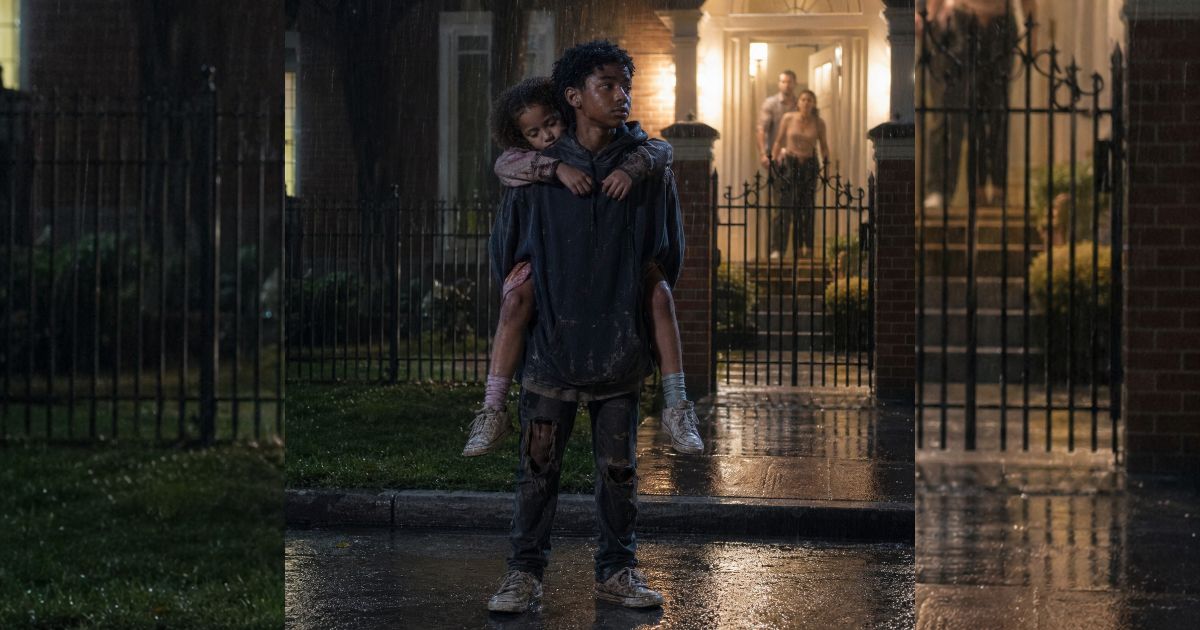
At the top of the hill, Malik saw the gate.
Black iron.
Tall brick pillars.
A long driveway curling behind it.
A house beyond the trees, wide and bright, with windows glowing like every room had been waiting awake.
Ava lifted her head before he said anything.
“I hear the fountain,” she whispered.
There was a small fountain somewhere inside the gate.
Water over stone.
Home had a sound.
Malik walked to the call box.
His finger hovered over the button.
For one second, he imagined pressing it and disappearing before anyone came out.
Just leaving her safe inside the gate.
No questions.
No eyes.
No adults deciding what to do with him.
Then Ava said, “Will you say goodbye?”
His chest tightened.
“Yeah.”
He pressed the button.
Static crackled.
A man’s voice answered.
“Yes?”
Malik leaned close.
“I found Ava.”
Silence.
Then the voice changed.
“What did you say?”
“I found Ava. She’s here.”
A sharp sound came through the speaker.
Not words.
A chair scraping.
A breath breaking.
The gate clicked.
Then slowly opened inward.
Malik stepped through.
Each step up the driveway felt unreal.
The house grew larger.
Too large.
The porch had white columns and a wide front door with glass panels.
A woman appeared first, wrapped in a cardigan, hair loose, face pale.
Behind her came the man from TV.
Nathan Whitmore.
He did not look rich in that moment.
He looked like a father whose heart had been outside his body for two days.
“Ava?” he called.
Ava slid off Malik’s back before he could help her all the way down.
She wobbled on the porch.
“Daddy?”
Nathan fell to his knees.
He did not care about the wet stone.
He reached for her, then stopped half an inch away.
“Can I hold you, baby?”
Ava sobbed.
“Yes.”
He folded her into his arms.
The woman covered her mouth and cried without sound.
Then she dropped beside them and touched Ava’s hair.
“My sweet girl. My brave girl.”
A man in a neat sweater stood in the doorway behind them, older, tense, with guilt written all over his face.
“Mr. Paul?” Ava said.
His face crumpled.
“I’m here, Ava.”
Nathan looked up at him, and the hallway went cold without anyone raising a voice.
But Malik barely noticed.
He had done what he came to do.
Ava was home.
She was in arms that knew her.
She was not his responsibility anymore.
That should have felt like relief.
It did.
And it hurt.
He stepped backward.
The woman turned through her tears.
“Wait. Please. Come inside. You’re freezing.”
Malik shook his head.
“I’m okay.”
Nathan looked at him then, really looked.
“What’s your name?”
Malik opened his mouth.
But Ava answered first.
“His name is Malik. He gave me his sandwich. He told me a story. He didn’t leave.”
Nathan’s face changed.
Not shock.
Not pity.
Something heavier.
Gratitude when it has nowhere big enough to go.
“Malik,” he said. “Please come inside.”
The house was warm behind him.
Too warm.
Too bright.
Too full of things he could stain just by standing near them.
Malik saw the polished floor.
The framed photos.
The clean blankets.
The silver tray on a side table.
He saw a world where every object had a place.
He did not.
“She’s safe now,” he said.
Then he turned and walked back down the steps.
“Malik!” Ava cried.
He stopped.
For half a second.
He did not look back.
If he looked back, he might not leave.
And Malik had learned long ago to leave before people changed their minds.
So he lifted one hand, just a little, and kept walking.
The gate closed behind him with a soft metal click.
By the time he reached the bus stop five blocks away, his body had begun to shake.
Not from emotion.
From cold.
From hunger.
From carrying hope too far on too little food.
He sat under the glass shelter and pulled his knees to his chest.
There was an ad on the side panel showing a smiling family eating pancakes at a kitchen table.
Malik stared at it until his eyes burned.
He told himself he had done enough.
Ava was home.
That was the point.
Nothing else was supposed to happen.
Nothing else ever did.
He coughed into his sleeve.
The rain slowed.
Cars passed.
A bus came and went.
Nobody got off.
Nobody sat beside him.
He closed his eyes.
When he woke, the sky was darker.
For one confused second, he thought he was back under the gas station tarp.
Then he heard a voice.
“Malik.”
He opened his eyes.
Nathan Whitmore stood in front of the bus shelter wearing a dark coat, rain shining on his shoulders.
He was not alone.
The woman was with him, holding a folded blanket.
Ava was not.
For some reason, that made Malik sit up faster.
“Is she okay?”
Nathan’s expression softened.
“She’s safe. Warm. Asleep. She made me promise to find you before she would close her eyes.”
Malik looked away.
“She shouldn’t worry about me.”
“She does.”
The woman stepped closer, but not too close.
“I’m Julia,” she said. “Ava’s mother.”
Malik nodded.
His hands were shaking, so he hid them under his arms.
Nathan crouched, not caring about the wet sidewalk.
“You carried my daughter across the city in a storm.”
Malik shrugged.
“She needed to get home.”
“You gave her your food.”
“She was hungry.”
“You gave her your socks.”
“She was barefoot.”
Nathan’s voice thickened.
“You walked away.”
Malik stared at the ground.
“Didn’t want trouble.”
“Trouble?”
“People see a kid like me with a kid like her, they make up stories.”
Julia closed her eyes like the sentence hurt her.
Nathan was quiet for a long moment.
Then he said, “You’re right. Some people do.”
Malik looked at him, surprised.
“I won’t insult you by pretending they don’t,” Nathan continued. “But no one in my house believes anything except what Ava told us.”
“What’d she tell you?”
“That you were kind. That your voice sounded like warm toast. That you were scared and helped anyway.”
Malik swallowed hard.
Julia unfolded the blanket.
“May I?” she asked.
Malik hesitated.
Then nodded.
She placed it around his shoulders.
It was thick.
Dry.
Clean.
He almost pulled away because clean things made him nervous.
Instead, he gripped the edge.
Nathan sat beside him on the bus shelter bench.
Not above him.
Beside him.
For a while, nobody spoke.
Traffic moved through the wet street.
A bus sighed at the corner.
Julia wiped her eyes with the heel of her hand.
Finally Nathan said, “I need to ask you something, and you can tell me no.”
Malik braced himself.
“Where do you sleep?”
“Different places.”
“Tonight?”
“Don’t know yet.”
Nathan nodded slowly, like he had expected the answer but hated hearing it.
“Do you have family we can call?”
“No.”
“School?”
Malik gave a small, bitter laugh before he could stop it.
“Not lately.”
Julia sat on his other side now.
“Malik,” she said gently, “you are a child too.”
He hated that sentence.
It made him feel weak.
It made him feel seen.
“I’m sixteen.”
“That is a child,” she said.
“I’ve been on my own a while.”
“That does not make it right.”
He looked at her then.
There was no pity in her face.
Only steadiness.
That was worse.
Pity you could dodge.
Steadiness stayed.
Nathan pulled a thermos from inside his coat.
“Tea,” he said. “Ava said you didn’t like coffee because it smells like burnt dirt.”
Malik almost smiled.
“She said that?”
“She said you agreed with her.”
“I did.”
Nathan handed him the thermos.
Malik drank.
It was sweet.
Too sweet.
Perfect.
Warmth slid into his chest and startled him.
He looked away fast.
“I didn’t do it for money,” he said.
“I know.”
“I don’t want cameras.”
“You won’t have them unless you choose.”
“I don’t want people calling me some hero for a week and forgetting I’m still hungry after.”
Nathan inhaled slowly.
“That is fair.”
Malik’s voice shook now, and he hated that too.
“I don’t want to be a story.”
Julia’s eyes filled again.
“Then don’t be a story,” she said. “Be a person we help tonight.”
The words landed quietly.
Not like a rescue.
Like an open door.
Malik looked at the rain running down the glass.
“What happens after tonight?”
Nathan answered carefully.
“We figure it out with people who know how to help, and we do it the right way. No shortcuts. No secrets. No promises we can’t keep. But tonight, you get dry clothes, food, a room with a door, and sleep.”
A room with a door.
Malik had not known how badly he wanted that until someone said it.
He rubbed his thumb over the thermos lid.
“What if I say no?”
“Then we leave you with the blanket, food, and a number. And I’ll come back tomorrow if you let me.”
That answer broke something in him.
Because it was not a trap.
It was not a command.
It gave him back the one thing life had taken again and again.
Choice.
Malik stared at Nathan’s outstretched hand.
He had seen hands like that before.
Hands that pulled people into cars.
Hands that signed papers.
Hands that pointed toward doors.
This one waited.
Open.
Patient.
Ava’s voice echoed in his mind.
He didn’t leave.
Slowly, Malik reached out.
Nathan helped him stand.
Back at the Whitmore house, Malik stopped at the front door.
The warmth hit his face.
His shoes dripped onto the mat.
He froze.
Julia noticed.
“You’re not in trouble for being wet,” she said.
He let out a breath he had been holding for years.
Inside, everything smelled like soup and lemon cleaner and cinnamon.
A woman from the household staff, Mrs. Ellis, met them near the hall with towels.
She was older, with silver hair pulled into a bun and a face that looked like it had no patience for nonsense but plenty of room for kindness.
“This way, young man,” she said. “Bathroom first. Dry clothes on the counter. Soup after. No arguments.”
Malik blinked.
Nathan almost smiled.
“I don’t argue with Mrs. Ellis.”
“Smart man,” she said.
The bathroom was bigger than Malik’s whole shelter.
He stood under the shower for ten full seconds before touching the soap.
Hot water ran over his hair, his shoulders, the cold places between his bones.
He watched gray water circle the drain.
He thought he would feel happy.
Instead, he felt like crying.
He pressed his hand against the tile and kept quiet until it passed.
The clothes waiting for him were simple.
Sweatpants.
A plain sweatshirt.
Thick socks.
No logos.
No rich-person nonsense.
Just warm.
When he came out, Mrs. Ellis looked him over.
“Better,” she said. “Still too thin.”
“I know.”
“At least you’re honest.”
She led him to the kitchen.
Nathan and Julia sat at the table.
Ava sat between them wrapped in a blanket, her hair washed and braided loosely.
When she heard Malik’s footsteps, she sat up straight.
“Warm toast?”
Malik froze.
Then he said, “Crinkly shoes?”
Ava smiled so big his chest hurt.
“You came back.”
“Your dad found me.”
“I told him to.”
“Bossy.”
“Yes.”
He sat across from her.
Mrs. Ellis put a bowl of chicken noodle soup in front of him.
The steam rose into his face.
He waited.
Everyone was watching, but not in a bad way.
Still, he could not lift the spoon.
Julia seemed to understand.
She looked away first and began helping Ava with her cup.
Nathan turned to Mrs. Ellis and asked about towels.
The room gave Malik privacy without leaving him alone.
So he ate.
Slow at first.
Then not slow.
The soup was warm and salty.
The bread beside it was soft.
His body forgot manners for a minute.
When he realized, he stopped, embarrassed.
Mrs. Ellis placed another piece of bread on his plate.
“Growing boys eat,” she said. “That’s not a character flaw.”
Ava giggled.
Malik looked down so they wouldn’t see his eyes.
After dinner, Nathan asked Malik to sit with him in the study.
Malik stiffened at the word study.
He imagined leather chairs, books nobody touched, and questions he could fail.
But Nathan left the door open.
Julia stayed nearby.
Ava sat on the rug outside the study with a music box in her hands, refusing to go upstairs until she knew Malik wasn’t leaving.
Nathan placed a folder on the desk.
“I want you to know what we’ve learned,” he said.
Malik sat on the edge of the chair.
“About me?”
“About Ava.”
Nathan opened the folder.
Not police papers.
Not anything dramatic.
Just printed timelines, phone records, notes from staff, a map of West End Park.
“Paul was supposed to stay beside her,” Nathan said. “He took a personal call. Then he waited too long to tell us she was gone because he panicked. He thought he could find her himself and avoid admitting he had failed.”
Malik stared at the map.
That delay had cost Ava hours.
Maybe a whole night.
“Is he going to jail?” Malik asked.
Nathan shook his head.
“This is being handled as a serious breach of trust and employment responsibility. There are consequences. But tonight is not about revenge.”
Malik liked that answer more than he expected.
People with power often sounded eager to crush someone.
Nathan sounded tired.
And hurt.
“I keep thinking,” Nathan said quietly, “that while the adults were protecting their pride, a sixteen-year-old with nothing protected my daughter.”
Malik did not know what to say.
Nathan closed the folder.
“I’m sorry.”
“For what?”
“For the kind of world that made you believe you had to disappear after doing something good.”
Malik looked down at his hands.
They looked different clean.
Still his.
But unfamiliar.
“I did disappear.”
“You tried.”
Ava called from the hallway.
“He’s bad at it.”
For the first time, Malik laughed in that house.
Nathan laughed too, softly.
That night, Malik slept in a guest room at the end of the hall.
The bed was too soft.
The room was too quiet.
The door clicked shut, and panic rose in his chest.
He opened it again.
Just a crack.
Then he lay down fully dressed under the blanket.
On the nightstand, Julia had placed a glass of water, a plate with two biscuits, and a small note.
You are safe here tonight.
No one will come in without knocking.
—Julia
Malik read it three times.
Then he placed it under the pillow beside his mother’s photo.
Sleep came slowly.
When it did, it came deep.
In the morning, sunlight touched the wall.
For one second, Malik did not know where he was.
Then he smelled pancakes.
He sat up fast.
The biscuits were still on the plate.
Nobody had taken them.
Nobody had taken his backpack.
Nobody had taken his shoes.
He opened the door.
Ava stood in the hallway with one hand on the wall.
“Malik?”
“How’d you know I was awake?”
“Your door squeaked.”
“You been standing there?”
“Maybe.”
“That’s creepy.”
“I’m seven.”
“That doesn’t make it less creepy.”
She grinned.
“Breakfast.”
In the kitchen, Nathan was burning pancakes.
Julia was pretending not to notice.
Mrs. Ellis was noticing very loudly.
“Mr. Whitmore, if that pan gets any hotter, it will need its own zip code.”
Ava laughed.
Malik stood in the doorway, unsure whether to enter.
Nathan looked up.
“Good morning.”
No speech.
No heavy thank-you.
Just good morning.
Like Malik belonged at breakfast.
Like it was normal for him to be there.
That almost sent him running.
Instead, Ava held out a chair with both hands and missed the table by a foot.
“This is your seat.”
Malik sat.
The pancake was slightly burnt.
He ate every bite.
Over the next week, the outside world tried to turn Malik into a headline.
Unknown Teen Hero.
Homeless Boy Saves Heiress.
Angel in a Hoodie.
Nathan shut most of it down.
“No interviews,” he told reporters at the gate.
“No cameras near my daughter.”
“No, we are not sharing private details about a minor.”
When people asked about Malik, Nathan said only one thing.
“He helped my daughter when she needed help. Now the adults are going to help him with the dignity he deserves.”
Malik saw one clip on the kitchen TV and asked them to turn it off.
They did.
That mattered.
A caseworker came.
Not the cold kind Malik remembered.
A woman named Ms. Raymond with soft shoes, patient eyes, and a folder she did not wave around like a weapon.
She asked Malik questions.
Real ones.
Where had he last gone to school?
Did he feel safe?
Did he have documents?
Was there any adult from his past he trusted?
Malik answered slowly.
Sometimes not at all.
Nobody rushed him.
Nathan did not try to buy his way around the process.
Julia did not make promises about adoption over breakfast like life was a movie.
They did things carefully.
Properly.
With meetings and signatures and calls and waiting.
Malik hated the waiting.
But he respected the honesty.
Temporary placement came first.
Then school enrollment support.
Then counseling he refused twice and accepted the third time because Ava told him, “Talking is just thinking where somebody else can hear it.”
He told her that sounded like something from a fortune cookie.
She said fortune cookies were wise and crunchy.
By the third week, Malik had new shoes, two school sweatshirts, a bus pass, and a room that still felt borrowed.
He kept his backpack packed beside the bed.
Julia saw it one morning.
She did not tell him to unpack.
She only placed a small wooden hook on the wall.
“For when you’re ready,” she said.
He hated how kind she was.
He loved it too.
School was harder.
Students recognized him from the blurred video even though his face had never been clear.
Some whispered.
Some stared.
One boy asked if he got paid.
Malik walked away.
One girl left a granola bar on his desk without a word.
He put it in his backpack and ate it later.
He was behind in math.
Ahead in reading.
Quiet in every class.
When a teacher asked him to write about a personal hero, he wrote about his mother making skillet toast in a cold apartment and singing like the lights were still on.
The teacher handed it back with a note.
You have a voice. Use it carefully. It matters.
Malik folded that note and put it with Julia’s under his pillow.
Ava changed too.
Slowly.
She started sleeping through the night.
She started laughing when Mrs. Ellis scolded the toaster.
She returned to her music lessons.
But she also reached for Malik whenever the house got too loud.
He became her map through rooms she already knew.
“Three steps,” he would say.
“Chair on your right.”
“Your dad left his shoes in the hall again.”
Nathan would call from another room, “I heard that.”
“You were supposed to,” Malik would say.
Ava loved that.
One Sunday, the house smelled like cinnamon.
Malik came downstairs and stopped in the kitchen doorway.
Julia was making French toast.
Ava sat at the counter cracking eggs badly.
Nathan read the paper and pretended he wasn’t getting flour on his sleeve.
Mrs. Ellis stood guard with a dish towel.
It was loud.
Warm.
Messy.
The kind of morning Ava had described in the alley.
The kind of morning Malik had thought belonged only to other people.
Ava tilted her head.
“Malik’s sad.”
Everyone paused.
Malik stiffened.
“I’m not sad.”
“Yes, you are. Your quiet got heavy.”
He almost snapped.
Not because she was wrong.
Because she was right in front of everyone.
Julia set down the whisk.
Nathan folded the paper.
No one pushed.
That gave Malik enough room to speak.
“My mom used to make breakfast on Sundays,” he said.
His voice sounded rough.
Nobody filled the silence.
So he kept going.
“She’d burn the first piece of toast every time. Said it was tradition. Then she’d scrape it with a knife and give it to herself because she said moms get the ugly piece.”
Julia’s eyes shone.
Ava smiled softly.
“Can we make one ugly piece?” she asked.
Malik laughed under his breath.
“That’s weird.”
“Tradition is weird.”
Mrs. Ellis placed a slice of bread in the pan.
“Ugly piece coming up.”
When it was done, dark at the edges, Julia put it on a small plate and set it in the middle of the table.
Not for eating.
Just there.
A little burnt offering to a woman none of them had met, but who had raised a boy who gave away his only sandwich.
Malik stared at it until the room blurred.
Nathan placed a hand on the table, not touching him, just near.
“We can make room for her memory here,” he said.
That was the moment Malik began to unpack.
Not all at once.
One shirt in a drawer.
Then the comb.
Then the photo of his mother on the nightstand.
Then the clean napkin, still folded.
Ava asked about it.
“Why do you keep a napkin?”
Malik shrugged.
“It was clean.”
She nodded like that made perfect sense.
And maybe it did.
Months passed.
The city moved on.
People found new stories to share, new headlines to argue over, new reasons to forget.
But inside the Whitmore house, nobody forgot.
Not Ava, who still called Malik warm toast when she wanted to annoy him.
Not Julia, who packed his school lunch with two sandwiches because she knew hunger could haunt even after food arrived.
Not Nathan, who sat with him through every meeting, every form, every careful step toward making the placement permanent.
Not Mrs. Ellis, who pretended not to cry the day Malik called her “ma’am” and she told him for the tenth time to call her Mrs. E like everyone else.
And not Malik.
He remembered the alley.
The sandwich.
The rain.
The gate.
The way he almost left forever because being wanted felt more dangerous than being cold.
The day the final approval came, there was no grand speech.
No cameras.
No dramatic announcement.
Just Nathan walking into the kitchen with papers in his hand and tears in his eyes.
Julia covered her mouth.
Ava stood so fast her chair nearly tipped.
Mrs. Ellis said, “Careful,” but she was crying too.
Malik looked at the papers.
Then at Nathan.
“What does it mean?”
Nathan’s voice broke.
“It means if you want this to be your home, it is. Not just tonight. Not just for now.”
Malik could not move.
Ava reached for his hand and missed, catching his sleeve instead.
“You’re staying?”
Malik looked around the kitchen.
At the burnt toast plate they still used on Sundays.
At his backpack hanging empty on the wooden hook.
At his mother’s photo tucked beside Ava’s school picture on the shelf.
At the people waiting for his answer like it mattered.
He thought about the boy he had been behind the bakery.
Invisible.
Hungry.
Certain the world had no place for him.
Then he thought about a little girl’s voice in the rain.
Are you still there?
Malik squeezed Ava’s hand.
“Yeah,” he said, his voice trembling. “I’m staying.”
Ava smiled.
Nathan pulled him into a hug, slow enough that Malik could step away if he needed to.
He didn’t.
Julia joined them.
Then Ava.
Then Mrs. Ellis, who claimed she was only keeping everyone from falling over.
For the first time in years, Malik let himself be held without planning his escape.
That night, he sat on the front porch after dinner.
The rain had returned, but gently.
It tapped the roof like fingers on a table.
Ava sat beside him wrapped in a blanket.
Nathan and Julia were inside cleaning the kitchen badly while Mrs. Ellis complained loudly enough for the neighbors to hear.
Ava leaned her head against Malik’s arm.
“Tell me the story again,” she said.
“Which one?”
“The girl who heard colors.”
Malik looked out at the dark driveway, the brick pillars, the gate that no longer looked like a wall keeping him out.
“Okay,” he said.
“Once there was a girl who could hear colors. She got lost in a city that was too busy to listen. But a boy found her. He didn’t have much. No car. No map. No dry socks. But he had a sandwich, a story, and a stubborn heart.”
Ava smiled.
“What color was his heart?”
Malik thought about it.
The alley.
The rain.
His mother’s skillet toast.
The warm kitchen.
The empty backpack on the hook.
“I don’t know,” he said. “What color do you think?”
Ava listened to the rain.
“Gold,” she said.
Malik shook his head.
“Too fancy.”
“Brown, then,” she said. “Warm brown. Like toast.”
He laughed softly.
“Fine.”
“What happens at the end?”
Malik looked through the window.
Inside, Nathan dropped a pan.
Julia laughed.
Mrs. Ellis said something sharp.
The whole house sounded alive.
“At the end,” Malik said, “the boy finds out he wasn’t invisible after all.”
Ava slipped her hand into his.
“And the girl gets home?”
“Yeah.”
“And the boy?”
Malik held her hand gently.
“He gets home too.”
Thank you so much for reading this story!
I’d really love to hear your comments and thoughts about this story — your feedback is truly valuable and helps us a lot.
Please leave a comment and share this Facebook post to support the author. Every reaction and review makes a big difference!
This story is a work of fiction created for entertainment and inspirational purposes. While it may draw on real-world themes, all characters, names, and events are imagined. Any resemblance to actual people or situations is purely coincidenta