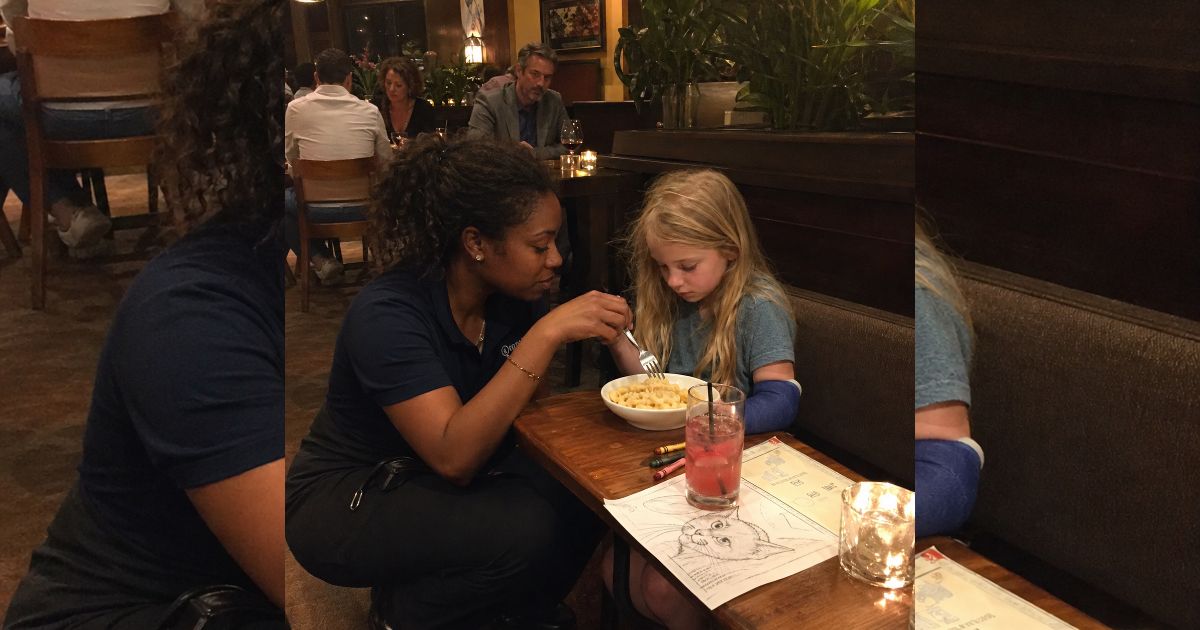
A waitress with aching feet helped a quiet little girl eat with one hand — not knowing the child’s father owned the restaurant and was watching everything.
The glass hit the floor so hard that every table went silent.
One second, Tiana Brooks was reaching for a water pitcher.
The next, a crystal glass was in pieces across the black-and-white tile, glittering under the warm restaurant lights like crushed ice.
Forks froze halfway to mouths.
A woman in a pearl sweater leaned back like the sound had offended her personally.
Someone near the bar whispered, “Oh, dear.”
Tiana was already on her knees.
“Sorry,” she said quickly, though no one had asked for an apology yet. “I’ve got it.”
Her hands moved fast, too fast, scooping the larger pieces into a folded napkin. Her fingers trembled as she worked around the tiny shards.
She had been on her feet since noon.
It was almost nine at night.
Her back ached.
Her knees burned.
Her black non-slip shoes had a hole near the left toe, and every step reminded her she needed new ones.
But new shoes could wait.
Rent could not.
Her mother’s medication could not.
The final notice taped to the refrigerator could not.
“Tiana.”
That one word came sharp from behind her.
She didn’t have to turn around to know who it was.
Darren Cole stood near the host stand with his arms crossed over his chest, wearing his tight manager smile that never reached his eyes.
He was in his mid-forties, pale, round-faced, and always freshly pressed.
He liked his shirts white, his shoes shiny, and his employees nervous.
“That’s the third glass this month,” he said loudly enough for nearby tables to hear. “You know where that comes from.”
Tiana kept her eyes on the floor.
“My check,” she said.
“That’s right.”
A man at table six suddenly became fascinated with his soup.
A woman at table nine looked down at her phone.
Nobody said a word.
Tiana stood slowly, careful not to let the shame show on her face.
Her name tag had tilted sideways.
Tiana. Server.
She brushed invisible glass dust from her apron and forced her voice to stay calm.
“Won’t happen again.”
Darren looked her up and down.
“It better not.”
Then he turned away like she was a spill someone else needed to clean.
Tiana swallowed the bitterness and carried the broken glass toward the trash.
She had learned a long time ago that pride did not pay bills.
Neither did being right.
And she could not afford to lose this job.
Not this week.
Not with her mother’s walker making that tired metal squeak every time she moved down the hallway.
Not with the pharmacy balance still waiting.
Not with the landlord leaving polite but firm notes under the door.
At twenty-eight, Tiana Brooks looked younger than she felt.
She was tall, with dark brown skin, tired eyes, and tight black curls pulled into a bun that had started neat that afternoon and was now barely holding on.
Her navy uniform was clean but faded at the seams.
Her apron had two stubborn stains that would not come out no matter how many times she scrubbed it in the sink.
Her fingers carried small burns from hot plates.
Her shoulders carried everything else.
Four years earlier, she had worn a white coat instead of an apron.
She had walked through the halls of Boston Commonwealth School of Medicine with a notebook under one arm and a stethoscope tucked in her pocket.
She had wanted to work with children.
Not because it sounded noble.
Because kids told the truth with their eyes before they ever spoke.
Her professors had noticed.
Especially Dr. Elaine Rodman, who had once pulled Tiana aside after a pediatric rotation and said, “You calm children before you even say a word. That cannot be taught.”
Tiana had carried that sentence like a small light in her pocket.
Then her mother collapsed in the kitchen.
One minute Dorothy Brooks was stirring soup.
The next, the spoon clattered against the stove and the bowl slid from her hands.
The diagnosis came fast.
A progressive nerve disease.
A flood of appointments.
A new stack of bills every week.
Tiana withdrew from school because there was no one else.
Her mother needed help bathing.
Help walking.
Help remembering which pills came before breakfast and which ones came at night.
And Tiana needed money.
So the white coat went into a storage bin.
The stethoscope went into a drawer.
The dream was placed somewhere quiet, where it could not keep begging her to come back.
“Tiana,” Darren called from the service station. “Table twelve needs bread. Table seven needs refills. And don’t forget the couple by the window.”
“On it,” she said.
She grabbed a bread basket, two waters, and a clean set of napkins, then moved through the dining room with the kind of speed that looked easy only to people who had never done it.
The restaurant was called The Sapphire Room.
It sat in a pretty old brick building in Cambridge, just across from a row of small boutiques and expensive apartments.
Inside, everything was soft lighting, polished wood, white plates, and quiet jazz.
The kind of place where people ordered dessert even when they said they were too full.
The kind of place where a single dinner could cost more than Tiana made in a shift.
It was beautiful from the outside.
But behind the swinging kitchen doors, it was the same as every other place she had worked.
Too few people.
Too many rules.
Not enough grace.
“Tiana?”
She turned.
Jessica Miller stood near the server station, blonde ponytail swinging, lip gloss shining under the overhead light.
Jessica was twenty-one, pretty in an easy way, and one of Darren’s favorites.
She lived with her parents in a suburb outside the city and talked often about being “so broke,” though she had once complained that her dad made her wait a week before buying her a new phone.
“Can you cover my section for like twenty minutes?” Jessica asked. “My boyfriend’s outside. He brought dinner, and I really need to talk to him.”
Tiana stared at her.
“I’m already covering five tables.”
“I know, but you’re better at this than me.”
“That’s not the compliment you think it is.”
Jessica gave a little laugh, then lowered her voice.
“Come on. Remember last week when you took that call from your mom’s doctor behind the walk-in? I didn’t say anything to Darren.”
Tiana’s jaw tightened.
That call had lasted seven minutes.
Seven minutes while she stood between boxes of lettuce and a humming freezer, listening to a nurse explain that her mother’s latest treatment plan needed to be adjusted again.
Seven minutes while Tiana tried not to cry into her sleeve.
She looked at Jessica.
“Twenty minutes.”
“Thank you. You’re the best.”
Jessica was already moving toward the front door before Tiana finished nodding.
Twenty minutes became forty.
Forty became an hour.
By then, Tiana was balancing two sections, three complaints, and one table that kept sending back their iced tea because it had “too much ice.”
Darren saw everything.
He said nothing.
At nine-thirty, he pinned the new schedule to the corkboard near the kitchen.
Servers gathered around it in little waves, checking their shifts, sighing, swapping complaints.
Tiana waited until the crowd moved.
Then she stepped forward.
Her eyes ran down the list.
Monday.
Nothing.
Tuesday lunch.
Friday dinner.
Sunday lunch.
Three shifts.
She stared, waiting for the letters to rearrange.
They did not.
She usually worked seven.
She found Darren in the narrow office near the storage room.
“Can I ask about next week?” she said.
He didn’t look up from his computer.
“What about it?”
“I’m down to three shifts.”
“That’s what the schedule says.”
“I usually have seven.”
“Jessica asked for more hours.”
Tiana stood very still.
“She left her section tonight for over an hour.”
“She’s good with customers.”
“I’m good with customers.”
Darren leaned back.
“Tiana, don’t make this emotional.”
The words hit her in the chest.
“I’m not making it emotional. I’m telling you I need the hours.”
“We all need things.”
“My mother depends on me.”
“That is not the restaurant’s responsibility.”
For a second, the office seemed too small for the breath in her lungs.
Tiana nodded once.
Not because she agreed.
Because she knew what happened when a woman with no safety net argued with a man holding the schedule.
She walked back out.
Three more hours.
That was what she had left before she could sit down.
Three more hours to smile.
Three more hours to refill glasses.
Three more hours to pretend her life was not cracking under the weight of other people’s decisions.
She did not know that at table fifteen, tucked into the quiet corner by the windows, someone was waiting who would change everything.
The hostess found Tiana near the coffee station just before the last dinner rush thinned.
“Hey,” she said, looking uncomfortable. “Table fifteen. It’s just a kid for now. Her dad’s running late. Nobody else wants to take it.”
Tiana glanced across the room.
A little girl sat alone at the corner table.
She looked about ten, maybe eleven.
Her honey-blonde hair fell around her face like a curtain.
A blue cast covered her right forearm from wrist to elbow.
A wheelchair sat behind the chair she had transferred into, the silver wheels catching the warm light from the window.
The girl’s feet did not quite touch the floor.
She was picking at the edge of the kids’ menu with her left hand.
Nobody had brought her anything except water.
Tiana sighed softly.
“I’ll take it.”
The hostess looked relieved.
“Thank you.”
Tiana tucked her order pad into her apron and walked over.
She did not tower over the girl.
She bent slightly, placing herself at eye level.
“Hi there,” she said gently. “I’m Tiana. I’ll be taking care of you tonight.”
The girl looked up.
Only for a second.
Then back down.
“What’s your name?”
Her left hand twisted the corner of the napkin.
“Lila.”
“Nice to meet you, Lila. Can I get you something to drink while you wait? We have lemonade, apple juice, strawberry soda, ginger ale.”
Lila’s voice came out almost too soft to hear.
“Strawberry lemonade.”
“You got it.”
Tiana returned a few minutes later with the drink on a small tray.
She had already put in a bendy straw.
Not because anyone told her to.
Because she had noticed the cast.
Lila glanced at it, then up at Tiana.
“Extra cold,” Tiana said. “That’s the only proper way to drink strawberry lemonade.”
Lila almost smiled.
Almost.
“Are you ready to order, or do you need more time?”
Lila stared down at the menu.
Her lips pressed together.
Tiana recognized that look.
Too overwhelmed to choose.
Too proud to say so.
“How about this?” Tiana said. “I know the kids’ menu looks boring. But there’s a mac and cheese back there that is not officially on this menu, and it is serious business.”
Lila’s eyes lifted.
“It has three cheeses,” Tiana whispered, like she was sharing a state secret. “And toasted breadcrumbs. And if anyone asks, we never had this conversation.”
A tiny breath came out of Lila.
It was not quite a laugh.
But it was close enough.
“Can I have that?”
“You absolutely can.”
Tiana wrote it down as if it were the most important order in the building.
“Mac and cheese. Strawberry lemonade. Excellent taste.”
As she turned, she noticed a man step through the front door.
Tall.
Dark hair with a little gray at the temples.
Tailored charcoal overcoat.
His face was calm, but his eyes were searching.
The hostess leaned toward him, whispering.
He looked toward table fifteen.
Relief softened his face for half a second.
But he did not go to Lila.
Instead, he asked something quietly.
The hostess nodded and led him to a table two spots away, partly hidden behind a half-wall and a tall plant.
From there, he could see Lila clearly.
But Lila could not easily see him.
Tiana noticed.
Servers notice more than people think.
They notice which husband flinches when the bill comes.
Which woman is smiling too hard.
Which child is trying not to cry.
Which man is watching from two tables away like his whole heart is sitting alone in the corner.
She placed Lila’s order, then ran refills to table seven and bread to table twelve.
Jessica still had not returned.
Darren stood near the bar, talking to two regulars, his smile wide and fake.
When the mac and cheese came up, Tiana carried it herself.
Another server could have done it.
But she wanted to check on Lila.
The bowl was warm, creamy, golden on top.
Lila looked at it like she was hungry but afraid to begin.
Her cast rested awkwardly against the table.
She picked up her fork with her left hand, tried to angle it, then dropped it with a small clatter.
Her cheeks went red.
Tiana pulled out the chair across from her.
“May I sit for just a second?”
Lila shrugged.
Tiana sat.
“Cast making dinner difficult?”
Lila nodded.
Her eyes shone, but she held the tears back with the stubborn pride of a child who had already been watched too much.
Tiana kept her voice easy.
“You know, when one part of your body gets hurt, the rest of you starts learning new tricks. Your brain is very good at backup plans.”
Lila looked up.
“How do you know?”
Tiana hesitated.
Then she smiled.
“I used to study medicine.”
“You were a doctor?”
“Almost. I was studying to become one. For kids, mostly.”
“Why did you stop?”
Tiana’s hand paused for only a moment.
“Life needed me somewhere else.”
Lila seemed to think about that.
Tiana gently picked up the fork.
“Try holding it a little farther back. Like this. Let your wrist rest on the edge of the table so your hand doesn’t have to do all the work.”
She demonstrated first.
Then she guided Lila’s left hand only after the girl nodded.
“There,” Tiana said softly. “See? Your brain is already figuring it out.”
Lila got one small bite.
Then another.
Her shoulders dropped.
“It’s not broken,” she said suddenly, lifting the cast a little. “Just fractured. I fell off my skateboard.”
“That still counts as brave dinner work.”
“It was my fault.”
“Maybe. Or maybe the sidewalk was being rude.”
Lila blinked.
Then she laughed.
A real laugh.
Small, surprised, and bright.
Across the room, the man in the gray coat leaned forward.
Tiana saw it from the corner of her eye.
He heard it too.
Lila looked at her bowl.
“I like to draw,” she said. “But now I have to use my left hand.”
“That is impressive.”
“It looks bad.”
“Most great art starts by looking a little strange.”
Lila studied her.
“You really think that?”
“I do. And for the record, I cannot draw with either hand. So you are already ahead of me.”
Lila laughed again.
Tiana felt something inside her ache.
Not the bad kind.
The kind that reminded her of who she had once wanted to be.
A child’s fear loosening.
A small body relaxing.
A mind deciding it was safe.
She stood slowly.
“I have to check on a few tables before Darren’s eyebrows start yelling at me. But I’ll be back.”
Lila glanced toward the manager.
“Is that the man who yelled at you?”
Tiana lowered her voice.
“He thinks volume is leadership.”
Lila covered her mouth with her casted arm and giggled.
From two tables away, the man watched Tiana with a look she did not understand.
Not pity.
Not judgment.
Something sharper.
Something like recognition.
By dessert time, Lila was talking.
Not loudly.
Not easily.
But little pieces of herself began slipping out.
She told Tiana about the orange cat her father was allergic to but let her keep anyway.
She told her about the sketchbook she now turned sideways because her right hand was “on vacation.”
She told her she hated when adults bent down too much and spoke slowly, as if her cast had made her unable to understand English.
Tiana listened.
She did not rush her.
She did not finish her sentences.
She did not say, “Poor thing.”
At one point, Tiana folded an extra napkin and tucked it under the edge of the cast so it would not rub against Lila’s skin.
The girl let her.
That small bit of trust landed quietly between them.
Then Darren’s voice cut across the dining room.
“Tiana.”
She turned.
He stood near the service station, clipboard in hand.
“Jessica’s table has been waiting ten minutes for drinks.”
Tiana took a breath.
“Jessica has been gone for over an hour. I’m covering her section and mine.”
Darren’s mouth tightened.
“Don’t argue on the floor.”
“I’m not arguing. I’m explaining.”
“Then explain faster.” His eyes shifted toward Lila. “And stop babying the kid in the corner. This is not a day care.”
The dining room went quiet in that horrible way people pretend not to notice.
Lila stiffened.
Her left hand curled around the edge of the table.
Tiana felt heat rise in her chest.
But when she spoke, her voice stayed calm.
“Her name is Lila. She is a guest. I’m doing my job.”
Darren’s face darkened.
“Office. After your shift.”
Tiana nodded once.
Not defeated.
Just storing the moment for later.
She turned back toward Lila.
The girl’s eyes were wide.
“Did I get you in trouble?”
“No,” Tiana said immediately. “You did not.”
“But he’s mad.”
“Darren is mad when ice melts too slowly.”
Lila stared for half a second.
Then she laughed so hard she had to cover her mouth.
The man in the gray coat looked down at his table.
His jaw moved once.
When he looked back up, there was no softness in his eyes.
There was decision.
The check came a little later.
Lila had drawn a crooked cat on the back of the kids’ menu using her left hand.
Its eyes were uneven.
Its tail was too long.
One ear pointed up while the other drooped.
Tiana leaned over.
“I love him.”
Lila wrinkled her nose.
“He looks weird.”
“Most interesting cats do.”
“He needs a name.”
Tiana studied the drawing seriously.
“He looks like he has survived something dramatic. Maybe Crash.”
Lila’s face lit up.
“Crash the Cat.”
“Exactly. Crash the Cat. Star of his own comic.”
Lila picked up a crayon awkwardly in her left hand and wrote CRASH above the cat’s head.
The letters wobbled.
But they were hers.
When Tiana returned with the bill, the man from two tables away stood.
He moved toward Lila first.
“Hey, sweetheart.”
“Dad,” Lila said, not surprised. “You were hiding.”
“I was observing.”
“That’s hiding with better vocabulary.”
He smiled faintly.
Then he looked at Tiana.
Up close, he looked more tired than rich.
There were faint lines near his eyes.
His overcoat was expensive, but his face had the worn look of a parent who had spent too many nights sitting beside a child’s bed, wondering how to help.
“I’m Miles Whitaker,” he said.
“Tiana Brooks.”
“I know.”
She blinked.
Something about that made her uneasy.
He slid his card into the bill folder.
“I want to thank you.”
“No need. She was a great guest.”
“I mean it,” he said quietly. “You made this evening easier than it should have been.”
Tiana’s hands tightened around the folder.
“I was just doing my job.”
“No,” Miles said. “You were doing far more than that.”
Before she could answer, Darren appeared beside them.
“Tiana. Office. Now.”
Miles turned his head slowly.
His eyes landed on Darren.
For the first time all night, Darren’s confidence seemed to flicker.
Tiana noticed.
Darren recovered quickly.
“She’s needed in back,” he said.
Miles said nothing.
That silence was worse than any argument.
Tiana looked at Lila.
“You keep drawing Crash, okay?”
Lila nodded.
“I will.”
Miles looked at his daughter.
“You good for a few minutes?”
“I’m fine. Crash is in trouble with Gravity.”
“That sounds serious.”
“It is.”
Tiana followed Darren toward the back hallway.
She did not know that Miles Whitaker was not just a guest.
She did not know he owned The Sapphire Room.
She did not know he had spent the last hour watching one exhausted waitress do what trained professionals had struggled to do for his daughter.
She only knew her feet hurt.
Her mother needed her.
And Darren was about to make her night worse.
The hallway behind the kitchen was hot and narrow.
It smelled like fryer oil, lemon cleaner, and old cardboard.
Tiana followed Darren into the office, where a stack of invoices leaned against a dusty plastic plant.
“Close the door,” he said.
She did.
Darren dropped into his chair like a judge preparing to sentence someone.
“What was that out there?”
“I helped a child eat dinner.”
“You ignored your section.”
“I covered two sections because Jessica left.”
“You agreed to cover her.”
“For twenty minutes.”
“That’s between you and Jessica.”
Tiana stared at him.
“You’re the manager.”
“And I’m managing,” he said. “I’m making a note in your file.”
Her stomach tightened.
“For helping a guest?”
“For failing to prioritize table turnover.”
The phrase sounded like something he had read in a handbook and loved too much.
“She had a cast, Darren.”
“And we are not a hospital.”
The words struck harder than they should have.
Tiana felt her old life flinch inside her.
Darren leaned forward.
“Look, Tiana, you’re a good worker when you stay in your lane. But this sad-story energy you bring in here? It’s heavy. Customers come here to enjoy themselves.”
“My mother being sick does not affect how I serve tables.”
“It affects your availability. Your attitude. Your focus.”
“My focus is the only reason half this floor survived tonight.”
Darren’s eyes sharpened.
“You need to watch your tone.”
Tiana looked at the schedule on his desk.
She already knew.
But she asked anyway.
“What did you do to my shifts?”
He smiled without warmth.
“I adjusted them.”
“How many?”
“One lunch. One dinner.”
The room seemed to tilt.
Two shifts.
Two shifts would not cover rent.
Two shifts would not cover utilities.
Two shifts would not cover anything.
“Darren, please,” she said, and hated that word the moment it left her mouth. “I need those hours.”
“We all need something.”
“My mother depends on me.”
“Your mother is not on payroll.”
Tiana went very still.
Darren must have seen something in her face because he looked away first.
“Tips are pooled tonight,” he said, opening a drawer.
He pulled out a small envelope and tossed it toward her.
It slid across the desk.
She picked it up.
It felt too light.
“New distribution system,” he said. “Based on teamwork.”
“Teamwork,” she repeated.
“Yes.”
“Jessica left the building.”
“And you agreed to cover.”
There it was again.
The neat little circle.
No exit.
Darren turned back to his computer.
“You’re here Tuesday. Don’t be late.”
Tiana left without another word.
Not because there was nothing to say.
Because everything she wanted to say would cost her more than she had left.
She walked through the emptying dining room.
Lila was gone.
So was Miles.
On table fifteen, the kids’ menu remained.
Crash the Cat stared up from the paper, lopsided and brave.
Beside him, in wobbly left-handed letters, Lila had written:
He is not broken. He is learning.
Tiana stood there for one long second.
Then she folded the paper carefully and slipped it into her apron pocket.
Outside, the night air was cool.
Her old Honda sat under a flickering parking lot light.
Fifteen years old.
A dent near the back bumper.
A passenger window that sometimes stuck halfway.
She sat behind the wheel before opening the envelope.
Forty-three dollars.
Ten hours.
Two sections.
A full dinner rush.
Forty-three dollars.
Tiana did not cry.
Crying took energy.
She drove home through quiet streets, past dark storefronts and glowing apartment windows, past people whose lives looked soft from the outside.
At home, the hallway light buzzed.
Their apartment sat on the second floor of an older brick building just off a busy road in Cambridge.
The carpet in the hallway was worn flat down the middle.
Somewhere downstairs, a television played too loudly.
Tiana opened the door slowly.
The apartment smelled like lentil soup and lavender lotion.
Mrs. Chen from down the hall had left a note on the kitchen counter.
Dorothy ate half a bowl. Evening pills taken. Good spirits. I’ll check in tomorrow.
Tiana touched the note with two fingers.
Mrs. Chen refused real payment.
She accepted groceries, rides to appointments, and Tiana’s homemade cornbread.
Tiana peeked into her mother’s bedroom.
Dorothy Brooks slept on her side, thin hands tucked under her cheek, silver scarf wrapped around her hair.
A medication chart sat on the bedside table.
A walker waited beside the bed.
Tiana watched her for a moment.
Her mother had once been the kind of woman who could carry three grocery bags in each hand and still scold you for not wearing a coat.
Now some mornings she needed help lifting a cup.
Life did not ask permission before changing everything.
In the kitchen, Tiana set the envelope beside the bills.
Water.
Electric.
Rent.
Pharmacy balance.
She sat at the small table and finally let her shoulders drop.
Her body hurt in places she had stopped naming.
She opened her laptop because habit was stronger than hope.
The old medical school portal was still bookmarked.
She did not know why she kept it.
Maybe because deleting it would feel too much like burying herself.
The page loaded slowly.
A red bubble blinked near the top.
One new message.
From Dr. Elaine Rodman.
Tiana’s breath caught.
She clicked.
Subject: Pediatric Neurology Fellowship — Late Application
She stared at the words until they blurred.
Then she read.
Tiana,
I hope this reaches you. I never removed your access because I could not bring myself to close a door I believed you would one day walk through again.
A fellowship position has opened unexpectedly in pediatric neurology. It includes tuition remission, clinical placement, research support, and a living stipend.
The formal deadline passed yesterday, but I have spoken to the committee. If your materials come in immediately, they will review them.
You belonged here then.
You belong here now.
Call me.
Rodman
Tiana covered her mouth.
A sound rose in her throat, somewhere between a laugh and a sob.
She searched her inbox.
There it was.
The original notice.
Sent three weeks ago.
The week her mother had two appointments, the water heater failed, and Tiana worked six double shifts.
She had never seen it.
Her fingers shook as she typed a reply.
Not polished.
Not perfect.
Just honest.
Dr. Rodman,
I just saw this. I am so sorry. I still want this more than I know how to explain. If there is any chance left, I will do whatever is needed.
Tiana
She hit send at 2:17 a.m.
Then she sat back in the kitchen chair and looked at the ceiling.
Even if the committee said yes, how would she do it?
Who would help her mother?
How would they live until the stipend began?
What if she tried to climb back into her old life and fell even harder?
At six in the morning, her phone alarm buzzed.
Morning medication.
Tiana stood, her knees stiff, and moved through the routine by memory.
Water glass.
Pill organizer.
Small napkin.
Blood pressure cuff.
Her mother stirred when Tiana entered.
“Baby?” Dorothy whispered.
“Morning, Mama.”
“You just got home.”
“I slept a little.”
Dorothy gave her the look mothers give when they know their child is lying but do not have the strength to fight it.
“You eating?”
“I will.”
“That means no.”
Tiana smiled faintly.
“I’ll make toast.”
Dorothy took her pills slowly.
Her fingers trembled, but she managed the glass on her own.
That was a good morning.
Tiana counted good mornings like coins.
At 6:07, someone knocked on the front door.
Sharp.
Measured.
Not a neighbor knock.
Not Mrs. Chen.
Tiana froze.
Dorothy looked toward the hall.
“Who is that?”
“I don’t know.”
Tiana walked to the door and peered through the peephole.
A courier stood outside holding a thick cream envelope.
She opened the door with the chain still on.
“Tiana Brooks?”
“Yes.”
“Signature required.”
She signed on a small screen, removed the chain, and took the envelope.
It was heavy.
On the front, embossed in plain black letters, was a name she did not recognize.
Whitaker Hospitality Group.
Inside was a business card and a letter.
The card read:
Miles Whitaker
Founder and Chief Executive Officer
Tiana sat down before she opened the letter.
Miss Brooks,
Last night, I watched you treat my daughter with a kind of care and respect I have been praying someone would show her for more than a year.
You did not know who she was.
You did not know who I was.
That is why it mattered.
Lila has been quiet since her accident. Not simply shy. Quiet in a way that frightened me. Last night, because of you, she laughed. She drew. She called herself “learning” instead of broken.
I would like to meet with you today.
A car will arrive at 9:00 a.m. and wait ten minutes. You are free to ignore this invitation. Nothing will be held against you.
But Lila asked me to send it.
She said, “Please tell Tiana I made Crash a cape.”
Respectfully,
Miles Whitaker
Tiana read the letter twice.
Then a third time.
Her mother watched her from the bedroom doorway, one hand gripping the walker.
“What is it?”
Tiana looked up.
“I think the man from the restaurant owns the restaurant.”
Dorothy blinked.
“That sounds like either a blessing or a problem.”
“I don’t know which.”
Dorothy’s mouth curved.
“Then put on the blazer.”
“Mama.”
“If life sends a car at nine in the morning, you do not answer the door in yesterday’s sorrow.”
Tiana laughed despite herself.
Then she cried.
Just a little.
At exactly 9:00 a.m., a black town car pulled up in front of the building.
Tiana stood at the window in her only professional outfit.
Navy blazer.
Pressed black slacks.
Low heels she had not worn in years.
Small pearl earrings from her medical school days.
Her curls were pulled back neatly.
Her hands would not stop smoothing the front of her blazer.
Mrs. Chen sat at the kitchen table with Dorothy, waving her off like a general.
“Go,” Mrs. Chen said. “I have tea. I have instructions. I have your mother telling me what I’m doing wrong already.”
Dorothy lifted her chin.
“Because you put too much water in oatmeal.”
Mrs. Chen rolled her eyes.
Tiana kissed her mother’s forehead.
“I’ll be back soon.”
“Come back with good news,” Dorothy said.
“I don’t know if that’s what this is.”
“Then come back with your head up.”
The ride took her through the city she knew by bus stops and overdue errands.
This time, she saw it from the back seat of a quiet car with bottled water in the door and leather so soft she was afraid to touch it.
The Whitaker office sat on the upper floors of a glass building overlooking the river.
No real warmth from the outside.
Just steel, windows, and money.
But when the elevator opened, the first sound she heard was Lila’s voice.
“Tiana!”
Lila sat near a wide window in her wheelchair, a sketchbook open across her lap.
Her cast was covered with tiny stickers.
A tall glass of strawberry lemonade sat on the table beside her.
At nine-thirty in the morning.
Tiana smiled before she could stop herself.
“Strawberry lemonade before lunch?”
Lila grinned.
“I have connections.”
“I see that.”
“And Crash has a cape now.”
She turned the sketchbook around.
Crash the Cat now wore a crooked cape, one side longer than the other.
His front paw was raised.
Underneath, Lila had written: Not broken. In training.
Tiana’s throat tightened.
“That is excellent character development.”
Lila beamed.
“My dad’s on a call. He said I could start without him.”
“Start what?”
“Convincing you to stay.”
Tiana blinked.
Before she could answer, Miles stepped into the waiting area.
No overcoat today.
Just a charcoal suit, open collar, tired eyes.
“Lila,” he said gently.
“What? You said we were going to ask.”
“I said I was going to speak with Miss Brooks.”
Lila looked at Tiana.
“Adults make everything take longer.”
Tiana laughed softly.
Miles smiled, but his expression carried weight.
“Miss Brooks, thank you for coming.”
“Tiana is fine.”
“Then please call me Miles.”
He gestured toward a conference room.
“Would you join me for a few minutes?”
Tiana glanced at Lila.
“I’ll watch Crash,” Lila said solemnly. “He gets nervous in meetings.”
Inside the conference room, the city spread out below them.
Tiana stayed standing.
So did Miles.
For a few seconds, neither spoke.
Finally, Tiana said, “I only have one question.”
“I imagine you have several.”
“Why am I here?”
Miles nodded slowly, as if he had expected that.
“Because last night I saw my daughter laugh for the first time in months.”
Tiana’s guarded expression did not change.
“I’m glad. But that doesn’t explain this.”
“No,” he said. “It doesn’t.”
He slid a folder across the table.
“I own The Sapphire Room. I also own several other restaurants under our hospitality group. I am not involved in the daily management of each location, which is not an excuse. It is the reason I missed things I should not have missed.”
Tiana opened the folder.
Schedules.
Tip pool records.
Staff complaints.
Email printouts.
Her name highlighted several times.
So was Jessica’s.
So was Darren’s.
Tiana’s stomach tightened.
“What is this?”
“An internal review that should have happened long ago.”
She turned a page.
There were notes about shift cuts after medical absences.
Complaints from two former servers about tip distribution.
A handwritten report that had never been forwarded.
Miles’s voice stayed even, but there was anger underneath it.
“Darren was terminated this morning.”
Tiana looked up.
The words did not land right away.
“What?”
“He no longer works for us. There will be a full audit. Any staff member affected by improper scheduling or tip practices will be compensated where appropriate. A new manager is being brought in while we review the location.”
Tiana set the folder down.
She did not feel joy.
Not exactly.
She felt the strange emptiness that comes when someone finally says, Yes, that was wrong, but only after you have already paid for it.
“He said my mother wasn’t on payroll,” she said quietly.
Miles’s face changed.
“I’m sorry.”
“You didn’t say it.”
“No. But it happened in my restaurant.”
The room went still.
Tiana looked toward the glass wall.
Lila was outside, drawing carefully with her left hand.
“You didn’t bring me here just to tell me Darren was fired.”
“No.”
Miles placed another folder on the table.
“I want to offer you options.”
Tiana let out a short breath.
“Options usually come with strings.”
“These do not come with personal strings. But they do come with responsibility.”
She met his eyes.
“Go on.”
“The first option is a management role at The Sapphire Room. Full salary. Benefits. A real schedule. You know the floor, the staff, and the gaps better than anyone.”
Tiana stared at him.
“Managing the place where I was humiliated?”
“If that is how it feels, then it is the wrong option.”
She said nothing.
“The second option,” Miles continued, “is with our community outreach program. We partner with neighborhood clinics, family centers, and pediatric support groups. Your medical background would be useful. The pay is stable, and it includes housing assistance.”
Tiana’s chest tightened again.
Medical background.
Those two words hurt.
Like someone touching a bruise.
“And the third?”
Miles slid a cream envelope toward her.
“The third is school.”
She did not touch it.
“I spoke to Dr. Rodman this morning.”
Tiana’s breath caught.
“She was very careful,” Miles said. “She did not share private details. I reached out only after reading what you had listed in your employee file about your prior education. She confirmed there is a possible fellowship review if you submit your materials today.”
Tiana’s hand moved to the edge of the envelope.
“What exactly are you offering?”
“A scholarship through a private educational fund my family controls. Tuition support. Housing support for you and your mother. In-home care coverage during class and clinical hours. No repayment. No employment requirement with my company. No expectation that you treat Lila, advise us, or become part of our personal life.”
Tiana stared at him.
Her mouth went dry.
“You expect me to believe that?”
“I expect you to question it.”
“Good.”
“I would worry if you didn’t.”
She pushed the envelope back slightly.
“I’m not a project.”
“I know.”
“I’m not a story you can tell at a fundraiser.”
“You won’t be.”
“I’m not some woman you rescue so you can sleep better.”
Miles accepted every word without flinching.
“No,” he said. “You are someone with skill, discipline, and rare instincts. You were placed in a job that used your strength while ignoring your value. I saw that. I have the ability to remove a barrier. That is all.”
Tiana’s eyes burned.
She hated that.
She hated tears in rooms with glass walls.
She looked away.
“Why does your daughter use a wheelchair?” she asked softly.
Miles’s gaze moved toward Lila.
“After her accident, her arm fracture healed better than her confidence. She had some balance issues for a while, then fear did the rest. We are working on it. Carefully. She is physically improving. Emotionally, she has been harder to reach.”
He paused.
“She used to draw every day. Then she stopped. Last night, you handed her crayons like you were handing back a piece of herself.”
Tiana swallowed.
“I just saw a kid who needed a minute.”
“That is the point,” Miles said. “You saw her.”
Outside the room, Lila lifted her sketchbook and pressed it against the glass.
Crash the Cat now stood on a mountain labeled Table Fifteen.
His cape flew behind him.
Tiana laughed through the ache in her throat.
Miles looked at the drawing, then back at Tiana.
“Whatever option you choose, it is yours. If you choose none, that is also yours. The driver will take you home either way.”
Tiana looked at the three folders.
Restaurant.
Community work.
Medical school.
Her old life was sitting in front of her, but not the way she had left it.
This version had scars.
Bills.
A mother who needed care.
A little girl with a blue cast and a superhero cat.
“Can I ask one more thing?” Tiana said.
“Of course.”
“If I go back, and I mean if, I do it as myself. Not as a symbol. Not as your good deed. Not as Lila’s future doctor.”
“I would not want it any other way.”
“And the staff at the restaurant?”
“Protected during the audit. Paid for all scheduled shifts this week. Offered interviews with the interim manager. No retaliation.”
Tiana nodded.
She thought of the broken glass.
The $43.
Her mother at the kitchen table.
Dr. Rodman’s email.
Lila’s careful left-handed letters.
He is not broken. He is learning.
Tiana reached for the third envelope.
Her fingers shook.
But this time, they did not shake from humiliation.
They shook because hope was heavier than she remembered.
“I want to go back to school,” she said.
Miles nodded once.
No applause.
No speech.
Just respect.
“Then we start there.”
The next week moved like a storm.
Not the destructive kind.
The kind that clears the air after too many humid days.
Dr. Rodman called Tiana personally.
“I knew you’d come back,” she said.
Tiana sat at the kitchen table, one hand over her mouth, while Dorothy pretended not to listen from the living room and failed completely.
“I didn’t know,” Tiana admitted.
“That’s all right,” Dr. Rodman said. “I knew enough for both of us.”
There were forms.
Meetings.
A review committee.
Proof of prior coursework.
A housing application.
Care schedules.
Dorothy argued with everyone about needing “all this fuss,” then cried quietly when she saw the accessible apartment they were offered near campus.
It had wide doorways.
A bathroom with safety rails.
A small balcony where she could keep basil and mint.
Mrs. Chen came over to help pack and declared the new place “acceptable,” which from her meant excellent.
The restaurant audit made quiet waves.
No headlines.
No public spectacle.
Just meetings, corrected pay, apologies, and a new manager who actually listened when staff spoke.
Jessica sent Tiana a text two weeks later.
I’m sorry.
Tiana stared at it for a while.
Then she wrote back.
I hope you learn from it.
That was all.
Forgiveness did not have to be warm to be real.
Darren never contacted her.
She was grateful for that.
Some doors are not meant to be reopened.
By fall, Tiana was back in a classroom.
The first morning, she arrived thirty minutes early.
Her white coat hung over her arm.
She sat in the front row because old habits came back easily when they belonged to your truest self.
Around her, students opened laptops and coffee cups.
Someone laughed about being tired after one late night.
Tiana smiled to herself.
She had worked dinner rushes on three hours of sleep.
She had filled pill organizers before sunrise.
She had balanced plates while wondering if the heat would stay on.
She was not the same woman who had left medical school.
She was steadier.
Sharper.
Less impressed by pressure.
When Dr. Rodman entered the lecture hall and saw her, she paused.
Then she smiled.
“Welcome back, Ms. Brooks.”
Tiana put on her white coat.
The sleeves felt strange at first.
Then familiar.
Like a song she had not heard in years but still knew by heart.
Months passed.
Her mother began physical therapy in the new apartment building’s clinic.
Some days were hard.
Some days Dorothy snapped because she hated needing help.
Some nights Tiana cried in the shower so her mother would not hear.
School did not become easy just because she had been given a way back.
There were exams.
Clinical hours.
Long readings that made her eyes ache.
Moments when she sat in the library at midnight and wondered whether she had mistaken a miracle for a challenge too big to survive.
Then her phone would buzz.
A picture from Lila.
Crash the Cat learning to climb stairs.
Crash the Cat dropping his pencil and finding another way.
Crash the Cat wearing a tiny white coat.
Under one drawing, Lila wrote:
Some brains take scenic routes.
Tiana printed that one and taped it above her desk.
She and Lila did not become a fairy tale.
That mattered to Tiana.
She was not hired to fix the girl.
She did not move into their lives like a movie ending.
But sometimes, on Saturday afternoons, Dorothy and Tiana went to the Whitaker home for lunch.
Dorothy and Lila became fast friends, mostly because both of them were stubborn and enjoyed telling Miles when he was wrong.
Lila kept drawing.
Her right arm healed.
Her confidence took longer.
But she began using her wheelchair less.
Then only for long outings.
Then not at all, except when she was tired and annoyed at being asked about it.
Tiana never praised her like a miracle.
She simply said, “Your brain is still making good backup plans.”
Lila would grin and say, “I know.”
One year after the night at The Sapphire Room, Tiana stood in the lobby of a new pediatric therapy center on the edge of Boston.
It was not named after a corporation.
Miles had been careful about that after Tiana raised one eyebrow and said, “Children are not billboards.”
Instead, it was called The Corner Table Center.
Lila had chosen the name.
“Because that’s where people get seen,” she said.
The building was bright without feeling cold.
There were low windows for children in wheelchairs.
Quiet rooms for overwhelmed kids.
Art tables with thick crayons, left-handed scissors, and adaptive grips.
A small family kitchen where parents could make coffee, heat soup, and sit down like human beings.
Not patients.
Not problems.
People.
Tiana had helped review some of the child-friendly designs as a student advisor.
Not a doctor yet.
Not pretending to be.
Just someone who remembered what it felt like to be invisible in a polished room.
The opening was small.
No press.
No giant ribbon.
Just families, staff, a few donors, and children running or rolling or walking carefully through the halls.
Dorothy sat near the front, dressed in a blue blouse, her walker beside her and pride all over her face.
Mrs. Chen sat next to her with a purse full of snacks she insisted nobody needed until everyone did.
Miles stood near the entrance, watching Lila adjust a framed drawing on the wall.
Crash the Cat stood at a corner table with a cape, a fork, and a bowl of mac and cheese.
Beside him stood three figures.
A girl with a blue cast.
A tired waitress with kind eyes.
A cat who looked odd and brave.
Underneath, in Lila’s handwriting, were the words:
She did not fix me.
She saw me.
That was where healing started.
Tiana read it twice.
Her throat tightened.
Lila rolled her eyes.
“Don’t cry. It makes Dad cry, and then he gets weird.”
“I do not get weird,” Miles said.
“You absolutely do.”
Dorothy leaned toward Mrs. Chen.
“He does.”
Miles placed a hand over his heart like he had been betrayed by an entire jury.
Tiana laughed.
A year ago, she had stood in a parking lot holding forty-three dollars after ten hours of work.
A year ago, her dream had felt like a locked door.
A year ago, she thought the best she could do was survive one more shift.
Now she stood in a building designed for children who needed time, patience, dignity, and someone willing to look them in the eye.
She was still tired.
Still busy.
Still carrying more than people could see.
But she was no longer shrinking herself to fit inside someone else’s low expectations.
Later that afternoon, after the guests had eaten small sandwiches and too many cookies, Lila tugged Tiana toward the art room.
“I have something for you.”
On the table sat a new drawing.
This one was cleaner.
More confident.
Crash the Cat stood at the edge of a road split into three paths.
One path led to a restaurant.
One to a medical school.
One to a small apartment balcony full of plants.
Crash was walking down the middle, carrying a tray in one paw and a stethoscope in the other.
Tiana laughed softly.
“Crash is multitasking.”
“He learned from you.”
Tiana looked at the drawing for a long moment.
Then she looked at Lila.
“You know, you helped me too.”
Lila frowned.
“I didn’t do anything.”
“Yes, you did.”
“What?”
“You reminded me I was still in there.”
Lila’s face softened.
For once, she had no quick answer.
She leaned against the table and looked down at Crash.
“Dad says people sometimes meet at the exact wrong time, but it turns out to be the exact right time.”
“Your dad says things like that?”
“Only when he’s trying not to cry.”
Tiana smiled.
“Then he may be right.”
That evening, after the center emptied, Tiana drove Dorothy back to their apartment.
The sun was low over the city.
Dorothy sat in the passenger seat, quiet for several blocks.
Then she said, “I was afraid I had taken your life from you.”
Tiana’s hands tightened on the wheel.
“Mama.”
“I was. Don’t tell me not to say it. Mothers have fears too.”
Tiana pulled into a small overlook near the river and parked.
For a moment, neither of them spoke.
The water caught the last light.
People walked dogs along the path.
A little boy in a red hoodie tried to race his father and nearly tripped over his own feet.
Dorothy looked straight ahead.
“When I got sick, you stopped everything.”
“I did what I had to do.”
“I know. But I still saw it. The white coat went into the box. Your books went quiet. You smiled, but not all the way.”
Tiana’s eyes filled.
“I was angry sometimes,” she admitted.
Dorothy nodded.
“I know.”
“Not at you.”
“I know that too.”
“I was angry that love could cost so much.”
Dorothy reached over slowly and placed her hand over Tiana’s.
Her fingers were thin now.
Still warm.
“Love costs,” she said. “But it should not bury you.”
Tiana looked at her mother then.
Really looked.
At the woman who had raised her alone.
Who had packed lunches when money was thin.
Who had stayed up sewing patches onto school uniforms.
Who had shouted loudest at graduations.
Who had become fragile without ever becoming weak.
“You didn’t bury me,” Tiana said. “You kept me human.”
Dorothy’s mouth trembled.
Then she nodded, once, like she would accept that.
A few days later, Tiana returned to The Sapphire Room for the first time since leaving.
Not as an employee.
Not as a guest exactly.
The new manager had asked her to speak with the staff about service, dignity, and the difference between attention and pity.
Tiana almost said no.
Then she thought of table fifteen.
So she went.
The dining room looked the same.
Soft lights.
Polished wood.
White plates.
Quiet jazz.
But the air felt different.
Or maybe she did.
The staff gathered before opening.
Some faces she knew.
Some she did not.
No Darren.
No clipboard held like a weapon.
Tiana stood near the corner table.
Her old section.
Her old battlefield.
Her old doorway.
She did not give a fancy speech.
She told them about noticing.
Not hovering.
Not assuming.
Not treating a guest like an inconvenience because they need an extra minute.
She told them that people do not always bring their pain loudly into a restaurant.
Sometimes they bring it in quietly.
In a child’s cast.
In an old man’s shaking hands.
In a mother counting prices on the menu.
In a server working double shifts with a smile pinned to her face because rent is due.
“Service is not making people feel small while you help them,” she said. “It is protecting their dignity while you do.”
The room stayed quiet.
This time, it was not the silence of people pretending not to see.
It was the silence of people listening.
Afterward, a young server came up to her.
He could not have been more than nineteen.
“My dad’s sick,” he said awkwardly. “I just started here. I was scared to tell anyone I need Tuesday mornings off for his appointments.”
Tiana looked at the new manager.
The manager nodded.
“Tell us what you need,” she said.
The young man looked startled.
Like kindness had surprised him.
Tiana knew that feeling.
Before she left, she walked to table fifteen.
For a second, she could see it all again.
Lila’s blue cast.
The untouched water.
The strawberry lemonade.
The crooked cat.
The father watching from two tables away, afraid to interrupt the first laugh he had heard in months.
Tiana placed one hand on the back of the chair.
Then she let go.
Some places hold your pain.
Some places hold your beginning.
Sometimes they are the same place.
Two years later, Tiana stood in a pediatric exam room wearing her white coat, a badge clipped neatly to her pocket.
She was not a full doctor yet.
Not quite.
But she was close enough to feel the shape of it.
A little boy sat on the exam table, refusing to look at anyone.
His left hand was wrapped in a soft brace.
His mother looked exhausted.
His father kept checking his watch and then looking ashamed for checking it.
The attending physician glanced at Tiana.
“Want to try?”
Tiana stepped forward.
Not too close.
Not too fast.
She crouched so the boy did not have to look up.
“I heard your hand is taking a break,” she said.
The boy’s eyes flicked toward her.
Just for a second.
“That sounds inconvenient.”
He shrugged.
“I know someone who had a cast once,” Tiana continued. “She became a left-handed comic artist for a while. Very exclusive career.”
The boy looked at her.
“Really?”
“Really. She drew a superhero cat named Crash.”
“That’s a weird name.”
“He was a weird cat.”
A tiny smile appeared.
There it was.
That small opening.
That sacred little crack where fear lets in air.
Tiana did not rush.
She never rushed those moments anymore.
Later, after the appointment, she found a message from Lila waiting on her phone.
Crash got accepted into the school art show. He says thank you for believing in his early work.
Attached was a drawing of Crash wearing a graduation cap.
Tiana laughed alone in the hallway.
Then she typed back:
Tell Crash I expect great things.
Lila replied immediately.
He expects snacks.
Tiana slipped the phone into her pocket and walked toward her next patient.
Her feet still hurt sometimes.
Different shoes now.
Better ones.
But long days were long days.
Her mother still had hard mornings.
Bills still came.
Life did not become perfect because one good person opened a door.
But it became possible.
And possible was not small.
Possible was everything.
On the anniversary of that first night, Lila insisted they all meet at The Sapphire Room.
“Full circle,” she said.
Dorothy said, “I hope the mac and cheese is as good as everyone keeps claiming.”
“It is,” Tiana said.
“It better be.”
Miles reserved table fifteen.
Not the private room.
Not the best table.
The corner table.
Lila walked in on her own, taller now, hair pulled into a messy ponytail, sketchbook under one arm.
Her old blue cast was long gone, but she had kept it in a box.
“Historical artifact,” she called it.
They ordered strawberry lemonade.
Mac and cheese.
Coffee for Dorothy.
Tea for Mrs. Chen, who had somehow become part of every important family event without anyone formally deciding it.
Halfway through dinner, Lila pulled out a folded paper.
“I wrote something.”
Miles looked alarmed.
“Should I be worried?”
“Yes,” Lila said.
She stood beside the table and read.
“Two years ago, I thought people only saw what was wrong with me. My cast. My chair. My fear. Then a waitress I did not know sat down like she had all the time in the world, even though she probably had none.”
Tiana looked down at her napkin.
Lila continued.
“She helped me hold a fork. But really, she helped me hold on to myself. My dad says that night changed our lives. I think it changed hers too. So I made a rule for myself.”
She unfolded the paper farther.
“When I see someone sitting alone at the corner table, I will not assume they want to be left alone. I will ask. I will look. I will see.”
The table went quiet.
Dorothy dabbed at her eyes.
Mrs. Chen pretended she was not crying by aggressively stirring her tea.
Miles looked at the ceiling.
Lila pointed at him.
“See? Weird.”
Everyone laughed.
Tiana reached across the table and squeezed Lila’s hand.
“You did good.”
Lila smiled.
“You always say that.”
“Because you keep doing good.”
At the end of dinner, the server brought the check.
Miles reached for it.
Dorothy slapped his hand lightly with the edge of a napkin.
“Not every good moment has to be purchased by you, Mr. Whitaker.”
Miles froze.
Tiana covered her mouth.
Lila looked delighted.
Dorothy took the bill folder, opened it, and placed a few bills inside.
“It is my turn,” she said.
Miles looked helplessly at Tiana.
Tiana shrugged.
“You heard my mother.”
The server came back and smiled.
“Whenever you’re ready.”
Dorothy handed over the folder with the pride of a queen signing a treaty.
Outside, the night was cool.
The sidewalk lights glowed.
People moved past them, wrapped in their own lives, their own worries, their own private turning points.
Tiana paused near the restaurant window and looked back inside.
Table fifteen was empty now.
Clean.
Reset.
Waiting for whoever needed it next.
She thought about broken glass.
About a man with a clipboard.
About forty-three dollars in an envelope.
About a blue cast and a bowl of mac and cheese.
About a little girl who thought she was broken.
About a woman who thought her future was gone.
Neither had been right.
They had only been interrupted.
Delayed.
Rerouted.
And sometimes a rerouted life still finds its way home.
Tiana turned from the window.
Lila was walking ahead with Dorothy, explaining some new Crash the Cat storyline involving a hospital, a spaceship, and a villain named Bad Wi-Fi.
Miles fell into step beside Tiana.
“You ever think about what would have happened if I hadn’t been late that night?” he asked.
Tiana looked at him.
“I think about what happened because you were.”
He nodded.
“That’s a better answer.”
She smiled.
“I’ve had practice.”
The group moved down the sidewalk together.
Not perfect.
Not magical.
Not untouched by fear or money or illness or regret.
Just human.
And maybe that was the whole lesson.
A life can break open in the middle of an ordinary shift.
A future can hide at a corner table.
A child’s laugh can become a door.
And sometimes, the smallest act of dignity can travel farther than anyone in the room can see.
Thank you so much for reading this story!
I’d really love to hear your comments and thoughts about this story — your feedback is truly valuable and helps us a lot.
Please leave a comment and share this Facebook post to support the author. Every reaction and review makes a big difference!
This story is a work of fiction created for entertainment and inspirational purposes. While it may draw on real-world themes, all characters, names, and events are imagined. Any resemblance to actual people or situations is purely coincidenta