If you’ve already read part 1 of this story on Facebook, go here for Part 2!
The first thing Mia noticed when her father walked into the restaurant was not his face.
It was the jacket.
That same old brown jacket.
Frayed at the cuffs. Shiny at the elbows. One pocket sagging lower than the other like it had been carrying a secret for too long.
Mia was twenty-two years old, sitting in a booth at the little diner off Maple Street, holding a white envelope with her first real paycheck inside it. She had rehearsed this moment in her head all week.
She was going to buy her father a new jacket.
Not because he asked.
He never asked for anything.
Not because he couldn’t technically afford one.
Though Mia knew things had been tight since the factory cut his hours.
She wanted to buy it because every winter of her childhood, her father had worn that jacket through rain, snow, school pickups, late-night pharmacy runs, broken-down cars, and every parent-teacher conference he attended still smelling faintly of motor oil and cold air.
And now she could finally give something back.
“Dad,” she said, smiling before he even sat down, “don’t get mad.”
Ray Morales paused with one hand on the back of the booth.
His face tightened.
“I’m already suspicious.”
Mia laughed, but he didn’t.
He slid into the seat across from her, careful and quiet, like always. He was fifty-six, though the gray at his temples made him look older when he was tired. His hands were rough from work, the knuckles scratched, the nails permanently darkened no matter how hard he scrubbed.
He ordered coffee.
Black.
He didn’t look at the menu.
He never did.
Mia pushed the envelope toward him.
“I got paid today.”
His eyes softened for half a second.
“That’s good, mija.”
“And I want to do something.”
“No.”
“You don’t even know what it is.”
“I know your face.”
She leaned forward. “I want to buy you a new jacket.”
The waitress came by with coffee at that exact moment, and Mia would always remember how the cup clinked against the saucer when her father’s hand bumped the table.
“No,” he said.
One word.
Sharp enough to make her blink.
“Dad—”
“I said no.”
The warmth in Mia’s chest folded in on itself.
She looked at the jacket again. The ripped seam near his shoulder. The place where he had tried to sew the lining himself with black thread that didn’t match. The zipper that caught halfway unless he pulled it just right.
“It’s falling apart,” she said quietly.
“It’s fine.”
“It’s embarrassing.”
The second she said it, she wanted to take it back.
Her father’s eyes lifted.
Not angry exactly.
Worse.
Hurt.
But then his face closed the way it always did. Like a door she had spent her whole life knocking on.
“Then don’t sit with me,” he said.
Mia stared at him.
The diner noise seemed to swell around them. Forks tapping plates. Someone laughing near the pie case. A little boy whining because his pancakes had blueberries.
“Seriously?” she whispered.
He reached for his coffee, but his hand wasn’t steady.
“I don’t need you wasting your money on me.”
“It’s not wasting.”
“It is.”
“You bought me things my whole life.”
“That was different.”
“How?”
“Because you were my kid.”
“And you’re my father.”
His jaw moved like he was chewing words he refused to say.
Mia felt the old ache rise in her throat. The one she had carried through high school every time he missed a choir concert because of work. Every time he answered her stories with a nod instead of questions. Every time he told her to “be careful” instead of “I’m proud of you.”
Her mother used to soften him.
“He loves you in quiet ways,” she would say, brushing Mia’s hair before school.
But her mother had been gone four years now, and the quiet had become colder.
Sometimes Mia wondered if her father had used up all his tenderness on grief.
“Fine,” she said, pulling the envelope back. “Keep it.”
He looked down at the table.
“Mia.”
“No. It’s okay.” She forced a smile that hurt. “You don’t need anything from me. I get it.”
“That’s not what I said.”
“It’s what you always say.”
He flinched.
She grabbed her purse too quickly, knocking a sugar packet onto the floor.
The waitress looked over.
Mia hated that. Hated being watched while she was becoming small again.
Her father reached down slowly to pick up the sugar packet, but she was already standing.
“I have to go.”
“Mija, sit down.”
“I said I have to go.”
This time, her voice sounded like his.
Sharp.
Final.
His face changed then. For one strange second, he looked scared. Not annoyed. Not stubborn. Scared.
But Mia was too hurt to understand it.
She walked out with her paycheck in her purse and tears burning behind her eyes.
Outside, the March wind slapped cold against her cheeks. Through the diner window, she saw her father sitting alone in the booth, both hands wrapped around the coffee cup.
The brown jacket hung from his shoulders like something heavier than cloth.
For two weeks, they barely spoke.
He called once. She didn’t answer.
He texted: You eating okay?
She wrote back: Yes.
That was all.
Then, on a Thursday morning, Mia was shelving paperbacks at the bookstore where she worked when her phone rang.
Unknown number.
She almost ignored it.
Then she saw the voicemail appear.
She stepped into the break room and played it.
“Hi, this is County General calling for Mia Morales. Your father, Raymond Morales, was brought in this morning after he became dizzy at work. He is stable, but we need a family member to come in.”
The room tilted.
Mia drove to the hospital with both hands locked on the steering wheel, praying in broken pieces.
Please let him be okay.
Please let me not have waited too long.
Please let the last real thing I said to him not be about a jacket.
She found him in a curtained room near the nurses’ station. Pale. Awake. Annoyed.
Which should have comforted her.
“You didn’t have to come,” he said.
Mia stood at the foot of the bed, breathless and angry and terrified.
“Don’t start.”
His mouth closed.
A nurse explained it was dehydration, exhaustion, blood pressure, stress. Words that sounded simple until they were attached to the only parent Mia had left.
“He needs rest,” the nurse said gently. “And someone should take his belongings home.”
That was when Mia saw it.
The brown jacket folded over a plastic chair.
Even there.
Even in a hospital room.
Even after scaring her half to death.
The jacket.
Something in her cracked.
She walked to it and lifted it with both hands.
It was heavier than she expected.
“Why?” she whispered.
Her father’s eyes opened.
“Leave it alone.”
Mia turned toward him.
“Dad, why this jacket?”
His face went pale in a different way.
“Mia.”
“No.” Her voice shook. “You snapped at me. You made me feel stupid for trying to love you. And now you’re lying in a hospital bed, still acting like that thing matters more than I do.”
His eyes filled so quickly she almost didn’t believe what she was seeing.
Ray Morales, who had not cried at her mother’s funeral until everyone left the cemetery, looked at his daughter and whispered:
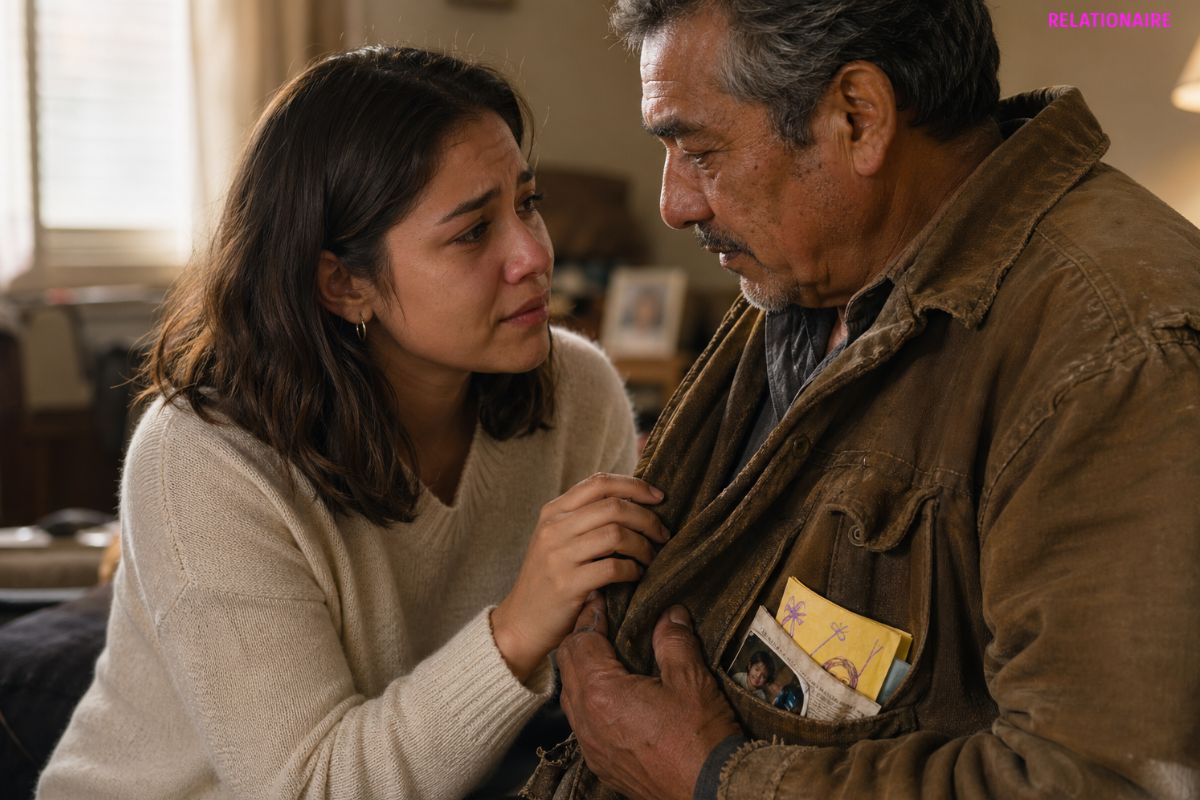
“That jacket is the only place I knew how to keep you.”
Mia stopped breathing.
Then something slipped from the inside pocket and landed softly at her feet.
A folded piece of yellow construction paper.
On the outside, in crooked purple crayon, was written:
Daddy, don’t forget me.
Mia bent down slowly and picked it up.
Her father tried to sit up.
“Mia, please don’t open that yet.”
PART 2
Mia held the folded construction paper like it might fall apart in her hands.
The hospital room seemed too bright.
Machines hummed softly near the bed. Someone laughed at the nurses’ station. A cart squeaked down the hallway with the ordinary sound of a world that did not know hers had just cracked open.
Daddy, don’t forget me.
Her handwriting.
Her little-girl handwriting.
The y was too long. The D was backwards. Purple crayon pressed so hard it had left dents in the paper.
Mia looked at her father.
He had one hand lifted toward her, not reaching exactly, but almost.
Almost was the closest he had ever come to asking.
“Please,” he said.
That word did something to her.
Her father had said no a thousand times. Be careful. Don’t waste money. Lock the door. Call me when you get there.
But please was rare.
Mia folded the paper back exactly as it had been and set it on the blanket near his hand.
“I won’t,” she said.
His shoulders lowered.
Not much.
Enough.
The nurse came in with forms, and the moment disappeared into blood pressure cuffs and discharge instructions and the practical language of care. Mia listened carefully because her father kept pretending he didn’t need to.
No lifting for a few days.
Follow-up appointment.
Better meals.
More water.
Less overtime.
At that, Mia turned to him.
“Overtime?”
He looked away.
The nurse hesitated, sensing the weather in the room.
“He mentioned he’s been taking extra shifts,” she said gently. “Probably too many.”
Mia stared at him.
“You told me they cut your hours.”
“They did.”
“So why extra shifts?”
Ray reached for the paper cup of water and took a slow sip.
“Mia.”
“Dad.”
He hated when she used his tone back at him.
They left the hospital just before sunset.
He insisted on walking, but Mia stayed close enough to catch him if pride stopped being enough. In the parking lot, he shivered.
She held out the brown jacket.
For once, he didn’t put it on right away.
He just looked at it.
Then at her.
Then he slipped his arms through the sleeves with the carefulness of someone putting on a memory.
At his apartment, Mia noticed things she had been too busy being hurt to see.
The fridge had eggs, a half-empty jar of salsa, two apples, and tortillas.
The kitchen table held three unopened bills stacked under a saltshaker.
His work boots were by the door, one lace knotted because it had snapped.
On the couch was the blanket her mother used during chemo, washed so many times it had gone thin.
Mia stood in the middle of the living room feeling like an intruder in the truth.
“You’re staying here tonight,” she said.
“No, I’m not.”
“Yes, you are.”
He lowered himself into the armchair.
“Mia, I’m fine.”
“You were in the hospital.”
“I got dizzy.”
“You scared me.”
That quieted him.
She went to the kitchen and opened cabinets. Rice. Beans. Coffee. Peanut butter. A box of crackers. It was food, technically. Not enough to look like living.
Her throat tightened.
“Dad,” she said, facing the cabinet, “are you skipping meals?”
“No.”
She turned.
He looked too tired to lie well.
“Sometimes,” he said.
Mia pressed her fingers against the counter.
The edge of it was chipped in the same place it had been since she was eight.
“Why?”
He gave a small laugh without humor.
“You know why.”
“No, I don’t.”
He rubbed a hand over his face.
“Yes, you do.”
She did.
She just didn’t want to.
Her student loans. The car repair he had paid for last fall and called “an early birthday thing.” The phone bill that had stayed in his name because she was “just getting started.” The envelopes he mailed with grocery store gift cards, saying he had won them at work.
She thought of every time she had rolled her eyes at his questions.
You got gas money?
You need anything?
Your tires okay?
She had thought he was hovering.
Maybe he had been holding up pieces of her life from a distance.
“I didn’t ask you to do that,” she said, but it came out broken.
“No,” he said. “That’s why I could.”
Mia sat down slowly on the couch.
Her father leaned back and closed his eyes. For a moment, he looked small inside the old jacket.
She hated that more than anything.
“I wanted to buy you something nice,” she whispered.
“I know.”
“You made me feel like I was stupid.”
His eyes opened.
Pain moved across his face before he covered it.
“You were never stupid.”
“Then why did you snap?”
He looked toward the hallway, where old family photos lined the wall. Mia’s kindergarten picture. Her missing front tooth. Her mother with a scarf tied around her head, smiling like she had decided joy was an act of rebellion.
Ray swallowed.
“Because I didn’t know how to explain it without falling apart.”
Mia waited.
He reached into the inside pocket of the jacket, then stopped.
“After your mom got sick,” he said, “you started leaving me things.”
Mia frowned.
“I did?”
“Everywhere.”
He gave the smallest smile.
“In my lunch bag. In my coat. In my work boot once.”
Despite herself, Mia laughed softly.
“I don’t remember.”
“You were nine.”
Nine.
The year hospitals became normal. The year dinner was sometimes cereal. The year her mother’s perfume disappeared from the house and was replaced by sanitizer, medicine bottles, and whispered phone calls.
“You were scared,” he said. “You thought if I went to work, I might not come back either.”
Mia looked down at her hands.
A memory flickered.
Standing in the hallway before school. Her father kneeling to tie her sneaker because her hands were shaking. Asking him, “Are you coming back after work?” And him saying, “Always.”
“You left me that note the first time I had to work a double during your mom’s treatment,” he said.
Daddy, don’t forget me.
Mia’s chest hurt.
“I didn’t mean…”
“I know what you meant.”
His voice was rough now.
“You meant, don’t forget I’m here. Don’t forget I’m little. Don’t forget I’m scared too.”
Mia covered her mouth.
Ray looked down at the jacket.
“I put it in my pocket so I could feel it when I worked. Then there were more. Drawings. Birthday cards. Receipts from places we went because your mom said kids need memories even when life is hard.”
He touched the sagging pocket with two fingers.
“I kept them in here because I was afraid if I put them somewhere else, I’d lose them.”
The apartment was quiet except for the refrigerator clicking on.
Mia wanted to reach for the pocket.
She didn’t.
Not yet.
Her father’s face had gone pale again.
“You should rest,” she said quickly.
He nodded, grateful for the escape.
That night, Mia slept on the couch under her mother’s blanket while her father slept in the bedroom with the door half open, as if he still needed to hear her breathing.
Around 2 a.m., she woke to the sound of him coughing.
Then silence.
Then a drawer opening.
Softly.
She sat up.
Light spilled from the hallway.
“Dad?”
No answer.
Mia followed the light to the kitchen.
Her father stood at the table in his undershirt and pajama pants, the brown jacket laid open in front of him.
Around it were small pieces of paper.
So many.
Notes.
Receipts.
School pictures.
A hospital bracelet.
A faded napkin.
A tiny pink hair clip.
He froze when he saw her.
And in his hand was a receipt Mia recognized instantly.
The toy store on Franklin Avenue.
The date printed across the top was her tenth birthday.
The birthday he had missed.
The birthday she had never forgiven him for.
Her father looked at the receipt, then at her, and whispered:
“That was the night I almost lost your mother.”
PART 3
Mia had carried that birthday like a bruise for twelve years.
Her tenth birthday.
Chocolate cake from the grocery store. Purple candles. Her mother home from the hospital for one good day, wearing lipstick even though her hands shook.
Her father had promised he would be there by six.
By seven, her cake leaned to one side.
By eight, the candles had melted into little puddles.
By nine, her mother was asleep on the couch, one hand resting over her chest, and Mia sat at the kitchen table wearing a paper crown she no longer wanted.
When her father finally came home, she had already gone to bed.
She remembered the hallway light sliding across her blanket.
His shadow in the doorway.
A whisper.
“Happy birthday, mija.”
She had pretended to be asleep.
For years, that was the memory.
Her father missing her birthday.
Her father choosing work.
Her father standing there too late.
Now he stood in the kitchen under the weak yellow light, holding a receipt from a toy store like it was evidence in a trial he had never defended himself in.
“What do you mean?” Mia asked.
He sat down slowly.
Not because he wanted to.
Because his legs gave up a little.
Mia sat across from him.
The jacket lay between them.
Open.
Its lining was torn near the seam, and inside that hidden space were pieces of her life.
Ray placed the toy store receipt on the table.
“I wasn’t at work that night.”
Mia felt her stomach tighten.
“I thought you said—”
“I know what I said.”
He rubbed his thumb over the faded ink.
“Your mom had been saving for that dollhouse you wanted. The little blue one with the porch.”
Mia remembered it immediately.
She had circled it in a catalog until the page tore.
“We couldn’t afford it,” he said. “Not with the bills. Not with everything.”
She looked at the receipt.
Paid cash.
Final sale.
Her father took a breath.
“Your mom gave me her wedding earrings.”
Mia went still.
“She told me to pawn them and buy the dollhouse.”
“No,” Mia whispered.
He nodded once.
“I told her no too. We argued about it right there in the hospital parking lot. She was so mad at me.”
A tiny smile crossed his face and disappeared.
“She said, ‘Ray, she is ten. Let her be ten for one day.’”
Mia pressed her hand against her mouth.
“So I went,” he said. “I bought it. I put it in the trunk. And when I got back to the hospital to pick up your mom, she couldn’t breathe.”
He stopped.
Mia reached across the table without thinking.
Her fingers touched his wrist.
He looked at her hand as if he hadn’t expected kindness to arrive there.
“The doctors took her back,” he continued. “I stayed. I didn’t call because your abuela was with you and I didn’t want you scared on your birthday. I kept thinking, just one more minute. Just let her be okay one more minute.”
His voice broke on the word okay.
Mia remembered the dollhouse.
It had appeared the next morning in the living room, assembled crookedly, with a ribbon tied around the chimney.
Her mother had sat beside it on the couch, smiling weakly.
Her father had stood behind her with red eyes and said, “Your mom picked it.”
Mia had hugged her mother.
Not him.
He had never corrected her.
“Why didn’t you tell me?” Mia asked.
Ray looked at the jacket.
“Because you needed someone to blame.”
The sentence landed softly.
That made it worse.
“You were losing her,” he said. “I was losing her. The house was full of fear. If being mad at me helped you keep loving her without being scared, then…”
He shrugged, like sacrifice was just another bill to pay.
“I could carry that.”
Mia began to cry then.
Not loudly.
Just enough that the little girl inside her finally sat down.
Her father reached into the jacket and took out the yellow construction paper.
“Open it,” he said.
Mia’s hands shook.
She unfolded it carefully.
Inside was a drawing.
A little girl with black pigtails. A tall man in a brown jacket. A woman lying in a bed with a big smile and a crown on her head.
Underneath, in purple crayon:
Daddy, don’t forget me when Mommy is sick.
Mia made a sound that was almost a sob.
Ray looked away, but she saw the tears anyway.
“You thought I forgot you,” he said.
She nodded because lying would have been another cruelty.
“I didn’t,” he whispered. “Not once.”
Then he showed her the rest.
Not all at once.
Slowly.
Like opening a door he had kept locked because everything inside was too precious and too painful.
A receipt from the diner the morning after her mother’s funeral, when Mia had refused to eat anything but pancakes and he ordered three plates because he didn’t know which kind she wanted.
A movie ticket from the summer she turned thirteen, when he fell asleep halfway through the cartoon and she thought he was bored. He had worked a twelve-hour shift first.
A wrinkled program from her high school choir concert with grease stains along the edge. He had stood in the back in his work uniform because he arrived late and didn’t want her to see him dirty.
A parking receipt from the college campus where he watched her move into her dorm, then sat in his truck for an hour before driving home.
A tiny grocery receipt with only three items.
Soup.
Tea.
Strawberry ice cream.
“The week you had the flu,” he said.
“You said you were just going to the store.”
“I was scared your fever would get worse.”
She touched each piece of paper like it had a heartbeat.
The jacket had not been a jacket.
It had been an album.
A prayer.
A pocket-sized version of loving someone when you didn’t have the words to say it properly.
Morning came slowly.
Mia made eggs and toast. Her father complained that she burned the toast. She told him hospital patients didn’t get opinions.
He laughed.
It was rusty, but it was real.
Over the next few weeks, Mia changed things in small ways.
She moved his follow-up appointments onto her phone calendar.
She brought groceries without asking permission.
She paid her own phone bill and ignored the way he protested.
And one Saturday, she came over carrying a long garment bag.
Her father narrowed his eyes from the armchair.
“Mia.”
“Relax.”
“That sounds expensive.”
“You sound old.”
“I am old.”
“Then you need a warmer jacket.”
His face hardened on instinct.
She raised a hand.
“I’m not replacing it.”
He went quiet.
Mia unzipped the garment bag and pulled out a new brown jacket. Soft, sturdy, almost the same color as the old one.
Then she turned it around.
Inside the lining, over the heart, she had sewn a pocket.
Not neat.
But strong.
Her father stared at it.
Mia swallowed.
“For new things,” she said. “Not instead of the old ones.”
He took the jacket with both hands.
For a long moment, he didn’t speak.
Then he reached for the old jacket on the chair beside him and removed one thing from the inside pocket.
The yellow construction paper.
He folded it and placed it inside the new jacket, over the heart.
Mia’s tears came fast.
“Dad.”
He stood slowly, then wrapped his arms around her.
It was not a perfect hug.
He was stiff at first. She was crying too hard. His hand landed awkwardly on her shoulder before finding her back.
But then he held on.
And Mia realized something.
Some parents never learn how to say love in a way that sounds soft.
Some say it through oil changes.
Through grocery receipts.
Through showing up late but still showing up.
Through skipping meals and keeping drawings and wearing the same frayed jacket until the whole world thinks they are stubborn.
Sometimes the things we judge are only containers for pain we haven’t been trusted with yet.
And sometimes, when we finally open them, we don’t find coldness inside.
We find every proof that we were loved all along.