If you’ve already read part 1 of this story on Facebook, go here for Part 2!
The first time Jonah looked for his mother from a stage, she wasn’t there.
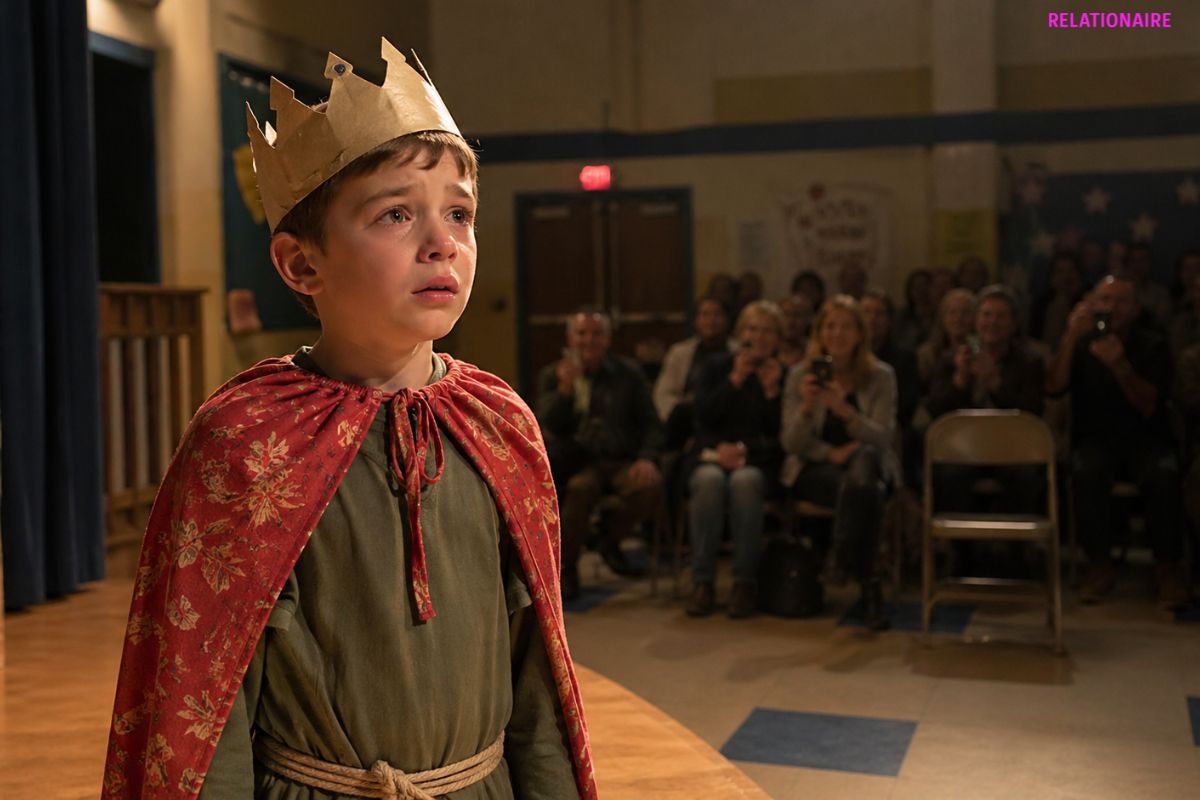
He was seven years old, wearing a cardboard crown that kept sliding over one eye and a red cape his grandmother had sewn from an old Christmas tablecloth. His cheeks were pink from the heat of the cafeteria lights. His hands were folded exactly the way his teacher, Mrs. Bell, had taught him.
But his eyes were not on the audience.
They were searching.
Row by row.
Face by face.
Every time the back doors opened, his little chin lifted.
Every time they closed, it dropped again.
His mother had promised.
“I’ll be there, bug,” she had whispered that morning, tying his sneakers while still wearing her blue nurse scrubs from the night before. “Front row if I can. Back row if I have to. But I’ll be there.”
Jonah had believed her because children still do that at seven.
They believe promises like they are bricks.
All day, he carried that promise around in his chest.
He told his teacher, “My mom’s coming. She works at the hospital, but she said she’s coming.”
He told the lunch lady, “My mom might still smell like hand sanitizer.”
He told Eli, who was playing the dragon, “Don’t be scared if my mom claps loud. She does that.”
By six-thirty that evening, the cafeteria had filled with parents in work shirts, grandparents holding phones up too high, babies fussing in strollers, and dads crouching near the front with cameras ready.
Jonah stood behind the curtain, peeking through the gap.
He saw Eli’s father.
He saw Mia’s older sisters.
He saw Mrs. Bell’s husband setting flowers on an empty chair.
He saw almost everyone.
Not his mom.
“Places,” Mrs. Bell whispered.
Jonah stepped back, swallowed hard, and touched the folded paper tucked inside his sleeve.
It was a small note from his mother.
Three words written on a pharmacy receipt.
Be brave, bug.
She had left it beside his cereal bowl before going to bed that morning, too tired to eat, too tired to take off her badge. He had folded it twice and kept it with him all day.
The play began.
It was about a lonely king who forgot how to laugh until the village children taught him kindness. Jonah had six lines. He knew all of them. He had practiced them in the bathtub, in the car, even in the hospital parking lot when his mother had picked him up late from aftercare two nights before.
“You have to say it like your heart means it,” she had told him, one hand on the wheel, the other rubbing at the deep marks her mask had left on her face.
So when his cue came, Jonah stepped into the yellow light.
The cafeteria grew quiet.
He looked out.
Still no mom.
For one second, everything inside him shook.
Then he said his first line.
“A kingdom is not lonely if someone comes home.”
A few people in the audience made that soft sound adults make when children say something sweet.
Jonah didn’t hear them.
He was watching the doors.
His second line came.
Then his third.
Between each one, he searched.
By his fifth line, his mouth had started to tremble.
By his sixth, his eyes were shining so badly that the paper crown blurred in front of him.
Mrs. Bell stood off to the side, her hand pressed to her chest.
He finished anyway.
That was the thing that made it hurt more.
He did everything right.
He remembered every word.
He bowed when everyone bowed.
He smiled when Mrs. Bell pointed at the parents to clap.
And then he walked offstage, found the little backpack cubby behind the curtain, and sat on the floor with his cape gathered in his fists.
Mrs. Bell crouched beside him.
“Jonah,” she said softly.
“She forgot,” he whispered.
Mrs. Bell opened her mouth, then closed it again.
“She didn’t forget.”
Jonah stared at the floor.
The cafeteria was loud now. Families were hugging children. Parents were giving flowers and taking pictures. Someone was laughing. Someone said, “Again, again!” while a little girl spun in her costume.
Jonah stood up so fast his crown fell off.
“She said she would come.”
Mrs. Bell reached for him, but he stepped away.
His grandmother, Ruth, arrived a few minutes later, breathing hard from the walk between the parking lot and the school doors. She had been sitting near the middle, holding an old phone with a cracked screen, filming the whole thing for Jonah’s mother.
“You were wonderful,” Ruth said, wrapping him in both arms.
Jonah let her hug him, but his body stayed stiff.
“Did she call?” he asked.
Ruth’s face changed.
Only for a second.
But Jonah saw it.
Children see more than adults think they do.
“She must’ve gotten held up at the hospital,” Ruth said.
“That’s what she always says.”
“Baby—”
“She promised.”
Ruth looked toward Mrs. Bell, and Mrs. Bell looked down at the crown in her hands.
No one knew what to say to a boy whose heart was breaking in a school cafeteria.
At home, Jonah put his costume on the kitchen chair and went straight to his room.
His mother came in at 9:48 p.m.
He knew because he was awake, staring at the glowing numbers on the little dinosaur clock beside his bed.
He heard her key turn.
He heard her shoes stop at the door.
He heard the soft sound she made when she took off the bag she carried for twelve-hour shifts.
Then he heard Grandma Ruth say, “He’s awake.”
His mother’s voice was hoarse.
“Did he do okay?”
There was a pause.
“He was beautiful.”
Jonah squeezed his eyes shut.
Footsteps came down the hallway.
His door opened a crack.
A thin strip of kitchen light fell across the floor.
“Bug?” his mother whispered.
He turned his face to the wall.
The room went quiet.
“I am so sorry,” she said.
He didn’t answer.
“I tried.”
He pulled the blanket over his shoulder.
“Jonah, please look at me.”
He didn’t.
His mother came closer. He could smell the hospital on her, that sharp clean smell mixed with rain and coffee. He hated it suddenly. He hated the blue scrubs. He hated the badge. He hated every person who got his mother when he needed her.
“I watched for you,” he said, his voice small and hard.
“I know.”
“No, you don’t.”
Her breath caught.
“I was the king,” he said. “And you weren’t there.”
She sat on the edge of the bed, but he moved his feet away from her.
That hurt her. He could tell.
Still, he did it.
“I’m sorry,” she whispered again.
“You always are.”
The words came out before he understood how sharp they were.
His mother stood very still.
Then she placed something on his dresser.
“I’ll explain tomorrow,” she said.
“I don’t want you to.”
She left the room without turning on the lamp.
The next morning, Jonah refused pancakes.
He refused to wear the shirt she picked out.
He refused to say goodbye.
At school, he kept his backpack on even after the bell rang, as if he might need to leave quickly if his feelings got too big.
Mrs. Bell waited until the other children were at art.
Then she called him to her desk.
“I found something backstage after everyone left,” she said.
Jonah stared at his shoes.
“It was tucked behind the curtain near the hallway door.”
“I don’t care.”
“I think you should see it.”
She opened her desk drawer.
Inside was a folded school play program.
On top of it was a small hospital visitor sticker, creased down the middle, with the date printed in black.
Jonah looked at it.
Then he looked at Mrs. Bell.
And she said the sentence that made his stomach drop.
“Jonah… your mom was here.”
PART 2
Jonah didn’t touch the sticker at first.
It sat on Mrs. Bell’s desk like a thing from another world.
White background.
Blue border.
One corner bent.
VISITOR.
His mother’s name was written in black pen beneath it.
MARA HAYES.
The date was yesterday’s date.
The time printed at the bottom said 6:58 p.m.
Jonah knew enough numbers to know what that meant.
The play had started at 7:00.
He stared at the sticker until the letters blurred.
“No,” he said.
Mrs. Bell didn’t push it toward him.
She just rested her hands flat on the desk.
“She came in through the side hallway,” she said gently. “I didn’t see her until after your second line. She was standing by the door.”
Jonah’s throat felt tight.
“She wasn’t in the chairs.”
“No.”
“Then she wasn’t there.”
Mrs. Bell took a breath.
“Sometimes people are there in the only way they can be.”
That sounded like something grown-ups said when they wanted children to stop asking questions.
Jonah hated it.
He hated that the sticker had his mother’s name.
He hated that it made him feel wrong.
He hated that part of him wanted to grab it and hold it against his chest.
Mrs. Bell unfolded the program.
Jonah saw the list of names first.
Then the messy circles.
His lines had been circled in pen.
All six of them.
Beside the first one, his mother had written a tiny star.
Beside the last one, she had written:
That’s my brave boy.
Jonah sat down without meaning to.
His backpack slid off one shoulder.
Mrs. Bell’s eyes softened, but she didn’t smile.
“She tried to come inside,” she said. “Security stopped her because the back hallway was closed after the show started. There had been some confusion with the doors. She didn’t want to make a scene. She stood there as long as she could.”
“Why didn’t she wave?”
“I don’t know.”
“Why didn’t she tell me?”
“I think she wanted to. But maybe she was tired. Maybe she thought you were too hurt to hear it.”
Jonah remembered the strip of kitchen light on his bedroom floor.
His mother’s voice.
I tried.
He had thrown the blanket over his shoulder like a wall.
“You always are,” he had said.
Now those words came back and sat on his chest.
Heavy.
At lunch, he didn’t eat his chicken nuggets.
At recess, he sat near the fence with the folded program in his lap.
Eli came over wearing one untied shoe.
“You okay?”
Jonah shrugged.
“My dad said you cried onstage,” Eli said.
Jonah looked at him sharply.
Eli kicked a pebble.
“Not bad crying. Like movie crying.”
Jonah almost laughed, but it got stuck.
He folded the program again and slid it into his backpack beside the note from his mother.
Be brave, bug.
That afternoon, Grandma Ruth picked him up.
Not his mom.
Jonah climbed into the old silver car and buckled himself in without speaking.
Ruth looked at him in the rearview mirror.
“Mrs. Bell called me,” she said.
Jonah stared out the window.
Rain streaked sideways across the glass.
“Did Mom really come?”
Ruth’s hands tightened on the steering wheel.
“Yes.”
“Then why did she leave?”
“She didn’t leave because she wanted to.”
Jonah waited.
Ruth pulled into the grocery store parking lot but didn’t turn off the engine. For a long moment, the wipers moved back and forth, back and forth, like they were trying to clean something that wouldn’t come off.
“Your mother was supposed to get off at five yesterday,” Ruth said. “She packed her bag before her shift ended. She had your program in her pocket. She even changed her shoes because she didn’t want to squeak across the cafeteria floor.”
Jonah pictured that.
His mother in the hospital bathroom, bending over tired feet, trying to hurry.
“Then what?”
Ruth looked at the rain.
“There was an emergency.”
Jonah knew that word.
It was the word that stole dinners.
The word that made birthday candles melt too low before Mom got home.
The word that made Grandma Ruth answer the phone in the middle of board games and say, “Yes, I’ve got him.”
“She stayed because someone needed her,” Ruth said.
“More than me?”
The question came out before he could stop it.
Ruth turned around then.
Her face looked older than it had that morning.
“Oh, honey.”
Jonah looked down.
“That’s what it feels like.”
Ruth unbuckled her seat belt and shifted as much as she could in the small car.
“Your mama has spent seven years trying to be in two places at once,” she said. “And every time she can’t, she comes home carrying the part of herself she thinks she failed.”
Jonah didn’t fully understand that.
But he understood failed.
He had seen his mother at the kitchen table with unpaid bills and a calculator. He had seen her take one bite of toast and say she wasn’t hungry, then wrap the rest for his lunch. He had seen her fall asleep sitting up with one hand still on his homework folder.
He had seen all of it.
He just hadn’t known what it meant.
At home, his mother was asleep on the couch.
Still in her scrubs.
One arm was hanging down, fingers nearly touching the floor. Her hair had come loose from its clip. Her shoes were beside the door, wet at the toes.
On the coffee table sat a half-eaten granola bar, a bottle of headache medicine, and Jonah’s cardboard crown.
She had fixed it.
The bent side had been taped carefully from the inside.
Jonah stood in the doorway.
Grandma Ruth whispered, “She got home at three this morning.”
Jonah didn’t move.
His mother looked smaller asleep.
Not like a nurse.
Not like the person who gave medicine and answered alarms and stayed calm when other people panicked.
Just Mom.
His mom.
The one who still cut grapes in half because she forgot he wasn’t little anymore.
The one who tucked notes under his cereal bowl.
The one who had tried to stand in a hallway to hear six lines.
Jonah took the program out of his backpack.
He wanted to wake her.
He wanted to say he was sorry.
He wanted to ask why she hadn’t fought harder to get inside.
He wanted to ask whether she had heard his voice shake.
Instead, he set the visitor sticker on the coffee table beside the crown.
His mother stirred.
Her eyes opened slowly.
For one second, she looked confused.
Then she saw him.
“Bug,” she whispered.
Jonah’s hands curled into fists.
Not because he was angry now.
Because he was trying not to cry.
“Did you hear my last line?” he asked.
His mother pushed herself up on one elbow.
Her face changed.
“Yes,” she said.
Her voice broke on the word.
Jonah stared at her.
“You did?”
She nodded.
“I heard all of them.”
“Then why didn’t you come in?”
Mara closed her eyes.
When she opened them again, they were wet.
“Because I had blood on my sleeve,” she whispered. “Not a lot. But enough. I had come straight from the hospital, and I didn’t want you to see me like that.”
Jonah froze.
She looked down at her hands.
“I thought if I stayed by the door, I could hear you, and then afterward I could clean up and come hug you. But security asked me to move. I tried to explain quietly. I didn’t want to interrupt your play.”
Jonah’s mouth trembled.
“And then when I got outside,” she said, “my phone rang.”
The room went still.
Grandma Ruth covered her mouth.
Mara swallowed.
“It was the hospital,” she said. “They needed me back.”
Jonah looked at the fixed crown on the table.
The tape.
The sticker.
The program with his lines circled.
His mother reached for him, then stopped herself halfway, like she wasn’t sure she was allowed to touch him anymore.
That was when Jonah understood something terrible.
His silence had hurt her too.
Maybe not the same way.
But deeply.
He stepped closer.
Not all the way.
Just close enough.
“Did you really write ‘That’s my brave boy’?” he asked.
Mara nodded.
Her tears slipped before she could wipe them away.
“I wrote it during your first line,” she said. “Because I knew I was going to miss the hug afterward.”
Jonah looked at his mother’s tired face, and something in him cracked open.
But before he could speak, Ruth’s phone rang.
She looked at the screen.
Her face went pale.
“Mara,” she said quietly. “It’s the hospital again.”
PART 3
Mara didn’t answer right away.
The phone kept ringing in Ruth’s hand.
Once.
Twice.
Three times.
Jonah watched his mother’s face change before she even reached for it.
That was the part he had never noticed before.
Work didn’t just call her phone.
It called her body.
Her shoulders tightened. Her eyes cleared. The tiredness didn’t leave, exactly, but it moved behind something else.
Duty.
Fear.
A kind of love Jonah was too young to name.
Mara took the phone.
“Hello?”
She listened.
Jonah stood by the coffee table, one hand resting near the taped crown.
His mother looked at him while the voice on the other end spoke.
“I understand,” she said.
Another pause.
“No. I can’t come in tonight.”
Jonah blinked.
Ruth looked up.
Mara pressed her fingers against her forehead.
“I know,” she said softly. “I know you’re short. But I’ve worked the last four nights, and I need to be home with my son.”
The room was so quiet Jonah could hear the rain tapping the window.
His mother listened again.
Then she said, “I’m sorry. I can’t.”
She hung up.
For a moment, nobody moved.
Jonah had heard his mother say yes to the hospital so many times that no felt like a strange new sound in the house.
Mara set the phone down.
Then she looked at him with a sadness that made her seem both strong and broken.
“I should have done that sooner,” she said.
Jonah didn’t know what to say.
“I thought working more would keep us safe,” she continued. “Rent. Groceries. Your school things. Grandma’s medicine. The car. I kept telling myself that if I just pushed a little harder, I could give you everything you needed.”
She laughed once, but there was no happiness in it.
“And then I missed the one thing you asked me to come to.”
Jonah looked down at his socks.
“They needed you.”
“So did you.”
Those three words landed differently than anything else.
Not loud.
Not dramatic.
Just true.
Mara slid off the couch and sat on the floor in front of him, still in wrinkled scrubs, still with sleep lines on her cheek. She looked like a mother who had been running for years and had finally stopped long enough to see where she was.
“I need to tell you something,” she said.
Jonah’s stomach tightened.
“When your dad left, I was so afraid you’d feel like people could just disappear from your life.”
Jonah’s face went still.
They didn’t talk about his father much.
Not because it was forbidden.
Because it hurt in places neither of them knew how to touch.
Mara reached toward the coffee table and picked up the little pharmacy receipt.
Be brave, bug.
“I started leaving notes because I wanted you to wake up and know I had been there. Even if I was sleeping. Even if I was working. Even if I missed breakfast. I wanted there to be proof.”
Jonah swallowed.
“I kept them,” he whispered.
Mara looked at him.
“All of them?”
He nodded.
“In my dinosaur box.”
Her face crumpled a little.
Jonah ran to his room.
He came back with a green plastic box under one arm. It was supposed to hold toy dinosaurs, but inside were folded notes, grocery receipts, sticky notes, the back of envelopes, and a napkin from a fast-food place with a heart drawn in blue pen.
Mara covered her mouth.
Jonah sat beside her on the floor and opened the box.
“This one was from when I had a spelling test,” he said, pulling out a yellow note.
You know more than you think.
“This one was when I lost my tooth.”
Your smile is still my favorite.
“This one was from when you missed breakfast.”
I saved you the biggest strawberry.
Mara touched the notes like they were fragile.
“I didn’t know you kept them.”
“I didn’t know you wrote them because you were scared.”
Ruth turned away toward the sink, but Jonah saw her wipe her eyes.
For a while, they sat there on the floor with the rain outside and the broken-open box between them.
No big speech fixed everything.
The rent was still due.
The car still made a strange sound when it turned left.
Mara was still a nurse.
People would still need her at inconvenient times.
Jonah would still get angry sometimes when she was late.
But something had shifted.
The silence between them had a door in it now.
Mara picked up the school program.
“Will you show me?” she asked.
Jonah frowned.
“My lines?”
She nodded.
“Right now?”
“Right now.”
“I don’t have my cape.”
“I fixed your crown.”
That made him smile, even though he tried not to.
Ruth pulled the kitchen chair into the living room like it was a front-row seat. Mara sat cross-legged on the floor, holding the program in both hands.
Jonah put on the taped crown.
It sat crooked.
Nobody fixed it.
He stood in front of the coffee table and took a breath.
At first, he felt silly.
Then he saw his mother’s face.
She wasn’t checking her phone.
She wasn’t rubbing her eyes.
She wasn’t halfway somewhere else.
She was watching him like the room had gone dark and he was the only light left.
Jonah straightened.
“A kingdom is not lonely if someone comes home,” he said.
Mara pressed the program to her chest.
He said the second line.
Then the third.
At the fourth, his voice grew stronger.
At the fifth, Ruth clapped once, then covered her mouth like she had broken a rule.
By the last line, Jonah wasn’t performing anymore.
He was giving his mother the thing she had missed.
And she was giving him the thing he had needed.
Her whole face.
Her whole attention.
Her whole tired, aching heart.
When he finished, Mara stood and clapped.
Not loud.
Not like the cafeteria.
Just enough for him to know.
Then she opened her arms.
This time, Jonah ran into them.
He hit her so hard she stumbled backward, laughing and crying at the same time. She held the back of his head, the way she had when he was small.
“I’m sorry,” he whispered into her scrub top.
“No,” she said, holding him tighter. “I’m sorry.”
“I thought you picked them.”
Mara knew what he meant.
The hospital.
The patients.
The ringing phone.
Everyone else.
She kissed his hair.
“I picked you first,” she whispered. “I just didn’t always know how to show it.”
After that night, Mara changed some things.
Not all at once.
Real life rarely lets people become new overnight.
She talked to her supervisor. She stopped taking every extra shift. She asked Ruth for help before she was drowning instead of after. She put school events on the refrigerator in red marker. She still came home exhausted, but sometimes she came home in time.
And when she couldn’t, she told Jonah the truth.
Not the heavy parts.
Not the parts too big for seven.
But enough.
“I’m trying.”
“I’m late.”
“I’m sorry.”
“I love you.”
Jonah kept the visitor sticker.
He stuck it inside the cover of his dinosaur box, beside the program with his lines circled.
Years later, when the cardboard crown had softened at the edges and the ink on the sticker had faded, he would still remember that night.
Not just the empty chair.
Not just the hallway door.
Not just the hurt.
He would remember his mother sitting on the living room floor in wrinkled scrubs, choosing not to answer a call, asking him to perform six lines just for her.
He would remember that love is not always where you expect to see it.
Sometimes it is standing just outside the door, soaked from the rain, still trying to get in.
And sometimes, when you finally open that door, you find out it had been there all along.