If you’ve already read part 1 of this story on Facebook, go here for Part 2!
The first thing Mrs. Ellis noticed was the cardboard.
Not the missing title.
Not the crooked pencil lines.
The cardboard.
It was bent down the middle like someone had folded it in half and tried to pretend they hadn’t.
Malik Turner carried it into Room 12 with both arms wrapped around it, his chin tucked low, his hoodie sleeves pulled over his hands. The other kids came in laughing, bumping backpacks, dragging poster tubes and plastic grocery bags full of glitter glue, foam letters, pipe cleaners, and solar system stickers.
Malik came in like he was carrying something injured.
It was Science Fair Week at Lincoln Elementary, which meant the whole school smelled like dry erase markers, cafeteria pizza, and panic.
Mrs. Ellis had been teaching fifth grade for nineteen years. She could tell the difference between a child who forgot and a child who couldn’t.
Malik hadn’t forgotten.
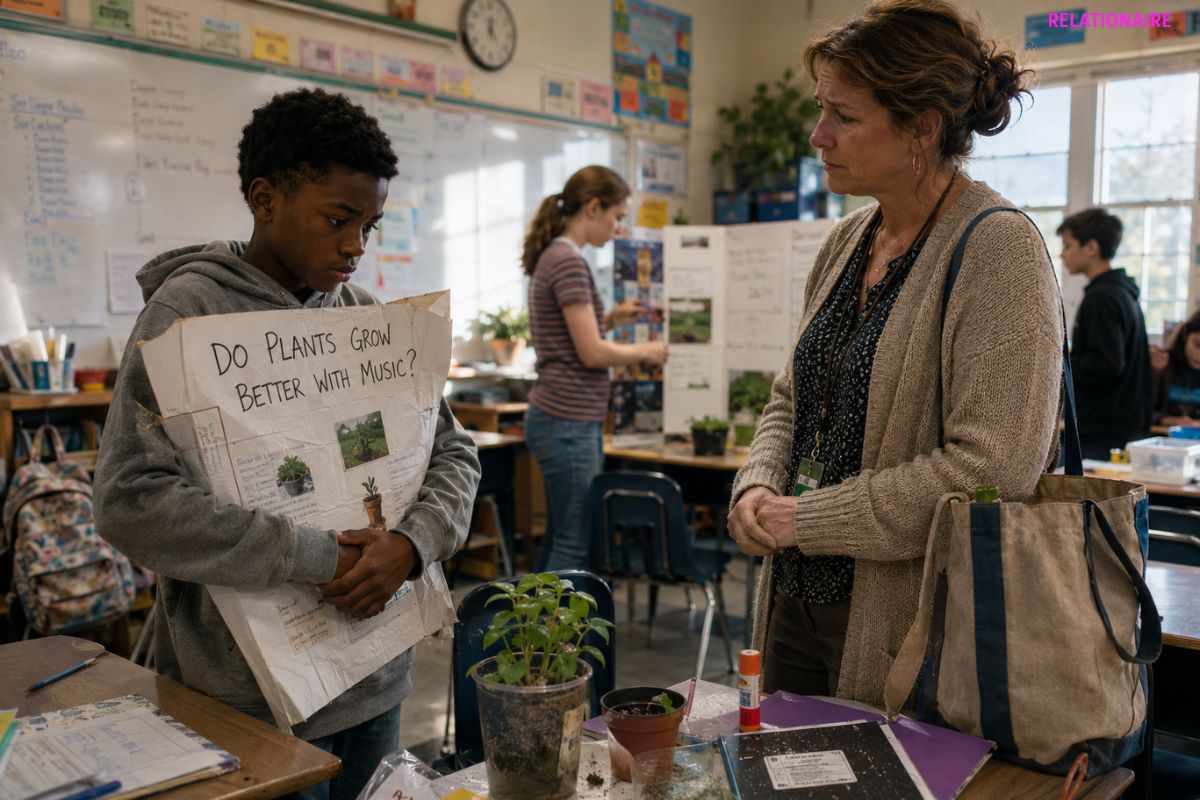
His trifold board was the thin kind from the discount bin, the kind that buckled if you breathed too close to it. One corner was crushed. The left panel had a shoeprint-shaped smudge. Across the middle, in careful block letters, he had written:
DO PLANTS GROW BETTER WITH MUSIC?
The words leaned uphill.
He stood near his desk without sitting.
A few kids noticed.
“Dang,” Jaden whispered, not quietly enough. “What happened to your board?”
Malik’s jaw tightened.
“Nothing.”
A girl at the next table looked at the bent crease and said, “You know we’re presenting these in the gym, right?”
“I said nothing.”
Mrs. Ellis looked up from the attendance sheet.
“Settle in, everyone. Boards against the back wall. Data sheets on your desks.”
The room shifted into the usual morning noise. Chairs scraped. Glue stick caps rolled. Someone asked if markers counted as shared supplies. Someone else had spilled soil from a plant cup into their backpack.
Malik didn’t move.
Mrs. Ellis walked over slowly, as if approaching a stray cat.
“Malik,” she said softly, “why don’t you put yours by the windows so it doesn’t get bumped?”
His eyes flicked to hers.
“I got it.”
“I know.”
He hated that answer. She could see it in his face.
He hated anything that sounded like pity.
Malik Turner had been in her class since August. He was bright in a quiet, guarded way. He finished math early but left the answers small. He read above grade level but never volunteered. He held doors for younger kids when nobody was watching, but if anyone thanked him, he shrugged like they had insulted him.
And lately, he had been angry.
Not loud angry.
Tight angry.
The kind that lived in shoulders.
Mrs. Ellis knew some of the pieces. His mother, Tasha, worked the early shift at the hospital cafeteria and cleaned offices at night. His father was not listed on the emergency contact form anymore. There had been a second name there in September, scratched out hard enough to tear the paper.
But teachers only ever know pieces.
The rest walks into their classrooms wearing sneakers with peeling soles and says, “I’m fine.”
At recess, Mrs. Ellis found the board leaning by the windows.
Up close, it looked worse.
The fold had cracked the surface. The right flap sagged. Malik had taped the back with three strips of old masking tape, probably from home. His plant drawings were done in pencil because he didn’t have color markers. His graph was careful, though. Neat little bars. Correct labels. Real observations.
He had done the work.
He just didn’t have the materials to make the work look like it mattered.
Mrs. Ellis stood there a moment longer than she meant to.
Her own tote bag sat under her desk, frayed at the handles, stuffed with spelling tests, granola bars, and a receipt from the teacher supply store she hadn’t told her husband about because they were still paying off the water heater.
She thought about the twenty-dollar bill folded in the inside pocket of her purse.
Gas money.
Then she looked at Malik’s board again.
At lunch, she stopped him at the classroom door.
“Malik, can I talk to you a second?”
His face closed before she even finished.
“I didn’t do nothing.”
“I know.”
“Then what?”
The hallway was loud around them. Fifth graders heading to lunch. A kindergartner crying because his mitten was missing. The custodian pushing a yellow mop bucket past the trophy case.
Mrs. Ellis lowered her voice.
“I was looking at your project. Your experiment is strong.”
He stared at the floor.
“I was thinking,” she continued, “I have an extra board in my car. A sturdier one. You could transfer your information after school if you want.”
His head snapped up.
“I don’t need your board.”
“It’s just sitting there.”
“I said I don’t need it.”
A few students looked over.
Mrs. Ellis kept her voice calm. “Okay.”
“No, it’s not okay.” Malik’s cheeks had gone hot. “You think because mine’s messed up, I need you to fix it?”
“I think your work deserves to be seen clearly.”
“My work is fine.”
“Malik—”
“I’m not some charity kid.”
The hallway went quiet in that strange way schools do when one child says something too sharp.
Mrs. Ellis felt the words land.
Not because they were rude.
Because they were rehearsed.
Malik grabbed his lunch card from the basket and walked away fast, his shoulders lifted like he was bracing for someone to laugh.
No one did.
That almost made it worse.
After school, the classroom emptied in stages.
Bus riders first. Then after-school program kids. Then the pickup line children, all craning their necks toward the parking lot.
Malik stayed at his desk, slowly putting papers into a backpack with a broken zipper. His science board was still by the windows.
Mrs. Ellis didn’t mention it.
She wiped the board. She stacked folders. She pretended not to notice him watching her from under his lashes.
At 3:41, his mother arrived.
Tasha Turner stood in the doorway in scrubs, one hand still holding her car keys, the other pressed to her lower back. Her hair was pulled into a loose bun. Her eyes had the dull shine of someone who had not sat down all day.
“I’m sorry,” she said before Mrs. Ellis could greet her. “The bus was late getting me back from work.”
“No problem at all.”
Malik stood quickly. “Ma, let’s go.”
Tasha looked toward the windows. “Is that your science board?”
“It’s fine.”
Her face changed.
Just a little.
A tiny wince she tried to hide.
Mrs. Ellis saw it.
That was the thing about schools. People thought teachers only watched children. But teachers watched parents too. The trembling hands at pickup. The apology before anyone accused them. The lunch forms folded small in coat pockets. The shame people carried for things that were not sins.
Tasha stepped toward the board. “Baby, I told you I was gonna try to get—”
“It’s fine,” Malik said louder.
Mrs. Ellis busied herself with the attendance folder.
Tasha touched the crushed corner with two fingers.
“It was the only one they had left,” she whispered.
Malik’s whole body went stiff.
“Can we go?”
Tasha looked at Mrs. Ellis, then away.
“I can send some money Friday,” she said quietly. “For whatever he still needs. I just—”
“Ma.”
Mrs. Ellis shook her head gently. “Please don’t worry about that.”
Malik turned on her.
“We don’t need anything from you.”
Tasha’s eyes filled instantly, and Mrs. Ellis realized this was not the first time those exact words had been said in that exact tone.
“Malik,” his mother said.
But he was already grabbing the board.
Too fast.
The weak cardboard folded again in his hands with a dry cracking sound.
The right panel tore halfway down the seam.
For one second, nobody moved.
Then Malik stared at the torn board like it had betrayed him in front of everyone.
His mouth opened.
Nothing came out.
Tasha covered her lips with her hand.
Mrs. Ellis stepped forward without thinking. “Malik, sweetheart—”
“Don’t call me that.”
His voice shook.
Then he looked straight at his mother and said something so cold, so wounded, that Mrs. Ellis felt it change the room.
“This is why Dad said taking help makes people look pathetic.”
PART 2
Tasha closed her eyes.
Not long.
Just long enough for Mrs. Ellis to understand that the words had not surprised her.
They had only hurt where something was already bruised.
Malik stood in the middle of Room 12 holding the torn science board, breathing hard through his nose. His face was angry, but his eyes were young. Too young for the sentence he had just said.
Tasha lowered her hand from her mouth.
“Malik,” she said softly, “your father had no right—”
“I don’t want to talk about him.”
“You brought him up.”
“No, you did.” He shoved the board under one arm. “Every time you can’t buy something.”
That one landed hard.
Tasha looked down at her shoes.
They were black work sneakers, the kind with thick soles and tired creases. One lace was frayed near the end.
Mrs. Ellis wanted to step in.
She also knew some moments belonged to families, even when they happened under fluorescent lights beside a chart of irregular verbs.
So she waited.
Tasha took a breath.
“I’m doing my best.”
“I know,” Malik snapped.
But he didn’t say it like comfort.
He said it like accusation.
Like her best was another thing he had to carry.
Mrs. Ellis had heard that tone before, though never from Malik. Children loved their parents so fiercely that sometimes the love came out as blame. Especially when they knew the parent was already breaking.
Tasha’s eyes shone again, but she didn’t cry.
“I’m sorry about the board,” she said.
Malik looked away.
Mrs. Ellis walked to the supply closet, opened it, and pulled out a roll of clear tape. She set it on the nearest desk.
Not in Malik’s hand.
Not in Tasha’s.
Just near them.
“We can leave this here,” she said. “No decision right now.”
Malik glanced at the tape like it was a trap.
Tasha whispered, “Thank you.”
Malik flinched.
That tiny movement told Mrs. Ellis more than his yelling had.
He didn’t only hate needing help.
He hated watching his mother thank someone for it.
The next morning, Malik’s seat was empty.
Mrs. Ellis marked him absent with a small ache in her stomach.
During planning period, she found herself standing in the front office beside the lost-and-found bin, pretending to check her mailbox.
The secretary, Mrs. Bloom, was sorting late slips.
“You waiting on something?” Mrs. Bloom asked.
“No.”
Mrs. Bloom looked over her glasses.
Mrs. Ellis sighed. “Maybe.”
At 10:18, Tasha Turner came in alone.
She was still in scrubs, but today there was a coffee stain near the pocket. She held a manila envelope, bent at one corner.
“I’m sorry to bother you,” Tasha said.
Mrs. Ellis stepped into the office hall with her.
“You’re not bothering me.”
Tasha nodded, but didn’t seem to believe it.
“Malik wouldn’t come in today. Said his stomach hurt. It didn’t. He just… he couldn’t face everybody.”
Mrs. Ellis felt the familiar teacher-pain. The kind that had nowhere to go.
“I’m sorry.”
Tasha pressed the envelope against her chest.
“I wanted to explain yesterday.”
“You don’t owe me an explanation.”
“I think maybe I do.” She swallowed. “Not because of the board. Because of what he said.”
They moved into the small conference room beside the nurse’s office. There were two chairs, a round table, and a poster about handwashing curling at the corners.
Tasha sat down slowly.
“His dad used to make fun of people who needed help,” she said. “Food stamps. School supplies. Church baskets. Anything. He’d say, ‘Don’t let nobody feel sorry for you. That’s how they own you.’”
Mrs. Ellis listened.
Outside the door, the nurse asked a child if his stomach hurt or if he just missed his mom.
Tasha twisted the envelope in her hands.
“When Malik was little, he’d come home from kindergarten with free books or donated mittens, happy as anything. His dad would look at the tag and say, ‘You proud of wearing somebody’s pity?’”
Mrs. Ellis’s throat tightened.
“He said that to a five-year-old?”
Tasha nodded.
“Not once.”
The room felt smaller.
Tasha kept going because sometimes the truth, once opened, will not close again.
“When I finally made him leave, I thought the worst part was over. But Malik still hears him. In his head. In his own voice now.”
She wiped under one eye with her thumb.
“I work two jobs and still can’t always get it right. I thought if I just kept him fed and safe, we’d be okay. But shame gets in through little cracks. A board. A lunch form. A teacher offering kindness.”
Mrs. Ellis thought of Malik standing in the hallway, saying, “I’m not some charity kid.”
Not defiant.
Terrified.
Tasha slid the envelope across the table.
Inside was the torn right panel of Malik’s board.
“He ripped it off after we got home,” she said. “Then he sat on the kitchen floor and cried like he was mad at the tears.”
Mrs. Ellis touched the edge of the cardboard.
On the back, written in pencil, were lines Malik must have planned for his presentation.
Music did not make the plants grow faster.
But the plant with music grew straighter toward the light.
Mrs. Ellis read the sentence twice.
Something about it hurt.
Tasha looked at her.
“I don’t want him thinking kindness is something you survive,” she said. “But I don’t know how to teach him different when he’s so afraid of being looked down on.”
Mrs. Ellis sat back.
Nineteen years of teaching had taught her decimals, reading levels, behavior plans, and how to keep twenty-seven children calm during a fire drill.
It had not taught her how to unteach a father’s voice.
But it had taught her something else.
Children learn from what adults repeat.
So maybe the answer was not one grand speech.
Maybe it was repetition.
Quiet. Steady. Public enough to be real. Gentle enough not to humiliate.
That afternoon, Mrs. Ellis drove to the teacher supply store after school.
She did not buy one board.
She bought six.
Three white. Two blue. One black.
She bought foam letters, markers, tape, glue dots, and a small pack of plant stickers she knew were overpriced.
At home, her husband found the bag on the kitchen table.
“Science fair?” he asked.
She nodded, rubbing her eyes.
He looked at the receipt.
Then at her.
Then quietly took two twenties from his wallet and laid them beside the bag.
She stared at them.
“We need groceries,” she said.
“We’ll stretch,” he answered.
Mrs. Ellis turned away before he could see her face.
The next day, Malik came back.
He walked into Room 12 with no board.
His hoodie was zipped to his chin. His eyes dared anyone to mention it.
No one did.
Because before morning announcements, Mrs. Ellis stood at the front of the room beside six blank boards.
“Class,” she said, “I made a mistake.”
Twenty-six faces looked up.
Malik’s did not.
Mrs. Ellis continued. “I assumed everyone had the same materials for the science fair. That wasn’t fair teaching. Scientists share tools. Engineers share tools. Artists share tools. So today, our back table is a supply station. Anyone can use anything. No names. No explaining. No permission needed.”
The room stayed quiet.
Then Jaden raised his hand. “Can I get tape? My volcano’s falling apart.”
“Yes.”
A girl near the window said, “Can I switch boards? Mine has marker bleeding through.”
“Yes.”
Slowly, children began moving.
Tape. Markers. Glue dots. Foam letters.
Not charity.
A classroom supply station.
Malik still sat frozen.
Mrs. Ellis did not look at him.
That mattered.
At recess, when the room was empty, she found him standing at the back table.
His hands hovered over the black board.
“That one’s sturdy,” she said from her desk, not lifting her head from the papers she was grading.
Malik pulled his hand back.
“I was just looking.”
“Looking is allowed.”
He stood there another minute.
Then he said, almost too low to hear, “If I use it, people will know.”
Mrs. Ellis set down her pen.
“Know what?”
His jaw worked.
“That mine broke.”
“They already know your board broke.”
He looked down.
She softened her voice.
“But that’s not what you meant.”
His eyes filled so suddenly he looked angry at them.
Mrs. Ellis did not move closer.
He whispered, “My dad said people only help you so they can talk about you later.”
There it was.
The real wound.
Not poverty.
Not the broken board.
The fear that kindness came with a hook.
Mrs. Ellis’s heart ached, but she kept her voice steady.
“Malik,” she said, “some people do that.”
He looked up, surprised.
She nodded. “Some people help loudly. Some people help to feel bigger. Some people make kindness into a spotlight.”
His lips pressed together.
“But that doesn’t make all kindness fake,” she said. “And it doesn’t make needing something a weakness.”
He wiped his nose with his sleeve and looked away.
Mrs. Ellis reached into her desk drawer.
She pulled out an old school photo.
A little girl with uneven bangs, missing a front tooth, wearing a sweater too big for her shoulders.
She placed it on the desk facing him.
“That’s me in fourth grade,” she said. “My teacher bought me that sweater from the lost-and-found because mine had a hole in the elbow.”
Malik stared at the photo.
“I was embarrassed too,” she said. “Until she told me something I never forgot.”
“What?”
Mrs. Ellis breathed in.
“She said, ‘You don’t owe shame to anyone who helps you stand taller.’”
Malik looked at the black board again.
His hands were trembling.
For a moment, Mrs. Ellis thought he would take it.
Then the recess bell rang.
Children flooded the hallway outside.
Malik stepped back from the table.
“I can’t,” he whispered.
And before Mrs. Ellis could answer, he walked out.
But he left the old school photo on his desk.
PART 3
The science fair was on Friday.
By Thursday afternoon, Room 12 looked like a craft store had given up.
There were glue smears on the tables, paper scraps under every chair, and one suspicious trail of glitter leading from the reading corner to the pencil sharpener.
Projects leaned against the walls.
Mold experiments.
Battery circuits.
A volcano that had already erupted twice and was now sitting in a plastic tub like a guilty dog.
And in the back corner, on a black trifold board, was Malik’s project.
He had not taken the board during recess.
He had taken it after dismissal, when the room was empty except for Mrs. Ellis, the hum of the heater, and the sound of a basketball bouncing somewhere in the gym.
He had walked to the supply table without speaking.
Picked up the black board.
Held it against his chest.
Then looked at Mrs. Ellis and said, “I’m still doing all the work myself.”
Mrs. Ellis had nodded.
“I would expect nothing less.”
That was all.
No hug.
No speech.
No soft music playing over the moment.
Just a boy accepting a board and trying not to let his face crack open.
But now his project looked beautiful.
Not fancy.
Beautiful.
His title was written in green marker. His graph was straight. His plant drawings had careful little roots. In the center, he had taped three photos of bean plants on a windowsill.
Under his conclusion, he had written:
The plant with music did not grow the tallest.
But it leaned toward the sound and light the most.
I learned that growing is not always about being biggest.
Mrs. Ellis stood in front of it after the final bell Thursday and pressed her fingers to her lips.
Teachers know when a child has written more than an assignment.
Friday night, the gym filled with families.
The floors shone under bright lights. Tri-fold boards stood in rows on cafeteria tables. Little siblings tugged on tablecloths. Parents crouched to read crooked labels. Teachers carried clipboards and smiled with the tired pride of people who had made it to Friday by faith and coffee.
Malik stood beside his board in a clean button-down shirt that was a little too large at the cuffs.
Tasha stood behind him in hospital scrubs, holding a paper cup of water she never drank.
She looked exhausted.
She also looked proud in a way that seemed to scare her.
Mrs. Ellis moved from project to project, listening to children explain mold, magnets, and why gummy bears expanded in water. But her eyes kept finding Malik.
He was doing well.
Quiet, but clear.
When the principal stopped by, Malik explained his process without looking at the floor.
When a younger boy asked if music really helped plants, Malik said, “Maybe not the way people think.”
Mrs. Ellis smiled.
Then she saw the man at the gym doors.
He stood half inside, half out, wearing a dark jacket and work boots. He had Malik’s eyes but none of his softness. Tasha saw him too. Her shoulders tightened.
Malik’s voice stopped mid-sentence.
Mrs. Ellis felt the air change.
The man walked toward the table slowly, glancing at the black board, the neat letters, the plant photos.
“Well,” he said. “Look at all this.”
Malik stared at him.
“Dad?”
Tasha stepped forward. “Darren, this isn’t a good time.”
“I heard about the science fair.” He smiled, but it did not reach his eyes. “Thought I’d come see what my son made.”
Malik’s hands gripped the edge of the table.
For a second, he looked smaller than fifth grade.
Darren looked at the board again.
“Nice board,” he said. “Your mama finally buy you something decent?”
Tasha’s face flushed.
Mrs. Ellis began walking toward them.
Malik swallowed.
“It was from class.”
Darren gave a short laugh.
“From class.”
The words were not loud, but they were sharp enough.
A few nearby parents looked over, then looked away, pretending not to hear because people often mistake privacy for kindness.
Darren leaned closer to the board.
“So you took a handout.”
Malik’s face emptied.
That was worse than tears.
Mrs. Ellis reached the table.
“Good evening,” she said, calm as a locked door. “I’m Mrs. Ellis, Malik’s teacher.”
Darren glanced at her. “I know who you are.”
“Then you know this is a school event,” she said. “And every child here deserves respect.”
He gave her a look. “I’m talking to my son.”
“Yes,” Mrs. Ellis said. “And he is standing beside work he completed with care. So that is what we’re going to talk about.”
Tasha looked at her, startled.
Malik did too.
Darren’s jaw moved.
“He needs to learn not everybody’s gonna save him.”
Mrs. Ellis nodded once.
“You’re right.”
That surprised him.
It surprised Malik more.
Mrs. Ellis turned slightly toward the board.
“Not everyone will save him. That’s why we teach children how to accept the people who are safe.”
The gym noise seemed to fade around them.
Darren scoffed. “You people act like giving a kid cardboard makes you heroes.”
“No,” Mrs. Ellis said. “Cardboard doesn’t make anyone a hero.”
She looked at Malik then.
“Courage does.”
His eyes were wet.
“And Malik showed courage when he redid his project after it broke. He showed courage when he presented it tonight. And he showed courage when he accepted a tool without letting anyone take ownership of his effort.”
Darren looked away first.
But Malik was still staring at Mrs. Ellis.
Something was happening in his face.
Something painful and new.
Tasha whispered, “Malik, baby, you okay?”
He nodded once.
Then he turned to his father.
“My project isn’t about the board.”
Darren blinked.
Malik’s voice shook, but he did not stop.
“It’s about plants. And light. And how things grow.”
Mrs. Ellis held her breath.
Malik pointed to the conclusion.
“I thought needing help meant I was weak. But plants need stuff too. Water. Soil. Sun. Nobody calls them pathetic.”
Tasha covered her mouth.
Darren’s face hardened, but there was uncertainty beneath it now.
Malik kept going.
“You used to say people help so they can own you.”
His voice broke on the last two words.
Then he looked at Mrs. Ellis.
“She helped and didn’t own anything.”
That was the moment Tasha cried.
Quietly.
One hand over her mouth, shoulders trembling, like she had been waiting years for her son to hand back a shame that never belonged to him.
Darren did not apologize.
This is not that kind of story.
Some people do not become gentle just because the truth stands in front of them.
He muttered something about needing to go and walked out through the gym doors, leaving behind the cold space his words had always made.
Malik watched him leave.
Then he looked down at his board.
For a second, Mrs. Ellis thought he might fall apart.
Instead, he straightened the little index cards beside his project.
A family approached.
A grandmother with silver hair and a girl in a yellow dress.
The grandmother smiled. “Young man, can you tell us about your experiment?”
Malik wiped his cheek fast.
Then he stood taller.
“Yes, ma’am,” he said. “I tested whether music helped plants grow.”
His voice was still shaky.
But it was his.
At the end of the night, Malik did not win first place.
A girl with a homemade water filter did.
He did not win second either.
The volcano took that, mostly because it erupted on command and delighted every kindergartner in the building.
Malik won a small certificate labeled:
Best Scientific Reflection
It was printed crooked because the office printer was running out of ink.
You would have thought it was a college diploma.
Tasha took a picture of him holding it in front of the black board. Mrs. Ellis stood behind the table, watching.
Then Malik turned.
“Mrs. Ellis?”
“Yes?”
He held out the certificate.
Not to give it to her.
To show her.
Really show her.
“I’m gonna keep this one.”
She smiled, though her eyes burned.
“You should.”
He looked at the board, then back at her.
“Can we leave it here till Monday? I don’t want it getting bent in the car.”
Mrs. Ellis laughed softly.
“Of course.”
On Monday morning, Malik arrived early.
He taped the certificate inside his desk, where only he could see it.
The black board stayed in the classroom for one more week. Younger students came by to look at the fifth grade projects. Malik explained his without rushing.
Each time he reached the conclusion, his voice grew steadier.
Growing is not always about being biggest.
By spring, he was still quiet.
Still proud.
Still sometimes quick to anger when embarrassment got too close.
Healing is not a clean line.
But he started taking breakfast from the cafeteria cart without pretending he wasn’t hungry.
He asked for markers when he needed them.
He helped Jaden fix a ripped book cover with tape from the supply drawer.
And one rainy afternoon, when a second grader in the hallway dropped a shoebox diorama and burst into tears, Malik crouched beside him before any adult could move.
“Hey,” he said, picking up a paper tree. “It broke, but it’s not ruined.”
Mrs. Ellis heard him from the classroom door.
The second grader sniffled. “My mom’s gonna be mad.”
Malik shook his head.
“Nah. We can fix it.”
Then he looked back at Mrs. Ellis.
Not asking permission.
Just knowing she would say yes.
She walked over with tape, glue dots, and the quietest smile.
There are lessons no test can measure.
How to divide fractions.
How to label a graph.
How to stand in a gym with your shame showing and learn it is not the same thing as weakness.
Sometimes a teacher buys a broken child a board.
Sometimes what she is really giving him is proof.
That help can be clean.
That kindness can be quiet.
That needing light does not make anything less worthy of growing.