PART 1
“Ma’am, excuses won’t keep Mateo awake.”
The words landed harder than the front-office secretary probably meant them to.
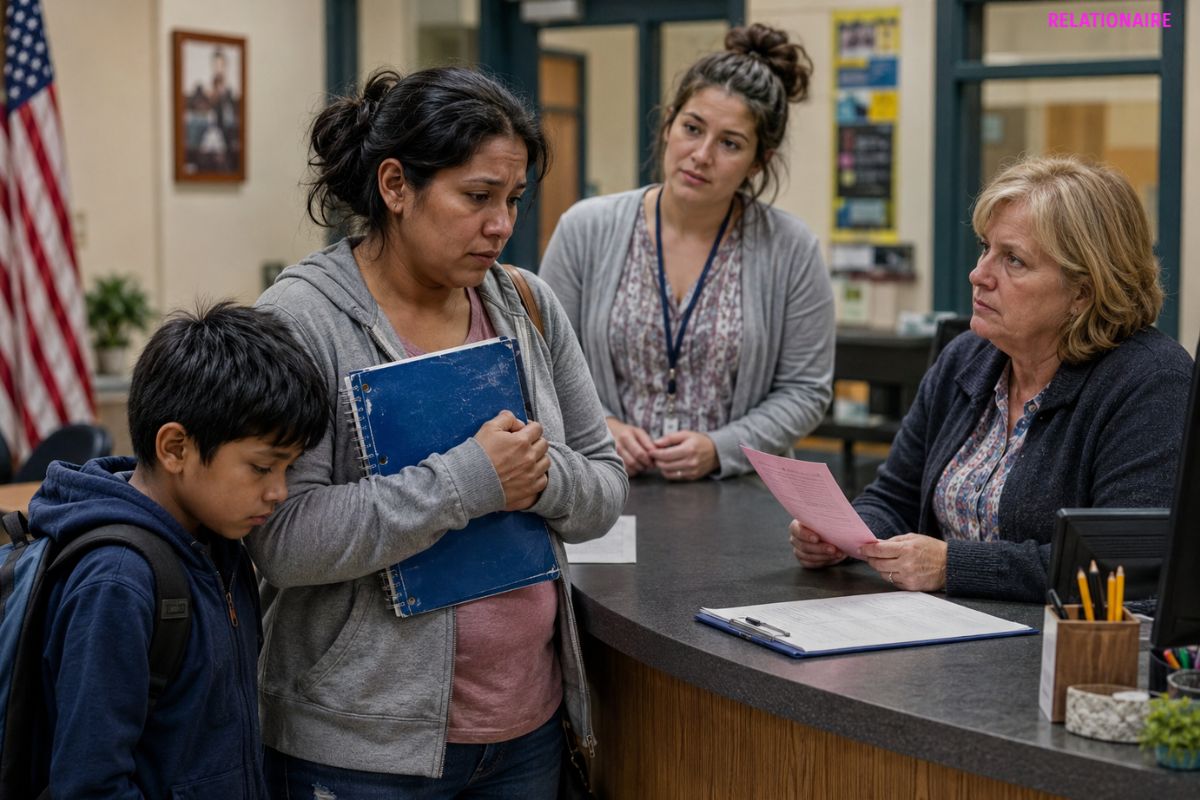
Maria Alvarez stood on the other side of the counter at Pine Hollow Elementary in Garland, Texas, with both hands wrapped around a worn blue spiral notebook. The corners were soft from being opened and closed too many times. A rubber band held it together because the cover had started tearing near the metal rings.
Beside her, eight-year-old Mateo stared down at his sneakers.
His backpack hung from one shoulder.
His hair was still damp from the quick combing Maria had done in the bathroom sink of their apartment before sunrise. His shirt was clean, but the collar had a permanent wrinkle that would not come out no matter how carefully she folded it.
Behind the counter, Mrs. Dalton pushed a pink tardy slip across the laminated surface.
“This is the fourth time this month he’s been sent to the nurse’s office for sleeping,” she said. “And now his teacher says he put his head down during reading again.”
Maria nodded too quickly, the way she did when she understood only half the words and feared asking for the other half.
“Yes,” she said softly. “I know. I am sorry.”
Mrs. Dalton exhaled through her nose. She was not yelling. That almost made it worse. Her voice had the tired flatness of someone who had already decided the story before hearing it.
“Mrs. Alvarez, sorry doesn’t help him learn.”
Maria looked from Mrs. Dalton to the tardy slip, then back again.
“I talk to him,” she said. “I say, Mateo, please sleep. Please.”
Mrs. Dalton folded her hands.
“Then why isn’t he sleeping?”
The question seemed simple.
Maria’s mouth opened.
Nothing came out.
English always felt smaller when people were watching her. At home, she practiced sentences while washing dishes. She repeated words from school papers out loud until they lost their shape. But in places like this, under buzzing fluorescent lights, with a line forming behind her and office staff pretending not to listen, every word scattered before she could catch it.
Mateo shifted beside her.
“It’s okay, Mamá,” he whispered.
Mrs. Dalton glanced at him. “Sweetheart, let your mom answer.”
Maria’s face warmed.
She hugged the blue notebook tighter to her chest.
A father in a polo shirt stood a few feet away holding a forgotten lunchbox. A younger mother with a stroller waited near the sign-in sheet. Two fifth-grade girls sat on the bench by the nurse’s door, pretending to look at the posters on the wall.
Everyone was quiet enough to hear.
Maria tried again.
“I work,” she said. “Night. But I come. Every morning. I walk him. I make food. I—”
Mrs. Dalton lifted a hand, not unkindly, but firmly.
“We’re not questioning whether you bring him to school. We’re saying he needs structure. Children need bedtime. They need routine. They need an adult making sure school comes first.”
Maria blinked.
School comes first.
She had crossed three apartment complexes, one gas station parking lot, and a busy road that still scared her every morning because school came first.
She had chosen the apartment with the broken heater because it was just inside the district line because school came first.
She had turned down extra cash from a cousin for moving farther away because Mateo’s teacher had once written, “He is very bright,” on a paper, and Maria had carried that sentence in her purse for six months because school came first.
But she did not know how to say all that.
Not in the kind of English that made people stop looking at her like she was failing.
“I try,” Maria repeated.
Mrs. Dalton looked at the notebook.
“What’s that?”
Maria lowered her eyes. “Nothing.”
“If it’s schoolwork, his teacher needs to see it.”
“No,” Maria said quickly.
The secretary’s expression tightened.
Mateo reached for his mother’s sleeve, but Maria did not move.
“Mrs. Alvarez,” Mrs. Dalton said, “this is exactly what I mean. We’re trying to help your son, but you have to cooperate.”
The office door opened, letting in a burst of hallway noise.
Children’s voices.
Sneakers squeaking.
A teacher reminding someone to walk.
Then Ms. Whitaker stepped inside with a stack of folders against her hip.
She was Mateo’s teacher, thirty-two, soft-spoken, with a messy bun and a cardigan that always had dry-erase marker on one sleeve. She stopped when she saw Mateo standing at the counter.
“Mateo?” she said.
He looked up, then immediately looked down again.
Mrs. Dalton seemed relieved.
“Good, Ms. Whitaker. I was just speaking with Mrs. Alvarez. Mateo slept through reading again yesterday, and we need to address what’s happening at home.”
Ms. Whitaker’s eyes moved to Maria’s face.
Then to the notebook in her hands.
Then to Mateo’s hand gripping the strap of his backpack so tightly his knuckles had gone pale.
“What notebook is that?” Ms. Whitaker asked gently.
Maria swallowed. “It is not for school.”
Mateo whispered, “Mamá, don’t.”
That was the first thing that made Ms. Whitaker’s expression change.
Not the tardies.
Not the sleeping.
Not even Maria’s trembling voice.
It was the way Mateo said it.
Like the notebook was not embarrassing because he had done something wrong.
Like it was embarrassing because he had done something loving.
Mrs. Dalton reached across the counter.
“Let’s just take a look.”
Maria stepped back.
The father with the lunchbox looked away. The woman with the stroller froze. The two fifth-grade girls stopped pretending not to listen.
Ms. Whitaker set her folders down slowly.
“Mrs. Dalton,” she said, “wait.”
But the rubber band slipped from the notebook.
It snapped softly against the floor.
The blue cover fell open in Maria’s hands.
Ms. Whitaker saw one page.
Only one.
And the look on her face shifted from concern to something much quieter.
Something almost ashamed.
She stepped closer, her voice barely above a whisper.
“Maria,” she said, “who wrote all of this?”
Maria held the notebook tighter.
Mateo’s eyes filled.
And before anyone could speak, Ms. Whitaker reached for the open page.
PART 2
Ms. Whitaker did not grab the notebook.
She simply held out her hand and waited.
That small patience nearly broke Maria more than Mrs. Dalton’s questions had.
People were always reaching quickly.
For papers.
For explanations.
For answers Maria did not know how to give fast enough.
But Ms. Whitaker waited as if Maria had all the time in the world.
Finally, Maria let her look.
The page was filled with two kinds of handwriting.
At the top, in uneven adult print, Maria had copied words from a bill.
Below each line, in smaller, neater letters, Mateo had written what they meant.
Electric payment due.
Past balance.
Final notice.
Call customer service.
On the next page, he had copied part of a school letter.
Parent conference.
Reading assessment.
Please return signed form.
Underneath, in Spanish, he had written careful explanations for his mother.
Ms. Whitaker turned one page, then stopped herself. She looked at Mateo first.
“Did you write these?” she asked.
Mateo wiped his cheek with the back of his hand.
“Yes, ma’am.”
Mrs. Dalton stood behind the counter, very still.
The office had gone silent in a different way now. Not judgmental. Not curious. Heavy.
Ms. Whitaker crouched slightly so she was closer to Mateo’s height.
“When do you do this?”
Mateo looked at his mother.
Maria shook her head once, a tiny movement.
Not because she wanted him to lie.
Because she had spent years trying not to let her child carry adult things in public.
Mateo took a breath.
“At night,” he said.
Ms. Whitaker’s eyes softened.
“After homework?”
“After Mamá gets home.”
“What time is that?”
He looked down.
“Sometimes two. Sometimes three.”
Mrs. Dalton pressed her lips together.
Maria stepped forward.
“No, no,” she said quickly. “Not every night. Only sometimes. He is a good boy. I say sleep. I say go to bed.”
Her voice shook harder now because she could feel the story slipping out in pieces, and every piece made her look like the kind of mother Mrs. Dalton already thought she was.
A mother whose child stayed awake at night.
A mother who needed her third grader to read letters.
A mother who smiled at teachers while hiding final notices in a kitchen drawer because she could not understand which ones mattered most.
“I don’t make him,” Maria said. “I don’t ask. He sees. He wants to help.”
Mateo looked up fast.
“You do ask, Mamá.”
Maria froze.
His voice was not angry.
That made it worse.
“You ask the words,” he said. “Not me. You ask the paper.”
The father near the door lowered the lunchbox in his hand.
Ms. Whitaker’s eyes glistened.
Maria covered her mouth.
Because he was right.
She did not ask Mateo.
Not exactly.
She sat at the small kitchen table after work with the papers spread out beneath the yellow light, whispering words to herself. She held envelopes up to the bulb to see if anything important was inside. She traced due dates with her finger. She opened school emails at the library when she had time and copied the words she did not understand into the notebook.
And Mateo, pretending to drink water, would appear beside her.
“I know that one,” he would say.
At first, it had been one word.
Then one sentence.
Then a whole page.
Soon, he had a system.
Red circle for money.
Star for school.
Check mark for something already done.
Maria had told him he was too little to worry.
He told her he was just practicing reading.
She believed the lie because she needed it.
Ms. Whitaker stood slowly.
“Mrs. Alvarez,” she said softly, “is this why he’s tired?”
Maria looked at the floor.
“I clean offices,” she said. “At night. Two places. One near Plano. One near downtown. I finish late. Then I come home. I make breakfast. I walk him here.”
“You walk?” Mrs. Dalton asked before she could stop herself.
Maria nodded.
“Bus is not close. And I don’t have car right now.”
Ms. Whitaker glanced at Mateo.
“How far?”
Mateo answered. “Twenty-six minutes if we go fast.”
Maria gave him a look that almost said hush, but there was no strength in it.
“We move here for school,” she said. “Better school. I want him here.”
Mrs. Dalton leaned back from the counter as if the words had pushed her there.
The pink tardy slip still sat between them.
Suddenly it looked very small.
Ms. Whitaker closed the notebook carefully and handed it back with both hands.
“Maria,” she said, “why didn’t you tell me?”
Maria gave a sad little laugh, but there was no humor in it.
“How?”
One word.
That was all.
How?
How do you explain exhaustion without sounding careless?
How do you explain poverty without asking for pity?
How do you explain love in a language that keeps failing you in front of strangers?
How do you tell a teacher that your son is sleeping in reading class because he spent midnight sounding out electric bills?
Maria touched the notebook’s torn blue cover.
“I come here,” she whispered. “People talk fast. I smile. I say yes. Then I go home and Mateo asks, ‘What did they say?’”
Mateo began crying then, quietly, angrily, like he hated the tears for betraying him.
“I’m not tired because of her,” he said.
No one answered.
He wiped his face again.
“She tells me to sleep. I just don’t want her to be scared of letters.”
That was the sentence that changed the room.
The younger mother by the stroller turned her face toward the wall.
The fifth-grade girls stared at their shoes.
Mrs. Dalton looked down at the tardy slip she had pushed across the counter, the one that now felt less like paperwork and more like a verdict.
Ms. Whitaker put a hand over her heart, not dramatically, just as if something inside her had ached in a place she could not ignore.
Maria reached for Mateo, but he stepped back.
Not far.
Just enough.
“Mijo,” she whispered.
He shook his head.
“I can help,” he said. “I’m good at reading.”
“I know,” Maria said.
“I don’t want them to think you don’t care.”
The words came out louder than he expected.
They filled the front office.
Maria’s face crumpled.
She turned toward Mrs. Dalton, then toward Ms. Whitaker, then toward the people waiting by the wall.
“I care,” she said.
Her voice was small, but everyone heard it.
“I care so much.”
Ms. Whitaker looked at the notebook again.
Then at the pink tardy slip.
Then at Mateo.
And for the first time that morning, she seemed to understand that the problem was not a mother who did not care.
It was a mother who had been caring so hard, and so quietly, that no one had recognized the shape of it.
Mrs. Dalton picked up the tardy slip.
Her hand hesitated.
Then she tore it in half.
Not for show.
Not loudly.
Just once, down the middle.
Mateo stared.
Maria stared too.
Mrs. Dalton’s voice changed when she spoke.
“Mrs. Alvarez,” she said, “I owe you an apology.”
But Maria did not know what to do with an apology in front of people.
She only held the notebook and waited, because sometimes kindness was harder to understand than judgment.
PART 3
Mrs. Dalton came around from behind the counter.
That alone made Mateo stop crying.
In his whole time at Pine Hollow Elementary, he had only ever seen Mrs. Dalton behind that counter, surrounded by visitor badges, late slips, sign-in sheets, and the little bell no one was supposed to ring twice.
Now she stood on the same side as Maria.
Her shoulders looked smaller there.
“I’m sorry,” Mrs. Dalton said.
She did not say it to the room.
She said it to Maria.
Then she looked at Mateo.
“And I’m sorry to you too.”
Mateo sniffed.
“You thought she didn’t care.”
Mrs. Dalton nodded.
“I did. And I was wrong.”
Maria’s fingers tightened around the notebook.
She seemed unsure whether to accept the words, or hide from them, or apologize for having needed them.
So Ms. Whitaker stepped in gently.
“Maria,” she said, “would you come sit with me for a minute?”
The office had a small round table near the nurse’s door where parents filled out forms. Ms. Whitaker pulled out a chair. Maria sat slowly. Mateo sat beside her, close enough that their shoulders touched.
Mrs. Dalton brought over a box of tissues and a cup of water.
No one made a speech.
No one turned it into a lesson for the people watching.
That mattered.
Maria had not needed a crowd to witness her pain. She had needed one person to finally believe her.
Ms. Whitaker opened a folder.
“I should have noticed sooner,” she said.
Maria shook her head. “No. He is quiet.”
“He is,” Ms. Whitaker said. “But quiet children still tell us things. We just have to pay attention.”
Mateo looked at his teacher.
“I tried not to sleep.”
“I know,” she said. “And starting today, you don’t have to carry this alone.”
He frowned.
“But the letters—”
“We’ll help your mom with the letters.”
Maria looked up quickly.
Ms. Whitaker kept her voice calm.
“We have a family liaison who speaks Spanish. She comes in three mornings a week. I can introduce you. We can send home translated copies when possible. And if something comes in English only, you can bring it here. Not to Mateo. To us.”
Maria blinked several times.
“I don’t want trouble.”
“This isn’t trouble,” Ms. Whitaker said. “This is school.”
Mrs. Dalton stood nearby, holding the two halves of the torn tardy slip.
“And I can help you fill out the transportation form,” she said quietly. “There may be a route or a transfer stop we can check. I should have asked before I assumed.”
Maria looked at her.
For a moment, neither woman moved.
Then Maria nodded.
A tiny nod.
But it carried a great deal.
Mateo leaned against his mother’s arm.
“She works a lot,” he said, as if the room still needed convincing.
Maria brushed his hair back.
“Too much,” she whispered.
“For me,” he said.
“For us,” she corrected.
Ms. Whitaker smiled sadly.
Then she reached for the blue notebook again, but this time she did not open it without asking.
“May I?”
Maria handed it to her.
Ms. Whitaker turned to the back, where several blank pages remained.
She took a pen from her cardigan pocket and wrote a note in simple, clear English. Then she paused, thinking, and wrote beneath it in Spanish as best she could. It was not perfect. A word was probably wrong. The grammar was stiff.
But Maria read it.
Then read it again.
Her eyes filled.
Mateo leaned over.
“What does it say?” he asked, out of habit.
Maria held the page closer.
This time, she answered him.
“It says,” she began slowly, “your mother is welcome here.”
Her voice broke on the last word.
Mateo stared at the sentence.
Then he looked at Ms. Whitaker.
“You wrote it in Spanish.”
“I tried,” Ms. Whitaker said.
Mateo almost smiled. “The second line is a little funny.”
Ms. Whitaker laughed softly. “Then maybe you can teach me.”
Maria laughed too, just once, through tears.
It was the first easy sound she had made all morning.
By noon, things had started changing in small, ordinary ways.
Not movie ways.
Real ways.
Mrs. Dalton called the family liaison and set a meeting for the next morning after drop-off. Ms. Whitaker gave Mateo a quiet reading corner for ten minutes after lunch, not as punishment, not as special treatment, but as a place where his body could stop fighting itself.
A counselor checked in with him gently.
No one made him feel like a hero.
That was important too.
Children should not have to be heroes at the kitchen table after midnight.
That afternoon, when the final bell rang, Maria was already outside near the pickup area, still in the same faded sweatshirt, her hair pulled back, her face tired but less guarded.
Mateo ran to her with his backpack bouncing.
Ms. Whitaker walked out behind him carrying the blue notebook.
“I think this belongs to you,” she said.
Maria accepted it.
There was a new rubber band around it.
Fresh.
Strong.
Inside the front cover, Ms. Whitaker had tucked a folded paper with names, phone numbers, and office hours written clearly.
Mrs. Dalton stood in the doorway of the school office.
For a second, she looked like she might retreat inside.
Instead, she lifted one hand.
“Mrs. Alvarez?”
Maria turned.
Mrs. Dalton walked over with a small envelope.
“I printed the forms in Spanish,” she said. “And I put my direct extension at the top. If you call and I talk too fast, you can tell me to slow down.”
Maria took the envelope carefully.
“Thank you,” she said.
Then she added, with effort, “I will tell you.”
Mrs. Dalton nodded.
“I hope you do.”
There was no big embrace.
No cheering crowd.
No perfect ending that fixed rent, work, exhaustion, or the long walk home.
Maria still had a night shift waiting for her.
Mateo still had spelling words to study.
The world did not become easy because one office finally listened.
But as they walked away from Pine Hollow Elementary, Mateo reached for his mother’s hand.
She held the blue notebook in the other.
At the crosswalk, he looked up.
“Mamá?”
“Yes?”
“Tonight, I can sleep?”
Maria smiled, tired and full.
“Yes, mijo,” she said. “Tonight, you sleep.”
He nodded like that was the best news he had heard all year.
Behind them, the school doors closed softly.
In Maria’s hand, the notebook was still worn. Still bent at the corners. Still full of hard words.
But now it was not proof that she had failed.
It was proof that love had been working there all along, even when nobody knew how to read it.