If you’ve already read part 1 of this story on Facebook, go here for Part 2!
The backpack had been sitting in the lost-and-found for twenty-three school days before anyone thought to open it.
That was the part that bothered Ms. Elena Reyes later.
Not what she found inside.
How long it had been there.
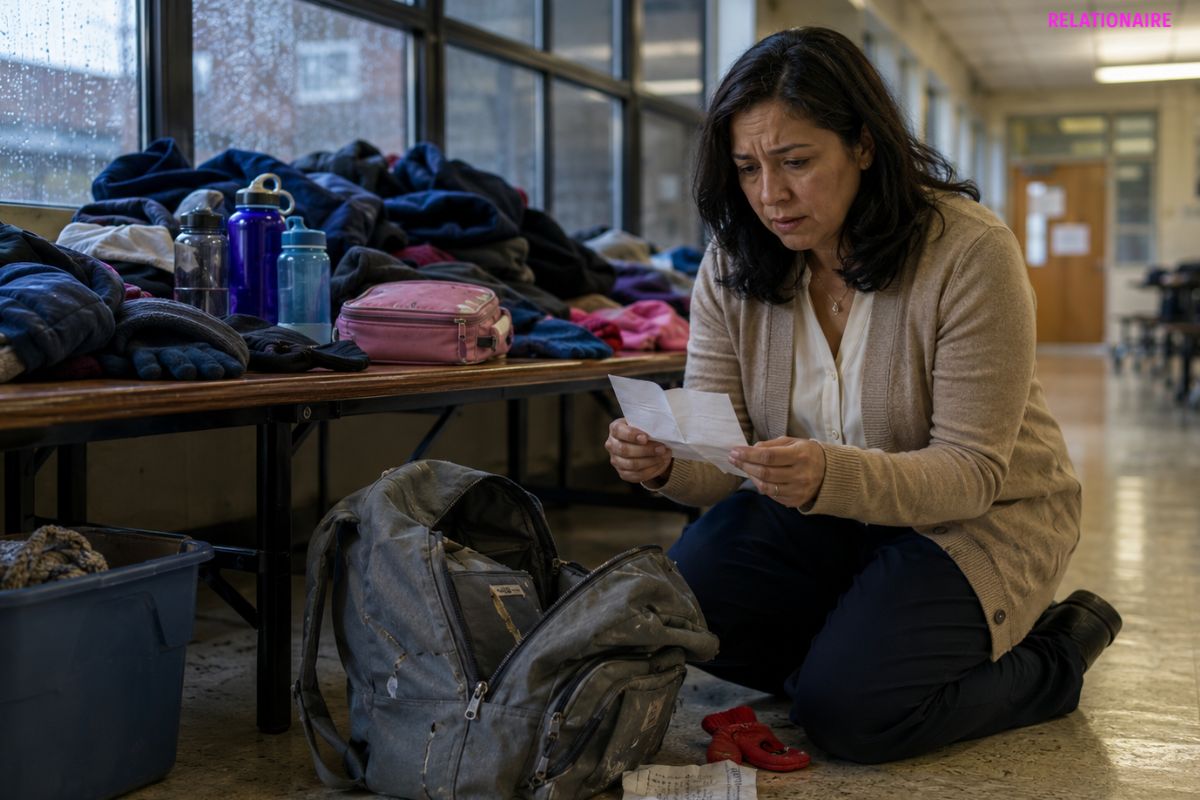
It was a gray backpack with one broken zipper, shoved beneath a heap of winter coats, single gloves, water bottles with cloudy plastic, and a pink lunchbox that had started to smell faintly sour.
Donation day was Friday.
Every year, the front office made the same announcement over the intercom.
“Please check the lost-and-found table by the cafeteria. Unclaimed items will be donated at the end of the week.”
Every year, children walked past their own hoodies like strangers.
Every year, Ms. Reyes, the school counselor, stayed after the final bell and sorted through the mess.
She did it because the office staff was already drowning in attendance calls and parent emails.
She did it because teachers were taping torn book bins back together and writing behavior notes they hated writing.
She did it because somebody had to.
And because once, years ago, a little girl had burst into tears when Ms. Reyes found her grandmother’s scarf in the bin.
“My grandma made that before she died,” the girl had whispered.
After that, Elena never threw anything into a donation bag without checking the pockets.
So that Thursday afternoon, while rain ticked against the cafeteria windows and the hallway smelled like wet sneakers and disinfectant, Ms. Reyes sat cross-legged on the floor beside the lost-and-found table with a donation box at her knees.
She checked jacket pockets.
She shook out gloves.
She unzipped lunchboxes with the careful fear of a woman who had seen too many forgotten bananas.
Then she pulled the gray backpack from the bottom.
It was heavier than it looked.
The zipper caught halfway, the little metal tab bent like someone had yanked it too hard in a hurry.
Inside were three crumpled permission slips, an overdue library notice, a math worksheet with only the name written at the top, and a hoodie that smelled faintly like rain.
The name on the worksheet was small and dark.
Mason Bell.
Ms. Reyes stopped moving.
She knew Mason.
Everyone knew Mason in the way schools know certain children.
Not because he was loud.
Because he was hard to reach.
Seventh grade.
Always in the back row.
Always with his hood up until someone told him to take it down.
Never raised his hand.
Never smiled for the yearbook camera.
If a teacher asked him to participate, he shrugged like he had practiced disappearing from inside his own body.
His file had words in it that sounded official.
Withdrawn.
Defiant.
Limited peer interaction.
Frequent refusal to engage.
No current behavior plan.
His teachers had tried.
Ms. Patel kept granola bars in her bottom drawer and offered them without making it a big deal.
Mr. Dugan, the science teacher, put Mason in groups with gentle kids who wouldn’t embarrass him.
The assistant principal had called home twice about missing assignments.
No answer.
His grandmother was listed as his emergency contact, but the number had been disconnected in October.
That was another thing Elena hated about schools.
Sometimes the emergency contact form told the whole story before the child ever did.
One name.
One crossed-out number.
No backup.
No margin.
Ms. Reyes had met Mason three times.
The first time, he had sat in her office with his sleeves pulled over his hands and stared at a poster that said Feelings Are Visitors.
She had asked, “How are things going?”
He said, “Fine.”
She had asked, “Anything feel hard right now?”
He said, “No.”
She had offered him a stress ball shaped like a basketball.
He left it on the chair.
The second time, he came because he had snapped a pencil in class when another student asked why he always looked mad.
“I didn’t touch him,” Mason said before she even spoke.
“I know,” Ms. Reyes said.
He looked surprised by that.
The third time, he didn’t come at all.
She sent a pass.
He never showed.
His teacher said he had gone to the restroom and returned ten minutes later with wet hair, as if he had splashed water on his face.
After that, Ms. Reyes meant to follow up.
She really did.
But that same week, two siblings cried in her office because their mother had been arrested.
A fourth grader stopped eating lunch.
A teacher broke down in the staff restroom.
A parent screamed over the phone about a bullying report.
A kindergartener kept falling asleep during circle time because his family was living in their car.
And Mason Bell, quiet and rude and invisible by choice, slipped to the edge of her list.
Not off it.
Just down.
Schools were full of children at the edge of lists.
Elena sat on the cafeteria floor with his backpack in her lap and felt that familiar pinch beneath her ribs.
Guilt had a particular shape when you worked with children.
It was not dramatic.
It was a small, daily ache.
A hundred names you meant to check on.
A hundred small signs you hoped were not as serious as they looked.
A hundred children saying “fine” in voices that meant anything but.
She reached into the front pocket of Mason’s backpack, looking for an ID badge.
Instead, her fingers touched paper.
Not worksheet paper.
Notebook paper.
Folded twice.
Pressed flat.
She pulled it out and almost set it aside with the other scraps.
Then she saw the first line.
I’m sorry I’m so hard to like.
Ms. Reyes went still.
The cafeteria lights hummed above her.
Somewhere down the hall, a custodian rolled a mop bucket, the wheels squeaking softly against the scuffed tile.
Elena unfolded the paper slowly.
The handwriting was Mason’s.
Small.
Tight.
Angry at first glance.
But the more she looked, the more it seemed less angry than careful, like he was trying not to take up too much space on the page.
I’m sorry I’m so hard to like.
I know people get tired of me.
Teachers think I don’t care.
Kids think I’m weird.
Maybe I am.
I don’t know how to make my face look normal when everyone is looking at me.
I don’t know how to answer when people ask what’s wrong.
Because if I start talking, I don’t think I’ll stop.
Her throat tightened.
She looked toward the cafeteria doors, as if Mason might be standing there, hood up, eyes lowered, waiting to snatch the note back.
But the hallway was empty.
She kept reading.
I didn’t lose the backpack.
I left it.
I thought maybe if I left enough things behind, people would get used to me being gone a little at a time.
Elena’s hand went cold around the page.
Not gone from the world.
Not necessarily.
The note did not say that.
But it had the weight of a goodbye anyway.
A child did not have to write certain words for an adult to hear the door closing.
She looked back into the backpack with new fear.
There was a cracked pencil case.
A school photo envelope, unopened.
A wrinkled spelling test from another class, though Mason was in seventh grade. At the top, in purple marker, someone had written Good effort, buddy!
Not Mason’s test.
A younger child’s.
Elena reached deeper.
There was a tiny red mitten.
A library book for first graders.
A folded drawing of two stick figures under a square roof.
One tall.
One small.
The small one had a speech bubble.
Don’t go.
Ms. Reyes pressed her fingers to her mouth.
She had misjudged the backpack.
She had misjudged the silence.
Maybe everyone had.
At the bottom of the bag was one more paper, half-hidden beneath the hoodie.
An attendance sheet.
Not Mason’s.
A daycare sign-out form from three weeks earlier.
And written in the margin, in the same tight handwriting, were five words that made Elena stand so fast the backpack tipped over onto the cafeteria floor.
He can’t be alone again.
She grabbed the note, the daycare form, and Mason’s file from her office.
Then she ran down the hallway toward the front office, her shoes slipping slightly on the freshly mopped tile.
The secretary looked up, startled.
“Elena?”
Ms. Reyes held up the paper with trembling hands.
“When was the last time Mason Bell was in school?”
The secretary clicked quickly through the attendance screen.
Then her face changed.
Not confusion.
Not annoyance.
Fear.
“Elena,” she said quietly, “he hasn’t been here since Monday.”
PART 2
For three seconds, Ms. Reyes could not hear anything but the rain.
It hit the front office windows in thin silver lines, blurring the buses parked along the curb.
Then the school phone rang.
The copier beeped.
A child in the nurse’s office coughed.
Life kept moving, because schools always did, even when someone’s heart had just dropped through the floor.
“Since Monday?” Elena asked.
Her voice sounded too calm.
The secretary, Mrs. Lang, looked back at the screen.
“Monday morning. First period marked present. Then absent every period after lunch. Tuesday absent. Wednesday absent. Today absent.”
“No call?”
“No.”
“Auto-dial?”
“Went straight to voicemail.”
Elena turned toward the hallway.
Mason’s teachers were still in the building. She knew they were. Most of them stayed too late and called it catching up, though nobody ever caught up.
She found Ms. Patel in Room 214, sitting beneath a string of paper stars, entering grades with her coat still on.
The room smelled like dry erase markers and old coffee.
“Mason Bell,” Elena said.
Ms. Patel looked up immediately.
That was the thing about good teachers. They heard a child’s name differently when something was wrong.
“What happened?”
“When did you last really speak to him?”
Ms. Patel’s face went pale around the edges.
“Monday,” she said. “Before lunch.”
“What did he say?”
The teacher closed her laptop slowly.
“I told him he was missing his essay. He said, ‘It doesn’t matter.’ I said it did matter. He said…” She swallowed. “He said, ‘Not to me.’”
Elena waited.
“I thought he was being rude,” Ms. Patel whispered. “I was frustrated. I had twenty-nine kids talking at once and one student crying because someone wrote on her binder. I told him, ‘Mason, you have to start caring about something.’”
Her eyes filled.
“He looked at me and said, ‘I do.’”
The words sat between them.
Small.
Heavy.
Too late to hear properly.
Elena showed her the daycare form.
Ms. Patel read the name printed at the top.
Leo Bell.
Age six.
Authorized pickup: Mason Bell.
“That’s his brother?” Ms. Patel asked.
“I think so.”
Ms. Patel sank into her chair.
“I didn’t know he had a brother.”
No one had.
That was the second ache.
Not that Mason had hidden things.
Children hid things all the time.
The ache was how easily a child could carry a whole life through a school building and not one adult have the full picture.
Elena and the assistant principal, Mr. Hargrove, started making calls.
The disconnected number.
The old apartment complex.
The daycare.
The district family liaison.
The emergency shelter list.
The school nurse checked Mason’s health form.
The attendance clerk searched for an updated address.
Mrs. Lang pulled old enrollment papers from a filing cabinet that stuck on the bottom drawer.
Every adult moved quickly, but nobody said the word panic.
Not out loud.
In schools, adults learned to keep their panic folded.
Children were always watching.
The daycare finally answered on the fourth call.
“Yes,” the woman said carefully. “Leo Bell is enrolled here.”
“Has he been picked up this week?”
There was a pause.
“Who is calling?”
“This is Ms. Reyes, counselor at Mason’s school. We’re trying to reach the family.”
Another pause.
Then the woman’s voice softened.
“Mason picked him up Monday. He was late. Very upset. He said their grandmother was sick again.”
“Sick?”
“That’s what he said.”
“Do you have an updated contact number?”
“I can’t release—”
“I understand,” Elena said. “But I need you to listen to me. Mason is twelve. We found something that suggests he may be in serious emotional distress, and we cannot locate him.”
The line went quiet except for children shouting faintly in the background.
Then the woman gave them the apartment complex name.
Not the one in Mason’s file.
A cheaper one near the edge of town, behind the laundromat and the gas station with the broken sign.
Mr. Hargrove drove.
Elena sat in the passenger seat with Mason’s backpack on her lap.
It felt wrong to hold it.
It felt worse not to.
The rain had slowed to mist by the time they reached the complex.
The building was brick, tired, and stained under the window units. A shopping cart sat sideways near the dumpster. Someone’s wet socks hung over a balcony rail.
At apartment 2C, Mr. Hargrove knocked.
No answer.
He knocked again.
“School district,” he called gently. “Ms. Reyes and Mr. Hargrove from Jefferson Middle.”
A small sound came from inside.
Not footsteps.
Something scraping.
Elena leaned closer to the door.
“Mason?”
Silence.
Then a child’s voice.
Not Mason.
“Is he in trouble?”
Elena’s heart clenched.
“No, sweetheart,” she said. “We just want to make sure everyone’s okay.”
The chain slid back.
The door opened only three inches.
A little boy looked out.
He had Mason’s eyes.
Same dark watchfulness.
Too old for his face.
“Hi,” Elena said softly. “Are you Leo?”
He nodded.
“Is Mason here?”
Leo looked behind him.
That look told Elena more than words could.
Mr. Hargrove crouched so he would not tower over the child.
“We’re not here to punish anybody.”
Leo’s lower lip trembled.
“He said not to open the door.”
“Where is he?”
“In Grandma’s room.”
The apartment smelled like canned soup, damp carpet, and medicine.
A cartoon played silently on the television. On the coffee table sat two paper bowls, rinsed and reused. A first-grade reader lay open beside a pile of folded towels.
In the back bedroom, an elderly woman slept propped against pillows, breathing through parted lips. A pharmacy bag sat beside her, unopened.
Mason was sitting on the floor next to the bed.
Hood up.
Knees pulled to his chest.
His face changed when he saw Ms. Reyes.
Not fear first.
Shame.
That was what undid her.
Not anger.
Not defiance.
A twelve-year-old boy looking ashamed because adults had finally seen what he had been trying to carry alone.
“Mason,” she said.
He looked away.
“I didn’t do anything.”
“I know.”
“I didn’t steal the backpack if that’s what they said.”
“No one said that.”
“I left it there.”
“I know.”
His jaw tightened.
“You read it?”
Elena did not lie.
“Yes.”
His eyes closed.
For a moment, he looked younger than Leo.
“I wasn’t going to do anything,” he said quickly. “Not like that. I just…” He pressed his sleeve against his mouth. “I just didn’t want to be there anymore.”
“At school?”
“At anywhere people could see me.”
Leo climbed onto the bed beside their grandmother and held her hand.
“She was supposed to get better,” Mason said.
His voice broke on supposed.
“She took care of us after Mom left. Then she fell. Then she started forgetting stuff. Then she got sick and I had to get Leo and make dinner and wash his uniform and sign his folder because his teacher kept writing notes and I didn’t know what to say.”
He wiped his face hard, angry at the tears.
“And everybody kept asking why I didn’t turn things in.”
Elena sat down on the floor across from him.
Not too close.
Close enough to stay.
“I thought if I disappeared slow,” Mason whispered, “nobody would have to be mad at me all at once.”
There it was.
The truth inside the note.
Not a child trying to be difficult.
A child trying to shrink his needs small enough that nobody would notice he had them.
Mr. Hargrove stepped into the hallway to make calls.
Family services.
The district liaison.
The school nurse.
Emergency support.
Food assistance.
A wellness check for the grandmother.
Elena stayed on the floor.
Mason stared at the backpack in her lap.
“I forgot Leo’s mitten was in there,” he said.
“I found it.”
“He cried when he lost it.”
“I bet he’ll be glad to have it back.”
Mason gave a tiny nod.
Then he said the sentence that would stay with Elena for years.
“I’m tired of being the grown-up, but if I stop, he gets scared.”
No training manual prepared you for a sentence like that.
No professional development slideshow.
No cheerful poster about resilience.
Just a boy on the floor of a bedroom that smelled like medicine, apologizing for being tired of a life no child should have been asked to manage.
When they left the apartment that evening, it was not with a perfect solution.
Real life rarely handed those out.
The grandmother was taken to the clinic by a neighbor and a district social worker.
Leo went home with a licensed aunt who had not known how bad things had gotten because the old phone number had stopped working and Mason had been too embarrassed to call.
Mason refused to leave at first.
“I can take care of him,” he said.
Elena crouched in front of him.
“I know you can,” she said. “That’s the problem.”
His face twisted.
“You’re not in trouble,” she added.
He looked at her like he wanted to believe it but didn’t have the energy.
The next morning, Mason came to school.
Late.
Wearing the same hoodie.
Carrying no backpack.
He walked through the front doors while the bell rang and everyone rushed past him.
Elena saw him from the office.
He saw her too.
For one second, she thought he might come toward her.
Instead, he turned down the seventh-grade hallway alone.
At lunch, Ms. Patel found him sitting at the end of a table, untouched tray in front of him, staring at the empty chair across from him.
She placed the gray backpack gently on that chair.
Washed.
Zipper fixed with a key ring.
Leo’s red mitten tucked in the side pocket.
Mason looked at it.
Then at Ms. Patel.
Then he saw the small folded note taped to the front.
His name written in careful blue marker.
He did not open it.
Not at first.
He just stared at it with both hands curled into fists under the table, as if one more kind thing might break him wide open.
PART 3
Mason did not open the note during lunch.
He carried the backpack through the rest of the day like it was fragile.
Or like he was.
By seventh period, half the teachers in the building knew enough to be gentle, but not enough to smother him.
That was important.
Children like Mason could survive many things.
Pity was not always one of them.
So Mr. Dugan only said, “Glad you’re here,” and handed him the lab sheet.
Ms. Patel did not ask for the essay.
She put a granola bar on his desk without looking at him.
The librarian quietly cleared his overdue notice.
Mrs. Lang in the front office updated his emergency contact form with three names instead of one.
Small things.
School things.
Human things.
By dismissal, Mason had still not opened the note.
Elena watched from her doorway as he stood near the bus loop, backpack straps tight over both shoulders.
Middle schoolers swarmed around him in noisy waves.
Someone laughed too loudly.
Someone dropped a trumpet case.
A teacher shouted, “Walk, please!”
Buses coughed and hissed at the curb.
Mason stood still in all of it.
Then he took the note off the backpack.
He unfolded it.
Elena was too far away to see his face clearly, but she knew every word on the page.
She had helped write it.
Not alone.
That mattered too.
Dear Mason,
We are sorry we missed how heavy things were.
You should not have had to leave pieces of yourself behind before someone noticed.
You are not hard to like.
You are not a problem to solve.
You are a child we are lucky to know.
Your teachers want you here.
Leo needs his brother, but he does not need you to be the only grown-up.
You can be twelve here.
Start there.
—The adults who should have noticed sooner
Mason read it once.
Then again.
Then he folded it smaller than before and put it in the front pocket of the backpack.
Not the bottom.
Not hidden beneath old papers.
The front pocket.
Where he could reach it.
Over the next weeks, nothing turned magical.
That was the honest part.
His grandmother did not recover overnight.
His mother did not reappear with apologies and a steady job.
Mason did not suddenly become cheerful, popular, and eager to write essays about symbolism.
Healing, Elena had learned, rarely looked good on posters.
It looked like a child coming to school three days in a row.
It looked like him eating half his lunch.
It looked like him letting the counselor sit beside him for six silent minutes without saying, “I’m fine.”
It looked like Leo arriving at the elementary school with both mittens.
It looked like the aunt signing forms with tired hands and saying, “I didn’t know. I swear, I didn’t know.”
It looked like Ms. Patel saving Mason’s seat near the window, not because he asked, but because he always seemed to breathe easier there.
It looked like Mr. Hargrove driving a bag of donated groceries to the aunt’s apartment and leaving it at the door because Mason hated feeling watched.
It looked like a school choosing dignity over drama.
No announcements.
No assemblies.
No viral fundraiser with a photo of Mason’s face.
Just adults doing what adults were supposed to do.
Quietly.
Consistently.
Late one afternoon in December, Elena found Mason outside her office, staring at the Feelings Are Visitors poster.
His repaired backpack hung from one shoulder.
“You busy?” he asked.
She was.
There were three emails open on her screen, a stack of counseling request forms on her desk, and a voicemail from a parent who sounded angry before she even said hello.
“No,” Elena said.
Mason stepped inside.
He sat in the same chair where he had once left the basketball stress ball untouched.
This time, he picked it up.
He rolled it between his palms.
“My grandma remembered me yesterday,” he said.
Elena kept her face steady.
“That must have felt good.”
“It did.” He looked down. “Then she called me my uncle’s name.”
“That must have hurt.”
He nodded.
For a while, neither of them spoke.
The heating vent clicked. A glue stick cap rolled somewhere in the hallway. A teacher laughed softly with a student outside the office.
Then Mason reached into his backpack.
He pulled out the folded note.
Not the goodbye one.
The other one.
The one from the adults.
“It’s getting messed up,” he said.
The paper had softened at the creases from being opened and closed too many times.
“I can print you another copy.”
He shook his head.
“I don’t want a new one.”
Elena understood.
A new one would not be the same.
This was the one that had found him.
This was the one that had told the truth.
She opened her drawer and took out a clear plastic sleeve.
“Will this help?”
He slid the note inside carefully.
His fingers were still too thin. His sleeves were still pulled over his hands. But he did not look like he was trying to vanish that day.
Not completely.
As he stood to leave, he paused at the door.
“Ms. Reyes?”
“Yes?”
“My old note.”
She knew which one he meant.
The one that began, I’m sorry I’m so hard to like.
“I still have it,” she said gently. “Locked in my file.”
He looked at the floor.
“Can I have it back?”
Elena hesitated.
Not because she wanted to keep it.
Because she was afraid of what it might still mean to him.
Mason seemed to know.
“I don’t want it for that,” he said. “I just…”
He swallowed.
“I want to remember I don’t feel exactly like that every day anymore.”
Elena felt tears come fast, but she held them back.
Children should not have to comfort the adults who care about them.
She unlocked the file cabinet.
Inside Mason’s folder, the note lay where she had placed it weeks earlier, inside an envelope marked private.
She handed it to him.
He did not open it.
He tucked it into the same plastic sleeve, behind the newer note.
Two pieces of paper.
One from the day he thought nobody would notice.
One from the day they finally did.
In January, Mason started spending mornings in the elementary wing before the first bell, helping Leo hang up his coat.
The kindergarten teacher noticed that Leo cried less when Mason was allowed to walk him in.
So the school made it work.
Rules mattered.
So did children.
In February, Mason turned in an essay three weeks late.
Ms. Patel graded it anyway.
At the top, she wrote, Your voice matters. Keep going.
He pretended not to care.
But Elena saw him fold the paper carefully and slide it into the front pocket of his backpack, right beside the notes.
In March, the lost-and-found table filled again.
Coats.
Water bottles.
One shoe.
A lunchbox with a superhero sticker peeling off the side.
Donation day came around like it always did.
This time, Mason was the one who stopped at the table.
He lifted a small blue backpack from the pile and checked the tag.
“Belongs to a second grader,” he told Mrs. Lang.
The secretary smiled.
“Thank you, Mason.”
He shrugged.
But he carried it to the office.
And when he walked past Ms. Reyes, he said, so quietly she almost missed it, “Somebody might need it back.”
She watched him continue down the hall, shoulders still slightly hunched, hood still up, but walking a little slower now.
Not dragging himself through the building.
Arriving in it.
That was the lesson Elena carried after all those years in schools.
Not every child asks to be saved.
Some only leave clues.
A backpack.
A missing assignment.
A hard stare.
A tray of untouched food.
A note folded so small it almost gets thrown away.
And sometimes the most important thing an adult can do is stop long enough to open what everyone else was ready to give away.