If you’ve already read part 1 of this story on Facebook, go here for Part 2!
The chair stayed empty every parent night.
Not late.
Not “running behind.”
Empty.
By October, I knew not to set out a name tag for Mrs. Alvarez anymore.
I still placed one at first, because teachers are trained to hope. We lay out folders and sharpen pencils and arrange children’s work like someone is coming to care.
But after the third conference night, after the fifth unanswered phone call, after the seventh permission slip returned with no signature and a coffee stain across the corner, I stopped writing her name.
Her son, Mateo, noticed.
He noticed everything.
He was nine years old, small for fourth grade, with serious brown eyes and a backpack that looked like it had survived a war. One strap was tied together with a shoelace. The zipper had little silver teeth missing from one side, so papers slid out whenever he dropped it too hard.
And lately, he dropped it hard every morning.
Thud.
Right beside his desk.
Then he would sit down, fold his arms, and dare the room to ask him anything.
He was smart. Painfully smart.
The kind of child who could finish multiplication before everyone else but stare at a blank writing page like it had personally offended him.
The kind who remembered every science fact but forgot to turn in homework that was clearly done and crumpled at the bottom of his backpack.
The kind who corrected other students under his breath, then snapped when they looked at him.
“Mateo,” I said one morning, after he called another boy “dumb” for reading the word “island” out loud with the s.
His jaw tightened.
“I need you to apologize.”
“He should know it,” Mateo muttered.
“That doesn’t make it kind.”
He stared at the scuffed floor. “Kind doesn’t matter on tests.”
The room went quiet in that way classrooms do when a child says something too adult.
I looked at him.
“What did you say?”
He shrugged. “Nothing.”
But I heard it.
Kind doesn’t matter on tests.
That was the week before parent night.
I sent home a bright yellow reminder in every student’s folder. I emailed. I called. I left a message for Mrs. Alvarez in my careful teacher voice.
“Hi, this is Ms. Carter from Ridgeway Elementary. I’d really love to meet with you about Mateo. He’s very bright, but I’m concerned about some changes I’m seeing.”
I almost said, “He seems angry.”
I didn’t.
There are words that sound like accusations when you say them into someone’s voicemail.
That Thursday, the hallway smelled like floor wax and cafeteria pizza. Student work hung on the walls with crooked staples. In my classroom, I had twenty-two folders lined up across the back table, each with a reading score, a math sheet, and one little “glow and grow” note.
Parents came in with tired smiles and work badges still clipped to their shirts.
Grandmothers carried purses and peppermints.
A father in muddy boots sat too carefully in a tiny blue chair.
A mother cried when I told her daughter had started raising her hand.
One by one, the folders disappeared.
One by one, the chairs emptied.
Mateo’s folder sat untouched.
Inside it was his latest reading response. The assignment had been simple: “Write about someone who helps you.”
Most children wrote about moms, dads, coaches, older sisters, grandpas.
Mateo wrote three sentences.
My mom sleeps.
My mom works.
My mom says sorry even when she did not do anything.
I had stared at those sentences for a long time.
Then I wrote, in purple pen, I would love to hear more about this.
He never answered.
At 7:42 p.m., I checked the hallway again.
No Mrs. Alvarez.
No rushed footsteps.
No apologetic wave.
Nothing.
Only the custodian, Mr. Bell, pushing his mop bucket past the front office with the slow patience of a man who had seen teachers disappointed before.
“You waiting on one more?” he asked.
I gave a tired little laugh. “Always.”
He nodded toward Mateo’s folder. “Some folks carry heavy.”
I looked at the empty chair.
“Some folks don’t show up,” I said.
I hated how sharp it sounded.
Mr. Bell didn’t correct me. He just wrung out his mop and kept moving.
The next morning, Mateo came in later than usual. His hair was damp, like someone had tried to smooth it down quickly with water. His hoodie sleeves were stretched over his hands.
I waited until the class was working on spelling.
Then I placed his conference folder on his desk.
“Please give this to your mom.”
He didn’t touch it.
“Mateo.”
His pencil stopped.
“It’s important.”
He looked up at me with those serious eyes.
“She won’t read it.”
The words came out flat. Not rude. Not embarrassed.
Just tired.
I softened my voice. “Then maybe you can ask her to call me.”
“She won’t.”
“Why not?”
His mouth pressed into a hard line.
I should have stopped there.
A better teacher might have.
But I was tired too.
Tired of chasing forms. Tired of children falling apart in front of me while adults stayed unreachable. Tired of buying glue sticks and snacks and winter hats from the clearance bin because somebody had to.
So I said, “Mateo, your mom needs to be part of your education.”
His face changed.
Not anger first.
Hurt first.
Then anger, fast enough to cover it.
“You don’t know my mom.”
“I’m trying to.”
“No, you’re not.”
The classroom went still again.
A glue stick cap rolled off someone’s desk and clicked twice on the floor.
I kept my voice calm because twenty-one other children were watching.
“Step into the hallway, please.”
He stood so quickly his chair scraped backward.
In the hallway, beneath a bulletin board full of paper pumpkins, Mateo finally exploded.
“She cares!” he said.
“I didn’t say she doesn’t.”
“Yes, you did! You all do!”
His fists were clenched at his sides, small and shaking.
“Mateo—”
“She’s not lazy!”
I froze.
The word had never left my mouth.
But somehow it had reached him anyway.
Through my sighs.
Through my reminders.
Through the way I stopped setting out the name tag.
Through the way I had begun to expect nothing.
“She’s not lazy,” he said again, quieter this time.
Then his eyes filled with tears, and that was worse than the shouting.
Because Mateo did not cry.
He swallowed hard, furious with himself for it.
“She tries,” he whispered.
Before I could answer, he pushed past me and went into the classroom.
That afternoon, I found his folder in the trash.
Not crumpled.
Placed carefully beneath a paper towel, as if hiding it had taken thought.
I pulled it out.
The yellow parent-night form was still inside.
The math test.
The reading response.
And at the bottom, a folded piece of notebook paper I had never seen before.
It was tucked so tightly into the side pocket that I almost missed it.
On the outside, in Mateo’s careful handwriting, were three words:
For my teacher.
My chest tightened.
I stood alone in the empty classroom while the buses groaned outside and children shouted in the pickup line.
For a moment, I only held it.
Then I opened the note.
PART 2
The note was not long.
That made it hurt more.
Please don’t call my mom during the day. She sleeps then. Please don’t be mad she doesn’t sign stuff. She tries to read it but gets headaches. Please don’t tell her I told you. She wants to learn before I know. But I already know.
I read it once.
Then again.
The room blurred around the edges.
Outside my classroom window, the last bus pulled away from the curb, leaving behind that heavy after-school quiet. The kind where the building exhales and teachers finally stop performing energy they no longer have.
I sat in Mateo’s chair.
His desk was too small for me. My knees bumped the metal bar underneath. There were pencil shavings caught in the groove at the top and a small gray eraser worn down to almost nothing.
I stared at his note.
She wants to learn before I know. But I already know.
That sentence sat in my chest like a stone.
I thought about every missed call.
Every unsigned form.
Every time I had said, “Mateo, did your mother even see this?”
Every time his jaw had tightened.
He hadn’t been defiant.
He had been protecting her.
The next morning, I watched him differently.
Not softer in a way that would embarrass him. Children like Mateo notice pity before they notice kindness. So I taught as usual. Fractions. Vocabulary. A science video about weathering.
But I saw things I had missed.
How he slid papers into his backpack upside down so no one could read them.
How he lingered when I passed out forms, waiting to see if I would make a comment.
How he checked the clock after lunch with a look that was not boredom, but calculation.
At dismissal, I asked him to stay for one minute.
His shoulders went up immediately.
“I’m not in trouble,” I said.
He looked at the floor. “Okay.”
I held out the note.
“I found this yesterday.”
His face drained.
“You said you wouldn’t tell her,” he whispered.
“No,” I said gently. “You asked me not to. And I’m going to be very careful.”
His eyes searched mine like he was trying to decide if adults could be trusted twice in one week.
“I owe you an apology,” I said.
That got his attention.
Teachers apologize to students more often than people think. But not always for the right things. Sometimes we apologize for raising our voice. For misunderstanding a homework answer. For forgetting it was library day.
This was different.
“I judged something I didn’t understand,” I said. “And I think you knew that.”
His mouth twisted.
“I’m sorry, Mateo.”
He did not say it was okay.
I was glad he didn’t.
Some things are not okay just because someone finally feels bad.
He only nodded once.
Then he said, “She’s smart.”
“I believe you.”
“No, you don’t understand.” His voice sharpened, but not at me this time. At the whole world. “She remembers everything. Like bills. Bus times. My medicine. What days the laundry room is empty. She can count money fast. She can fix the sink with tape. She can make eggs in a coffee pot.”
He stopped, embarrassed by how much had come out.
I kept my face steady.
“She sounds very smart,” I said.
“She just doesn’t read good.”
I nodded.
“My abuela used to read for her,” he said. “But she died last year.”
There it was.
One sentence.
A whole missing person inside it.
I had seen “grandmother deceased” on the emergency contact update form, but it had been one line among many. Crossed-out phone number. New apartment. No secondary contact.
Paperwork makes grief look small.
Children do not.
Mateo rubbed his sleeve under his nose.
“After that, everything got messed up.”
“Does your mom know you know?”
He shook his head quickly. “She thinks I don’t. She hides the books.”
“What books?”
He looked at me for a long second.
Then he whispered, “Library ones.”
That afternoon, after my last student left, I went to the school library.
Mrs. Han, our librarian, was restacking a cart of overdue books with her glasses pushed up on her head.
“Do we have adult literacy books?” I asked.
She looked at me over a copy of Because of Winn-Dixie.
“For students’ parents?”
“Yes.”
Her expression changed. Not surprise. Recognition.
Teachers are not the only ones who notice.
“We have some,” she said. “Old, but good. Why?”
I hesitated.
“I may need resources.”
Mrs. Han lowered her voice. “For Mateo’s mom?”
I looked at her.
“She comes in sometimes,” Mrs. Han said quietly. “Right before closing. Never checks anything out under her name. Asks for ‘easy grown-up books.’ Says they’re for a cousin.”
My throat tightened.
“How long?”
“Since September.”
September.
All that time, Mrs. Alvarez had been coming into the same building she never entered on parent night.
Not to avoid us.
To learn before we could see she needed to.
The next evening, I packed Mateo’s missing assignments into my old teacher tote bag. The one with ink stains and a ripped handle. I added a book Mrs. Han gave me in a plain envelope, along with a note that simply said:
No pressure. Only support. —Ms. Carter
Then I drove to the apartment complex listed on Mateo’s emergency form.
It was twenty minutes from school, behind a gas station and a laundromat with flickering lights. The buildings were brick, tired-looking, with metal stairs and patchy grass. Children’s bikes leaned against railings. Someone had hung a school uniform shirt over a balcony to dry.
I sat in my car for a moment, hands on the steering wheel.
Teachers are told not to get too involved.
Keep boundaries.
Protect your time.
Don’t carry every child home with you.
Good advice.
Impossible advice.
Because sometimes a child sits in your classroom with anger wrapped around his heart, and you realize the anger is the only thing keeping his family’s dignity from spilling out onto the floor.
I found Building C.
Apartment 214.
The hallway smelled like laundry soap and fried onions. Somewhere a baby cried. A TV murmured behind a door.
I knocked softly.
No answer.
I almost turned away.
Then I heard movement inside.
Slow footsteps.
A chain sliding.
The door opened a few inches.
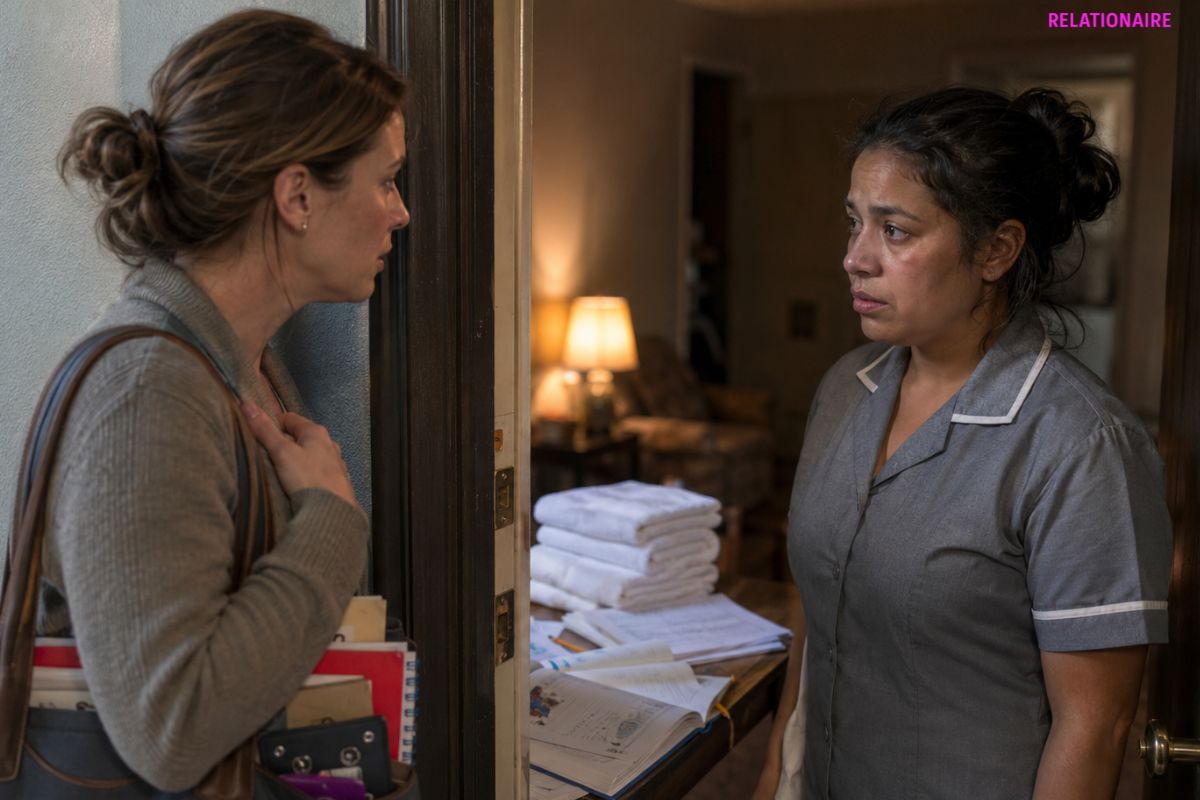
Mrs. Alvarez stood there in a faded housekeeping uniform, her dark hair pulled into a loose bun, one cheek marked with the crease of a pillow. She looked younger than I expected and more exhausted than anyone should look standing upright.
For a second, neither of us spoke.
Then her eyes dropped to the tote bag in my hand.
Her face filled with fear.
“Is Mateo okay?”
“Yes,” I said quickly. “He’s okay. I’m sorry. I should’ve started with that.”
She opened the door a little wider.
Behind her, the apartment was small and dim. A lamp glowed beside a folded blanket on the couch. On the coffee table were three things I will never forget.
A stack of hotel towels.
Mateo’s unsigned permission slips.
And an open children’s book with the words carefully underlined in pencil.
Mrs. Alvarez saw me see it.
Her hand moved quickly, trying to close the book.
But it was too late.
We both stood there, caught between shame and truth.
And then she said the words that broke something open in me.
“Please don’t tell my son I’m stupid.”
PART 3
I have never hated a word as much as I hated stupid in that moment.
Not because she said it.
Because someone had made her believe it belonged to her.
Mrs. Alvarez stood in the doorway with one hand still on the book, her fingers pressed hard against the page like she could hold the truth down if she tried.
“Please don’t tell my son,” she said again.
Her voice was small.
Not weak.
Small from years of being careful.
I set my tote bag down slowly.
“Mrs. Alvarez,” I said, “I would never say that. Because it isn’t true.”
She looked at me like she wanted to believe me but didn’t have the energy to risk it.
Behind her, the apartment told a story no form ever could.
A pair of Mateo’s sneakers sat by the door, one lace knotted three times. A school lunch menu was taped to the fridge with days circled in red. On the counter, there was a pill bottle, a jar of coins, and a grocery list written in careful block letters.
Milk.
Eggs.
Soap.
Bus card.
Some words were spelled wrong.
All of them were trying.
“I missed parent night,” she said, as if confessing a crime. “I work at the hotel from ten at night to six. Then I clean offices three days. I sleep when I can. I meant to come. I really did.”
“I know.”
She shook her head. “No, you don’t. I set alarms. Three alarms. I put my shoes by the door. But I sat down after work and woke up when it was dark.”
Her face tightened.
“Mateo was so mad.”
“He was protecting you.”
Her eyes lifted.
I regretted saying it immediately. Not because it was untrue, but because truth can feel like exposure when someone has spent so long hiding.
She stepped back and let me in.
The apartment was warm. Too warm. A little fan hummed near the window. On the couch was the folded blanket where she had been sleeping. Beside it sat a library card.
“I didn’t finish school,” she said. “My mother read things for me. Bills. Medicine papers. School papers. Everything. After she passed, I thought…”
She stopped.
Her hand went to the back of a chair.
“I thought I could fake it.”
There was no self-pity in her voice.
Only exhaustion.
“But school sends so much paper,” she said. A tired laugh slipped out, almost embarrassed. “Every day, another paper. Sign here. Read this. Due Friday. Bring five dollars. Return by Monday. I try with my phone sometimes, but the words…” She touched her forehead. “They move when I’m tired.”
I thought of every packet I had sent home.
Every reminder written in bright marker.
Every “Please sign and return.”
I had thought of them as communication.
To her, they had been a wall.
“I wanted to help him with homework,” she said. “He asks less now. He says he can do it. But I see his face when other mothers read things.”
She looked toward the hallway, where Mateo’s room must have been.
“I don’t want him ashamed of me.”
“He isn’t,” I said.
Her mouth trembled.
“He is angry.”
“Yes,” I said softly. “But not because he’s ashamed.”
She looked at me then.
“Because he loves you,” I said. “And he’s tired of people not seeing you.”
For the first time, she cried.
Not loudly.
Just one hand over her mouth, shoulders folding inward, as if even grief had to be quiet in that apartment.
I stayed only twenty minutes.
Long enough to give her Mateo’s work.
Long enough to tell her we could send voice messages instead of long emails.
Long enough to ask if she would like Mrs. Han to help her find adult reading classes at the community center.
Long enough to say, “We can do this without making you feel small.”
She wiped her face with the heel of her hand.
“I don’t want charity.”
“I know,” I said. “This isn’t charity.”
“What is it?”
I thought about the empty chair at parent night.
About Mateo’s note.
About all the children who came to school carrying grown-up secrets in broken backpacks.
“It’s partnership,” I said.
The next week, things changed quietly.
Not perfectly.
Life does not become easy because one teacher finally understands.
Mrs. Alvarez still missed calls.
She still forgot one form.
Mateo still slammed his backpack twice that week.
But I stopped sending home paragraphs when three clear sentences would do.
I added a box on important papers: Call me and I’ll explain.
Mrs. Han started leaving books in plain brown envelopes marked “Family Reading.”
Our school counselor found a community literacy program that met on Saturday afternoons and offered child care.
And every Friday, Mrs. Alvarez left me a voice message.
The first one was only seven seconds.
“Hello, Ms. Carter. This is Mateo’s mom. I got the paper. I understand. Thank you.”
I played it twice.
Not because it was remarkable.
Because it was.
In December, we held Family Reading Morning.
It was not as grand as it sounds. Just coffee in the library, donated muffins, children sitting with adults on carpet squares and plastic chairs.
Mateo came in wearing a collared shirt under his hoodie. He pretended not to care.
But he looked at the door every few seconds.
At 8:19, Mrs. Alvarez walked in.
She wore jeans, a black sweater, and the same tired eyes. But her hair was brushed smooth, and she held a small book against her chest like it mattered.
Mateo saw her.
For one second, his face opened completely.
Then he remembered he was nine and looked down.
She signed in at the front table.
Slowly.
Letter by letter.
No one rushed her.
I watched from across the library as she found him.
“Hi, mijo,” she said.
He shrugged. “Hi.”
“You saved me a seat?”
He nodded toward the chair beside him.
She sat.
On the table in front of them was a picture book about a boy and his grandmother. I had not chosen it. Maybe Mrs. Han had. Maybe fate has a library card.
Mrs. Alvarez opened the book.
Her hands shook.
Mateo noticed.
So did I.
So did everyone who knows the difference between nervous and brave.
She leaned close to him and whispered something.
He whispered back.
Then she began to read.
Slowly.
Carefully.
Some words took longer.
Some she sounded out under her breath before saying them aloud.
Mateo did not correct her.
He did not look embarrassed.
He moved his finger beneath the words, just enough to help her without making it look like help.
Halfway down the page, she got stuck.
The word was remembered.
She stared at it.
Her cheeks flushed.
Across the table, another parent glanced over.
I saw Mateo’s shoulders tense.
The old anger was there, ready to defend her.
But before he could say anything, Mrs. Alvarez took a breath.
“Re…mem…bered,” she said.
Then she looked at her son.
“Remembered.”
Mateo smiled.
Not big.
Not for anyone else.
Just enough for his mother to see.
“That’s right,” he whispered.
And in that little school library, surrounded by overdue books and paper cups of bad coffee, something in him finally rested.
At the end of the morning, he brought me a folded piece of paper.
For a second, my heart remembered the first note.
But this one was different.
He stood there, shifting from one foot to the other.
“My mom wrote it,” he said.
I opened it after they left.
The handwriting was uneven. Some letters leaned too far. One word was crossed out and rewritten.
Dear Ms. Carter,
Thank you for not making me feel dumb. Thank you for seeing me. I am trying. My son is worth learning for.
I sat down in the library chair and cried where no one could see me except Mrs. Han, who quietly slid a box of tissues across the table without saying a word.
Years later, I would forget many test scores.
I would forget which reading program we used that year.
I would forget the district goal written on the staff lounge whiteboard.
But I would not forget Mrs. Alvarez sounding out remembered while her son held the page steady.
Because sometimes the most important lesson in a school building is not taught from the front of the room.
Sometimes it happens when a child sees his mother’s dignity protected.
Sometimes it happens when a teacher realizes care is not the same as judgment.
And sometimes an empty chair is not proof that nobody is coming.
Sometimes it is proof that someone is working so hard to get there, in ways we never bothered to see.