If you’ve already read part 1 of this story on Facebook, go here for Part 2!
The first time I knew something was wrong, it was pizza day.
Every child in Room 14 smelled it before the lunch cart even turned the corner.
Twenty-two third graders lifted their heads at once, like little animals catching rain in the air.
“Pizza!” Marcus shouted, even though we all knew he was not supposed to shout.
Ava clapped both hands over her mouth and bounced in her chair.
Even quiet little Ben, who usually ate his sandwich crust first and saved the soft middle like treasure, smiled down at his math worksheet.
But in the back row, by the window, Lily Mercer closed her notebook and whispered, “I’m not hungry.”
That was the third time that week.
At first, I thought she was being picky.
Teachers are not supposed to say that out loud, but we think it sometimes. We see children refuse apples because they have spots. We see them cry over green beans. We see perfectly good trays dumped into trash cans because the macaroni touched the carrots.
So when Lily pushed her lunch card back toward me on Monday, I said what I always said.
“You need something in your stomach, sweetheart.”
She smiled politely.
Not warmly.
Politely.
Like a tiny receptionist.
“I ate breakfast,” she said.
On Tuesday, she said her stomach hurt.
On Wednesday, she said she was saving room for dinner.
On Thursday, she said she had a big snack before school.
And on Friday, pizza day, she said she was not hungry.
That was when I stopped believing her.
Lily was eight years old, with brown hair she wore in the same loose braid every day. The braid always started neatly near her ear and fell apart by recess. She had a purple backpack with a broken zipper, patched with a safety pin and a piece of blue ribbon.
She was not a loud child.
She was not a child people noticed first.
She turned in her homework. She said please. She sharpened her pencil over the trash can instead of at her desk. She helped push in chairs without being asked.
The kind of child adults praise because she makes their day easier.
The kind of child who can disappear right in front of everyone.
By October, I had learned to watch for the quiet ones.
I had been teaching third grade for nineteen years.
Long enough to know that children rarely say, “I am scared.”
They say, “My stomach hurts.”
They say, “I forgot.”
They say, “I don’t care.”
They say, “Can I go to the nurse?”
They say, “I’m not hungry.”
That Friday, I stood by the cafeteria line with my class behind me, the air heavy with warm cheese and floor cleaner. Lunch trays clattered. A milk carton rolled under the serving counter. Somewhere, a kindergartner sobbed because his pudding was chocolate instead of vanilla.
Lily stayed at the end of the line with her arms folded across her chest.
When Mrs. Donnelly, the cafeteria worker, smiled at her and said, “Cheese or pepperoni, honey?” Lily looked at the tray like it had asked her a question she could not afford to answer.
“No, thank you,” she said.
Mrs. Donnelly glanced at me.
I glanced at Lily.
Lily stared at her shoes.
They were pink sneakers, but one lace was white and the other was gray. The gray one was not a shoelace. It was a piece of string.
“Just milk then?” I asked gently.
She shook her head.
“I’m not hungry.”
I wanted to press her.
I wanted to kneel down right there on the scuffed cafeteria floor and say, “Lily, who told you not to eat?”
But children do not give you the truth just because you ask with a soft voice.
Sometimes they hand it to you in pieces.
Sometimes they hide it in a desk.
Sometimes they carry it home in their backpack.
So I let her sit with the class.
She chose the end of the table, near the wall.
All around her, children folded pizza slices in half and talked with red sauce on their cheeks. Someone spilled milk. Someone traded carrots for cookies. Someone dropped a crust on the floor and tried to pick it up before I saw.
Lily folded her hands in her lap and watched the clock.
Not the children.
Not the food.
The clock.
Like she was waiting for lunch to be over.
After recess, while the class was at music, I stood alone in Room 14 with the soft hum of the heater and the smell of dry erase markers.
I opened my bottom drawer.
Inside were the things teachers keep because schools run on emergencies.
Band-Aids.
Extra pencils.
A hair tie.
A stack of nurse passes.
Granola bars.
Crackers.
A pair of socks.
A toothbrush still in its wrapper.
Things bought one at a time at the grocery store and never submitted for reimbursement because there was no line on the budget form for “children whose lives are quietly falling apart.”
I took out a small pack of peanut butter crackers.
Then I hesitated.
We were trained not to make children feel singled out. Not to shame them. Not to assume.
So I walked to Lily’s desk and slipped the crackers into the little metal basket underneath, beside her reading folder and a crumpled spelling list.
When the class returned, Lily sat down and froze.
Her hand went under her desk.
She felt the package.
Her eyes lifted to mine.
I was writing the date on the board.
October 13.
I did not turn around.
I simply said, “Class, take out your science notebooks.”
For three minutes, Lily did not move.
Then I heard the soft crackle of plastic.
She ate one cracker.
Only one.
Then she wrapped the rest carefully, so carefully, and slid the package into the front pocket of her backpack.
That was the beginning.
Every morning after that, I put something small in Lily’s desk.
Crackers.
An applesauce pouch.
A cereal bar.
A little box of raisins.
Nothing big.
Nothing obvious.
And every day, she found it.
Every day, she looked at me.
Every day, I pretended not to see.
But the strange thing was this.
She almost never ate it.
Sometimes she took one bite.
Sometimes she held the package in her lap during silent reading, running her thumb over the wrapper like she was counting something.
But most days, she tucked it away unopened.
At first, I thought she was embarrassed.
Then I wondered if someone at home had told her not to accept food.
Then I wondered if she was hoarding.
Teachers learn terrible words without wanting to.
Food insecurity.
Neglect.
Chronic stress.
Mandatory reporting.
We learn to hear the difference between a child who forgot lunch and a child who has learned not to expect one.
But Lily did not look neglected.
That was part of what made me doubt myself.
Her hair was brushed. Her clothes were clean, though often too thin for the weather. Her homework was signed in careful block letters: Daniel Mercer.
Her emergency contact form had only one name.
Father.
No mother listed.
No grandmother.
No aunt.
Just one name, written twice, once in blue ink and once crossed out and corrected with a new phone number.
I asked the office if anyone knew the family.
Mrs. Alvarez, our secretary, lowered her voice.
“Dad picks her up every day. Very polite. Always on time.”
“That’s it?”
“That’s it.”
At pickup, I started watching.
Daniel Mercer drove an old silver sedan with a dented passenger door and a back window patched with clear tape. He always parked two blocks away instead of joining the long pickup line. He wore a navy work jacket, even when the afternoons were warm.
Lily always ran to him.
Not walked.
Ran.
He always crouched down like he had been waiting all day to be small enough for her. She threw her arms around his neck. He closed his eyes when he hugged her.
That did not look like neglect.
That looked like love.
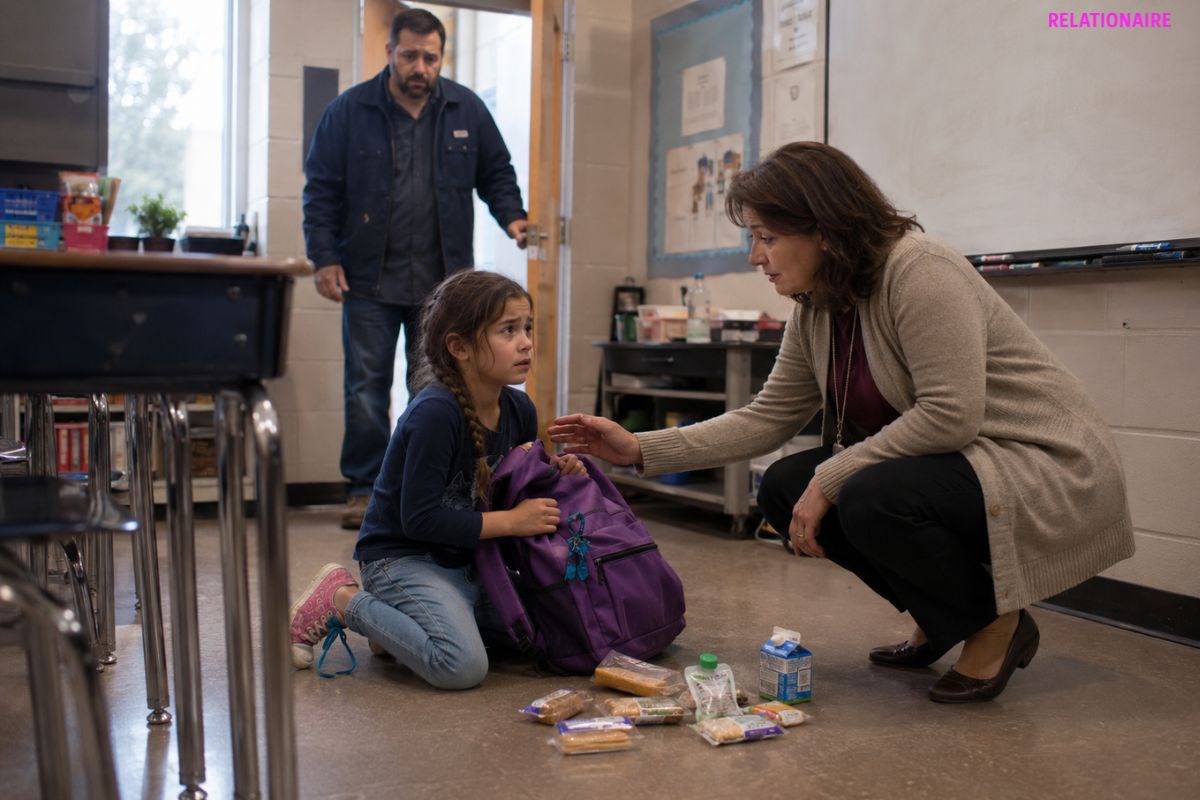
Still, something was wrong.
One afternoon, I found Lily in the classroom after dismissal. The buses had left. The hallway had gone quiet except for the squeak of our custodian’s cart.
She was on her knees beside her desk, frantically emptying her backpack.
Folders spilled out.
A library book.
A mitten.
A wrinkled permission slip.
Three unopened packs of crackers.
Two cereal bars.
An applesauce pouch.
A small carton of shelf-stable milk from breakfast.
She looked up and saw me.
Her face changed instantly.
Not guilty.
Terrified.
“Lily,” I said softly.
She scrambled to shove everything back.
“I was just cleaning,” she said.
But her hands were shaking so hard she could not zip the broken backpack.
I knelt beside her.
“I’m not upset.”
She shook her head fast.
“I didn’t steal them.”
“I know.”
Her eyes filled.
“I didn’t.”
“I know, sweetheart.”
She clutched the backpack to her chest.
For a second, she looked younger than eight.
Much younger.
Like the whole world had handed her something too heavy and told her to keep quiet about it.
I reached slowly toward the front pocket, where the crackers had spilled halfway out.
Lily grabbed my wrist.
Not hard.
Just desperate.
“Please don’t take them,” she whispered.
The classroom seemed to go silent around us.
Outside, a basketball bounced once in the empty gym.
I looked at the food.
Then at her.
And for the first time, I understood I had been asking the wrong question.
It was not why Lily was not eating.
It was who she was saving the food for.
Before I could say anything, the classroom door opened.
Daniel Mercer stood there in his navy work jacket, breathing hard like he had run from the parking lot.
His eyes went to Lily.
Then to the backpack.
Then to the food scattered across the floor.
And his face broke in a way I have never forgotten.
He whispered, “Lily… what did you do?”
PART 2
For a moment, no one moved.
Daniel Mercer stood in the doorway with one hand still gripping the frame. His work jacket hung loose on him. Not stylish loose. Hungry loose. The cuffs were frayed white at the edges.
Lily rose slowly from the floor, clutching her backpack against her chest.
“I didn’t steal,” she said again.
Her voice was smaller this time.
Daniel’s eyes flicked to me.
Then back to Lily.
“What is all that?”
The question was not angry.
That was what hurt.
It was scared.
Lily’s chin trembled, but she lifted it the way children do when they are trying to protect someone bigger than themselves.
“It’s mine.”
“Lily.”
“It is.”
I stood up carefully.
“Mr. Mercer,” I said, “I gave some of it to her.”
He stared at me.
The color drained from his face.
“You gave her food?”
“Yes.”
His expression shifted in three painful steps.
Confusion.
Shame.
Then something close to panic.
“I didn’t ask for that,” he said quickly. “I mean, I appreciate it, but we’re fine. She eats. I pack things when I can. I mean—”
He stopped.
Because there was no lunchbox in Lily’s backpack.
There had not been one all week.
Lily turned toward him.
“You said you ate at work.”
Daniel closed his eyes.
Just once.
Too long.
That was the moment the truth entered the room.
Not all of it.
But enough.
I had seen children lie before. I had seen parents lie too. Usually to protect themselves.
This felt different.
This was a father and daughter lying in opposite directions, each trying to keep the other from hurting.
Daniel opened his eyes and tried to smile.
It was the saddest smile I had ever seen on a grown man.
“I do eat at work, bug.”
Lily shook her head.
“No you don’t.”
The words fell hard.
Daniel flinched.
I had the sudden feeling I should not be standing there. That I had walked into the most private room of their lives, even though we were in a third-grade classroom under fluorescent lights, with multiplication posters on the wall and glue stick caps under the desks.
But sometimes school becomes the place where private pain spills because children cannot carry it all the way home.
Lily unzipped the broken backpack and pulled out the crackers.
One pack.
Then another.
Then a cereal bar.
Then the applesauce.
She placed them on her desk, one by one.
“I was saving them,” she said.
Daniel’s mouth tightened.
“For what?”
“For you.”
The heater clicked on.
Somewhere down the hall, someone laughed.
I looked at Daniel’s face, and I understood then why he always wore the same jacket. Why he parked far from the pickup line. Why Lily watched the clock at lunch. Why she ran to him every day like she was checking whether he was still there.
Daniel sat down in the tiny blue chair beside Lily’s desk.
It was too small for him. His knees came up awkwardly. He looked like a man folded into a child’s world because there was nowhere else to fall apart.
“Lily,” he said, barely above a whisper.
“You say you ate,” she said. “But I heard your stomach at night.”
His hand went to his eyes.
Not to wipe tears.
To hold them in.
“I’m the dad,” he said. “That’s not your job.”
“But you’re hungry.”
“No.”
“You are.”
He shook his head, but the lie had lost its shape.
Lily pushed the crackers toward him.
Her little hand stayed there, palm flat on the desk.
“I don’t need pizza,” she whispered. “You need dinner.”
I turned away then.
Not because I was uncomfortable.
Because he deserved one second not to be watched.
Teachers see too much sometimes.
We see children arrive in winter without coats and say they are not cold.
We see parents count coins at book fair tables.
We see grandparents filling out custody forms with hands that shake.
We see mothers read late notices in the front office and apologize like poverty is a personal failure.
We learn that dignity is fragile.
And that helping someone without breaking it is harder than any lesson plan.
Daniel stood abruptly.
“I’m sorry,” he said to me.
“For what?”
“For this.”
He gestured toward the food, the backpack, the small classroom, his daughter’s tears.
As if hardship had made a mess and he was responsible for cleaning it up.
“There’s nothing to be sorry for.”
He nodded too fast.
“We’re just in between right now.”
People say that when the floor has already dropped out.
“We’re okay,” he added.
Lily looked down.
I did not argue with him.
Not there.
Not in front of her.
Instead, I said, “Can we step into the hallway for a minute?”
Lily’s eyes widened.
Daniel noticed.
“It’s okay, bug.”
“No,” she whispered.
He crouched beside her.
“I’m not in trouble.”
She looked at me.
“You won’t make him leave?”
That sentence landed harder than anything else.
Daniel went still.
I knelt in front of her.
“No one is making your dad leave.”
She stared at me like she needed to memorize my answer in case adults changed their minds later.
“You promise?”
“I promise.”
Only then did she let go of his sleeve.
In the hallway, Daniel kept his voice low.
“I lost my job six weeks ago,” he said.
He did not look at me when he said it.
He looked at the bulletin board beside us, at paper pumpkins with children’s names written in black marker.
“I was a mechanic. Shop closed. No warning. I’ve been doing day labor when I can get it. Deliveries sometimes. There’s unemployment, but it’s slow. I’ve sold things. I’m not asking for anything.”
“I know.”
“I mean it. I’m not.”
“I know.”
His jaw tightened.
“She has food. I make sure she has food.”
I said nothing.
His eyes filled, and this time he could not hide it.
“I make sure she eats first.”
There it was.
The whole story in one sentence.
Not neglect.
Sacrifice.
Not carelessness.
A father doing math no parent should have to do.
A child learning the numbers anyway.
He rubbed both hands over his face.
“I thought she didn’t know.”
“They always know,” I said gently.
He let out a broken breath.
“My wife died two years ago.”
I had not known that.
The emergency form had not said deceased. Just blank.
“Cancer,” he said. “Lily was six. I told myself if I could keep her routine the same, maybe she’d be okay. Same school. Same bedtime. Same pancakes on Saturday.”
He laughed once, without humor.
“Pancakes got expensive.”
Down the hall, the after-school program children marched past in a crooked line. One boy waved at me. I waved back.
Daniel turned his head away until they passed.
“I don’t want people looking at her different,” he said. “She’s had enough.”
That was the part that broke me.
Because he was right to fear it.
Adults say children are resilient, but sometimes what we mean is that they are too small to stop us from seeing their pain.
“I can connect you with some resources,” I said.
He stiffened.
“I said we’re not—”
“I heard you.”
His shoulders rose.
I chose my next words carefully.
“Not charity. School support. Things already there for families. Lunch account help. Weekend food bags. A counselor if Lily needs someone. Community closet. Gas cards sometimes.”
His face hardened.
“We don’t need people knowing our business.”
“Then they won’t.”
He looked at me.
I held his gaze.
“I can be discreet.”
For the first time, he seemed unsure whether to believe me.
Before he could answer, Lily stepped out of the classroom.
She had packed the food back into her bag.
All of it.
Her braid had come loose around her face.
“Daddy,” she said, “can we go home now?”
Daniel swallowed.
“Yes, bug.”
She slipped her hand into his.
Then she looked at me.
“Do I have to give it back?”
I shook my head.
“No.”
Her shoulders dropped with relief.
Daniel looked like he might object, but I spoke first.
“Actually, I was wondering if you could help me with something tomorrow.”
Lily blinked.
“Me?”
“Yes. I have too many snacks in my drawer, and they are taking up space. Could you take some home?”
She looked suspicious.
Third graders are excellent at spotting lies.
“What kind?”
“Crackers. Cereal bars. Maybe soup cups if I find them.”
Her eyes moved to her father.
Daniel looked at the floor.
I could see the war in him.
Pride on one side.
His daughter on the other.
Finally, he nodded once.
Only once.
Lily nodded too.
“Okay,” she said.
But I knew it was not enough.
A drawer full of snacks does not fix rent.
A cereal bar does not repair unemployment.
A teacher’s kindness cannot replace a paycheck.
That night, I sat at my kitchen table grading spelling tests I could not focus on.
My own apartment was quiet except for the refrigerator humming and the scratch of my red pen.
On the chair beside me sat my old canvas teacher tote bag. The straps were worn thin. There was a coffee stain near the bottom and a permanent marker streak across one side.
I had carried that bag through nineteen years of first days, field trips, parent nights, fire drills, lice notices, and children who needed more than I had.
Sometimes I resented it.
Sometimes I looked at it and felt like it held every child I had ever failed.
At 11:37 p.m., I opened my laptop and wrote an email to our principal, Mrs. Henson.
Subject: Quiet support needed for a family.
I did not include details that were not mine to share.
I wrote just enough.
Third-grade student. Recent family hardship. Food insecurity. Parent protective and private. Need discreet support.
Then I sat there with my fingers above the keyboard.
Because once you write something down in a school system, it becomes real in a different way.
It becomes forms.
Meetings.
Files.
People.
Good people, mostly.
But still people.
And Daniel had asked for dignity.
Lily had asked if we would make him leave.
I deleted two sentences.
Then three.
Then I started again.
The next morning, Mrs. Henson appeared in my doorway before the first bell.
She was a strict principal, the kind children straightened up for automatically. She wore blazers and sensible shoes and kept a clipboard against her hip like a shield.
Some parents thought she was cold.
Some teachers did too.
But I had once seen her sit on the cafeteria floor beside a boy who had thrown a chair and say, “You are not your worst minute.”
So when she said, “Tell me what you need,” I nearly cried.
“Privacy,” I said.
She nodded.
“And help.”
She nodded again.
By noon, she had done more than I thought possible.
She arranged for Lily’s lunch account to be quietly covered through the year under an anonymous school fund.
She called our counselor.
She found a winter coat in the community closet that was Lily’s size, purple, with the tags still on.
She contacted a local church pantry that already partnered with the school.
And then she did something I did not expect.
She picked up the phone and called her brother.
He owned a small auto shop across town.
That afternoon, when Daniel arrived for pickup, Mrs. Henson asked him to step into the office.
I watched from my classroom window as he hesitated.
Lily held his hand tighter.
I saw his face close down.
Pride again.
Fear again.
The old instinct to protect his child from pity.
He looked toward Room 14.
Toward me.
As if asking whether this was the moment I had promised would not happen.
I walked into the hallway.
Lily saw me first.
Her mouth was a straight line.
“You promised,” she said.
And the terrible thing was, I had.
PART 3
I have never forgotten the look Lily gave me in that hallway.
It was not anger.
Anger would have been easier.
It was betrayal.
Small, quiet, wounded betrayal.
The kind a child feels when she finally hands an adult one corner of the truth, and the adult pulls too hard.
I crouched in front of her.
“I did promise,” I said.
Daniel stood behind her, his face pale.
“Then why does she want Daddy in the office?”
His hand rested on Lily’s shoulder.
Not gripping.
Steadying.
Maybe himself more than her.
Mrs. Henson stood a few feet away, watching carefully. She could have stepped in with her principal voice. She could have explained policy. She could have taken control.
She did not.
That was one of her gifts.
She knew when being powerful meant staying quiet.
I looked at Lily.
“Your dad is not in trouble.”
She did not move.
“And nobody is taking him away.”
Her eyes searched mine.
I kept my voice low.
“Mrs. Henson found something that might help him. That’s all.”
Daniel’s brow tightened.
“What kind of something?”
Mrs. Henson stepped forward then.
“A job lead,” she said.
Not charity.
Not a handout.
A job lead.
Those two words changed the hallway.
Daniel blinked.
“My brother owns an auto repair shop. He needs someone experienced. I told him I knew a father who showed up on time every single day.”
Daniel looked at her like he had not understood.
Mrs. Henson continued.
“I did not share private details. I told him your name and that you had experience as a mechanic. If you are interested, he can meet with you tomorrow morning.”
Daniel’s lips parted.
No sound came out.
Lily turned to him.
“Daddy?”
He looked down at her.
Then away.
Toward the glass trophy case full of dusty plaques and spelling bee photos and children holding certificates from years nobody remembered.
His eyes shone.
“I don’t have work boots anymore,” he said.
It was such a small sentence.
That was why it hurt.
Not “thank you.”
Not “yes.”
Not even “I need help.”
Just the practical detail that stood between a man and his dignity.
Mrs. Henson nodded once.
“What size?”
Daniel shook his head immediately.
“No. I can’t—”
“What size?” she repeated, softer.
He swallowed.
“Eleven.”
Mrs. Henson wrote it down on her clipboard as if she were recording a bus change.
Calm.
Normal.
Nothing to be ashamed of.
“I believe we have a community closet donation in that size.”
He looked at me.
Then at her.
“I don’t want Lily thinking—”
“She already thinks you’re hungry,” Mrs. Henson said gently.
That landed.
Daniel closed his eyes.
Lily slipped her hand into his.
“I don’t care about boots,” she whispered. “I care about you eating.”
A sound came from Daniel then.
Not a sob exactly.
Something quieter.
Something a person makes when the wall inside them finally gives way, but they are still trying not to scare their child.
He knelt in front of Lily right there in the hallway.
The bell rang above us, loud and careless.
Children poured from classrooms, laughing, dragging jackets, losing papers, calling for buses.
The whole school moved around them.
But for one moment, Daniel and Lily were still.
“I’m sorry,” he said.
Lily shook her head.
“You didn’t do bad.”
He pulled her into his arms.
“No,” he whispered into her hair. “But I let you worry like a grown-up.”
She clung to him.
Behind them, Mrs. Alvarez appeared at the office door with a tissue box in her hand. She did not say anything. She just set it on the small table near the lost-and-found bin and disappeared again.
That is how schools care sometimes.
Not loudly.
Not perfectly.
Just one person noticing, then another, then another, until a child is no longer the only one holding the weight.
The next morning, Daniel came to school in borrowed work boots.
They were a little scuffed, but clean.
Lily walked beside him wearing the purple coat from the community closet. She kept rubbing the sleeve with her fingers, like she could not believe something warm belonged to her.
Daniel stopped at my classroom door.
“I have an interview,” he said.
He looked nervous, almost boyish.
“That’s wonderful.”
He nodded.
Then he reached into his jacket pocket and pulled out a folded paper bag.
“I packed her lunch today.”
He handed it to Lily.
She held it with both hands.
Inside was a peanut butter sandwich, a banana with a bruise near the top, and two small cookies wrapped in a napkin.
Lily peeked inside and smiled.
A real smile.
Not polite.
Real.
Then she looked up at her father.
“What about yours?”
Daniel paused.
Then, very deliberately, he pulled another paper bag from his other pocket.
“Mine too.”
Lily studied his face.
“Show me.”
He opened it.
Sandwich.
Apple.
Cereal bar.
She nodded once, satisfied.
“Okay.”
That was the first day Lily ate lunch at school.
She did not eat all of it.
Healing does not happen in one cafeteria period.
But she ate half the sandwich.
Then the cookies.
Then she drank her milk.
And when Marcus asked if she wanted his carrots because he hated “orange sticks,” Lily rolled her eyes and said, “They’re just carrots.”
It was such an ordinary third-grade sentence that I had to turn toward the window for a second.
Daniel got the job.
Not because anyone pitied him.
Because he was good at fixing things.
That was what Mrs. Henson’s brother told her after the first week.
“He saw what was wrong with an engine just by listening.”
I thought about that for a long time.
Some people do that with children.
They hear what everyone else misses.
A too-quick answer.
A fake stomachache.
A child watching the clock instead of the pizza.
A backpack too heavy with unopened food.
By November, Lily’s shoulders looked different.
Children carry worry in their bodies. You can see it if you know how.
Hers began to lower.
She laughed more.
She stopped hoarding every snack, though sometimes she still tucked one into her backpack “just in case.” We did not make a big thing of it.
Just in case is a hard habit to unlearn.
The school helped quietly.
A grocery gift card appeared in an envelope marked “family support.”
No announcement.
No assembly.
No smiling photo for the newsletter.
The counselor met with Lily once a week under the excuse of a “lunch bunch.” She drew pictures at first. Then she talked.
She told the counselor she remembered her mother’s hospital blanket.
She remembered her dad crying in the kitchen when he thought the water was running loud enough.
She remembered counting crackers in her backpack and feeling proud because maybe that meant dinner.
When the counselor told me that, I sat in the staff bathroom during my planning period and cried into a paper towel.
Then I washed my face, grabbed my lesson plans, and taught fractions.
That is teaching.
You break a little in private.
Then you walk back into the room and say, “Who remembers what the denominator tells us?”
In December, our class held a family breakfast before winter break.
Nothing fancy.
Store-brand muffins.
Orange juice.
Coffee in cardboard boxes.
Children made paper snowflakes and taped them crookedly to the windows.
Parents stood around the room in coats, holding tiny napkins, trying to fit themselves into little chairs.
Daniel came in his work uniform.
His name was stitched over the pocket.
Dan.
There was grease under one fingernail.
His face looked fuller.
Not much.
Enough.
Lily walked him straight to her desk.
“This is where I sit,” she said.
“I know,” he said.
“This is my book bin.”
“I know.”
“This is where Mrs. Carter put the crackers.”
The room went quiet inside me.
Daniel looked at me.
I waited for embarrassment to pass over his face.
It did not.
Instead, he looked at Lily.
Then at the small metal basket under her desk.
Then back at me.
“Thank you,” he said.
Two simple words.
But they carried six weeks of hunger, pride, fear, grief, and every unopened cracker his daughter had saved.
I shook my head.
“She was the brave one.”
Lily leaned against her father’s side.
Daniel rested a hand on her hair.
“No,” he said softly. “She was the child.”
That sentence stayed with me.
Because he was right.
Children can be brave.
They can be kind.
They can be strong in ways that humble every adult in the room.
But they should not have to be the safety net.
They should not have to save dinner.
They should not have to listen for hunger through apartment walls.
They should not have to pretend they are not hungry on pizza day.
Before leaving, Daniel handed me a small envelope.
On the front, in Lily’s careful handwriting, it said:
For Mrs. Carter’s snack drawer.
Inside were three boxes of crackers and a note.
Not from Daniel.
From Lily.
Thank you for pretending not to see until I was ready.
I read it twice.
Then a third time.
Because sometimes children understand mercy better than adults do.
By spring, Lily was still quiet.
That did not change.
Not every story ends with a child becoming loud and shiny and healed.
Some children remain gentle.
Some remain watchful.
But she no longer disappeared.
She raised her hand in science.
She joined Ava at recess.
She asked for extra ranch dressing on salad day.
And on pizza day, she got in line.
The first time she took a slice, Mrs. Donnelly behind the counter tried not to react.
She failed.
Her eyes filled up immediately.
“Cheese or pepperoni, honey?”
Lily smiled.
“Pepperoni.”
Then she paused.
“Can I have a napkin too? My dad says I get sauce everywhere.”
Mrs. Donnelly handed her three.
Just in case.
At the end of the year, we had our character awards.
Not the highest grades.
Not perfect attendance.
Not fastest reader.
Character.
The thing schools sometimes forget to measure, even though it is what children carry longest.
I gave awards for courage, kindness, perseverance, honesty, leadership.
For Lily, I made one by hand.
A small certificate with a gold sticker in the corner.
The Quiet Strength Award.
When I called her name, she walked to the front with her braid falling loose and her purple coat folded over one arm even though it was May.
Daniel stood in the back of the classroom.
He clapped with both hands.
Lily looked at the certificate, then at me.
“Is this because of the food?” she whispered.
I bent down.
“No,” I said. “It’s because you loved someone so much that you tried to carry too much. And then you learned you didn’t have to carry it alone.”
Her eyes filled.
But she smiled.
That afternoon, after everyone left, I opened my bottom drawer.
There were still crackers inside.
Granola bars.
Band-Aids.
Extra pencils.
Socks.
Things the school budget would never fully understand.
I thought about all the children who had passed through Room 14.
The ones who came hungry.
The ones who came angry.
The ones who came grieving.
The ones who came spotless on the outside and shattered underneath.
And I thought about how often a school is judged by test scores and rankings and bright posters in the hallway.
But sometimes the most important thing that happens in a school is much smaller.
A teacher notices.
A child trusts.
A father accepts help without losing his dignity.
A secretary finds a tissue box.
A principal makes one phone call.
A cafeteria worker adds an extra napkin.
No applause.
No headline.
Just people standing close enough to keep a family from falling through the cracks.
And maybe that is what every child deserves.
Not a perfect world.
Just one ordinary place where someone is paying attention.