If you’ve already read part 1 of this story on Facebook, go here for Part 2!
PART 1
The teachers expected Malik Turner to make the little boy cry.
That was the quiet truth nobody said out loud when Mrs. Ellis matched the reading buddies on a rainy Tuesday morning, with twenty-four first graders sitting cross-legged on the library rug and twenty-four fifth graders trying to look too old to care.
Malik stood in the back with his hood up.
He was eleven, but he carried himself like someone twice that age and twice as tired. His knuckles were scabbed. His shoes were untied. His backpack hung open because the zipper had broken sometime before Christmas and nobody had replaced it.
Every teacher knew his name.
Not in the good way.
Malik had flipped a desk in October.
He had gotten into two hallway fights before Thanksgiving.
He had once told the music teacher, “I don’t sing,” with such coldness that half the class stopped singing too.
By January, the front office had a folder with his name on it, thick with behavior reports and parent contact logs that led mostly nowhere.
So when Mrs. Ellis, the reading specialist, looked at her clipboard and said, “Malik, you’ll be with Noah,” the whole library seemed to pause.
Noah Reed looked up from the rug.
He was the smallest child in first grade, a pale little boy with glasses that slid down his nose and sleeves pulled over his hands. He did not speak much. When he did, his voice came out like he was asking permission to exist.
“Noah,” Mrs. Ellis said gently, “this is your reading buddy.”
Malik looked at him.
Noah looked at the floor.
Across the room, Mrs. Patterson, Noah’s teacher, pressed her lips together. She had already asked Mrs. Ellis that morning if maybe Noah could be paired with someone “a little softer.”
Mrs. Ellis had only said, “Let’s see.”
But everyone was seeing the same thing.
A shy first grader who cried when someone bumped his chair.
An angry fifth grader who had been suspended for shoving a boy into the lockers.
A reading program meant to build confidence.
A disaster waiting in the picture book aisle.
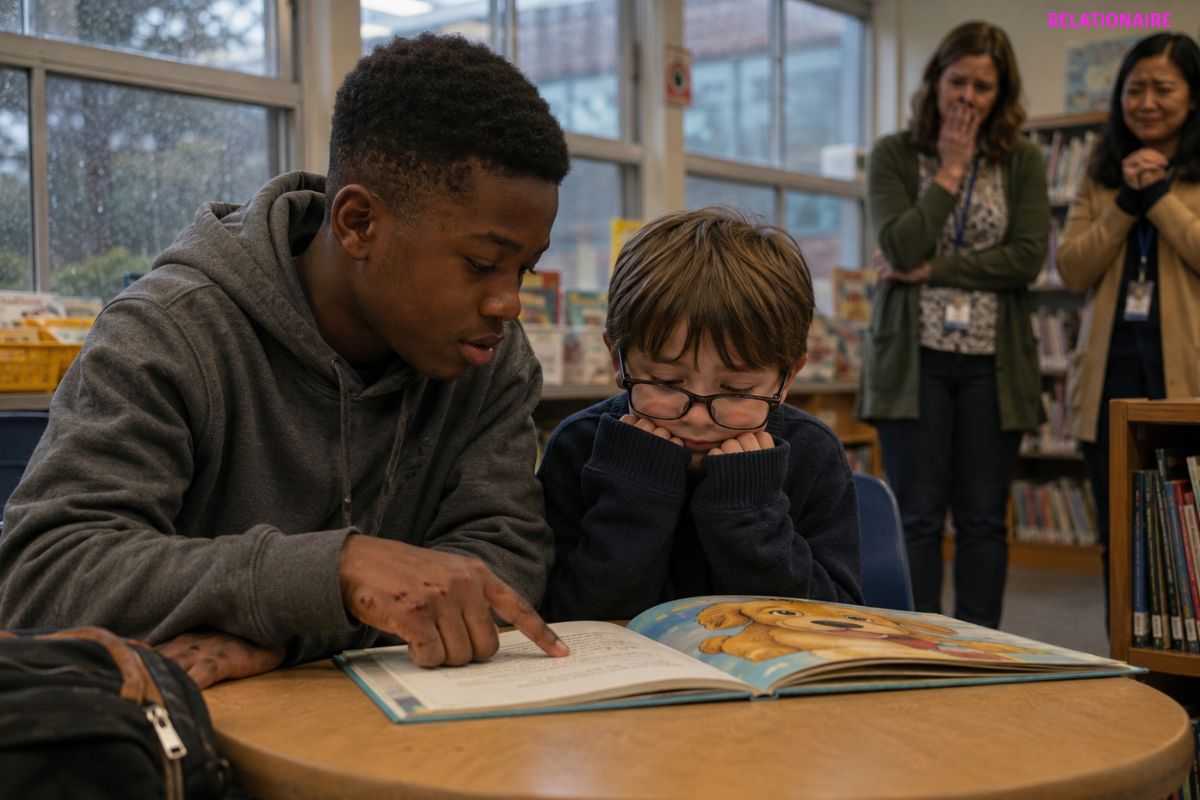
Malik dropped into the tiny chair beside Noah, knees almost touching the underside of the small round table. The chair squeaked under him. Noah flinched.
Malik noticed.
His face did not change.
Mrs. Ellis placed a thin book between them. It had a smiling dog on the cover and big friendly letters.
“Take turns,” she said. “Older buddies help, not rush.”
Malik stared at the book like it had offended him.
Noah’s fingers curled into his sleeves.
For a moment, nobody moved.
Then Malik pulled the book closer.
The librarian pretended to organize bookmarks behind the counter. Mrs. Patterson pretended to check attendance. Two fifth-grade boys whispered near the nonfiction shelf, waiting for Malik to say something mean.
Malik opened the book.
Noah swallowed.
The rain tapped the windows.
And then Malik read the first line.
Not loud.
Not annoyed.
Softly.
So softly, at first, Mrs. Patterson thought she had imagined it.
“The dog… sat… by the red ball.”
He slid one finger under each word, slow and careful.
Noah stared at him.
Malik looked at the page, not at the room.
“Your turn,” he said.
Noah shook his head.
“It’s just words,” Malik said.
Noah’s eyes filled immediately.
Mrs. Patterson took one step forward.
But Malik did not snap. He did not roll his eyes. He did not laugh.
He leaned closer, lowering his voice until only Noah could hear.
“I ain’t gonna let nobody hear you mess up.”
Noah blinked.
Malik tapped the first word.
“The.”
Noah whispered, “The.”
“Dog.”
“Dog.”
“Sat.”
Noah hesitated.
Malik waited.
Not the impatient kind of waiting adults sometimes did, with a smile that still pushed. Real waiting. Quiet waiting. Like he had all day.
“Sat,” Noah finally said.
Malik nodded once.
“See? You got it.”
Mrs. Patterson stopped moving.
The two boys by the shelf stopped whispering.
Noah read the next three words with Malik’s finger under them. His voice shook, but it came out.
When he finished the page, Malik turned it carefully, like the paper mattered.
For twenty minutes, that was all they did.
No big moment.
No speech.
No miracle.
Just an older boy in a gray hoodie, bent over a picture book, reading beside a child who seemed to shrink less with every page.
When the bell rang, chairs scraped. Fifth graders stood too fast, relieved to return to their regular world of multiplication quizzes and pretending not to care about anything.
Noah stayed seated.
He touched the corner of the book.
“Do you come back tomorrow?” he asked.
It was the most words Mrs. Patterson had heard from him all week.
Malik shrugged, but something moved across his face.
“Yeah,” he said. “If they don’t kick me out first.”
Noah looked confused.
Malik pushed the chair in and walked away before anyone could praise him.
That should have been the end of it.
A surprising good day.
A note in Mrs. Ellis’s clipboard.
A small reason to hope.
But by Thursday afternoon, the whole school had heard what happened in the cafeteria.
It started with chocolate milk.
Noah was carrying his tray with both hands, the way first graders do when the milk carton feels as heavy as a brick. A third grader named Ryan bumped him near the condiment station.
The milk spilled across Noah’s tray, soaking his napkin, his chicken nuggets, and the little paper book he had brought from the library to practice.
Ryan laughed.
“Baby Noah’s gonna cry.”
Noah froze.
The cafeteria got loud in that dangerous way children recognize before adults do.
Malik, sitting at the fifth-grade table across the room, stood up.
The lunch monitor called his name.
“Malik, sit down.”
He did not.
Ryan said something else. Nobody heard exactly what it was, but Noah’s face changed. His chin tucked. His hands disappeared into his sleeves.
Malik crossed the cafeteria in six long steps.
“Say it again,” he said.
Ryan backed up.
The monitor moved faster now. “Malik.”
Ryan lifted both hands. “I was just playing.”
“No, you weren’t.”
Malik did not hit him.
He did not shove him.
He did something worse, at least in the eyes of everyone who had already decided what kind of boy he was.
He picked up Ryan’s full lunch tray and slammed it down so hard on the table that applesauce jumped from its cup and splattered across the floor.
The cafeteria went silent.
Noah started crying then.
Not because of Ryan.
Because everybody was staring.
Malik’s jaw tightened.
Two adults reached him at the same time.
“Office,” the lunch monitor said.
Malik did not argue.
He only turned to Noah and said, “Don’t let them throw your book away.”
Then he walked out with applesauce on his sleeve and every old label following him down the hall.
By the end of the day, Mrs. Patterson heard three versions of it.
Malik threatened a child.
Malik lost control again.
Malik ruined lunch.
The principal, Mr. Alvarez, called his grandmother.
No answer.
He called the backup number.
Disconnected.
He put Malik in the conference room with a behavior reflection sheet and a dull pencil.
At 3:40, after the buses had pulled away and the hallway smelled like wet coats and floor cleaner, Mrs. Patterson found Noah standing outside the office.
His backpack looked too big on him.
In his hands was the library book.
The pages were warped from milk.
“Noah?” she asked. “Sweetheart, pickup is outside.”
He did not move.
Through the office window, Malik sat alone at the conference table, hood down now, face turned toward the wall.
Noah held the book tighter.
“I have to give him this,” he whispered.
Mrs. Patterson crouched beside him. “Why?”
Noah looked at Malik through the glass.
Then he said something that made every adult in the office go still.
“Because he told me he knows what it feels like when nobody comes.”
PART 2
Mrs. Patterson did not ask Noah what he meant right away.
Sometimes children say things like that and the room leans too hard toward them. They feel the weight of adult attention and disappear inside themselves.
So she only sat beside him on the vinyl bench outside the office and said, “You can give him the book.”
Noah nodded.
His hands shook as he walked to the conference room door.
Mr. Alvarez looked up from his desk. Mrs. Ellis stood behind him with her reading clipboard pressed against her chest.
No one stopped Noah.
He opened the door just enough to slide inside.
Malik did not turn around at first.
Noah stood there with the milk-wrinkled book held against his sweatshirt.
“I saved it,” he said.
Malik’s shoulders moved, barely.
“Good.”
Noah took two small steps closer.
“They said you’re in trouble.”
Malik gave a short laugh with no humor in it. “I’m always in trouble.”
Noah looked down at the book.
“You didn’t hit him.”
That made Malik turn.
His eyes were red, but his face was hard.
“No,” he said. “But I wanted to.”
The adults outside the door heard it. Every word.
Noah did not look afraid.
He only said, “My dad used to slam things too.”
Mrs. Patterson felt the sentence land in her stomach.
Mr. Alvarez closed his eyes for one second.
Noah’s father had not been listed on his emergency card since kindergarten registration. There was one name crossed out in blue ink, and beside it, his mother had written “Do not contact” so hard the pen had torn the paper.
Noah had never talked about him.
Not at school.
Not with teachers.
Not with the counselor who offered him crayons and feelings charts.
But there he was, standing in front of the boy everyone feared, saying the thing he could not say to anyone else.
Malik looked at him for a long time.
Then his face changed.
Not softer exactly.
Older.
“Mine too,” he said.
Noah’s mouth parted.
“And people think you’re scared of loud noises,” Malik said. “But really you’re scared of what comes after.”
The conference room went quiet.
Outside the glass, the school day had ended. The front office printer hummed. A late parent signed a checkout sheet. Somewhere down the hall, a custodian pushed a mop bucket past a row of tiny jackets on hooks.
But inside that room, two boys sat with a truth no spelling list could touch.
Mrs. Patterson stepped away before Noah could see her crying.
The next morning, the school did what schools often do when the adults are good people but the system is tired.
They held a meeting.
Mr. Alvarez sat at the head of the table with Malik’s file open in front of him. Mrs. Ellis was there. Mrs. Patterson. The counselor, Ms. Kim. Two fifth-grade teachers. A behavior specialist from the district joined on a laptop that kept freezing.
The words came out neat and careful.
Escalation.
Pattern.
Safety.
Consequences.
Support plan.
Malik sat outside the room on a bench, swinging one foot, pretending he could not hear any of it.
His grandmother came twenty minutes late, breathless, in a grocery store uniform with her name tag still pinned crookedly to her chest.
“Bus was late,” she said before anyone accused her.
No one had.
But she looked used to defending herself.
Her name was Mrs. Turner. She was fifty-nine and raising Malik and his two younger sisters in a two-bedroom apartment above a laundromat. Malik’s mother was “not steady right now,” which was the phrase Mrs. Turner used because the real words hurt too much to say in school offices.
“He’s not bad,” she told them, hands folded around a paper cup of office coffee she never drank. “I know what that folder says. But he’s not bad.”
No one answered quickly enough.
So she said it again.
“He’s not bad.”
Mrs. Ellis looked toward the door, where Malik’s hood was visible through the glass.
“No,” she said quietly. “He’s not.”
The behavior specialist recommended removing Malik from the reading buddy program.
“Given the incident,” she said through the laptop speakers, “we have to consider risk.”
Mrs. Patterson thought of Noah standing with the ruined book in his hands.
She thought of Malik’s finger under the words.
I ain’t gonna let nobody hear you mess up.
“What if,” Mrs. Patterson said slowly, “the reading buddy program is the first place he’s shown us who he is when he feels trusted?”
The room shifted.
One of the fifth-grade teachers sighed. “I understand that, but we can’t let him think slamming trays is acceptable.”
“No one is saying that,” Mrs. Ellis said.
“He scared children.”
“He was protecting one.”
“He used intimidation.”
“He used the only tool he thought he had.”
That sentence stopped everyone for a moment.
Even the behavior specialist went quiet.
Mr. Alvarez rubbed his forehead. He was a good principal, but lately he looked like a man trying to hold a leaking roof together with both hands. There were lunch debt emails unanswered in his inbox. A teacher shortage. A broken heater in the kindergarten wing. Parents angry about test scores. Children coming to school hungry and tired and full of things they had no words for.
He looked at Mrs. Turner.
“What does Malik need from us?” he asked.
Her face tightened.
It was the kind of question that sounded simple only to people who had never had to choose between an electric bill and new shoes.
“He needs people to stop deciding he’s dangerous before he opens his mouth,” she said.
Then she looked down at her coffee.
“And he needs to sleep. But I can’t fix that right now.”
Mrs. Patterson looked up.
Mrs. Turner seemed to regret saying it.
“What do you mean?” Ms. Kim asked gently.
Mrs. Turner shook her head. “Nothing.”
But the silence had already opened.
Finally, she said, “His little sister gets scared at night. Cries for their mother. Malik sleeps by the door so she can see him. Says he’s guarding the apartment.”
No one moved.
“He gets up when the baby coughs. Checks the lock. Makes sure the girls’ clothes are dry. He’s eleven, but he thinks he’s the man of the house.”
Mrs. Turner wiped under one eye with the side of her finger.
“And then he comes here and you all tell him to stop acting grown.”
Mrs. Patterson felt ashamed.
Not because consequences did not matter.
They did.
But because she had spent months seeing Malik’s anger and had not wondered enough about the exhaustion underneath it.
Later that day, Noah refused to read.
He sat at his little table and stared at the empty chair across from him.
Mrs. Ellis placed a different fifth grader beside him, a cheerful girl with a neat braid and perfect fluency.
Noah pulled his sleeves over his hands and whispered, “That’s not my buddy.”
The girl looked hurt. Mrs. Ellis gently moved her to another table.
“Noah,” she said softly, “Malik had to take a break today.”
Noah looked at the book.
“Because of me?”
“No, sweetheart.”
But children often believe they cause the storms around them.
Noah closed the book.
In the afternoon, Mrs. Patterson found him in the coat cubbies, sitting beside a lost-and-found bin overflowing with gloves that had no partners.
He had a folded piece of paper in his lap.
“What’s that?” she asked.
Noah covered it.
“It’s for Malik.”
“Do you want help spelling something?”
He shook his head.
“I can write it.”
So she sat on the floor beside him and did not look while he wrote with a broken pencil, his letters uneven and huge.
When he finished, he folded the paper twice.
On the outside, in first-grade spelling, he wrote:
FOR MY BUDY.
Mrs. Patterson carried it to the fifth-grade hall after dismissal.
Malik was standing outside Room 12, waiting for his grandmother, holding two paper bags from the cafeteria. The school had started sending home extra food without making a show of it. A quiet thing. A necessary thing.
Mrs. Patterson handed him the note.
“From Noah,” she said.
Malik looked suspicious, like kindness might be a trick.
Then he opened it.
His face changed before he finished reading.
Not much.
Just enough.
His mouth pressed into a line. His eyes lowered. His hand tightened around the paper.
“What does it say?” Mrs. Patterson asked softly.
Malik folded it back up.
For a second, she thought he would not answer.
Then he handed it to her.
Inside, in shaky pencil, Noah had written:
You are not scary when you read.
Under it, he had drawn two stick figures sitting beside a book.
One big.
One small.
And above them, a roof.
The next morning, before announcements, Malik walked into the library without being told.
Mrs. Ellis was sorting book bins.
He stood in the doorway, hood down.
“I’ll apologize to Ryan,” he said.
Mrs. Ellis set the books down.
“And the lunch monitor,” he added.
“That matters,” she said.
He nodded.
Then he swallowed.
“But don’t take Noah away.”
His voice cracked on the last word, and he looked furious at himself for it.
Mrs. Ellis did not rush to fill the silence.
Malik stared at the carpet.
“I know he’s scared,” he said. “Everybody thinks scared looks like crying. Sometimes it looks like swinging first.”
Mrs. Ellis looked at the boy in front of her.
The same boy whose file said aggressive.
Defiant.
Disruptive.
And now, finally, honest.
“Malik,” she said, “who were you swinging at before?”
He did not answer.
But his eyes filled.
And for the first time since anyone at that school had known him, Malik Turner covered his face with both hands.
PART 3
The apology happened in the cafeteria.
Not because it was easy there.
Because it mattered there.
Mr. Alvarez stood nearby, but not too close. Mrs. Ellis waited by the wall. Mrs. Patterson sat with Noah at the first-grade table, where he held his milk carton with both hands and kept glancing toward the door.
When Malik walked in, the room noticed.
Children always notice the things adults pretend are private.
Ryan sat at the end of the third-grade table, staring into his mashed potatoes. He was not a villain. He was a child who had laughed because other children were watching, and because cruelty sometimes feels like power when you are small.
Malik stopped in front of him.
The whole cafeteria softened into whispers.
Malik looked like he wanted to run.
Then he pulled the folded note from Noah out of his hoodie pocket. Not to show it. Just to hold it.
“I shouldn’t have slammed your tray,” he said.
Ryan looked up.
Malik’s voice was low, but steady.
“I was mad. But I scared people, and that wasn’t right.”
Ryan nodded fast.
“I shouldn’t have called him a baby,” he said.
Malik looked over at Noah.
Noah was staring at the table.
“He’s not a baby,” Malik said.
“I know.”
“No,” Malik said, and this time his voice changed. “You don’t.”
The adults tensed.
But Malik did not step closer. He did not raise his hands.
He only looked at Ryan the way someone had maybe never looked at him when he needed it.
“Some people are quiet because they’re listening for trouble,” Malik said. “That don’t make them babies.”
Ryan’s face went red.
For a moment, he looked nine years old in the most honest way.
“I’m sorry, Noah,” he called across the aisle.
Noah did not answer right away.
Then, barely loud enough to hear, he said, “Okay.”
It was not a movie ending.
No one clapped.
The lunch monitor still had to wipe up ketchup near table six.
A kindergartner still dropped a spoon and cried like the day had betrayed him.
The world kept being the world.
But something had shifted.
After that, Mrs. Ellis changed the reading buddy program.
Not officially.
Not in a memo.
She simply began choosing partners with more care.
The loud child with the child who needed courage.
The lonely child with the child who noticed loneliness.
The one who acted out with the one who had stopped trusting adults.
And twice a week, Malik sat beside Noah at the round table in the library.
He still had hard days.
He still got detention once for walking out of math after a boy made a comment about his mother.
He still clenched his fists when adults used that careful voice with him.
Healing did not make him convenient.
But every Tuesday and Thursday, he came to the library.
Sometimes he was late.
Sometimes he arrived with dark circles under his eyes.
Sometimes his hoodie smelled faintly of laundromat soap because his grandmother had washed clothes at midnight.
But he came.
And when Noah stumbled over a word, Malik waited.
“Sound it out.”
“I can’t.”
“You can.”
“It’s too hard.”
“Lots of stuff is.”
Noah would glare at the page.
Malik would tap the first letter.
And they would begin again.
By spring, Noah was reading whole pages.
Not perfectly.
Not quickly.
But with his shoulders down and his voice clear enough for the table beside them to hear.
The first time he finished a book by himself, he looked up at Malik like he had found a door inside a wall.
“I did it.”
Malik leaned back in the tiny chair, trying not to smile.
“Told you.”
Mrs. Patterson turned away because some moments were too tender to look at directly.
A week later, the school held its character assembly.
Normally, the awards went to children with clean desks, steady grades, and parents who arrived early with cameras.
There was nothing wrong with those children.
But Mrs. Ellis had asked Mr. Alvarez for one more award that month.
“No certificate template,” she said. “Just let me say it.”
So on Friday afternoon, the students gathered in the gym. Sneakers squeaked on the floor. The microphone crackled. Teachers sat on folding chairs along the wall with coffee in travel mugs and exhaustion tucked behind their smiles.
Malik sat in the back with his class.
Noah sat cross-legged near the front.
His glasses were crooked.
His hands were hidden in his sleeves.
Mr. Alvarez gave out the usual awards first.
Perfect attendance.
Math growth.
Kindness helper.
Then Mrs. Ellis walked to the microphone.
“I want to recognize a student today,” she said, “not because he has never made a mistake.”
The gym got very still.
Malik looked up.
Mrs. Ellis held no certificate.
Just a worn copy of the dog book with milk-wrinkled pages.
“This student reminded us that reading is not only about words,” she said. “Sometimes it is about making someone feel safe enough to try.”
Malik’s face hardened immediately.
Not angry.
Afraid.
He looked at the exits.
Noah turned around.
Mrs. Ellis continued.
“Sometimes the child we think needs the most correcting is also the child who has been protecting someone quietly for a long time.”
Mrs. Patterson saw Malik’s grandmother near the gym doors.
She had come in late, still in her grocery store uniform, standing in the back because she had not wanted to interrupt. Her hands were clasped in front of her. Her eyes were already wet.
“Malik Turner,” Mrs. Ellis said, “will you come up here?”
A murmur moved through the gym.
Malik did not move.
His teacher touched his shoulder.
He shook his head once.
Then Noah stood up.
No one expected that.
He walked from the first-grade row to the fifth-grade row, small shoes squeaking, sleeves pulled over his hands.
He stopped in front of Malik.
The gym watched.
Noah held out his hand.
Malik stared at it like it was the hardest test he had ever been given.
Then he took it.
They walked to the front together.
One big.
One small.
Just like the picture Noah had drawn.
Mrs. Ellis handed Malik the book.
The cover was bent. The pages were stained. The smiling dog looked out from a story that had somehow become bigger than itself.
Malik held it with both hands.
Mrs. Ellis stepped back from the microphone.
Noah leaned toward it first.
“He helped me read,” he said.
A few teachers smiled.
Then Noah added, “And he helped me not feel scared at school.”
The gym went silent in a different way.
The kind of silence that does not wait for entertainment.
The kind that understands it has been trusted with something fragile.
Malik looked down.
His grandmother covered her mouth.
Mr. Alvarez wiped one eye quickly and pretended to adjust his glasses.
Then Malik moved toward the microphone.
He did not give a speech.
He was eleven.
He was tired.
He was still learning how to be soft in a world that had rewarded him for being hard.
But he looked at Noah, then at the rows of students, then at the teachers who had once only known him by his worst days.
“I used to think,” he said, “if people were scared of me, they couldn’t hurt me.”
His voice shook.
No one laughed.
“Noah wasn’t scared of me when I read. So I kept reading.”
That was all.
It was enough.
The applause started softly.
Then it grew.
Not loud in the way assemblies usually got loud, with children clapping because adults told them to.
This was different.
Teachers stood.
Then students.
Then the lunch monitor near the gym door, still wearing her apron.
Then Mrs. Turner, crying openly now, clapping for the boy she had been defending for years in rooms where people only saw the file.
Malik did not smile exactly.
But his face broke.
Just a little.
Enough for Noah to see.
Enough for the school to see.
After the assembly, Malik tried to hand the book back to Mrs. Ellis.
She shook her head.
“Keep it.”
“I’m in fifth grade,” he said.
“I know.”
“It’s a baby book.”
“No,” she said. “It’s a reminder.”
He looked down at the warped pages.
Noah stood beside him, rocking on his heels.
“Can we read the next one Tuesday?” Noah asked.
Malik put the book carefully into his broken backpack.
“Yeah,” he said. “But you’re reading first.”
Noah groaned.
Malik smiled then.
A real one.
Small, surprised, almost embarrassed.
And for one brief second, he looked like what he was.
A child.
Not a threat.
Not a folder.
Not a problem to manage.
A child who had been carrying too much, for too long, and still somehow had tenderness left to give.
Years later, Mrs. Patterson would forget many test scores.
She would forget which reading curriculum came with the blue binders and which one came with the red.
She would forget staff meeting agendas, benchmark charts, and the names of programs that promised to fix everything.
But she would remember Malik Turner standing in that gym with a milk-stained book in his hands.
She would remember Noah’s small voice saying he felt safe.
She would remember that sometimes the most important lesson in a school building is not written on the board.
Sometimes it sits beside a child who is afraid, lowers its voice, points to the first word, and says, “You can.”