If you’ve already read part 1 of this story on Facebook, go here for Part 2!
PART 1
The first time Maya Tran failed a test, I thought she had made a mistake.
The second time, I thought she was tired.
By the third time, when she shoved the paper into her backpack without even looking at the red number circled at the top, I thought something I am not proud of.
I thought she had stopped caring.
Maya had been the kind of student teachers talked about in the staff lounge with soft admiration. Not because she was perfect. Because she tried like her life depended on it.
Her handwriting leaned neatly to the right. Her folders were color-coded. Her backpack had one broken zipper she fixed with a paper clip, but inside it, everything had a place.
She turned in permission slips early.
She helped other students without making them feel stupid.
She once stayed after class to erase the board because she said, “You looked tired, Ms. Bell.”
That was Maya.
Then October came, and she changed.
At first, it was small.
A blank homework page.
A spelling quiz with words half-finished.
A library book three weeks overdue.
Then she stopped raising her hand.
Then she started snapping.
When Jonah accidentally knocked her pencil off the desk, she said, “Can you not breathe so close to me?”
The whole room went silent.
Maya stared down at her paper like she had surprised herself.
I pulled her aside after class.
“Maya,” I said gently, “that wasn’t like you.”
She shrugged one shoulder.
“I said sorry.”
“You didn’t.”
Her face tightened.
“Then sorry.”
She said it like the word hurt her mouth.
I watched her walk away down the hallway, shoulders sharp under her frayed gray hoodie, and felt disappointment rise in me before concern could catch it.
That is the truth.
Teachers are supposed to notice everything.
But sometimes we are tired.
Sometimes we see a missing assignment and forget there may be a whole life behind it.
By November, Maya’s grades had fallen so fast that the computer system flagged her account in red. A girl who had never had less than a 96 was now failing math, science, and reading.
Her report card printed with the others on a Thursday afternoon.
The printer in the front office coughed and whined. Mrs. Alvarez, our secretary, handed me the stack with a rubber band around it.
“Rough quarter?” she asked, seeing my face.
“One student,” I said.
She didn’t ask which one.
Everyone in a school eventually learns the names that make teachers go quiet.
I slipped the report cards into homework folders before dismissal.
Maya’s folder was blue, the corners soft from use. I paused before putting hers inside.
Three F’s.
One D.
One lonely A in art.
The comments I had typed two nights before suddenly felt too cold.
“Maya is capable of stronger effort.”
I stared at that sentence.
Capable.
Effort.
Words teachers use when we do not know what else to say.
That afternoon, Maya did not come to school.
The report card stayed in her folder.
Friday, she came in late with wet hair and no coat, even though the morning air had teeth. She slid into her seat while I was explaining fractions.
“Glad you joined us,” I said.
It came out sharper than I meant.
A few students looked back at her.
Maya did not look at me.
At recess, I found the blue folder still in her desk.
The report card was gone.
No parent signature came back Monday.
Or Tuesday.
Or Wednesday.
Instead, Maya failed another test.
This time, she crumpled it before I even finished passing papers back.
“Maya,” I said.
“What?”
“Please smooth that out.”
“It’s mine.”
“It still matters.”
She laughed once, but there was no humor in it.
“No, it doesn’t.”
The class went still again.
I sent her to the hallway.
She stood against the cinderblock wall beneath the faded poster that said CHARACTER COUNTS. Her arms were crossed so tightly her hands disappeared into her sleeves.
“What is going on with you?” I asked.
Her eyes flashed.
“Nothing.”
“This isn’t nothing.”
“You don’t know anything.”
That hit harder than it should have.
“I know you’re not doing your work.”
“Congratulations.”
“I know you’re being rude to classmates.”
“Write me up then.”
I stared at her.
There was a trembling in her chin, but her eyes dared me to mistake it for attitude.
So I did.
I wrote the referral.
By lunch, she was sitting in the principal’s office beside a lost-and-found bin overflowing with single gloves and forgotten sweatshirts. I watched through the glass as she picked at the corner of her sleeve.
Mr. Han called her mother.
No answer.
He called again.
No answer.
He tried the emergency contact.
Disconnected.
When Maya returned to class, she did not cry. That almost made it worse.
She simply opened her notebook and wrote nothing for forty minutes.
After school, I sat alone at my desk with the referral copy beside my cold coffee.
Outside, buses hissed at the curb. Children shouted goodbye. A glue stick cap rolled under a table, bright orange against the scuffed tile.
I opened Maya’s file.
Perfect attendance last year.
Honor roll.
Reading award.
Teacher comments full of the same words: responsible, thoughtful, hardworking, kind.
Then I saw the emergency contact form.
Mother: Linh Tran.
Father: blank.
Emergency contact: Daniel Tran — brother.
One name crossed out in pen.
Another written beside it.
Eli Tran.
Relationship: brother.
Age: 17.
There was something about the handwriting that made me stop.
It looked like an adult had started the form, but the correction had been made by a child.
Careful.
Small.
Maya’s handwriting.
I should have called home sooner.
That thought sat heavy on my chest.
So on Thursday, after dismissal, I drove to the address in her file.
It was a small apartment complex behind a laundromat, the kind with cracked steps and bicycles chained to railings. I carried a folder under my arm and told myself this was a normal home visit.
Teachers do home visits.
Teachers check in.
Teachers fix things before they break all the way.
But when Maya opened the door, her face went pale.
“Ms. Bell?”
Behind her, the apartment was dim. A pot simmered on the stove. The TV was on mute. A stack of unopened mail sat on a chair.
Somewhere inside, someone coughed.
A deep, painful cough that made Maya flinch.
“I’m sorry to come by without much notice,” I said. “I wanted to talk with your mom about school.”
“My mom’s at work.”
“Can I come in for a minute?”
“No.”
She said it too fast.
Then a voice from inside called, weak but teasing, “Maya, don’t be rude. Let the teacher in.”
Maya closed her eyes.
Just for one second.
Then she stepped aside.
The apartment smelled like rice, detergent, and medicine.
On the couch lay a boy who looked too young to be that thin. Seventeen, maybe, with a blanket pulled to his chest and a knit cap on his head though the room was warm.
He smiled at me like he was trying to make the room less sad.
“You must be Ms. Bell,” he said. “Maya talks about you.”
Maya’s face hardened.
“No, I don’t.”
He laughed softly, then coughed into a towel.
I looked away because it felt too private.
On the kitchen table were pill bottles, a stack of hospital papers, and Maya’s math workbook open beside a bowl of untouched soup.
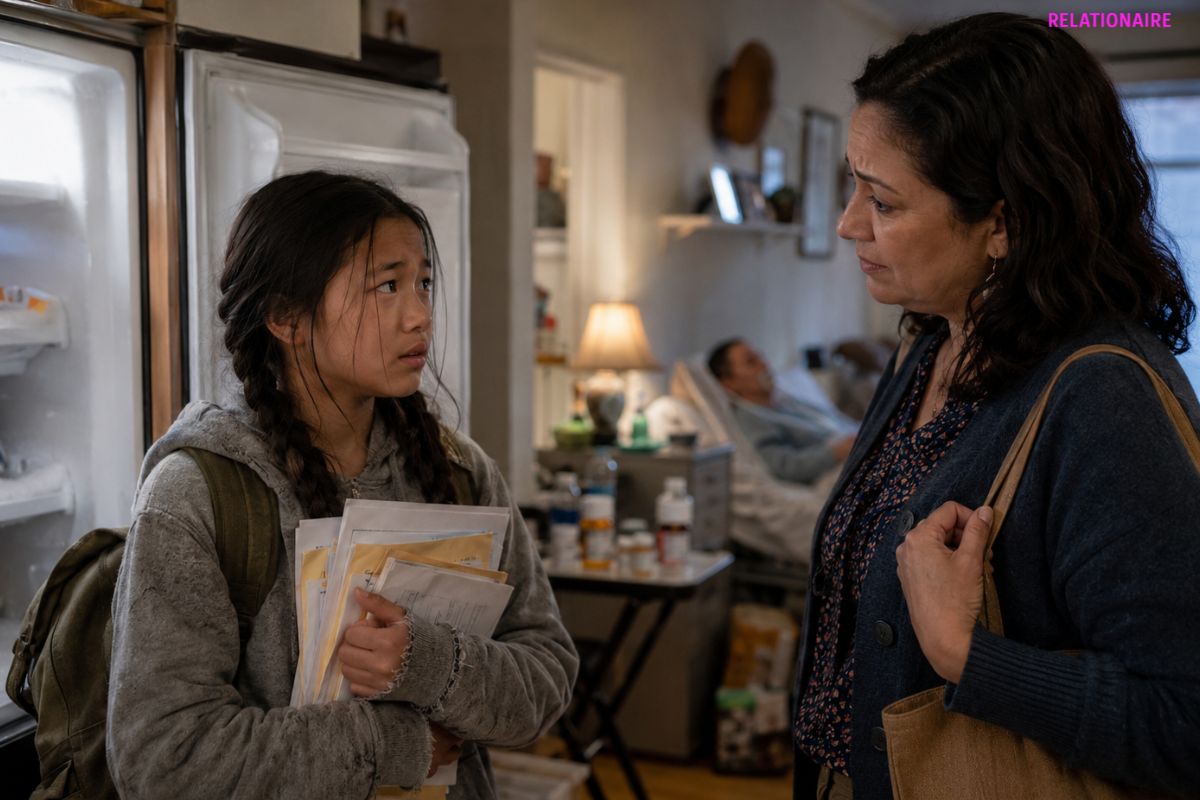
Then I saw the freezer.
It stood slightly open, humming loudly in the corner of the small kitchen. A white envelope stuck out from beneath a bag of frozen peas.
Just the edge of it.
But I recognized the blue school logo.
Maya saw me see it.
Her eyes filled with panic.
“Maya,” I said quietly, “is that your report card?”
She stepped in front of the freezer like she could protect it with her whole body.
And from the couch, her brother whispered something that made the room stop.
“She hides them there so Mom won’t cry.”
PART 2
For a moment, nobody moved.
The freezer hummed.
The TV flashed silently across the room.
A spoon rested in a bowl of soup, untouched, sinking slowly into the broth.
Maya stood in front of that freezer with both hands behind her back, as if I had caught her stealing.
But she had not stolen anything.
She had been hiding proof that she was falling apart.
Her brother, Eli, tried to sit up.
Maya turned sharply.
“Don’t.”
“I’m fine.”
“You’re not.”
He gave me a small, tired smile.
“She’s bossy now,” he said. “Used to be sweet.”
Maya glared at him, but her eyes were wet.
I should have said something teacherly. Something calm and helpful. I should have asked to speak with a parent, or explained the importance of communication, or reminded Maya that grades needed signatures.
Instead, I stood there with my folder under my arm and felt every assumption I had made about that child loosen inside me.
“She hides them there,” Eli said again, softer, “because my mom checks her backpack when she gets home. But she never checks the freezer.”
Maya’s voice cracked.
“Stop talking.”
“Maya.”
“I said stop.”
She looked at me then, and I finally saw what I should have seen weeks ago.
Not arrogance.
Not laziness.
Not disrespect.
Terror.
The kind children wear when they think adults cannot afford to break, so they break quietly instead.
I set the folder on the kitchen table.
“Maya,” I said, “why didn’t you tell me?”
She laughed, but this time it sounded like a sob that had been trained to behave.
“Tell you what? That my brother can’t walk to the bathroom by himself some days? That my mom cries in the car before work? That our fridge has more medicine than food? What was I supposed to write on the homework excuse line?”
Eli closed his eyes.
Maya kept going.
“You wrote that I’m capable of stronger effort.”
I felt my face burn.
She had read it.
Of course she had.
“I’m sorry,” I said.
She looked away.
Not angry now.
Worse.
Tired.
Eli coughed again, and Maya moved before the sound finished. She grabbed the towel, checked the water cup, adjusted his blanket, then went back to standing like a guard between me and the freezer.
I had taught her fractions, main idea, theme, comma rules.
No one had taught her how to be twelve and not feel responsible for keeping her family alive.
Their mother came home twenty minutes later wearing a grocery store vest over her uniform from a second job. Her name tag was still pinned crookedly to her chest.
LINH.
She looked at me, then at Maya, then at the freezer.
The shame on her face arrived before any words did.
“I’m sorry,” she said immediately. “I know she’s behind. I know. I have been meaning to call. I just…”
Her eyes moved to Eli.
She did not finish.
Maya folded into herself.
“Mom, don’t.”
Mrs. Tran put one hand on the back of a chair.
“I signed the first one,” she said to me quietly. “The progress report. Then I cried in the bathroom because she had a C. A C. And Eli heard me, and Maya heard him trying to tell me it was okay.”
“I didn’t mean to,” Eli said.
Mrs. Tran shook her head.
“I know.”
The room held too much tenderness and too much pain.
That was the thing about schools. We saw children for six hours a day and thought we knew the shape of their lives. But they went home to rooms like this. To medicine schedules taped to refrigerators. To mothers sleeping in work pants. To brothers pretending not to hurt. To report cards hidden between frozen peas and ice trays because a child had decided one more bad thing might crush everyone.
Mrs. Tran opened the freezer.
Maya whispered, “Please don’t.”
But her mother reached past the vegetables and pulled out three envelopes.
Progress report.
Report card.
Math test.
The papers were cold and slightly curled at the edges.
Mrs. Tran held them like they were fragile.
Then she sat down at the kitchen table and cried.
Not loudly.
Not dramatically.
Just one hand over her mouth, shoulders folding forward, as if her body had finally found a place to put the weight.
Maya stood frozen.
Eli looked at the wall.
I wanted to disappear.
Instead, I sat across from Mrs. Tran.
“These papers are not an emergency,” I said.
Maya looked at me.
“They’re not?” she asked.
Her voice was so young.
“No.”
Mrs. Tran wiped her face quickly.
“But school matters.”
“Yes,” I said. “It does. But Maya matters more than her grades.”
The sentence landed in the room like something everyone had needed but no one had known how to ask for.
The next morning, I met with Mr. Han, the counselor, the nurse, and Maya’s other teachers. We sat around the conference table with lukewarm coffee, attendance sheets, and a box of tissues that had been refilled too many times that year.
I told them what I had permission to tell.
Not everything.
Enough.
The math teacher leaned back and rubbed his forehead.
“I thought she was just being defiant.”
“So did I,” I said.
Nobody looked proud of that.
We made a plan.
Late work frozen for two weeks.
No public callouts.
No surprise tests.
Counselor check-ins twice a week.
A quiet pass to the nurse if she needed to cry.
A breakfast bag each morning placed discreetly in her locker.
But plans on paper are clean.
Real life is not.
Maya did not soften right away.
On Monday, I found the breakfast bag still in her locker, untouched.
On Tuesday, she snapped at a classmate again.
On Wednesday, she fell asleep during independent reading with her pencil still in her hand.
Some students whispered.
“She gets special treatment now?”
“She doesn’t even do the work.”
“Why does Maya get passes?”
I shut it down when I heard it.
But children notice difference faster than adults can explain mercy.
Then came Friday.
We were working on personal narratives. The prompt was simple: Write about a time you had to be brave.
Most students wrote about roller coasters, dogs, storms, or trying out for soccer.
Maya stared at the page for ten minutes.
Then she wrote one sentence.
Then another.
Then she stopped.
At the end of class, she folded the paper in half and placed it on my desk without looking at me.
“Don’t read it out loud,” she said.
“I won’t.”
After dismissal, I unfolded it.
The handwriting was not neat anymore. It slanted and shook.
I read the first line.
Being brave is putting your report card in the freezer because your mom already has enough bad news.
I sat down.
The classroom was empty except for the buzz of the lights and the distant squeak of the custodian’s cart.
I kept reading.
She wrote about Eli teaching her multiplication with cereal pieces when she was little.
About him walking her to kindergarten and pretending her backpack was too heavy so she would laugh.
About the hospital bracelet he kept in a drawer because he said when he got better, he wanted to throw them all away at once.
Then she wrote one line that made me cover my mouth.
Sometimes I fail on purpose because if I get good grades, everyone says I’m strong, and I don’t want to be strong anymore.
That night, I took the paper home in my worn teacher tote bag.
I read it at my kitchen table after midnight, next to ungraded worksheets and a mug of tea gone cold.
I had spent years telling children to do their best.
I had put stickers on perfect scores.
I had called parents with proud news.
I had written “excellent work” in the margins.
But no one had ever told me what to do when a child’s best was simply making it through the day without falling apart.
On Monday, Maya was absent.
On Tuesday, too.
Wednesday morning, Mr. Han came to my classroom before the bell.
His face told me before his words did.
“Eli was admitted last night,” he said. “It’s serious.”
I gripped the edge of my desk.
“Does Maya know?”
“She was there.”
The room was still empty. Twenty-seven chairs waited for children who would arrive carrying backpacks, lunch boxes, gossip, missing pencils, and invisible worlds.
Mr. Han handed me a small envelope.
“Maya’s mother dropped this at the office,” he said. “She asked if you could keep it safe.”
Inside was the frozen report card.
Still cold.
And written across the back in Maya’s handwriting were six words:
Please don’t make me go back.
PART 3
I read the note three times.
Please don’t make me go back.
At first, I thought she meant school.
That is where my teacher brain went.
Attendance.
Absences.
Missing work.
A child slipping further behind.
Then I turned the report card over in my hands and saw the water stains along the edges from where it had thawed. Saw the red marks. Saw the sentence I had typed before I knew anything.
Maya is capable of stronger effort.
And I understood.
She did not mean school.
She meant back to being the girl everyone expected her to be.
The perfect one.
The easy one.
The one who made adults smile because her grades were good, her desk was clean, and her pain stayed folded neatly inside a blue homework folder.
That afternoon, I drove to the hospital after school.
I did not go as her teacher with forms to sign.
I went with a paper grocery bag from the staff lounge.
Inside were granola bars, two juice boxes, a clean hoodie from the lost-and-found that Mrs. Alvarez had washed, a pack of pencils, and the class photo from last spring.
Maya was sitting in the hallway outside Eli’s room.
Her knees were pulled to her chest. Her hair was in a messy braid. There was a cafeteria tray beside her with an unopened carton of milk.
She looked smaller outside school.
Without the desk, the backpack, the sharpened pencils, she was just a child on a hard hospital floor trying not to cry where her mother could see.
I sat down beside her.
For a while, neither of us spoke.
Across the hall, machines beeped softly behind closed doors. Nurses moved with tired kindness. Someone laughed at the front desk, then lowered their voice.
Finally Maya said, “Are you here to tell me I have to come back?”
“No.”
She looked at me.
“I’m here to tell you that you don’t have to be who you were before.”
Her face changed.
Just a little.
Like she had heard a sound from another room.
“You were proud of me before,” she said.
“I’m proud of you now.”
“I failed everything.”
“You carried too much.”
“That doesn’t count.”
“It counts with me.”
Her eyes filled, but she blinked hard.
“I don’t want everyone to know.”
“They won’t.”
“I don’t want them to feel sorry for me.”
“They don’t have to.”
“I don’t want to be the sick kid’s sister.”
I nodded.
That one felt too big to answer quickly.
After a minute, I said, “Then we’ll make school a place where you can just be Maya.”
She looked down at her sleeves.
“What if I’m not good at being her anymore?”
I had no perfect teacher answer.
So I told the truth.
“Then we’ll practice.”
Eli was awake when we went in.
He looked even thinner than he had at the apartment, but when he saw the grocery bag, he smiled.
“Is that homework?”
“No,” I said. “Snacks.”
“Finally. A teacher with priorities.”
Maya rolled her eyes, but a small smile escaped before she could stop it.
I put the class photo on the windowsill.
Eli picked it up.
“There she is,” he said, pointing to Maya in the front row. “Honor roll face.”
Maya’s smile vanished.
“Don’t.”
Eli looked at her, then at me.
He understood before I did.
He set the photo down gently.
“Sorry,” he said.
Maya stood beside his bed with her arms folded.
“I’m not that girl right now.”
“I know,” he said.
“No, you don’t. Everyone keeps waiting for me to go back. Mom keeps saying, ‘When things calm down.’ Teachers keep saying I’m capable. You keep saying I’m smart. But I can’t think. I sit there and the numbers move. The words move. And then I feel bad because you’re the one who’s sick, and I’m the one failing.”
The room went quiet.
Eli reached for her hand.
His fingers trembled.
“Maya,” he said, “I never needed you to be perfect.”
She shook her head.
“You always bragged about me.”
“Because I’m your brother. That’s my job.”
“You told Mom I’d get a scholarship someday.”
“You might.”
“I might not.”
He swallowed.
“Then don’t.”
Maya stared at him.
Eli’s eyes were wet now.
“Don’t get a scholarship for me. Don’t get A’s for Mom. Don’t hide bad grades in the freezer. Don’t fail on purpose so people stop clapping. Just… live your own life, okay?”
Maya covered her face.
He squeezed her hand.
“And maybe pass math eventually,” he added weakly. “Because fractions are embarrassing you.”
She laughed through her tears.
It broke something open.
Not loudly.
Not like in movies.
Just a tired, hurting laugh in a hospital room where a child finally had permission to stop being a trophy for everyone else’s hope.
Eli’s condition did not magically improve.
That would be an easier story.
A less honest one.
There were weeks when Maya came to school after sleeping in a hospital chair. Weeks when her assignments were half-finished. Days when she cried in the nurse’s office and then washed her face before lunch so nobody would ask questions.
But something changed.
Not her grades at first.
Her breathing.
She stopped bracing for school like it was another place where she had to perform.
We changed her report card comments.
No more capable of stronger effort.
Instead, her teachers wrote what we actually saw.
Maya asks thoughtful questions when she is ready.
Maya shows care for others even on hard days.
Maya is rebuilding trust in herself.
Maya is learning that help is not failure.
Some people might say those comments did not belong on a report card.
I disagree.
Schools measure many things.
Attendance.
Reading levels.
Test scores.
Credits.
But anyone who has spent enough years in a classroom knows children bring their whole lives to those little desks. Hunger sits there. Grief sits there. Fear sits there. Hope too, sometimes, if we are careful with it.
In December, our class held a small winter breakfast before break.
Nothing fancy.
Paper plates.
Store-brand muffins.
Orange juice in tiny cups.
Maya arrived late, carrying a plastic container wrapped in a dish towel.
“My mom made egg rolls,” she said.
The class cheered because children forgive faster when food is involved.
She placed the container on the back table, then came to my desk.
“I brought something else,” she said.
From her backpack, she pulled out a folded paper.
A report card.
For one second, my chest tightened.
Then she handed it to me.
There were no straight A’s.
There were two B’s, one C, one incomplete, and an A in art.
On the signature line was her mother’s name.
Beside it, shaky and uneven, was Eli’s.
I looked up.
Maya’s eyes were bright, but steady.
“He signed it at the hospital,” she said. “He said C means ‘currently surviving.’”
I laughed, then had to look down quickly.
On the back, Maya had written something in pencil.
Not hidden.
Not folded small.
Not frozen away where grief could not find it.
I read it quietly.
I am trying. Please count that.
I did.
At the end of the day, after the children left and the room smelled like oranges and dry erase markers, I taped a small note inside my desk drawer.
Not for Maya.
For me.
It said:
Before you ask why a child stopped trying, ask what they are trying to survive.
I still grade papers.
I still teach fractions.
I still believe effort matters.
But now, when a student’s work changes suddenly, when a careful child becomes careless, when a sharp voice comes from a hurting face, I try to remember the freezer in that small apartment.
I try to remember the report card hidden between frozen peas.
And I try to remember that sometimes the most important thing a teacher can do is not push a child back to who they were.
Sometimes it is standing beside them while they become someone who can breathe again.