If you’ve already read part 1 of this story on Facebook, go here for Part 2!
PART 1
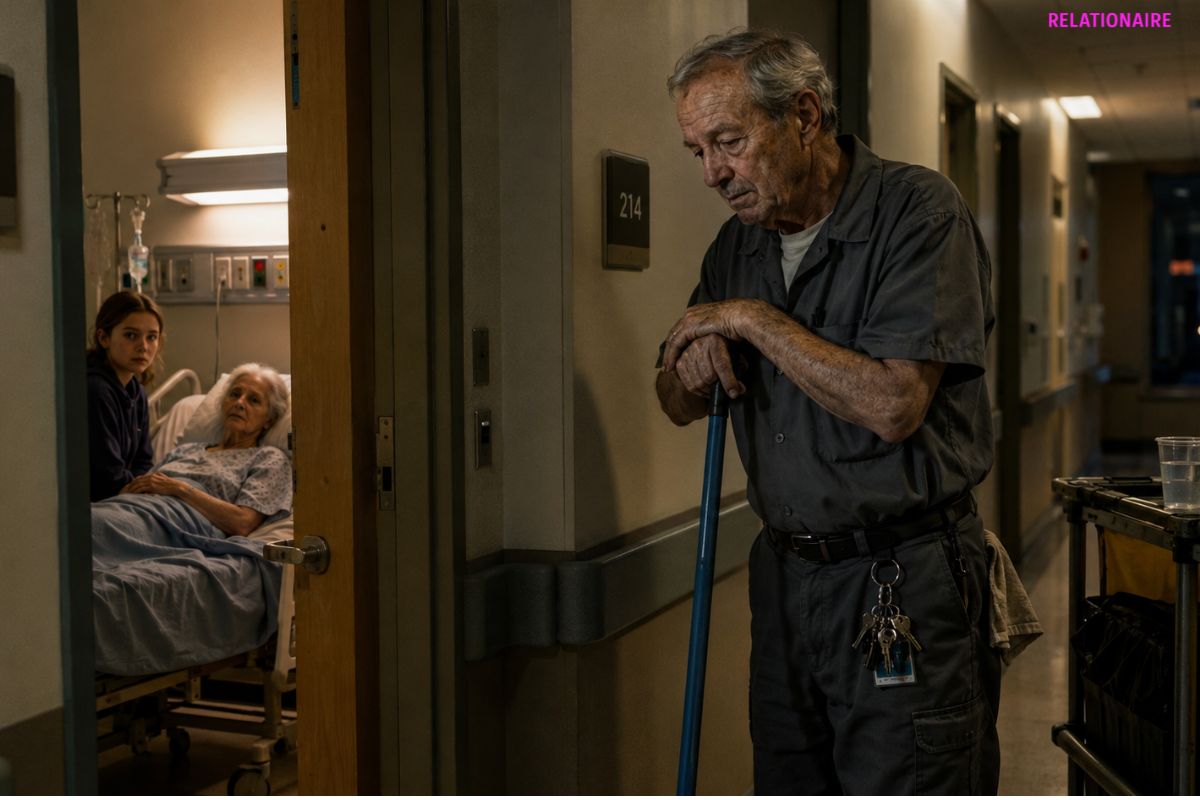
The first time I saw the old cleaner stop outside Room 214, I thought he was listening for something he had no right to hear.
He stood there with one hand on his mop handle, his gray uniform wrinkled at the elbows, his keys hanging heavy from his belt.
The hallway lights had already dimmed for the night.
Most of the nurses had lowered their voices. The visitors had gone home with tired eyes and folded discharge papers they didn’t understand.
But he stayed.
Just stood there.
Outside Room 214.
My grandmother’s room was across the hall, Room 213, close enough that I could watch him through the half-open door while pretending to scroll on my phone.
He didn’t knock.
He didn’t go in.
He just lowered his head for a moment, like the door was a person, then reached into his pocket and touched something I couldn’t see.
After almost a minute, he quietly moved on.
I remember thinking, That’s strange.
By the third night, strange had turned into annoying.
I was sixteen that summer, old enough to think I understood adults and young enough to be wrong about almost all of them.
My grandmother had been admitted after a bad fall in her kitchen. Nothing dramatic, the doctors kept saying. A few bruises, some weakness, more tests.
But when you love someone, even the word “tests” can sit in your stomach like a stone.
Every evening after school, Mom dropped me at the hospital with a backpack, a container of soup, and strict instructions not to let Grandma charm me into giving her vending machine cookies.
Grandma tried anyway.
“Just one pack,” she’d whisper, pointing at the hallway like the crackers were medicine.
“No.”
“You are cruel like your mother.”
“You raised her.”
She would smile then, but only for a second. Hospitals have a way of stealing even the good moments before they fully land.
At night, when visiting hours stretched thin and the halls grew quiet, I started noticing things.
A nurse rubbing her forehead at the station.
A man sleeping upright in a chair with a visitor badge stuck to his shirt.
Cold coffee cups lined up near the microwave.
The squeak of shoes.
The soft beep of machines behind closed doors.
And always, around 9:40, the old cleaner.
His name tag said Mr. Elias.
He moved slowly but not weakly. Carefully. Like every room deserved respect.
He wiped handrails. Emptied trash. Refilled paper towels. Mopped around slippered feet and sleeping sons and daughters who forgot to say thank you.
But Room 214 was different.
He always saved it for last.
And he always paused before going in.
One night, I finally asked a nurse about him.
“Why does that cleaner keep hanging around 214?” I whispered.
The nurse, whose name was Carla, glanced up from a chart.
“Mr. Elias?”
“I guess.”
“He cleans this floor.”
“I know, but he stands outside that room every night. It’s creepy.”
Carla’s face changed, just a little.
Not anger.
Not exactly.
More like disappointment that arrived before she could hide it.
“He’s harmless,” she said.
That made me feel worse, though I didn’t know why.
The next night, Grandma was more tired than usual. Her silver hair was flattened against the pillow, and her hospital bracelet looked too large on her wrist.
I was opening her soup when she turned her head toward the hallway.
“Is he here yet?”
“Who?”
“The man with the keys.”
I looked up.
Mr. Elias was pushing his cart past the nurse station, yellow gloves tucked into his back pocket, a stack of fresh linens folded neatly on top.
“You mean the cleaner?”
Grandma’s eyes followed him.
“Yes,” she said softly. “Elias.”
“You know him?”
She didn’t answer right away.
Her fingers moved over the blanket, smoothing a wrinkle that wasn’t there.
“He closes that room last,” she said.
“I noticed.”
Grandma looked at me then, and something in her face made me stop talking.
There was sadness there, but not fear.
Recognition.
Like she had been waiting for me to ask the right question.
“Room 214,” she said. “Is the man still there?”
I glanced toward the closed door across the hall.
“Yeah. I think so.”
“Does anyone visit him?”
I shrugged.
I had seen a woman come once in a blazer, staying less than ten minutes. A man came another day and left with a phone pressed to his ear. Mostly, Room 214 was quiet.
Mostly, nobody came.
“I don’t know,” I said. “Not much.”
Grandma closed her eyes.
“That poor boy.”
“Boy? Grandma, he’s old.”
“To someone my age, most people are boys.”
I smiled, but she didn’t.
That night, Mr. Elias reached Room 214 later than usual.
The hallway was nearly empty. Mom had texted that she was stuck finishing a shift and would come soon. Grandma had drifted off, one hand curled around the edge of the blanket.
I watched Mr. Elias stop outside the door.
Same pause.
Same bowed head.
But this time, instead of moving on, he reached into his cart and took out a small paper cup of water.
Then he knocked softly and opened the door.
I shouldn’t have followed.
I know that now.
But curiosity can feel like righteousness when you’re young.
I slipped into the hallway and stood near the supply closet, close enough to see through the narrow gap before the door closed.
The patient in Room 214 was sitting up in bed, thin shoulders under a blue hospital gown, face turned toward the window where the city lights blurred against the glass.
Mr. Elias placed the water cup on the tray.
Then he did something no cleaner had to do.
He took a folded blanket from his cart and laid it gently over the man’s legs.
The man didn’t speak.
Mr. Elias did.
“Your feet get cold after nine,” he said, almost too quiet to hear. “I remembered.”
The patient turned his head.
For a second, his face changed.
Not into a smile exactly.
Something smaller.
Something more painful.
I backed away fast before they could see me.
When Mom arrived, I told her.
“I think that cleaner is doing stuff he’s not supposed to do,” I said. “He goes into 214 and talks to the patient. Brings him things.”
Mom was tired, still in her pharmacy scrubs, her hair falling from its clip.
“Maybe he’s being kind.”
“But what if he’s not allowed?”
Mom gave me that look parents give when they don’t have the strength to argue but still know you’re missing something.
“Not every rule is the same as goodness, Mia.”
I hated when adults said things that sounded wise instead of useful.
The next evening, Grandma seemed brighter. She ate half her soup and complained that the hospital carrots tasted like wet shoelaces.
Then, just after nine, she reached for my hand.
“If Elias comes by,” she said, “ask him to come in.”
“The cleaner?”
“Yes.”
“Why?”
Her grip tightened.
“Because I need to tell him something before it’s too late.”
My throat went dry.
“Before what’s too late?”
She didn’t answer.
Across the hall, the wheels of the cleaning cart squeaked.
Mr. Elias appeared under the dim hallway light, moving slowly toward Room 214.
Grandma pushed herself up with more strength than I’d seen all week.
“Mia,” she whispered. “Go get him.”
I stepped into the hallway just as Mr. Elias stopped outside Room 214.
For the first time, he saw me watching.
His eyes were tired.
Not strange.
Not lazy.
Tired in a way I suddenly didn’t know how to judge.
“My grandma wants you,” I said.
He looked past me into Room 213.
At the sound of his name, Grandma lifted one trembling hand.
Mr. Elias went still.
Then Grandma said a sentence that made the hallway feel like it had dropped beneath my feet.
“Elias,” she called softly, “does he know you’re the reason he’s still alive?”
PART 2
Mr. Elias did not move.
For a moment, the whole hallway seemed to hold its breath around him.
The nurse station phone rang once, then stopped. Somewhere farther down the hall, a cart bumped softly against a wall. The automatic doors by the elevator sighed open and closed.
But Mr. Elias stood frozen between Room 213 and Room 214, his hand still on the handle of his cleaning cart.
My grandmother’s words hung there.
Does he know you’re the reason he’s still alive?
I looked from her to him.
“What does that mean?” I asked.
Mr. Elias lowered his eyes.
“Mrs. June,” he said, and his voice was rough, like he hadn’t used it much that day. “You shouldn’t trouble yourself.”
Grandma gave him the look she used when someone tried to help her carry groceries.
“I am eighty-two years old,” she said. “I have earned the right to trouble everyone.”
A corner of his mouth moved, but it did not become a smile.
He stepped into her room slowly, leaving his cart parked outside like a patient animal. Up close, I noticed things I had missed before.
The small tear near his sleeve cuff.
The careful polish on his old black shoes.
The wedding ring on his left hand, loose enough to slide when he moved.
His name tag had a tiny scratch through the E.
Grandma reached toward the chair.
“Sit.”
“I’m working.”
“You can sit for one minute.”
He hesitated.
Then he sat.
Not all the way back. Just on the edge, as if the chair did not fully belong to him.
I stood near the foot of Grandma’s bed, trying to look invisible while needing to hear every word.
Grandma turned to me.
“Mia, close the door.”
That was when I knew this was not hospital gossip.
This was something old.
Something that had waited years to enter the room.
I closed the door halfway, leaving it open just enough to hear if a nurse called.
Grandma looked at Mr. Elias.
“She saw you with him.”
His jaw tightened.
“She shouldn’t have.”
“I know,” Grandma said. “But children see what adults step around.”
“I’m not a child,” I said automatically.
Neither of them looked at me.
Mr. Elias folded his hands. They were large hands, dry and cracked around the knuckles.
“I only bring him small things,” he said. “Water. A blanket. Sometimes I fix the blinds so the morning sun doesn’t hit his eyes. That’s all.”
“That is not all,” Grandma said.
He looked toward the wall.
Room 214 was on the other side.
“You know him?” I asked.
Mr. Elias took a breath.
“I knew him once.”
Grandma’s eyes softened.
“Tell her.”
He shook his head.
“It’s not my story to make important.”
“That’s exactly why it matters.”
For a long moment, he said nothing.
Then his fingers moved to his shirt pocket.
He pulled out what I had seen him touch every night outside Room 214.
A folded prayer card.
The edges were worn soft, almost cloth-like from years of being held.
On the front was a faded picture of a small chapel. On the back, someone had written two words in blue ink.
Come back.
Mr. Elias held it like it might break.
“Thirty-one years ago,” he began, “I was not the man who cleans this floor.”
His voice stayed low. Calm. But something underneath it shook.
“I was younger than your mother. Angry. Proud. I had lost my job. My wife was pregnant. We had one month of rent left and no family nearby. I thought a man was supposed to carry everything without making a sound.”
He looked at his hands.
“So I stopped making sounds.”
Grandma closed her eyes, as if she remembered the shape of that silence.
“I came to this hospital one night,” he said. “Not because I was sick. Because I didn’t know where else to go. I sat outside by the ambulance bay until sunrise. I had a paper bag with all my work documents inside. I was going to leave town. Leave my wife a note. I thought she would be better without me.”
My chest tightened.
He did not say it dramatically. That made it worse.
He said it like a man describing weather he had survived.
“A doctor found me there,” he continued. “He had just finished a long shift. White coat over wrinkled clothes. Tie loosened. Coffee in one hand. He sat beside me on the curb even though I smelled like rain and old cigarettes.”
Mr. Elias swallowed.
“He didn’t ask me what was wrong at first. He just handed me his coffee and said, ‘The first rule is you don’t make permanent decisions before breakfast.’”
Grandma let out the smallest laugh through her nose.
“That sounds like him.”
Mr. Elias nodded.
“He bought me eggs from the cafeteria. Sat with me for forty minutes. Called my wife for me. Helped me find work through someone he knew in maintenance. He told me, ‘Come back tomorrow. And if tomorrow is too heavy, come back the day after that.’”
He looked down at the prayer card.
“Before I left, he wrote this on the back. Come back.”
I thought of the man in Room 214, the thin shoulders, the turned-away face.
“That patient was the doctor?”
“Yes,” Mr. Elias said. “Dr. Raymond Vale.”
I knew the name.
Not because I had met him.
Because there was a framed photo near the elevator with the words Founding Director, Community Medicine, and a much younger version of the man from Room 214 smiling beside a group of nurses.
“That was him?” I whispered.
Grandma nodded.
“He treated half this city at one time or another.”
“And now nobody visits him?”
The words came out sharper than I meant.
Mr. Elias flinched anyway.
“Families are complicated,” he said.
“That’s what people say when they don’t want to admit someone got abandoned.”
“Mia,” Grandma said gently.
“No,” I said, suddenly angry in a way that embarrassed me. “He saved your life, and now you’re the only one checking on him? Where are his people?”
Mr. Elias stared at the prayer card.
“He had a son,” he said. “Still does. I think. There was a daughter too. I’ve seen names on old flowers. But time does things. Hurt does things. Sometimes people stay away because coming close would break something they don’t know how to fix.”
“That doesn’t make it right.”
“No,” he said. “It doesn’t.”
The room went quiet.
Grandma squeezed her blanket.
“I knew Raymond when your grandfather was ill,” she said to me. “He sat with me after visiting hours. Explained every paper twice because I was too scared to understand the first time. He remembered how your grandfather liked his tea. He was a good man.”
“Then why didn’t you tell anyone what Mr. Elias was doing?” I asked.
“Because kindness done quietly is still kindness,” she said. “And because hospitals are full of people who only notice a cleaner when something is dirty.”
That landed hard.
I thought of myself calling him creepy.
Lazy.
Strange.
Mr. Elias must have seen my face because he shook his head.
“You didn’t know.”
“That doesn’t mean I wasn’t wrong.”
He looked at me then, really looked, and I saw no accusation in his eyes.
Only exhaustion.
Only patience.
Only a sadness so practiced it had become gentle.
A knock came at the door.
Nurse Carla leaned in.
“Elias,” she said softly, “Room 214 is asking for you.”
His whole face changed.
Not with surprise.
With fear.
He stood too fast, gripping the chair as if the floor tilted.
Grandma reached for him.
“Go,” she said.
He tucked the prayer card back into his pocket.
I followed him into the hall without asking.
Carla did not stop me.
Outside Room 214, Mr. Elias paused again.
But this time I understood.
He wasn’t wasting time.
He was gathering himself.
Inside, Dr. Vale sat propped against white pillows, his face pale under the warm bedside lamp. A tray of untouched soup rested near his hand.
His eyes moved to Mr. Elias.
For the first time since I had seen him, he spoke.
“Eli,” he whispered.
Mr. Elias gripped the doorframe.
“I’m here, Doctor.”
Dr. Vale’s eyes shifted toward me, then back to him.
“I remembered,” he said.
Mr. Elias took one step closer.
“Remembered what?”
The old doctor’s fingers trembled against the blanket.
“The card,” he whispered. “The curb. The rain.”
Mr. Elias stopped breathing.
Dr. Vale’s eyes filled, but his voice stayed clear enough to break every heart in that hallway.
“I thought I was the one who saved you,” he said. “But all these months, you were the only one coming back for me.”
PART 3
Mr. Elias covered his mouth with one hand.
Not to hide tears.
To keep himself standing.
The room was so quiet I could hear the soft plastic rustle of Dr. Vale’s hospital bracelet when he moved his wrist.
Nurse Carla stepped back into the hallway, giving them privacy without leaving them alone. That was something I would later understand about good nurses. They knew how to be near without taking up space.
I stayed by the door because no one told me to leave.
Maybe they forgot I was there.
Or maybe some moments need a witness.
Mr. Elias approached the bed slowly.
“You remembered,” he said.
Dr. Vale looked embarrassed by his own tears.
“Not everything,” he whispered. “Faces go in and out. Dates disappear. But that night came back. The ambulance bay. You were soaked through.”
Mr. Elias gave a broken laugh.
“I was a mess.”
“You were a man,” Dr. Vale said. “A tired man. There’s a difference.”
Those words did something to Mr. Elias.
He lowered himself into the chair beside the bed, the same way he had done beside my grandmother, careful and unsure of his right to sit.
Dr. Vale turned his head toward him.
“Did your child come?”
Mr. Elias’s lips pressed together.
“A girl,” he said. “Sofia. She’s thirty now. Has two boys who eat like wolves and leave crumbs in every room.”
Dr. Vale smiled.
A real one this time.
Small, but real.
“Good,” he whispered.
Mr. Elias reached into his pocket and took out the prayer card.
He placed it on the blanket between them.
“I kept it.”
Dr. Vale stared at the words on the back.
Come back.
His fingers touched the ink.
“I wrote that?”
“You did.”
“I was bossy.”
“You were right.”
The old doctor breathed out slowly. His eyes drifted to the window, where the city lights trembled in the dark glass.
“I wasn’t always right after that.”
Mr. Elias did not answer.
Dr. Vale closed his eyes.
“I was good with strangers,” he said. “Not as good at home.”
The sentence sat there.
No excuses around it.
No grand speech.
Just a truth that had taken a hospital bed to become simple.
“My son stopped calling after his mother died,” Dr. Vale said. “My daughter tried longer. I kept choosing work. Emergencies. Committees. Other people’s pain. I told myself my family understood because the work mattered.”
His mouth trembled.
“But children don’t need to understand why you’re absent. They just know the chair is empty.”
I thought of my mother finishing shifts and still coming to get me. Of my grandmother saving soup containers because she hated waste. Of all the ways love could be tired and still show up.
Mr. Elias looked at the card.
“You saved many people.”
Dr. Vale opened his eyes.
“And lost some who needed me most.”
There was no bitterness in Mr. Elias’s face.
Only recognition.
Like both men knew that gratitude and regret could sit in the same room.
Dr. Vale turned toward him.
“Have they come?”
Mr. Elias hesitated.
“No.”
The doctor nodded once, as if he had expected it and still hoped differently.
“I don’t blame them.”
Mr. Elias leaned forward.
“I found a number once,” he said quietly. “In an old flower card. I never called. It wasn’t my place.”
Dr. Vale’s fingers tightened on the blanket.
“Maybe now it is.”
Mr. Elias looked afraid again.
Not of mops or rules or supervisors.
Of hope.
Hope can be cruel when it comes too late.
But he stood.
He went to the small cabinet near the wall and took out a cardboard box of things that had been moved from Dr. Vale’s previous room. A folded sweater. Reading glasses. Old get-well cards. A child’s drawing, yellowed at the edges, of a house with three stick figures and a very large sun.
Behind the cards was a small blue envelope.
Mr. Elias held it up.
Dr. Vale nodded.
Carla helped him find the number written inside.
No one spoke while Mr. Elias called from the room phone.
His voice was quiet.
“My name is Elias Martin,” he said. “I work at St. Anne’s Hospital. I’m here with your father.”
A pause.
Then he closed his eyes.
“No, he didn’t ask me to call before. He’s asking now.”
Another pause.
“He remembers you.”
The words changed the air.
I watched Mr. Elias listen.
His face did not give much away, but his shoulders slowly lowered.
“Yes,” he said. “Tonight, if you can.”
When he hung up, Dr. Vale was staring at the ceiling.
“She’s coming,” Mr. Elias said.
The doctor covered his eyes.
“She?”
“Your daughter.”
Dr. Vale made a sound that was not quite a sob.
Mr. Elias sat beside him until it passed.
Later, I returned to Grandma’s room and told her what happened.
She listened with her hands folded over her blanket, her eyes wet but calm.
“Good,” she said. “That room needed a door opened.”
At 11:18 that night, a woman stepped off the elevator wearing a raincoat over pajamas and sneakers with untied laces.
She looked about fifty, maybe older, but in that moment she looked like someone’s child.
Her hair was pulled back badly. Her face was bare and frightened.
She stopped outside Room 214.
Mr. Elias stood there waiting.
For once, he was not the one pausing.
She was.
“I don’t know what to say to him,” she whispered.
Mr. Elias looked through the doorway at the old doctor in the bed.
Then back at her.
“Start with hello,” he said. “That is usually enough for the first door.”
She pressed her lips together and nodded.
Before she went in, she touched Mr. Elias’s sleeve.
“Are you family?”
He looked surprised.
“No, ma’am. I clean this floor.”
She glanced at the water cup on the tray, the blanket over her father’s legs, the blinds turned just right against the morning sun that had not come yet.
Then she looked at him again.
“No,” she said softly. “You did more than that.”
She entered the room.
The door stayed partly open.
I did not hear everything.
I only heard the first word.
“Dad?”
And then, after a long silence, Dr. Vale’s answer.
“Hello, Annie.”
My grandmother cried then.
Quietly.
Not from sadness exactly.
From the kind of relief that hurts because it arrives carrying all the years it couldn’t fix.
In the days that followed, Annie came back.
Not all day. Not with perfect answers. Not like a movie where pain disappears because one phone call was made.
But she came.
She brought old photographs in a paper envelope. She sat stiffly at first, then closer. Sometimes she cried in the hallway. Sometimes she left angry. Sometimes she returned with coffee and no makeup and stayed until the overnight lights dimmed.
Mr. Elias still cleaned Room 214 last.
But now, when he paused outside the door, it felt different.
Less like grief.
More like prayer.
A week later, Grandma was discharged.
She made me help her write a note before we left.
Her handwriting shook, but she refused to let me write it for her.
Dear Elias,
Thank you for remembering what everyone else forgot.
She folded it once and asked me to give it to him.
I found him by the janitor’s closet, rinsing out a mop bucket. He looked embarrassed when I handed him the note.
“My grandma wanted you to have this.”
He read it slowly.
Then he looked away.
“I didn’t do anything special,” he said.
That time, I did not let him disappear behind the sentence.
“Yes, you did.”
He smiled faintly.
“You’re a good granddaughter.”
“I misjudged you.”
“You learned.”
“That doesn’t erase it.”
“No,” he said. “But it can change what you do next.”
I thought about that all the way home.
Two months later, a card arrived for Grandma.
Inside was a photo of Dr. Vale sitting in a wheelchair by a courtyard window. Annie stood behind him with one hand on his shoulder. Mr. Elias stood beside them, uncomfortable in the picture, holding a paper cup of coffee like he didn’t know where to put his hands.
On the back, someone had written:
He came back for me until I could come back to her.
Grandma taped the photo to her refrigerator.
Years have passed since then, but I still think about Room 214 whenever I see someone working quietly while everyone else looks past them.
The cleaner pushing a cart.
The aide adjusting a pillow.
The receptionist remembering a name.
The cafeteria worker adding an extra packet of crackers because she noticed a child hadn’t eaten.
Sometimes the person holding a place together is not the one with the title everyone recognizes.
Sometimes grace comes in wrinkled uniforms, squeaking shoes, and keys at the end of a long hallway.
And sometimes love is simply this:
Someone keeps coming back.
Even after everyone else stops.